

 let’s connect


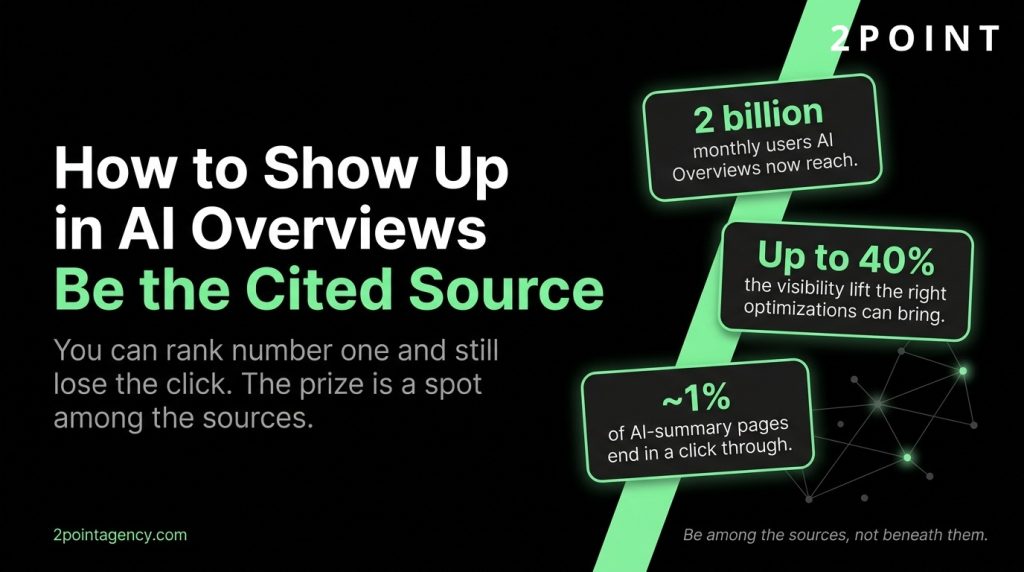
You can rank number one and still lose the click, because an AI Overview answered the question before anyone scrolled to you. The prize has changed. It is no longer the blue link, but a spot among the sources Google's AI summary cites.
You can rank number one and still lose the click, because an AI Overview answered the question before anyone scrolled to you. The prize has changed. It is no longer the blue link, but a spot among the sources Google's AI summary cites.
That shift rewrites the playbook. Figuring out how to show up in AI Overviews is now its own discipline, and it starts with understanding what triggers an AI Overview.
At 2POINT, we help brands get cited inside AI answers, not just ranked beneath them. If you own SEO or content, this is built for you.
What Is a Google AI Overview?
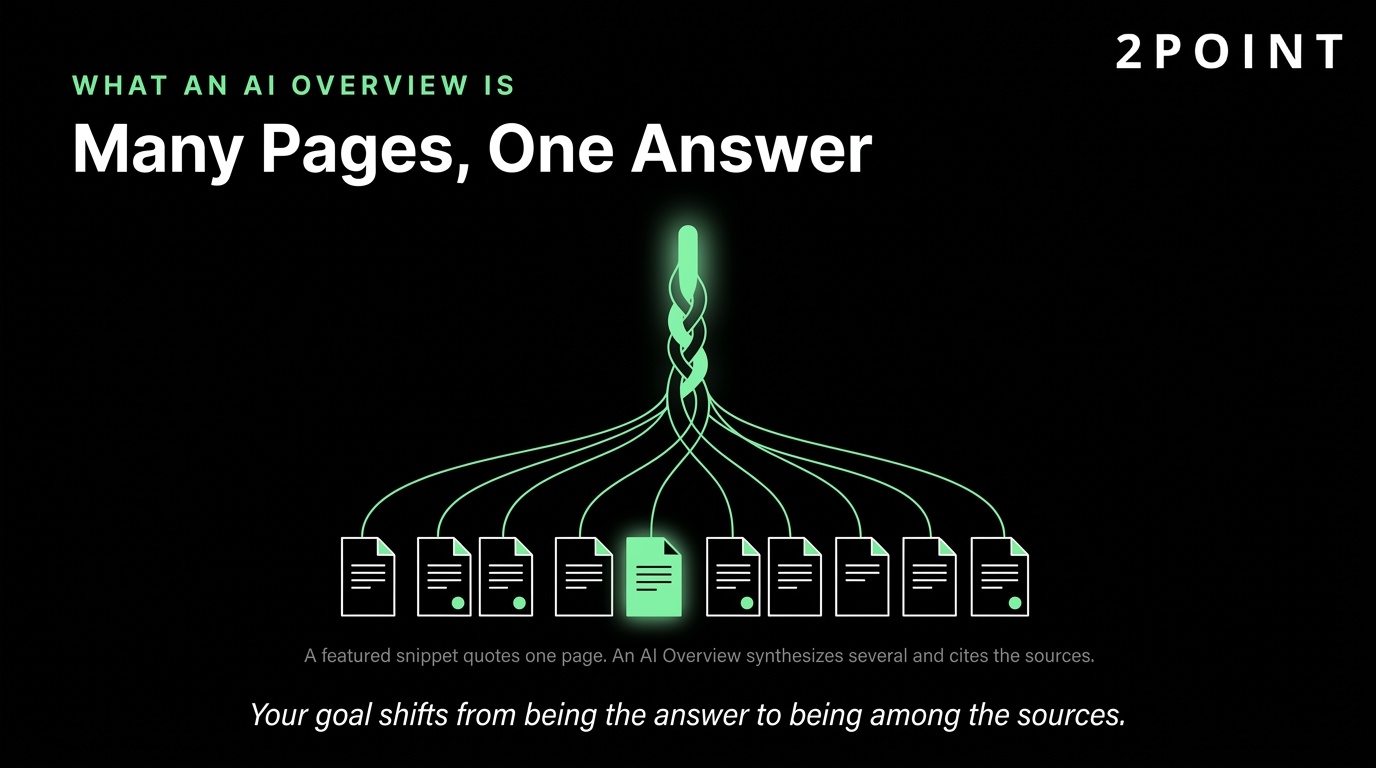
A Google AI Overview is an AI-generated summary at the top of some search results, pulling from multiple pages and linking to the sources it used.
They appear most on informational and question-style queries. According to Google Search Central, an overview shows only when its systems decide it adds value beyond the classic results, which is the heart of what triggers an AI Overview, and why most searches produce none.
| Feature | AI Overview | Featured snippet |
|---|---|---|
| Source | Multiple pages, synthesized | One page, extracted |
| What shows | AI-written summary plus cited links | A single-quoted block |
| Common trigger | Informational or complex queries | Direct-answer queries |
| Your goal | Be one of the cited sources | Be the one quoted page |
The difference is plain. A featured snippet quotes one page, an AI Overview synthesizes several, so your goal shifts from being the answer to being among the sources.
Anatomy of an AI Overview
Three parts matter, and each one tells you something different.
First comes the summary, the synthesized answer Google writes at the very top. Beneath it sit the cited sources, the handful of links Google credits inline or in a side panel. That citation row is the exact spot you are competing for.
Then come the follow-up prompts, the expandable related questions underneath. Most people skim past them, yet they double as a free map of the nearby intents Google associates with the query, which makes them your shortlist of what to target next.
Why Showing Up in AI Overviews Matters
Showing up in AI Overviews puts your brand in front of the searcher when they get their answer. Even without a click, that visibility builds recognition, branded search, and links.
The scale makes it urgent. As reported by TechCrunch, Google's AI Overviews reach two billion monthly users, and Google says the feature drives over 10% more searches for the query types where it appears.
A citation is exposure you cannot buy. As AI answers spread, being a cited source shifts from an edge to table stakes, future-proofing your visibility.
How Does Google Build an AI Overview?
Google keeps the full recipe private, yet the broad logic is clear enough to optimize for. Think of it as three moves.
It expands your query into related sub-questions, pulls self-contained passages from pages it already trusts, and then synthesizes them into a single cited answer. Notice what that implies for you.
The system leans heavily on pages that already rank, so classic SEO is the foundation of an AI Overview citation, not a separate game.
Query Fan-Out and Passage-Level Extraction
Start with how Google gathers material.
According to Google's optimization guide for generative AI features, its AI experiences rely on retrieval-augmented generation and a query fan-out technique, issuing multiple related searches across subtopics to build a response.
Just as important, it pulls specific passages rather than whole pages. For you, that means one clean, self-contained, quotable block beats a long, meandering article every time.
It Leans on Pages Already Ranking
The eligibility rule is refreshingly plain. Google states that to appear as a supporting link, a page must be indexed and eligible to show in Search with a snippet.
Read that again, because it settles a debate. AI Overviews draw from pages already ranking. Page-one visibility is your prerequisite, not an afterthought, and no AI trick substitutes for it.
It Rewards Structure and Credibility
Finally, make the lift easy. Four signals do most of the work.
- Clean question headings that mirror real queries.
- Answer capsules: a direct 40-60-word response up top.
- A schema that labels what each block is.
- Visible E-E-A-T, named authors, and cited claims.
The same signals that win featured snippets tend to win AI Overview citations, and they shape how AI engines pick sources well beyond Google.
How to Show Up in AI Overviews, Step by Step
There is no secret button. You earn AI Overview citations by doing strong SEO and making your pages exceptionally easy to quote. These seven steps are the practical core of how to show up in AI Overviews SEO teams can run this quarter, from query targeting to a clean crawl.
Step 1: Target Long-Tail, Question-Based Queries
Conversational, roughly ten-word questions trigger AI Overviews far more often than short head terms. Knowing what triggers an AI Overview lets you target those queries deliberately instead of guessing. Then group related prompts onto one thorough page rather than spinning up a thin page per question.
Step 2: Lead Every Section With an Answer Capsule
Under each question-style heading, open with a 45 to 75-word direct answer written to stand alone when Google lifts it. The test is simple. If a passage only makes sense inside its surrounding context, it will not get quoted.
Step 3: Add Schema Markup
Next, label your content so machines can read it without having to guess. Add FAQPage, Article, Product, and Review markup from the Schema.org vocabulary, but only where it genuinely matches what is visible on the page. Markup that oversells the content invites trouble rather than citations.
Step 4: Publish Genuinely Unique Content
Original data, first-hand experience, and expert commentary give the model something it cannot get anywhere else.
Google Search Central states that helpful, people-first content is what its systems reward, and that is exactly how you rise above the "me too" pages. Cite your own authoritative sources by name and link them.
Step 5: Earn Brand Mentions and Authority
Brand mentions and authoritative coverage teach Google to trust you as a source.
Guest posts, digital PR, expert roundups, podcasts, and journalist requests all build that reputation, and the links you earn along the way compound it. Authority is the slowest step here, which is why you start it early.
Step 6: Keep Crawlability Clean
None of this lands if Google cannot crawl you. Avoid accidental noindex tags, keep critical content out of JavaScript-only rendering, fix broken links, and submit a sitemap. Beyond access, you can also point AI crawlers at your strongest pages so the models find your best work first.
Step 7: Refresh Content on a Schedule
Finally, keep it current. Replace stats older than a year, add trending subtopics, and update the modified date when the changes are real. Prioritize pages already ranking in the top ten, since those sit closest to earning a citation and reward the effort fastest.
The Page Makeover: Turn an Ordinary Post Into a Citable One
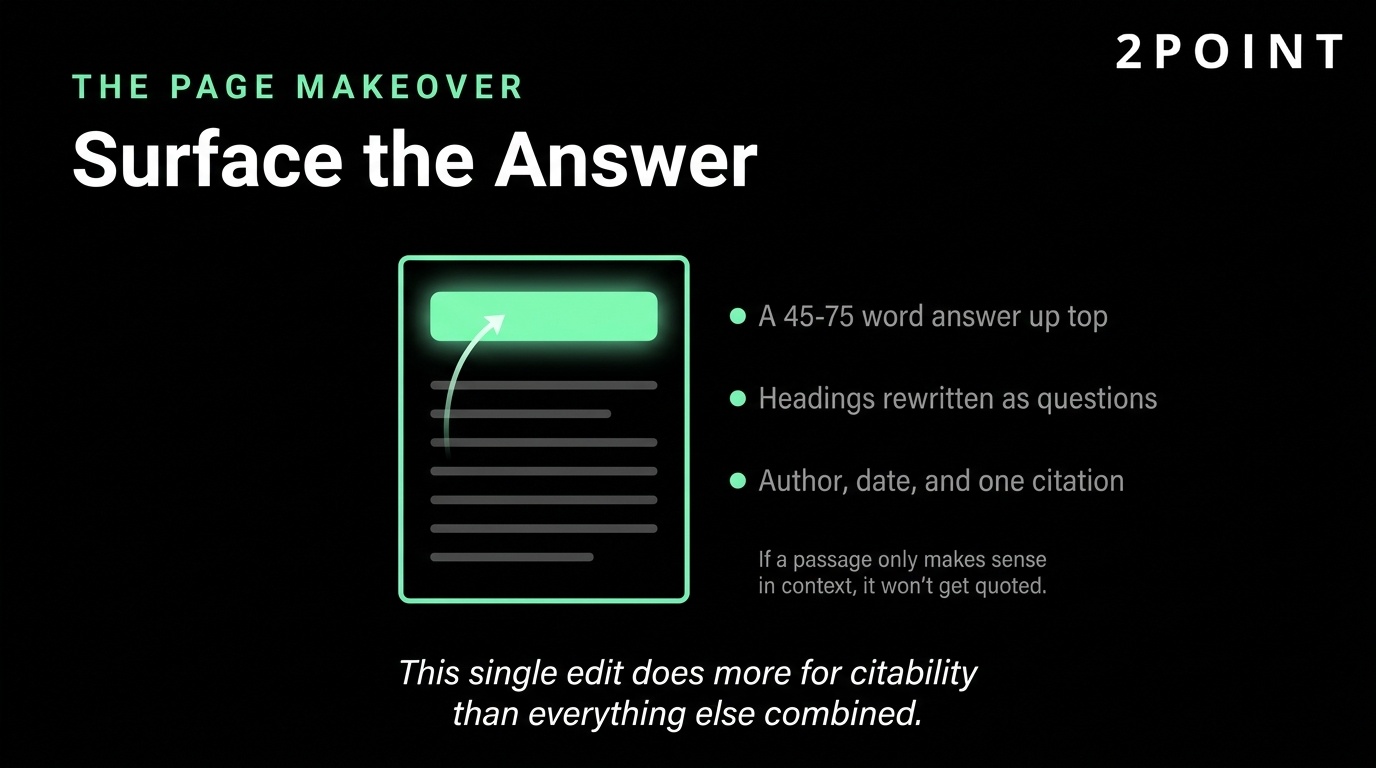
The fastest win is remaking a page you already have. Take one post that ranks but never gets cited, then make four edits. Surface the answer, rewrite the headings as questions, add proof, and mark it up. Most pages need only an afternoon to become far more quotable.
Before: The Answer Is Buried in Paragraph Six
Picture the typical post. The real answer sits under a long personal intro, so an engine scanning for a quotable passage gives up before it ever finds one. Readers do the same, and both leave.
Edit 1: Move a 45 to 75 Word Answer to the Top
Lift the direct answer to the very top, right under the H1, where readers and Google both see it first. This single edit does more for citability than everything else combined, because it hands the engine a ready-made passage.
Edit 2: Rewrite Headings as the Questions People Ask
Next, turn each heading into the exact question a searcher types. Every section then maps cleanly to a query, which is precisely how passage-level extraction finds its match.
Edit 3: Add Proof
Now make it believable. Add a named author, one credible citation, and a visible last-updated date. Together, they signal the trust and freshness that separate a citable page from an anonymous one.
Edit 4: Mark It Up With FAQ and Article Schema
Finally, label what you built. Add an FAQ and Article schema that matches the visible text, then run it through the Rich Results Test before publishing. Markup that passes validation gets read cleanly, and markup that oversells the page gets ignored or worse.
Run the Experiment: Are You Already Being Cited?
Before you optimize anything, measure your starting point. The test costs nothing and takes an hour, yet it tells you exactly where you stand and which pages to fix first.
- Build a 15 to 20-question prompt list from the questions your buyers actually ask, not the keywords you wish they searched.
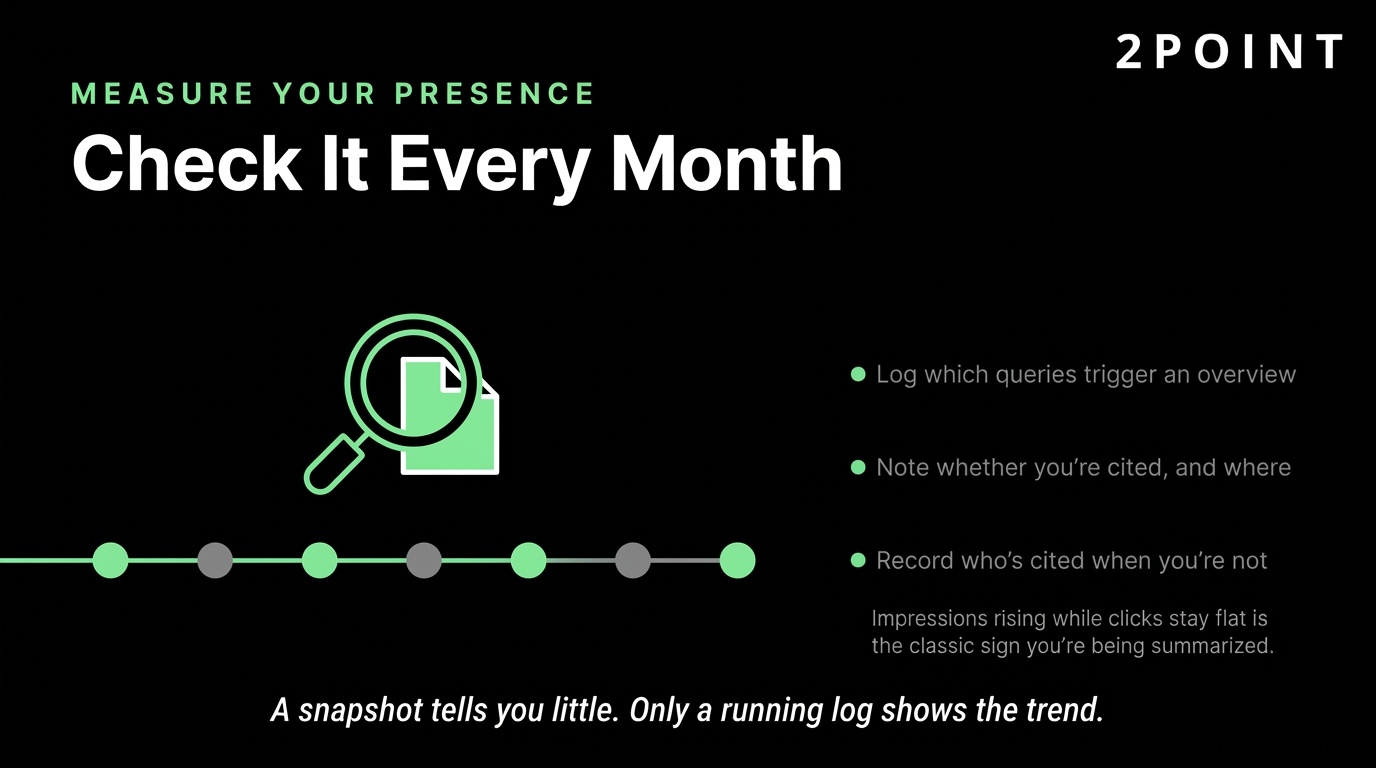
- Search each one signed out and in an incognito window, then log which queries trigger an AI Overview, whether you are cited, and where you sit among the sources.
- Note who is cited when you are not, since those names are your real competitors for each answer.
Then repeat it monthly. AI Overview results shift often, so a citation you hold today can vanish next month, and only a running log shows you the trend rather than a snapshot.
How to Measure AI Overview Performance
There is no dedicated AI Overview dashboard yet, so you combine signals. Two views, checked together, tell you most of what you need to know.
Watch Impressions Versus Clicks in Search Console
Search Console folds AI Overview appearances into your regular Web performance data rather than reporting them separately. That is why the pattern matters more than any single number.
Watch for this combination on your informational queries.
- Impressions rising while clicks stay flat or fall, the classic sign you are being summarized rather than visited.
- Average position holding steady, which rules out a rankings drop as the cause.
- The pattern clustering on question-style queries, where AI Overviews trigger most.
See all three together, and you are almost certainly appearing in the answer itself.
Track AIO Presence With a Rank Tracker
Pair that with a position-tracking tool that has an AI Overview filter, so you can see which of your keywords show the feature and whether you are among the cited sources.
Watch the trend monthly rather than reacting to single checks.
If you would rather have a team run the tracking and the fixes, our managed SEO covers both.
The Honest Part: Does an AI Overview Citation Actually Help?
Yes and no, and you deserve the real answer. Some informational queries lose all clicks once the AI Overview answers them. According to the Pew Research Center, only about 1% of visits to a results page with an AI summary end in a click on a cited source.
Yet the citation still pays. It builds brand recognition and branded search, and the original GEO research paper found that the right optimizations can lift a source's visibility in AI answers by up to 40%.
So the verdict is both. Track citation share alongside clicks, not instead of them, and judge the channel on influence rather than sessions alone.
Common Mistakes That Keep You Out
A few habits quietly keep good pages out of AI Overviews. Check your best-ranking posts against these five before you write anything new.
- Burying the answer under a long, meandering intro, so the extractable passage never gets found.
- Publishing walls of unbroken text with no subheads gives passage-level extraction nothing to grab.
- Running a missing or mismatched schema, leaving machines to guess what each block is.
- Producing thin "me too" content that gives the model no reason to cite you over the page it already trusts.
- Blocking the very crawlers that need to read your pages, which removes you from consideration entirely.
Most pages fail on one or two of these, not all five. Find the one holding your strongest page back, fix it first, and you are usually an afternoon from citable.
Your AI Overviews Game Plan (the One-Page Checklist)
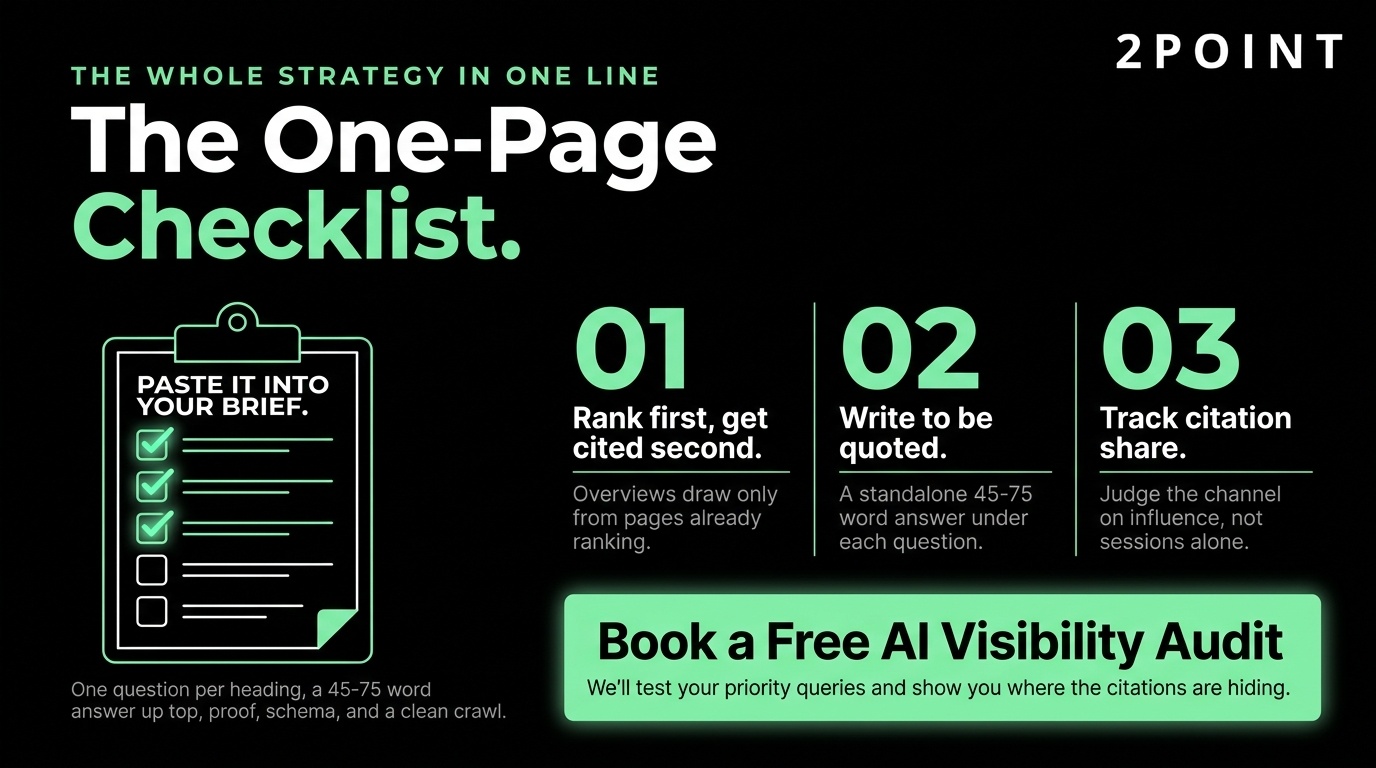
Paste this straight into your next content brief.
- One clear question per H2, with a 45-75-word answer capsule under each.
- The direct answer above the fold, never in paragraph six.
- FAQ and Article schema that matches the visible text.
- A named author, a visible date, and at least one credible citation.
- Original data or first-hand experience that the model cannot find elsewhere.
- A clean crawl, with no accidental noindex and no JavaScript-only content.
- Priority given to pages already ranking in the top ten.
That checklist is the practical core of how to show up in AI Overviews SEO teams can act on this week. The bigger citation strategy behind it is answer engine optimization, which extends the same moves beyond Google.
FAQs
What triggers a Google AI Overview?
AI Overviews trigger most on informational, question-style queries, especially longer conversational ones where a synthesized answer adds value beyond classic results.
Google decides case by case, and navigational or transactional searches rarely show one.
Since there is no published trigger list, knowing what triggers an AI Overview means testing your priority queries monthly.
Do AI Overviews help or hurt my SEO traffic?
Both, depending on the query. Simple informational searches can lose the click once the answer appears, while Google says clicks from pages shown with AI Overviews tend to be more engaged.
The honest read on AI Overviews and SEO is that citation share matters alongside clicks, so track both and target high-intent queries.
How is an AI Overview different from a featured snippet?
A featured snippet quotes a single page, lifting a single block and crediting the source.
An AI Overview synthesizes an answer from multiple pages and cites several. Extraction versus generation is exactly how AI Overviews will change SEO, since you now compete to be among the sources. The same structure and authority win both.
How long until a new page can appear in an AI Overview?
There is no guaranteed timeline. Google must crawl and index the page, then it has to rank well enough to be eligible, since AI Overviews draw from pages already shown in Search with a snippet. The fastest way to show up in AI Overviews is by upgrading a page already ranking in the top ten.
Can I opt out of AI Overviews?
Partly. There is no separate switch for AI Overviews, since they are built into Search itself.
You can limit how content appears with nosnippet, data-nosnippet, or max-snippet controls, and noindex removes a page from Search and the feature together. Most brands gain more by optimizing for citation than by opting out.