let’s connect


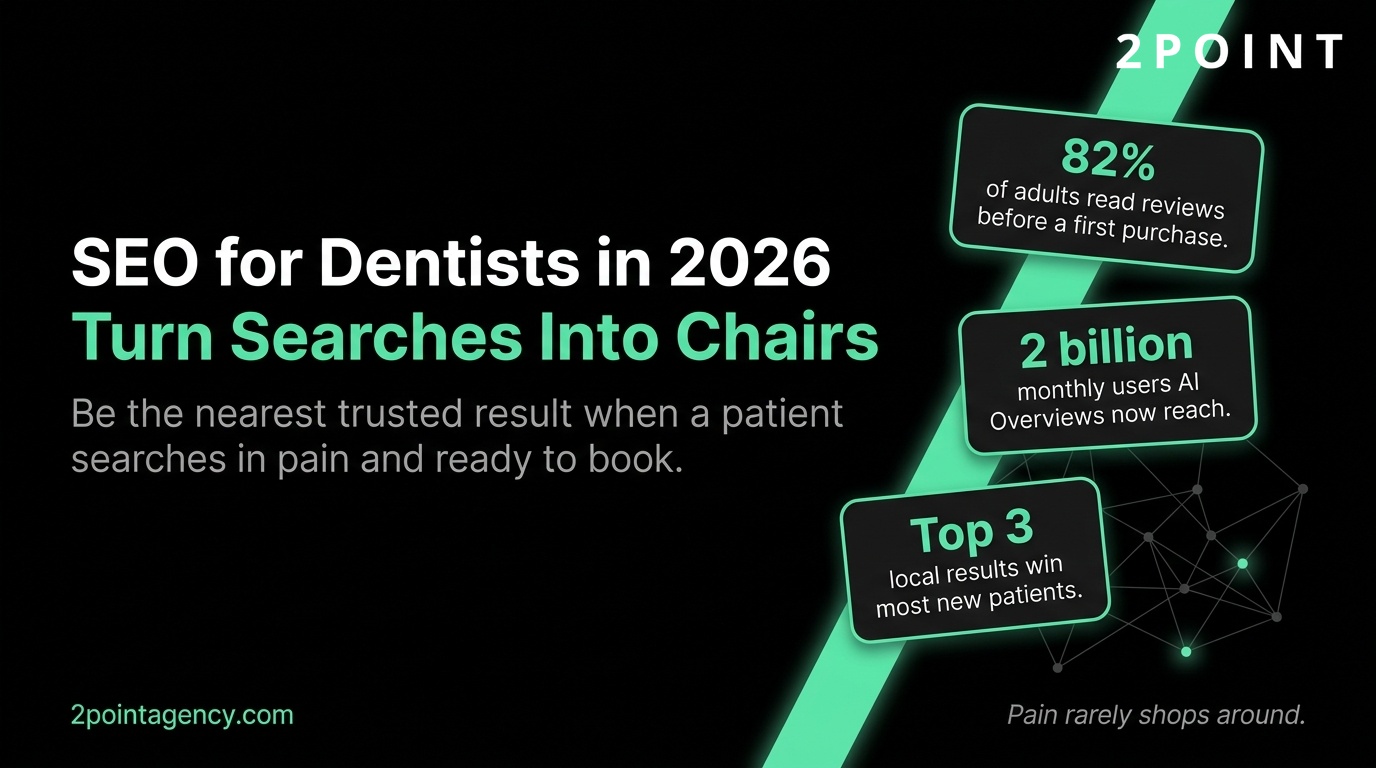
It is 2 am, and someone in your town wakes with a cracked molar. They grab their phone, search “emergency dentist near me,” and book the closest practice that looks trustworthy. If that is not yours, you lost a patient who never knew your name.
That scene repeats thousands of times daily, and pain rarely shops around. The nearest trusted result wins, often for years. Becoming that result is what SEO for dentists delivers.
At 2POINT, our dentist SEO services turn those searches into booked chairs. If you run a practice, not an SEO team, this is for you.
What Is Dental SEO?
SEO for dentists is the work of optimizing your practice’s website, Google Business Profile, and reviews, so you appear in local map results, organic listings, and AI answers when nearby patients search for a dentist or treatment. It has two halves.
Local SEO wins the map pack and near-me searches, while on-site SEO builds the service pages that rank and convert.
Why SEO Matters for a Dental Practice
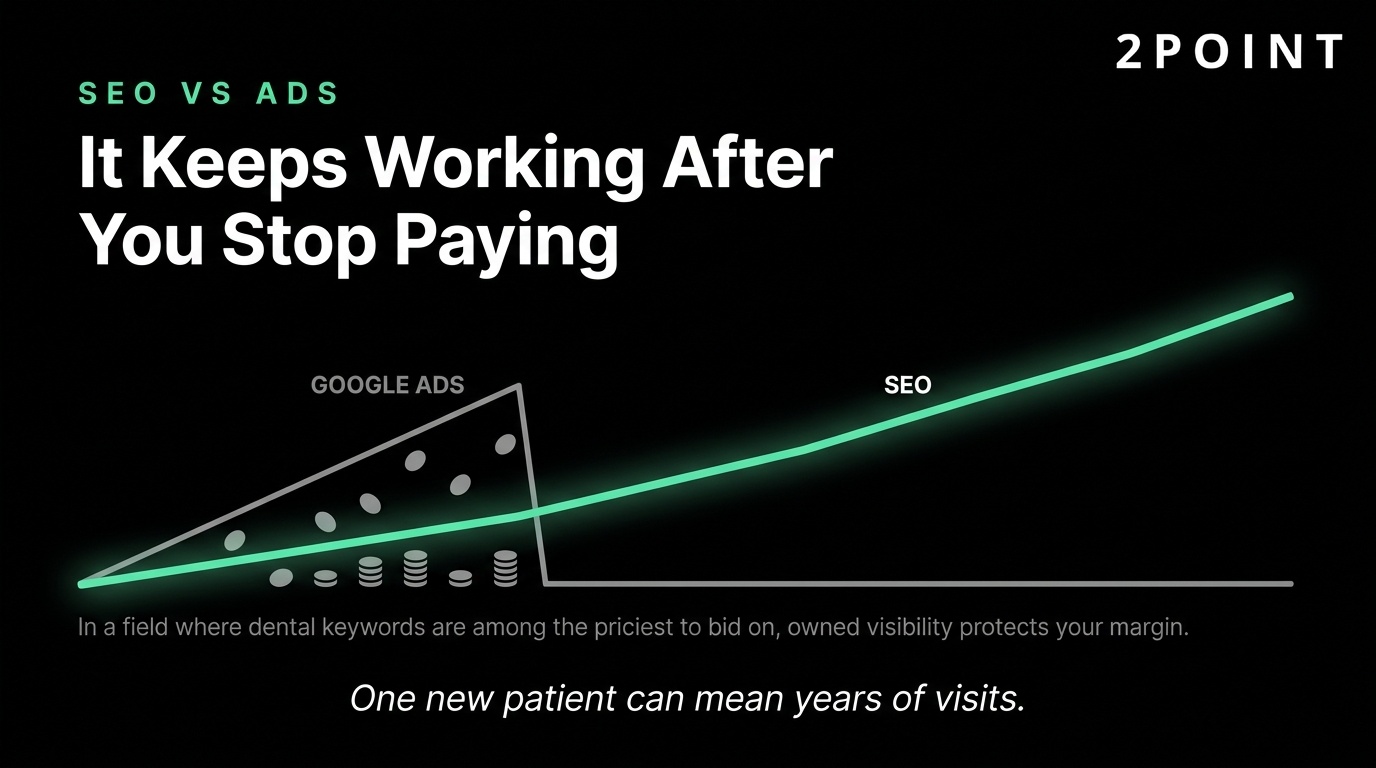
Here is why it earns its place. SEO puts your practice in front of patients the moment they are ready to book, and unlike ads, it keeps working after you stop paying.
In dentistry, these compounds are used since one new patient can mean years of visits.
Done well, local SEO for dentists brings a steadier flow of patients, more high-value cases, and trust that builds with every review you earn.
You Get Found at the Exact Moment Patients Are Searching
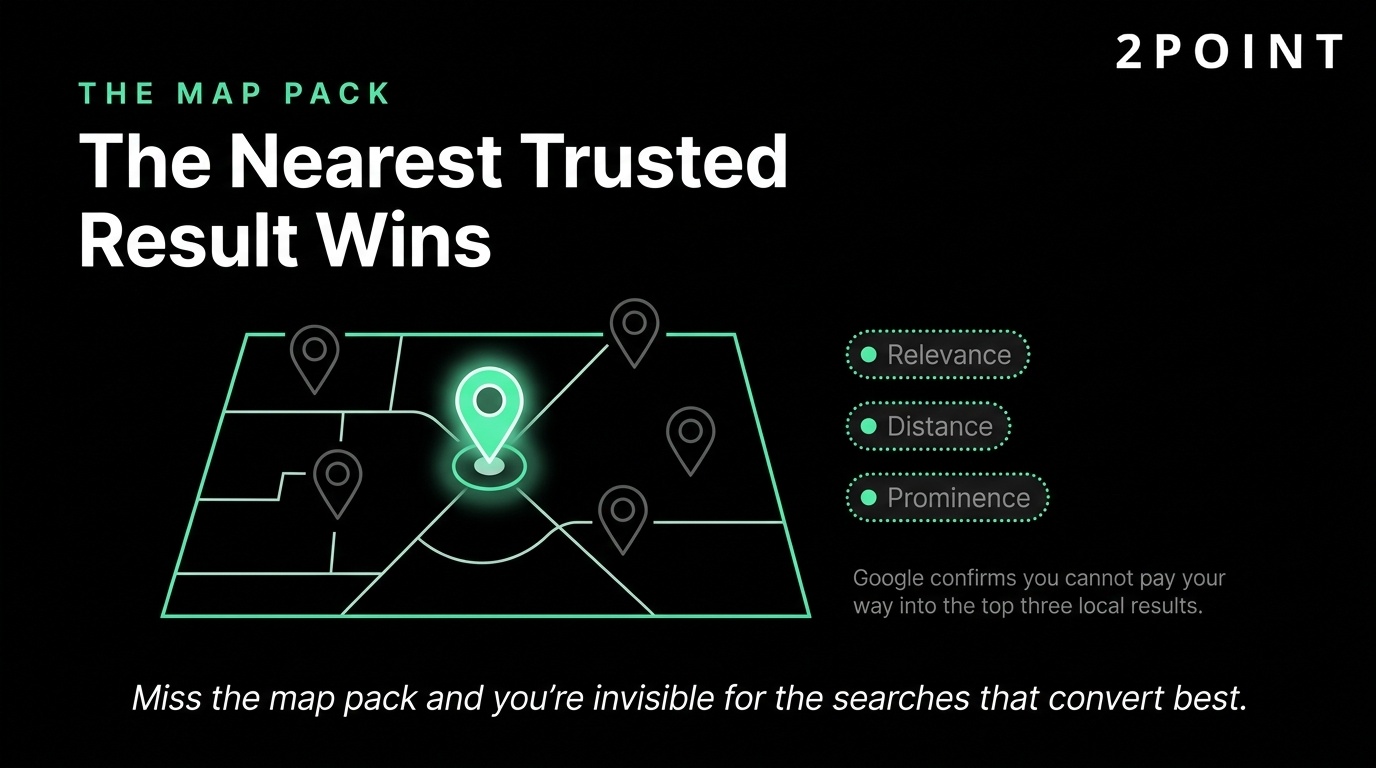
When someone searches “dentist near me,” they are ready to book, not browse. A page-one and map-pack spot puts you in front of that patient at the exact moment they decide.
Those top three local results are not random either. Google ranks them on relevance, distance, and prominence, and confirms you cannot pay your way in. Miss them, and you are effectively invisible for the searches that convert best.
Winning that placement is the core of local SEO for dentists, and where most of your new patients come from.
You Build a Steady Patient Flow Without Paying Per Click
Google Ads rent you visibility. The moment your budget pauses, so do the calls.
SEO works the other way around. The rankings and reviews you build this quarter keep bringing in patients next year at no cost per click. In a field where dental keywords are among the priciest to bid on, owned visibility protects your margin while it compounds.
You Attract Higher-Value Cases
Not every patient is worth the same to your practice. Ranking for implants, Invisalign, and cosmetic work pulls in the cases that lift revenue per chair, well beyond routine cleanings.
You win them with dedicated service pages, one per treatment, that answer the specific questions those higher-value patients ask before they commit. Generic pages rarely rank for that intent.
You Compound Trust Through Reviews
Reviews do double duty for your practice. They feed your local rankings, and they reassure patients before anyone ever calls. That second part matters more than owners realize.
Consider the behavior behind a booking. A Pew Research Center survey found that 82% of US adults read online reviews at least sometimes before a first-time purchase, and choosing a dentist is just such a decision. So a thin or stale review profile quietly costs you, patients.
The fix is a steady stream of recent reviews, not a one-time push.
How Patients Actually Find a Dentist in 2026 (the Search Journey)
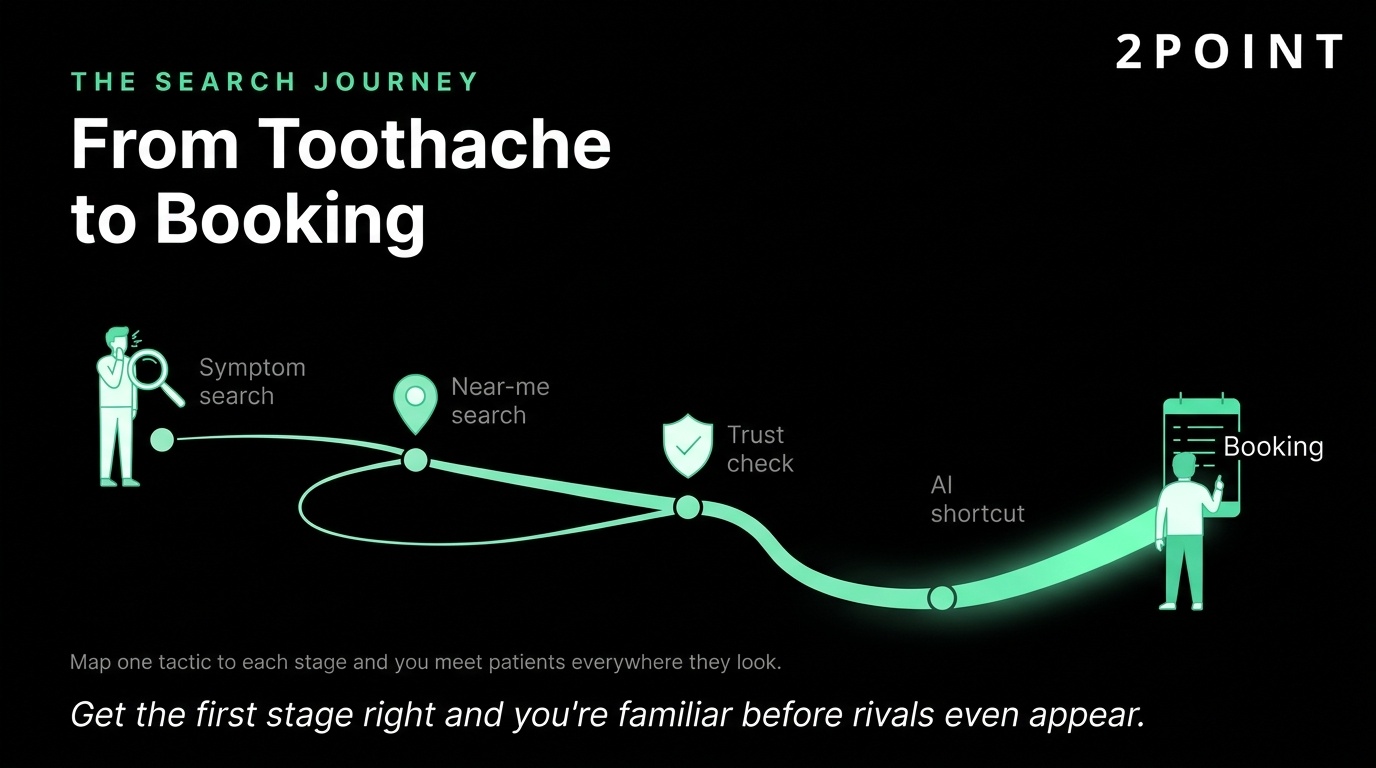
Patients rarely jump straight from a toothache to booking. They move through a short journey, from a symptom search to a “near me” lookup, then a trust check, and increasingly an AI answer.
Map one tactic to each stage, and you meet patients everywhere they look, including the AI tools that now sit in front of Google.
Stage 1: The Symptom Search
It usually starts with a worry, like “tooth pain” or “do I need a root canal?”
Plain-English content that answers that worry plants your name early, well before the patient is ready to book. Get this stage right, and you will be familiar before your competitors even enter the picture.
Stage 2: The ‘Dentist Near Me’ Search
This is the highest-intent moment in the journey, and the map pack decides it. Your Google Business Profile and how close you sit to the searcher do most of the work here. Win this one, and you capture a patient ready to call right now.
Stage 3: The Trust Check
Before dialing, patients scan your reviews, photos, and credentials. A strong rating, real photos of your practice, and clear dentist bios turn a hesitant maybe into a booking. This is the stage where a thin or neglected profile quietly costs you, patients.
Stage 4: The AI Shortcut
Increasingly, patients skip the list and ask ChatGPT or Google’s AI for the “best dentist in [city],” then act on the single answer they get.
Google’s AI Overviews already reach two billion monthly users, so you now need to be citable, not just rankable. Earning that citation is the job of answer engine optimization, covered in the AEO step ahead.
Stage 5: The Booking Moment
Finally, the booking itself. Click-to-call, online scheduling, and a fast mobile site are what close the deal. Add any friction here, a slow page or a clunky form, and you lose the very patient you worked hard to reach.
The Dental SEO Game Plan, Step by Step
Here is the step-by-step SEO plan we run for dentists, in the order that works. Each step opens with why it matters and the single thing to do first, so your team can start today without an SEO degree. Work them in sequence, since the early steps deliver the fastest wins and set up everything you do after.
Step 1: Optimize Your Google Business Profile
Your Google Business Profile is the biggest local lever you control, so claim it and complete every field first. Google confirms that accurate, complete profiles get matched to more searches. Our profile checklist shows exactly what to fill in.
Choose the Right Categories and List Every Service
Your category is one of the strongest ranking signals you control. Set an accurate primary category, such as General Dentist versus Cosmetic Dentist, then add each treatment as its own service item. That is how you get matched to specific searches instead of generic ones.
Add Real Photos and Post Weekly
Real photos of your practice build more trust than stock ever will, so add clear shots of the exterior, interior, and team. Then post something once a week.
Even a small update signals to Google that your practice is active, which helps you stay visible.
Collect and Respond to Reviews
Reviews feed both your rankings and a patient’s decision to call. Ask happy patients to name the treatment they had, since “great Invisalign experience” gives Google a signal it can match. Reply warmly to every review, positive or negative, and never mention any health details.
Step 2: Run a Technical SEO Audit
No amount of content ranks on a broken foundation. Start by running your site through Google Search Console and a free speed test, then work through the three areas that trip up most dental sites.
- Core Web Vitals and mobile speed, Google’s page-experience metrics for load and stability. Most “near me” searches happen on a phone, so test on a real device and fix whatever drags.
- Crawlability and indexation. Check Search Console for accidental noindex tags, which quietly tell engines to skip a page, or redirect loops that bury your pages.
- HTTPS, structure, and links. Keep the site secure and shallow, with key pages one or two clicks deep and nothing pointing at a dead end.
Step 3: Research Local, Service, and Intent-Based Keywords
The right keywords aim your content at patients ready to act, not just browse.
Start by combining treatment and location, like “dental implants [city],” then map each term to informational, commercial, or transactional intent. Favor the long-tail phrases you can realistically win, since page one for a specific term beats page five for a broad one.
Step 4: Build the Content That Converts
Dedicated pages let you rank for, and convert, each treatment you offer. Start by giving your top three services their own page.
One Page Per Service.
Implants, Invisalign, whitening, and emergency dentistry each deserve a page and a keyword of their own, never on a single crowded services page. A focused page ranks and converts far better than a catch-all.
Location Pages for Multi-Office Practices.
Give each office a genuine page with real detail, hours, staff, and directions, not a thin duplicate with the city name swapped. Google spots and discounts near-identical pages.
Educational Blog Posts That Nurture Future Patients.
Answer the low-difficulty questions patients ask, like “how long do veneers last,” to earn trust and plant your name early, well before they are ready to book.
Step 5: Prove E-E-A-T (Dentistry Is YMYL)
Your health content is held to a higher bar. Google weighs expertise, accuracy, and trust most heavily for topics that affect someone’s health or safety, treating dentistry as a Your Money or Your Life subject.
So show your credentials plainly. Add named dentist authors with qualifications, before-and-after photos shared with consent, an About the Team page, and a credible source behind every health claim.
Step 6: Nail On-Page Optimization
On-page signals tell Google exactly what each page is about. Give every page one clear focus, then get these three right on each service page.
- Titles, headings, and body copy. Use one clear H1 per page and weave your keyword naturally, without stuffing.
- Meta titles and descriptions. Lead with your primary keyword and the clinic name, and give the description a compelling reason to click, like same-day emergencies.
- Dental schema markup. Add Dentist, LocalBusiness, and FAQ schema so engines read your details cleanly and you qualify for rich results.
Step 7: Build Local Citations and Quality Backlinks
Consistent listings and trusted local links prove you are a real, established practice. Start by making your name, address, and phone number identical across all sources, then claim the major dental and local directories. Quality beats volume here.
A few trusted local links from a sponsor or partner clinic outweigh a hundred spammy ones, and the mechanics of consistent listings across directories are worth getting exactly right.
Step 8: Optimize for AI Search (AEO and GEO)
Patients increasingly get answers straight from AI, and you want to be the practice it names. Start by adding answer-first blocks, keeping your structure clean, and letting GPTBot crawl you, so ChatGPT, Gemini, and AI Overviews can cite you.
This is the heart of answer engine optimization, and it is quickly becoming as important as ranking itself.
What Makes Dental SEO Different From Generic Local SEO
SEO for dentists follows stricter rules than for a typical local business.
Because it is health content, Google holds it to a higher trust bar, and dental boards and the FTC regulate how you handle reviews and before-and-after photos. Get these extra layers right, and you protect both your rankings and your license.
YMYL and the Higher Trust Bar
Health content counts as Your Money or Your Life, so Google weighs expertise, accuracy, and author credibility far harder than it would for a coffee shop. For your practice, that makes named dentist authors and cited claims non-negotiable, not nice extras.
Review Rules You Cannot Ignore
The rules here are stricter than ordinary marketing, and breaking them carries real risk. Keep three straight.
- Never buy or incentivize reviews, as the FTC and dental boards consider that deceptive.
- Handle testimonials and before-and-after photos carefully, always with patient consent.
- Keep every claim truthful, a duty the ADA’s Code of Ethics makes core to the profession.
A gated or fake review can cost you far more than a ranking, since it puts your license at risk.
Insurance and Financing Keywords
Patients search practical, high-intent terms like “dentist that takes [plan]” and “payment plans,” and these ready-to-book queries convert unusually well. Give them a clear insurance and financing page, and you capture that intent instead of losing it to a competitor.
Photos and the Human Factor
Authentic office and team photos beat stock for map-pack engagement, and they do something stock never can. Patients want to see the real space and the real people before they trust you with a drill. Show them, and you turn a cautious browser into a booking.
Your First 90 Days: A Recall-Style Rollout
Think of this like a recall schedule for your online presence, a simple, phased plan your office can actually keep. Ninety days is enough to fix the foundation, publish the pages that convert, and start building authority, all without overwhelming a busy team.
Days 1 to 30: Foundation
Start with the moves that pay off fastest.
Claim and optimize your Google Business Profile, ensure your NAP is consistent everywhere it appears, and set up a simple review-request routine at checkout. These deliver the quickest wins and build early momentum.
Days 31 to 60: Content
With the foundation set, turn to what converts. Publish or rewrite your top three service pages, add dental schema so engines read them cleanly, and speed up the mobile site most patients use. This is where searches start turning into booked appointments.
Days 61 to 90: Authority
Finally, build the trust that protects your rankings. Earn a few credible local links, add FAQ content to your key pages, and double down on whatever moved the needle in the first two months. Momentum compounds from here, so keep the routine going.
How Much Does Dental SEO Cost?
Most dental SEO runs on a monthly retainer, but any single price you see quoted online is close to meaningless on its own. Published ranges swing wildly, because “dental SEO” covers everything from basic profile upkeep to full content and link programs, and because the right number depends entirely on your situation.
Three things move it more than anything else. How competitive your local market is, how many services and locations you run, and how much groundwork your site already has in place.
So rather than trust a published figure, look at what the work actually includes and insist on transparent, conversion-level reporting. If you want a real number for your practice, our dentist SEO services start with a plain-English visibility check and a scoped quote, not a one-size-fits-all package.
Red Flags: Tactics That Put a Dental Site at Risk
A few tactics can sink your rankings, and sometimes your reputation with them, so learn to spot them before you hire anyone. If an agency pitches any of these, walk away.
Real dental SEO is patient, transparent, and fully within the rules.
- Fake or gated reviews, which break both platform policies and dental board rules.
- Keyword-stuffed city pages that read as spam to Google and patients alike.
- Duplicate location pages with nothing changed but the city name.
- Any promise to “guarantee number one,” since no one controls Google’s algorithm.
Even one of these in a sales pitch is your cue to keep looking.
What’s Your One Move This Week?
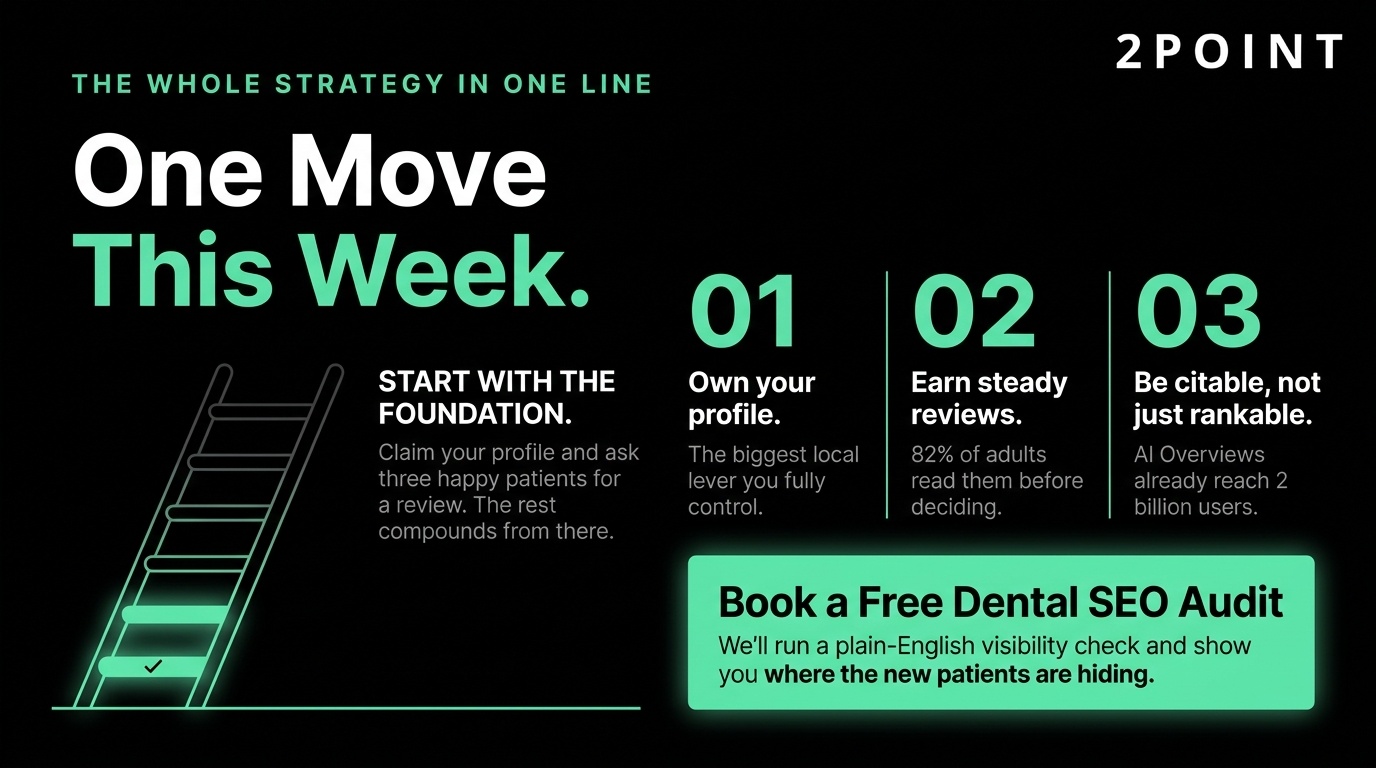
The biggest lever is simple. A complete, active Google Business Profile, backed by a steady stream of genuine reviews, does more than anything. Nail that first, and the rest of this plan compounds.
Your move this week is small: claim your profile and ask three happy patients for a review.
When you want a hand, our managed SEO folds into the multi-channel marketing that fills your chairs. Strong SEO for dentists is a marathon of consistent moves.
FAQs
How long will it take for dental SEO to bring in new patients?
Most practices see early movement in three to four months and meaningful new-patient growth by six to nine, depending on your market and starting point. Google Business Profile wins come fastest. Treat SEO for dentists as an ongoing routine, not a one-time project.
Is SEO or Google Ads better for a dental practice?
Both, ideally together. Google Ads deliver instant leads but stop when you pause spending, while SEO compounds and keeps bringing patients at no cost per click. Run ads for quick wins while you build local SEO for dentists underneath, then lean less on paid.
How many reviews do I need to rank in the map pack?
There is no magic number. Recency, rating, and a steady flow matter more than any total, though competitive cities can need a hundred or more. Ask every happy patient at checkout, and never buy or incentivize reviews, which breaks dental board and FTC rules.
Should each dentist in the practice have their own bio page?
Yes. For a YMYL health field, bio pages are among your highest-value pages. List each dentist’s credentials, specialties, and a real photo, since Google weighs author expertise heavily. Individual bios also help rankings, which is why strong dentist SEO services include them.
How much should a dental practice budget for SEO?
Plan for a monthly retainer, not a one-time fee, since SEO is ongoing. Ignore fixed quotes online, since real pricing depends on your local competition, your service and location count, and how much your site needs fixing. Start with the free wins first.