let’s connect


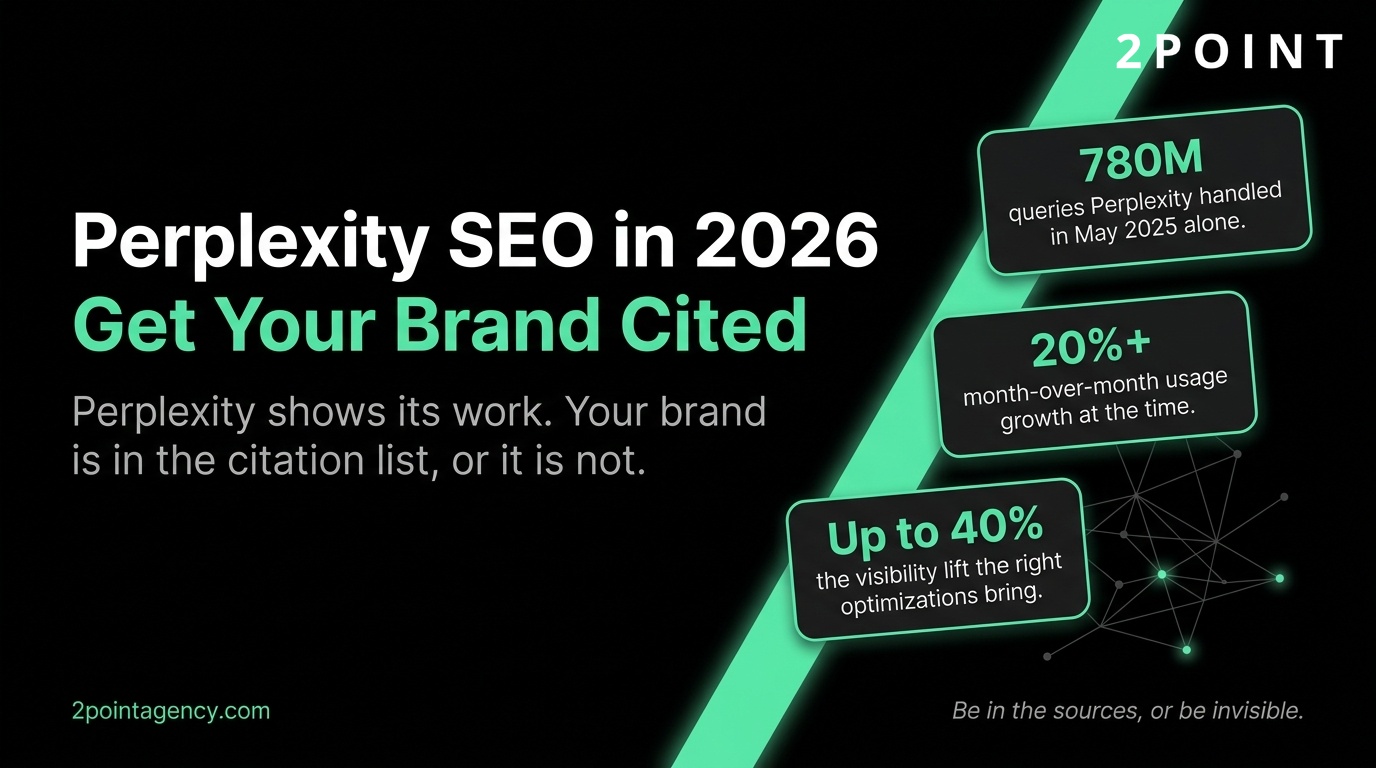
A buyer comparing vendors no longer opens ten tabs. They ask Perplexity for the best option and read one sourced answer. In that moment, the shortlist is written.
Perplexity differs from Google in one way that matters. It shows its work. Every answer lists its sources, which turns Perplexity SEO into a concrete, visible goal. Your brand is in that citation list, or it is not. That transparency is the heart of how to optimize content for Perplexity AI SEO teams can copy.
At 2POINT, we help brands earn citations in the AI tools buyers now use to research. If you lead SEO or content, this is built for you.
What Is Perplexity SEO?
Perplexity SEO is the practice of optimizing your content, so Perplexity selects and cites your page as one of the three to five sources behind its answers. The goal is source selection, not a ranking position.
That distinction changes how you compete. You are optimizing to be quoted, not just to rank, and your real rivals are whichever pages currently hold those few citation slots for your buyers’ questions.
What ‘Ranking’ Means on Perplexity (and Why Classic SEO Still Counts)
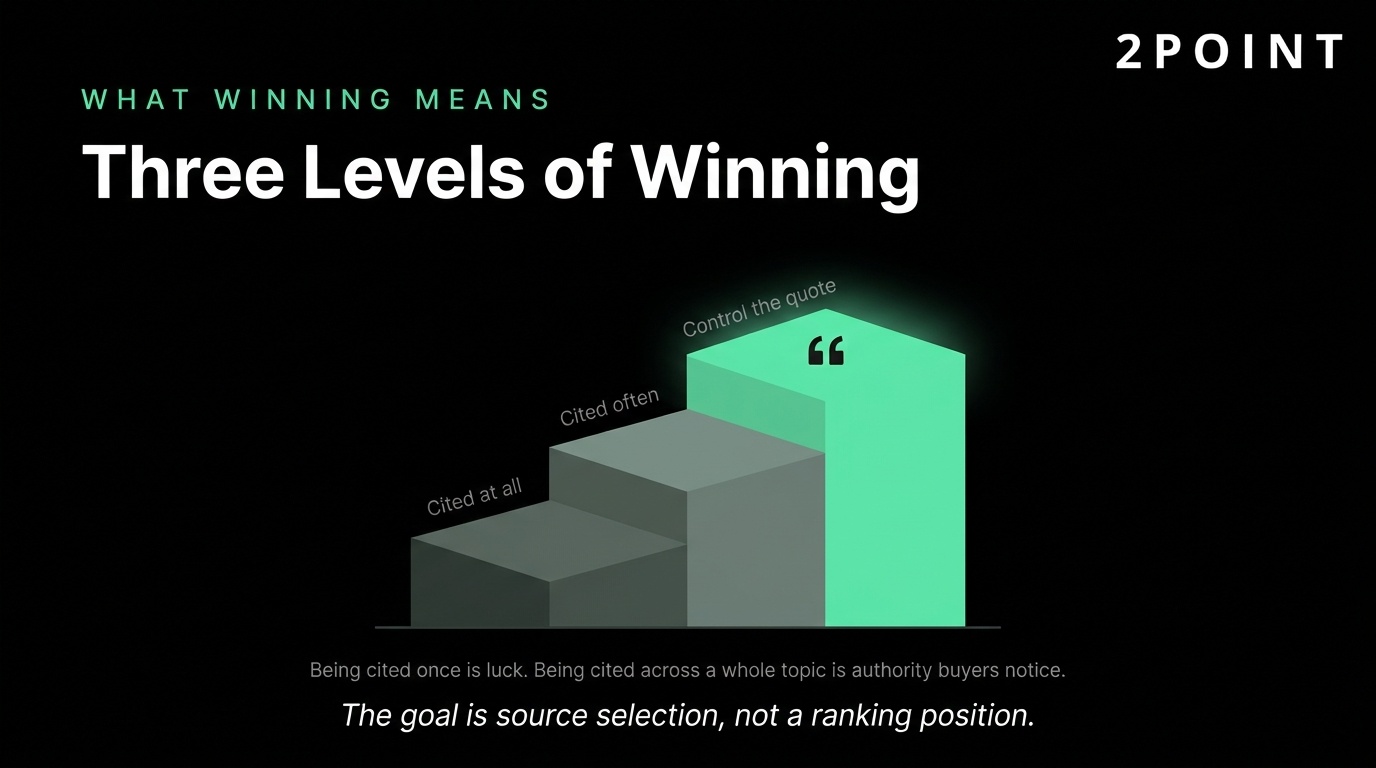
On Perplexity, there is no blue-link ranking. Success runs in three levels instead. First, you get cited at all, then you get cited often across related prompts, and finally, you control which passage of your page gets quoted.
Classic SEO still counts underneath all three. Clean indexation, authority, and first-page presence are what make you eligible to be pulled in the first place. The comparison below makes the shift concrete.
| Dimension | Traditional SEO | Perplexity SEO |
|---|---|---|
| Goal | Rank a page | Be a cited source |
| Unit of success | The page or URL | The quoted passage |
| Success metric | Rankings and clicks | Citation frequency, share of answer |
| Key signals | Backlinks, on-page | Extractability, freshness, authority |
| Where it shows | Blue links | Inline citations |
Are You Cited at All?
The first win is simply appearing in the citation list under an answer. Everything else builds on that, so treat presence as your baseline metric. Run your priority prompts and look for your domain among the sources.
If you are not in the list, nothing else matters yet, and your first job is earning that initial slot.
How Often Are You Cited Across Related Prompts?
Citation frequency is the Perplexity version of ranking. Being cited once is luck. Being cited across a whole topic is authority, and that is the level buyers notice.
Track how many related prompts name you, then grow that share deliberately, since repeat visibility is what turns citations into enterprise B2B leads rather than one-off mentions.
Which Passage of Your Page Gets Quoted?
Finally, control your quote surface area, the specific block Perplexity lifts from your page. Tighten it, and you shape the story told about you.
- Keep the block self-contained, readable without surrounding context.
- Lead it with the claim you want repeated.
- Put your brand name inside the passage, not just the byline.
Small edits here change what buyers read in the answer.
Why Google Fundamentals Still Matter
Underneath all three levels, the classics still have gate entry. Clean crawlability, topical authority, and first-page presence remain prerequisites, as Perplexity relies on pages that already rank and index cleanly.
In other words, Perplexity SEO sits on top of classic SEO rather than replacing it. Skip the fundamentals, and no citation tactic above can save you.
How Perplexity Works: The RAG Pipeline in Plain English
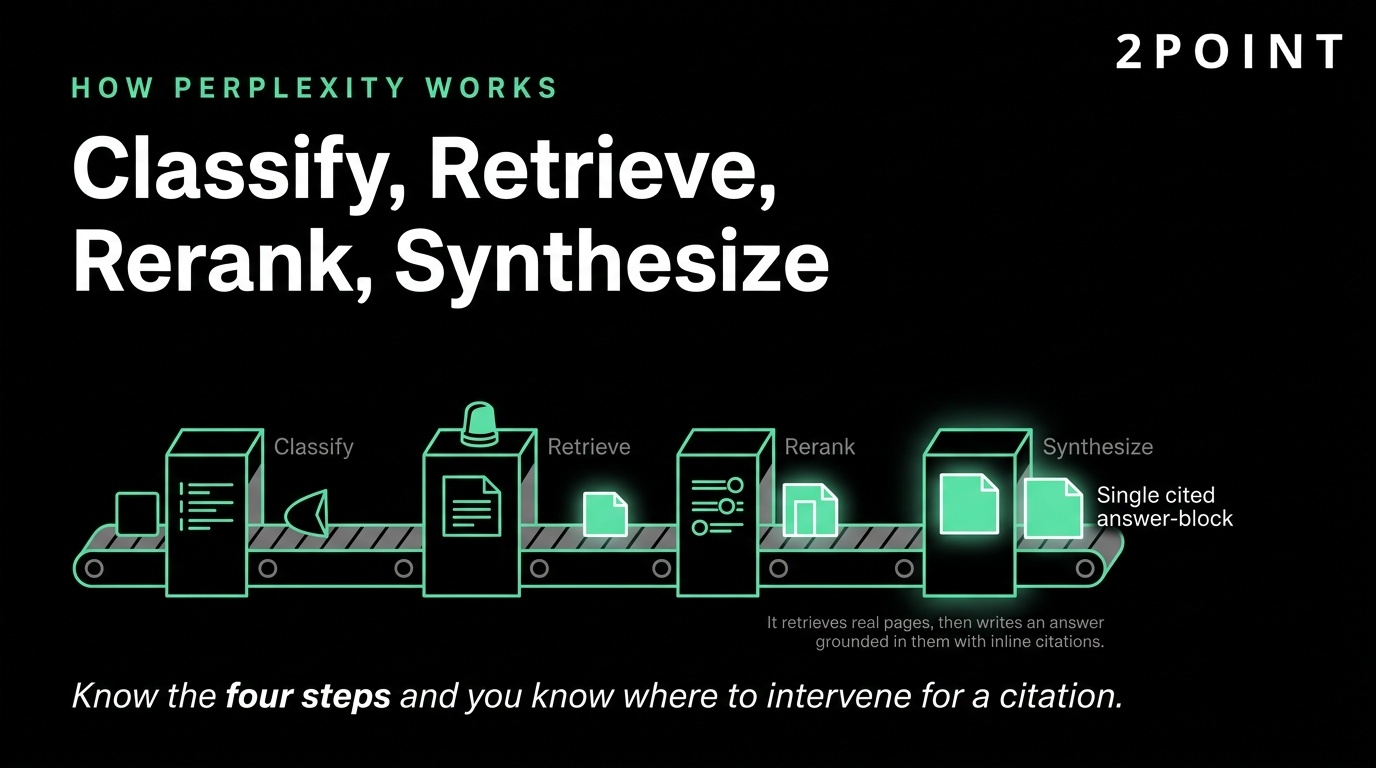
Perplexity runs on retrieval-augmented generation. It retrieves real web pages, then writes an answer grounded in them, with inline citations. Understand its four steps: classify, retrieve, rerank, and synthesize, and you know where to intervene for a citation.
Query Classification
First, Perplexity reads your query and sorts it into a type, because each type gets its own retrieval strategy.
- Factual: a single verifiable answer.
- In a comparative, options are weighed against each other.
- Procedural, steps to do something.
- Opinion, judgment calls, and recommendations.
Match your page format to the query type you target, and you fit the strategy Perplexity brings.
Retrieval From the Web
Next comes retrieval, where Perplexity pulls candidate pages from its own real-time index.
According to Perplexity’s developer documentation, the engine is built for real-time, web-wide research, meaning that fresh, crawlable pages enter the pool while stale or blocked pages never do. Your job at this step is simple. Stay indexable, stay current, and give it something to retrieve.
Reranking and Source Blending
Then, a quality reranker filters the candidates, scoring them for extractability and authority before any writing begins.
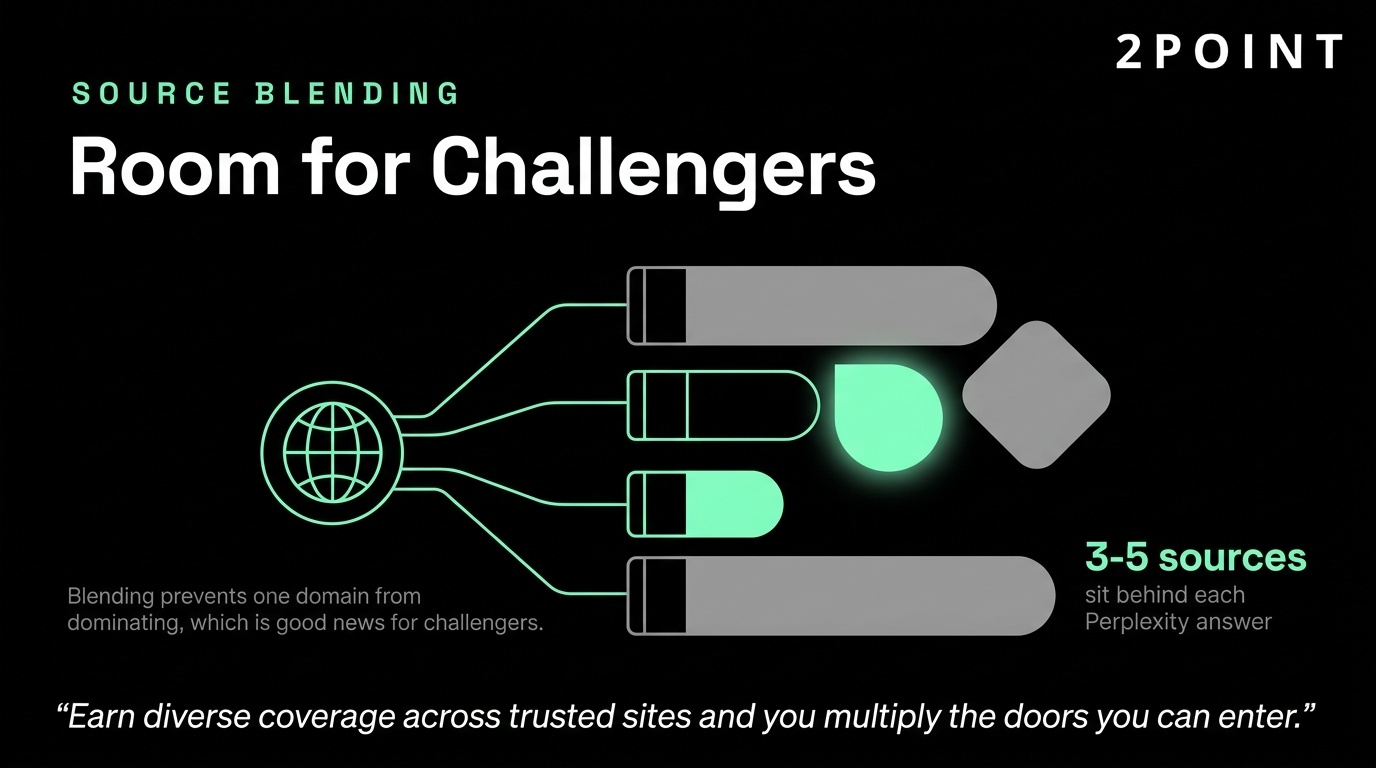
Blending comes next and prevents a single domain from dominating an answer. That guardrail is good news for you, since it leaves room for challengers. Earn diverse, credible coverage across several trusted sites, and you multiply the doors you can enter through.
Answer Synthesis With Citations
Finally, Perplexity writes a concise answer with inline citations tied to specific claims, not vague end-of-page references. That precision is why your quotable block matters, since the engine links each statement back to the passage supporting it.
The mechanics mirror how other AI engines choose their citations, and one well-structured page earns visibility across several of them.
How Perplexity Chooses Which Sources to Cite
Four qualities make a page citable on Perplexity. It is verifiable, easy to extract, credible within its topic, and current. Hit all four, and you become the page a reranker reaches for. Miss them, and you sit in the candidate pool, unquoted.
The gap between those two outcomes is worth real effort. The original GEO research paper found that the right optimizations can lift a source’s visibility in AI answers by up to 40%, so this is a winnable game, not a lottery.
Verifiable
Specific claims, clear evidence, and accurate terminology beat vague marketing copy every time. An engine grounding its answer needs statements it can check, which means every number you source and every term you use precisely makes you easier to quote safely.
Easy to Extract
Next, format for the lift. Short definition blocks, numbered steps, tables, and tight question headings hand the engine a clean block it can pull without rewriting. If a human editor could copy-paste your passage and it still made sense, so can the model.
Credible Within the Topic
Depth beats breadth here. Consistent, thorough coverage of one subject signals you are a real source rather than a passerby, and that topical authority is the same principle behind answer engine optimization. One great page on a topic you never touch elsewhere rarely wins.
Current
Finally, freshness is weighted heavily. Recently updated pages tend to earn a visibility boost, while undated or stale content quietly loses ground. Put a visible date on your pages and honor it with real updates, since a fake refresh is easy to spot and easy to discount.
The Six Tactics That Earn Citations
Here is the playbook. Six tactics turn a page from candidate to cited, and none is exotic. Most build directly on the SEO you already run, which makes them the practical core of how to optimize content for Perplexity AI SEO teams can start this quarter.
Tactic 1: Lead With the Answer (BLUF)
Put a direct, self-contained answer in the first 100 words. Cited pages answer the question up front, then earn the deeper read underneath. If your answer currently sits below a warm-up intro, moving it up is the single highest-return edit you can make.
Tactic 2: Structure for Extraction
Give the engine clean blocks to lift. Use HTML tables instead of paragraph comparisons, plus numbered steps, tight definitions, consistent H2S and H3S, and FAQ blocks.
Then mark them up with the Schema.org vocabulary so machines parse them without guessing.
Tactic 3: Build Topical Authority Clusters
One article rarely sustains visibility on its own.
Build a hub page supported by sub-topic, comparison, and FAQ pages instead, since a cluster proves the depth a reranker reads as authority. Interlink the set so each page lends strength to the rest.
Tactic 4: Prioritize Freshness
Perplexity weights recency, and you can feed that deliberately. Use current-year data, refresh stats quarterly, and get new pages indexed quickly before they go stale and wait to be found.
A visible last-updated date helps, provided the update behind it is real.
Tactic 5: Strengthen Domain Credibility
Your credibility lives beyond your own domain.
Perplexity frequently cites platforms like G2, Clutch, Reddit, LinkedIn, and YouTube, which means verified profiles and an active, genuine presence on those platforms carry over into the answers.
Original research earns you the citations that compound it.
Tactic 6: Monitor and Iterate
Finally, close the loop. Track your share of answers and citation frequency, then feed what you learn back into the content, repeating what wins and fixing what slips.
If you would rather have a team run that loop, our managed SEO covers the tracking and the fixes.
Build a Citation Block: The Answer-First Template
Give your writers a reusable block they can drop into any page. It front-loads the answer, adds proof, and hands Perplexity a clean, self-contained passage to quote. Build it once, and every new page ships citable by default.
The Source-Ready Block
Structure every block the same way, top to bottom.
- Claim: one direct sentence that states the answer.
- Why, one to two sentences of reasoning behind it.
- How, three to six numbered steps.
- Evidence, links to the sources that back it.
- Caveat: one honest sentence on limits.
That last line matters more than it looks, since an honest caveat reads as a sign of credibility to both readers and rerankers.
The Formats Perplexity Keeps Quoting
Certain formats earn citations again and again, so build your calendar around them.
- Direct-answer explainers (“what is X”, “how does X work”).
- Comparisons and alternatives (“X vs Y”, “best X for Y”).
- Original data, stats, and mini-studies.
- Well-sourced, step-by-step how-tos.
Original data is the strongest of the four, because it makes you the primary source everyone else has to cite.
Prompts, Not Keywords: Research for Perplexity
Perplexity research starts with prompts, not keywords. The mapping runs from keyword theme to prompt cluster to content cluster. Pick 20 to 50 prompts your buyers actually type, then build a hub page plus supporting pages that answer them.
Getting that mapping right is the practical heart of Perplexity SEO, since every prompt you cover is another answer you can enter.
The 7-Day Perplexity Sprint
You do not need a quarter to start. This day-by-day sprint gets your best pages citation-ready in one working week, and it measures itself, so you finish with evidence instead of theory.
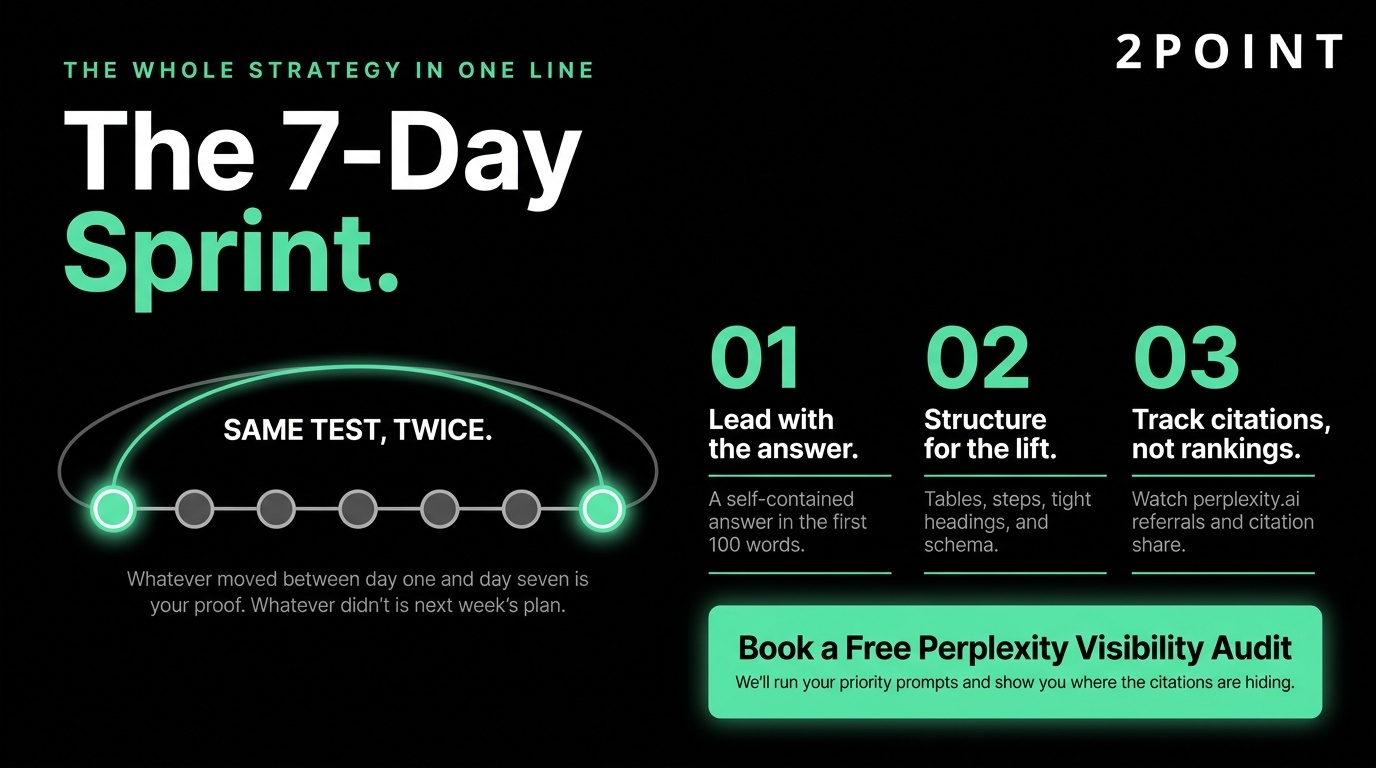
- Day one, list 20 buyer prompts and log who currently gets cited.
- Day two, add answer blocks and sources to your three best pages.
- Day three, build one comparison or best-of page for a money query.
- Day four, fix the schema and crawl access, and allow PerplexityBot through.
- Day five, pitch two data points or quotes to relevant publications.
- Day six, answer two relevant Reddit or forum threads, genuinely.
- Day seven, re-run the prompt list and record any new citations.
Days one and seven are the same test run twice, which is the point. Whatever moved in between is your proof, and whatever did not is next week’s plan.
How to Measure Perplexity Visibility
You measure Perplexity by citations and referrals, not Google rankings. Two views cover it. Track perplexity.ai referrals in GA4, and use a prompt or citation monitor to watch where you appear across your priority prompts over time.
The audience justifies the effort. As reported by TechCrunch, Perplexity handled 780 million queries in May 2025 alone, and its CEO said usage was growing more than 20% month over month at the time.
In GA4, the path is Acquisition > Traffic acquisition > session source, where perplexity.ai appears as its own line. Give it a custom channel so it never gets hidden in generic referrals. Google Search Console will not help you here, since it only sees Google, which is why a citation monitor carries the other half, and the trackers worth trying range from lean monitors to enterprise platforms.
Track Perplexity.ai Referrals in GA4
Watch sessions, landing pages, and conversions from perplexity.ai, since together they show which cited pages actually drive visits. The landing-page view is the one to check weekly.
It tells you which citations are pulling their weight, and that is exactly what you double down on.
Do Not Rely on Google Search Console
GSC only reports Google, so it is entirely blind to Perplexity. No impressions, no citations, nothing. That leaves a dedicated prompt or citation monitor as the only way to track this surface properly, which is why your monthly prompt log matters even if it starts as a spreadsheet.
Common Mistakes (Why You Are Not Getting Cited)
A few patterns keep good pages out of Perplexity’s citations. Check your best candidates against these five before writing anything new.
- Generic content with no quotable blocks, so the reranker has nothing clean to lift.
- No primary sources or original data, so the engine has no reason to pick you over the page it already trusts.
- No named author or credibility signals, leaving your expertise invisible to a system built on trust.
- No topic cluster, just one lonely page, which reads as a passerby rather than an authority.
- Undated pages in a fast-moving topic, quietly losing ground to anything fresher.
Most pages fail on one or two, not all five. Find the one blocking your strongest page and fix it first.
When Buyers Ask Perplexity, Are You in the Sources?
The formula is not complicated. Be the well-sourced, current, widely-mentioned answer, and Perplexity quotes you.
Perplexity SEO is less about gaming an algorithm and more about genuinely being the clearest page on your topic. So build the clusters, front-load the answers, keep them fresh, and track your citations.
When you want it run for you, our managed SEO folds citation work into the multi-channel marketing that turns visibility into revenue.
FAQs
How is Perplexity SEO different from normal SEO?
Perplexity SEO optimizes to be cited inside an answer, while traditional SEO optimizes to rank a page and earn a click. That is the core of Perplexity vs traditional SEO. On Google, you win a position; on Perplexity, you win a citation slot, so extractable blocks, freshness, and topical authority carry extra weight.
How do I get my brand cited on Perplexity?
Make your content verifiable, extractable, credible, and up to date. Lead pages with a direct answer in the first hundred words, structure comparisons as tables, add schema, and keep dates fresh. Build a topic cluster, allow PerplexityBot, and earn mentions on Reddit, G2, and LinkedIn. Treat SEO for Perplexity as an ongoing habit, not a one-off.
Does Perplexity use Google’s rankings?
Not directly. Perplexity runs its own retrieval pipeline over a real-time web index rather than reprinting Google’s rankings. Still, pages that rank well tend to share the qualities it rewards: authority, clean structure, and relevance, so classic SEO usually helps. Ranking first on Google does not guarantee a citation, though.
Can small or low-authority sites get cited?
Yes. Perplexity blends sources so no single domain dominates an answer, giving focused, smaller sites real opportunities, especially on niche prompts where big brands spread thin. Depth on a narrow topic, original data, and fresh, well-sourced pages beat generic scale. Perplexity AI SEO rewards the best answer, not the biggest brand.
How long does it take to get cited?
It varies. A page that already ranks can earn citations within days to weeks after you add an answer block and schema, since Perplexity retrieves in near real time. Citation frequency across a topic takes a few months of consistent publishing. Track priority prompts monthly, and expect structure to move first, authority later.