FOLLOW US

Last update: Apr 13, 2026 Reading time: 12 Minutes
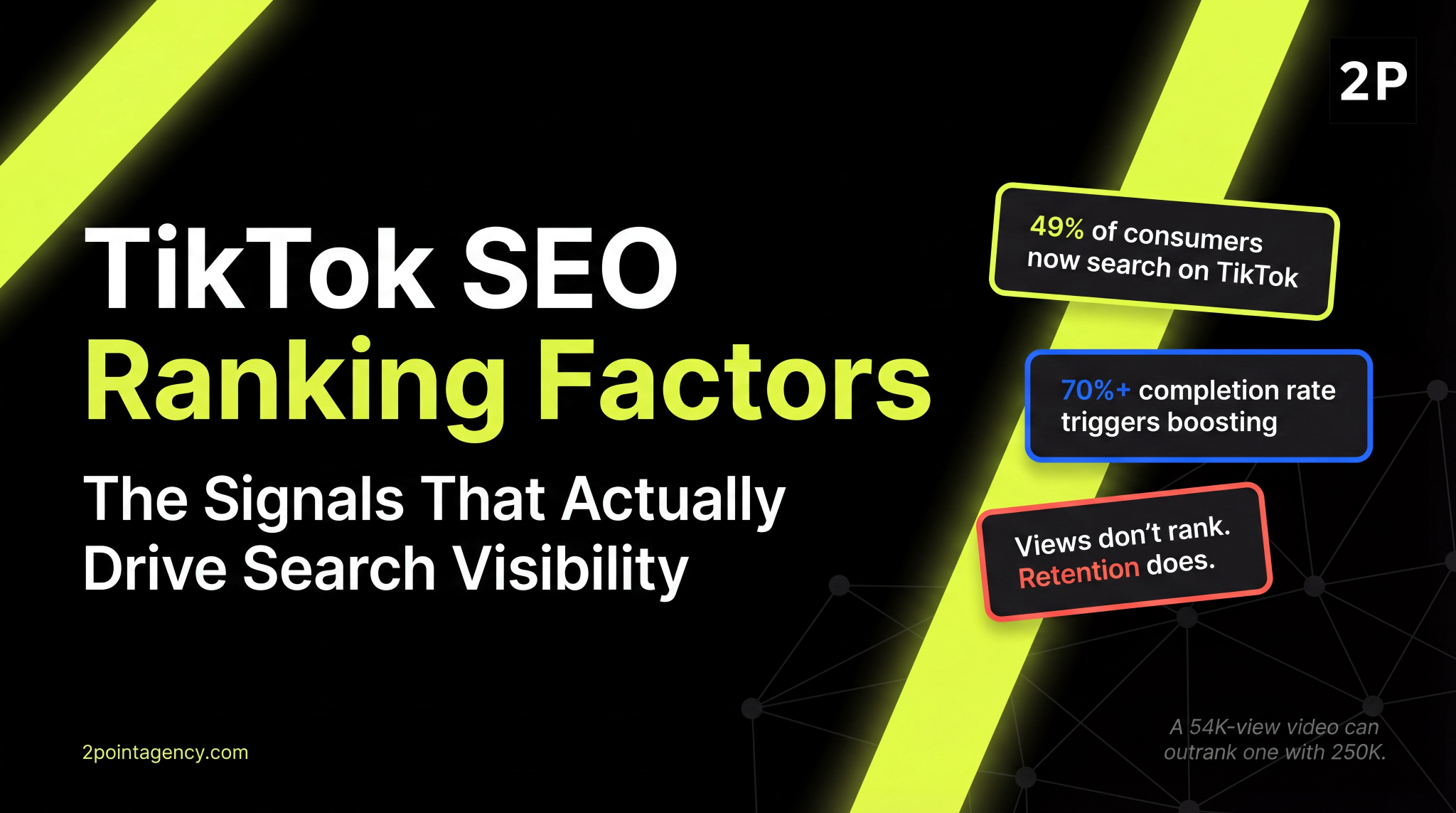
TikTok search doesn’t care about your view count. A video with 54,000 views can outrank one with 250,000, and it happens more than most brands think.
That gap comes down to TikTok SEO ranking factors most teams overlook: completion rate, spoken keywords, and on-screen text relevance. These are the TikTok algorithm ranking signals that actually drive search visibility, not vanity metrics.
At 2POINT, we see brands chase views while ignoring the signals that actually move rankings. A sharper TikTok SEO strategy starts with knowing which signals TikTok weighs, and exactly why.
TikTok is a search engine. Not “slowly becoming” one. It processes queries, ranks results, and decides which content wins, exactly like Google does.
The difference is what drives those rankings. According to Adobe Express, 49% of consumers now search on TikTok, up from 41% two years earlier. They want video tutorials (61%), product reviews (45%), and personal stories (41%), not a list of links.
That changes your TikTok SEO strategy entirely. Treat it like a social feed, and you miss the search traffic your competitors are already capturing. The brands pulling ahead already have a TikTok agency building around the algorithmic ranking signals that shape TikTok search results.
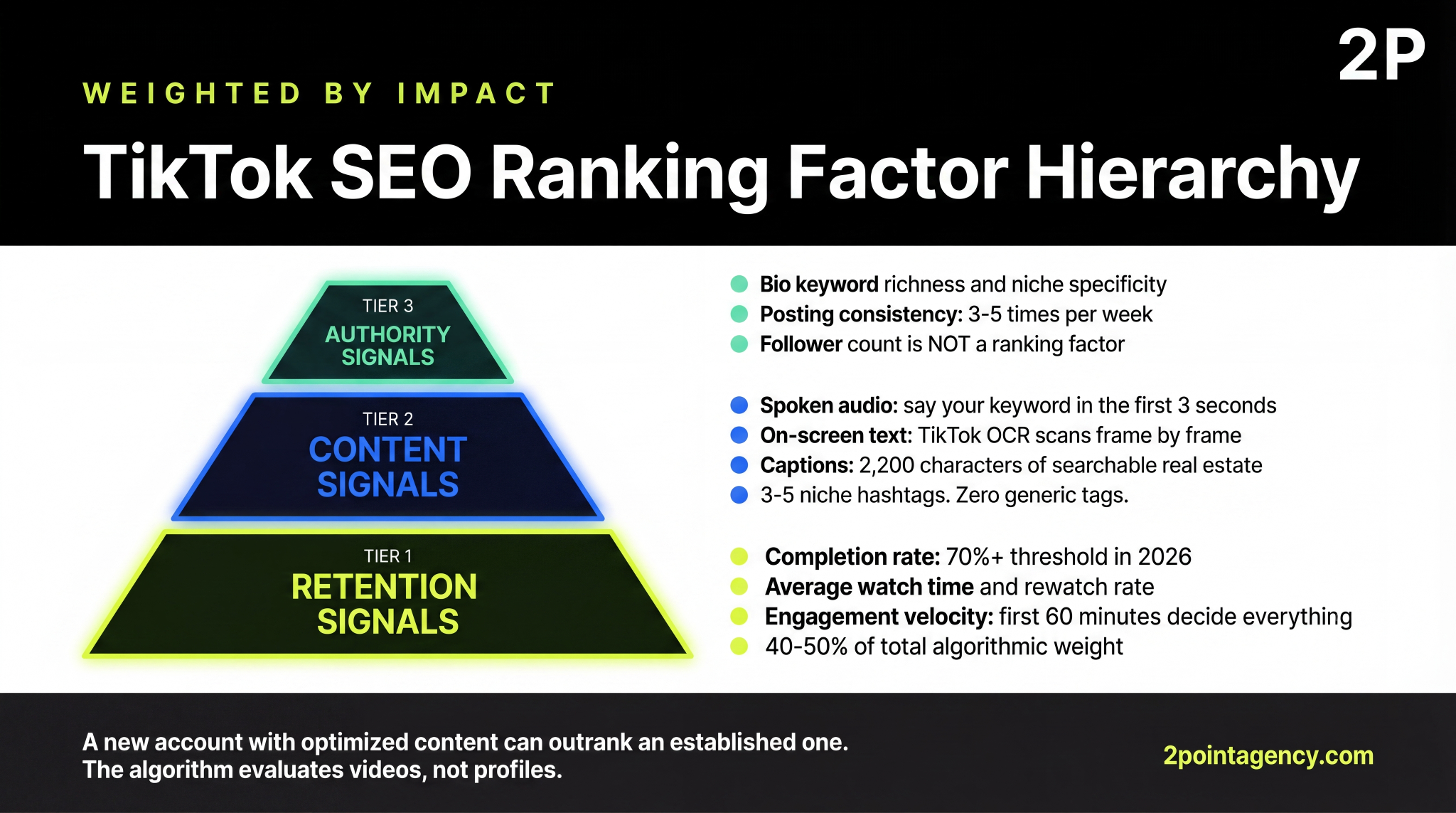
TikTok evaluates every video across multiple TikTok SEO ranking factors at once. But they’re not weighted equally. Where you rank depends on which signals you prioritize.
Retention is where TikTok starts, and it carries the heaviest weight.
According to Sprout Social, retention signals account for roughly 40-50% of TikTok’s algorithmic weight. Your video’s distribution is decided here, before most other engagement even kicks in.
Completion rate leads the TikTok completion rate algorithm. In 2026, that threshold is widely observed at 70%+ completion, up from around 50% in 2024. Miss that threshold, and the algorithm stops pushing your content.
Average watch time and rewatch rate reinforce it. When someone replays your video, TikTok reads that as a strong quality signal. Loop-structured content or a satisfying ending that pulls viewers back earns this naturally.
Then there’s engagement velocity. TikTok’s spark phase tests your video with 200-500 users first. 100 likes in 10 minutes outweighs 100 likes spread over 24 hours.
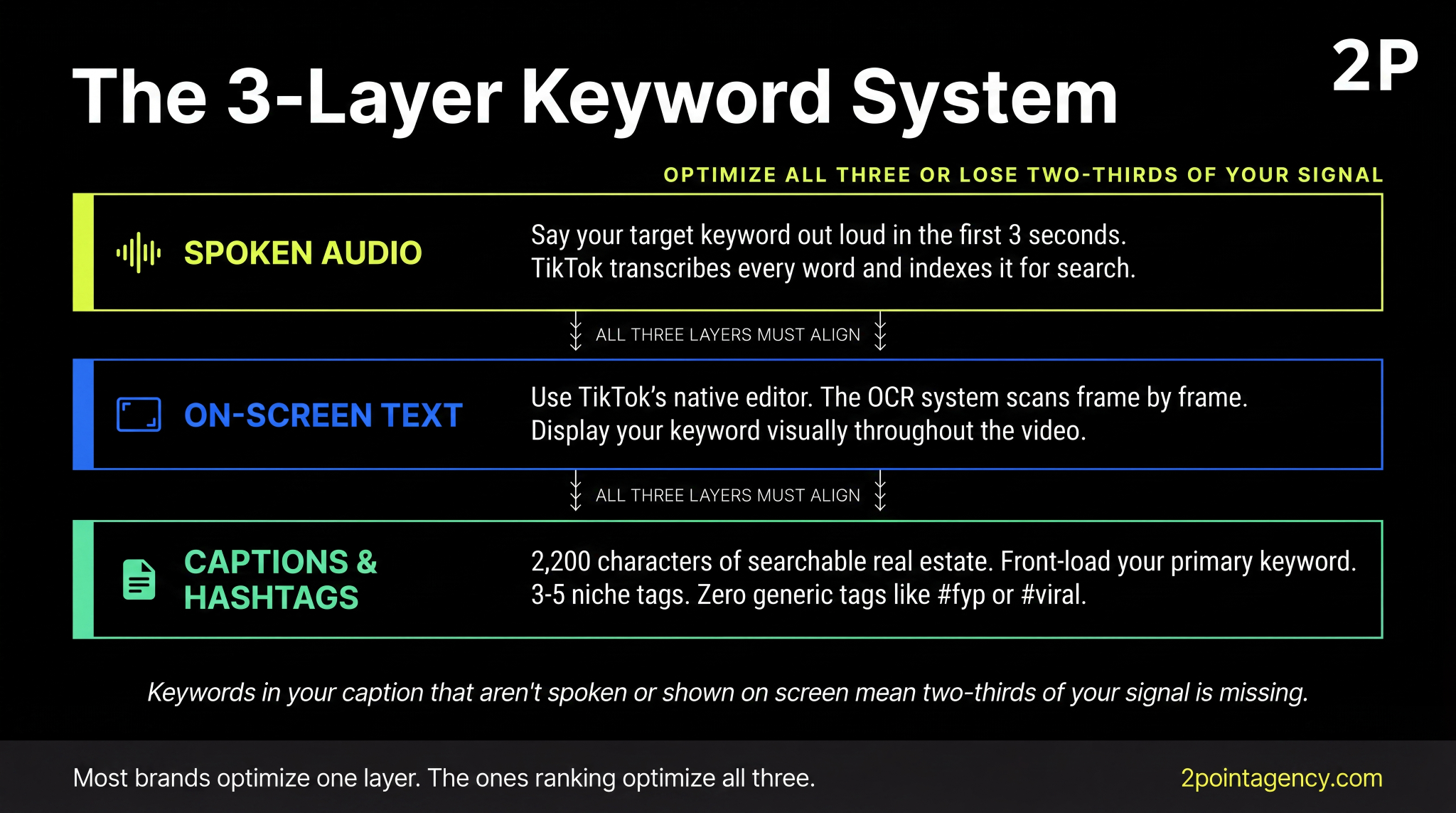
Content signals determine what your video is about. They’re how TikTok matches your content to the right searches, making them central to TikTok keyword optimization. TikTok reads your content three ways: spoken audio, on-screen text via OCR, and captions.
Here’s how to optimize each one:
Authority signals are tiebreakers. When two videos match equally in terms of retention and content, these are what determine the TikTok search ranking.
Three things build authority over time. Keep your bio keyword-rich and niche-specific. Post 3-5 times per week, because TikTok resets your distribution momentum when you go quiet. And engage within your niche.
How you interact with content directly trains how TikTok categorizes your account.
Here’s the part most brands miss: follower count is not a ranking factor. A new account with optimized content can outrank an established one. For brands on TikTok Shop, that’s a real advantage.
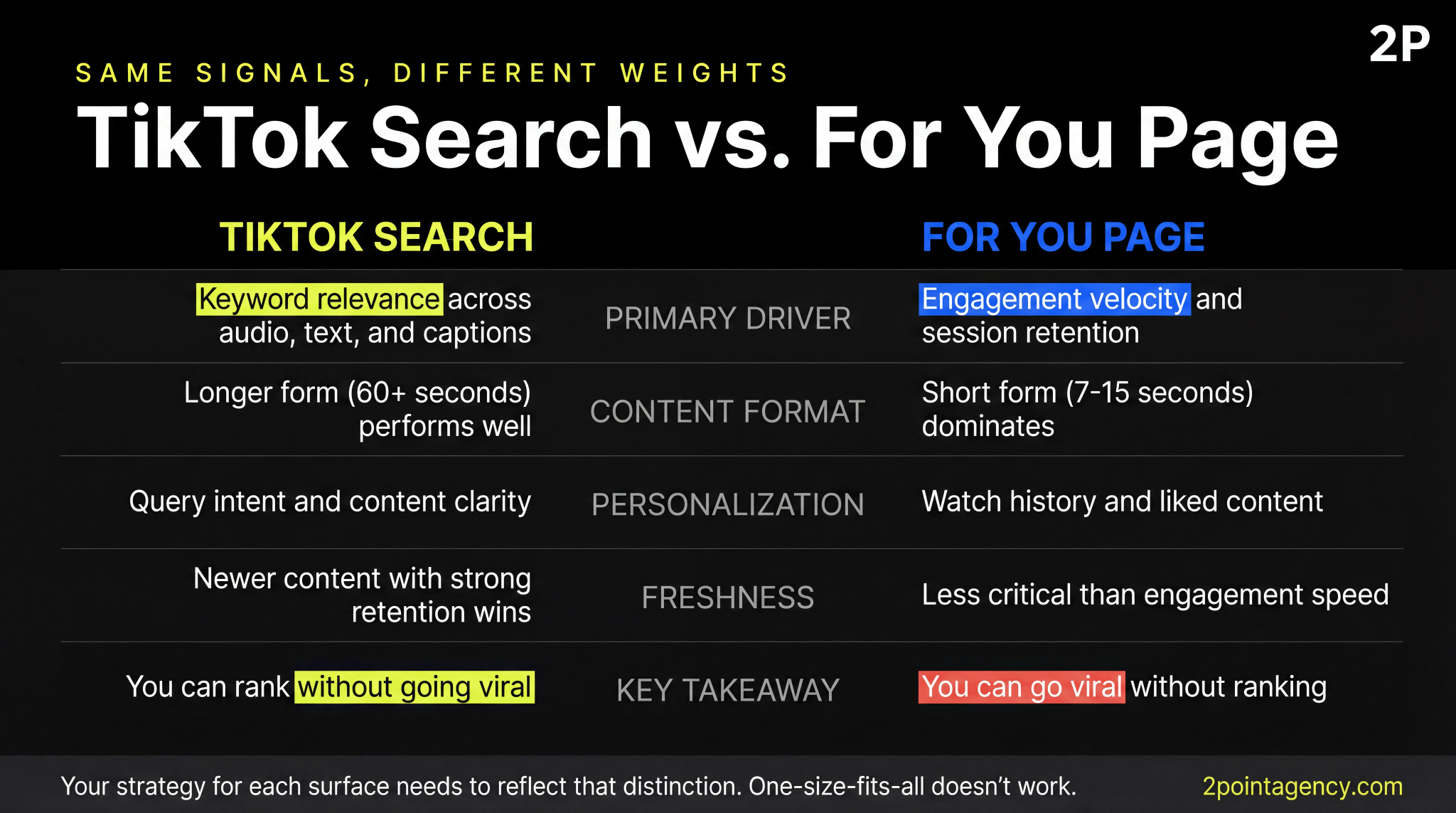
Both systems use the same underlying TikTok algorithm ranking signals but weight them differently, and understanding TikTok search vs For You Page differences is essential to building the right TikTok SEO strategy.
| Signal | For You Page | TikTok Search |
| Primary driver | Engagement velocity | Keyword relevance |
| Content format | Short-form (7 to 15 seconds) | Long-form (60+ seconds) |
| Personalization | Watch history, liked content | Query intent and content clarity |
| Freshness | Less critical | Newer content with strong retention wins |
| Session behavior | Does the user keep scrolling? | Newer content with strong retention wins |
The practical difference matters more than most teams realize. You can rank in TikTok search without going viral on the FYP. Search ranking rewards TikTok keyword optimization and relevance.
FYP ranking rewards engagement and entertainment. Your strategy for each surface needs to reflect that distinction.
The same logic applies across every search platform you operate on. Just as AI search and traditional SEO reward fundamentally different signals despite overlapping foundations, TikTok search and the FYP require platform-specific optimization rather than a one-size-fits-all approach.
Finding the right keywords is where your TikTok SEO strategy actually starts. Five methods worth knowing:
A repeatable process for every video you publish:
Pre-production: Research your target keyword using Creator Search Insights. Study the top three ranking videos for that keyword and note their format, length, and hook structure. Plan keyword placement across all three text layers before you record anything.
Hook (first 2 to 3 seconds): Say the target keyword out loud and display it as on-screen text. This double-signals relevance to TikTok’s audio transcription and OCR systems simultaneously.
Video body: Deliver clear, specific value without filler. For tutorial content, show the result upfront to hook viewers, then walk through the process after.
Loop structure: Design your ending to connect back to the beginning so viewers naturally rewatch. A seamless loop boosts both completion rate and rewatch rate, the two strongest TikTok algorithm ranking signals.
Caption: Front-load your primary keyword in the first line. Write 100 to 200 words of descriptive, keyword-rich text with 2 to 3 secondary keywords woven in naturally.
Hashtags:
Every tag in your TikTok hashtag strategy should accurately describe your content, not just attract volume.
Post-publish: Respond to every comment in the first hour and create reply videos to popular comments. Engagement velocity in the first 60 minutes directly determines whether you pass the spark phase.
Knowing what boosts your visibility is half the equation. The other half is knowing what kills it.
You can’t improve what you’re not tracking. These are the metrics that tell you whether your TikTok SEO strategy is actually working.
TikTok’s native analytics is your starting point. It tracks watch time, completion rate, and traffic source breakdown. Pay close attention to the “Search” traffic source. It shows exactly how many views came from TikTok search ranking versus FYP versus profile visits, giving you real multi-channel reporting clarity.
From there, track search impressions. Compare impressions against views to calculate your TikTok search CTR and identify which keywords are driving traffic versus which are just getting seen.
For competitive analysis and deeper keyword tracking, third-party tools like Exolyt, TokTrak, and Pentos fill the gaps that native analytics can’t.
Two benchmarks to set now. According to Sprout Social, Search should drive at least 10% of your views. Anything below that means your content isn’t ranking. And your completion rate should consistently clear 70%. That’s where search distribution makes a meaningful difference. Track both every week.
Most brands lose TikTok search ranking not because of bad content, but because of avoidable mistakes. These are the ones that show up most often:
Most brands sitting on TikTok without a search strategy aren’t just missing views. They’re handing competitors category keywords. Here’s how to know which approach fits where you are right now:
| In-House | Agency | |
| Content pipeline | Already producing TikTok videos consistently. | No pipeline yet or inconsistent output. |
| Keyword knowledge | Someone understands keyword research fundamentals. | Little to no search optimization experience. |
| Posting capacity | Can commit to 3-5 search-optimized posts per week. | Struggling to maintain a regular cadence. |
| Current results | Getting some search traffic already. | Videos get views but zero search traffic. |
| Strategy scope | TikTok-focused is enough for now. | Need TikTok, Google, and AI search working together |
In-house works when the fundamentals are already in place.
But most brands aren’t there yet, and the gap between posting on TikTok and actually ranking on it is wider than it looks. Keyword research, content structure, retention engineering, and multi-channel integration take time to build from scratch.
That’s where an agency makes the difference. 2POINT builds TikTok search strategies alongside Google and AI search optimization so your brand shows up where your audience is already searching. If you’re invisible on TikTok search for your category keywords right now, your competitors aren’t.
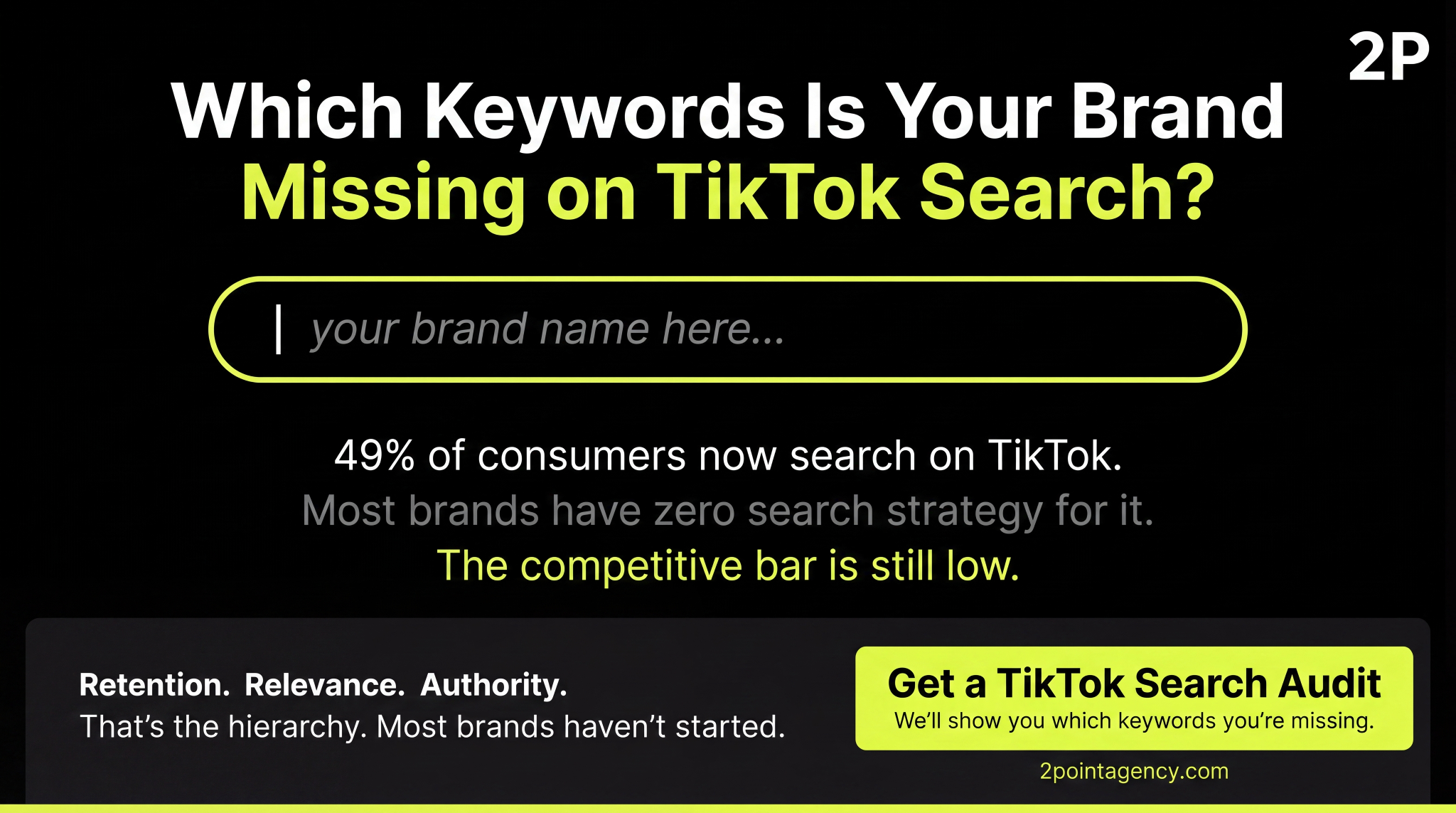
The hierarchy is clear. Retention, relevance, authority. Most brands haven’t optimized for any of it, which means the competitive bar is still low. Apply these TikTok SEO ranking factors now, before that window closes.
2POINT runs search visibility across TikTok, Google, and AI platforms. If you need it working together, that’s multi-channel.
Follower count is not a direct TikTok search ranking factor. TikTok evaluates each video independently based on completion rate, keyword relevance, and content quality. A new account with strong TikTok video optimization can outrank established accounts if the content better matches the search query.
The optimal TikTok hashtag strategy uses 3-5 niche-specific tags per video. Each tag should directly describe your content. Avoid #fyp and #viral since they carry zero search signal and dilute topical relevance. One trending tag paired with 2-3 evergreen category tags works best.
Completion rate leads every other signal in the TikTok completion rate algorithm. Videos watched to the end get prioritized above all other engagement metrics. Clearing the 70%+ threshold triggers algorithmic boosting across both TikTok search ranking and the For You Page.
TikTok search vs For You Page ranking uses overlapping signals weighted differently. Search prioritizes keyword relevance across audio, on-screen text, and captions. The FYP prioritizes engagement velocity and personalization. You can rank in TikTok search without going viral, making it a distinct discovery channel worth optimizing separately.
TikTok keyword optimization works across three layers simultaneously. Audio transcription indexes spoken words, OCR scans on-screen text, and caption parsing reads written keywords. Placing your target keyword across all three layers maximizes your search relevance signal and strengthens your overall TikTok SEO strategy.
The boost threshold for TikTok search ranking sits at approximately 70%+ completion in 2026, up from around 50% in 2024. Build your TikTok video optimization around strong hooks, tight pacing, and loop structures that keep viewers watching through to the end.
Yes. The TikTok algorithm ranking signals evaluate content quality per video, not account age. Knowing how to rank on TikTok search comes down to keyword placement across all three text layers, strong completion rates, and consistent posting to build topical authority from day one.

Most businesses investing in SEO can’t answer one question: Is it actually working? The problem is not the investment itself. SEO ROI is measurable, but only if you know where to look and what to connect. Traffic going up means nothing if revenue stays flat.
Most San Diego businesses are sitting on an underused asset: their email list. Social media reach keeps declining. Ad costs keep climbing. But email delivers a direct line to people who already opted in to hear from you.
A single click in San Diego's legal market can cost $200 or more. With every practice area saturated by firms fighting for the same clients, choosing the wrong agency wastes budget and costs you cases.

© 2POINT, INC 2026
(c) 2POINT, INC 2026

 let’s connect



