

 let’s connect


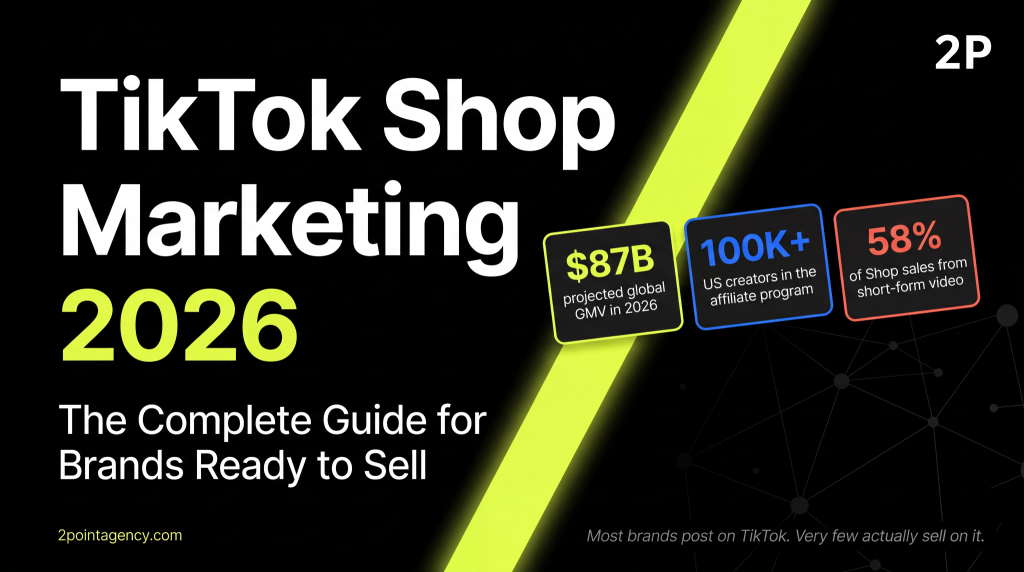
Most brands are posting on TikTok. Very few are actually selling on it.
The gap between the two is TikTok Shop, and it is wider than most marketing teams realize. Someone watches a creator demo a product, taps a pinned link, and completes the purchase without ever leaving the app.
That is TikTok Shop marketing in 2026, and it is reshaping how brands plan social budgets, creator partnerships, and fulfillment operations
The brands winning here understand how to sell on TikTok Shop through affiliates, LIVE events, and Shop Ads, working in sync. 2POINT built this playbook for brands ready to close that gap.
Key Takeaways
- TikTok Shop is the in-app marketplace where users discover, watch, and buy without leaving TikTok, making it the defining social commerce 2026 channel where content and checkout exist in the same feed.
- TikTok Shop reached roughly $66 billion in GMV in 2025 and is projected to top $87 billion in 2026, making it one of the fastest-scaling commerce channels in the world.
- A winning TikTok Shop strategy runs on four pillars: creator-led content, LIVE shopping, the TikTok Shop affiliate program, and TikTok Shop ads working together.
- TikTok Shop captures discovery demand while Amazon captures intent demand. The playbooks differ on creative format, measurement windows, and margin structure.
- Brands like Tarte, Crocs, and Pacsun have shown that creator-first content combined with LIVE events drives the highest conversion volume on Shop.
- Whether to run TikTok Shop in-house or with an agency comes down to SKU count, creator volume, paid scale, and your team's existing TikTok experience.
What Is TikTok Shop and Why It Matters in 2026
TikTok Shop Defined
TikTok Shop is the in-app marketplace built directly inside TikTok, where shoppers browse a catalog, watch creators demo products, and check out without ever switching apps. That last part matters more than it sounds.
Every extra tap between curiosity and purchase costs you real conversion, and TikTok Shop collapses that distance to almost zero.
You can reach Shop through three entry points:
- Shop Tab: Works like a curated marketplace homepage inside the app
- Shoppable in-feed videos: Product tags pinned directly onto clips as users scroll
- LIVE Shopping sessions: Creators host real-time events where viewers tap pinned products as the host demos them live
According to eMarketer, TikTok Shop now makes up nearly 20% of all US social commerce, with the category as a whole hitting $87 billion in 2025. That is not a niche channel. It is the dominant player, and the growth is accelerating.
Why 2026 Is the Year Brands Take It Seriously
Many brands sat out 2024 and early 2025 waiting to see if TikTok Shop would stick. It has.
The algorithm now actively rewards shoppable content over passive brand videos, meaning posts linked to Shop listings get more distribution than those without. Fulfilled by TikTok handles warehousing and shipping across major US categories reliably, with 14+ fulfillment centers and three-day delivery on eligible products.
And over 100,000 US creators are now enrolled in the TikTok Shop affiliate program, actively seeking products to promote for commission.
Beauty leads adoption, with apparel, supplements, and home goods close behind. If you operate in any of those verticals and still treat TikTok purely as an awareness channel, you are handing real purchase volume to competitors who made the switch earlier. That distance compounds every quarter.
TikTok Shop vs Amazon: How the Playbooks Actually Differ
You cannot port your Amazon playbook to TikTok Shop and expect it to work. Both channels end at checkout, but the mechanics underneath are completely different.
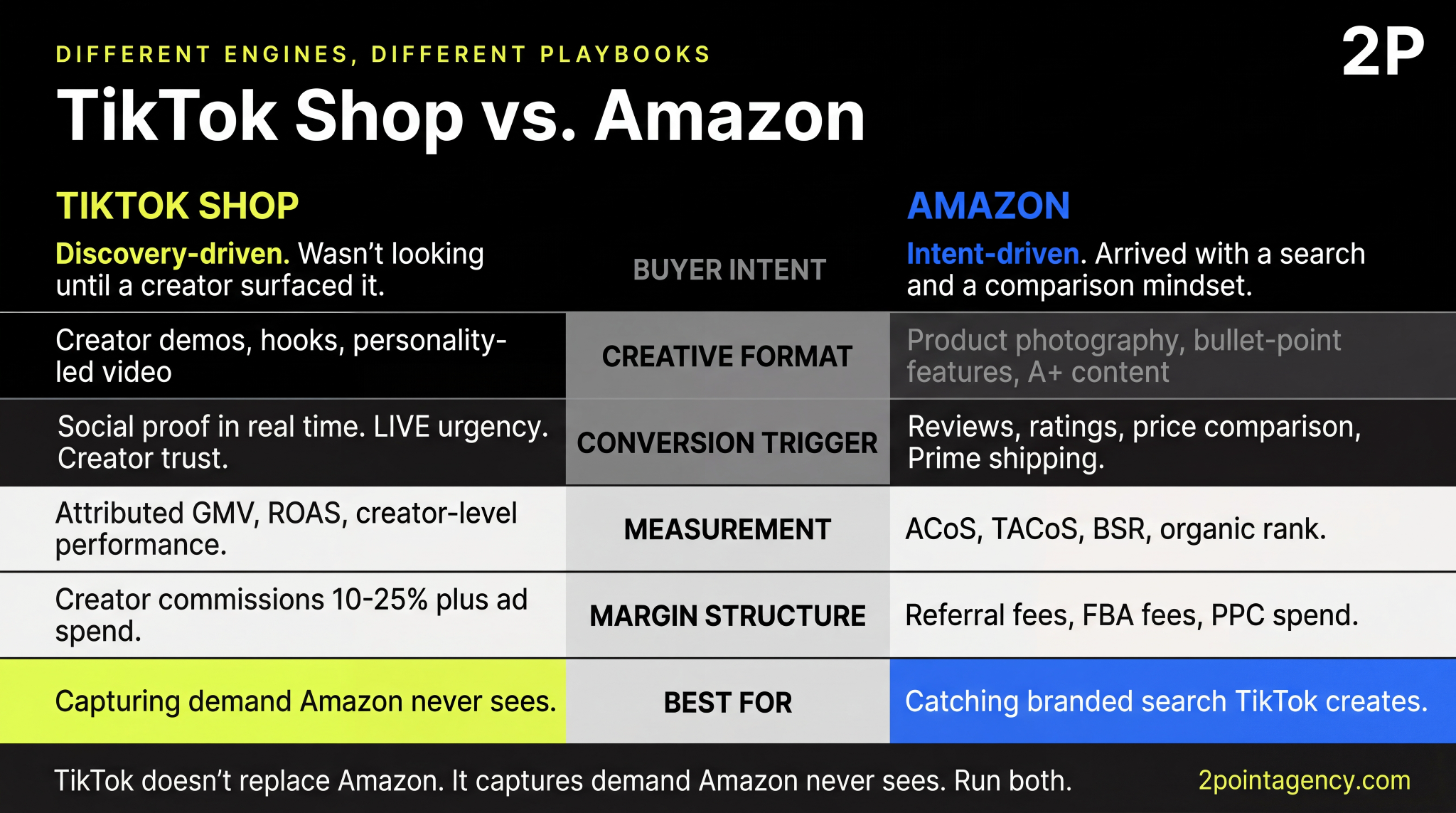
The TikTok Shop vs Amazon comparison starts with intent. Amazon is intent-driven. Shoppers arrive with a problem defined, a search bar ready, and a comparison mindset. TikTok Shop is discovery-driven. Shoppers weren't looking for your product until a creator surfaced it in an entertaining video.
That difference cascades into everything else. Creative on Amazon means product photography and bullet-point features. Creative on TikTok Shop means a creator hooks the viewer in within 2 seconds and demos the product like they are showing it to a friend.
Marketing Dive noted that brands like Pacsun have sold over 100,000 units of a single product, driven entirely by creator content on Shop.
TikTok Shop does not replace Amazon for most brands. It complements it. TikTok captures demand Amazon never sees, while Amazon catches the branded search that TikTok creates downstream.
The Four-Pillar TikTok Shop Marketing Playbook
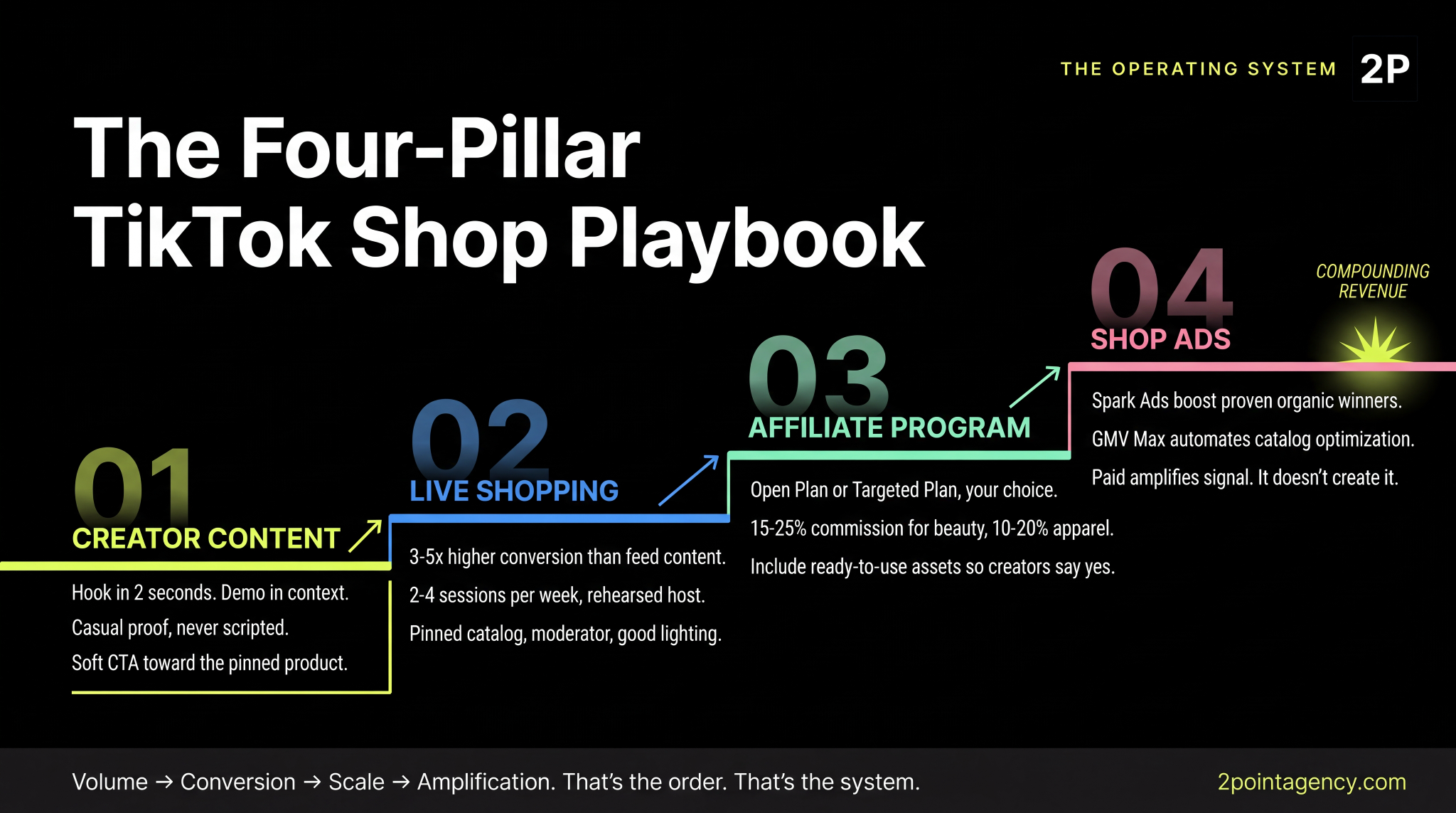
This is the strategic core of what you need to run TikTok Shop well. A complete TikTok Shop rests on four pillars working together. Skip one, and the others underperform.
Run all four in coordination, and you build something that compounds month over month.
Pillar 1: Creator-Led Content
The fastest lesson brands learn on TikTok Shop is that your polished brand content rarely outperforms a creator filming on a phone in a bedroom. TikTok rewards content that feels native to the feed, and feed-native content almost always means creator-led.
Briefing creators well is where most brands stumble. The creators producing winners on Shop follow a tight pattern:
- Hook in the first two seconds: A strong visual or a contrarian claim that stops the scroll
- Demo in context: Show the product solving a real problem that the viewer can picture themselves having
- Casual social proof: A brief mention of reviews or personal results, never scripted
- Soft call to action: A natural nudge toward the pinned product link, not a hard sell
Brief creators against that structure, and your content improves immediately. Building that creator bench is exactly what TikTok influencer marketing comes down to in practice.
Pillar 2: LIVE Shopping
LIVE Shopping is where TikTok Shop separates itself from every other commerce platform.
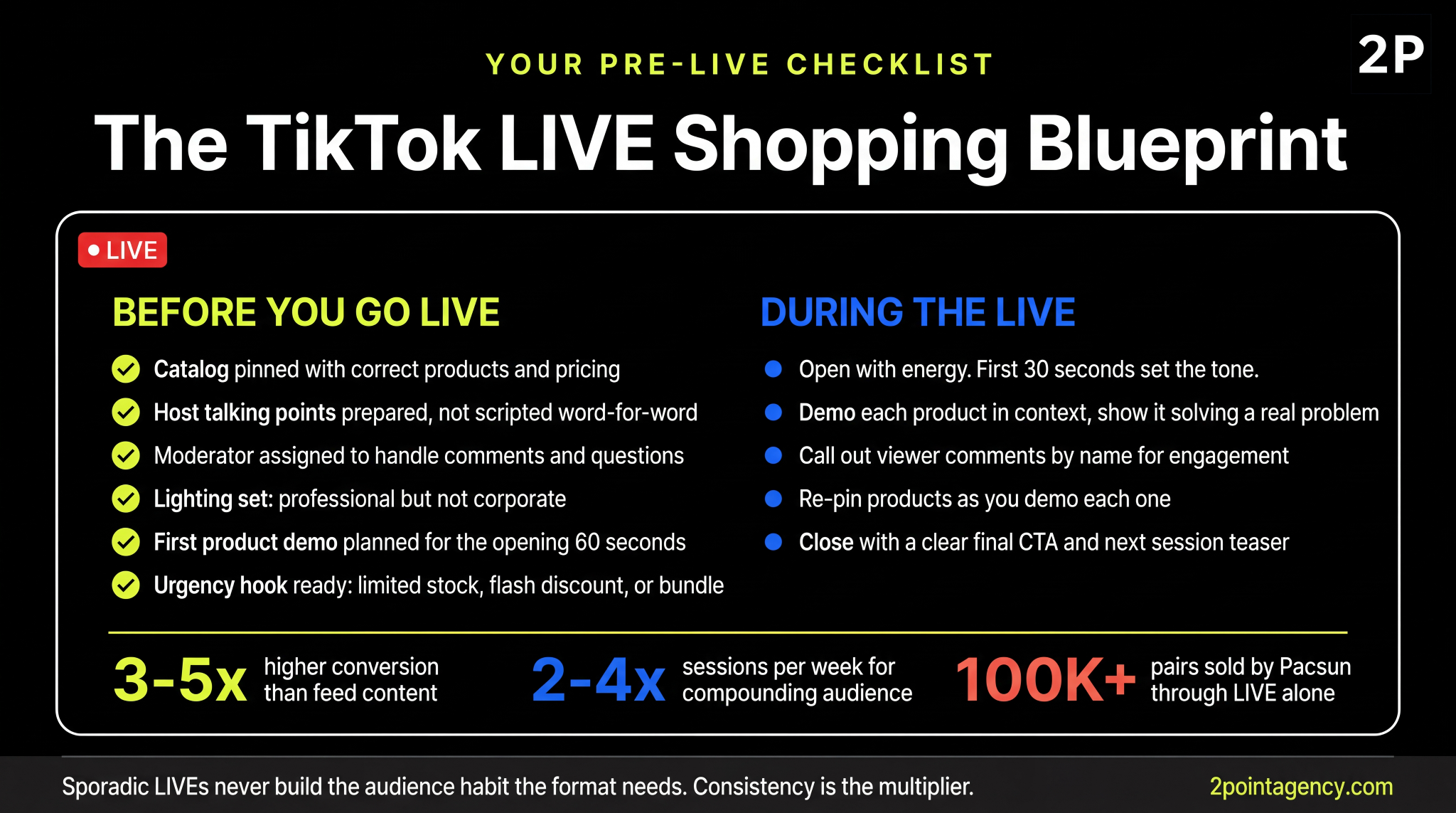
A LIVE session is a real-time broadcast where a host demos products on camera, and viewers tap pinned items to buy them immediately. The conversion rate inside a well-run LIVE often runs three to five times higher than feed content, because live urgency combined with real-time social proof creates a buying environment that nothing else replicates.
Cadence matters more than most brands expect. The ones seeing real revenue typically run two to four sessions per week, sometimes daily during launch periods. Sporadic LIVEs never build the audience habit the format needs to compound.
Your pre-LIVE checklist should cover pinned catalog, host talking points, a moderator handling comments, and lighting that signals professionalism without looking corporate. TikTok LIVE Shopping rewards hosts who treat every session like a rehearsed performance, not a casual stream.
Pillar 3: The TikTok Shop Affiliate Program
The TikTok Shop affiliate program is the most underused lever in TikTok Shop strategy, and brands taking it seriously are building an army of creators promoting their products on commission. You have two routes inside the program:
- Open Plan: Any approved creator can pick your product from the catalog and start promoting without direct outreach
- Targeted Plan: You invite specific creators with custom commission rates, better suited for established relationships and higher-priced products
Commission benchmarks vary by category. Beauty and supplements typically run 15-25%. Apparel sits closer to 10-20%. Pricing below your category benchmark is the single most common reason your product isn't being promoted.
Two quick fixes most brands miss: include ready-to-use video assets so creators don't have to shoot from scratch, and enable whitelisting so you can boost winning posts later with Spark Ads.
Pillar 4: TikTok Shop Ads (Spark Ads + GMV Max)
Your TikTok Shop ads strategy runs on two formats working together. According to Dataslayer's TikTok Shop analysis, 58% of US TikTok Shop sales come from short-form videos, which is exactly what your paid TikTok Shop ads strategy should be amplifying.
The two formats to know:
- Spark Ads: Boost organic creator content that has already proven itself in the feed, scaling posts with built-in real social proof.
- GMV Max: TikTok's automated Shop Ads product that optimizes for gross merchandise value across your catalog without manual audience building.
GMV Max works best once organic creator content is already proving a signal. Turn it on cold, and it usually disappoints. Turn it on after consistent organic volume, and it delivers.
The graduation rule for your TikTok Shop strategy: build three to five organic winners first, boost them through Spark Ads, then layer GMV Max once your creative library is deep enough to feed it. Working with a TikTok marketing agency that runs paid and organic together is what makes this playbook scale.
How to Set Up TikTok Shop: A Step-by-Step Walkthrough
Setting up a TikTok Shop for brands is more bureaucratic than technical. Eligibility in 2026 covers the US, UK, several Southeast Asian markets, and a growing list of European countries.
Before you apply, make sure you have:
- A registered business entity and tax documentation
- Banking information tied to your business
- Proof of inventory or supply capability
Verification takes anywhere from two days to two weeks, depending on your product category.
Catalog upload supports manual entry, CSV import, and direct Shopify integration, which automatically syncs your listings, inventory, and orders. Most brands take this route for speed.
Linking your TikTok Business account is the step most brands delay, and should not.
Without it, you cannot run TikTok Shop ads, whitelist creator content for Spark Ads, or maintain unified reporting. Do it immediately after verification clears. Knowing how to sell on TikTok Shop starts with getting this infrastructure right before anything else.
Real Brand Examples That Actually Work
Three brands keep coming up in trade coverage as the clearest examples of TikTok Shop done right.
Tarte Cosmetics built a creator-first model around long-term relationships rather than reach-only influencers, treating creators as extended sales channels with their own audiences rather than as one-off media buys.
Crocs is currently the number one footwear brand on TikTok Shop in the US, according to Retail Dive, by leaning into creator-driven content that feels like cultural commentary rather than product marketing.
Pacsun sold over 100,000 pairs of a single jean style and nearly half a million pairs through TikTok livestreaming alone, treating each LIVE session like a product drop with built-in urgency. The pattern across all three is the same: consistent presence, trusted creators, and TikTok content strategy treated as a serious revenue channel.
Common TikTok Shop Marketing Mistakes to Avoid
Most failed TikTok Shop marketing launches do not fail because the platform is broken. They fail because of avoidable mistakes that compound quickly. In social commerce 2026, the margin for error is thinner than ever.
The five mistakes worth knowing before you launch:
- Treating it like an Amazon listing: Static photos and bullet points do not work on a video-first platform. Your audience scrolls past anything that looks like a product page.
- Underpaying affiliate commissions: If your category benchmark is 20% and you offer 8%, creators promote competitors instead.
- Skipping LIVE Shopping: It is the highest-converting format on Shop. Hire a host if your team will not do it.
- No creator assets: Make it easy for creators to promote you by handing over hooks, talking points, and approved brand materials.
- Fulfillment failures at launch: TikTok weights review volume heavily in product surfacing. A bad first week tanks your visibility for months.
Knowing how to sell on TikTok Shop well starts with avoiding these before launch, not learning them the expensive way.
In-House vs Agency: Who Should Run Your TikTok Shop?
This is the question every brand eventually has to answer, and the right call depends entirely on your situation.
| Factor | In-House | Agency |
| SKU count | Under 20 | 20+ |
| Active creator partnerships | Under 15 | 15+ |
| Monthly paid spend | Under $10,000 | $10,000+ |
| TikTok experience | 12+ months in-house | Under 12 months |
| LIVE production | Founder or team member on camera | Dedicated host and producer |
| Creator network | Building from scratch | Existing relationships and benchmarks |
Most brands hit the agency threshold faster than they expect. Multi-creator coordination, weekly LIVE production, paid scaling beyond $10,000 monthly, and managing a growing SKU catalog are all functions that overwhelm a small in-house team quickly.
Agencies bring creator networks, cross-brand benchmarks, and paid expertise that take years to build internally.
Founder-led brands with strong personalities can lead early creative. But as volume grows, the gap between what you can run in-house and what an experienced TikTok agency can deliver widens fast. We offer a no-pressure TikTok Shop audit to give you a clear picture of where your current setup stands.
The 2026 Outlook for TikTok Shop
Statista projects TikTok Shop GMV will reach $87 billion or more globally in 2026.
According to Retail Dive, TikTok Shop's US sales are forecast to exceed $20 billion this year, with half of all US social shoppers projected to make a purchase on TikTok. Beauty leads by category, apparel is close behind, and home goods are growing fast as creators expand into lifestyle content.
Regulatory uncertainty in the US has stabilized, and brands are allocating budget to Shop with more confidence than they were 18 months ago.
Algorithm and policy changes are inevitable on any platform this large. The principle worth internalizing is that your four pillars stay constant even when tactics shift. Build your operating system around creator content, LIVE Shopping, the affiliate program, and Shop Ads, and the adjustments become minor rather than disruptive.
Are You Treating TikTok Like a Serious Revenue Channel Yet?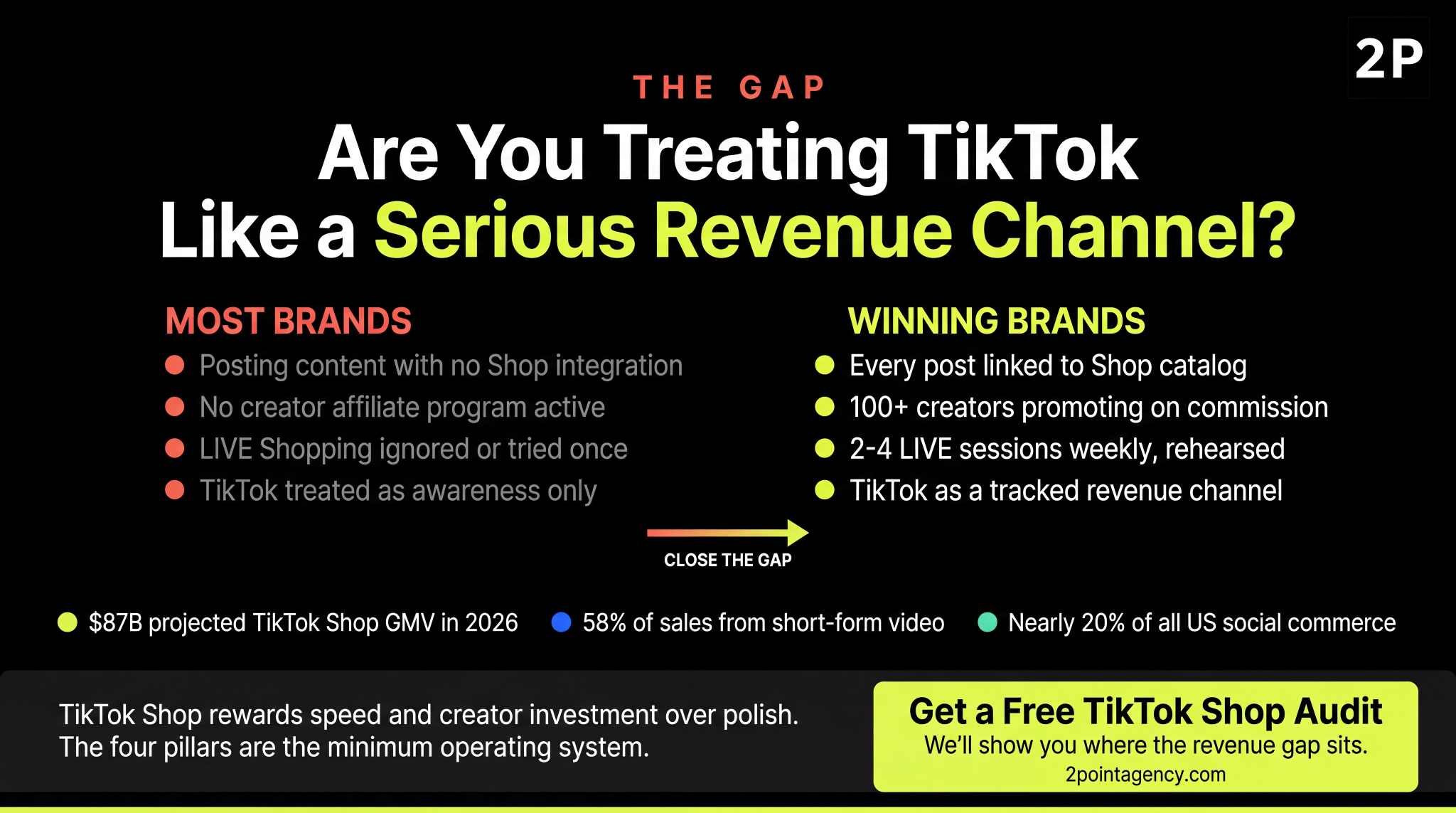
TikTok Shop marketing in 2026 rewards speed and creator investment over polish. The four pillars covered above are the minimum operating system every serious TikTok Shop strategy needs running together. Creator-led content brings the volume.
LIVE Shopping brings the conversion. The TikTok Shop affiliate program brings the scale, while TikTok Shop ads bring the amplification.
2POINT helps brands build and scale their TikTok presence the right way.
FAQs About TikTok Shop Marketing
What is TikTok Shop marketing?
TikTok Shop marketing is the practice of driving discovery and sales inside TikTok's in-app marketplace. It blends creator-led content, LIVE shopping events, the affiliate program, and paid Shop Ads so brands convert viewers into buyers without asking them to leave the app.
How big is TikTok Shop in 2026?
TikTok Shop reached roughly $66 billion in global GMV during 2025 and is projected to top $87 billion in 2026. Beauty, apparel, supplements, and home goods lead in social commerce 2026, with the US among the fastest-growing markets.
How do I start selling on TikTok Shop?
Apply through TikTok Seller Center, verify your business documents, upload your catalog or sync via Shopify, and link your TikTok Business account. Recruit affiliates and publish shoppable content immediately at launch. Knowing how to sell on TikTok Shop well starts with this infrastructure.
Is TikTok Shop better than Amazon?
A TikTok Shop vs. Amazon comparison is not a direct comparison. Amazon captures intent-driven search demand. TikTok Shop captures discovery demand from people not actively shopping. Most successful brands run both, with TikTok driving awareness and Amazon catching the branded search that follows.
How does the TikTok Shop affiliate program work?
Brands set commission rates and choose between Open Plan, where any approved creator can promote, or Targeted Plan, where you invite specific creators directly. You only pay when sales happen. Strong commissions plus ready-made assets drive the most consistent affiliate volume.
How much should I budget for TikTok Shop ads?
Smaller brands can validate TikTok Shop ads with a monthly spend of $1,000-$3,000. Mid-market brands scale into $5,000 to $15,000 once winning creative emerges. Larger brands running launches push past $25,000 monthly, with ROAS and attributed GMV as the metrics that matter.
Should I hire a TikTok Shop agency?
Bring in agency support for your TikTok Shop strategy when you need multi-creator coordination, weekly LIVE production, monthly paid spend above $10,000, or a catalog exceeding 20 SKUs. Most TikTok Shop for brands' operations hit a ceiling and bring help in by month six.