

 let’s connect


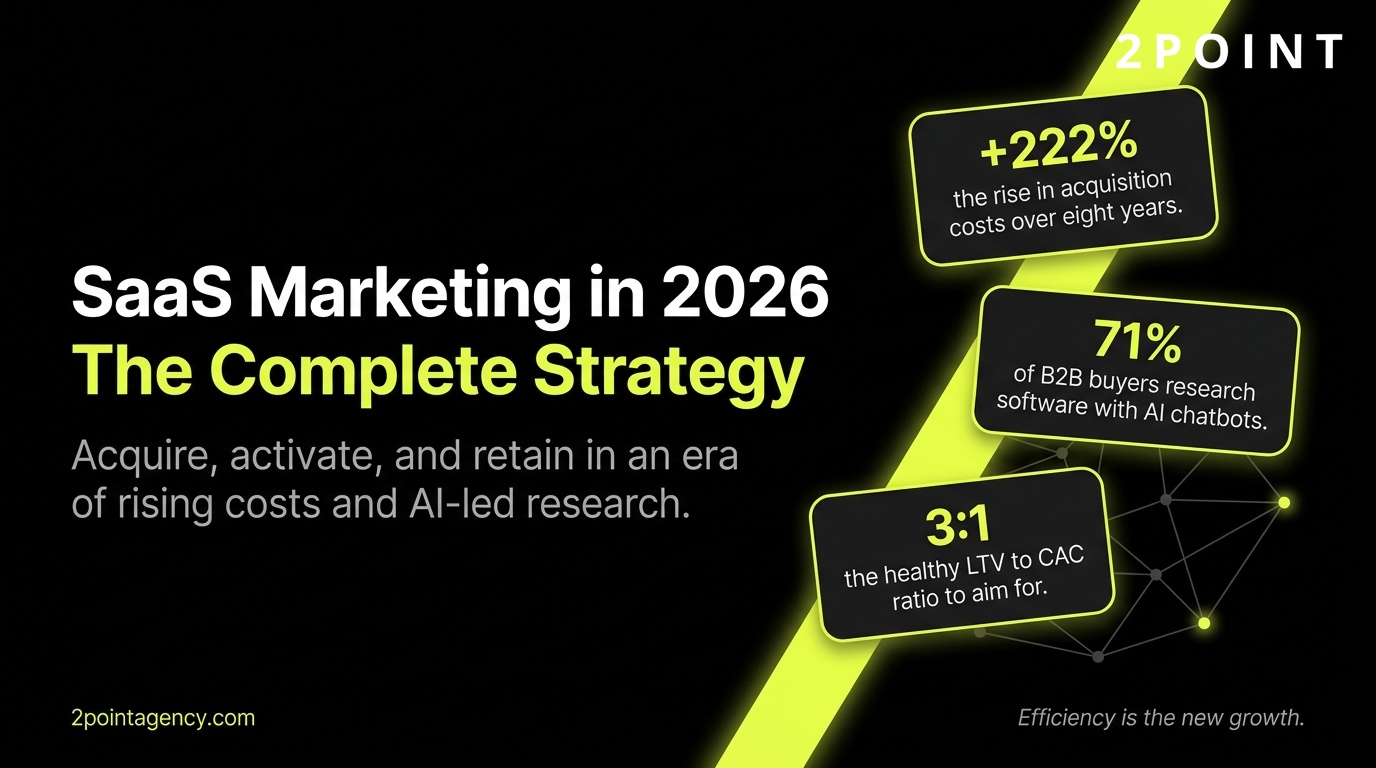
- SaaS marketing is the discipline of acquiring, activating, and retaining software-as-a-service customers through digital channels.
- Customer acquisition costs have surged 222% over the past eight years, forcing a shift from growth-at-all-costs to efficiency-driven strategies.
- 71% of B2B buyers now use AI chatbots to research software purchases before contacting a vendor.
- Successful SaaS marketing in 2026 requires optimizing for both traditional Google search and AI answer engines simultaneously.
- The industry benchmark for a healthy business is a 3:1 LTV:CAC ratio, meaning every dollar spent acquiring a customer should return three dollars in lifetime value.
- Referrals and organic SEO deliver the lowest long-term CAC, while outbound sales remains the most expensive acquisition channel at nearly $2,000 per customer.
- Retention is now a marketing function: existing customers generate 40% of new ARR at the median, and net revenue retention above 106% correlates with 2.5x faster growth.
- Winning SaaS companies in 2026 combine AI automation with authentic human content to cut through buyer fatigue.
The Customer Acquisition Cost Crisis Reshaping SaaS Marketing
No issue defines the current era of SaaS marketing more sharply than the explosion in customer acquisition costs. What was once manageable friction has become a structural challenge that forces every SaaS marketer, founder, and revenue leader to fundamentally rethink where and how they spend their budget. Understanding the forces behind this crisis is not optional reading. It is the strategic foundation everything else rests on.
Why CAC Has Exploded 222% in Eight Years
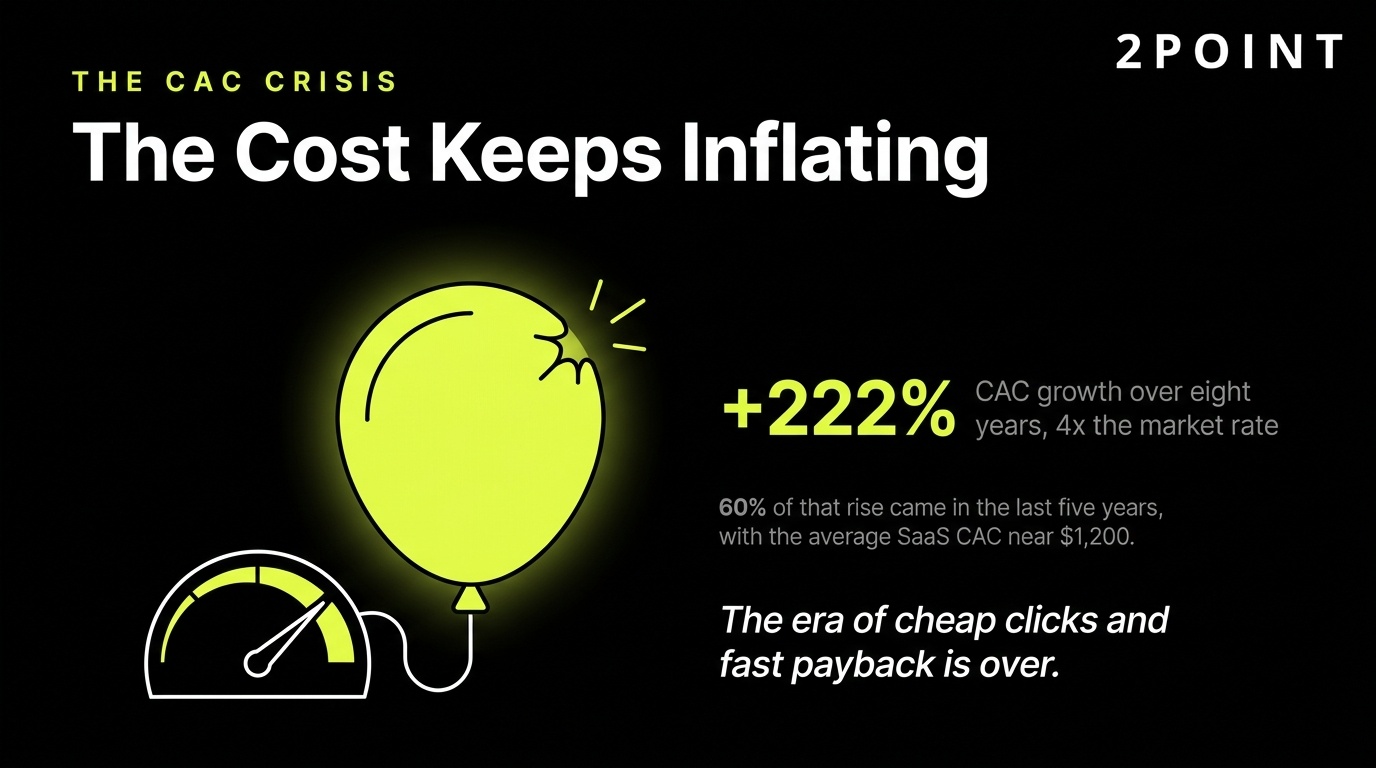
The numbers are stark. Customer acquisition costs in SaaS have surged 222% over the past eight years, with 60% of that increase concentrated in the last five years alone. This is not simply inflation at work. SaaS-specific CAC inflation is running at four times the general market rate, driven by a combination of channel saturation, market maturity, and increasingly sophisticated buyer behavior.
Google, Meta, and LinkedIn have all become dramatically more competitive. As more SaaS companies entered the market through the 2010s and early 2020s, auction-based advertising platforms responded predictably: prices climbed. The cost-per-click on keywords like "project management software" or "CRM platform" has reached levels that make paid acquisition economically unviable for many early-stage companies trying to build from scratch.
Buyer behavior has compounded the problem. The average B2B SaaS sales cycle has stretched to 134 days, up from 107 days in 2022. Buyers are more skeptical, more research-oriented, and more likely to involve multiple stakeholders in a purchasing decision. That means more touchpoints, more content, more sales team hours, and ultimately a higher cost per closed deal.
The average B2B SaaS company now spends approximately $1,200 to acquire a single customer. That figure, while an average across company sizes and verticals, illustrates the scale of the challenge facing anyone building a SaaS business today. The era of cheap clicks and fast payback periods is definitively over.
CAC Benchmarks by Channel: Where to Invest Your Budget
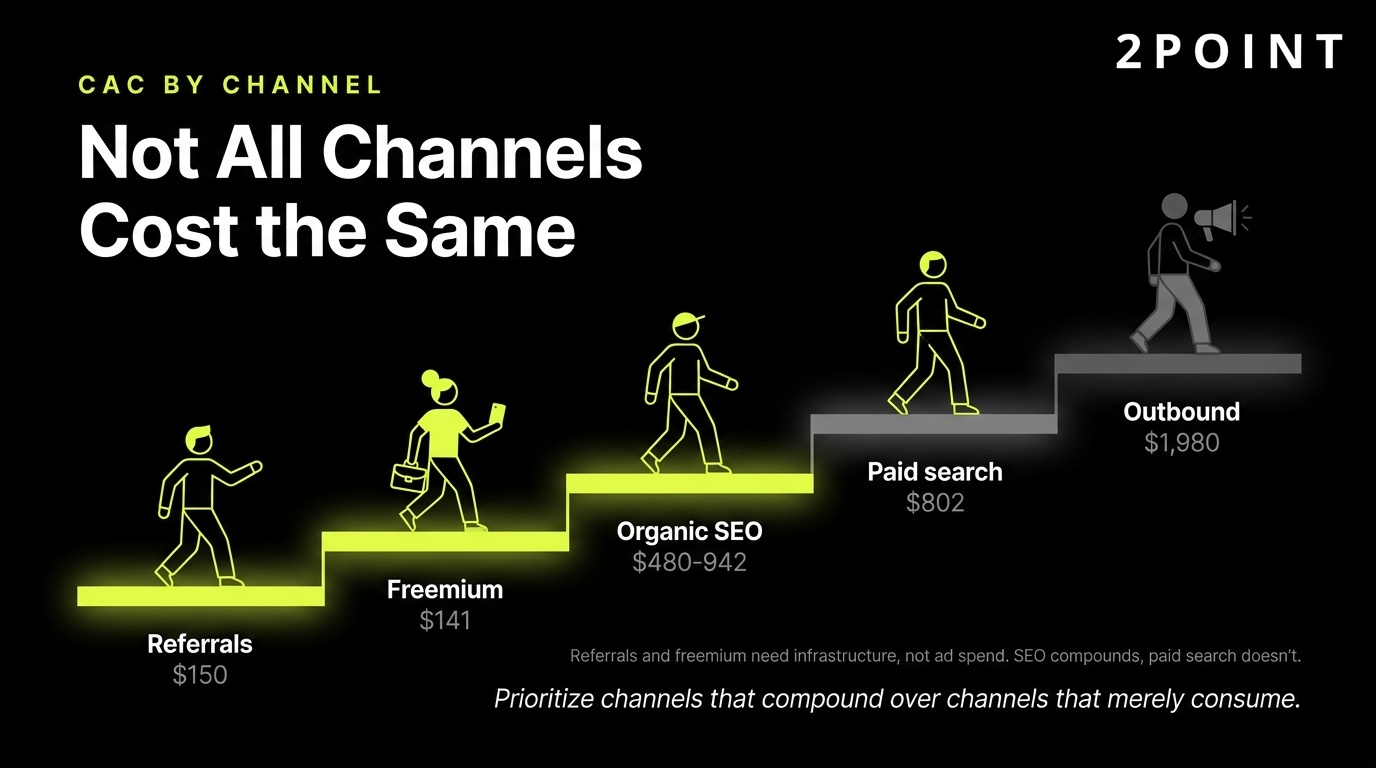
Not all acquisition channels are created equal, and the performance gap between them has never been wider. Understanding channel-level CAC benchmarks is the first step toward allocating budget intelligently rather than reactively. The data reveals a hierarchy that should shape every SaaS go-to-market plan.
| Acquisition Channel | Average CAC | Primary Advantage | Primary Limitation |
|---|---|---|---|
| Referrals | $150 | Lowest CAC, high trust, high conversion | Difficult to scale quickly |
| Freemium / PLG | $141 | Product proves value before purchase | Requires strong activation strategy |
| Organic SEO | $480 to $942 | Compounding returns, best long-term ROI | Slow to build, requires consistency |
| Paid Search | $802 | Scalable, measurable, fast results | High ongoing spend, no compounding |
| Outbound Sales | $1,980 | Targets specific accounts precisely | Most expensive, labor-intensive |
Referrals and freemium represent the most efficient acquisition paths available to SaaS companies, with CAC well below $200. The critical insight is that these channels require investment in infrastructure, not ad spend. Referral programs require structured incentives and systematic follow-up. Freemium models require a product experience strong enough to convert free users into paying customers.
Organic SEO sits in the middle of the cost spectrum, but its compounding nature makes it uniquely valuable. Content created today continues generating leads and customers for years without additional investment. In contrast, paid search delivers results only as long as the budget keeps flowing. The moment you pause campaigns, the pipeline dries up. Building a sustainable SaaS marketing strategy means prioritizing channels that compound over channels that merely consume.
The New Efficiency Metrics Every SaaS Marketer Must Track
In 2026, efficiency metrics have moved from internal reporting preferences to hard covenants embedded in investor term sheets. Venture capital firms and growth equity investors now scrutinize these numbers as closely as revenue growth, and for good reason: a company growing fast while spending recklessly is building on sand.
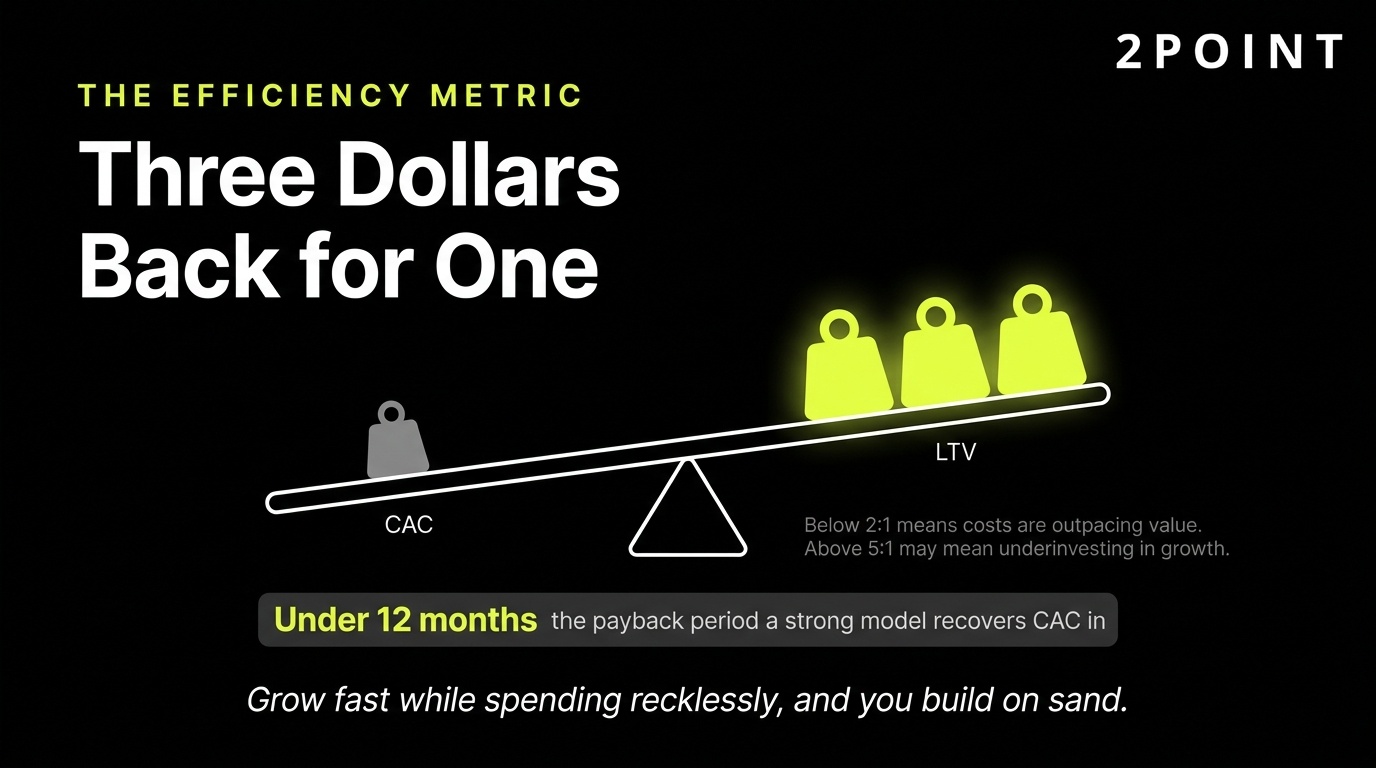
The most important efficiency metric is the LTV:CAC ratio. The target benchmark is 3:1, meaning every dollar invested in customer acquisition should return three dollars in lifetime customer value. Ratios below 2:1 signal that acquisition costs are outpacing the economic value of customers, often indicating misaligned positioning, weak retention, or both. Ratios above 5:1 may signal underinvestment in growth.
CAC payback period, the time required to recover acquisition costs from customer revenue, is the second critical benchmark. A payback period under 12 months indicates a strong acquisition model, while under 18 months remains acceptable for enterprise-focused companies with large contract values. Beyond 18 months, the business faces serious cash flow risk during scaling phases.
The median SaaS company currently spends approximately $2 for every $1 of new ARR acquired. This figure should serve as a reality check for any SaaS marketer building growth projections. Efficient companies bring this ratio closer to $1:$1 through strong organic channels, referral programs, and high retention rates. Inefficient companies can see this ratio climb to $4 or $5 per dollar of ARR, a position that rapidly becomes unsustainable.
Industry-Specific CAC Variations: Enterprise vs. SMB
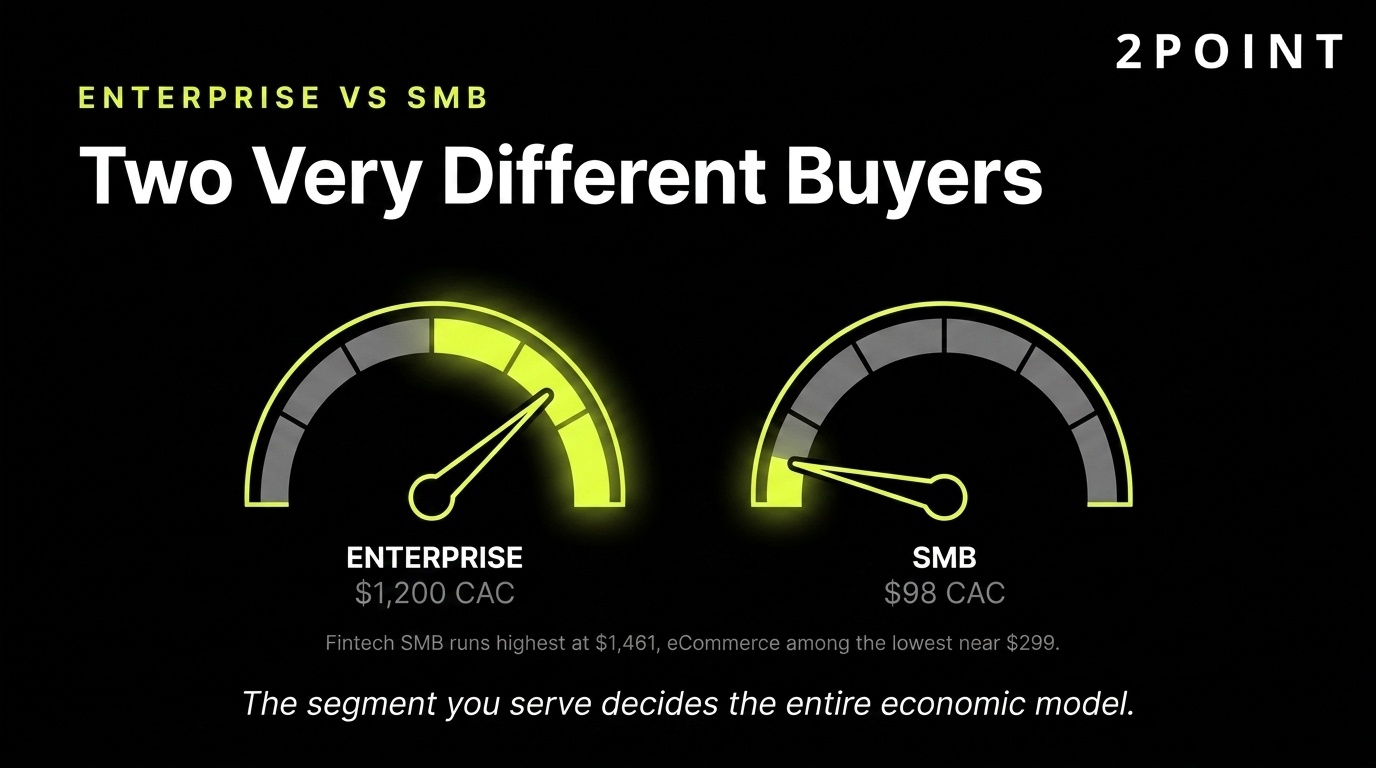
Aggregate CAC figures can be misleading without context. The type of customer a SaaS company pursues determines the acquisition economics more than almost any other variable. Enterprise SaaS companies average $1,200 in CAC, while SMB-focused businesses see a median of just $98. That twelve-fold difference reflects fundamentally different sales motions, not different levels of marketing competence.
Vertical specialization adds another layer of variation. Fintech SaaS companies face the highest SMB acquisition costs at $1,461, driven by regulatory complexity, buyer skepticism, and competitive markets. eCommerce SaaS sees some of the lowest CAC at $299, reflecting stronger product-led growth adoption and a more digitally native buyer base. Healthcare and HR SaaS sit in the middle, with compliance requirements extending sales cycles and elevating costs.
These variations have direct implications for go-to-market strategy. An SMB-focused SaaS company with a $50 monthly price point cannot sustain $500 in CAC and still build a viable business. Enterprise companies with six-figure ACV contracts can justify complex, expensive sales processes because the LTV calculation works in their favor. The most important strategic decision in SaaS marketing is often not which tactics to deploy but which customer segment to serve, because the segment determines the entire economic model.
Understanding your specific CAC by customer segment, not just overall, is the foundation of intelligent budget allocation. Companies that mix enterprise and SMB acquisition without separating the metrics risk making decisions based on blended averages that accurately describe neither population.
How AI Is Transforming SaaS Marketing in 2026
Artificial intelligence has moved from being a useful tool in the SaaS marketer's stack to being the organizing principle of how marketing itself works. This transformation is happening simultaneously on two fronts: inside marketing teams, where AI is automating and optimizing workflows, and inside the minds of buyers, where AI search and research tools are reshaping the purchase journey.
From Generative AI to Autonomous Marketing Agents
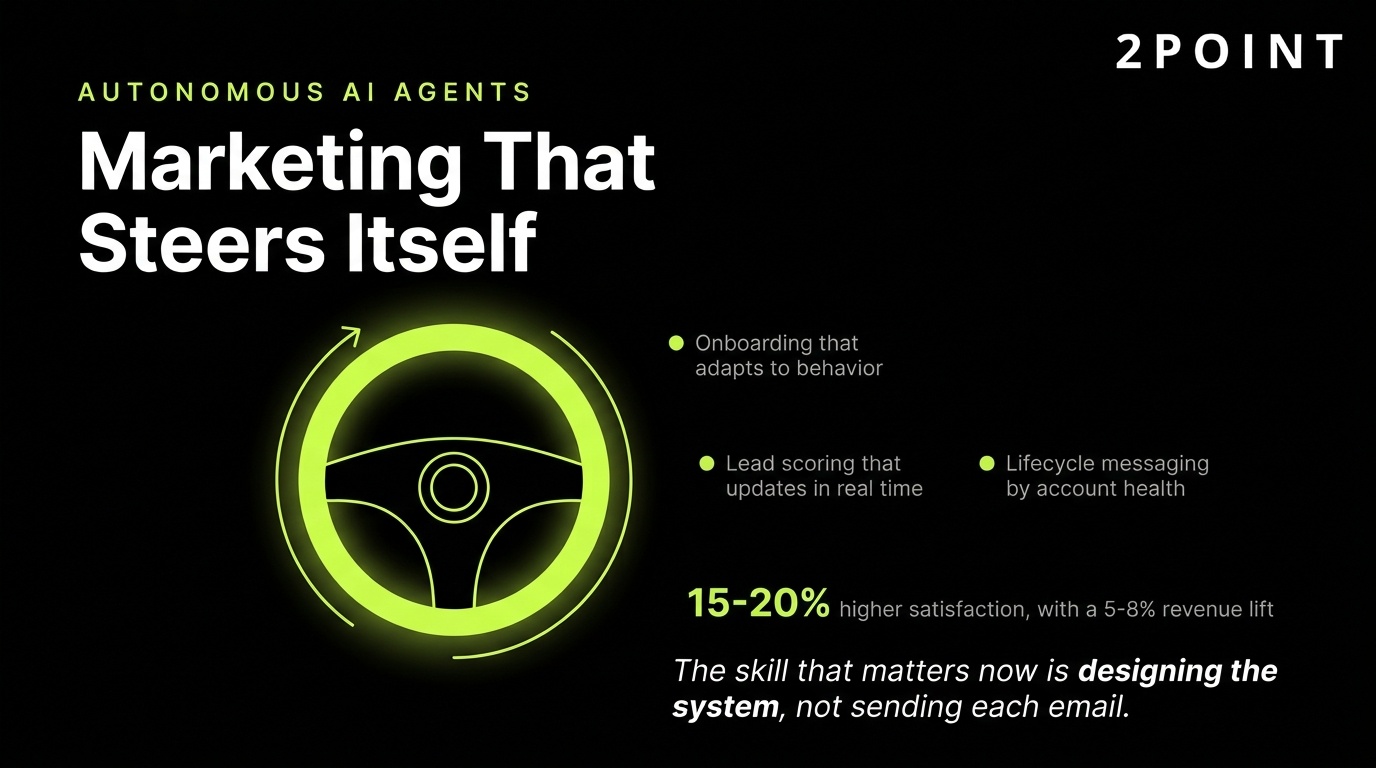
The first wave of AI in marketing was primarily generative: tools that write first drafts, suggest ad copy variations, or generate image concepts. That wave has largely crested. The current and more transformative wave involves autonomous agents that manage entire marketing workflows without requiring human intervention at every step.
These agents can handle onboarding email sequences that adapt based on in-product behavior, lead scoring models that update in real time as prospects engage with content, lifecycle communications that shift tone and content based on account health scores, and partner activation programs that trigger automatically when conditions are met. Gartner projects that 80% of enterprises will have deployed GenAI applications by 2026, a prediction that is already proving accurate as adoption accelerates across mid-market and enterprise segments.
The measurable impact is significant. AI-driven personalization and automation has been shown to raise customer satisfaction scores by 15 to 20% while increasing revenue by 5 to 8%. These are not marginal improvements. For a SaaS company at $5M ARR, an 8% revenue lift from AI-optimized marketing represents $400,000 in additional annual revenue, likely at minimal incremental cost once the systems are built.
The practical implication for SaaS marketing teams is a shift in the skills that matter most. The ability to write every email manually is less valuable than the ability to design agent workflows, interpret behavioral data, and continuously refine the logic that governs autonomous systems. Marketing operations has become one of the highest-leverage functions in the modern SaaS organization.
How AI Search Engines Are Changing SaaS SEO Forever
The emergence of AI answer engines, including ChatGPT, Perplexity, Google AI Overviews, and Microsoft Copilot, represents the most significant shift in search behavior since the smartphone era. These tools do not send users to a list of blue links. They synthesize an answer from multiple sources and present it directly, often with citations. For SaaS marketers who built their growth on capturing organic traffic, this shift demands an urgent strategic response.
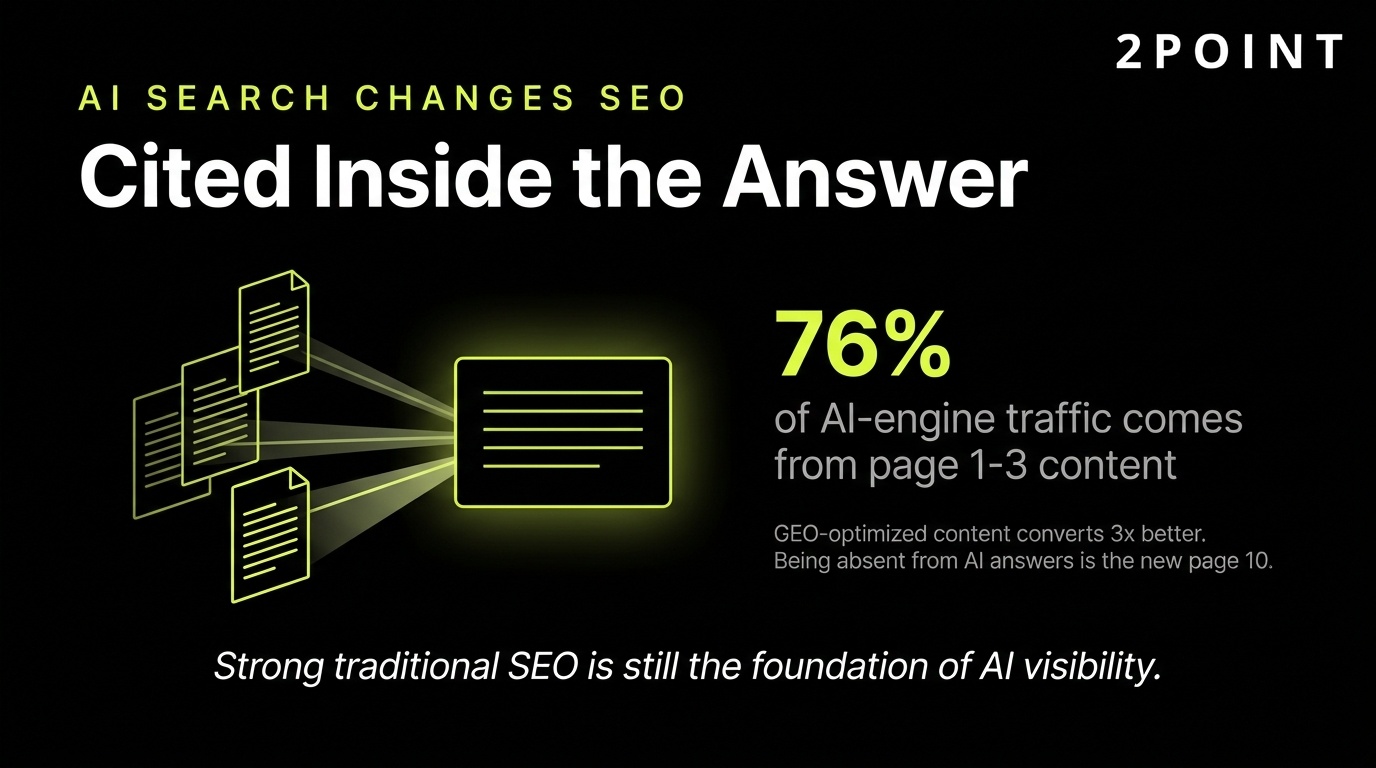
The good news is that 76% of traffic generated by AI answer engines originates from content that also ranks on Pages 1 through 3 of traditional Google search results. This means that strong traditional SEO remains the foundation of AI visibility. The distinction is that AI engines additionally reward content that is structured for direct citation: clear definitions, unambiguous factual statements, properly attributed statistics, and content that answers questions completely within a single page.
This has given rise to Generative Engine Optimization, or GEO, a discipline focused on optimizing content for inclusion in AI-generated answers rather than just for ranking in link lists. Early data shows that GEO-optimized content delivers three times higher referral conversion rates compared to content optimized purely for traditional search. When an AI engine cites your content in an answer, the user who clicks through has already received a recommendation from a source they trust, making them far more likely to convert.
For SaaS companies, the practical implication is clear: being absent from AI recommendation ecosystems is the 2026 equivalent of being on page 10 of Google. If 71% of B2B buyers are using AI chatbots to research software purchases, and your product is not appearing in those AI-generated research sessions, you are invisible to a majority of your potential customers before the conversation even begins. Data analytics now plays a critical role in measuring AI search visibility, not just traditional keyword rankings.
Hyper-Personalization That Actually Converts in SaaS
Generic persona-based marketing, the practice of writing content for a fictional "Marketing Mary" or "DevOps David," is losing effectiveness rapidly. AI has made true 1:1 personalization at scale not only possible but increasingly expected by buyers who are accustomed to experiences tailored to their specific context.
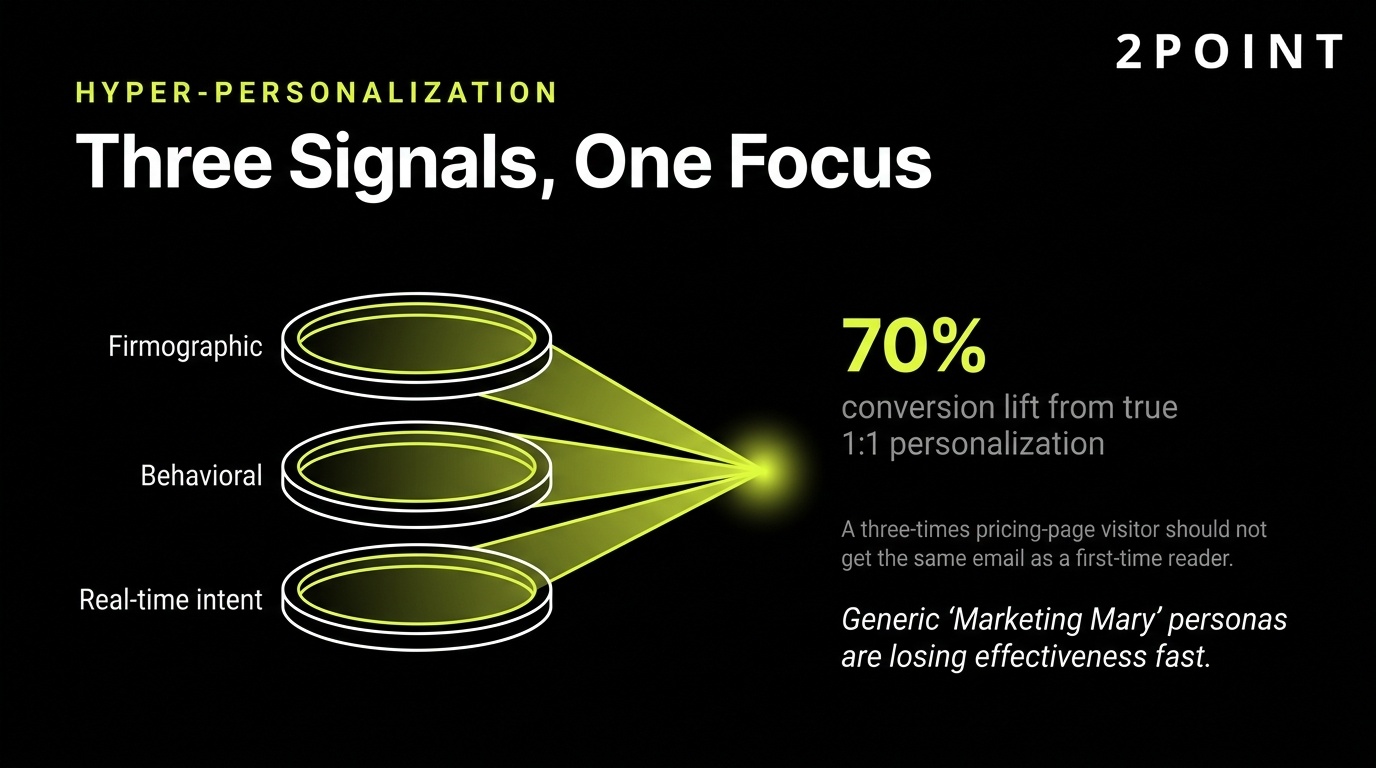
Modern SaaS marketing personalization operates on three dimensions simultaneously: firmographic data (company size, industry, tech stack), behavioral signals (pages visited, features used, content consumed), and real-time intent (search queries, category research, competitor comparison activity). When these three dimensions are combined and used to adapt messaging, content, and outreach in real time, the results are material. Hyper-personalization has been shown to boost conversion rates by 70% in B2B SaaS contexts.
The practical application extends across every marketing channel. A prospect who visited your pricing page three times but did not convert should receive different email messaging than one who just discovered the product through a blog post. A user who activated a specific feature in a free trial should see onboarding prompts that build on that behavior rather than generic "getting started" content. Personalized marketing at this level requires both the right data infrastructure and the AI tooling to act on signals in real time, but the conversion lift it produces justifies the investment many times over.
The Counter-Trend: Why Authenticity Beats AI-Generated Content
Here is the paradox at the heart of SaaS marketing in 2026: while AI enables remarkable efficiency, the buyers who are most valuable, those making large, considered software investments, are developing sophisticated radar for AI-generated inauthenticity. This is not a rejection of AI as a tool. It is a market signal about what earns trust.
Buyers who receive templated AI emails, read landing pages that feel algorithmically assembled, or attend webinars where every talking point sounds like a language model's output are learning to disengage. The companies winning the attention and trust of discerning B2B buyers are those that pair AI efficiency with authentic, human-led content: founder essays that share genuine perspectives, case studies written by real customers in their own words, and community interactions that feel genuinely reciprocal rather than orchestrated.
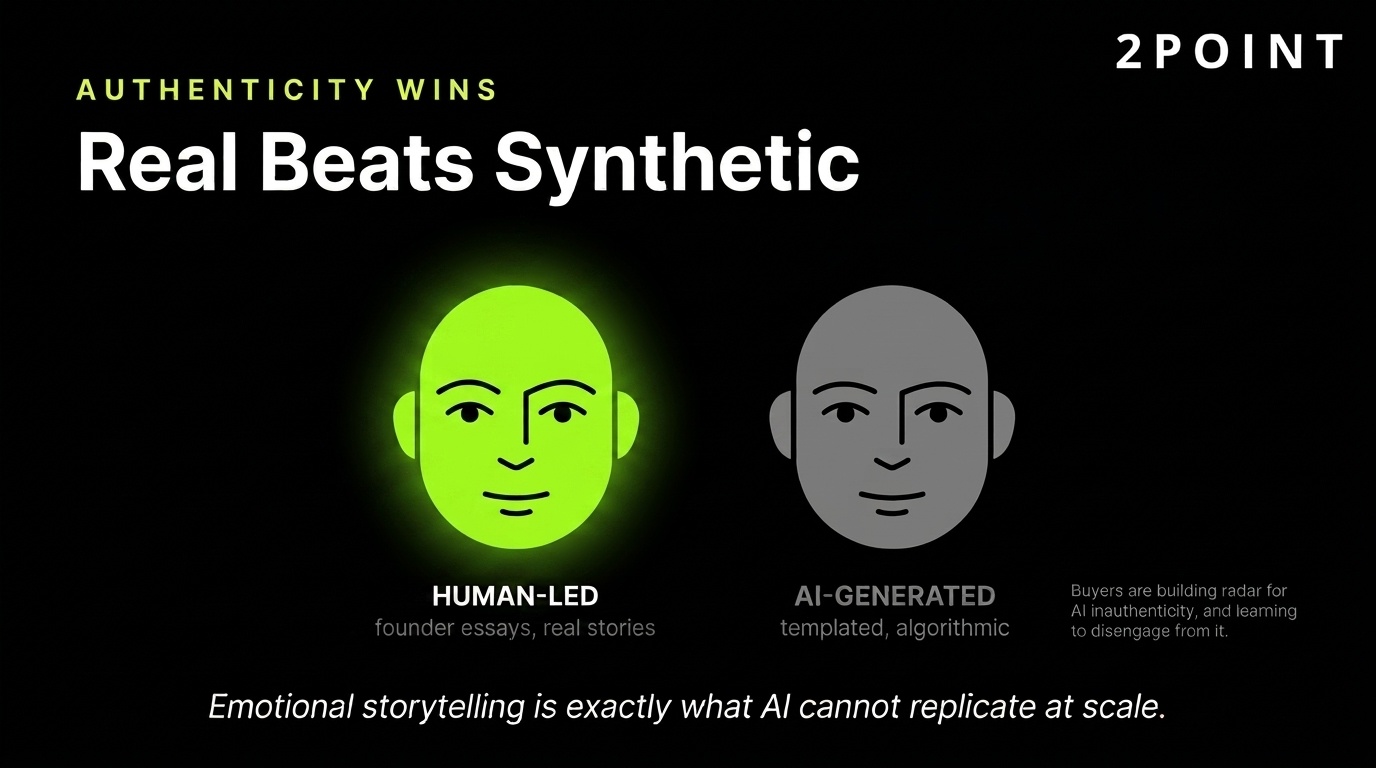
Founder-led distribution, in particular, has emerged as a differentiated growth motion. When a founder or executive consistently shares honest, specific insights about their industry, market, or product category, they build an audience that trusts them before a sales conversation ever happens. This is the human complement to AI automation, and the most effective SaaS marketing programs in 2026 deploy both intentionally. Emotional storytelling remains one of the most powerful tools available to SaaS marketers, precisely because it is what AI cannot authentically replicate at scale.
The 8 Most Effective SaaS Marketing Strategies for 2026
With the landscape context established, the practical question becomes: which strategies actually move the needle in 2026? The following are not a list of every possible tactic. They are the approaches supported by the strongest performance data, the most favorable economic profiles, and the widest applicability across SaaS business models and growth stages.
SaaS Content Marketing: Building Compounding Growth Assets
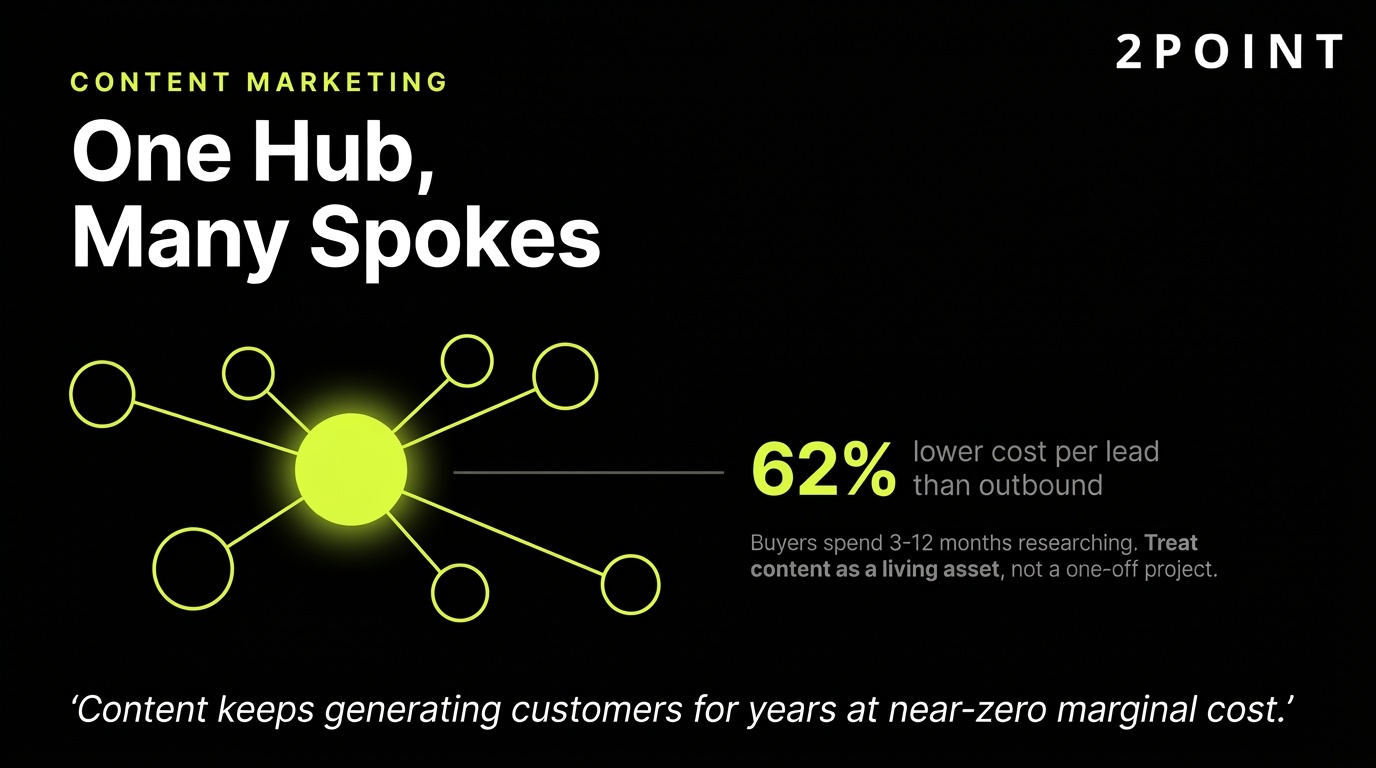
Content marketing remains the single most economically attractive growth strategy available to SaaS companies. The data is unambiguous: content marketing generates leads at 62% lower cost than traditional outbound approaches. That cost advantage compounds over time because content, unlike paid advertising, continues generating traffic, leads, and customers indefinitely after publication without additional investment.
The architecture that drives the best results in SaaS content marketing is the pillar-cluster model. A pillar page covers a broad topic comprehensively, often targeting a high-volume, high-competition keyword. Cluster pages cover more specific subtopics within that theme, each linking back to the pillar. This structure signals topical authority to search engines and ensures that visitors who land on any page in the cluster are naturally guided toward the most relevant content for their specific question. For a content marketing strategy to work at scale, this architectural thinking must precede the writing.
SaaS buyers typically spend three to twelve months in a research and evaluation phase before making a purchasing decision. This extended timeline makes educational content, the kind that helps buyers understand their problem before it ever mentions your product, exceptionally valuable. Blog posts that answer genuine questions, comparison guides that help buyers evaluate options honestly, and technical tutorials that demonstrate expertise all build the trust and familiarity that convert into sales at the end of a long consideration cycle.
The implementation framework for SaaS content marketing follows a clear sequence. Start by identifying the ten to fifteen questions your ideal customers ask most urgently. Map those questions to content formats that serve them best: definitional questions become glossary pages, how-to questions become step-by-step guides, comparison questions become structured comparison posts. Prioritize topics where you can genuinely add perspective beyond what already exists, and publish on a consistent cadence that search engines and readers can depend on. Quality and consistency, sustained over twelve to twenty-four months, is what separates the SaaS companies that dominate organic search from those that dabble in content without seeing returns.
One critical mistake to avoid is treating content as a project with a start and end date. The SaaS companies generating the most organic pipeline from content treat it as an ongoing program with dedicated resources, regular editorial planning, and systematic promotion. Content that is published and forgotten underperforms content that is continuously updated, promoted through email and social channels, and expanded as the topic evolves. Treat every piece of content as a living asset that can be improved, and the compounding value accelerates.
SaaS SEO and GEO: Optimizing for Both Google and AI Engines
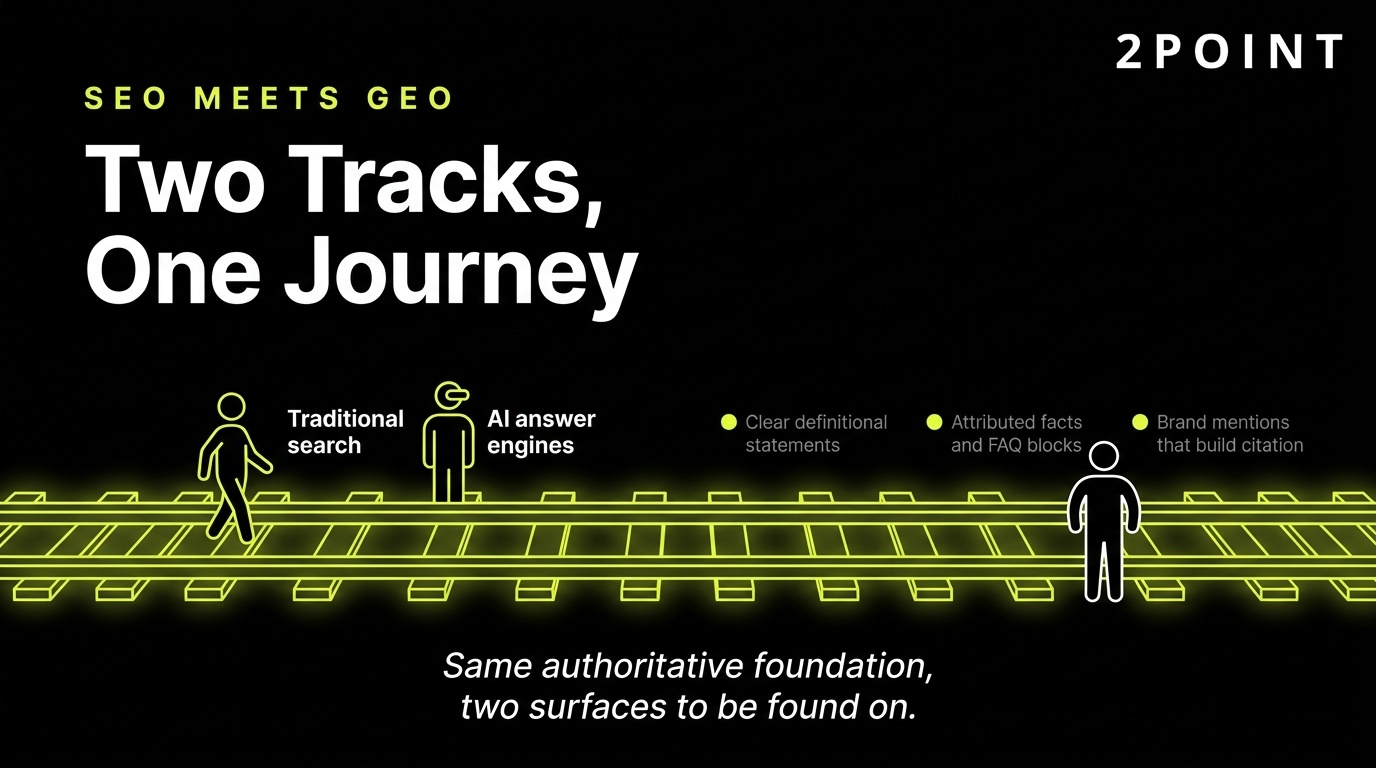
Modern SaaS SEO strategy in 2026 operates on two parallel tracks: traditional search engine optimization for Google and Bing, and Generative Engine Optimization for AI answer engines. Neglecting either track means leaving a significant portion of discoverable demand unaddressed. The good news is that the foundations of strong traditional SEO, authoritative content, clean technical infrastructure, and strong backlink profiles, also underpin effective GEO.
Technical SEO remains the necessary baseline. Page speed, Core Web Vitals, structured data markup, and clean site architecture determine whether search engines can crawl, index, and understand your content. SaaS companies with complex product pages, user-generated content, or multiple language and regional versions face specific technical challenges that require dedicated attention. Without resolving technical blockers, even excellent content will underperform its potential.
Beyond technical basics, SaaS SEO in 2026 requires depth. Thin content, posts that skim the surface of a topic in 500 words, no longer ranks competitively against the comprehensive, expert-level resources that dominate Page 1. The investment in producing genuinely excellent content is non-negotiable, but the long-term economics justify it. Content that ranks well in 2026 generates customers in 2028 and 2029 at near-zero marginal cost, while the $480 to $942 average CAC from organic search makes it one of the most efficient channels available across the entire acquisition landscape.
GEO-specific optimization adds a layer of tactical adjustments to traditional SEO work. AI engines prefer content that uses clear definitional statements ("X is Y"), provides factual claims with explicit attribution, structures information in scannable formats, and directly answers the question implied by the search query within the first few paragraphs. Adding an FAQ section to every major piece of content, structuring key points as numbered lists, and including concise summary sections all increase the likelihood that AI engines will cite your content in generated answers.
Brand mention optimization is an often-overlooked component of AI visibility. When other authoritative websites, podcasts, and publications mention your brand name in positive, informative contexts, AI engines incorporate that signal into their understanding of your credibility. Actively pursuing media coverage, guest contributions, and podcast appearances builds the brand citation profile that makes AI recommendation more likely. This is why PR and content marketing are increasingly inseparable in modern SaaS go-to-market strategy. Transparent marketing messages that clearly communicate your product's value also help AI engines accurately represent your offering in recommendation contexts.
Product-Led Growth Paired with Sales Intelligence
Product-led growth was the defining SaaS strategy of the late 2010s and early 2020s. The model, where the product itself serves as the primary acquisition, conversion, and expansion vehicle, delivered extraordinary results for companies like Slack, Figma, and Notion. In 2026, PLG remains highly effective, but it has become table stakes rather than a differentiator in most software categories. The companies pulling ahead are those that layer sales intelligence and human intervention on top of the PLG foundation.
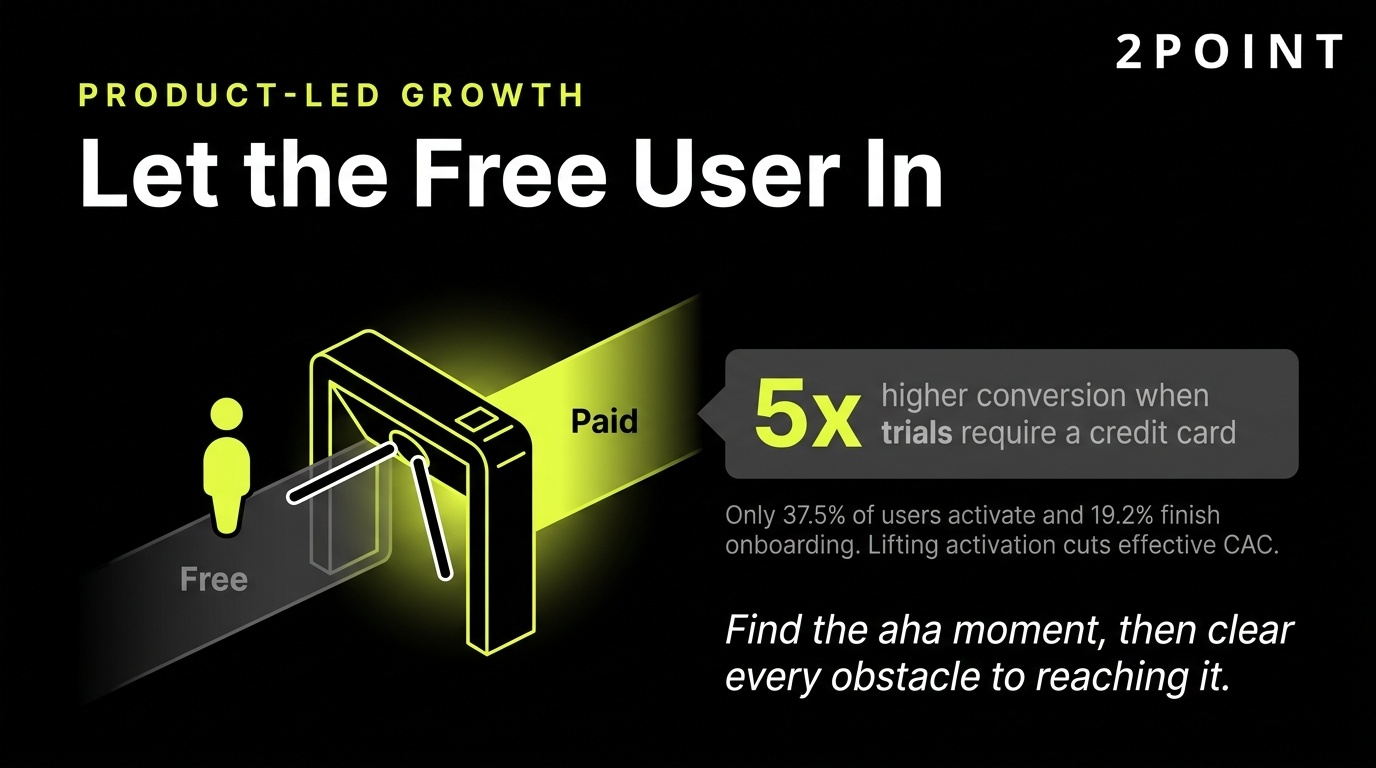
The activation problem is the most critical issue in PLG execution. The average activation rate across SaaS products is only 37.5%, meaning fewer than four in ten new sign-ups reach the moment where they experience the core value of the product. Even more sobering, only 19.2% of users complete the full onboarding sequence. These numbers represent an enormous opportunity: improving activation by even ten percentage points can meaningfully reduce effective CAC without changing acquisition spend at all.
Optimizing activation requires understanding the "aha moment," the specific action or outcome that reliably predicts long-term retention for your product. Once identified, every element of onboarding should be redesigned to help users reach that moment as quickly as possible. Unnecessary friction, excessive form fields, features surfaced before they are contextually relevant, and unclear next steps are all barriers that push activation rates down.
The product-led sales model extends PLG by using product usage data to identify expansion opportunities and prompt human intervention at exactly the right moments. When a free user reaches their usage limit, a well-timed sales touch beats an automated email. When an account has five users but 50 would benefit, a customer success manager who references specific usage patterns is far more effective than a generic upsell campaign. Free trials that require a credit card at sign-up convert at five times the rate of those that do not, a data point that underscores how important friction-removal and commitment signals are throughout the PLG funnel.
For SaaS companies considering PLG, the strategic question is not whether to offer a free tier or trial but whether the product experience in that free tier is strong enough to demonstrate genuine value. A mediocre free experience that frustrates users is worse than no free experience at all. The investment in building an exceptional PLG motion, superior onboarding, clear value delivery, and smart in-product messaging, pays dividends across acquisition, conversion, and retention simultaneously.
Retention and Expansion: Your Most Profitable Growth Lever
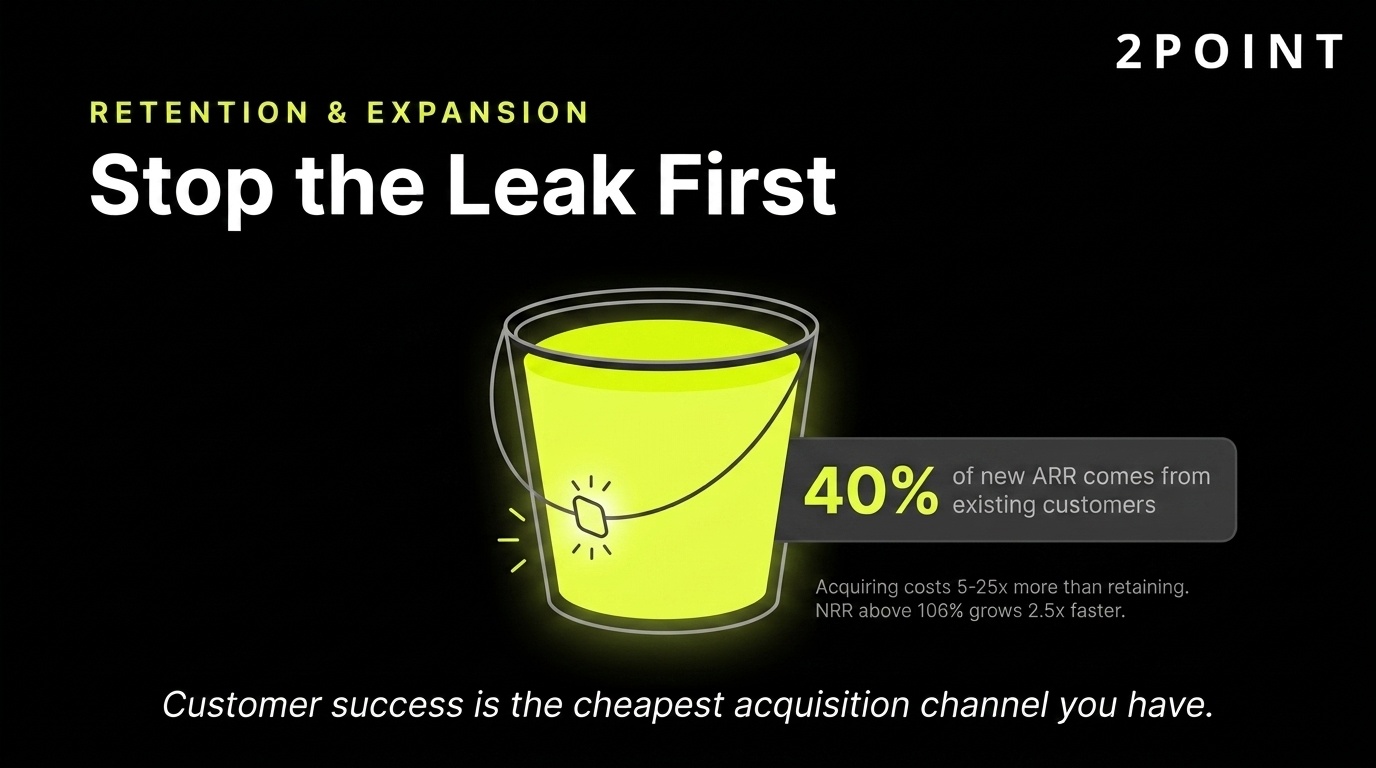
The most underutilized growth lever in SaaS marketing is the customer base that already exists. This is not a counterintuitive insight in theory, but in practice, most SaaS marketing budgets remain heavily weighted toward acquisition rather than retention and expansion. The data makes the case for rebalancing this allocation compellingly. At the median, existing customers generate 40% of new ARR through expansions, upsells, and renewals. That means nearly half of a company's growth is coming from people who have already made a purchasing decision in your favor.
The cost comparison between acquisition and retention is equally stark. Acquiring a new customer costs between 5 and 25 times more than retaining an existing one. When you factor in that retained customers also generate referrals, provide case study content, and participate in advocacy programs, the true value of a retained customer significantly exceeds their direct revenue contribution. Customer success is not overhead. It is the cheapest acquisition channel available to a growing SaaS company.
Net Revenue Retention is the metric that captures the full expansion picture. Companies with NRR above 106% grow 2.5 times faster than those below this threshold, even when new customer acquisition rates are comparable. NRR above 100% means the company grows its revenue from its existing base alone, creating a compounding effect that makes growth increasingly efficient over time. Driving NRR above 120% is the distinguishing characteristic of the most valuable SaaS companies in any market category.
Retention-focused marketing programs include health score-driven proactive outreach, personalized check-ins at renewal inflection points, expansion campaigns targeting accounts with clear signals of growing usage, and customer education programs that continuously improve product adoption. Customer retention should have its own dedicated marketing budget, team members responsible for it, and KPIs measured with the same rigor applied to new logo acquisition. The SaaS companies that build this function early grow faster, more profitably, and with greater resilience to market disruption than those that treat retention as a secondary concern.
Advanced SaaS Marketing Tactics That Drive Measurable Results
Beyond the core strategic pillars, a set of more targeted tactics can meaningfully improve marketing performance when deployed in the right context. These approaches are not universally applicable to every SaaS company at every stage, but for those where they fit, the returns are substantial.
Email Marketing: Behavior-Driven Sequences That Convert SaaS Users
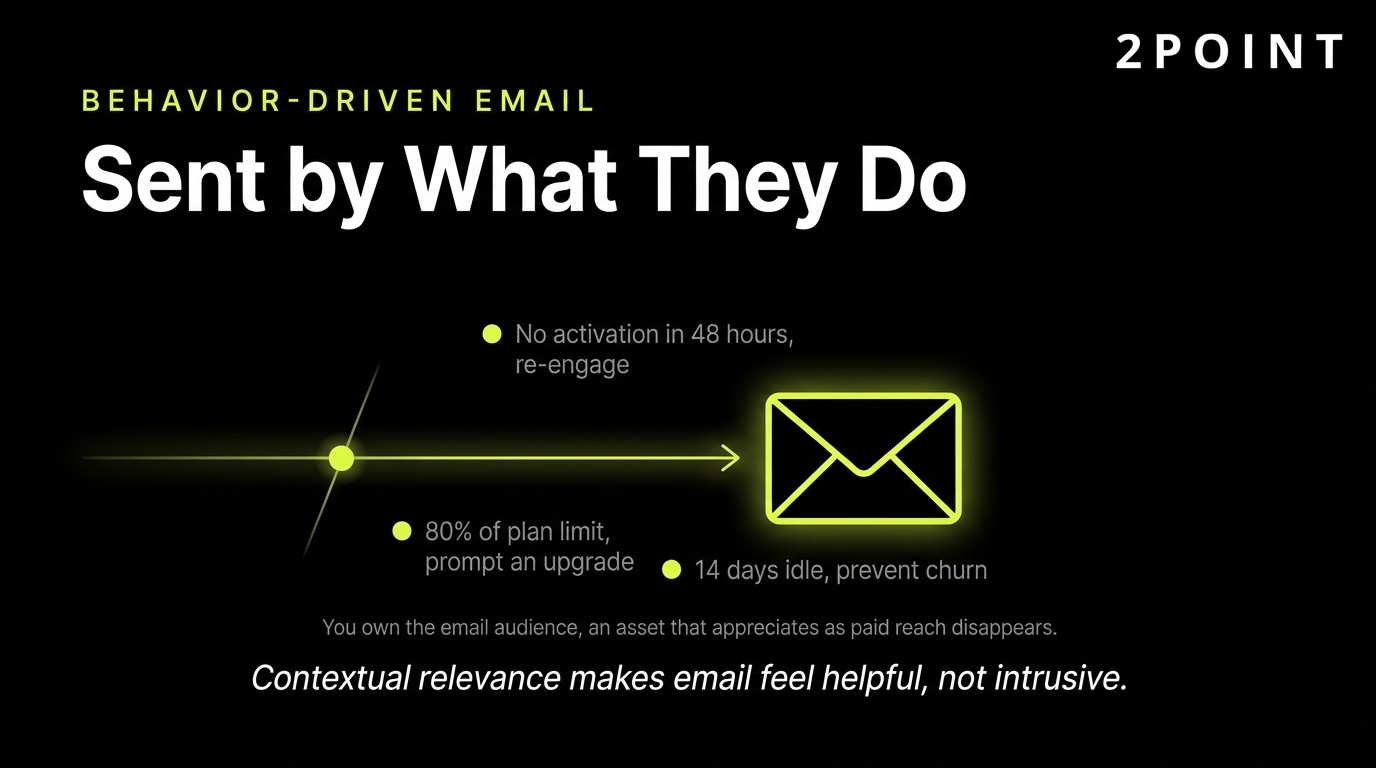
Email remains one of the highest-ROI marketing channels available to SaaS companies for a fundamental reason: you own the audience. Unlike paid media, where reach disappears the moment you stop spending, or social media, where algorithm changes can cut organic visibility overnight, your email list is an asset that appreciates over time. Email marketing strategies built around behavioral triggers rather than calendar-based blasts deliver dramatically better results in SaaS contexts.
Behavior-triggered sequences respond to what users actually do rather than how long they have been on a list. When a user signs up, an onboarding sequence begins. When a user does not activate within 48 hours, a re-engagement email fires. When a user reaches 80% of their plan limits, an upgrade prompt triggers. When a user has not logged in for 14 days, a churn prevention campaign starts. This level of contextual relevance makes emails feel helpful rather than intrusive, and it directly addresses the behavioral signals that predict whether a customer will expand, retain, or churn.
Lifecycle email automation extends this principle across the entire customer journey. Trial users receive different messaging than paying customers. New customers in their first 90 days need different content than power users who have been with the product for two years. Segmenting email programs by lifecycle stage and behavioral profile, then crafting messaging that is genuinely relevant to each segment, is the difference between an email program that drives revenue and one that accumulates unsubscribes. Building well-designed email campaigns with clear objectives for each stage of the customer lifecycle is the foundation of effective SaaS retention marketing.
Account-Based Marketing for High-Value SaaS Customers
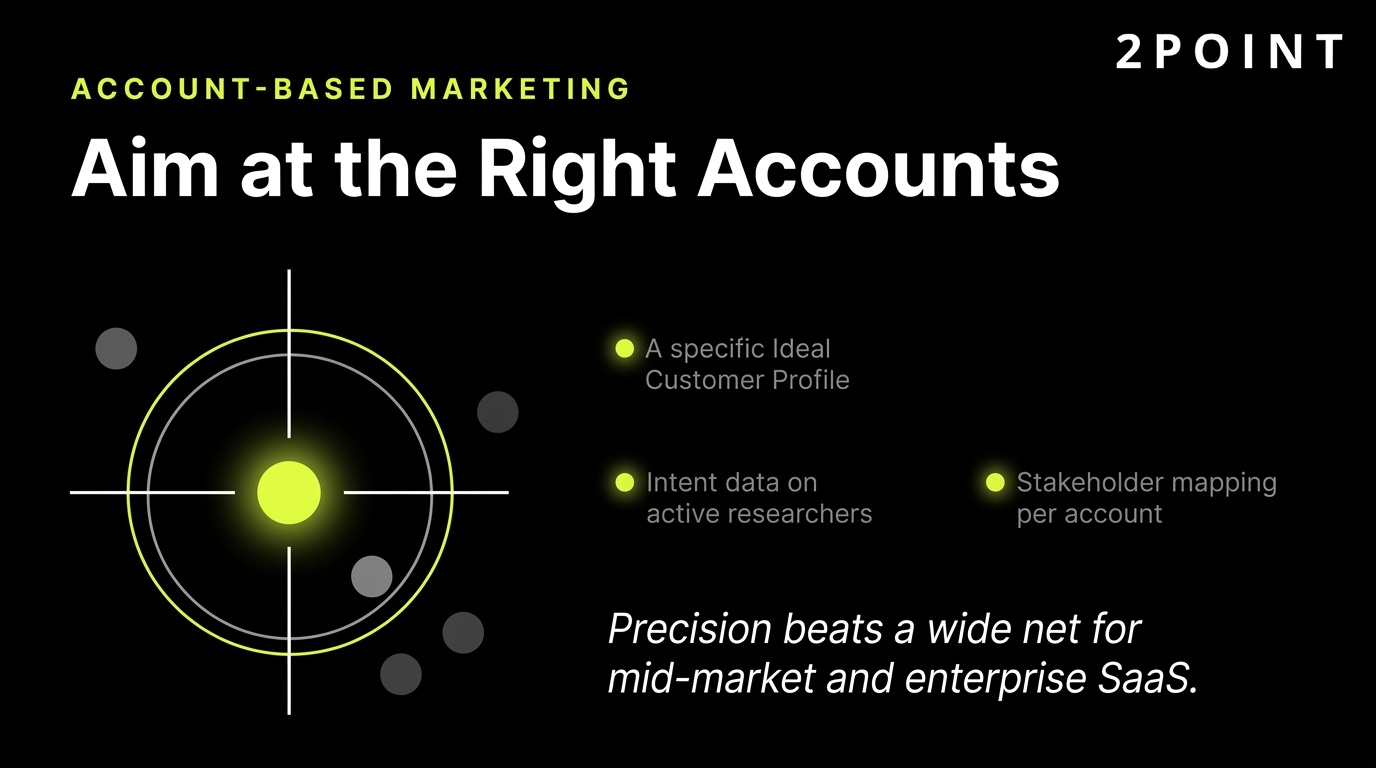
Account-Based Marketing, or ABM, is the strategic inversion of traditional demand generation. Instead of casting a wide net and qualifying leads as they come in, ABM identifies the specific accounts with the highest potential value and focuses marketing resources on creating personalized experiences for those accounts specifically. For SaaS companies targeting mid-market or enterprise customers, ABM is often the highest-leverage motion available.
The implementation of ABM in SaaS begins with building an Ideal Customer Profile that is specific enough to identify actual companies, not just personas. The ICP should define industry vertical, company size by headcount and revenue, technology stack characteristics, organizational structure, and business problems that your product uniquely solves. With this definition in place, the next step is building a target account list and enriching each account with intent data that reveals which companies are actively researching solutions in your category.
Personalization in ABM goes beyond inserting a company name into an email template. It means researching the specific challenges facing a target account, referencing their recent news, tailoring content to their industry, and aligning every touchpoint to the specific stakeholders involved in the buying decision. Stakeholder mapping, understanding who holds budget, who influences decisions, who uses the product daily, and who evaluates security and compliance, allows marketing to create assets that address each stakeholder's specific concerns. This kind of precision reduces wasted spend on unqualified leads and creates a buying experience that large organizations respect and respond to. When aligned with a well-defined marketing proposal process, ABM consistently outperforms broad-based demand generation for enterprise SaaS.
Referral Programs: The Lowest-CAC Channel in SaaS Marketing
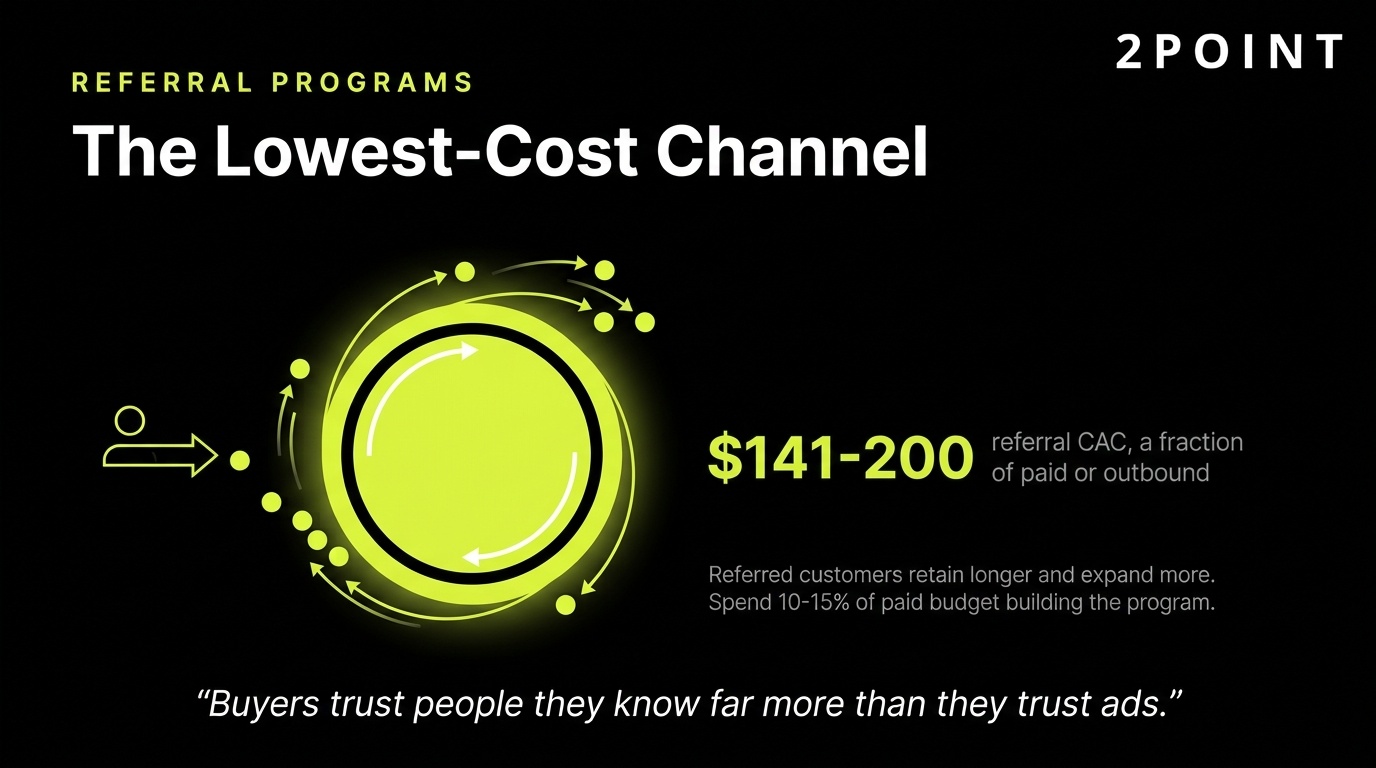
Among all acquisition channels, referrals offer the most compelling economics for SaaS companies. Referral CAC ranges from $141 to $200, a fraction of paid search or outbound sales costs, and referred customers consistently demonstrate higher retention rates, faster time-to-activation, and stronger expansion behavior than customers acquired through other channels. The mechanism is straightforward: buyers trust recommendations from people they know far more than they trust advertising.
Building an effective referral program requires more than adding a "Refer a friend" link to your dashboard. It requires a structured incentive framework that motivates existing customers to actively advocate for your product, a frictionless sharing mechanism that makes referrals easy to submit, and a tracking system that accurately attributes new sign-ups to their referral sources. Incentives should be meaningful enough to motivate action but aligned with genuine product love rather than creating mercenary behavior. Some of the most effective referral programs in SaaS combine financial incentives, such as account credits, with status-based recognition, such as community recognition or exclusive feature access.
The investment required to build a referral program is modest relative to its potential return. Allocating 10 to 15% of your paid acquisition budget to building and maintaining a referral program consistently delivers among the highest ROI of any marketing investment. The compounding effect is also worth noting: each referred customer becomes a potential referrer themselves, creating a flywheel that grows in value over time without proportional increases in spend.
Community-Driven Marketing and Micro-Influencer Partnerships for SaaS
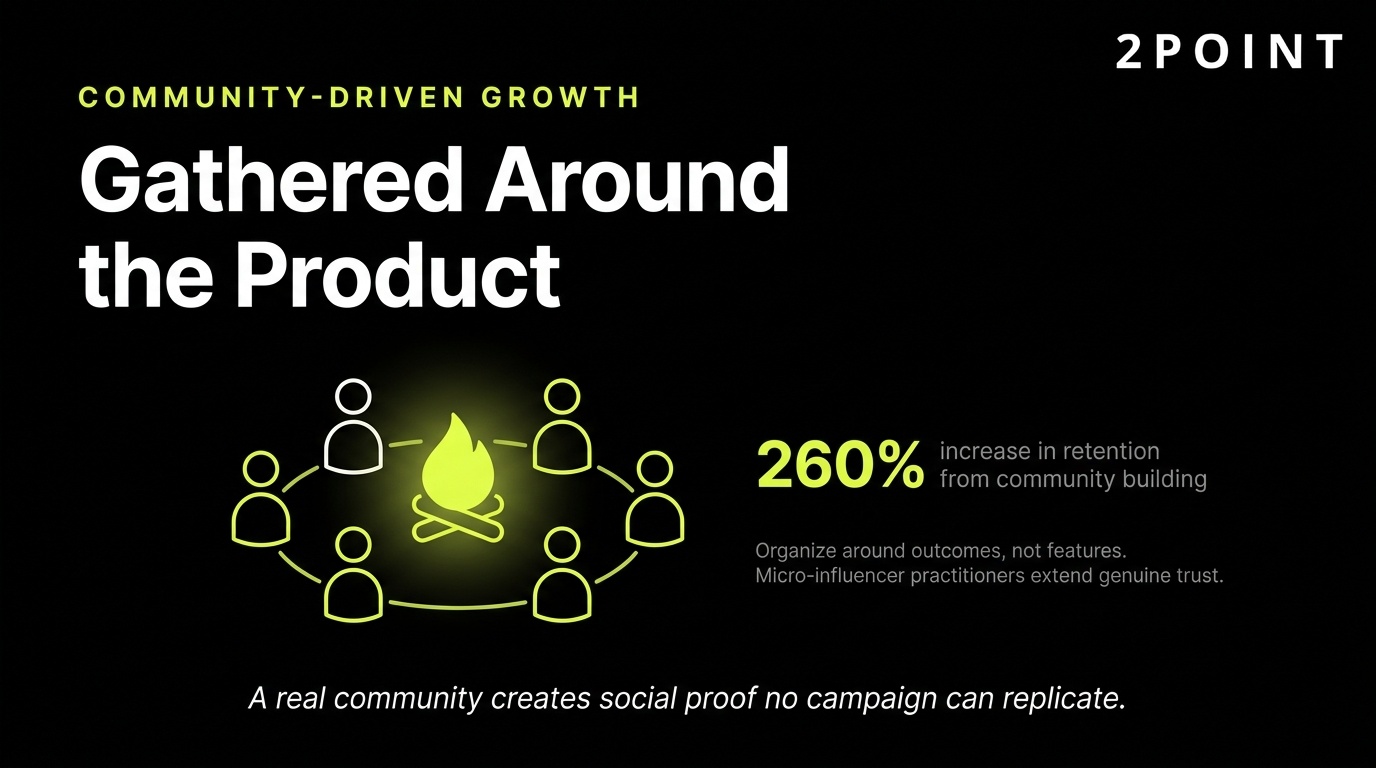
Community-driven marketing has matured from a nice-to-have to a genuine growth driver for SaaS companies with strong product-market fit. When a user community forms around a product, it creates a self-sustaining ecosystem of peer support, use case inspiration, and social proof that no marketing campaign can fully replicate. Community building increases customer retention by 260% in SaaS contexts, making it one of the most powerful retention investments available.
The most successful SaaS communities share certain characteristics. They are organized around outcomes and use cases rather than the product itself, meaning conversations focus on what members are trying to achieve rather than product features. They have clear norms, active moderation, and consistent programming, such as expert AMAs, peer showcases, and collaborative challenges, that give members reasons to return regularly. They are accessible through the channels where the target audience actually spends time: Slack, Discord, LinkedIn groups, or dedicated community platforms depending on the audience.
Micro-influencer partnerships complement community-driven marketing by extending reach into audiences that trust specific individuals' recommendations. In B2B SaaS, micro-influencers are often practitioners, developers, marketers, sales leaders, or operations professionals with specific expertise and authentic followings in their niche. A partnership with a respected voice in your category, even one with 5,000 to 50,000 followers, can generate more qualified pipeline than a broad advertising campaign because the trust transfer is genuine. Influencer marketing in the SaaS context works best when the influencer is a genuine user of the product and the partnership is transparent about its nature, reflecting the broader market preference for authenticity over polish. Tracking the outcomes of these programs carefully through social media outcomes measurement ensures that community and influencer investments are held to the same performance standards as other marketing channels.
Critical SaaS Marketing Metrics and How to Improve Them
Marketing strategy without measurement is guesswork. The following metrics form the operational foundation of SaaS marketing performance management. Understanding not just what they are, but what influences them and how to systematically improve them, separates effective SaaS marketers from those who rely on intuition.
The Core SaaS Revenue Metrics: ARR, MRR, and Churn Rate
Annual Recurring Revenue and Monthly Recurring Revenue are the foundational measures of SaaS business health. ARR represents the annualized value of all active subscription contracts, calculated by multiplying MRR by twelve. MRR captures the current monthly revenue rate, allowing for more granular tracking of month-to-month growth, contraction, and net impact from new customers, expansions, and churned accounts. Both figures should be tracked in their gross form and in their net form, which accounts for expansions and contractions to existing accounts.
Churn rate is the metric that most directly measures whether a SaaS product is retaining the value it creates. Revenue churn, the percentage of MRR lost in a given period to cancellations and downgrades, is generally more meaningful than logo churn, the percentage of accounts that cancel, because it captures the economic impact directly. Acceptable churn varies by market segment. Enterprise SaaS typically targets below 5% annual revenue churn, while SMB-focused products may see 10 to 15% as a baseline due to higher customer turnover in smaller businesses.
The relationship between churn and growth is one of the most important mathematical realities in SaaS. A company with 20% annual churn must replace one-fifth of its revenue base every year just to stand still. At that churn rate, achieving 50% net growth requires 70% gross growth, an enormous acquisition burden. Reducing annual churn from 20% to 10% effectively doubles the productive value of every new customer acquired, making churn reduction one of the highest-leverage improvements available to any SaaS marketing and customer success team.
Activation and Adoption: Turning SaaS Sign-Ups into Active Users
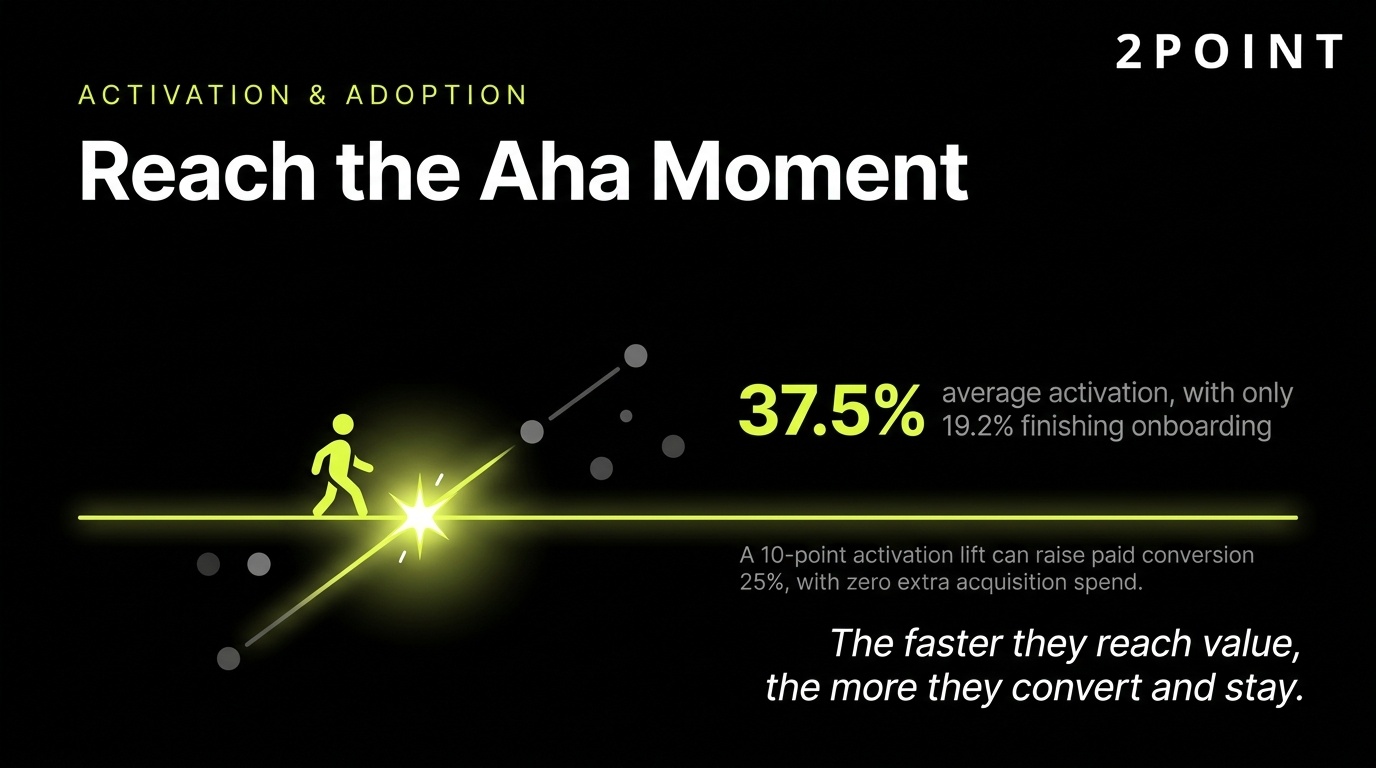
The gap between sign-up and activation is where most SaaS growth plans break down. Acquisition metrics look strong, trials are flowing in, but conversion to paying customers is disappointing. The root cause is almost always an activation problem, not an acquisition problem. With an average activation rate of only 37.5% across the SaaS industry, and onboarding completion at just 19.2%, the majority of trial users never experience enough of the product to make an informed purchase decision.
Time-to-value is the core concept driving activation optimization. The faster a new user reaches the moment where they genuinely benefit from the product, the more likely they are to convert, retain, and expand. Identifying your product's specific activation milestone, the action or outcome that most reliably predicts long-term retention, requires analyzing behavioral data from retained customers and comparing it against the journeys of users who churned or never converted. The patterns in this comparison reveal what the critical path to activation actually looks like.
Improving activation requires reducing friction at every step of the onboarding journey. This means removing unnecessary steps in the initial setup flow, replacing generic welcome content with contextually relevant guidance based on what the user is trying to accomplish, using in-product tooltips and progress indicators to maintain momentum, and deploying timely email nudges that reference specific in-product behavior. Each improvement to the activation journey, however incremental, compounds with every new trial user who enters the product. A 10-percentage-point improvement in activation rates, from 37.5% to 47.5%, can increase paid conversion volume by more than 25% with zero additional acquisition spend.
Net Revenue Retention: The Ultimate SaaS Growth Indicator
Net Revenue Retention measures what happens to revenue from the existing customer base over a given period, accounting for expansions, contractions, and cancellations. The formula is: beginning period MRR from existing customers, plus expansion MRR, minus contraction MRR, minus churned MRR, divided by beginning period MRR, expressed as a percentage. An NRR of 100% means the existing base generates exactly the same revenue it did at the start of the period. Above 100% means the base is growing on its own. Below 100% means the company is losing revenue ground even before accounting for new customer acquisition costs.
SaaS companies with NRR above 106% grow 2.5 times faster than those below this threshold, even when controlling for new customer acquisition performance. This statistical relationship reflects the compounding power of expansion revenue. When a company's existing customers collectively spend more each year, the growth model becomes progressively more efficient because a smaller portion of total growth requires expensive new customer acquisition.
Driving NRR above 106% requires a systematic approach to expansion revenue: usage-based pricing that naturally scales with customer success, structured upsell campaigns that introduce additional products or tiers at the right moments, cross-sell programs that expand the product footprint within an account, and renewal optimization that converts annual contracts before churn risk materializes. Marketing's role in this process extends well beyond onboarding, encompassing continuous customer education, outcome-focused case studies that inspire expanded use, and community programming that surfaces new use cases organically.
SaaS Sales Cycle Length and What It Means for Your Marketing Strategy
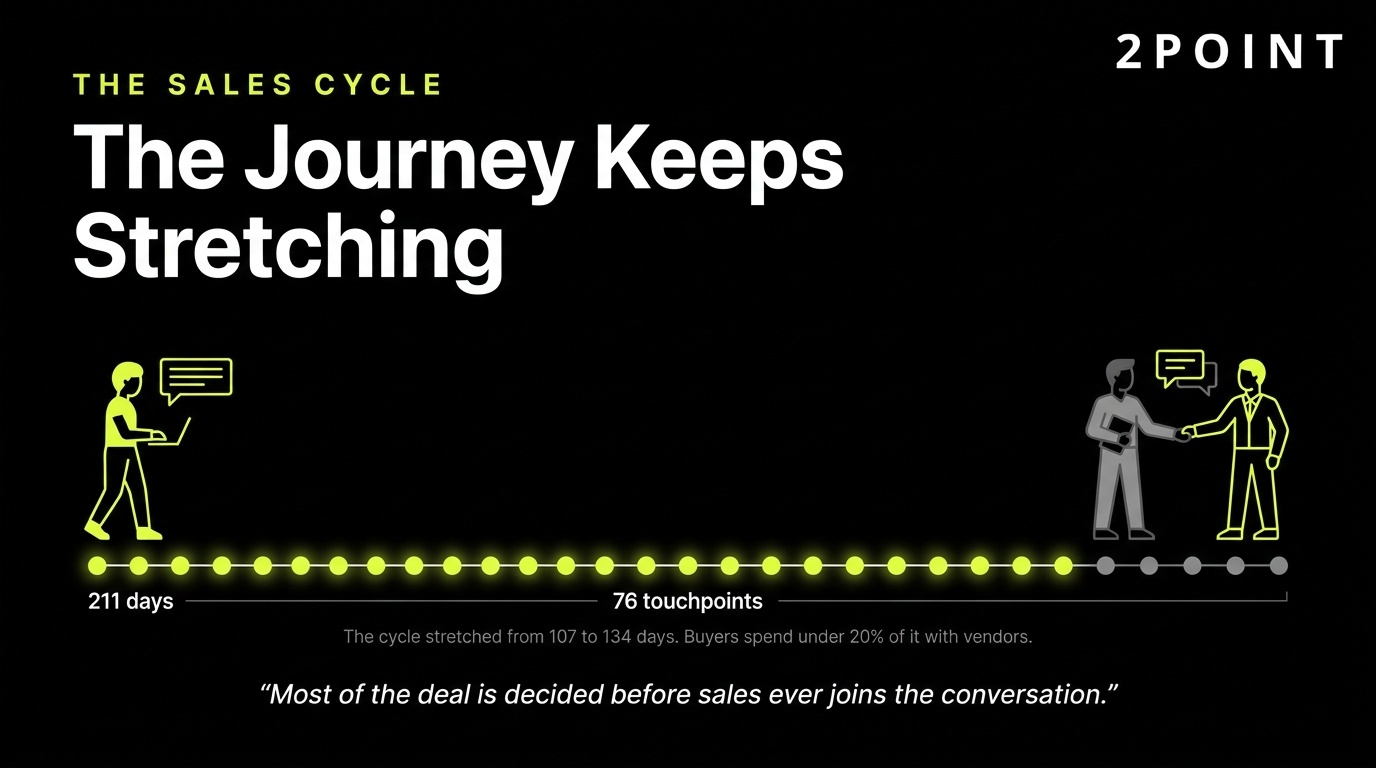
The average B2B SaaS sales cycle has extended to 134 days in 2026, up from 107 days in 2022. When the full customer journey is mapped from initial awareness to closed deal, including the research and consideration phases that precede vendor contact, the picture is even more sobering: 211 total days and 76 distinct touchpoints on average. This reality has profound implications for marketing strategy, content planning, and budget allocation.
A 211-day buyer journey means that most of the education, trust-building, and preference formation happening in the buying process occurs before a prospect ever speaks with your sales team. Buyers spend less than 20% of their total purchase journey time directly engaging with vendors. The remaining 80% is self-directed research: reading reviews on G2 or Capterra, watching product demos on YouTube, consuming comparison content, and increasingly, asking AI chatbots to synthesize options. If your content, social proof, and brand presence are not excellent during that independent research phase, you are losing deals before the sales conversation begins.
The strategic response to a lengthening sales cycle is to invest heavily in top-of-funnel and middle-of-funnel content that serves buyers during their independent research phase. This includes comprehensive category education content, transparent comparison guides, detailed customer case studies organized by use case and company type, and review management programs on third-party platforms. User-generated content in the form of customer reviews, testimonials, and community contributions is particularly valuable because it is inherently more credible than brand-produced content and is heavily weighted by both buyers and AI research tools. Integrating this insight into a broader cross-channel marketing approach ensures consistent, reinforcing messages across every touchpoint in the buyer's 211-day journey.
Building a High-Performing SaaS Marketing Team
Strategy is only as good as the team and systems executing it. The organizational structure of a SaaS marketing team, the roles it includes, how it aligns with sales and customer success, and the tools it operates with, determines whether strategic plans translate into measurable outcomes or remain aspirational documents.
The Essential SaaS Marketing Roles and Responsibilities
SaaS marketing teams differ from traditional B2B marketing departments in important ways. The product-led nature of many SaaS businesses blurs the line between marketing and product. The subscription revenue model makes retention as important as acquisition. The data richness of SaaS products enables personalization and targeting sophistication that requires dedicated analytical capability. These distinctions shape the roles a mature SaaS marketing team needs to fill.
| SaaS Marketing Role | Primary Responsibility | Key Metrics Owned |
|---|---|---|
| Demand Generation | Driving qualified pipeline through paid and organic channels | MQLs, pipeline volume, CAC by channel |
| Content Marketing | Building educational assets and organic search presence | Organic traffic, content-sourced pipeline |
| Product Marketing | Positioning, messaging, competitive intelligence, launches | Win rate, competitive displacement, conversion rate |
| Customer Marketing | Retention, expansion, advocacy, and community programs | NRR, expansion ARR, referral volume |
| Marketing Operations | Tech stack management, data integrity, automation | Data accuracy, campaign efficiency, system uptime |
| Marketing Analytics | Attribution, forecasting, performance reporting | Attribution accuracy, revenue influence |
The strongest SaaS marketing teams treat product marketing as a strategic leadership function rather than a support role, because the quality of positioning and messaging determines the ceiling on every other marketing program's effectiveness.
Aligning SaaS Marketing, Sales, and Customer Success
The organizational silo between marketing, sales, and customer success is one of the most expensive structural problems in SaaS. When these three functions operate with different definitions of success, different data systems, and different views of the customer, the result is a fragmented buyer experience, inflated CAC, and depressed NRR. The companies winning in 2026 have dissolved these silos into a unified revenue organization with shared metrics, shared data, and shared accountability.
Practical alignment requires a set of clearly defined service level agreements between functions. Marketing commits to delivering a certain volume and quality of leads based on agreed criteria. Sales commits to following up within a defined timeframe and providing structured feedback on lead quality. Customer success commits to sharing product usage data and customer health signals that marketing can use to improve onboarding and expansion programs. These SLAs create mutual accountability and replace finger-pointing with collaborative problem-solving.
Shared metrics are the operational glue that makes alignment sustainable. When marketing, sales, and customer success all track pipeline health, win rates, NRR, and customer satisfaction using the same definitions and the same data source, conversations shift from defending silos to jointly optimizing the system. Regular revenue team meetings that review the full funnel from awareness through expansion, attended by leaders from all three functions, create the forum for identifying and resolving the bottlenecks that cost growth. For B2B-focused SaaS companies, this kind of structural alignment is a prerequisite for the coordinated, account-level marketing motions that B2B marketing excellence requires.
The Tools Every SaaS Marketing Stack Needs
The modern SaaS marketing stack has expanded rapidly, creating both opportunity and complexity. The key principle for building an effective stack is not to acquire the most tools but to ensure the tools you have are integrated well enough that data flows seamlessly between them. A disconnected stack generates data silos that make attribution impossible and automation unreliable.
The essential categories include a Customer Relationship Management platform that serves as the system of record for all prospect and customer interactions, a marketing automation platform that manages email sequences, lead scoring, and campaign execution, a web analytics platform that tracks traffic, behavior, and conversion events, and an SEO and content management system that supports both traditional and AI search optimization. For companies beyond early stage, a Customer Data Platform that unifies behavioral data from the product, website, email, and CRM into a single customer profile is increasingly essential for delivering the hyper-personalized experiences that drive conversion and retention.
AI-powered personalization and intent data tools sit on top of this foundation, using the unified customer data to drive contextually relevant experiences at scale. The integration between these layers, specifically the ability of marketing automation to receive product usage signals and trigger relevant communications based on in-app behavior, is what separates modern SaaS marketing from traditional digital marketing. Building this integration correctly from the start, or rebuilding it if it was done poorly, is one of the highest-leverage investments a growing SaaS company can make in its marketing infrastructure.
Building SaaS Marketing Systems That Scale: Process Over Tactics
The most common failure mode in scaling SaaS marketing is over-indexing on individual tactics while neglecting the systems and processes that make tactics work reliably at scale. A brilliant email sequence that lives only in one person's head, a content program that depends on a single writer, or a paid acquisition strategy undocumented in any playbook are all examples of tactical execution without systemic foundation. When people change, systems without documentation collapse.
Systems thinking in SaaS marketing means designing every program with documentation, repeatability, and measurement as core requirements from the start. Campaign briefs that specify objectives, target audience, messaging, channels, and success metrics. Editorial calendars that define content themes, formats, publishing cadences, and distribution plans. Onboarding sequences mapped to user behavior with clear rules for what triggers each touchpoint. Attribution models that connect marketing activity to pipeline and revenue outcomes. These artifacts transform individual expertise into organizational capability that survives team changes and scales with growth.
The transition from $1M to $10M ARR in SaaS, and particularly from $10M to $50M, is largely a transition from a team of talented individuals doing creative work to a well-documented system of processes that talented individuals operate within and continuously improve. Companies that make this transition successfully are those whose marketing leaders prioritize building systems alongside executing campaigns, treating process documentation not as bureaucracy but as the organizational memory that makes scaling possible.
SaaS Marketing Strategies for Different Growth Stages
One of the most consequential mistakes in SaaS marketing is applying the strategies of a later-stage company to an earlier-stage business, or vice versa. The tactics, channels, and metrics that drive results at $50M ARR are often counterproductive at $500K ARR. Stage-appropriate strategy is not a compromise. It is the recognition that different business contexts require fundamentally different approaches.
Early-Stage SaaS Marketing: Clarity Over Volume
Before a SaaS product has found genuine product-market fit, the most valuable marketing investment is in clarity of positioning rather than volume of traffic. A homepage that clearly articulates who the product is for, what problem it solves, and why it is better than the alternatives will outperform a sophisticated demand generation engine aimed at a poorly defined audience. Getting this messaging right is the prerequisite for everything else.
Founder-led distribution is the most effective early-stage acquisition motion. When founders share their perspective on the problem they are solving, the customers they are serving, and the decisions they are making, they build an audience of people who are genuinely interested in the journey and the solution. This audience converts at higher rates, refers more freely, and tolerates the imperfections of early-stage products with more grace than customers acquired through impersonal advertising. The goal at this stage is not scale. It is signal: understanding which messages resonate, which customer types activate quickly, and which use cases generate genuine enthusiasm. Defining the Ideal Customer Profile with precision before scaling any acquisition program saves enormous amounts of money and prevents the false positives that come from growing with the wrong customers.
Growth-Stage SaaS Marketing ($1M to $10M ARR): Finding Your Scalable Channels
The growth stage is defined by the transition from doing everything experimentally to doing a few things excellently and predictably. The most effective approach at this stage is to focus on one to two core acquisition strategies and drive them to a level of predictability and efficiency before adding new channels. The temptation to diversify prematurely, to run paid search while building SEO while launching an ABM program while building a community, results in each initiative being starved of the resources needed to reach meaningful velocity.
Channel testing at this stage should be structured and time-boxed. Allocate a defined budget and timeline to test a channel, measure its performance against clear metrics, and make a binary decision: invest more or shut it down. Avoid the middle ground of perpetually funding underperforming channels because they might eventually work. The opportunity cost of mediocre channel diversification is the compounding advantage you could be building in the channels that are working.
Paid advertising can provide useful short-term pipeline at this stage while organic channels build momentum, but it should be treated as a bridge, not a foundation. The economic model of paid acquisition, where pipeline disappears as soon as spending stops, creates fragility in the growth plan. Building parallel organic programs, content marketing, SEO, referral programs, and community, creates the compounding assets that make growth increasingly efficient over time. At the same time, a well-crafted paid ads marketing strategy with disciplined targeting and continuous optimization can be a valuable component of the channel mix during this stage.
Scale-Stage SaaS Marketing ($10M to $50M ARR): Building Marketing as a Machine
At $10M to $50M ARR, the marketing challenge shifts from finding channels that work to building the systems, teams, and processes that can operate those channels at scale without proportional increases in headcount. This is the stage where marketing becomes a machine rather than a collection of programs, where the output is predictable and the inputs are optimized through continuous measurement and iteration.
Multi-channel orchestration becomes viable and necessary at this stage. A prospect might discover the product through a blog post, receive retargeted advertising on LinkedIn, be enrolled in an email nurture sequence, receive an outbound sequence from a sales development rep, and attend a webinar before booking a demo. The ability to track and optimize this multi-touch journey requires mature marketing operations, robust attribution modeling, and clear agreement on how to credit different touchpoints in the revenue process.
At this stage, existing customers should be generating 40% or more of new ARR through expansions and referrals. If that percentage is lower, it signals that the customer success and expansion marketing functions are underinvested relative to new logo acquisition. Rebalancing toward the existing customer base at this stage creates more efficient growth and builds the NRR metrics that command premium valuations in fundraising and M&A processes.
Enterprise SaaS Marketing ($50M+ ARR): Efficiency and Brand Dominance
At $50M ARR and beyond, the growth equation changes again. New logo acquisition becomes progressively more difficult because the easiest-to-win customers are already customers, and the remaining prospects require more complex, expensive sales motions. The strategic shift at this stage is toward efficiency optimization, brand-led demand generation, and maximizing expansion revenue from the existing base.
Brand investment becomes a quantifiable growth driver at this scale in a way that it is not at earlier stages. When a SaaS brand becomes synonymous with a category, such as when "Salesforce" becomes synonymous with CRM or "Zoom" becomes synonymous with video meetings, the cost of acquiring new customers drops substantially because awareness and preference are established before the sales process begins. Building toward this kind of category leadership requires consistent investment in brand positioning, thought leadership, and market education over years, not quarters.
At the enterprise stage, expansion ARR typically represents 50% or more of total new ARR. The marketing programs that support this expansion, customer education, community engagement, executive briefings, and account-based customer marketing, deserve the same level of strategic investment and measurement sophistication as new logo programs. The companies that dominate their categories at this stage are those that have built a loyal, expanding customer base that collectively produces as much growth as the entire new business development engine.
Future-Proofing Your SaaS Marketing Strategy for 2027 and Beyond
The SaaS market does not pause to allow companies to consolidate their gains. The forces shaping marketing strategy in 2026 are already evolving into the forces that will define 2027 and beyond. Staying ahead of these trends requires both awareness of what is coming and the organizational agility to adapt before competitors do.
Preparing for a Cookie-Less, Privacy-First SaaS Marketing World
The deprecation of third-party cookies has been anticipated for years, but its full implications are only now being felt across SaaS marketing operations. Retargeting campaigns that once followed prospects across the web with precision are becoming less effective. Cross-site tracking that provided attribution clarity is becoming unreliable. The data infrastructure that many SaaS marketing programs were built on is eroding.
The strategic response is a pivot to first-party data: information that users voluntarily provide through direct interactions with your product, website, and communications. First-party data is more accurate, more ethically obtained, and more durable than third-party data because it does not depend on browser policies or platform permissions that can change without notice. Building first-party data assets, email lists, product usage data, customer survey responses, and community participation records, requires offering genuine value in exchange for information rather than passively harvesting behavioral data.
Privacy regulations including GDPR, CCPA, and their equivalents in other jurisdictions continue to evolve and expand in scope. SaaS companies that treat compliance as a minimum requirement rather than a competitive advantage are missing an opportunity. Transparent data practices, clear opt-in processes, and honest communication about how customer data is used are increasingly valued by the enterprise buyers whose procurement processes include detailed data privacy reviews. Trust, in this regulatory environment, is a genuine competitive differentiator that compounds over time as competitors cut corners and face consequences.
The Rise of Vertical SaaS and Niche Specialization
Vertical SaaS, software built specifically for a single industry or professional function, represents one of the most significant structural shifts in the SaaS market. Vertical SaaS is growing at 23.9% CAGR, significantly outpacing the horizontal SaaS market, as buyers increasingly prefer solutions built specifically for their industry over general-purpose platforms that require extensive configuration.
The marketing implication of vertical SaaS is a mandate for deep specialization in messaging, content, and go-to-market motion. A vertical SaaS company serving restaurant operators does not compete with Salesforce. It competes with other restaurant-specific platforms and, increasingly, with industry associations and incumbent software vendors that have served the space for decades. The marketing advantage of vertical specialization is the ability to speak the precise language of the industry, reference the exact workflows and regulations that buyers face daily, and demonstrate credibility through industry-specific case studies and community involvement that horizontal competitors cannot match.
For SaaS companies evaluating positioning strategy, the question of vertical versus horizontal alignment has never been more consequential. Attempting to serve every industry with generic messaging is increasingly ineffective in markets where vertical specialists exist. Choosing a vertical or set of verticals and going deep, building industry-specific content, developing channel partnerships with industry organizations, and acquiring reference customers who are recognizable names in the space, creates a defensible position that is genuinely difficult for horizontal competitors to erode.
Usage-Based Pricing and Its SaaS Marketing Implications
The pricing model of a SaaS product is not a marketing detail. It is a core element of the product's value proposition and the framing that shapes every acquisition, conversion, and expansion conversation. 56% of SaaS companies have now adopted some form of usage-based pricing, reflecting a market-wide recognition that traditional seat-based subscription models create friction for buyers who cannot predict their usage and resist paying for seats they may not fully utilize.
Usage-based pricing creates specific marketing challenges and opportunities. The opportunity is a dramatically lower barrier to adoption: buyers can start at zero or near-zero cost and scale their investment as they derive value. This is particularly appealing to both startups experimenting with new tools and enterprise buyers who face internal procurement friction for large committed contracts. The challenge is that the initial deal size and revenue predictability are lower, requiring stronger expansion marketing to grow accounts toward their full potential value over time.
Messaging for usage-based products must emphasize the value of starting small and scaling naturally, rather than asking buyers to predict usage upfront. Customer education programs take on heightened importance because customers who do not understand how to use more of the product will not naturally expand their usage, and therefore their spending. Communities of practice that share use cases and inspire expanded usage become revenue drivers in usage-based models in a way they are not in flat-subscription models. Marketers working in usage-based SaaS need to think of customer education as a direct revenue function.
Emerging SaaS Marketing Trends for 2027 and Beyond
Looking toward 2027 and beyond, several emerging forces will shape how SaaS companies attract, convert, and retain customers. AI agent economies, where automated AI agents discover, evaluate, and purchase software on behalf of human users, will require SaaS companies to optimize their products and marketing for machine-readable decision criteria, not just human persuasion. The companies that build API-accessible product experiences and machine-readable trust signals, such as security certifications, compliance documentation, and performance benchmarks, will have a structural advantage as agent-led purchasing grows.
Voice and video search optimization will become increasingly important as AI assistants become the default interface for information retrieval across enterprise and consumer contexts. Voice search queries are conversational, longer, and more intent-specific than text queries, requiring different content structures and keyword strategies. SaaS companies that adapt their content to serve voice and video search while competitors remain focused purely on text will capture early-mover advantage in a distribution channel that is growing rapidly.
The convergence of marketing and product will continue accelerating. As AI enables more sophisticated in-product personalization, contextual education, and growth loops, the line between what is "marketing" and what is "product" will become increasingly blurry. The organizational structures and career paths that treat these as separate disciplines will gradually give way to unified growth teams that own the full customer experience from first impression to maximum expansion. SaaS companies that begin building this integration now, by creating shared metrics, shared data access, and shared accountability between marketing and product, will be better positioned to compete in a market where the product experience itself is the primary marketing channel.
SaaS Marketing in 2026: Putting It All Together
The landscape of SaaS marketing in 2026 is more complex, more data-intensive, and more competitive than at any point in the industry's history. The companies winning in this environment share a set of defining characteristics that are not about having bigger budgets or more sophisticated tools. They are about making better strategic choices and executing those choices with consistent discipline.
The CAC crisis that has reshaped acquisition economics requires a fundamental commitment to channel efficiency. Companies that continue to lean heavily on expensive paid acquisition without building compounding organic and referral channels are accepting a structural disadvantage that compounds against them over time. The shift toward efficiency-first thinking, maintaining healthy 3:1 LTV:CAC ratios, driving CAC payback periods below 12 months, and allocating budget toward the channels with the best long-term economics, is not a temporary adjustment to market conditions. It is the permanent new reality of operating in a mature, competitive SaaS environment.
AI has simultaneously made marketing more powerful and more complex. The companies that will thrive are those that embrace AI automation for the workflows where it excels, systematic personalization, behavioral triggering, data analysis, and pattern recognition, while deliberately investing in authentic human expression for the content and conversations where it matters most. Founder-led insights, genuine customer stories, and candid industry perspectives are not alternatives to AI-powered marketing. They are the human layer that makes AI-powered marketing trustworthy and worth engaging with.
The integration of traditional SEO with Generative Engine Optimization is not optional for any SaaS company that relies on organic discovery. Being present in AI-generated research answers requires the same foundation as traditional search ranking, authoritative content, strong backlink profiles, and technical excellence, but adds a layer of structural formatting, direct answer optimization, and brand citation building that must be deliberately pursued. The companies that understand both dimensions of modern search and optimize for both simultaneously will capture a growing share of buyer attention during the long, self-directed research phases that precede most software purchasing decisions.
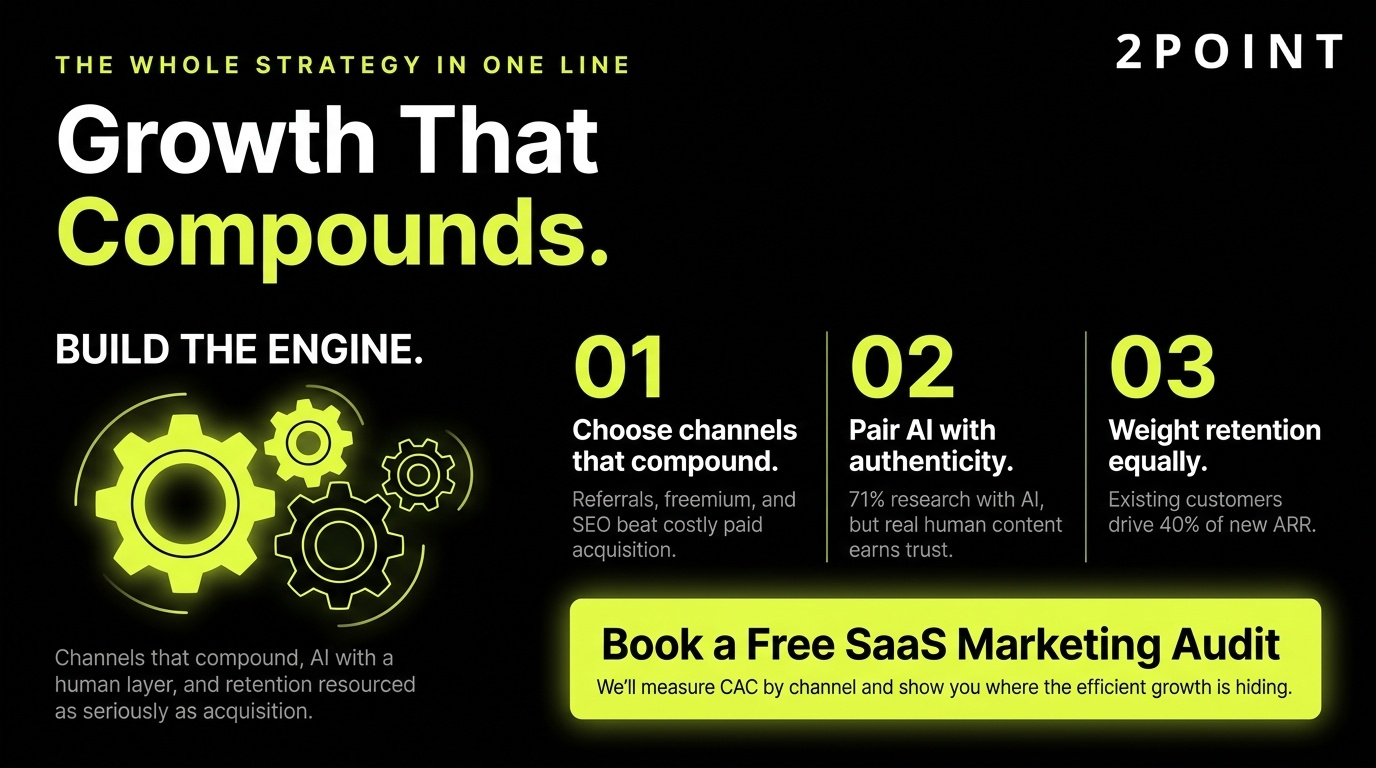
Retention and expansion deserve equal strategic weight with acquisition in every SaaS marketing plan and budget. The mathematical reality of NRR compounding, the cost differential between acquiring new customers and growing existing ones, and the referral and advocacy flywheel that satisfied customers create, all point toward the same conclusion: the customer success motion is the most efficient acquisition strategy available to a SaaS company with good product-market fit. Building customer marketing as a serious, resourced function rather than an afterthought is one of the most valuable investments a growing SaaS company can make.
The practical starting point for any SaaS company looking to improve its marketing performance is a focused audit: define the Ideal Customer Profile with the specificity required to identify actual target companies, measure CAC by channel rather than in aggregate to understand where efficiency is strong and where it is not, identify the one or two channels where genuine competitive advantage is achievable with focused investment, and build the retention and expansion programs that will compound the value of every customer acquired going forward.
For SaaS companies navigating these challenges, working with a partner who understands the specific economics and growth dynamics of subscription software businesses can accelerate the learning curve significantly. 2POINT works with SaaS companies to build the integrated marketing systems, from content and SEO to demand generation and retention programs, that create sustainable, efficient growth in a competitive market. Whether you are building your first SaaS marketing strategy or optimizing an existing program, the principles in this guide provide the foundation for making decisions that compound in your favor over time.
Frequently Asked Questions About SaaS Marketing
What is SaaS marketing and how does it differ from traditional software marketing?
SaaS marketing is the practice of acquiring, activating, and retaining customers for software-as-a-service products through digital channels. Unlike traditional software marketing, which focuses on one-time license sales, SaaS marketing prioritizes subscription retention, expansion revenue, and lifetime customer value as the primary economic drivers. This creates a much stronger focus on post-sale marketing, customer success, and ongoing product adoption than traditional software marketing requires.
What is a good customer acquisition cost for SaaS companies?
The appropriate CAC depends heavily on customer segment and product ACV. Enterprise SaaS companies average $1,200 in CAC while SMB-focused companies see around $98. The most important measure is not the absolute CAC number but the LTV:CAC ratio, which should target 3:1 or higher, and the CAC payback period, which should be under 12 months for a strong model and under 18 months for an acceptable one.
What are the most effective SaaS marketing strategies for customer acquisition?
The highest-ROI SaaS acquisition channels are referral programs ($141 to $200 CAC), freemium product-led growth ($141 average CAC), and organic content marketing and SEO ($480 to $942 CAC with compounding long-term returns). Paid search at $802 CAC and outbound sales at nearly $2,000 CAC offer faster initial results but no compounding benefit. The optimal mix depends on stage, segment, and available resources.
How does product-led growth work in SaaS marketing?
Product-led growth uses the product itself as the primary vehicle for acquisition, conversion, and expansion. New users access the product through a free tier or trial, experience its core value, and upgrade to paid plans when they outgrow the free version or need premium features. The critical challenge is activation: only 37.5% of SaaS trial users reach the point where they genuinely experience the product's value, making onboarding optimization central to PLG success.
What is net revenue retention and why does it matter for SaaS growth?
Net Revenue Retention (NRR) measures the percentage of revenue retained from existing customers after accounting for expansions, contractions, and cancellations. An NRR above 100% means the existing customer base grows revenue without any new customer acquisition. Companies with NRR above 106% grow 2.5 times faster than those below this benchmark, making it one of the most important indicators of sustainable SaaS business health.
How is AI changing SaaS marketing in 2026?
AI is transforming SaaS marketing on two fronts: inside marketing teams, where autonomous agents manage onboarding sequences, lead scoring, and lifecycle communications, and in buyer behavior, where 71% of B2B buyers now use AI chatbots to research software purchases. This requires SaaS marketers to optimize for both traditional search engines and AI answer engines, a discipline called Generative Engine Optimization (GEO), while deploying AI automation internally for efficiency.
What is the difference between SaaS marketing and B2B SaaS marketing?
SaaS marketing encompasses all software-as-a-service businesses, including both consumer and business-facing products. B2B SaaS marketing specifically addresses selling software to organizations rather than individuals, which involves longer sales cycles averaging 134 days, multiple decision-makers and stakeholders, higher deal values, and procurement processes with security and compliance requirements. B2B SaaS marketing typically relies more heavily on content marketing, account-based approaches, and sales and marketing alignment than consumer SaaS.
How long does it take for SaaS content marketing to generate results?
Content marketing typically requires six to twelve months to generate meaningful organic traffic and twelve to twenty-four months to produce material pipeline impact. This timeline reflects how long search engines take to index, rank, and surface new content for competitive keywords. The payoff is substantial: content that ranks well continues generating customers for years at near-zero marginal cost, making it the most economically attractive long-term acquisition channel for most SaaS companies.
What SaaS marketing metrics should early-stage companies prioritize?
Early-stage SaaS companies should prioritize activation rate (the percentage of sign-ups who reach the core product value moment), time-to-value (how quickly new users experience meaningful outcomes), and CAC by channel (to identify which acquisition sources deliver the best economics). Churn rate is equally critical: reducing early churn is far more economical than increasing acquisition spend. These metrics provide the signal needed to optimize the product experience before scaling acquisition.
Is SaaS marketing the same as subscription marketing?
SaaS marketing and subscription marketing share core principles, specifically the emphasis on retention, lifetime value, and expansion revenue, but SaaS marketing has additional dimensions unique to software products. These include product-led growth mechanics, in-product behavioral marketing, technical SEO for software categories, and the integration of marketing with product usage data. Not all subscription businesses are SaaS companies, and SaaS marketing best practices do not automatically transfer to other subscription models like media or eCommerce.
How should SaaS companies market to enterprise buyers vs. SMB buyers?
Enterprise SaaS marketing requires longer-cycle account-based approaches, stakeholder mapping across multiple decision-makers, security and compliance content, executive-level relationship building, and personalized demonstrations. SMB SaaS marketing succeeds with product-led growth, self-service trial experiences, transparent pricing, and high-volume digital channels. The economic models differ significantly: enterprise CAC averages $1,200 but justifies the spend through large ACV, while SMB CAC must stay near $98 to remain economically viable at typical SMB price points.
What is Generative Engine Optimization (GEO) for SaaS marketing?
Generative Engine Optimization is the practice of structuring content to be cited and recommended by AI answer engines like ChatGPT, Perplexity, and Google AI Overviews. GEO-optimized content uses clear definitional statements, properly attributed statistics, direct answers to common questions, and structured formats that AI systems can accurately excerpt and cite. Since 71% of B2B buyers use AI chatbots for software research, appearing in AI-generated answers is becoming as critical as traditional search ranking for SaaS discoverability.
