


 let’s connect


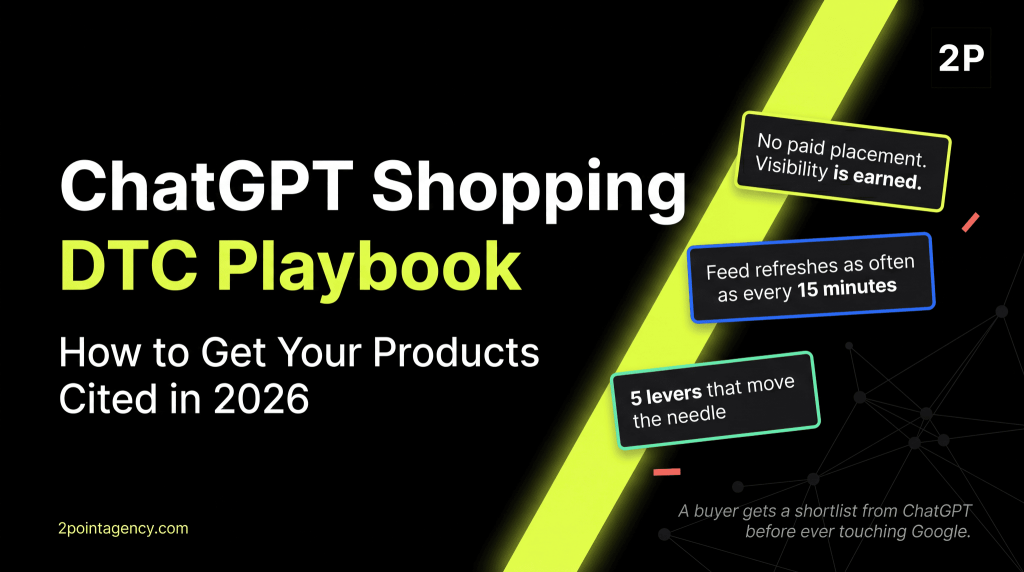
A buyer who used to land on your category page now asks ChatGPT for “the best lightweight running shoes for flat feet under $150” and gets a three-product shortlist with images, prices, and a direct purchase link.
No Google. No category scroll. Just a conversation that ends in a conversion.
That is ChatGPT Shopping, and ecommerce GEO is the discipline of getting your products into those results.
Most DTC brands are still treating this like a future problem. It is not. ChatGPT Shopping optimization is already influencing purchase decisions at scale, and the brands building their feeds and trust signals now are pulling ahead fast.
2POINT works with mid-market DTC brands navigating exactly this shift.
Key Takeaways
- ChatGPT Shopping surfaces product recommendations from a merchant feed that OpenAI can ingest every 15 minutes for high-velocity SKUs.
- Brands do not pay to appear. Visibility in ecommerce GEO is earned through feed quality, product schema, trust signals, and content that LLMs can actually parse.
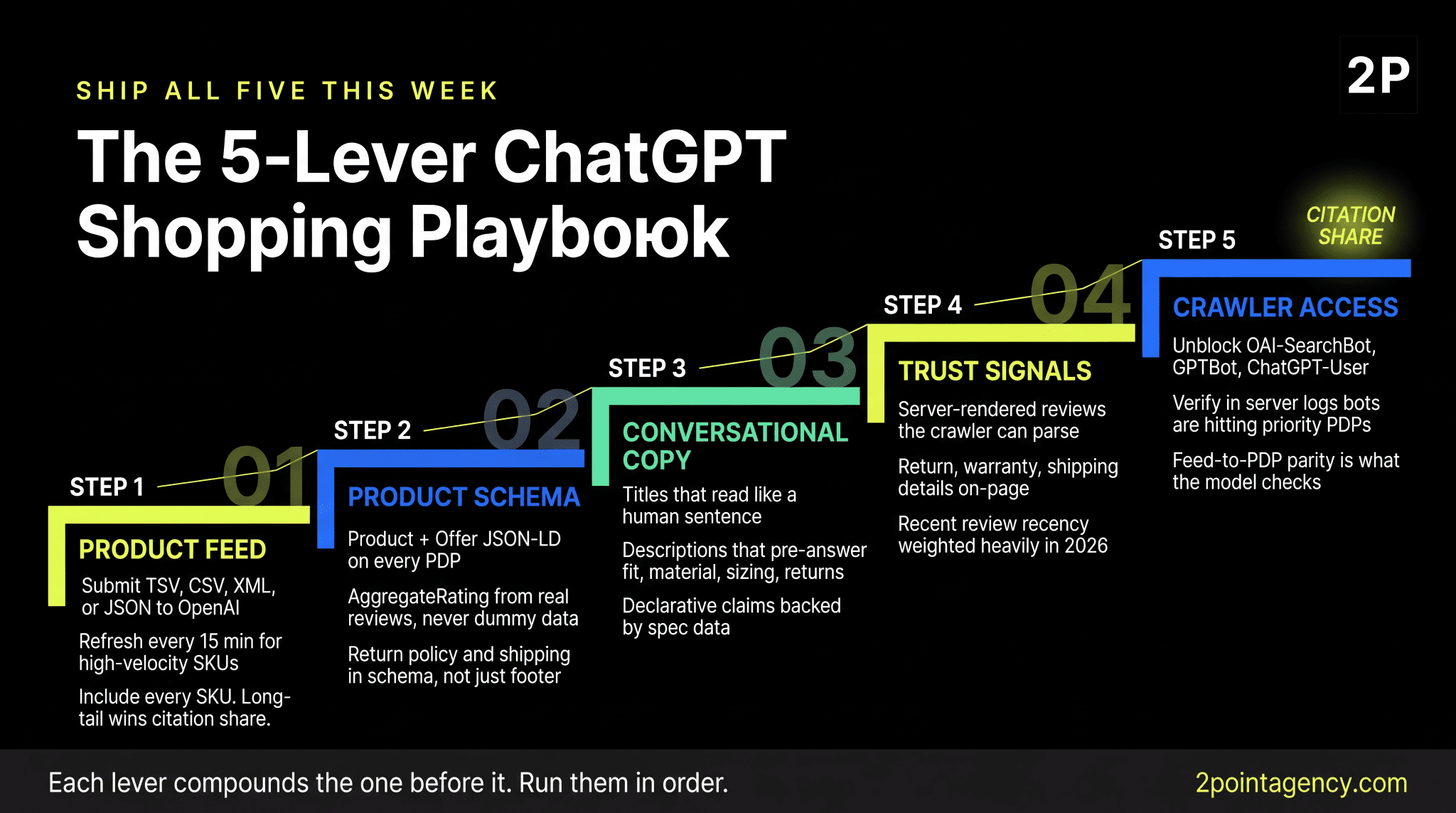
- Five levers move the needle: feed completeness, Product and Offer schema, conversational copy, review signals, and crawler access.
- The Perplexity Merchant Program is a free parallel channel that most DTC brands have not yet applied for, and it is one of the highest-converting AI referral sources available.
- Monitoring matters because citation volatility is high. Weekly spot-checks catch drops before they turn into lost revenue.
- Small catalogs can run this in-house. Brands with 1,000 or more SKUs usually need outside support to maintain the cadence.
What ChatGPT Shopping Actually Is in 2026
OpenAI started showing shopping results in ChatGPT in 2024 and rolled them out as the default experience through 2025 and into 2026. You do not opt in as a shopper. You ask for something, and the model surfaces a card-style carousel with pricing, ratings, and a direct purchase link.
Recommendations come from a merchant-submitted product feed that OpenAI ingests on a rolling basis.
As Search Engine Land reported, “the feed isn’t just another signal. It’s a primary authority on your brand and products.” That reframes product data from a nice-to-have into the actual foundation of your ecommerce GEO strategy.
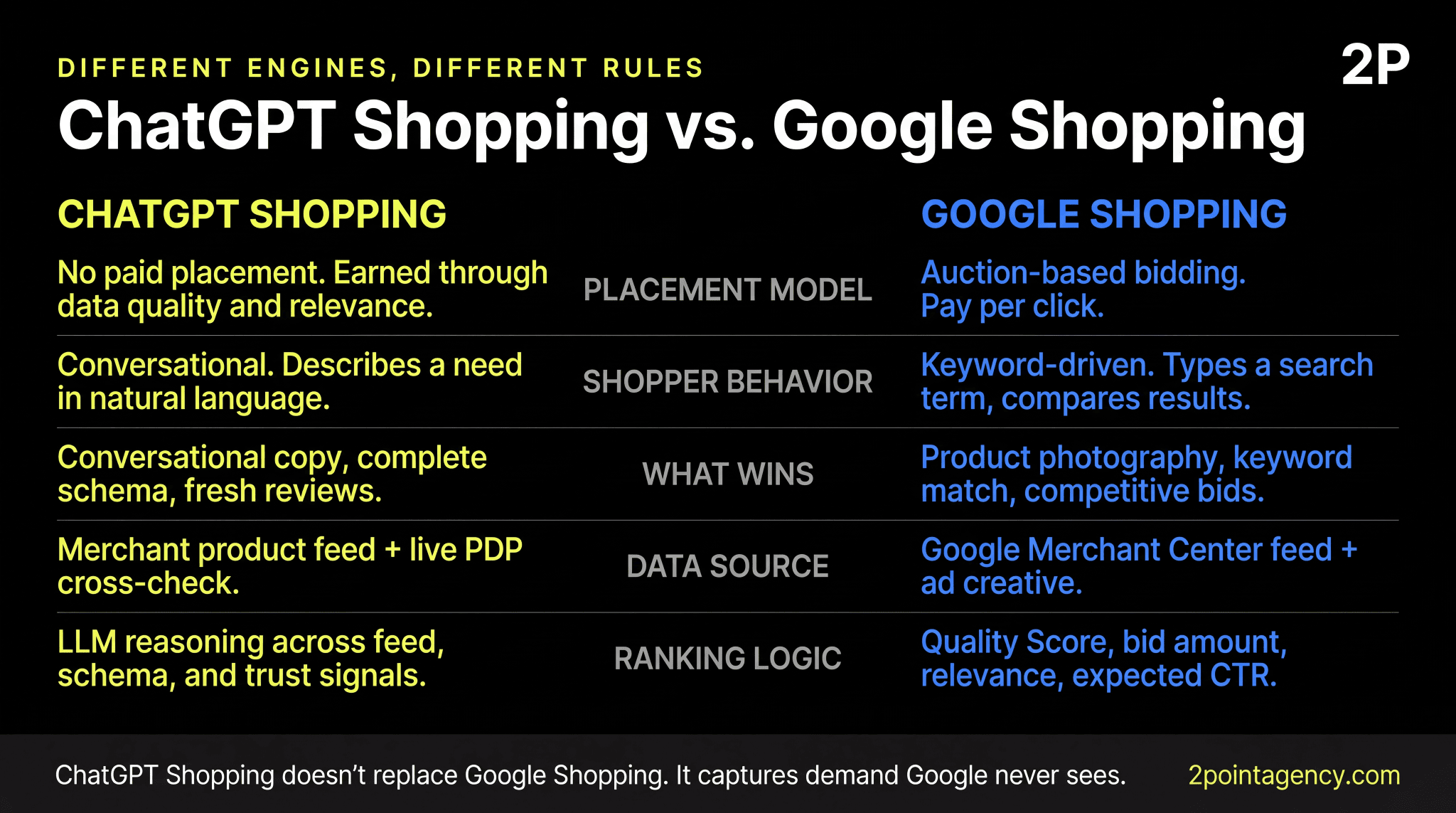
Three ways ChatGPT Shopping differs from Google Shopping:
- No paid placement: You cannot bid your way in. Visibility is earned through data quality and query relevance.
- Conversational intent: Shoppers describe needs in natural language, so the model rewards products with declarative, benefit-led copy.
- LLM reasoning, not rank: The model cross-references your feed against your live product page. If the two disagree, you lose.
Why Your Products Are Not Showing Up (Yet)
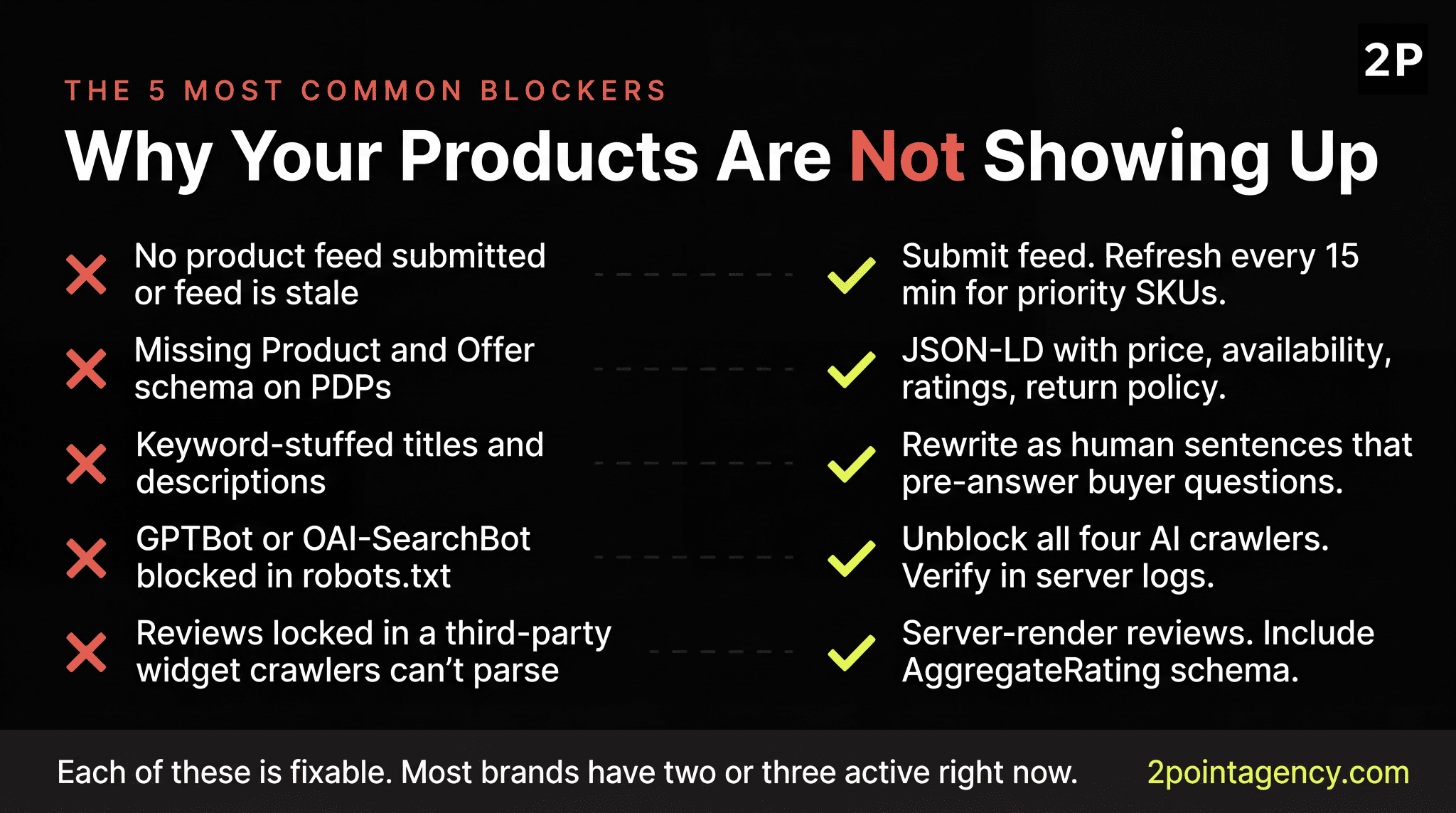
Pattern recognition from audits across dozens of ecommerce sites points to the same handful of blockers every time. If any of these sound familiar, you are not alone:
- No product feed submitted to OpenAI, or a feed uploaded once and left untouched for weeks
- Thin or missing Product and Offer schema on your product detail pages
- Keyword-stuffed titles and descriptions that read like 2018 SEO copy rather than natural buyer language
- OAI-SearchBot or GPTBot is blocked in robots.txt, cutting off the crawler that feeds the index
- Review and rating data are locked inside a third-party widget that the crawler cannot parse
Each of these is fixable. The rest of this playbook walks through exactly how to do it.
The ChatGPT Shopping Optimization Playbook
Five levers. Each one is something your DTC team can ship within a week with dev resources aligned. Run them in order because each step compounds the one before it.
1. Submit and Maintain a Clean Product Feed
Your product feed for ChatGPT Shopping is the foundation everything else builds on. OpenAI accepts TSV, CSV, XML, or JSON, with the following required fields: id, title, description, link, image, availability, price, brand, and GTIN.
Optional fields add performance signals, rich media, and custom variants that differentiate your listings inside a crowded category.
Refresh cadence matters just as much as completeness. For high-velocity SKUs, target feed updates every 15 minutes. Stale pricing or inventory data signals low reliability to the model, which directly reduces how often your products appear.
With your cadence locked in, two rules determine whether your feed actually performs:
- Include every SKU, not just hero products: Conversational queries skew toward specific products, and long-tail coverage is where most brands quietly win citation share.
- Keep feed and PDP prices identical: A price mismatch between your feed and product page is one of the fastest ways to get downranked in ChatGPT Shopping results.
Your SEO integration stack is what makes feed maintenance sustainable at scale.
2. Nail Product and Offer Schema on Every PDP
Feed submission is only half the story.
The model cross-checks what your feed says against what your live product page actually renders. ChatGPT Shopping product schema is the language it uses to do that check, embedded as JSON-LD on every PDP.
The fields you need on every product page:
- Product schema: brand, GTIN, image, description, and identifier fields.
- Offer schema: price, priceCurrency, availability, and priceValidUntil.
- AggregateRating and Review schema: pulled from real customer data, never dummy values.
- hasMerchantReturnPolicy and shippingDetails: AI shopping assistants weight these heavily because returns and shipping directly influence purchase decisions.
Getting these right is one of the clearest signals of how to get products in ChatGPT results. Your AI search visibility audit checks whether your PDPs pass this test before shipping fixes.
3. Rewrite Product Copy for Conversational Shopping
Product titles packed with comma-separated keywords help win Google Shopping impressions. In ChatGPT Shopping, they quietly lose.
The model prefers copy that reads like how a shopper actually describes a product.
A well-optimized title reads like a human sentence. "Classic Women's A-Line Cotton Midi Dress in Cherry Red" consistently outperforms "Red Dress Cotton Midi A-Line Women" in conversational AI results.
Beyond the title, your descriptions should proactively answer the questions a buyer would ask: fit, material, care instructions, sizing, and return window.
The underlying principle is simple. LLMs prefer declarative claims backed by spec data over vague language like "perfect for almost any occasion." Shopify's AI SEO framework reinforces this shift toward benefit-led, conversational copy as the baseline for AI-driven product discovery.
4. Build Trust Signals the Crawler Can Read
Reviews are the single biggest trust lever in ChatGPT Shopping optimization, yet most brands hide them from crawlers. If your reviews live inside a third-party iframe that loads after page render, the model treats your product as unreviewed.
Server-rendered reviews are the baseline.
Beyond that, return policy, warranty terms, and shipping details should live on the page and inside your ChatGPT Shopping product schema, not buried in a footer.
Freshness matters as much as volume. Recent reviews carry more weight because LLMs heavily favor recency as a quality signal in ecommerce GEO.
5. Unblock the Crawlers That Feed the Index
None of the work above matters if your robots.txt is quietly blocking the bots that feed the index.
The four user agents you need to verify access for are OAI-SearchBot, GPTBot, ChatGPT-User, and PerplexityBot. Pull your file up now and check.
Many brands blocked GPTBot in 2024 as a reflexive content protection move. Some of those same brands are now invisible in ChatGPT Shopping. Blocking GPTBot stops training ingestion but can also reduce live visibility. You need to decide which side of that trade-off best serves your brand.
Once access is confirmed, verify in your server logs that crawlers are hitting your priority PDPs. Google Search Central states that product structured data must be crawlable and visible in the HTML to be indexed, which directly affects how AI shopping surfaces read your pages.
The Perplexity Merchant Program: A Free Parallel Channel
While most brands are focused on ChatGPT, Perplexity is quietly building one of the highest-converting AI shopping surfaces available. The Perplexity Merchant Program is free to join and lets brands submit product data directly to Perplexity for use inside its recommendation answers.
As TechCrunch reported, merchants that provide detailed product data are more likely to have their products recommended because Perplexity has more complete information to work with.
Three reasons it is worth 30 minutes of your time:
- Citation transparency: Perplexity shows shoppers exactly where recommendations come from, making clicks more deliberate and higher intent.
- Conversion quality: Traffic from Perplexity converts closer to branded search rates because shoppers arrive with purchase intent already formed.
- Early mover advantage: The program is still small enough that early adopters capture a disproportionate share of voice while competitors are still debating whether it matters.
BigCommerce's ecommerce GEO analysis covers how these AI shopping surfaces are shifting across the broader market.
How to Monitor ChatGPT Shopping Visibility
Traditional rank trackers were never built for AI shopping surfaces. Your baseline workflow should include weekly manual spot checks on 10 to 20 priority shopping queries across ChatGPT, Perplexity, and Gemini.
For scale, tools like Profound, Peec AI, Otterly, and Athena HQ automate citation tracking across all major AI surfaces.
Three metrics actually matter: appearance rate, average position inside the product card carousel, and competitor appearance delta. Track all three monthly.
Beyond that, break out AI referral traffic inside GA4 as its own channel. That single step changes how leadership perceives your investment because they can see AI-driven revenue reported separately from organic search. Your tracking stack is what makes this sustainable at scale.
Common ChatGPT Shopping Mistakes DTC Brands Make
Most DTC brands make the same five mistakes when entering ChatGPT Shopping. Avoid these, and you are already ahead of most of your category:
- Treating the feed as a one-and-done upload: Product data is a live pipe, not a set-and-forget file. Stale feeds lose visibility fast.
- Skipping Offer schema updates: When your price or stock changes, your schema needs to match. Feed-to-PDP parity is what the model checks.
- Blocking GPTBot without understanding the cost: That block may also be cutting your live citation potential.
- Ignoring Perplexity: The traffic looks small today. It is growing faster than any other AI shopping surface right now.
- Measuring with legacy rank trackers: Traditional tools have no visibility into AI shopping surfaces.
In-House vs Agency: Who Should Run ChatGPT Shopping Optimization?
The honest answer depends on your catalog size, engineering bandwidth, and how seriously leadership takes AI search.
| Factor | In-House | Agency |
| SKU count | Under 500 | 500+ |
| Storefronts | Single market | Multi-market |
| GEO experience | 12+ months in-house | Little or no LLM experience |
| Feed maintenance | The dev team is fully available | Limited or no dedicated bandwidth |
| Quarterly reporting | Internal only | Leadership or board level |
| Audit cadence | Quarterly manageable | Monthly or faster needed |
Feed maintenance at scale, multi-market query sets, schema updates across thousands of PDPs, and executive-level reporting all compound quickly. Most in-house teams underestimate the ongoing cadence this channel demands until they are already behind.
2POINT's SEO team helps mid-market DTC brands build the technical and content foundation needed to earn citation share across AI shopping surfaces.
Is Your Product Feed Ready for ChatGPT Shopping?
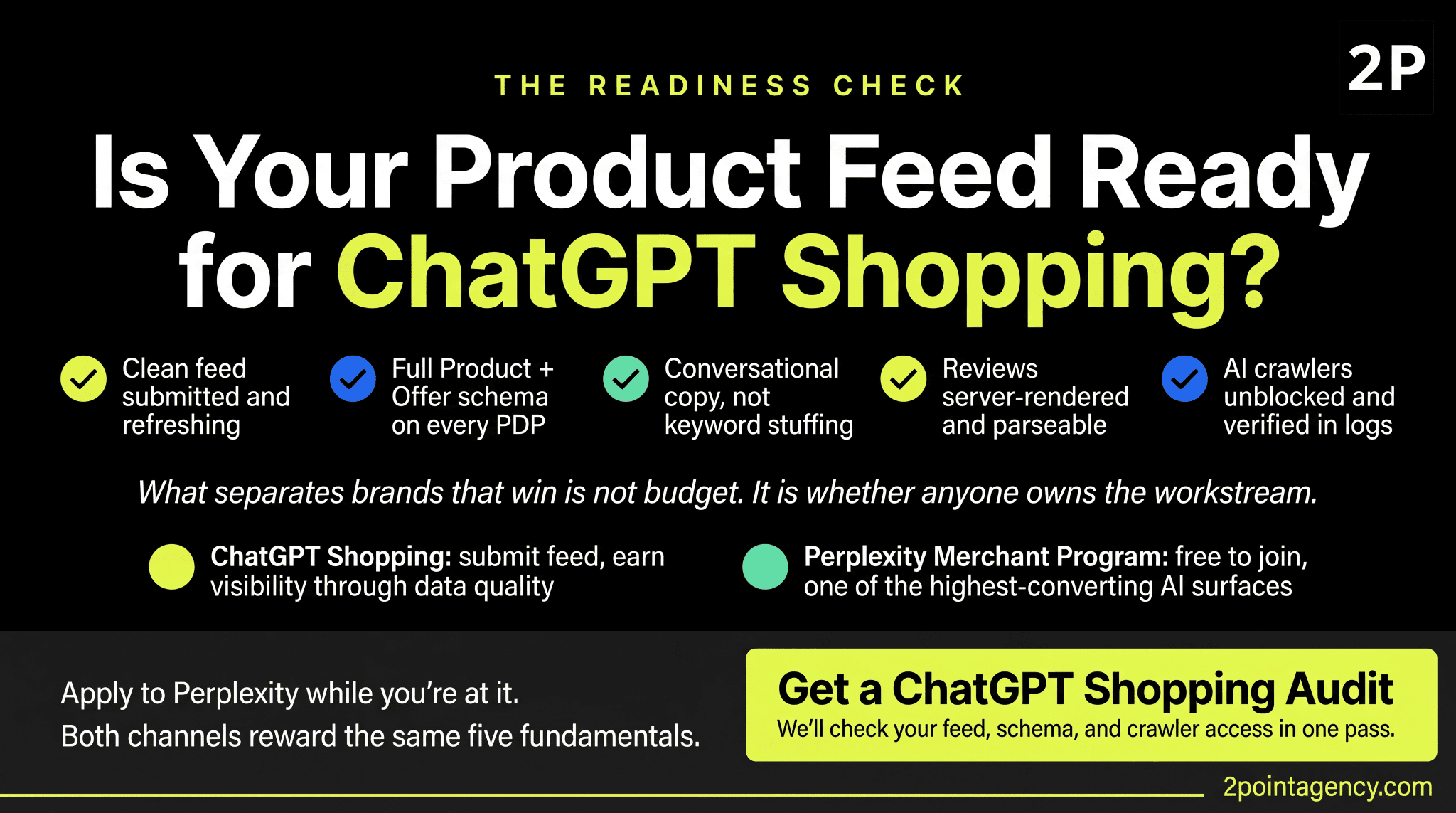
Knowing how to optimize for ChatGPT Shopping comes down to five things: a clean product feed, full ChatGPT Shopping product schema on every PDP, conversational copy, parseable trust signals, and unblocked crawlers.
Apply to the Perplexity Merchant Program while you are at it.
What separates brands that win from those that do not is not budget. It is whether anyone actually owns the workstream.
2POINT's SEO team, AIOBot, and multi-channel marketing support help DTC brands build the foundation that earns citation share across AI shopping surfaces.
FAQs About ChatGPT Shopping Optimization
What is ChatGPT Shopping and how does it work?
ChatGPT Shopping is OpenAI's in-chat product recommendation surface. Visibility comes from a merchant-submitted product feed combined with on-page ChatGPT Shopping product schema, not paid placement. When you ask for product advice, the model returns card-style listings with images, prices, and merchant links.
How do I submit a product feed to ChatGPT?
To submit a product feed for ChatGPT Shopping, use TSV, CSV, XML, or JSON through OpenAI's merchant onboarding process. Required fields include id, title, description, availability, price, brand, and GTIN. Refresh every 15 minutes for high-velocity SKUs.
Does ChatGPT Shopping charge brands for placement?
No. ChatGPT Shopping optimization is earned through feed quality, schema, trust signals, and copy that matches real shopper queries. There is no paid placement. That makes it much closer in spirit to SEO than to traditional Google Shopping ads.
How is ecommerce GEO different from Google Shopping SEO?
Google Shopping runs on paid bids and keyword matching. Ecommerce GEO for ChatGPT Shopping has no paid placement and runs on LLM reasoning applied to your feed and live PDP content. Shoppers search conversationally, which rewards natural copy over keyword-stuffed titles.
What is the Perplexity Merchant Program?
The Perplexity Merchant Program is a free initiative that lets brands submit product data directly to Perplexity for use in its recommendation answers. Merchants with detailed data are more likely to be recommended. It is one of the fastest-growing AI shopping surfaces available to DTC brands today.
Should I block GPTBot from my ecommerce site?
Blocking GPTBot stops training ingestion but can reduce live visibility across AI surfaces. If knowing how to get products in ChatGPT matters to your brand, weigh the tradeoff carefully before blocking it. Competitors who leave GPTBot unblocked will capture the citation share you give up.
How do I optimize Shopify for ChatGPT Shopping?
To optimize Shopify for ChatGPT Shopping, submit a complete product feed, add Product and Offer schema to every PDP, write conversational copy, ensure reviews are server-rendered, and confirm GPTBot is not blocked in your robots.txt. All five steps compound each other.