

 let’s connect


What Is B2C Marketing
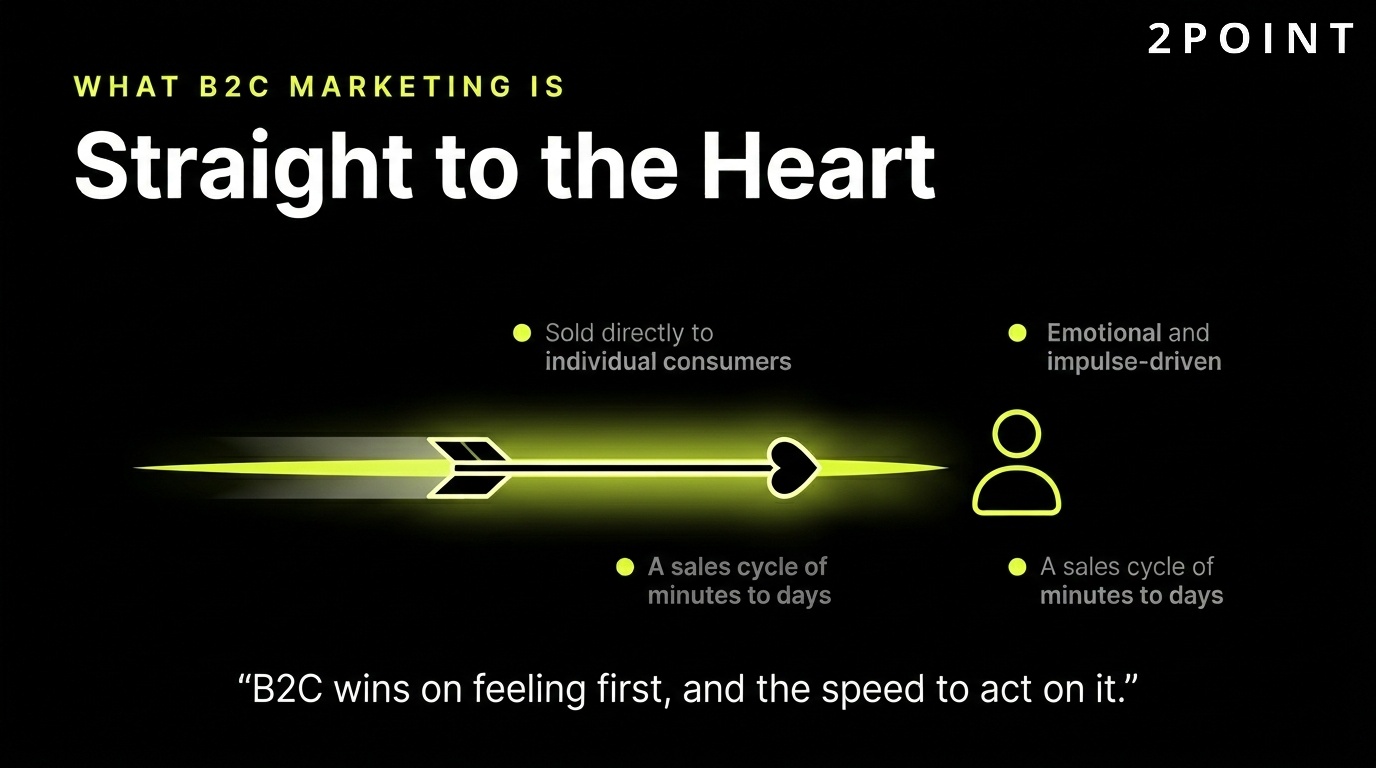
- B2C marketing covers every strategy and tactic a company uses to sell products or services directly to individual consumers.
- It focuses on emotional connections, shorter sales cycles, and impulse-driven purchasing decisions.
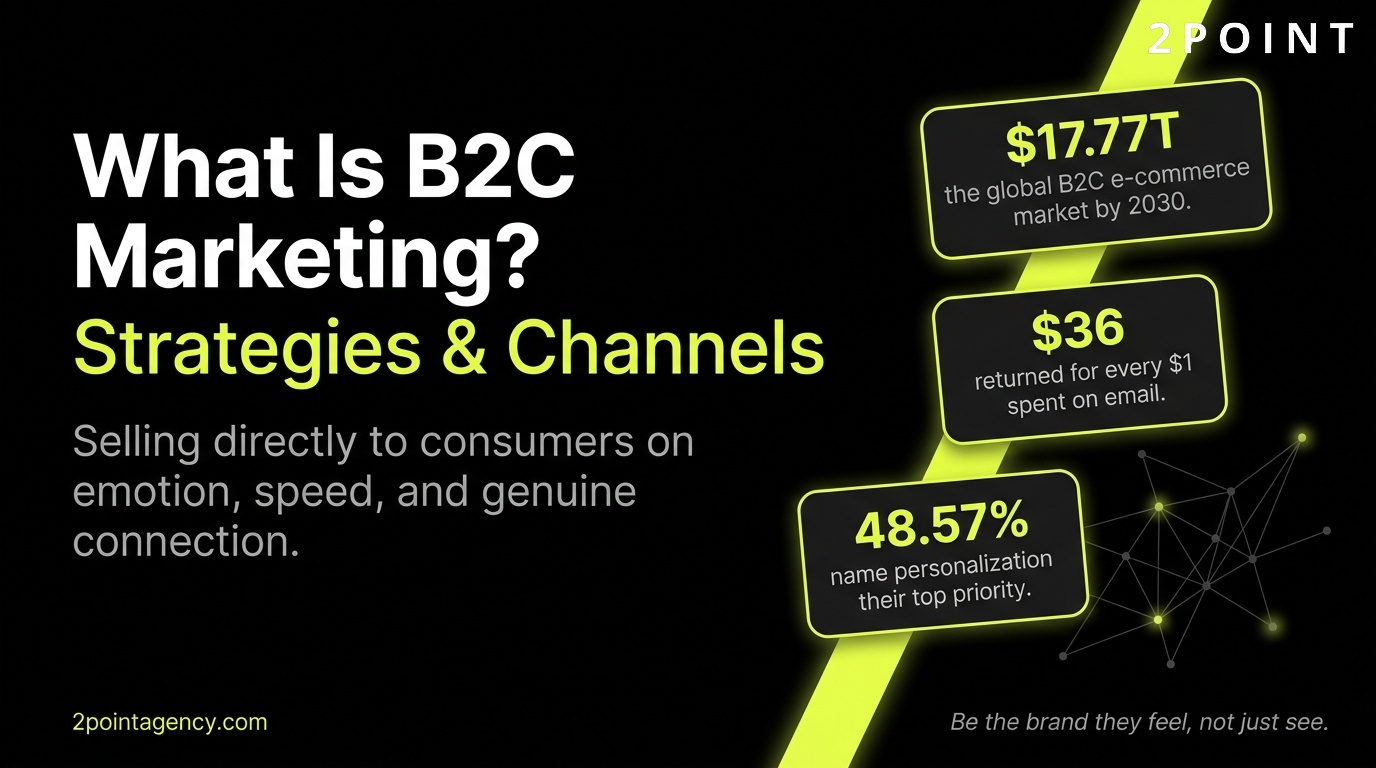
- The global B2C e-commerce market reached $4.47 trillion in 2023 and is projected to reach $17.77 trillion by 2030.
- Email marketing delivers a $36 return for every $1 spent, making it the top ROI channel for B2C brands.
- Social media is used by 91% of B2C marketers, with 76% of consumers reporting social media influenced their purchases.
- AI-driven personalization is the top B2C priority in 2026, adopted by nearly half of all B2C marketers.
- Successful B2C marketing balances technological innovation with genuine human connection, trust, and relevant value delivery.
- Privacy-first data strategies are now essential, with 83% of consumers naming data protection as a top trust factor.
Understanding B2C Marketing: Definition and Core Principles
B2C marketing is one of the most dynamic disciplines in the modern business landscape. At its core, it is the practice of promoting and selling products or services directly to individual end consumers rather than to other businesses. Whether a brand is selling running shoes, streaming subscriptions, home appliances, or travel experiences, B2C marketing is the engine that connects those offerings to the people who want them.
What Distinguishes B2C Marketing from B2B Marketing
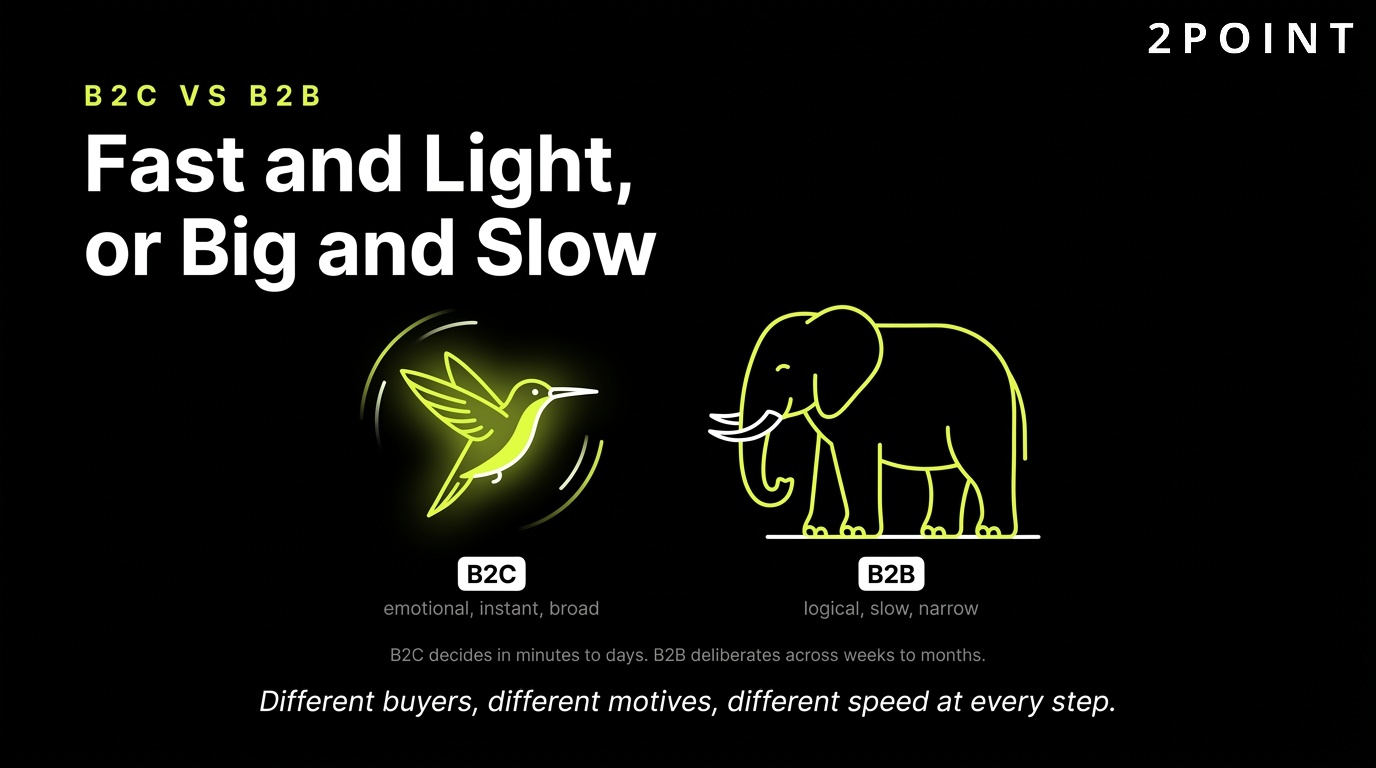
The most fundamental difference between B2C and B2B marketing lies in the decision-making process. According to EzyCourse's analysis of B2C marketing, B2C decisions are emotional and impulse-driven, shaped by personal preferences, immediate desires, and lifestyle aspirations. B2B purchasing, by contrast, involves committees, longer deliberation periods, and a focus on demonstrable ROI and business outcomes.
The sales cycle length is another defining distinction. B2C sales cycles can span mere minutes, from the moment a consumer discovers a product on Instagram to the moment they complete checkout. B2B cycles routinely stretch across weeks or months of evaluation, proposal review, and contract negotiation. This speed difference fundamentally shapes how B2C marketers structure campaigns, build funnels, and nurture prospects.
B2C marketing targets a broad audience of individual consumers, often using demographic and psychographic segmentation to reach millions of people simultaneously. B2B marketing narrows its focus to specific decision-makers within defined companies. The messaging differs accordingly: B2C copy leads with lifestyle benefits, personal satisfaction, and aspirational identity, while B2B content emphasizes efficiency gains, risk reduction, and financial returns.
| B2C Marketing Characteristic | B2B Marketing Characteristic |
|---|---|
| Emotional, impulse-driven decisions | Logical, committee-driven decisions |
| Sales cycle: minutes to days | Sales cycle: weeks to months |
| Broad consumer audience targeting | Narrow decision-maker targeting |
| Lifestyle and personal satisfaction messaging | ROI and business outcome messaging |
| High transaction volume, lower average order value | Lower transaction volume, higher average contract value |
The key takeaway is that B2C and B2B marketing require fundamentally different strategies because the people making purchase decisions, their motivations, and their timelines differ at every stage of the funnel.
The B2C Marketing Landscape in 2026
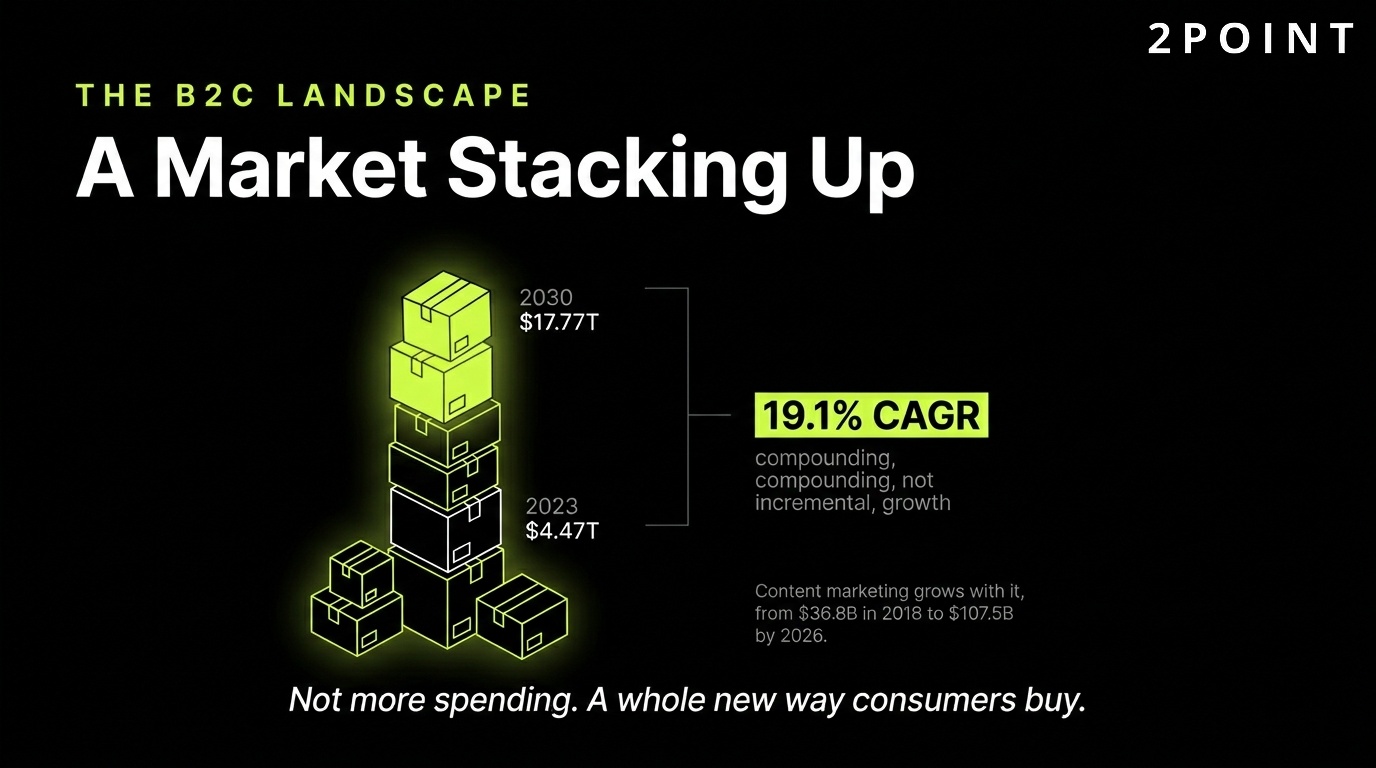
The scale of B2C commerce has reached extraordinary proportions. The global B2C e-commerce market stood at $4.47 trillion in 2023 and is forecast to reach $17.77 trillion by 2030, representing a compound annual growth rate of 19.1%. This is not incremental growth; it is a transformation of how consumers discover, evaluate, and purchase products across every category.
Content marketing, one of the most powerful tools in the B2C marketer's arsenal, has grown alongside this expansion. The global content marketing industry was valued at $36.8 billion in 2018. By 2026, it is forecast to reach $107.5 billion, with 2025 revenue already at approximately $94 billion and another 10.4% growth projected for 2026. These figures reflect how central content has become to consumer engagement and purchase influence.
Investment in B2C marketing is accelerating. Marketing budgets devoted to B2C activities now represent 26% of total marketing spend in 2026, and confidence in the channel remains high. In 2025, 88.2% of businesses expected their marketing budgets to grow or stay stable, a sign that brands recognize the compounding returns available to consistent B2C investment. For marketers who understand how to deploy resources strategically, the environment has never been more opportunity-rich.
Key Characteristics That Define Successful B2C Marketing
Successful B2C marketing shares a recognizable set of qualities regardless of industry or budget. The first is emotional resonance: the ability to create personal connections that make consumers feel a brand understands their lives, aspirations, or challenges. Brands that generate this kind of emotional bond do not just earn single transactions; they build loyalty that compounds over time.
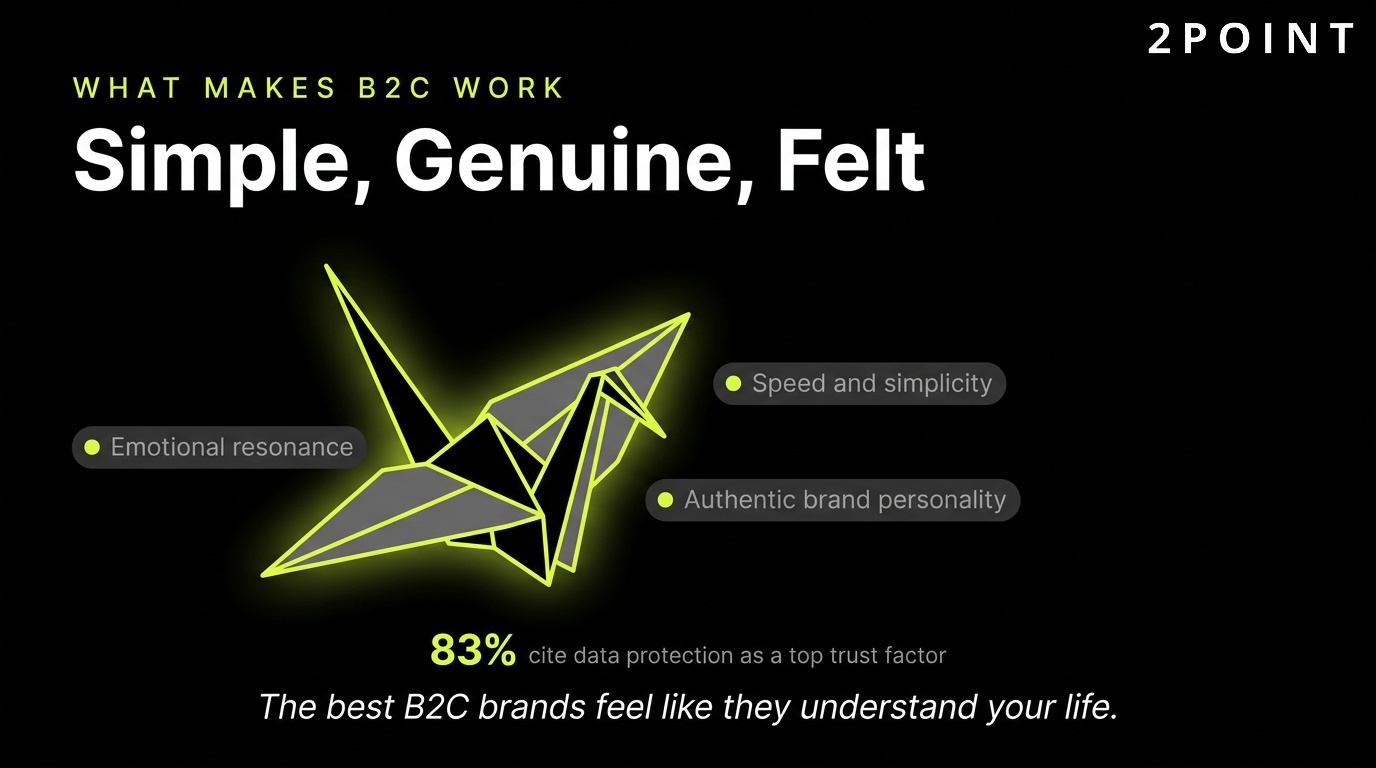
Speed and simplicity are equally critical. Consumers in 2026 are accustomed to frictionless digital experiences, from one-click checkout to instant streaming. Any unnecessary step in a purchase journey increases the probability of abandonment. The most effective B2C brands obsessively remove obstacles, streamline processes, and make the path from discovery to purchase as intuitive as possible.
Authentic brand personality, a focus on seamless customer experience, and the ability to quickly communicate relevant value complete the picture of B2C marketing excellence. Notably, 83% of consumers cite data protection as a top priority influencing trust, which means that how a brand handles consumer information is now as much a marketing consideration as the quality of its creative output.
The Evolution of Consumer Expectations
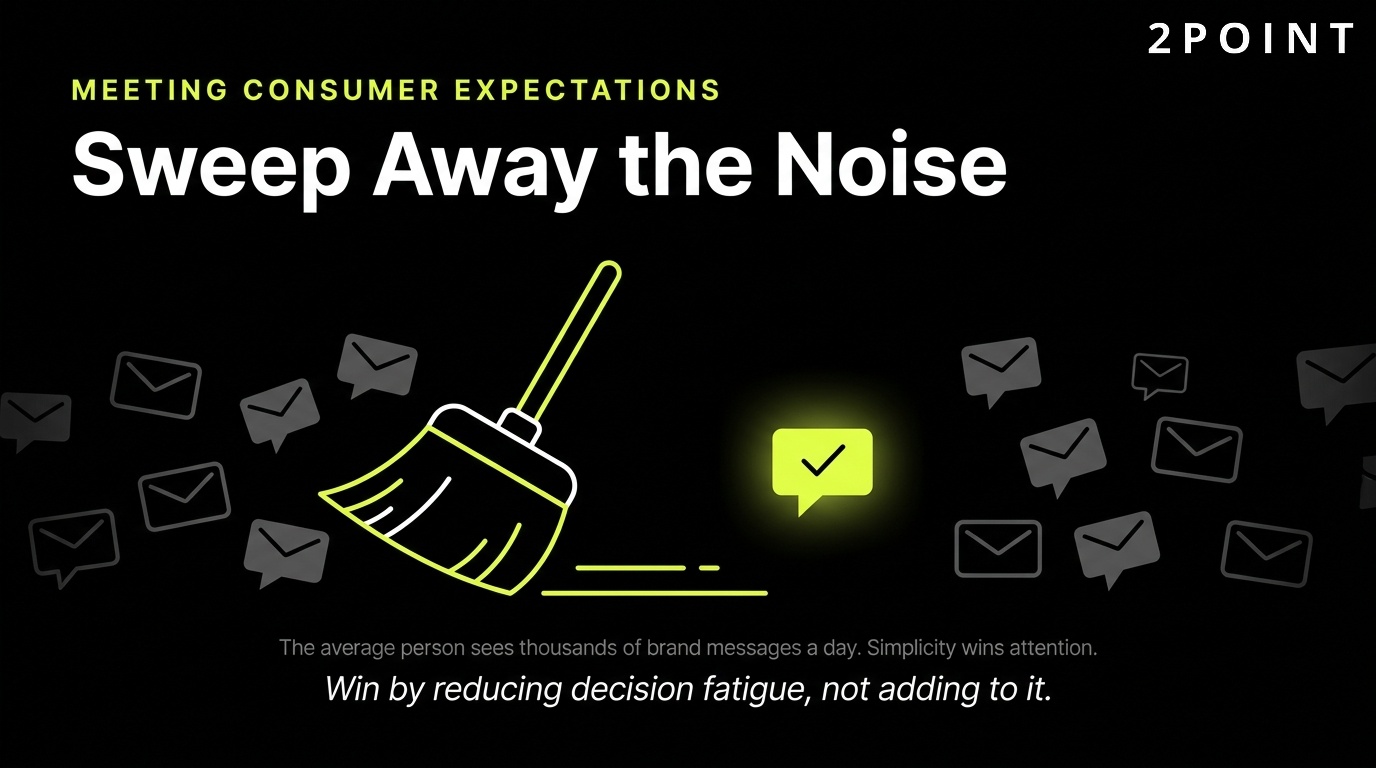
Consumer expectations have not just risen in recent years; they have been redefined entirely. Shoppers in 2026 expect brands to know their preferences, anticipate their needs, and communicate with them in ways that feel personal rather than generic. As Blueshift's 2026 B2C strategy analysis notes, brands that win will feel like they reduce decision fatigue rather than add to it.
Information overload is a genuine problem for modern consumers. The average person is exposed to thousands of brand messages daily across devices, platforms, and environments. The result is a kind of decision fatigue that makes consumers deeply appreciative of brands that simplify choices, communicate clearly, and deliver on promises without complexity. Brands that understand consumer expectations at this level earn attention that competitors cannot buy.
A growing sophistication around data privacy and AI usage is also reshaping the relationship between brands and consumers. People are increasingly aware that their data has value and that AI is influencing what they see online. This awareness creates both risk and opportunity for B2C marketers: brands that are transparent about data use and responsible about AI deployment build trust, while those that exploit consumer information or hide behind opaque algorithms face mounting backlash.
The Most Effective B2C Marketing Channels in 2026
Choosing the right channels is one of the most consequential decisions a B2C marketer makes. The channel mix determines where consumers first encounter a brand, how relationships deepen over time, and which touchpoints ultimately drive conversion. In 2026, the channel landscape is both richer and more competitive than ever before.
Email Marketing: The Highest ROI Channel for B2C Brands
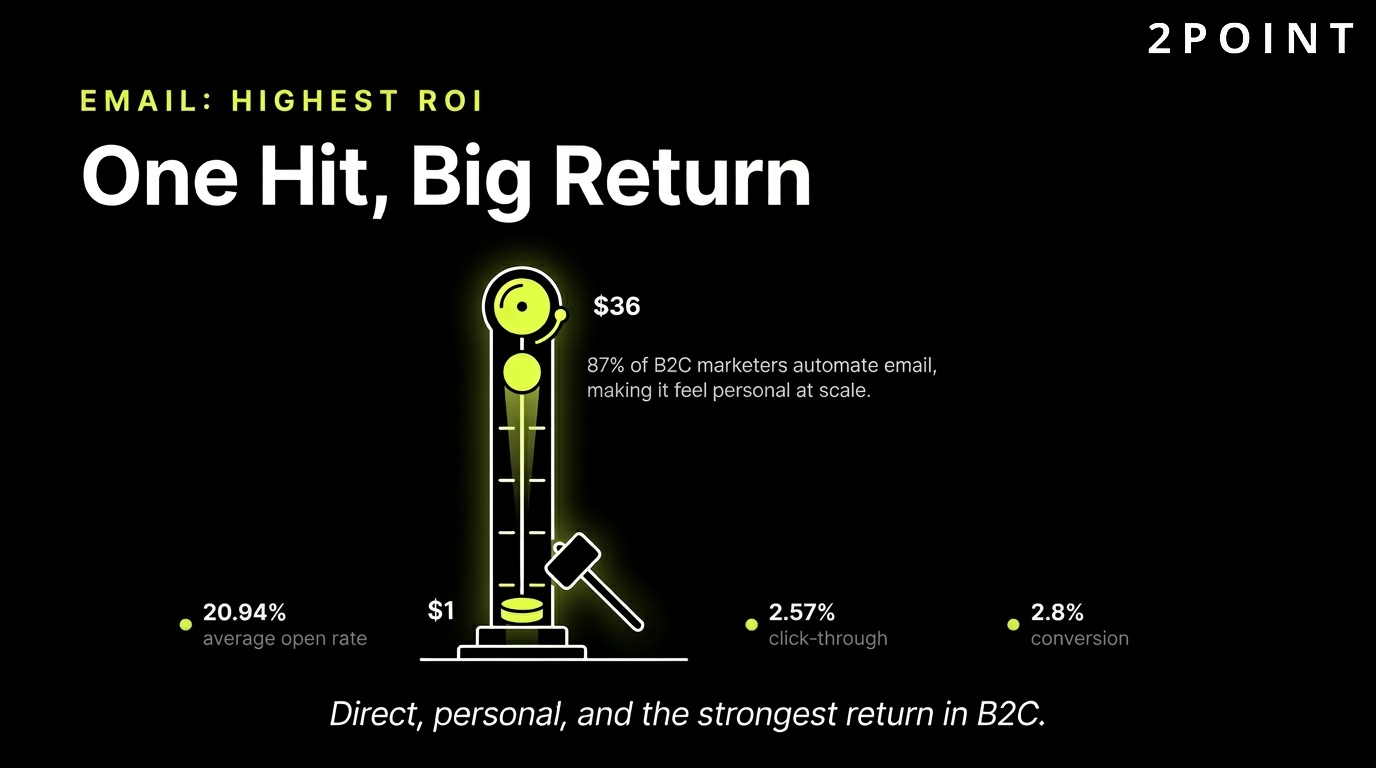
Email marketing consistently delivers the strongest return on investment of any B2C channel. According to current performance benchmarks, email delivers $36 for every $1 spent, a figure that has made it the backbone of countless B2C revenue strategies. Its ability to reach consumers directly, in a personal context, with messages tailored to their behavior and preferences, makes it uniquely powerful in an era of algorithmic uncertainty on social platforms.
Automation has transformed email from a broadcast tool into a dynamic, behavior-responsive channel. 87% of B2C marketers have integrated automation into their email strategies, enabling triggered sequences based on purchase history, browsing behavior, cart abandonment, and lifecycle stage. The result is a channel that can feel remarkably personal at scale, delivering the right message at the right moment without requiring manual intervention for every send.
Performance benchmarks provide useful targets for optimization. B2C emails achieve an average open rate of 20.94% and a click-through rate of 2.57%, with an overall conversion rate of 2.8% for B2C brands. These numbers may seem modest in isolation, but applied across large subscriber lists with intelligent segmentation, they translate into substantial revenue. Mobile optimization is non-negotiable: the majority of emails are now opened on smartphones, making responsive design and concise, scannable content essential for performance.
Best practices for B2C email include progressive personalization based on behavioral data, clear and compelling subject lines, single-minded calls to action, and consistent send frequency that maintains engagement without triggering fatigue. Segmentation by purchase stage, product category interest, and engagement level allows marketers to deliver relevance at scale, which directly drives both open rates and downstream conversions.
Social Media Marketing: Where Consumers Spend Their Time
Social media marketing has become a non-negotiable element of B2C strategy, and the numbers confirm why. 63.9% of the world's population actively uses social media platforms, creating an unprecedented concentration of consumer attention. For B2C brands, this represents both an enormous opportunity and an intensely competitive environment where differentiation requires genuine creativity and strategic clarity.
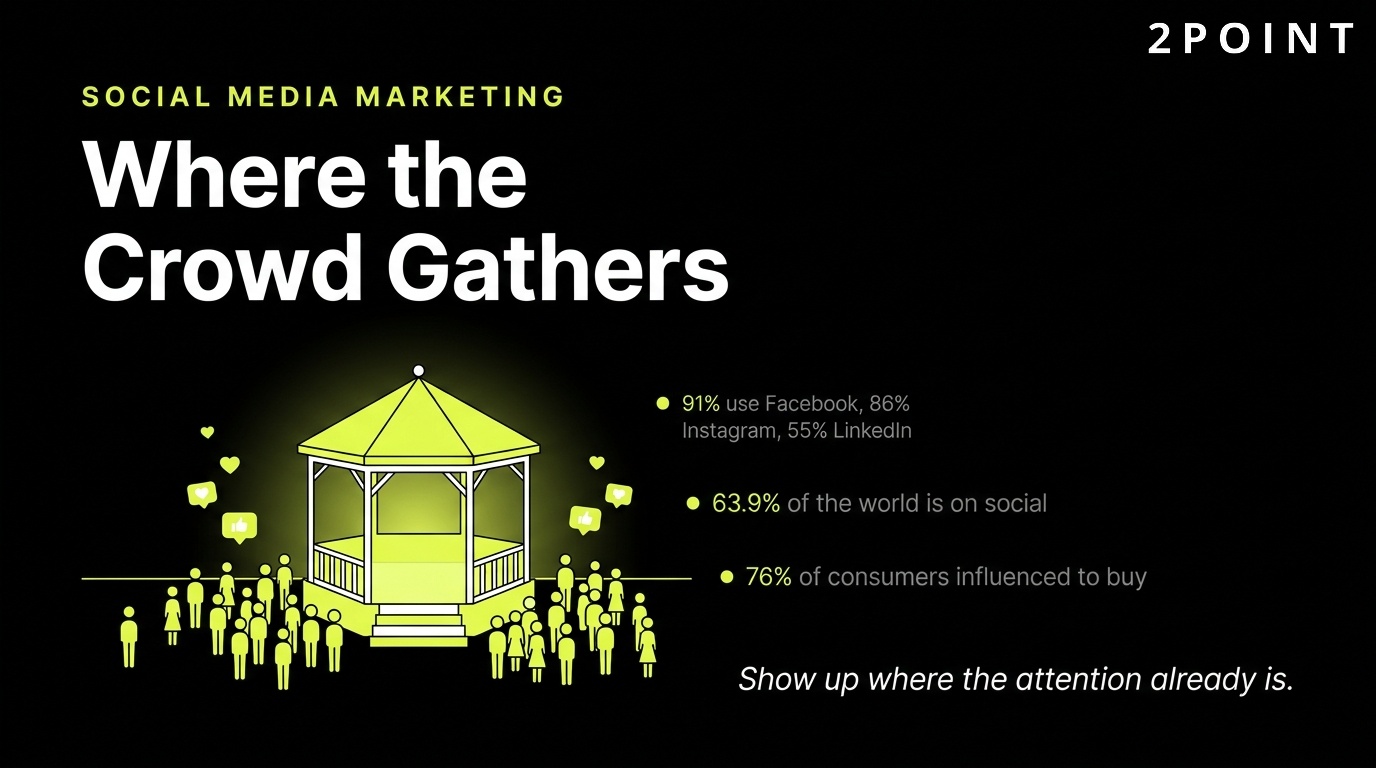
Platform preferences reveal important strategic considerations. Facebook is used by 91% of B2C marketers, making it the dominant platform despite demographic shifts. Instagram follows at 86%, with its visual-first format ideally suited to product discovery, lifestyle branding, and shoppable content. LinkedIn, typically associated with B2B, is used by 55% of B2C marketers, reflecting its growing relevance for brands targeting professional audiences or building thought leadership. According to research on B2C consumer behavior, 76% of consumers report that social media influenced their purchasing decisions, underscoring the channel's role in the purchase journey.
Organic social media content remains a vital strategy, used by 41.7% of B2C marketers in 2026. The shift toward native content that rewards platform-specific formats, whether that means vertical video on Instagram, long-form discussion threads on Facebook, or interactive polls on Stories, reflects an understanding that algorithms favor content that users engage with natively rather than content that feels imported from other channels.
Social commerce, the ability to discover and purchase products without leaving a social platform, is reshaping the B2C funnel in fundamental ways. In-platform purchasing reduces friction to near zero, shortening the distance between inspiration and transaction. Brands that have integrated their product catalogs with social commerce tools are capturing impulse purchases that previously required consumers to navigate away, potentially losing them in the process. The role of social media in modern marketing continues to expand well beyond awareness into active revenue generation.
Video Marketing: Short-Form Content Dominance in B2C Strategy
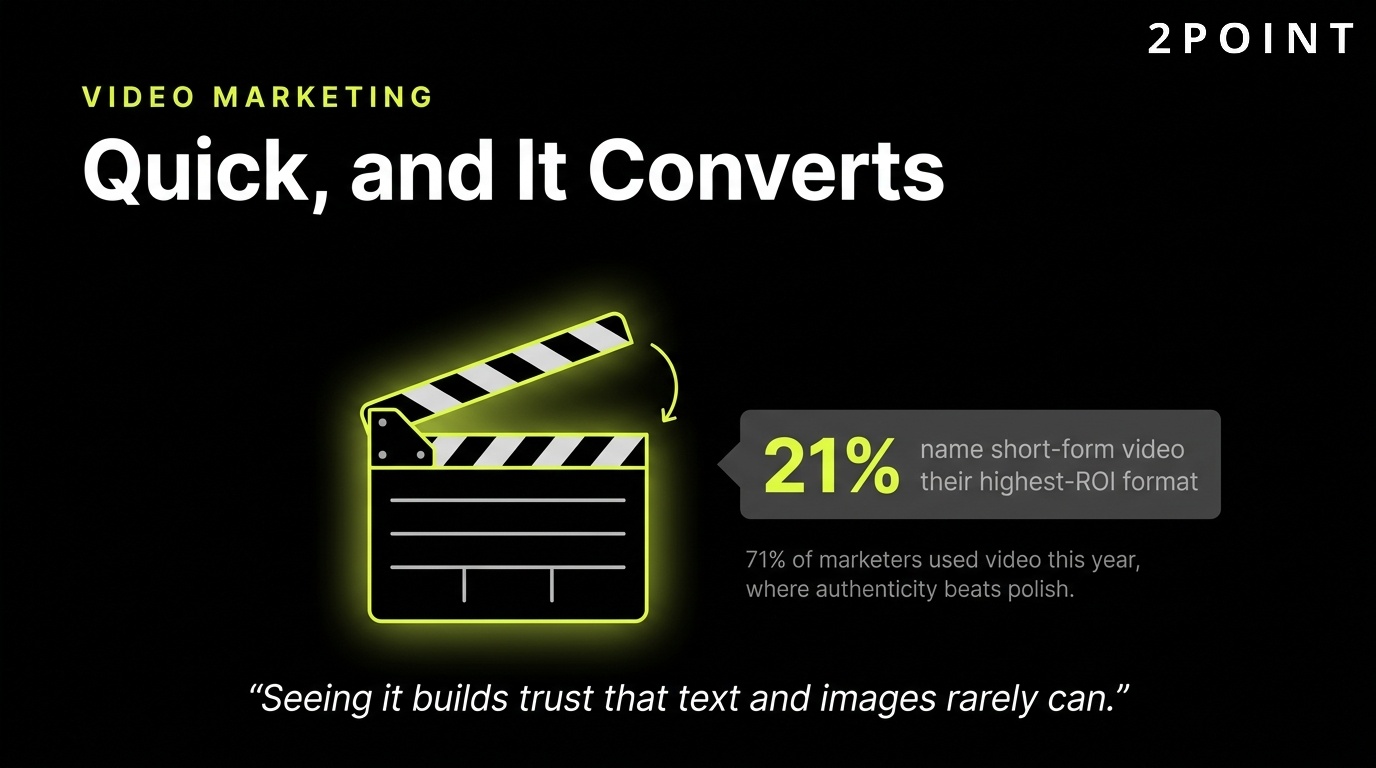
Video has emerged as the format that best serves B2C marketing's need for emotional impact, rapid trust-building, and platform-native engagement. 71% of marketers used video for content marketing in the last 12 months, and among those tracking format performance, 21% identify short-form video as the format delivering the highest ROI. These numbers reflect a broader cultural shift: consumers, particularly younger generations, have developed a preference for visual storytelling that delivers entertainment or information quickly and memorably.
TikTok, Instagram Reels, and YouTube Shorts have collectively redefined what video content looks like in a B2C context. The dominant aesthetic favors authenticity over production polish, with content that feels immediate and genuine outperforming slickly produced ads in engagement and trust metrics. This represents both a democratization of video production, brands no longer need Hollywood budgets to create effective content, and a new creative challenge: developing a distinctive voice that stands out in a crowded, fast-moving feed.
Video builds trust in ways that static content cannot easily replicate. Seeing a product demonstrated, hearing a founder's story, or watching real customers share their experiences creates a level of credibility that text and images rarely achieve. For B2C brands navigating an environment where consumers are increasingly skeptical of polished advertising, video offers a pathway to genuine connection. According to Blueshift's 2026 marketing analysis, video is increasingly where trust gets built, especially on social platforms where consumers spend the most time.
Content Marketing and SEO in a Zero-Click World

The relationship between content marketing and search engine optimization is undergoing its most significant transformation since the rise of mobile. A striking statistic defines the current reality: 58.5% of U.S. Google searches now end with no click, meaning the majority of searches result in answers consumed directly on the results page rather than traffic delivered to brand websites. Only 374 out of every 1,000 U.S. Google searches result in a click to the open web.
This zero-click reality does not make SEO irrelevant; it redefines what SEO success looks like. B2C brands that structure their content to be the source that search engines and AI assistants quote, summarize, and feature are building a form of authority that reaches consumers even when those consumers never visit the brand's website. Being the answer, not just the link, is the new competitive advantage in organic search.
Despite this shift, content creation remains central to B2C strategy. 83% of B2C marketers create short articles and posts as their primary content type, using them to build topical authority, serve existing audiences, and support other channels. The most effective B2C content strategies treat each piece of content as both a standalone value delivery for the consumer and a building block in a larger authority architecture that compounds over time. Understanding how to effectively track marketing performance ensures these efforts are measured accurately and optimized continuously.
AI and Personalization in B2C Marketing: Opportunity and Risk
Artificial intelligence has moved from a buzzword to a genuine operational reality in B2C marketing. The capabilities available to marketers in 2026, from predictive intent modeling to real-time content generation, would have seemed like science fiction a decade ago. But the widespread adoption of AI tools has also created new risks and a growing gap between brands that use AI thoughtfully and those that deploy it carelessly.
AI-Driven Personalization at Scale
Personalization at scale has become the defining ambition of B2C marketing in 2026. 48.57% of marketers cite it as their top priority, reflecting both the consumer expectation for relevant, individualized experiences and the technological capability that now makes one-to-one marketing feasible across millions of customers simultaneously. The goal is no longer to segment audiences into broad buckets; it is to treat each consumer as an audience of one, responding to their specific behaviors, preferences, and predicted needs.
The evolution of AI personalization has moved well beyond basic dynamic content insertion. The current generation of AI-driven marketing platforms can predict consumer intent before it is explicitly expressed, recommending products, adjusting pricing dynamically, and personalizing entire content journeys based on behavioral signals. This shift from reactive to proactive personalization, from responding to what consumers do to anticipating what they will want next, represents a genuinely new capability for B2C brands.
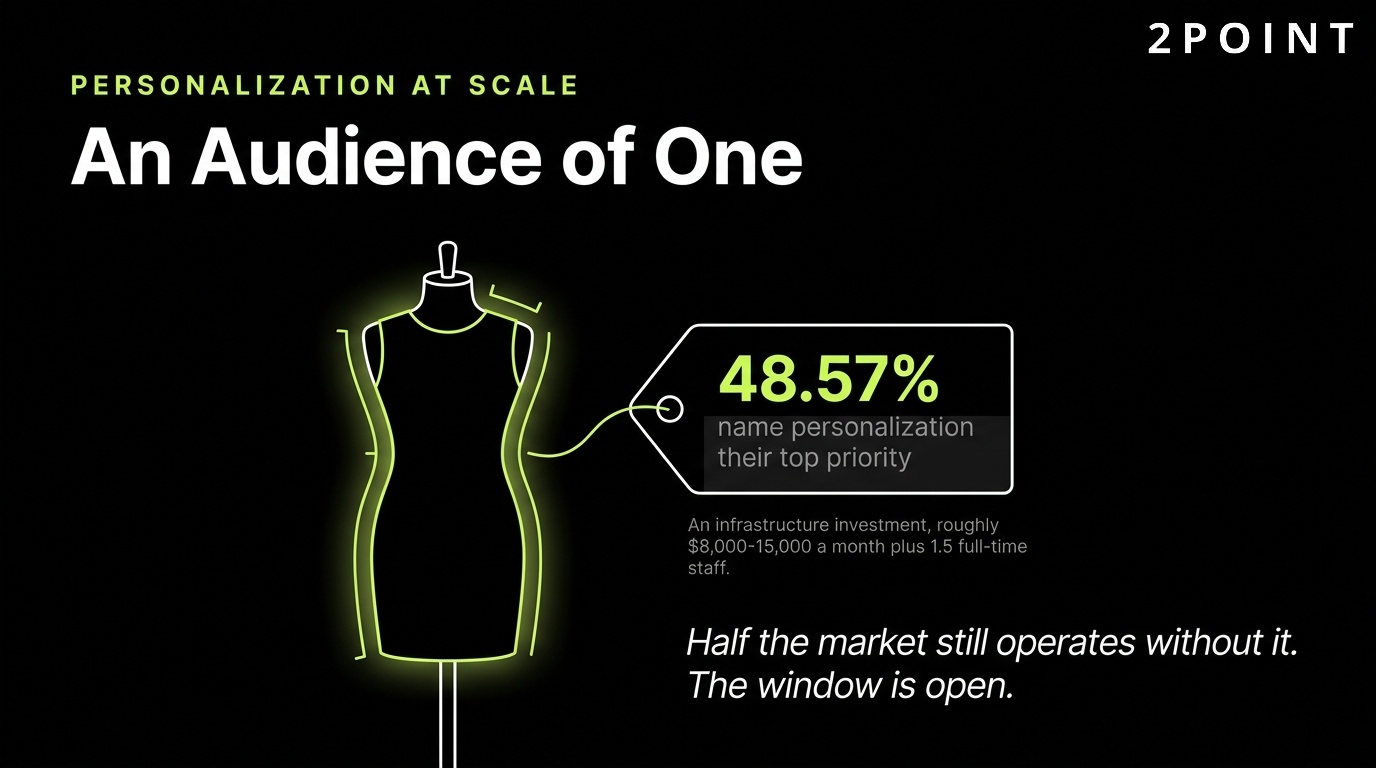
Implementation requires meaningful investment. Building an effective AI personalization infrastructure typically requires a monthly platform investment of $8,000 to $15,000 plus the equivalent of 1.5 full-time employees to manage, optimize, and interpret the system. This is not a lightweight addition to a marketing stack; it is a strategic commitment that requires organizational alignment, data quality, and sustained attention. However, for brands with the volume to justify the investment, the returns in customer retention and lifetime value can be transformative.
AI personalization has been adopted by 48.6% of B2C marketers, suggesting that roughly half the market is still operating without these capabilities. For brands that invest now, the competitive window for differentiation through AI-driven relevance remains open. Use cases span the full customer journey: personalized product recommendations on product pages, dynamic email content based on recent browsing, real-time ad optimization based on conversion probability, and personalized loyalty program communications that reflect individual customer value.
The AI Disruption Challenge Facing B2C Marketers
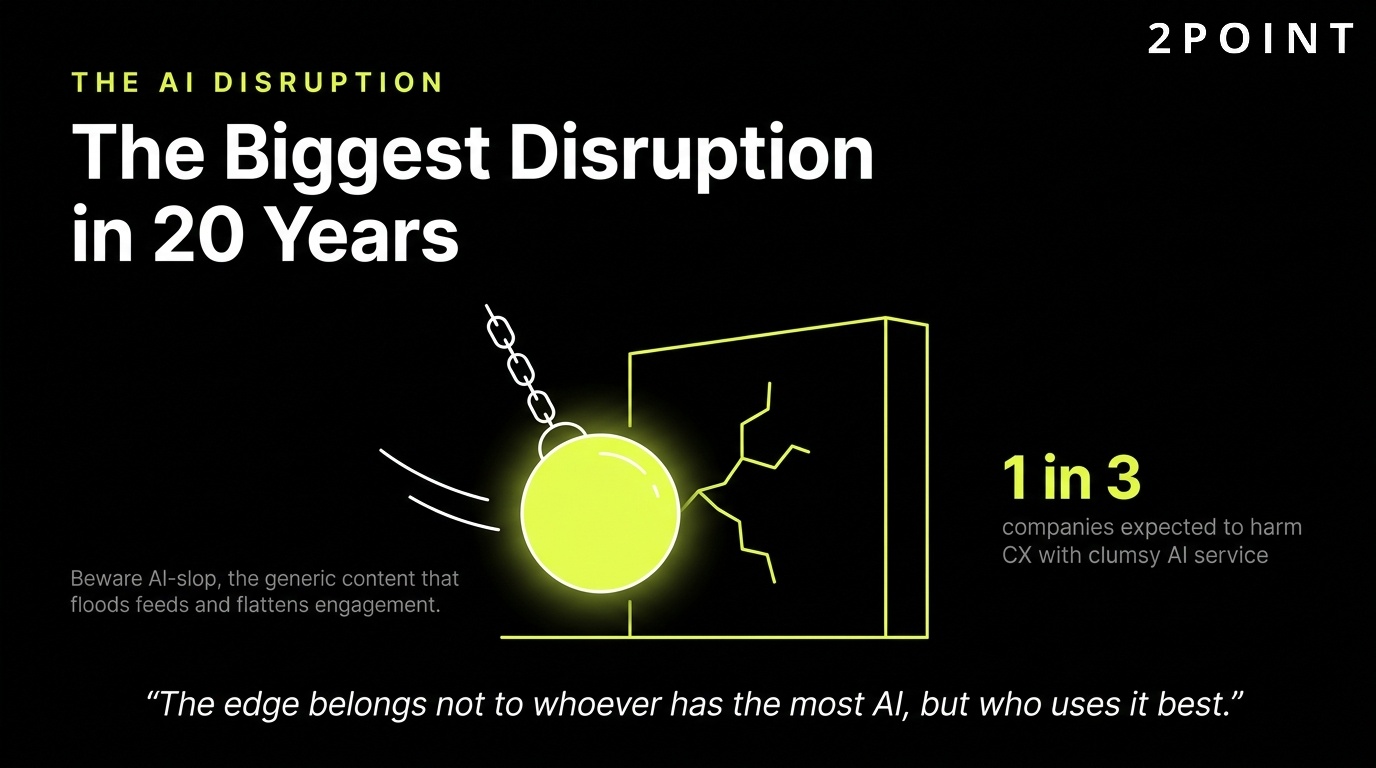
Not all news about AI in B2C marketing is optimistic. 61% of marketers believe marketing is experiencing its biggest disruption in 20 years due to AI, and that disruption is creating as much confusion and risk as it is opportunity. The challenge is not access to AI tools, which are now widely available, but the ability to deploy them in ways that genuinely improve consumer experiences rather than degrading them.
The concept of "AI-slop," a term for generic, formulaic content generated at scale without strategic intent or authentic human perspective, has become a real concern in the B2C content landscape. When every brand uses the same AI tools to generate similar content, the result is a homogeneous digital environment where nothing stands out and consumer engagement plummets. Forrester's 2026 predictions note that in 2026, a third of companies will harm customer experiences with frustrating AI self-service, a warning that premature or thoughtless AI deployment has measurable negative consequences.
Gartner has placed generative AI in the "Trough of Disillusionment" in its Hype Cycle, reflecting the gap between the extraordinary promises made about AI and the messier reality of implementation. The brands navigating this most successfully are those that treat AI as an enabler of human creativity and strategic thinking rather than a replacement for it. The competitive edge increasingly belongs not to whoever has the most AI, but to whoever uses it most intelligently.
Balancing Automation with Human Authenticity
As AI-generated content floods digital channels, the value of genuinely human creative work is rising. HubSpot's State of Marketing research indicates that consumers are actively seeking human-created content and will tune out brand and AI-generated content that lacks authenticity. This is not a rejection of technology; it is a natural market response to oversaturation with low-quality, undifferentiated content.
The migration of engaged audiences to gated spaces reflects this dynamic. Newsletters, podcasts, and YouTube channels with distinct, human voices are gaining subscribers at the expense of algorithmic social feeds. Blueshift's analysis notes that content is increasingly moving to platforms that AI has not yet overrun, where curated, creator-driven material commands genuine attention. For B2C brands, this means investing in authentic storytelling, real customer voices, and brand personalities that feel genuinely human rather than algorithmically assembled.
Maintaining brand consistency across human and AI-generated content is a practical challenge that requires clear voice guidelines, editorial standards, and human review processes. Brands that allow AI to generate content without strategic oversight risk creating a fragmented brand voice that confuses consumers and erodes the trust that effective B2C marketing depends on. When AI can generate endless technically correct copy, the advantage moves decisively to content that feels real, specific, and genuinely human.
Successful AI Implementation Strategies for B2C Marketers
Effective AI integration in B2C marketing follows a set of principles that distinguish thoughtful adoption from reckless deployment. The first principle is measurement: brands that close the gap between AI adoption and AI measurement achieve 2.4 times better content ROI than those that adopt AI tools without corresponding analytics frameworks. Knowing what AI is producing, how it is performing, and where it is falling short is the foundation of continuous improvement.
Testing before deployment at scale is equally important. AI-generated content, recommendations, and automated sequences should be evaluated against human-created alternatives in controlled tests before becoming the default. This requires patience and process discipline, but it dramatically reduces the risk of deploying AI in ways that harm rather than help consumer experiences.
Team training is the often-overlooked prerequisite for AI success. Marketers who understand how AI tools work, what their limitations are, and how to guide them toward better outputs consistently outperform those who treat AI as a black box that produces usable content on demand. Investment in AI literacy across marketing teams is not a luxury in 2026; it is a competitive necessity. Data-driven marketing approaches that incorporate AI measurement frameworks are increasingly separating high-performing teams from those struggling to justify their AI investments.
Data Strategy and Privacy-First Marketing for B2C Brands
Data is the raw material of modern B2C marketing. Without reliable, well-organized consumer data, personalization is impossible, targeting is inefficient, and measurement is unreliable. But the data landscape in 2026 is more complex and more regulated than it has ever been, requiring B2C marketers to approach data strategy with both ambition and careful responsibility.
The Shift to First-Party and Zero-Party Data
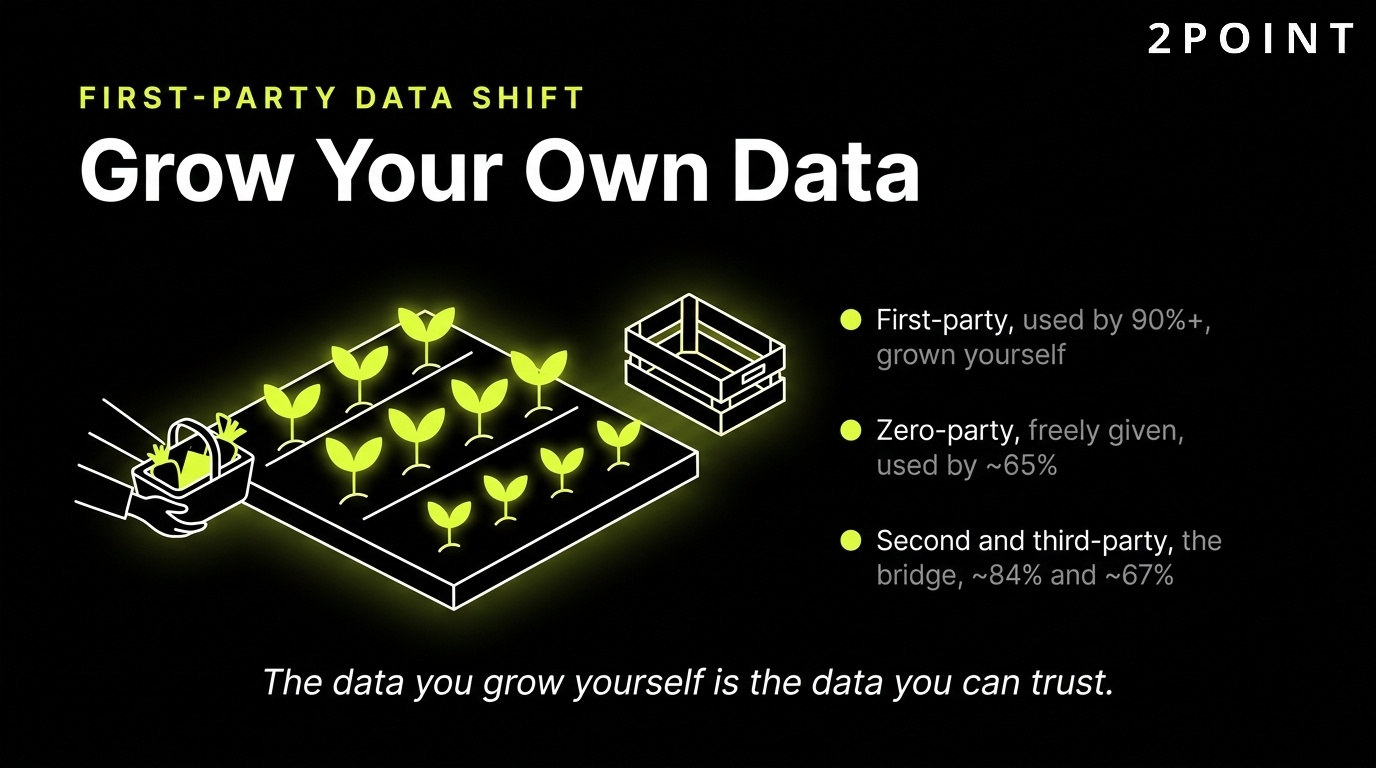
The deprecation of third-party cookies, the tightening of global privacy regulations, and growing consumer awareness of data practices have collectively driven a fundamental shift in how B2C brands build their data foundations. First-party data, information collected directly from consumers through brand-owned touchpoints, has become the most valuable and most trusted data source available. Over 90% of marketers now report using first-party data in their strategy, reflecting how central it has become to everything from campaign targeting to personalization to measurement.
Zero-party data, information that consumers intentionally and proactively share with brands, represents an even more valuable subset. When a consumer completes a product preference survey, answers quiz questions to receive personalized recommendations, or explicitly selects their communication preferences, they are providing data that is both accurate and consented. Approximately 65% of B2C brands use zero-party data, and the best strategies pair its collection with a clear value exchange: consumers share information in return for a meaningfully better, more personalized experience.
Third-party data usage, while declining in strategic importance, remains widespread, with approximately 67% of B2C brands still incorporating it alongside first-party sources. The transition away from third-party dependency is not instantaneous; it requires building first-party data assets through email list growth, loyalty programs, account creation incentives, and preference centers that make data sharing feel worthwhile to consumers. 84% of marketers use second-party data to some extent as a bridge during this transition, often through data partnerships with complementary brands. The goal of understanding customer insights has never been more important to refining B2C marketing efforts.
Building Consumer Trust Through Data Transparency
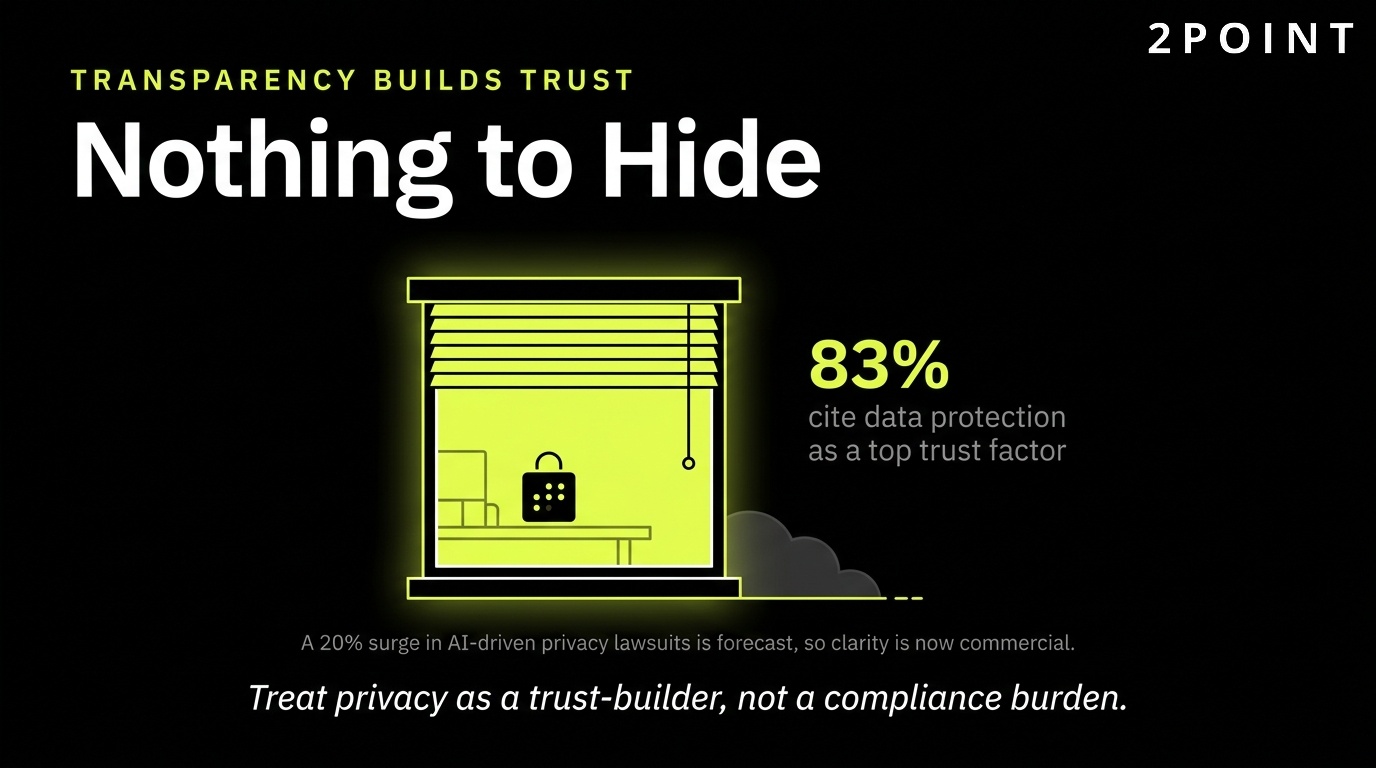
Data privacy is no longer purely a legal and compliance concern for B2C brands; it is a marketing consideration that directly affects consumer trust, brand perception, and long-term loyalty. 83% of consumers in PwC's 2024 research cite data protection as a top priority influencing their trust in brands. This means how a brand collects, uses, and protects consumer data is as visible and consequential as the quality of its products or the tone of its advertising.
The legal environment is also intensifying. Forrester's 2026 predictions forecast a 20% surge in AI-driven privacy breach class-action lawsuits, driven by increased regulatory scrutiny and growing consumer willingness to pursue legal action when their data is mishandled. Privacy concerns, combined with ongoing data breaches and the proliferation of AI-driven data processing, are creating a heightened legal environment that makes transparent data practices not just ethically correct but commercially essential.
Transparent data practices that build consumer confidence include clear, plain-language privacy policies, granular consent management that gives consumers genuine control over how their data is used, and regular communication about what data is collected and why. Brands that approach data transparency as a trust-building opportunity rather than a compliance burden consistently earn higher consumer confidence scores and benefit from higher retention rates. The business case for privacy is simple: consumers who trust a brand with their data are more likely to remain loyal customers, spend more, and recommend the brand to others.
Data Sources and Integration Challenges in B2C Marketing
The variety of data sources available to B2C marketers has expanded dramatically alongside the complexity of integrating them into coherent, actionable insights. Website analytics remain the most widely used source, with nearly two-thirds of marketers relying on website data for audience targeting. Social media data is used by 58% of marketers, survey data by 57%, email data by 56%, and point-of-sale data by 50%, creating a rich but fragmented data landscape.
The relationship between data volume and marketing effectiveness is nuanced. Brands whose content strategies are most effective are significantly more likely to use eight or more data sources (24%) compared to less effective brands (15%). However, more data sources also mean greater integration complexity. The reality for many B2C marketing teams is separate dashboards, disconnected platforms, and reporting silos that make it difficult to develop a unified view of consumer behavior across channels.
The operational cost of this fragmentation is significant: many marketing teams spend 18 or more hours per week on manual data collection, cleaning, and consolidation. This time expenditure directly reduces the capacity available for strategic thinking, creative development, and campaign optimization. Unified customer data platforms (CDPs) and integrated analytics solutions are the structural response to this challenge, enabling marketers to see the full consumer journey across touchpoints rather than individual channel snippets. Effective marketing performance tracking depends on resolving these integration challenges.
Data Quality and Strategic Challenges for B2C Teams
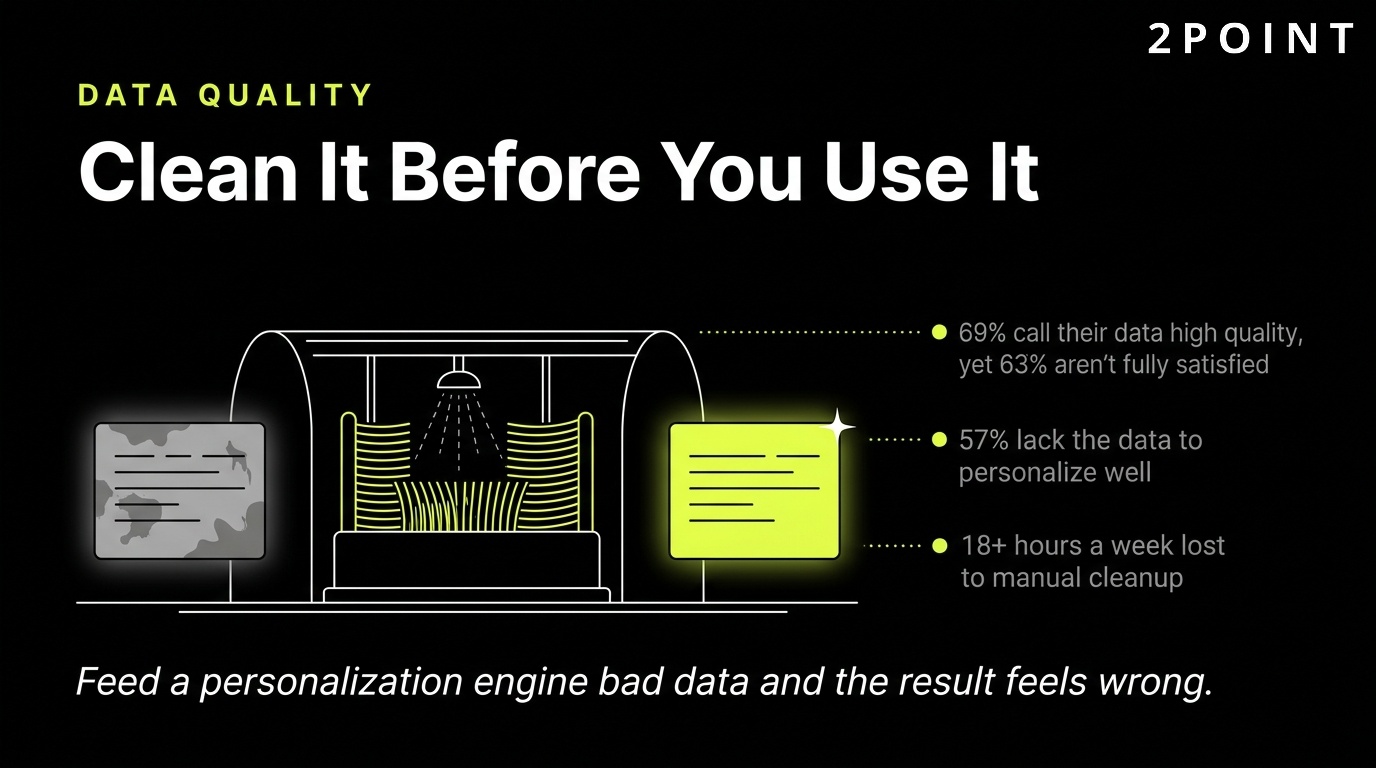
Data availability and data quality are distinct challenges that require different solutions. 69% of B2C marketers report that their audience data is high quality, which sounds encouraging until set alongside the finding that 63% of marketers are not fully satisfied with their data quality. The gap between perceived and actual quality reflects the difficulty of maintaining accurate, complete, and actionable consumer records across complex, multi-channel environments.
The practical consequences of poor data quality are immediate and costly. 57% of B2C marketers report struggling with having the correct data needed to personalize communications effectively. 43% lack the accurate contact information needed to reach consumers consistently across channels. When a personalization engine is fed inaccurate or incomplete data, the result is not just ineffective marketing; it is marketing that can feel jarring or wrong to the consumer, actively damaging the relationship it was designed to strengthen.
Best practices for data quality management in B2C include regular data audits that identify and remove duplicate, outdated, or incomplete records; progressive profiling strategies that build consumer profiles incrementally rather than demanding all information upfront; and ongoing validation processes that flag data anomalies before they propagate through marketing systems. The investment in data hygiene pays dividends across every channel and campaign that depends on consumer data to function correctly. Brands that approach adapting marketing strategies based on research tend to maintain higher data quality because research-driven teams treat data as a living asset rather than a static archive.
Content Marketing Strategy for B2C Success
Content marketing occupies a unique position in the B2C toolkit. It serves simultaneously as a brand-building tool, a consumer education platform, a search visibility asset, and a trust-building mechanism. Brands that invest in content strategically, rather than simply creating volume, consistently outperform those that treat content as a box to check rather than a competitive advantage to develop.
The State of B2C Content Marketing in 2026
B2C content marketing performs at a notably higher success rate than its B2B counterpart. 43.3% of B2C content marketers report strategy success, compared to 32% of B2B marketers. This advantage likely reflects B2C's more direct connection to consumer purchase behavior, where content can be measured against immediate conversion signals rather than the longer, harder-to-attribute B2B sales cycles.
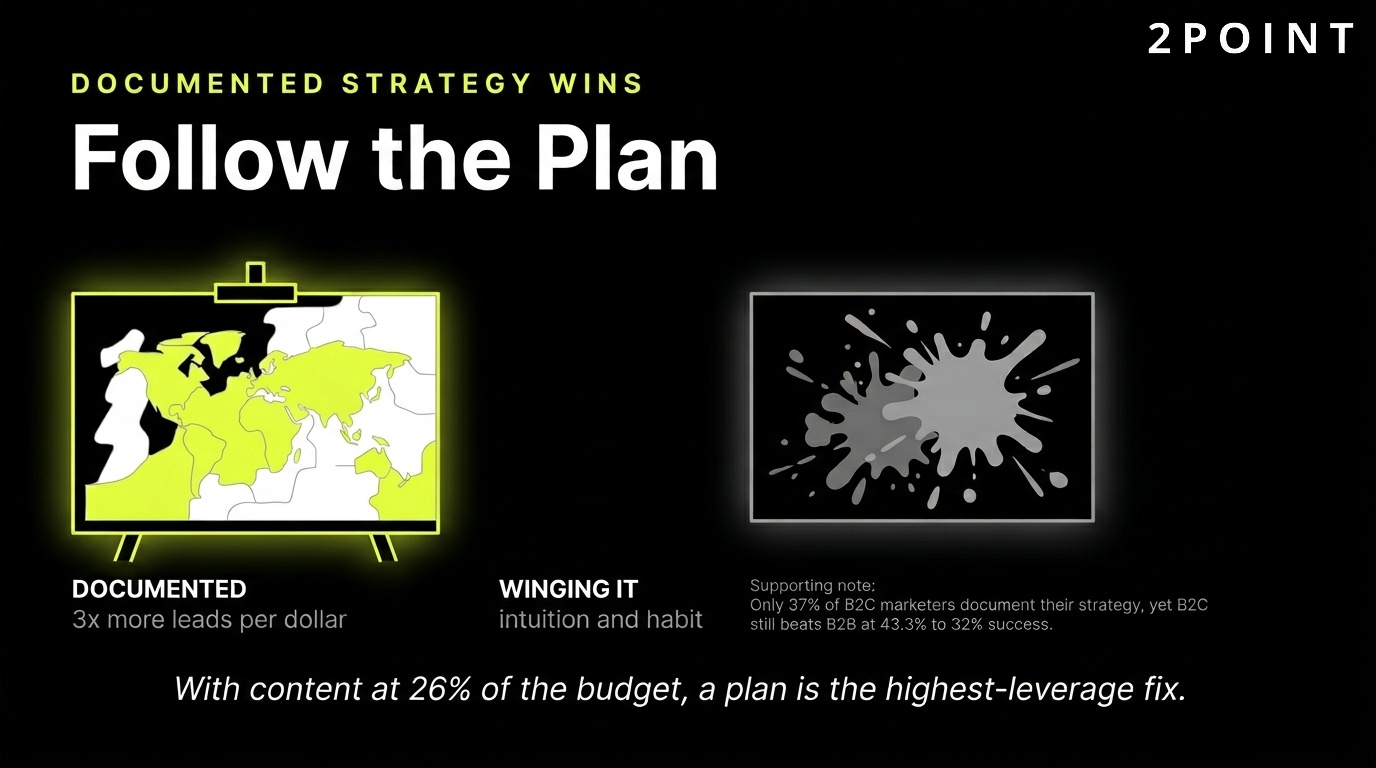
However, a striking paradox undermines B2C content marketing's potential: only 37% of B2C marketers have a documented content marketing strategy. The remaining 63% are operating on intuition, habit, or informal planning, which limits both effectiveness and scalability. A cohesive marketing strategy that includes documented content goals, audience definitions, editorial calendars, and performance benchmarks enables consistent execution and creates the organizational alignment that high-quality content requires.
The business case for documentation is clear. Companies with documented content strategies generate three times more leads per dollar than those operating without one. In an environment where content marketing budgets represent 26% of total marketing spend, the difference between documented and undocumented approaches has enormous financial implications. The winners in B2C content marketing in 2026 are not the brands producing the most content; they are the brands producing the most strategically intentional content, built on a clear understanding of audience needs, competitive positioning, and measurable outcomes. Creating compelling marketing strategies requires this kind of documentation discipline.
Resource Allocation and Team Structure in B2C Content Marketing
The operational reality of B2C content marketing is often leaner than the ambition behind it. 42% of surveyed B2C marketers have only one person responsible for all content types, meaning a single individual is expected to manage strategy, creation, distribution, and measurement across blogs, email, social media, video, and potentially more. This staffing reality directly constrains the depth, variety, and strategic sophistication of content that can be produced.
Outsourcing has emerged as a practical response to this resource constraint. 50% of all marketers outsource some portion of their content marketing, using agencies, freelancers, or content platforms to supplement internal capacity. The decision about what to keep in-house versus outsource typically comes down to strategic sensitivity (brand voice, editorial direction, and customer data analysis tend to stay internal) and production scalability (high-volume content like product descriptions, social posts, and supporting blog articles are common outsourcing candidates).
Resource allocation itself is a challenge: 66.5% of content marketers struggle with knowing where to allocate resources. Without a documented strategy that connects content types to specific funnel stages and business outcomes, it is genuinely difficult to make defensible decisions about budget and headcount. The solution is prioritization frameworks that tie content investments directly to revenue goals, allowing teams to focus their limited resources where they will generate the greatest measurable impact.
Content Types and Format Performance in B2C Marketing
Short articles and blog posts remain the most widely used content format in B2C marketing, with 83% of B2C marketers creating this content type. Their popularity reflects their versatility: they serve SEO, support email newsletters, provide social media source material, and establish topical authority across consumer interest categories. Well-executed short-form written content remains one of the most cost-effective B2C assets when produced with strategic intent.
Video, as noted earlier, has achieved near-universal adoption, with 71% of B2C marketers using it within the past twelve months. Its ability to demonstrate products, convey emotion, and create parasocial relationships with brand voices makes it uniquely powerful across the awareness and consideration stages of the consumer journey. The format premium has shifted from long-form brand films to short-form content that respects consumer attention while still delivering meaningful brand value.
Interactive content formats, including quizzes, assessments, configurators, and calculators, are gaining traction as ways to generate zero-party data while simultaneously delivering personalized value to consumers. User-generated content (UGC) continues to punch above its production budget in trust and authenticity metrics: real consumers sharing real experiences consistently outperform brand-created content in social proof studies. A robust strategy for leveraging customer reviews in marketing amplifies this authentic voice across owned and paid channels. The optimal content mix in 2026 combines brand-produced and consumer-generated material to deliver both quality and credibility.
Measuring Content Marketing ROI in B2C Campaigns
Measurement discipline is the factor that most consistently separates high-performing B2C content programs from average ones. 44% of marketers analyze campaign performance weekly, giving them the data cadence needed to identify what is working, what is not, and where optimization investment will have the greatest impact. Less frequent analysis allows underperforming content to continue consuming budget without delivering results, a particularly costly pattern in resource-constrained teams.
Connecting content metrics to genuine business outcomes remains the central measurement challenge in B2C content marketing. Vanity metrics like page views and social impressions are easy to measure but poorly correlated with revenue. The metrics that matter are those that trace the consumer journey from content engagement to purchase: lead generation rates, lead-to-customer conversion rates, customer lifetime value by acquisition channel, and repeat purchase rates among content-engaged audiences.
Attribution is a particular complexity in B2C's multi-touch journey. A consumer might discover a brand through a TikTok video, subscribe to its email list after reading a blog post, and complete a purchase after receiving a promotional email, making it difficult to assign credit appropriately. Understanding ROI in social media and other channels requires multi-touch attribution models that recognize the contribution of each touchpoint rather than assigning all credit to the last interaction. Lead-to-customer conversion consistently ranks as the second most important KPI for marketers across all business sizes, reflecting the recognition that content's ultimate purpose is to drive the relationships that become revenue.
Emerging Trends Shaping the Future of B2C Marketing
B2C marketing in 2026 is being reshaped by a set of converging trends that are simultaneously creating new consumer expectations and new opportunities for brands willing to move quickly and thoughtfully. Understanding these trends is not just about staying current; it is about making strategic investments now that will compound in competitive advantage over the next several years.
Social Commerce and Influencer Marketing: The Trust Economy
Social commerce has evolved from an experimental feature into a mainstream B2C revenue channel. The integration of discovery, evaluation, and purchase within a single platform session eliminates the traditional funnel friction that caused consumers to abandon purchases between the inspiration moment and the transaction. Platforms like Instagram, TikTok, and Pinterest have invested heavily in native shopping infrastructure, enabling brands to tag products in posts, create shoppable storefronts, and track purchase attribution directly within their platforms.
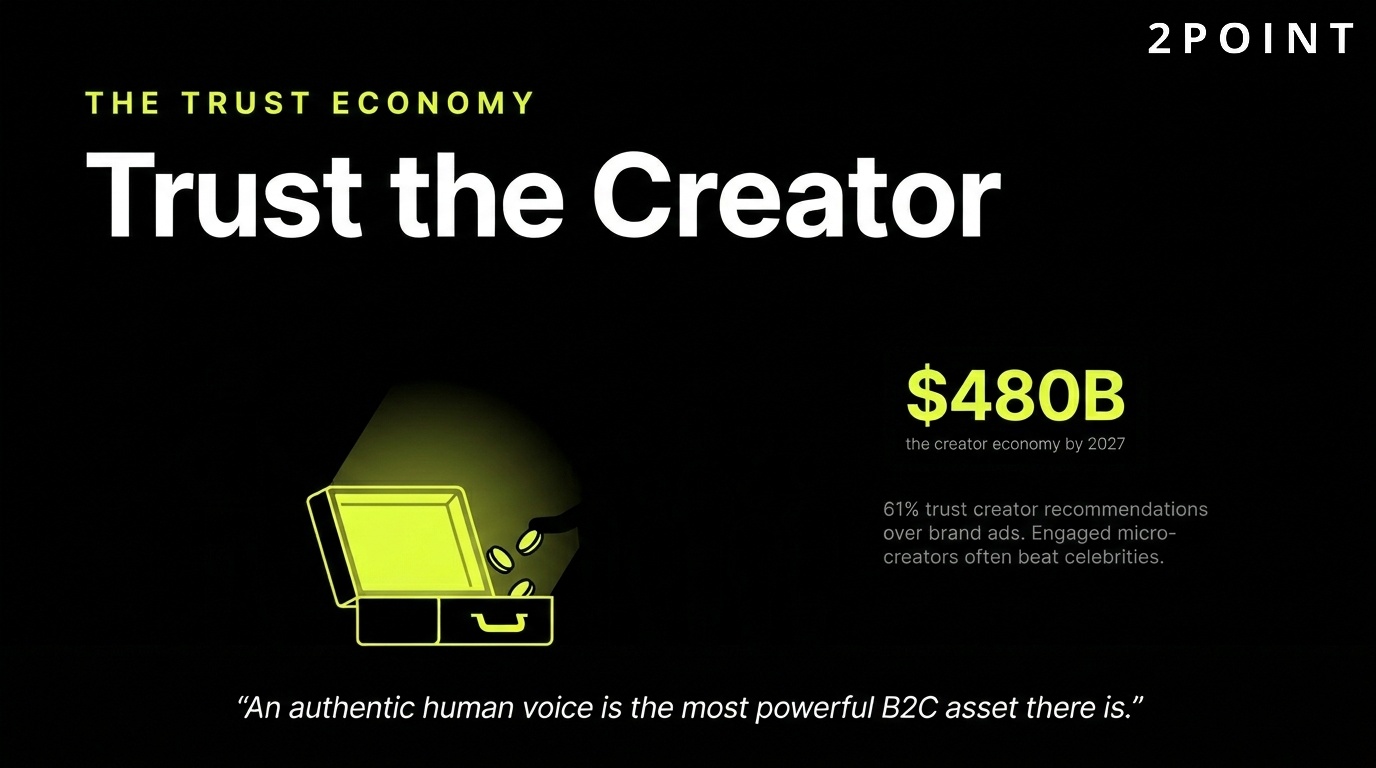
The creator economy is the fuel powering social commerce at scale. Research into B2C consumer behavior shows that 61% of consumers trust creator recommendations over traditional brand advertising when making purchasing decisions, a statistic that explains the extraordinary investment brands are making in influencer partnerships. The creator economy is projected to reach $480 billion by 2027, reflecting both the scale of creator-driven commerce and the recognition that authentic human voices are among the most powerful B2C marketing assets available.
Micro-influencer strategies have gained significant traction because they offer better engagement rates, more authentic audience relationships, and lower cost per partnership than celebrity influencer deals. A micro-influencer with 50,000 highly engaged followers in a specific niche can deliver more measurable B2C impact than a celebrity with 5 million passive followers. The most effective influencer strategies match brand values with creator identity, ensuring that partnership content feels natural rather than transactional. Viral marketing potential increases significantly when influencer partnerships are built on genuine alignment rather than paid placement alone.
Immersive Technologies: AR, VR, and Interactive Brand Experiences
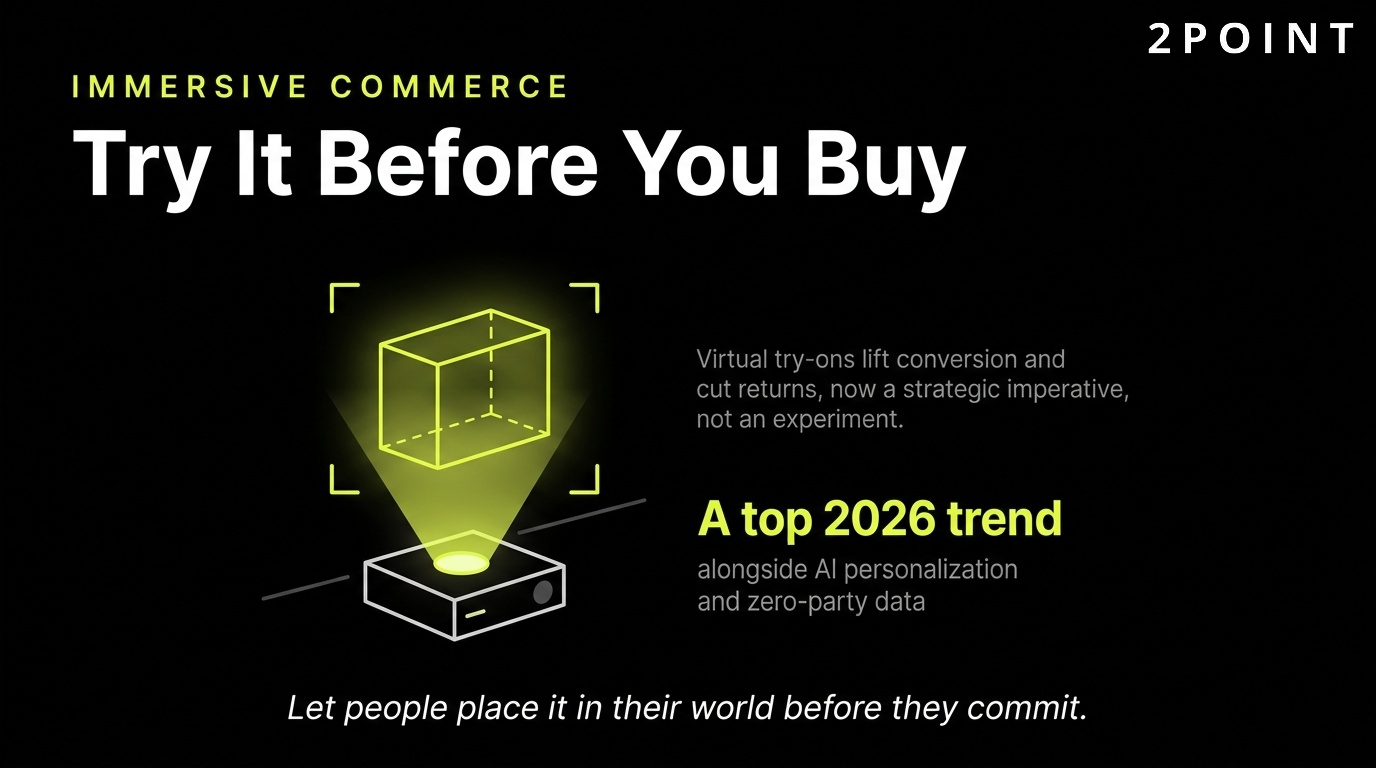
Augmented reality and virtual reality are transforming how consumers experience products before committing to purchase. AR enables virtual try-ons for beauty products, eyewear, clothing, and home furnishings, allowing consumers to visualize how a product will look in their specific context without visiting a store. This capability addresses one of the fundamental limitations of e-commerce: the inability to physically interact with a product before buying. Brands that have implemented AR product visualization tools report significant improvements in conversion rates and reductions in return rates.
VR creates opportunities for fully immersive brand experiences that go beyond product visualization into genuine experiential marketing. Virtual showrooms, immersive brand worlds, and interactive product demonstrations give consumers an experience of a brand's values and identity that no traditional advertising format can replicate. Experiential marketing principles translate powerfully into virtual environments, where the elimination of physical logistics makes ambitious experiences more accessible to brands of all sizes.
According to Improvado's analysis of B2C marketing trends, seven key B2C trends for 2026 include AI-driven personalization, zero-party data strategies, and immersive AR/VR commerce, reflecting the convergence of technology and consumer experience as the central competitive frontier. Consumer adoption of AR tools has accelerated alongside smartphone capability improvements, making AR-enabled experiences accessible to mainstream audiences rather than just early adopters. For B2C brands in retail, beauty, home furnishings, and fashion, AR investment in 2026 is shifting from experimental to strategic imperative.
Generational Marketing: Understanding Youth Culture to Future-Proof B2C Strategy
Generational marketing has become increasingly nuanced as B2C brands navigate the distinct values, behaviors, and digital habits of consumers who have grown up in fundamentally different technological and cultural environments. Millennials currently represent the primary target demographic: 74% of B2C marketers identify millennials as their main target audience in 2025. This generation's combination of purchasing power, digital fluency, and value-driven consumer behavior makes it the cornerstone audience for a wide range of B2C categories.
However, Gen Z's growing economic influence demands parallel attention. Research from Lippincott shows that Gen Z typically starts investing by age 19, significantly earlier than millennials (who typically began at 25) or boomers (35). This early financial engagement reflects a knowledge-is-power mindset shaped by growing up with unlimited information access, and it has implications for how B2C brands communicate: Gen Z responds better to transparency, education, and genuine value than to traditional aspirational advertising.
Gen Alpha, now entering their teenage years, represents the next wave of consumer influence. Brands that begin building relationships with younger audiences now, through content that reflects their actual interests rather than brand-centric messages, are making investments that will pay dividends as purchasing power transfers. Understanding the cultural references, platform preferences, and value frameworks of younger generations is not just good marketing; it is essential future-proofing for B2C brands with long-term growth ambitions. Understanding consumer expectations at a generational level allows brands to create content and experiences that resonate authentically across different age cohorts.
Brand Partnerships and Physical Products as Collectibles
Brand partnerships have emerged as a powerful B2C strategy for reaching niche audiences, generating press coverage, and creating consumer experiences that neither brand could deliver alone. The most effective partnerships go beyond co-branded product releases to create genuinely novel experiences that combine the unique equities of both brands in unexpected ways. Sports sponsorship represents one of the most established partnership channels: the global sports sponsorship market is projected to more than double in size over the next seven years, driven by the combination of live event appeal, digital amplification, and the passionate audience engagement that sports reliably deliver.
A related trend is the elevation of physical products from functional objects to collectible cultural artifacts. Limited-edition product releases, premium packaging designed with aesthetic intent, and collaboration collections that create secondary market value are transforming how B2C brands think about physical goods. When a consumer displays a brand's product, shares it on social media as a cultural statement, or participates in resale markets for limited editions, the product itself becomes a marketing vehicle and a social currency. The opportunity in 2026 lies in treating physical goods as collectible moments that carry meaning beyond their functional utility, creating brand affinity through objects consumers want to own, display, and share.
Conversion Optimization and Performance in B2C Marketing
Driving traffic and building brand awareness are only half of the B2C marketing equation. The other half is converting that interest and attention into actual purchases, repeat transactions, and loyal customer relationships. Conversion optimization is where the investment in brand building and channel strategy ultimately proves its value.
Understanding the B2C Conversion Funnel
The B2C conversion funnel has grown more complex alongside the proliferation of channels and touchpoints. Consumers no longer follow a linear path from awareness to consideration to purchase; they move fluidly between channels, revisit earlier stages based on new information, and bring prior brand experiences to every interaction. Understanding this non-linear reality is essential for building a conversion strategy that captures purchase intent wherever and whenever it arises.
The funnel stages most relevant to B2C conversion optimization are awareness (reaching consumers who do not yet know the brand), consideration (engaging consumers who are actively evaluating options), and conversion (turning consideration into purchase). Each stage requires different content, different channels, and different success metrics. Awareness campaigns are measured by reach and brand recall. Consideration campaigns are measured by engagement, dwell time, and website behavior. Conversion campaigns are measured by transaction volume, average order value, and conversion rate.
Reducing friction at the conversion stage has an outsized impact on overall funnel performance. Research consistently shows that consumers abandon purchases because of unexpected costs, complex checkout processes, mandatory account creation, or limited payment options. Each of these barriers is removable. Brands that have systematically eliminated checkout friction, through guest checkout options, saved payment methods, transparent pricing, and one-click purchase flows, consistently achieve significantly higher conversion rates than competitors who have not made these investments.
Personalization's Role in Driving B2C Conversions
Personalization influences conversion at every stage of the B2C funnel. At the awareness stage, personalized advertising targeting ensures that brand messages reach consumers whose profiles align with the brand's ideal customer. At the consideration stage, personalized product recommendations and dynamic content that reflects individual browsing behavior guide consumers toward the specific offerings most likely to meet their needs. At the conversion stage, personalized pricing, targeted promotions, and tailored urgency signals create the conditions for purchase.
The impact of personalization on conversion rates is well-documented. Personalized product recommendations on e-commerce sites can increase conversion rates by 10% to 15%, while personalized email campaigns consistently outperform generic broadcasts on every performance metric from open rate to purchase completion. The key is relevance: personalization that genuinely reflects a consumer's preferences and behaviors feels helpful and trust-building. Personalization that feels generic or presumptuous has the opposite effect.
Building a personalization infrastructure that delivers genuine relevance requires quality data, capable technology, and ongoing optimization. The brands achieving the best personalization outcomes are those that treat it as a continuous improvement process rather than a one-time implementation. Regular testing, segment refinement, and performance analysis ensure that personalization remains accurate and relevant as consumer preferences evolve over time. Connecting personalization investment to customer retention strategies multiplies its long-term value.
Customer Retention as a B2C Performance Multiplier

Acquiring a new customer costs five to seven times more than retaining an existing one, making customer retention not just a customer success priority but a fundamental financial lever. B2C brands that invest in post-purchase engagement, loyalty programs, and customer success strategies consistently generate higher lifetime values, stronger word-of-mouth, and lower effective customer acquisition costs than those focused exclusively on new customer growth.
Loyalty programs are one of the most proven retention tools in B2C marketing. Effective programs go beyond simple points accumulation to create a genuine sense of relationship and belonging. Tiered loyalty structures that reward increasing engagement with meaningful benefits, exclusive access, and personal recognition consistently outperform flat, transactional programs. The most sophisticated B2C loyalty programs use behavioral data to personalize rewards and communications, ensuring that what each customer receives from the program feels tailored rather than generic.
Post-purchase email sequences, reactivation campaigns for lapsed customers, and proactive customer success outreach are additional tools for retention. The goal is to maintain a meaningful relationship during the period between purchases, ensuring that when consumers are ready to buy again, the brand is front of mind and emotionally connected. Building genuine engaging content into retention campaigns keeps the brand relationship alive and warm between transactions.
Key B2C Marketing Performance Benchmarks
Understanding how your B2C marketing performance compares to industry benchmarks is essential for setting realistic targets and identifying improvement priorities. The following benchmarks reflect 2025 to 2026 industry data across key B2C channels and metrics.
| B2C Marketing Channel or Metric | Industry Benchmark (2025-2026) | Performance Insight |
|---|---|---|
| Email open rate | 20.94% | Above 25% indicates strong list quality and subject line performance |
| Email click-through rate | 2.57% | Above 3% suggests effective content and clear CTAs |
| Email conversion rate (B2C) | 2.8% | Personalized emails consistently exceed this benchmark |
| Email marketing ROI | $36 per $1 spent | Highest ROI channel across all B2C marketing formats |
| Short-form video ROI ranking | Top format (21% of marketers) | Investment in short-form video delivers measurable returns |
| Social media purchase influence | 76% of consumers influenced | Social presence directly correlates with purchase behavior |
| Content marketing leads per dollar | 3x more with documented strategy | Documentation discipline is a direct revenue driver |
| Weekly campaign analysis | 44% of marketers | Weekly analysis cadence enables faster optimization cycles |
The key takeaway from these benchmarks is that email and short-form video deliver the strongest measurable returns, while documented strategy is the highest-leverage operational improvement most B2C marketers can make.
B2C Marketing Strategy Development: A Practical Framework
With a clear understanding of the principles, channels, and trends shaping B2C marketing in 2026, the practical challenge is building a strategy that delivers consistent, measurable results. The following framework provides a structured approach for B2C marketers at any stage of strategic maturity.
Step-by-Step B2C Marketing Strategy Development
- Define your ideal consumer profile. Go beyond basic demographics to understand psychographics, behavioral patterns, purchase triggers, and the specific problems your product solves. Use first-party data from existing customers as the foundation and supplement with survey research and social listening.
- Set measurable business goals. Connect marketing objectives directly to business outcomes: revenue targets, customer acquisition goals, retention rates, and lifetime value benchmarks. Vague goals like "increase brand awareness" are insufficient; specify what measurable change will indicate success. Aligning marketing with business goals is the foundation of a strategy that earns organizational investment.
- Audit your current channel performance. Identify which channels are delivering the best ROI, where consumer engagement is highest, and where gaps exist between your audience's behavior and your current presence. Use this audit to inform resource allocation decisions.
- Document your content strategy. Define content pillars aligned with consumer interests and brand authority areas. Create an editorial calendar that maintains consistent output without overwhelming your team's capacity. Map content types to funnel stages to ensure every piece serves a strategic purpose.
- Build your data foundation. Prioritize first-party data collection through email list growth, account creation incentives, and preference centers. Establish data quality standards and regular hygiene processes. Implement analytics frameworks that connect content and campaign metrics to business outcomes.
- Integrate AI tools thoughtfully. Identify specific workflow inefficiencies where AI can add genuine value: content ideation, subject line testing, audience segmentation, or performance analysis. Test AI outputs against human alternatives before deploying at scale. Establish quality standards and human review processes.
- Launch, measure, and optimize. Begin executing with the understanding that initial results are learning opportunities. Establish a weekly or bi-weekly performance review cadence. Use insights from early campaign data to refine targeting, messaging, and channel mix continuously.
- Build for retention from day one. Design post-purchase experiences as carefully as acquisition campaigns. Loyalty programs, reactivation sequences, and ongoing value delivery ensure that acquisition investment generates compounding returns through repeat purchases and referrals.
Common B2C Marketing Strategy Mistakes to Avoid
Even well-resourced B2C marketing teams make predictable strategic errors. Recognizing these patterns early saves significant time, budget, and competitive ground.
- Operating without documented strategy: 63% of B2C marketers lack documented content strategies, limiting scalability and team alignment. Documentation is not administrative overhead; it is the infrastructure for consistent performance.
- Chasing channels rather than consumers: Adopting every new platform without evaluating whether your specific audience is there and engaged wastes resources and dilutes brand presence. Focus on the channels where your consumers genuinely spend time.
- Prioritizing quantity over quality in content: Publishing high volumes of undifferentiated content contributes to information overload without building brand authority. Fewer, better pieces consistently outperform content treadmills.
- Neglecting post-purchase marketing: Focusing all resources on acquisition while underinvesting in retention misses the most cost-efficient revenue available: existing satisfied customers who are predisposed to buy again.
- Deploying AI without human oversight: AI-generated content without strategic direction and quality review risks producing the "AI-slop" that consumers are increasingly tuning out. Technology amplifies strategy; it does not replace it.
- Ignoring data privacy as a marketing consideration: Treating data privacy as purely a compliance issue misses its significant impact on consumer trust, brand perception, and long-term loyalty.
The Competitive Advantage of Integrated B2C Marketing
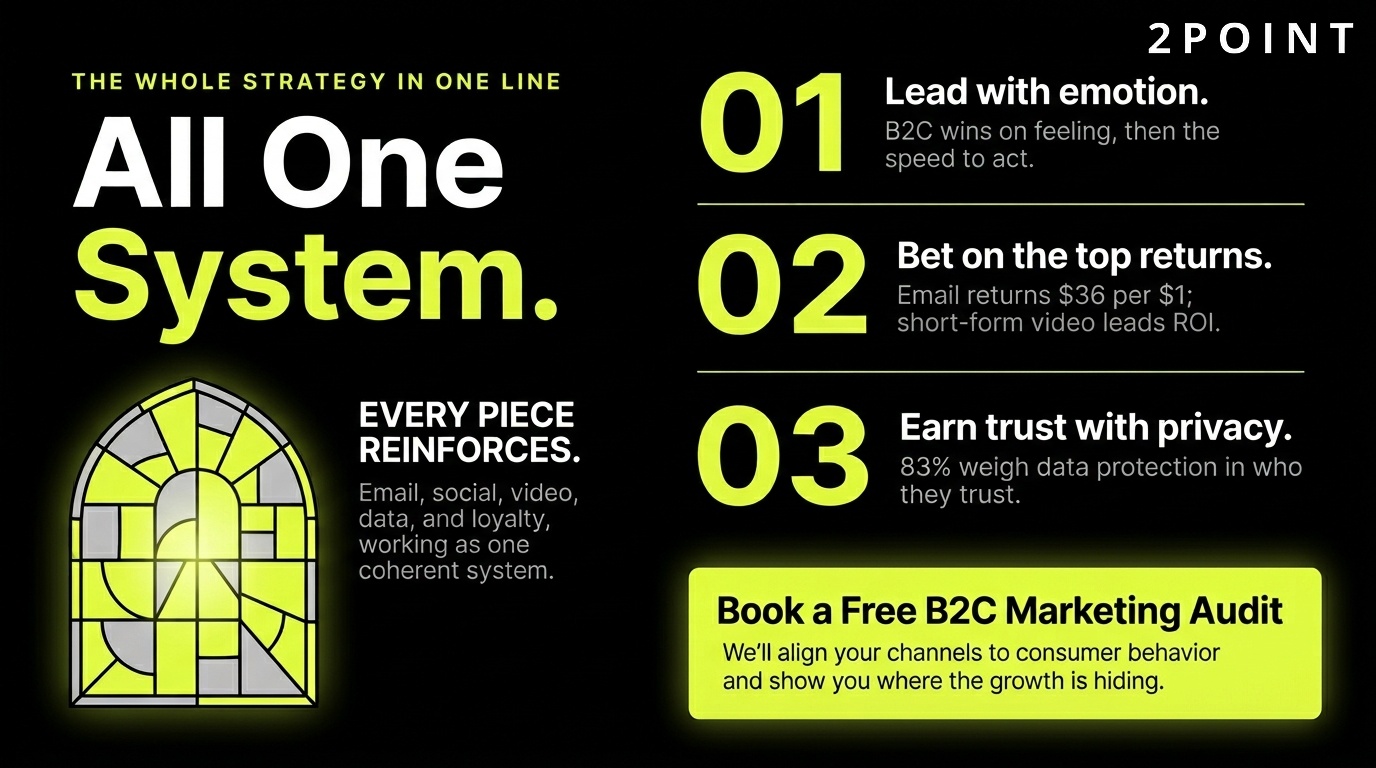
The brands achieving the strongest B2C marketing results in 2026 share a common characteristic: integration. Not just channel integration, though that is important, but the integration of strategy, data, content, technology, and human creativity into a coherent system where every element reinforces the others. Email personalization is more powerful when fed by quality first-party data. Social commerce converts better when it is supported by authentic influencer partnerships and strong brand content. Loyalty programs are more effective when they are connected to genuine personalization and consistent post-purchase communication.
Approaching B2C marketing as an integrated discipline rather than a collection of separate channel tactics is the mindset shift that separates high-performing B2C brands from average ones. It requires investment in coordination and planning but pays dividends in efficiency, consistency, and the kind of compounding brand equity that creates durable competitive advantage.
Brands working with experienced marketing partners can accelerate this integration process significantly. 2POINT specializes in helping brands develop and execute integrated B2C marketing strategies that align channel investment with consumer behavior, business goals, and measurable outcomes. The combination of strategic clarity, channel expertise, and performance orientation that defines effective B2C marketing at scale is exactly what 2POINT brings to its client relationships.
Comparing B2C Marketing Strategies: What Works Best for Different Business Types
B2C marketing is not a single discipline but a family of approaches that need to be calibrated to the specific characteristics of the business deploying them. Industry, price point, purchase frequency, and competitive context all influence which strategies will deliver the best returns.
B2C Marketing Strategy Comparison by Business Type
| B2C Business Type | Highest ROI Channels | Content Strategy Priority | Key Performance Metric |
|---|---|---|---|
| E-commerce retail | Email, paid social, SEO | Product content, UGC, reviews | Conversion rate, average order value |
| Subscription services | Email, content marketing, video | Value demonstration, education | Churn rate, subscriber lifetime value |
| Consumer packaged goods | Social media, influencer, video | Brand storytelling, lifestyle content | Brand awareness, repeat purchase rate |
| Local service businesses | Local SEO, email, social media | Community connection, trust-building | New customer acquisition, referral rate |
| High-consideration purchases | SEO, email, retargeting | Educational content, reviews, comparisons | Lead quality, sales cycle length |
| Experience and event brands | Social media, video, email | FOMO-driven, social proof, immersive previews | Ticket sales, social sharing, attendance rate |
The key takeaway is that while email and social media are foundational for almost every B2C business type, the content strategy priority and primary success metric differ significantly based on purchase frequency, consumer decision complexity, and business model.
How B2C Marketing Strategies Differ by Consumer Segment
Beyond business type, consumer segmentation reveals important strategy differences. Price-sensitive consumers respond strongly to value messaging, promotional offers, and comparison content that helps them feel confident they are making a smart purchase. Experience-driven consumers respond to aspirational content, exclusivity, and social proof that aligns the purchase with their identity and lifestyle aspirations.
Loyalty-prone consumers respond to recognition, community, and relationship-building content that makes them feel genuinely valued as individuals rather than transaction sources. Understanding which of these segments dominates your consumer base shapes everything from creative direction to promotional strategy to channel prioritization. Analyzing competitor marketing strategies can reveal which consumer segments are underserved and where positioning differentiation can create competitive advantage.
The most sophisticated B2C marketing programs develop distinct strategy tracks for different consumer segments, using data and behavioral signals to route individuals into the appropriate experience rather than treating the entire customer base as homogeneous. This segmentation-based approach to B2C marketing is increasingly accessible through modern marketing automation platforms that can execute complex, conditional customer journeys without requiring manual management of every variation.
Local and Community-Driven B2C Marketing
While national and global B2C brands command the most media attention, the vast majority of B2C transactions happen at a local level, in specific communities, neighborhoods, and regions where the relationship between brand and consumer is personal and place-based. Local marketing strategies have become increasingly important as consumers express preferences for brands that feel connected to their communities and responsive to their specific local contexts.
Local B2C marketing combines digital precision (Google Business Profiles, local SEO, geo-targeted social advertising) with community engagement tactics (local event sponsorship, partnerships with community organizations, and location-specific content that reflects genuine local knowledge). The combination creates a brand presence that feels simultaneously digitally sophisticated and authentically local, a combination that resonates powerfully with consumers who are skeptical of faceless national brands but still expect the convenience and quality of digital experiences.
For businesses operating across multiple locations, maintaining consistency while adapting to local contexts requires both clear brand guidelines and genuine flexibility for local customization. The core brand identity, values, and quality standards remain consistent, while messaging, local partnerships, and community engagement reflect the specific character of each location. This balance between brand consistency and local relevance is one of the defining challenges of B2C marketing at scale, and getting it right creates a competitive advantage that is difficult for purely national or purely local competitors to replicate.
Building a B2C Marketing Technology Stack
The technology stack that supports B2C marketing has become as strategically important as the campaigns it enables. Without the right combination of data management, marketing automation, analytics, and content tools, even the best strategies will underperform due to execution limitations.
Core Components of an Effective B2C Marketing Technology Stack
A well-constructed B2C marketing technology stack typically includes several integrated layers. The data layer consists of a Customer Data Platform (CDP) or CRM that unifies consumer information from all touchpoints into a single, actionable view. This layer is the foundation for every personalization and measurement capability above it.
The engagement layer includes email marketing and automation platforms, social media management tools, content management systems, and customer service platforms. These tools execute the strategies defined at the planning level and generate the behavioral data that flows back into the data layer for analysis and optimization.
The analytics and measurement layer provides the intelligence that turns data into decisions. This includes web analytics, attribution modeling tools, social media analytics, and business intelligence dashboards that connect marketing metrics to revenue outcomes. Without a robust analytics layer, the rest of the stack operates in a measurement vacuum, making optimization impossible and ROI justification difficult.
The intelligence layer, which has grown dramatically in recent years, includes AI and machine learning tools for personalization, predictive analytics, content generation assistance, and automated optimization. This layer amplifies the capabilities of human marketers when deployed thoughtfully, enabling scale and sophistication that would be impossible with manual processes alone.
Selecting and integrating these technology components requires careful consideration of both current needs and future scalability. The most common mistake in technology stack construction is acquiring tools before defining the strategy they are meant to support. Technology should follow strategy, not precede it. Brands that start with clear data and measurement requirements, then select tools that meet those requirements, consistently achieve better results than those that adopt popular tools and retrofit strategies around their capabilities.
Frequently Asked Questions About B2C Marketing
What is B2C marketing and how does it differ from B2B marketing?
B2C (Business-to-Consumer) marketing refers to all strategies and tactics a company uses to promote and sell products or services directly to individual end consumers. Unlike B2B marketing, which targets business decision-makers through long sales cycles and logic-driven messaging, B2C marketing focuses on emotional connections, lifestyle relevance, and shorter purchase journeys ranging from minutes to days.
What are the most effective B2C marketing channels in 2026?
Email marketing delivers the highest ROI at $36 for every $1 spent and is used by 91% of B2C marketers through social media platforms. Short-form video on TikTok, Instagram Reels, and YouTube Shorts is delivering the highest engagement rates, with 71% of B2C marketers incorporating video into their strategies. Social media, content marketing, and paid search round out the top performing channels.
How important is personalization in B2C marketing?
Personalization is the top B2C marketing priority in 2026, with 48.57% of marketers identifying it as their primary focus. AI-driven personalization enables one-to-one consumer experiences at scale, improving email open rates, conversion rates, and customer lifetime value. Brands that implement personalization effectively see measurable improvements across every stage of the consumer funnel.
What is the difference between first-party, second-party, and zero-party data in B2C marketing?
First-party data is information collected directly by a brand from its own consumer touchpoints, such as website behavior, purchase history, and email interactions. Zero-party data is information consumers intentionally share with a brand, such as preferences entered in a survey or product configurator. Second-party data comes from trusted partner brands, while third-party data is purchased from external data brokers and is declining in reliability due to privacy regulations.
How much should a B2C brand spend on content marketing?
Content marketing now represents 26% of total B2C marketing budgets in 2026, reflecting the channel's central role in consumer engagement and purchase influence. The right investment depends on business size, competitive intensity, and growth targets, but brands with documented content strategies consistently generate three times more leads per dollar than those without them.
Is AI making B2C marketing better or worse for consumers?
AI has the potential to significantly improve B2C marketing by enabling more relevant, personalized consumer experiences at scale. However, poorly deployed AI, including generic AI-generated content and frustrating automated service experiences, is creating negative consumer experiences for many brands. Forrester projects that one-third of companies will harm customer experiences with ineffective AI self-service in 2026, highlighting the importance of thoughtful, human-overseen AI deployment.
What is social commerce and why does it matter for B2C brands?
Social commerce is the integration of product discovery and purchase within social media platforms, allowing consumers to complete transactions without leaving apps like Instagram, TikTok, or Pinterest. It matters because it eliminates friction between the inspiration moment and the transaction, capturing impulse purchases that previously required consumers to navigate to a separate website. With 76% of consumers reporting that social media influences their purchasing decisions, social commerce is a growing revenue channel for B2C brands.
How do B2C marketers measure content marketing ROI?
Effective B2C content marketing measurement connects content engagement metrics to genuine business outcomes: lead generation rates, lead-to-customer conversion, average order value, and customer lifetime value by acquisition channel. Lead-to-customer conversion consistently ranks as the second most important KPI across B2C business sizes. Attribution modeling is essential for understanding how content contributes to conversions across multi-touch consumer journeys.
What is the biggest challenge facing B2C marketers in 2026?
The biggest challenge for B2C marketers in 2026 is navigating the simultaneous demands of AI adoption, privacy compliance, personalization at scale, and authentic human connection. 61% of marketers believe marketing is experiencing its biggest disruption in 20 years due to AI, while 83% of consumers cite data protection as a top trust factor. Balancing technological capability with genuine consumer trust requires both strategic clarity and operational discipline.
How does B2C content marketing compare to B2B content marketing in terms of success rates?
B2C content marketing reports a 43.3% strategy success rate compared to 32% for B2B marketers, giving B2C an 11-point advantage. This likely reflects B2C's more direct measurable connection to consumer purchase behavior and shorter attribution windows. However, only 37% of B2C marketers have documented content strategies, meaning significant performance improvement is available to B2C brands that formalize their strategic approach.
What role does influencer marketing play in B2C strategies?
Influencer marketing is a critical trust-building channel in B2C, with 61% of consumers trusting creator recommendations over traditional brand advertising and 76% reporting that social media influenced their purchases. The creator economy is projected to reach $480 billion by 2027. Micro-influencer partnerships with highly engaged niche audiences often outperform celebrity partnerships in measurable B2C conversion outcomes because of stronger audience trust and more authentic content integration.
How can B2C brands balance data collection with consumer privacy concerns?
B2C brands balance data collection and privacy by prioritizing first-party and zero-party data strategies that give consumers genuine control over their information. Clear opt-in processes, granular consent management, and transparent communication about data use build trust while remaining compliant with privacy regulations. A 20% surge in AI-driven privacy breach class-action lawsuits is projected for 2026, making privacy-first data strategies both an ethical and commercial imperative for B2C brands.
