

 let’s connect


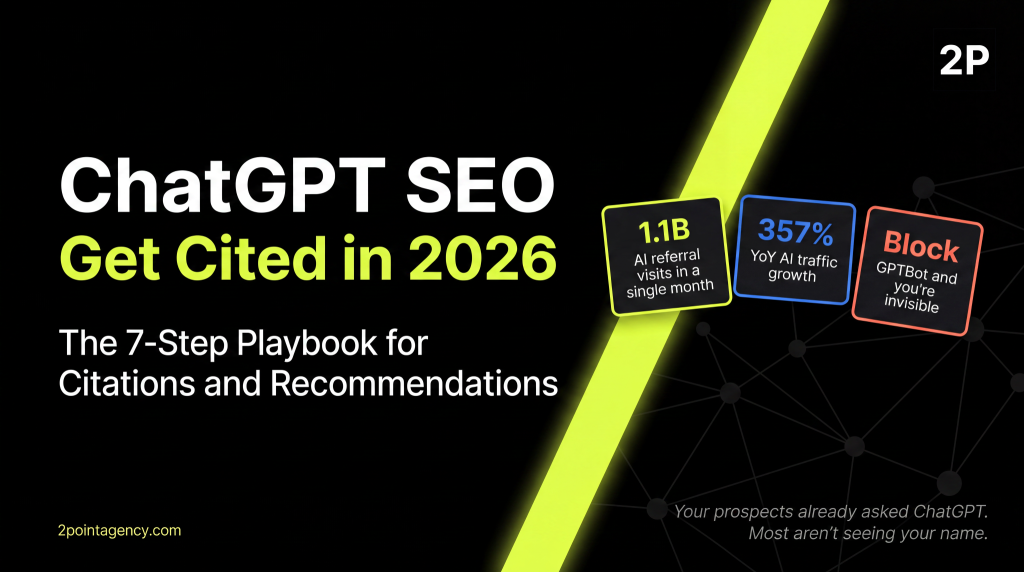
Your prospects are already asking ChatGPT about your category, and most of them aren't seeing your name. That's the gap ChatGPT SEO closes. It is the layer that decides whether ChatGPT trusts you enough to recommend your brand when a buyer asks for the best vendor in your space.
So search has changed. ChatGPT now acts as a recommender, not just a chatbot, and that shift changes what your SEO program needs to look like.
At 2POINT, we treat ChatGPT ranking as a core layer on top of traditional SEO, since strong fundamentals make every ChatGPT citation play compound faster.
Key Takeaways
- ChatGPT SEO is how you earn citations and brand recommendations inside ChatGPT search and base-model answers.
- ChatGPT search optimization rewards the same fundamentals that drive SEO, layered with entity authority and structured answer formats.
- Six ChatGPT search ranking factors decide who gets cited: source authority, topical match, structure, freshness, schema, and brand entity strength.
- Allowing GPTBot in robots.txt is the bare minimum. Blocking it makes you entirely ineligible for ChatGPT citations.
- Earning placements in publications ChatGPT already trusts is the fastest way to get recommended by ChatGPT in 'best of' queries and to optimize content for ChatGPT long term.
What Is ChatGPT SEO?
ChatGPT SEO is the practice of structuring, formatting, and positioning your content so ChatGPT cites, recommends, and accurately represents your brand inside its generated responses.
So the goal has shifted.
You're no longer chasing a top-ten ranking on Google. Instead, you're becoming the source ChatGPT pulls from when someone asks about your category, your competitors, or you.
That puts ChatGPT SEO somewhere between traditional SEO and broader LLM work. Keyword research still matters, but you also need entity signals, retrieval-friendly formatting, and trust signals from third-party sources that ChatGPT already references.
In other words, our LLM SEO glossary covers the umbrella concept, while the broader pillar framework walks through how everything you do for ChatGPT layers onto your existing SEO foundation.
Why ChatGPT SEO Matters Right Now (2026 Context)
ChatGPT as a Search Interface
Search behavior is shifting fast. Buyers blend Google, ChatGPT, and Perplexity across the same purchase journey, and many of those queries end without a single click.
So the zero-click defense plays we walk through elsewhere become table stakes here.
According to Similarweb, AI platforms generated over 1.1 billion referral visits in June 2025, up 357% year over year. So every response ChatGPT generates either mentions you or recommends a competitor.
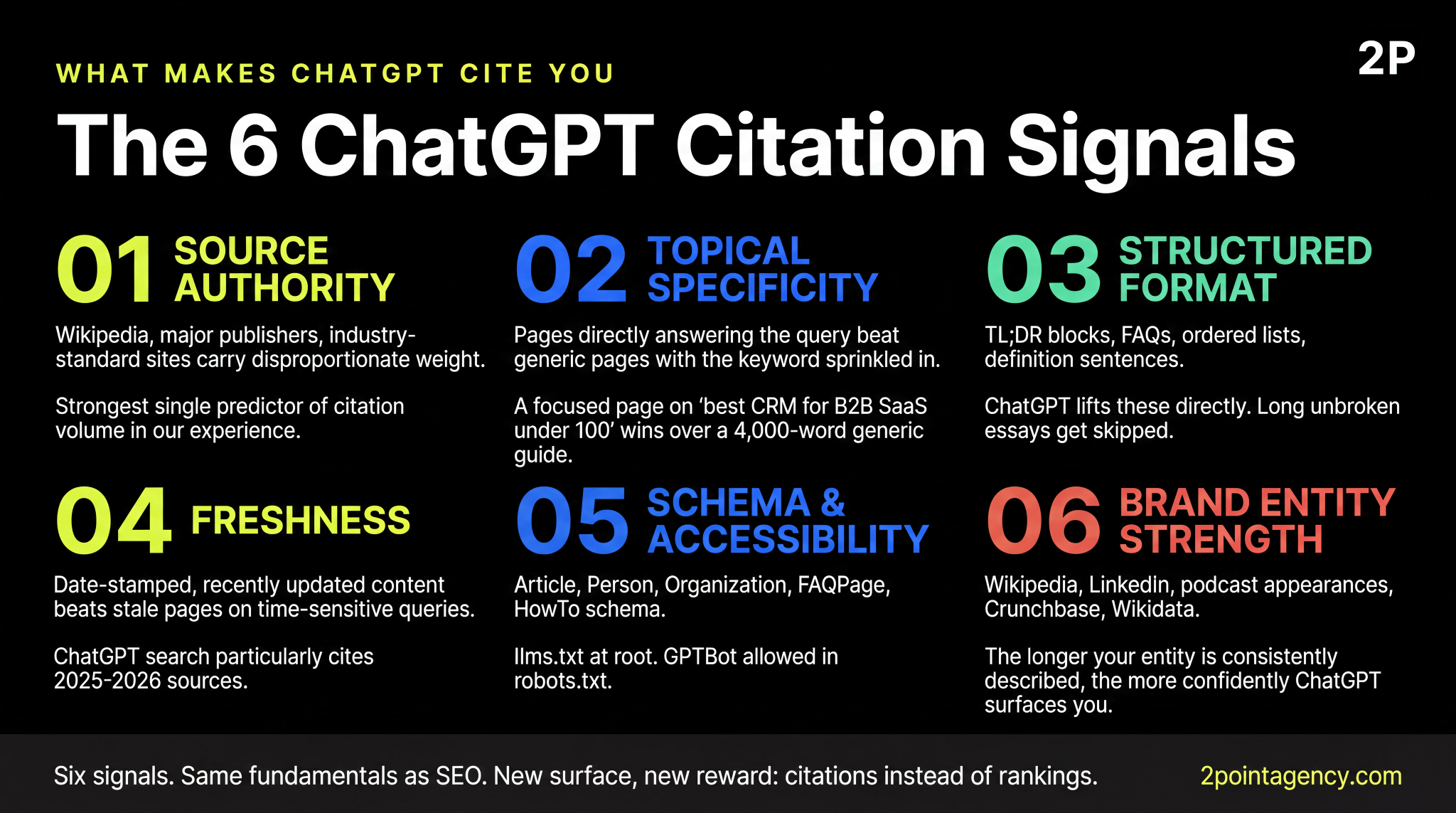
Two ChatGPT modes matter for SEO. The base model answers from training data with a hard cutoff, while ChatGPT search and browse fetch live sources and cite them inline. So both surfaces need attention if you want to rank in ChatGPT for the queries driving your pipeline, since each one rewards different signals.
What Brands Lose by Being Invisible in ChatGPT
When ChatGPT doesn't know who you are, it recommends someone else. So that cost lands in three places:
- Top-of-funnel discovery: Buyers research silently inside ChatGPT before ever opening a Google tab.
- Share of voice:"Best of" queries decide who makes a buyer's shortlist, and you're not on it.
- B2B research touchpoints: Procurement teams routinely use ChatGPT to compare vendors before booking demos.
In short, the B2B buyer journey now runs through AI surfaces, and invisibility there compounds quietly each quarter you wait.
How to Spot the Problem on Your Own Site
You don't need a tool to diagnose this. Just run five brand-relevant queries inside ChatGPT search. Use prompts your sales team hears every week, like "best [category] for [use case]" or "alternatives to [competitor]."
If your name doesn't appear and a competitor's does, you have a chatgpt seo gap. From there, track each gap in a simple sheet and group them by query intent.
That list becomes your first production input. Skip this audit, and you'll waste cycles producing content nobody is asking ChatGPT about.
How ChatGPT Selects and Cites Sources
The Two Modes That Matter for SEO
ChatGPT runs in two modes that shape how content surfaces, and each one rewards a different play.
The base model answers from training data up to a fixed cutoff, which means recommendations come from training memory. So older brands and high-authority pages tend to dominate base responses. To influence that surface, you need to maintain a strong long-term web presence and a consistent entity footprint.
ChatGPT search (browse-enabled mode) works differently. It fetches live or recently indexed sources at query time, then cites them inline. According to OpenAI's documentation, the system rewrites your query into targeted searches before fetching and citing results. So every ChatGPT browse mode citations opportunity sits inside that retrieval layer.
The Retrieval-Augmented Generation Pattern
ChatGPT search uses a Retrieval-Augmented Generation (RAG) pattern. It retrieves relevant sources from an index, then has the model summarize them with citations attached. So your job is straightforward: be one of the retrieved sources every single time.
For a deeper look at ChatGPT's source-citing mechanics, the full retrieval flow walks through query rewriting, source ranking, and snippet selection.
The 6 ChatGPT Citation Signals
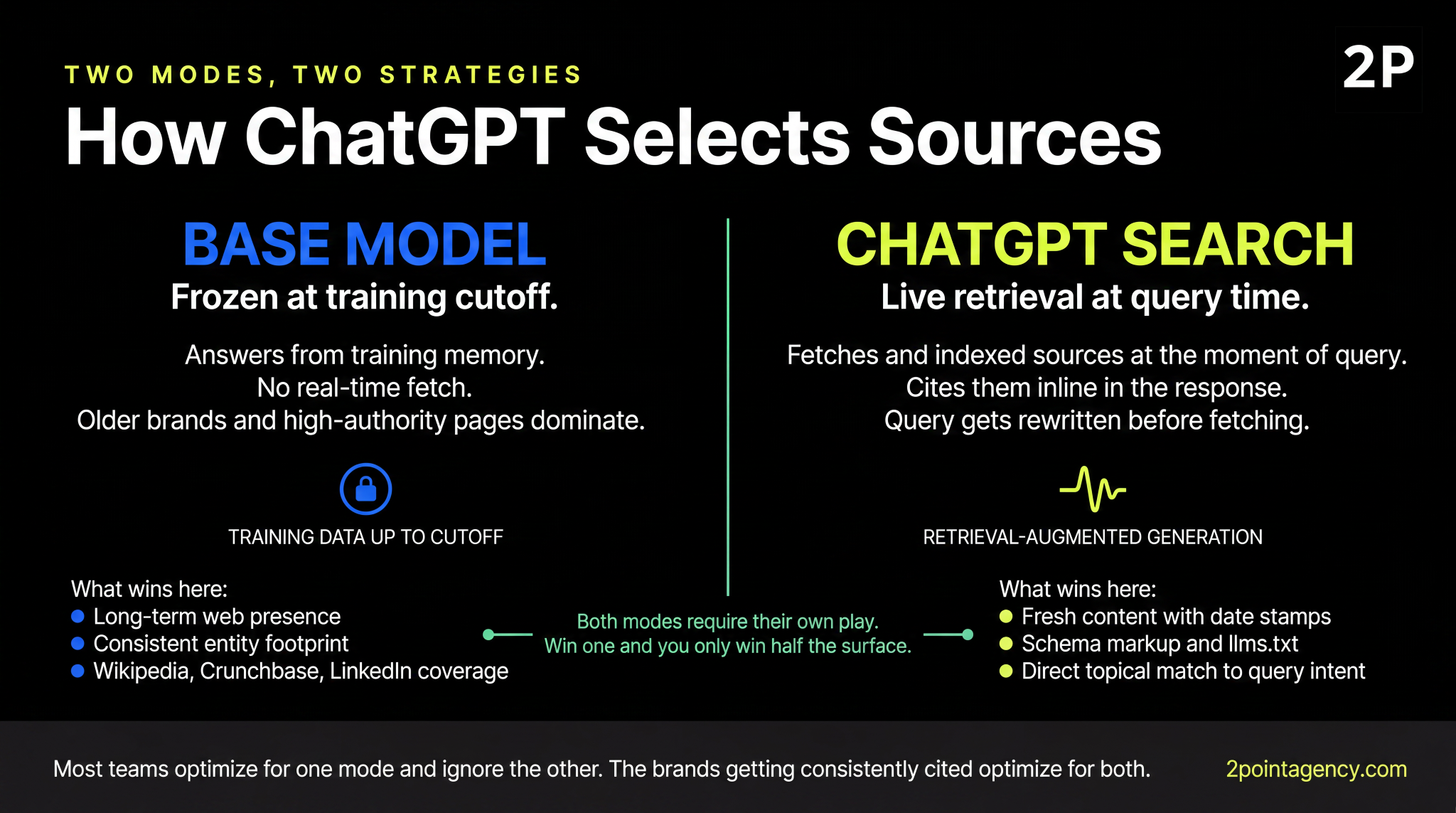
So, how do you actually get picked? These are the ChatGPT source ranking factors that decide whether ChatGPT cites you. Six signals do the heavy lifting.
1. Source Authority and Trust
Start with authority. ChatGPT favors well-known, high-authority domains and citations from sources its training set already trusts.
So, Wikipedia, major publishers, and industry-standard sites all carry disproportionate weight in ChatGPT source selection. Domain authority isn't the only input, but it remains the strongest single predictor of citation volume in our experience.
2. Topical Match and Specificity
Next, specificity. Pages that directly answer the user query get cited far more often than generic pages with the keyword sprinkled in. So a focused page on "best CRM for B2B SaaS under 100 employees" typically outperforms a 4,000-word generic CRM guide for the same ChatGPT citations. Breadth signals coverage, but specificity wins the site.
3. Structured, Skim-Friendly Format
Then format. ChatGPT provides clean answers when your page is already shaped like one. So include TL;DR blocks under your H1, definition sentences in your opening paragraph, FAQ blocks at the bottom, and ordered lists for any process.
Pages that read like long unbroken essays force the model to summarize on the fly, and that usually means it picks the page that already did the work.
4. Freshness and Recency
Freshness comes next. Date-stamped, recently updated content beats stale pages for time-sensitive queries.
So add "Last Updated" stamps to your pillar pages, refresh stats every six months, and date your data clearly. ChatGPT: search citations particularly for 2025 and 2026 sources for any time-sensitive query.
5. Schema and Machine Accessibility
Now for the technical layer. Article, Person, Organization, FAQPage, and HowTo schema all help ChatGPT understand what your page is about.
From there, pair that with an llms.txt file at your domain root and a robots.txt that allows GPTBot. That covers the machine-accessibility checklist.
6. Brand and Author Entity Strength
Finally, entity strength closes the loop. ChatGPT cross-references your brand and author data from Wikipedia, LinkedIn, podcast appearances, Crunchbase, and Wikidata when deciding who to mention by name.
So the longer your entity has been consistently described across those sources, the more confidently the model surfaces you.
The ChatGPT SEO Playbook: 7 Steps to Get Cited
Now you know the six signals. The playbook below is what our SEO team follows to take brands from invisible to consistently cited inside ChatGPT. Run the steps in order, since skipping one breaks the rest.
Step 1: Run a ChatGPT Visibility Baseline Audit
Start with a baseline. Test 20 brand-relevant queries inside ChatGPT search, then record which sources get cited, where you appear (or don't), and which competitors keep showing up.
From there, repeat the queries monthly to maintain a rolling baseline rather than a single snapshot. That sheet will serve as the foundation for every ChatGPT SEO decision you make in the next quarter.
Step 2: Map Real ChatGPT Queries to Content
Once your baseline is locked, expand your seed terms into the conversational queries buyers actually type. Use a combination of Semrush, Ahrefs, and ChatGPT itself to surface them.
The "fan-out" pattern matters here: one head topic spawns dozens of long-tail prompts that hide your real opportunities to rank in ChatGPT. So map every prompt to a pillar or cluster page.
Topics with the highest commercial value get pillar treatment, while supporting prompts become cluster posts that internal-link back. That structure is how you scale without producing fluff at the edges.
Step 3: Restructure Top Pages for Machine Reading
With your queries mapped, audit your top-traffic pages with one question: could ChatGPT extract a clean answer from this in 30 seconds? Most pages fail that test.
The fix is structural, not creative. Add TL;DR blocks (40 to 60 words) under every H1, FAQ sections with 100+ word answers, and definition sentences at the start of every intro. Convert step-by-step content into HowTo blocks.
The faster ChatGPT can find your answer, the more often it cites you.
Step 4: Allow GPTBot in robots.txt
Then comes the access layer. GPTBot SEO starts with one robots.txt line: don't block it. If GPTBot is disallowed, you're ineligible for a ChatGPT citation entirely.
So document the access decision in your robots.txt with a comment, since future engineers might reverse it without context. From there, pair the audit with our technical SEO checklist, so the bot-access piece sits inside a broader infrastructure review.
Step 5: Implement Schema Markup
With access sorted, schema is how machines confirm what your page actually is. So add Article, Person (with sameAs links to author profiles), Organization, FAQPage, and HowTo schema across your editorial pages.
From there, validate every page with the Schema Markup Validator before publishing. Audit quarterly so a CMS update doesn't quietly break your markup.
Step 6: Publish llms.txt and Build Brand Entity
Now for the long-term plays. Publish an llms.txt file at your domain root and treat it as a curated index of your most citation-worthy content.
Beyond that, build your author and brand entity through Wikipedia (where eligible), LinkedIn updates, podcast appearances, and consistent NAP across third-party profiles. Entity work is the slowest part of any ChatGPT SEO program, but it's also the part that compounds the most.
Step 7: Earn Citations from Sources ChatGPT Already Trusts
Finally, the borrowed authority layer. ChatGPT inherits authority from publications and communities whose training data it references.
So Forbes, Harvard Business Review, niche industry publications, Reddit threads, Quora answers, and respected newsletters all feed the citation pool.
That is why one placement in a respected outlet usually moves your ChatGPT search citations further than ten links from anonymous blogs your audience never reads. Earned media is the fastest way to get recommended by ChatGPT in shortlist queries that decide who gets a demo call.
ChatGPT vs Google AI Overviews vs Perplexity
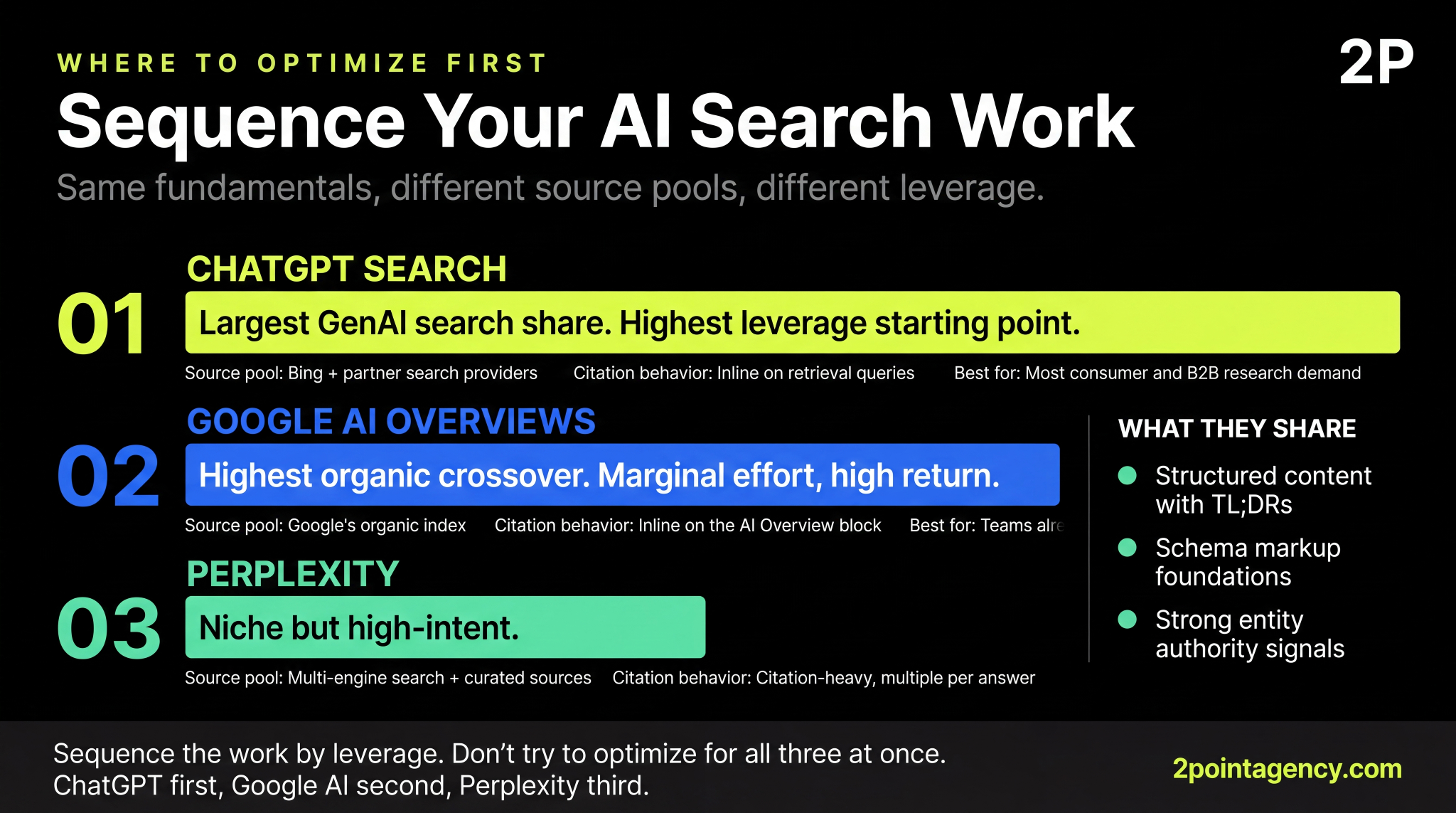
Most teams ask which AI surface to optimize for first. So here's the quick read on each one, since each has its own source pool, citation behavior, and update cadence.
Quick Comparison Table
| ChatGPT Search | Google AI Overviews | Perplexity | |
| Source pool | Bing index plus partner search providers | Google's organic index | Multi-engine search and curated sources |
| Citation behavior | Inline citations on retrieval queries | Inline citations on the AI Overview block | Citation-heavy by default, multiple per answer |
| Update frequency | Frequent for browse, slow for base model | Real-time tied to Google index | Frequent across all surfaces |
| Where to optimize first | Most consumer and B2B research demand | Highest organic crossover for SEO teams | Niche and research-heavy categories |
Where Brands Should Optimize First
Sequence the work based on where your buyers actually are. ChatGPT accounted for the largest share of generative AI search traffic in 2026, making it the highest-leverage starting point for most ChatGPT SEO programs.
After that, Google AI Overviews comes next, since the work overlaps heavily with traditional SEO, and the marginal effort is low. Perplexity and Gemini round out the stack, especially if you're in a niche or research-heavy category.
If you're working in commerce or product discovery, ChatGPT shopping runs on its own playbook around product feeds, schema, and recommendation surfaces.
How to Measure ChatGPT SEO Performance
Measuring chatgpt seo is harder than traditional SEO because the surfaces don't share standard analytics. So the metrics that matter sit across three buckets you'll want to track separately:
- Citation rate: How often does your brand appear as a cited source in ChatGPT responses? Tools like Profound, AthenaHQ, Otterly, and Peec.ai automate the tracking, though a monthly manual prompt panel of 20 to 50 queries works fine for most brands starting out.
- AI-attributed traffic and engagement: Referral sessions from ChatGPT, branded search lift, and any new direct traffic patterns. Adobe Analytics reported a 1,200% YoY jump in generative AI referral traffic to U.S. retail sites, so ChatGPT becomes a real revenue lever once you can attribute it cleanly.
- Brand mention sentiment and accuracy: Being cited badly is worse than not being cited at all. So track whether ChatGPT accurately represents your positioning, pricing, and category. Errors here flag entity work that needs cleaning up, especially across third-party profiles you don't update often.
Pair these metrics with content marketing ROI tracking so attribution holds when ChatGPT did the heavy lifting upstream of the click.
Common ChatGPT SEO Mistakes (and How to Fix Them)
You ran the playbook, but citations still aren't moving. Most stalled chatgpt seo programs are doing the work. They're just doing it wrong in one of four predictable ways.
Mistake 1: Blocking GPTBot Reflexively
Start here: blocking GPTBot in robots.txt out of a privacy or copyright reflex removes you from the citation set entirely. So treat the GPTBot decision strategically rather than defensively.
Decide deliberately which bots have access to which sections, then document the call so it can't be reversed during a future migration. Without that note, the next engineer to touch the file inherits the block without context.
Mistake 2: Generic AI-Written Content with No Original Insight
Even with the right access, generic content sinks the program.
ChatGPT favors novel data, original research, expert quotes, and proprietary frameworks. So sites that just paraphrase other sources get filtered out fast, since the model already has those summaries baked into its training.
If your post could be replaced by a five-prompt ChatGPT session, it probably will be. Strong AI-friendly content centers on the specific patterns models actually pull from in practice.
Mistake 3: No Author Bylines or Verifiable Credentials
Once your content has substance, ChatGPT looks for who's behind the words. Anonymous content reads as low-trust to both Google and ChatGPT.
So add author bylines to every post, then link each to a real bio page with credentials, publications, and external profiles. This is one of the fastest E-E-A-T wins you can ship in a single sprint, and it directly affects how ChatGPT scores your domain.
Mistake 4: Optimizing Only for Google
Beyond bylines, the surface itself matters. ChatGPT's source pool overlaps with Google's, but the two aren't identical. A page that ranks #1 on Google might never get cited by ChatGPT if the structure is wrong, the entity is weak, or the topic doesn't match retrieval intent.
So test both surfaces independently, since AI search and traditional SEO measure different things even when the queries overlap.
Treat ChatGPT as a Discovery Channel
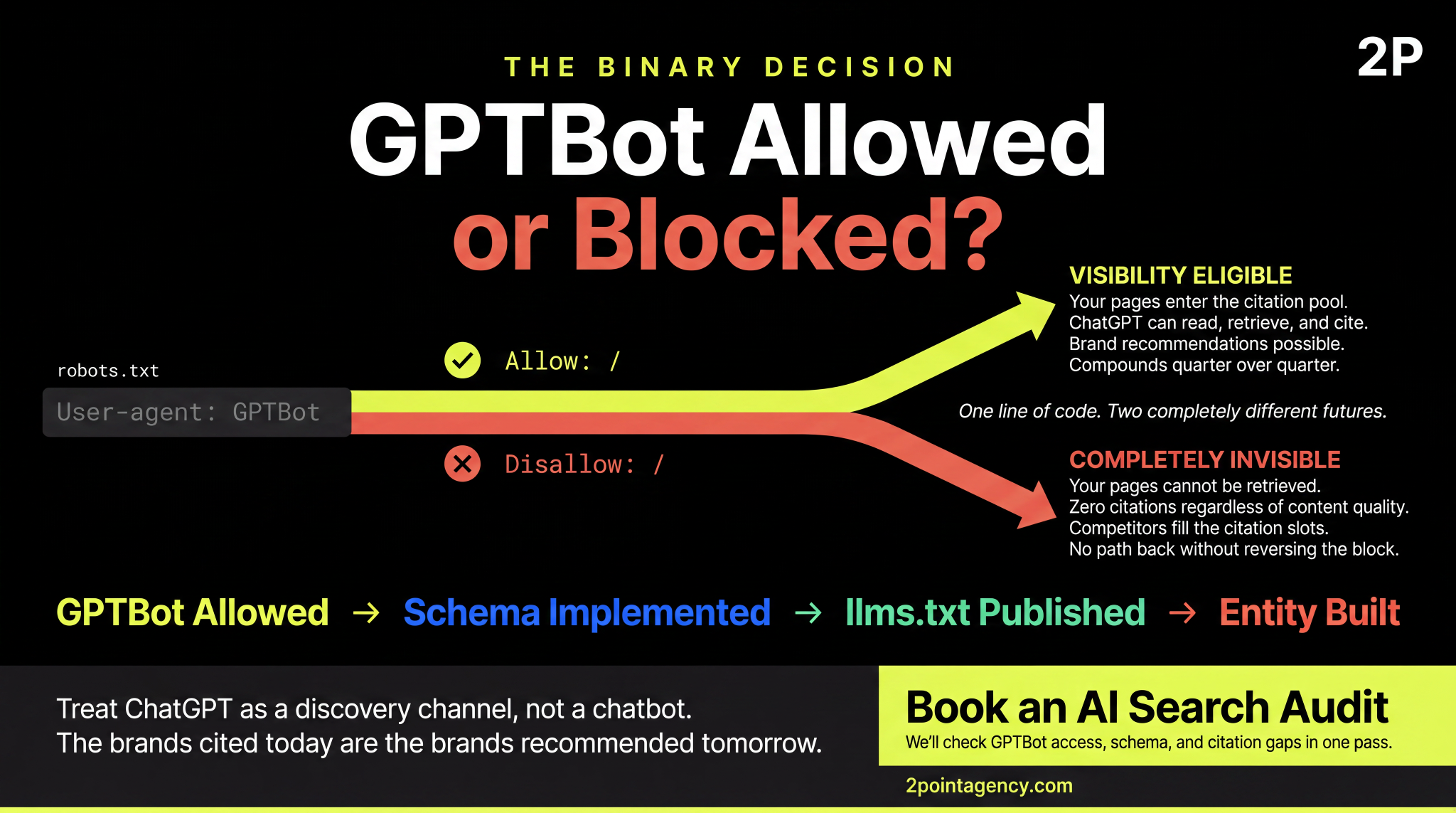
ChatGPT SEO is the next-default layer for any brand serious about visibility in 2026. Structured content, entity authority, and machine accessibility together equal ChatGPT citation eligibility. Build the playbook once, run it across every pillar, and your share of voice grows in places your traditional analytics can't see.
If your team is ready to make the shift, book a 2POINT AI Search Visibility Audit and we'll map your gaps end to end across ChatGPT, Google AI Overviews, and Perplexity.
FAQs
What's the difference between ChatGPT SEO and traditional SEO?
Traditional SEO targets Google's blue links through keywords and backlinks. ChatGPT SEO targets include being cited in ChatGPT search results and in base-model answers.
The signals overlap, but ChatGPT weighs entity authority, structured formats, and trust signals more heavily. So strong fundamentals make every chatgpt citations play compound faster.
Does blocking GPTBot protect my content?
Blocking GPTBot stops OpenAI from training future models on your content, but it also makes you ineligible for ChatGPT search citations entirely. So that tradeoff rarely works for editorial content. For gated, proprietary, or regulated pages, blocking is the right call.
Allow access to everything else.
How long does it take ChatGPT SEO to show results?
Most brands see early citation lifts within 60 to 90 days of restructuring content, adding schema, and earning two or three category-relevant placements. Compounding authority takes 6 to 9 months of consistent execution.
So ChatGPT source ranking moves more slowly than expected, since entity work and earned media propagate gradually.
How is ChatGPT SEO different from Google AI Overview optimization?
The fundamentals overlap, but source pools differ. Google AI Overviews pull from the Google organic index, so existing SEO work translates directly. ChatGPT search uses Bing and partner providers in its retrieval pipeline. So test both surfaces independently, since ChatGPT browse mode citations require their own measurement track.
Do I need a separate SEO strategy for ChatGPT?
You don't need a separate strategy. You need a separate layer on top of your existing SEO program. Most of the work is restructuring content, adding schema, allowing GPTBot, and building entity signals.
So you can rank in ChatGPT across your top 20 pages in one focused sprint.