

 let’s connect


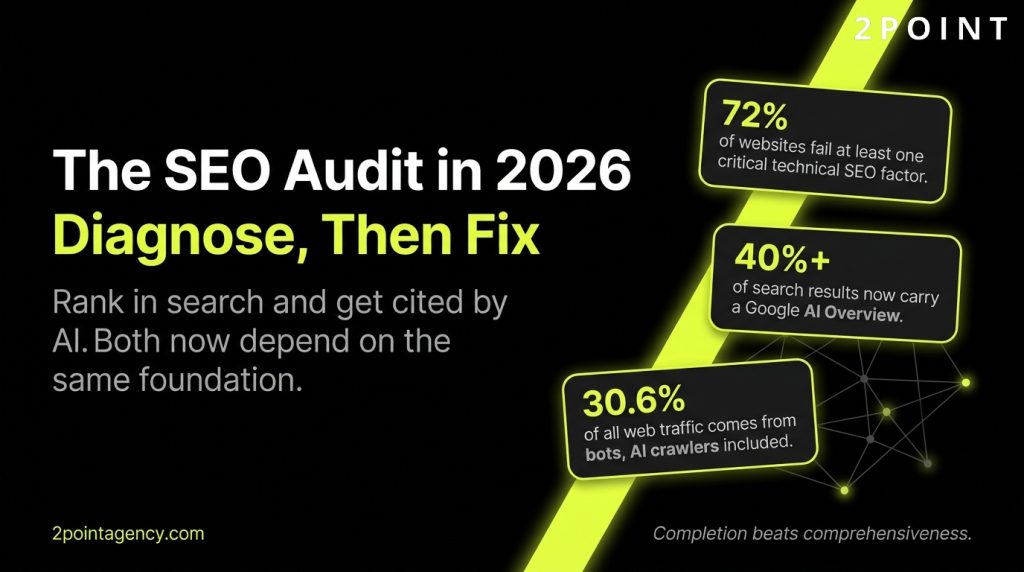
Search engines have fundamentally changed how they evaluate websites in 2026, and a modern SEO audit must keep pace with those changes. Google’s AI Overviews, the replacement of FID with INP in Core Web Vitals, and the explosive growth of AI crawler traffic have all added new layers of complexity to what was once a relatively straightforward diagnostic process. Whether you manage a five-page local business site or an enterprise platform with hundreds of thousands of URLs, conducting a thorough SEO audit is the single most important investment you can make in your organic visibility strategy.
This guide walks through every critical area of a complete SEO audit for 2026, from crawlability fundamentals to answer engine optimization readiness. You will find specific checklists, tool recommendations, and a step-by-step process for turning audit findings into a prioritized action plan that delivers measurable results.
What Is an SEO Audit and Why Does It Matter in 2026?
Before diving into methodology, here is a direct, complete answer to the core question this guide addresses:
- An SEO audit is a systematic evaluation of how well your website can rank in search engines and appear in AI-powered answer systems.
- Modern audits cover six core areas: technical SEO, on-page optimization, content quality, backlink profile, AI readiness, and analytics measurement.
- Google AI Overviews appear in over 40% of search results in 2026, making AI readiness a non-negotiable audit component.
- Core Web Vitals now include INP (Interaction to Next Paint) with a threshold of under 200ms, replacing the older FID metric.
- 30.6% of all web traffic comes from bots, including a growing share from AI crawlers that require specific technical accommodations.
- A quarterly audit cadence prevents small issues from compounding into significant ranking losses.
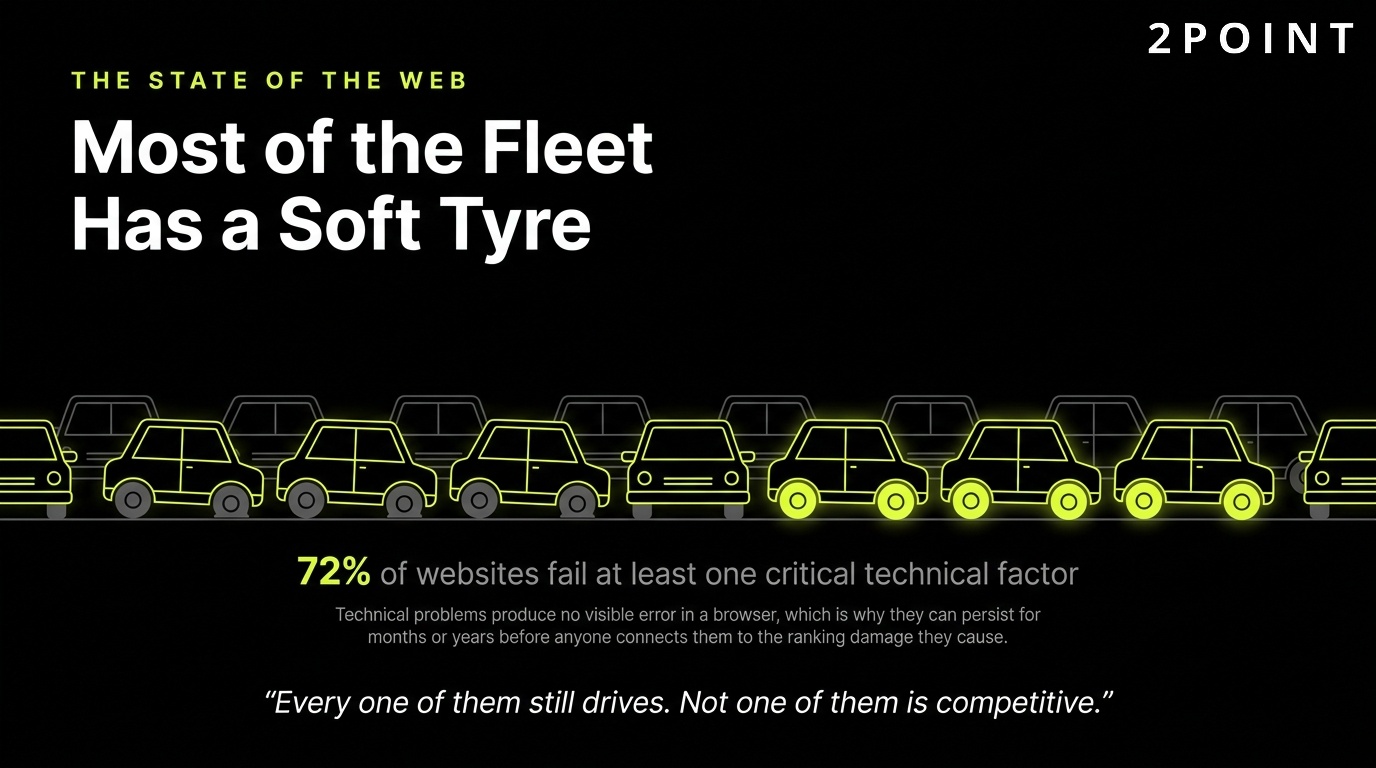
- 72% of websites currently fail at least one critical technical SEO factor that directly impacts visibility.
- Fixing technical issues before pursuing content or link building prevents wasted effort on a broken foundation.

With those fundamentals established, let us move through each major audit component in the detail you need to take action.
Why Technical SEO Forms Your Audit Foundation
Every SEO audit begins with technical infrastructure because no amount of content quality or backlink authority can compensate for a website that search engines cannot properly access, render, or prioritize. Technical SEO problems are the silent killers of organic performance: they often produce no visible error messages in a browser, which means they can persist for months or years before anyone notices the ranking damage they cause.
Understanding the architecture of technical failures helps you diagnose problems faster and explain their impact to stakeholders who may not have an SEO background. When you frame technical issues as communication breakdowns between your website and search engine crawlers, the urgency of fixing them becomes immediately clear.
The Three Types of Technical Failures That Kill Rankings

Technical SEO problems fall into three distinct categories, and each one requires a different diagnostic approach. Grouping issues this way makes it much easier to prioritize your audit findings and communicate them effectively.
The first category is access problems: situations where Google simply cannot reach your pages. This includes blocked URLs in robots.txt, noindex directives applied to high-value pages by accident, authentication walls, and server errors that return 5xx status codes. When Google cannot access a page, that page cannot rank, regardless of how well-optimized it is.
The second category is interpretation problems: situations where Google can reach your pages but cannot understand or render them correctly. JavaScript-heavy pages that require complex rendering, duplicate content without canonical directives, and hreflang errors on multilingual sites all fall into this category. Google may index these pages, but it indexes an incomplete or incorrect version of them.
The third category is priority problems: situations where Google can reach and understand your pages, but chooses to prioritize competitor pages instead. Thin content, weak internal link structures, slow page speeds, and poor Core Web Vitals scores create priority problems. According to Semrush’s 2025 benchmark data, 72% of websites fail at least one critical technical SEO factor that contributes to exactly this kind of competitive disadvantage.
For each page category in your audit, ask: Can Google reach this? Can Google understand this? Has Google chosen this over competitors? The answers will tell you which type of failure you are dealing with and what the fix should be.
Crawlability Hygiene: Your First Audit Priority
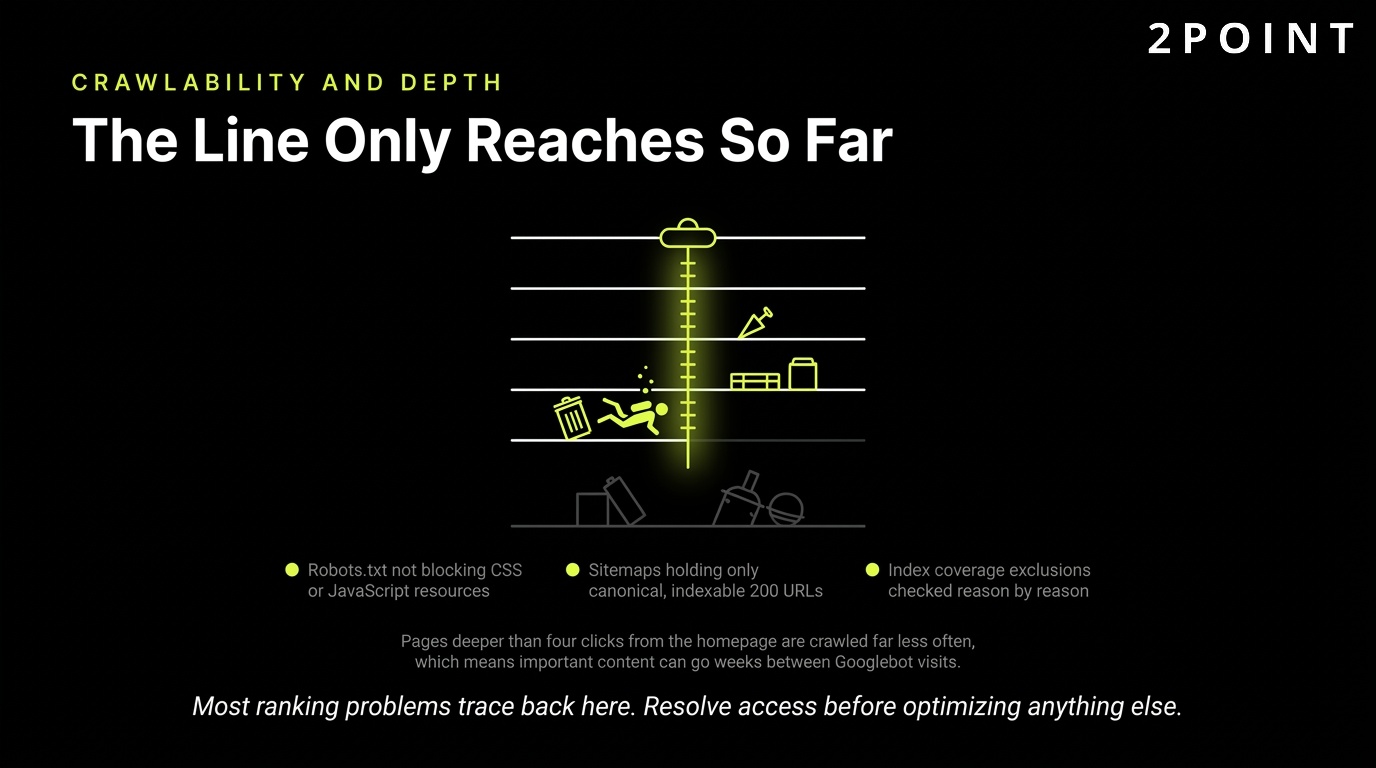
Crawlability is the starting point of every technical SEO audit because it determines which pages Google can even consider for indexing. A crawlability audit covers five primary areas: robots.txt validation, XML sitemap accuracy, index coverage monitoring, noindex directive audits, and URL hierarchy depth.
Your robots.txt file should be validated to confirm it is not accidentally blocking important pages or entire directory sections. A common error is blocking the /wp-admin/ path in WordPress sites, which is correct, but also blocking CSS and JavaScript resources that Google needs to render pages properly. Check your robots.txt against Google Search Console’s URL Inspection tool to see exactly what Googlebot can and cannot access.
Your XML sitemap should contain only canonicalized, indexable URLs. Sitemaps that include redirected URLs, noindex pages, or URLs with parameters create confusion in Google’s crawl queue and waste crawl budget. Validate your sitemap against the live site to ensure every URL it references returns a 200 status code and points to the correct canonical version.
Index coverage monitoring in Google Search Console reveals excluded pages and the reasons for their exclusion. Categories like “Discovered, currently not indexed” and “Crawled, currently not indexed” signal crawl budget or quality problems that need investigation. URL hierarchy depth also matters: pages buried more than four clicks from the homepage receive significantly less crawl frequency, which means important content may go weeks between Googlebot visits.
Most ranking problems in 2026 trace back to crawlability or indexation issues, making this the highest-priority section of any website audit. Resolve access problems before attempting any other optimization work.
Core Web Vitals in 2026: New INP Thresholds
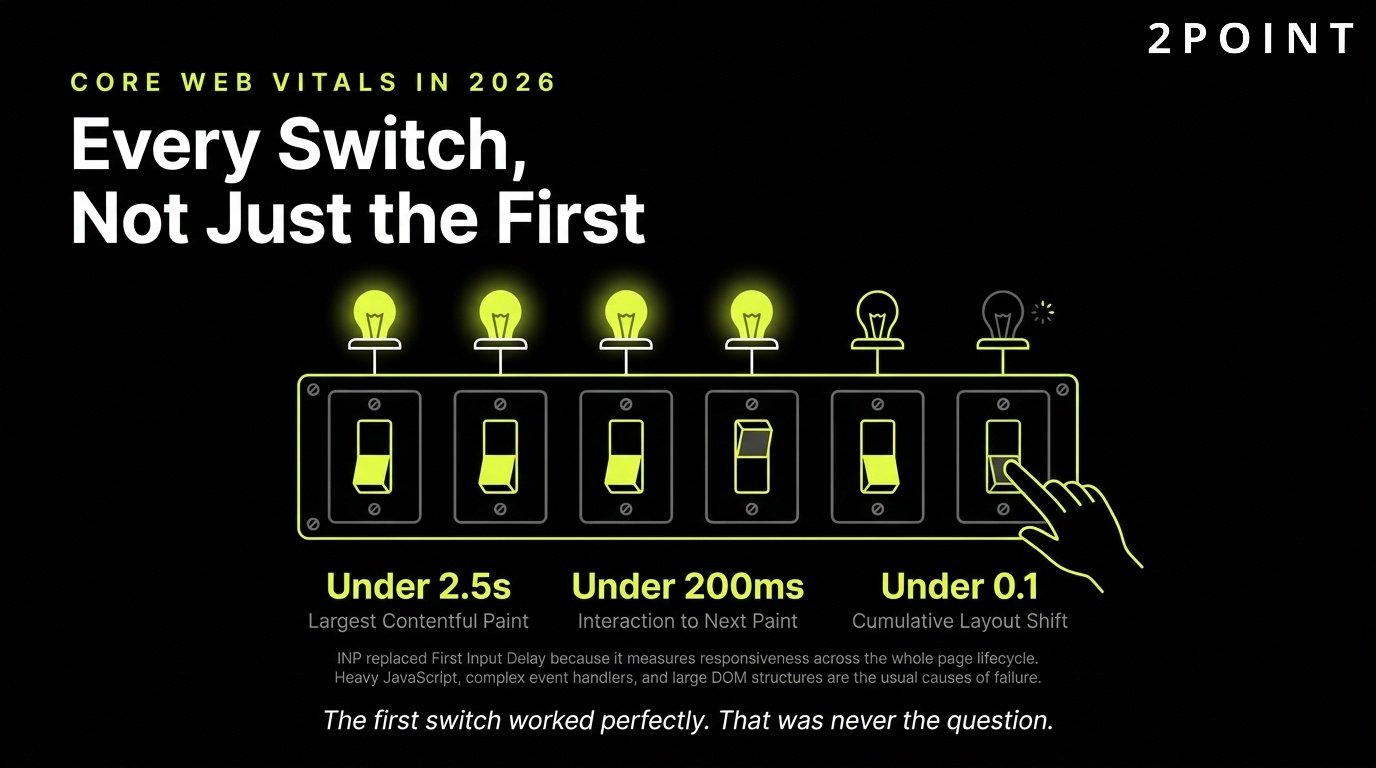
Core Web Vitals remain a confirmed ranking signal in 2026, and the metric set has evolved. The three metrics and their 2026 thresholds are Largest Contentful Paint (LCP) under 2.5 seconds, Interaction to Next Paint (INP) under 200 milliseconds, and Cumulative Layout Shift (CLS) under 0.1. INP replaced the older First Input Delay (FID) metric because it measures responsiveness across all interactions throughout the page lifecycle, not just the first one.
INP is the most demanding new threshold for many websites. It measures the time from a user interaction, such as a click or keyboard input, to the next frame rendered by the browser. Sites with heavy JavaScript execution, complex event handlers, or large DOM structures frequently fail this metric even when they appear fast in traditional load time tests. A Core Web Vitals audit in 2026 must specifically test INP across real-world interaction scenarios, not just synthetic benchmarks.
The compounding effect of strong Core Web Vitals is significant. Fast sites earn algorithmic preference, but they also convert at higher rates because users abandon slow experiences. Your audit should measure Core Web Vitals using both Google Search Console’s Core Web Vitals report (which uses real-user data from the CrUX dataset) and tools like PageSpeed Insights and Lighthouse for lab testing. Mobile-first measurement is essential, since Google uses mobile performance as the primary evaluation signal.
When diagnosing failures, check website speed factors including server response times, render-blocking resources, image sizes, and third-party script load impact. Each metric has a distinct set of common causes, and your audit report should link each failing metric to its most likely technical root cause.
Internal Linking Architecture Audit Strategy
Internal linking is one of the most underaudited technical areas, yet it controls how PageRank flows through your site and which pages Google considers most important. An internal link architecture audit operates at two levels: template-level links (navigation menus, footers, breadcrumbs) and content-level links (editorial links within page body copy).
Template-level links appear on every page of your site, meaning they carry enormous weight in your internal link graph. Mega menus with hundreds of links dilute the value passed to any individual page. Your audit should evaluate whether navigation structures are organized to concentrate link equity on your most commercially important pages rather than distributing it equally across every page on the site.
Internal redirects are a common and often overlooked problem. When Page A links to Page B, which redirects to Page C, the redirect chain wastes crawl resources and leaks PageRank. Your audit should identify all internal links that point to redirected URLs and update them to link directly to the final destination.
The hub versus standalone page decision also belongs in an internal link audit. Hub pages aggregate content around a topic and link outward to more specific pages, creating topical clusters that signal authority to Google. If your site lacks hub pages for its most important topics, you are missing an opportunity to concentrate relevance signals and improve ranking depth across your content catalog. Identify which topics warrant hub pages based on your keyword strategy, then audit whether your current internal link structure supports or undermines that organization.
JavaScript SEO: The Most Complex Audit Area
JavaScript has become the dominant development paradigm for modern websites, and it has also become the most complex area of SEO auditing. The core problem is simple to state but difficult to resolve: what you see in your browser is not necessarily what Google sees when it crawls your pages. Understanding this gap is the foundation of effective JavaScript SEO auditing.
Why JavaScript Breaks Traditional SEO Audits
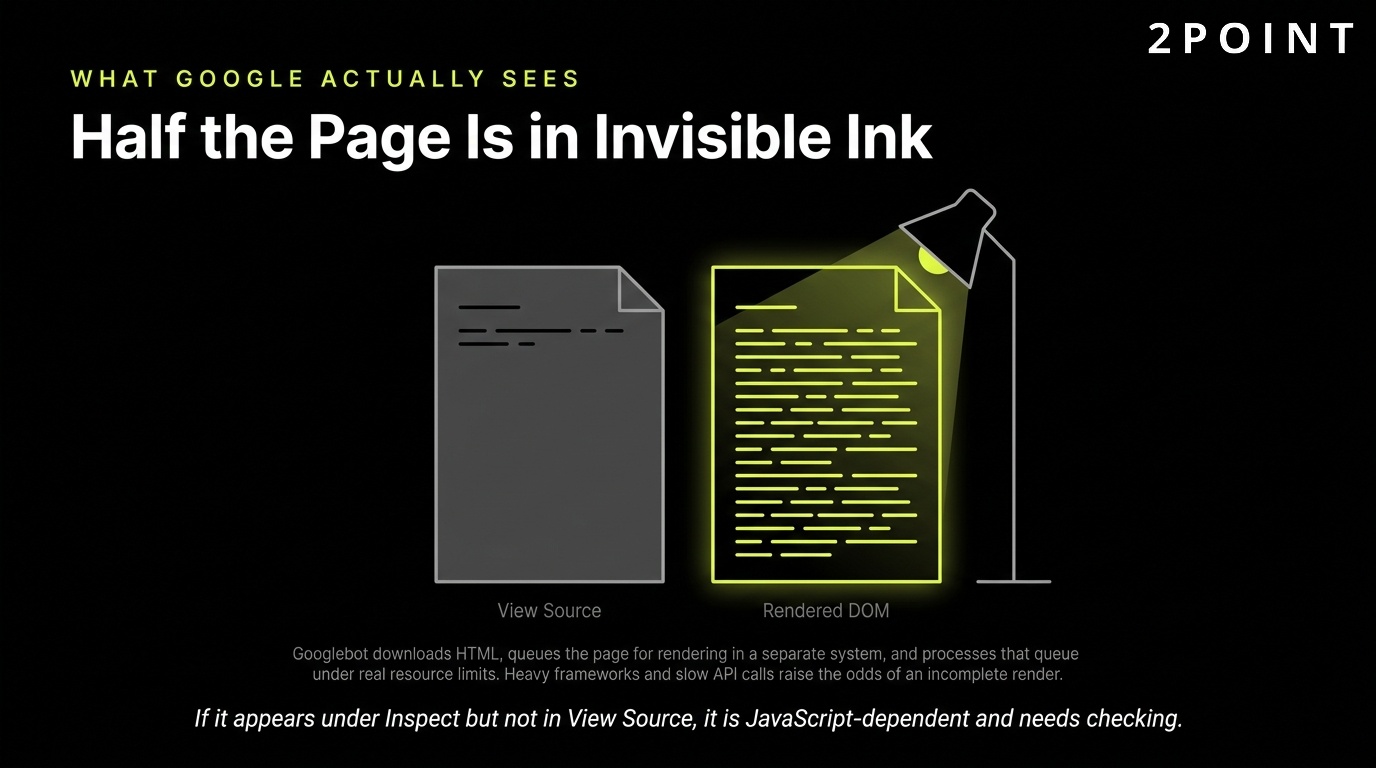
When you load a web page in Chrome, your browser downloads the HTML, executes all JavaScript files, renders the final visual output, and displays it within seconds. The experience is seamless and immediate. Google’s crawling system works very differently. Googlebot downloads HTML and JavaScript resources, queues pages for rendering in a separate system, and processes that rendering queue with significant resource and timing constraints.
The practical consequence is that content loaded or modified by JavaScript may not be visible to Google at the time it evaluates your page for ranking purposes. A navigation menu built entirely in JavaScript, product descriptions populated by a client-side API call, or review content loaded after user interaction are all examples of content that traditional browser testing would show as visible but that may be invisible or incomplete in Google’s rendering pipeline.
Resource allocation limits compound this problem. Google’s rendering system does not execute every JavaScript file with the same priority or completeness that a modern browser does. Heavy frameworks, large dependency chains, and slow API calls all increase the likelihood that Google will process an incomplete version of your page. This is why issues that appear perfectly normal in browser testing can represent genuine SEO failures in practice.
Traditional audit tools that check only the raw HTML of a page will completely miss JavaScript-dependent content problems. A proper JavaScript SEO audit requires rendering-aware evaluation tools and manual verification techniques that compare what Googlebot actually sees against what your browser displays.
Client-Side vs. Server-Side Rendering Audit Checks
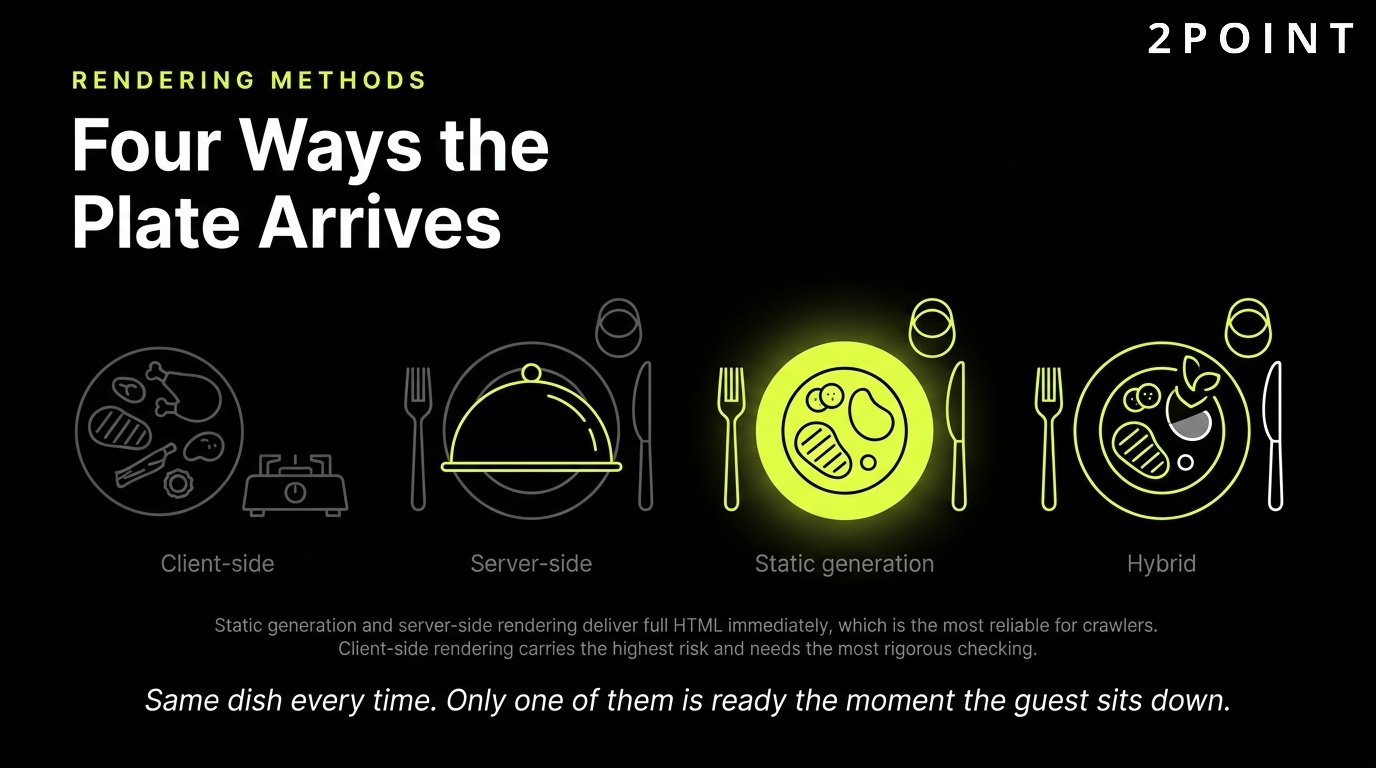
The rendering method your site uses determines which specific checks your audit needs to include. The three primary approaches are client-side rendering (CSR), server-side rendering (SSR), and hybrid approaches including static site generation (SSG) and incremental static regeneration (ISR).
| Rendering Method | How Content Reaches Google | Primary SEO Risk | Audit Priority |
|---|---|---|---|
| Client-Side Rendering (CSR) | JavaScript executes in Google’s rendering queue | Content may not render completely or at all | High: requires rendering verification |
| Server-Side Rendering (SSR) | Full HTML delivered to Googlebot immediately | TTFB increases, hydration delays possible | Medium: verify HTML completeness |
| Static Site Generation (SSG) | Pre-rendered HTML served from CDN | Stale content if rebuild frequency is low | Low: most SEO-friendly approach |
| Hybrid / ISR | Mix of static and dynamic rendering | Inconsistent rendering between page types | Medium: audit each page type separately |
The most SEO-reliable rendering method is SSG or SSR, since full HTML is immediately available to crawlers without requiring JavaScript execution. Client-side rendering is the highest-risk approach for SEO and demands the most rigorous auditing.
The quickest manual test for rendering issues is the View Source versus Inspect Element comparison. Right-clicking a page and selecting “View Page Source” shows the raw HTML that Googlebot receives before any JavaScript runs. Right-clicking and selecting “Inspect” shows the fully rendered DOM after JavaScript has executed. If critical content like headings, body text, or navigation items appears in the Inspect view but not in View Source, that content is JavaScript-dependent and requires further audit attention.
Testing JavaScript Rendering in Your SEO Audit
Google Search Console’s URL Inspection tool is your primary testing resource for JavaScript rendering. After entering a URL, click “Test Live URL” and then “View Tested Page” to see a screenshot of how Googlebot rendered the page, the rendered HTML, and a list of all resources Googlebot loaded or failed to load. This gives you direct visibility into what Google actually sees, rather than what your browser shows.
Pay particular attention to resources listed as “not loaded” in the URL Inspection results. These represent JavaScript files, stylesheets, or API endpoints that Googlebot could not access, which may cause incomplete rendering. Common reasons for failed resource loading include robots.txt blocking, authentication requirements, and CORS restrictions that prevent cross-origin requests from Googlebot’s IP addresses.
Mobile versus desktop rendering differences matter for SEO audits because Google uses mobile-first indexing. A page that renders correctly in desktop testing may still fail on mobile if the JavaScript implementation handles responsive breakpoints differently. Test critical pages using both mobile and desktop options in the URL Inspection tool.
Hydration delays are a specific issue with React, Vue, and Angular applications that use SSR. These frameworks deliver server-rendered HTML initially, then “hydrate” it with JavaScript to make it interactive. During the hydration window, the page exists in a partially functional state. If Googlebot’s rendering captures the page during this window, it may index an incomplete version. Your audit should check for visible hydration artifacts, content flashes, or layout shifts that indicate timing problems in the JavaScript execution sequence.
Critical Content and JavaScript Dependencies
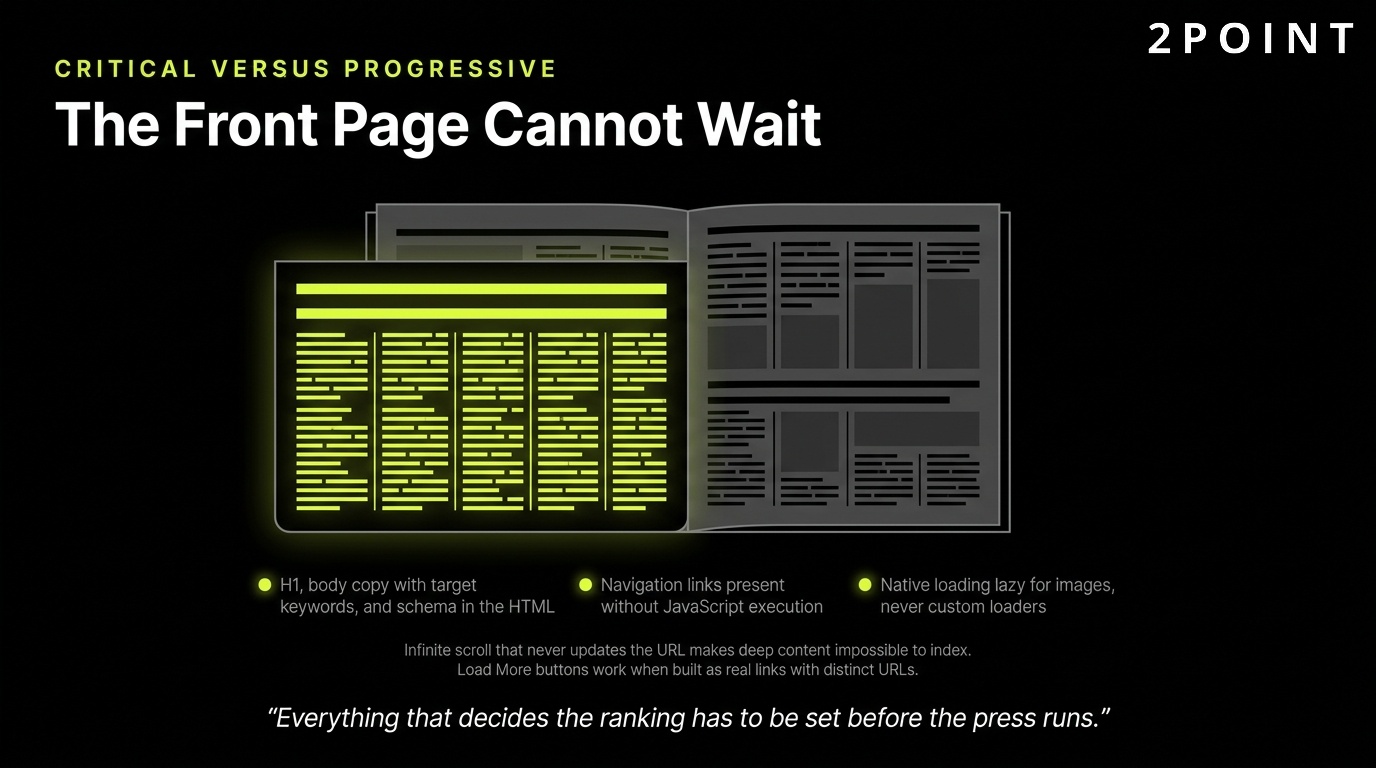
Not all JavaScript-dependent content carries equal SEO risk. Your audit should distinguish between critical content that must render immediately and supplementary content that can load progressively without ranking impact.
Critical content includes H1 headings, body copy containing target keywords, navigation links used for internal link equity distribution, and structured data markup. If any of these elements require JavaScript to render, they represent high-priority audit findings. Critical content should always be included in the server-delivered HTML or rendered server-side before Googlebot encounters the page.
Lazy loading is a common and generally acceptable technique for images and off-screen content, but it must be implemented correctly for SEO. Use the native loading=”lazy” attribute for images rather than custom JavaScript lazy loaders, since Google understands and handles the native attribute correctly. Custom lazy loaders that use intersection observers or scroll events may prevent Google from discovering and indexing images entirely.
Infinite scroll and “Load More” button patterns both create indexation challenges. Google can follow “Load More” buttons if they are implemented as standard links with distinct URLs, but infinite scroll that loads content without updating the URL makes it impossible for Google to index paginated content. Your audit should verify that paginated content uses either rel=”next”/rel=”prev” patterns, distinct URL parameters, or appropriately linked page segments so that deep content remains crawlable and indexable.
Schema Markup as Infrastructure, Not an Add-On
Schema markup has undergone a fundamental status change in 2026. What was once considered an optional enhancement for earning rich snippets is now better understood as core infrastructure that determines whether your website communicates effectively with both traditional search algorithms and AI answer systems. An audit that does not include thorough schema evaluation is an incomplete audit.
Why Schema Is Now Infrastructure, Not Optional

The role of structured data has expanded because AI systems, including Google’s AI Overviews, rely heavily on machine-readable data signals when deciding which sources to cite. A page with proper schema markup communicates its content type, authorship, publication date, and factual claims in a format that AI extraction systems can process with high confidence. A page without schema requires the AI system to infer these attributes from unstructured text, which reduces the system’s confidence in that page as a citation source.
According to W3Techs data from early 2026, 53% of the top 10 million websites use JSON-LD structured data. This means nearly half of the web still lacks proper schema implementation, creating a significant competitive advantage for sites that audit and optimize their markup correctly. JSON-LD is the preferred implementation method recommended by Google because it can be added to any page without modifying the existing HTML structure.
Schema markup also supports richer search result appearances. FAQ schema can generate expandable question-and-answer sections in search results. Product schema adds price and availability information. Review schema adds star ratings. Each of these enhancements increases click-through rate by making your result more visually prominent and informationally complete than plain text listings from competitors who lack structured data.
Think of schema as the bridge between your human-readable content and the machine-readable understanding that modern search and AI systems require. Without that bridge, even excellent content can be systematically undervalued by automated systems that cannot confidently interpret it.
Essential Schema Types for Every Content Page

Different page types require different schema implementations, and a thorough schema audit verifies that each page type on your site carries the appropriate markup. The following table summarizes the most important schema types and their required properties for 2026 compliance.
| Schema Type | Required Properties | Primary Use Case | Rich Result Eligibility |
|---|---|---|---|
| Article / BlogPosting | headline, author (Person entity), datePublished, dateModified, publisher | News articles, blog posts, guides | Top Stories carousel, article rich results |
| Organization | name, url, logo, contactPoint, sameAs | Sitewide brand identification | Knowledge Panel data, brand SERP features |
| WebSite | name, url, potentialAction (SearchAction) | Sitewide search box integration | Sitelinks Search Box in Google results |
| LocalBusiness | name, address, telephone, openingHours, geo | Physical location pages | Local Pack, Maps integration |
| BreadcrumbList | itemListElement with position and item | All pages within a navigational hierarchy | Breadcrumb path in search result URL display |
Implementing these five schema types across appropriate page templates covers the majority of structured data opportunities for most website types, and each one contributes directly to both traditional rich results and AI citation confidence.
For Article and BlogPosting schema, the author property deserves special attention. Defining the author as a Person entity with an associated URL, either a profile page on your site or an authoritative external profile, creates a named entity that Google and AI systems can use to evaluate author credibility. Anonymous content or content attributed only to a company name rather than an individual person scores lower on the E-E-A-T signals that both ranking algorithms and AI citation systems evaluate.
Product, Review, and FAQ Schema Opportunities
For e-commerce and review-heavy sites, additional schema types create significant rich result opportunities that translate directly into higher click-through rates. Product schema should include the name, description, image, SKU, brand, and Offer properties. The Offer property must contain current pricing and availability, since outdated price information can result in Google removing your rich snippet eligibility entirely.
Review and AggregateRating schema add star ratings to your search listings, which consistently improve click-through rates for products, services, recipes, and local businesses. When implementing AggregateRating, your schema must accurately reflect real user reviews, and the review display must be visible on the page rather than hidden behind a tab or loaded only by JavaScript. Google verifies that structured data claims are supported by visible on-page content.
FAQ schema generates expandable question-and-answer panels directly in search results, allowing your listing to occupy significantly more SERP real estate than a standard result. This schema type is particularly valuable for informational pages, service pages, and product pages that address common buyer questions. Your audit should identify pages with existing FAQ sections and verify whether FAQ schema has been implemented correctly on each one.
HowTo schema is valuable for instructional content. When implemented correctly, it can generate step-by-step rich results that display individual steps directly in search results, increasing the likelihood that users who are ready to take action click your result over a generic competitor listing. Review all tutorial, guide, and process-oriented pages in your audit to identify HowTo schema opportunities.
Schema Validation and Testing in Your Audit
Finding and implementing schema is only half of the structured data audit. Validation is equally important because invalid schema provides no benefit and can, in some cases, lead to manual actions if it misrepresents page content. Two primary tools support schema validation: Google’s Rich Results Test and the Schema Markup Validator.
The Rich Results Test at search.google.com/test/rich-results shows whether a specific URL or code snippet is eligible for rich results in Google Search. It displays detected schema types, lists any errors that prevent rich result eligibility, and shows warnings that may reduce display reliability without completely disqualifying the page. Errors must be resolved; warnings should be investigated and resolved where possible.
The Schema Markup Validator at validator.schema.org tests markup against the schema.org specification rather than Google-specific requirements. Using both tools together gives you the most complete validation picture. Common implementation mistakes include nesting errors (placing a schema type inside an incompatible parent type), missing required fields, and using deprecated property names from older schema.org versions.
After implementation, monitor schema performance in Google Search Console under Enhancements. This section shows which schema types Google has detected across your site, how many pages carry each type, and any validity issues detected during indexing. Make schema monitoring a regular part of your ongoing SEO metrics review process, not just a one-time audit task.
AI Readiness and Answer Engine Optimization
The single biggest shift in SEO auditing between 2022 and 2026 is the requirement to optimize for AI-powered answer systems in addition to traditional search rankings. Google’s AI Overviews, ChatGPT browsing, Perplexity, and similar systems represent a new visibility channel that operates on different signals than classic blue-link rankings. A complete SEO audit in 2026 must evaluate your site’s readiness for both channels.
The Dual Visibility Requirement in 2026
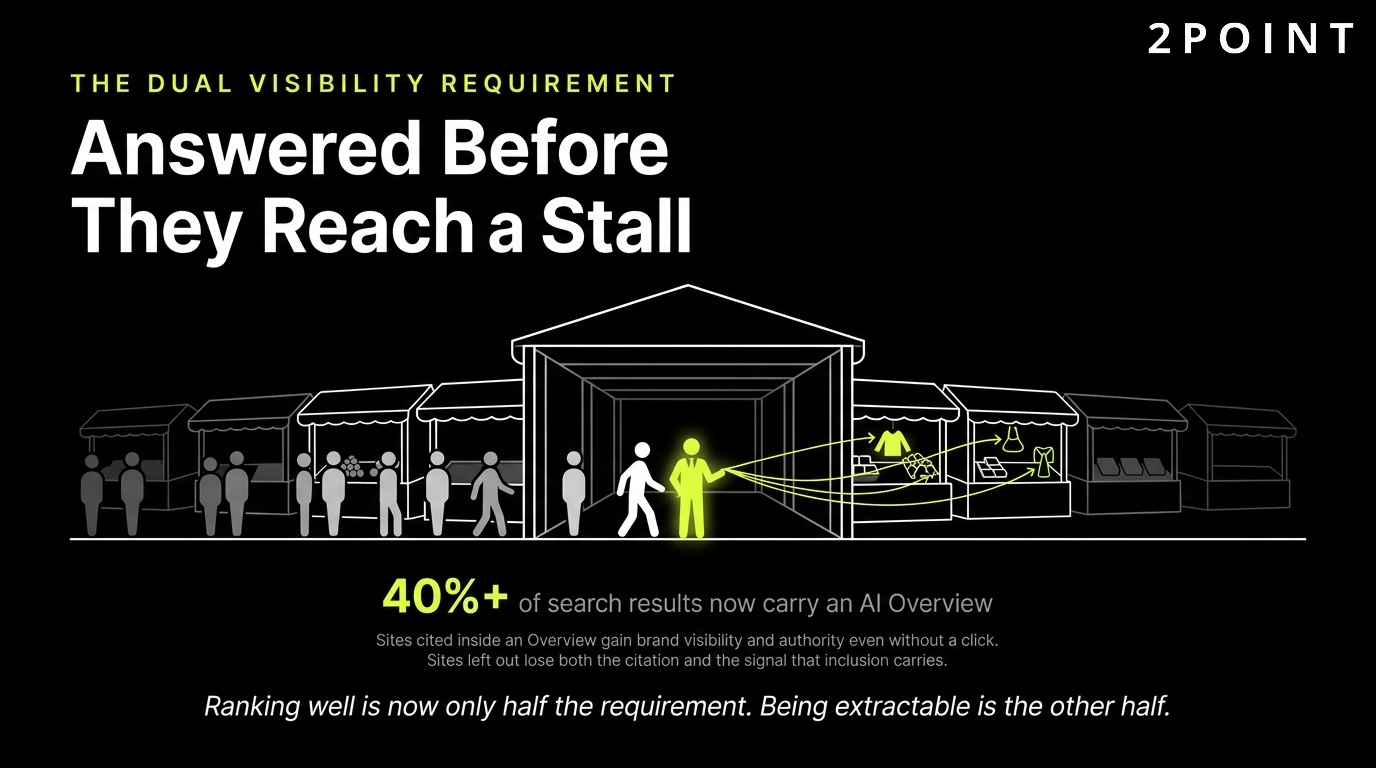
Traditional search visibility metrics measure ranking positions, organic click-through rates, and traffic from search results pages. These metrics remain important, but they now represent only one dimension of search visibility. Google AI Overviews appear in over 40% of search results in 2026, synthesizing answers from multiple sources and often reducing the click-through rate for queries they cover.
Sites cited within AI Overviews receive brand visibility and authority signals even when users do not click through. Sites excluded from AI Overviews lose both the citation opportunity and the implicit authority signal that inclusion provides. This creates a dual visibility requirement: your site must rank well in traditional results AND be structured in a way that AI systems can confidently extract and cite its content.
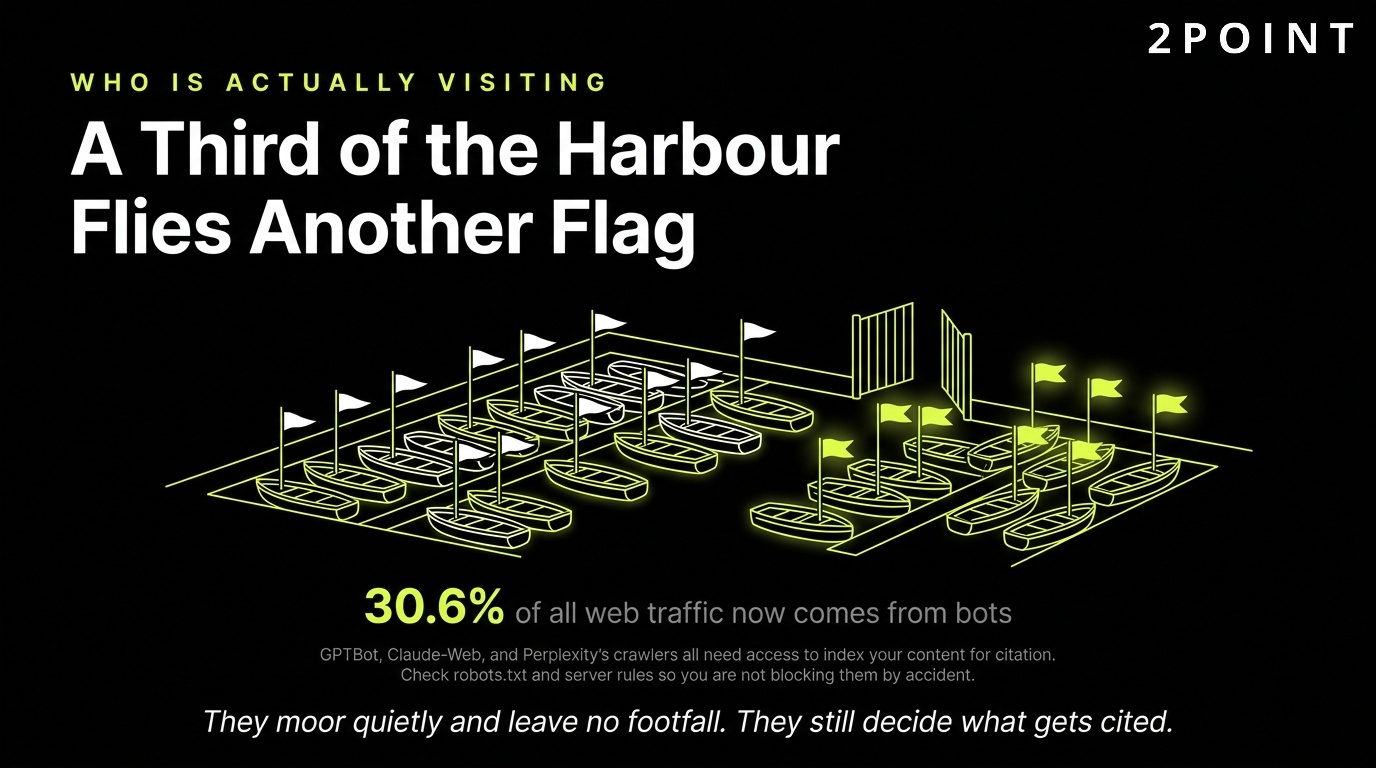
Cloudflare’s Q1 2026 data shows that 30.6% of all web traffic comes from bots, with AI crawlers representing a growing share of that total. These crawlers, including GPTBot from OpenAI, Claude-Web from Anthropic, and various Perplexity crawlers, need to be able to access your content. Check your robots.txt and server configurations to verify that you are not accidentally blocking legitimate AI crawlers that could be indexing your content for citation in their answer systems.
The concept of a “legible” website captures the AI readiness requirement well. A legible website communicates its content type, author identity, factual claims, publication context, and topical authority in formats that both human readers and machine systems can process reliably. Legibility requires a combination of structured data, clear content organization, explicit attribution, and consistent entity signals across all pages.
Answer Engine Optimization (AEO) Audit Checklist
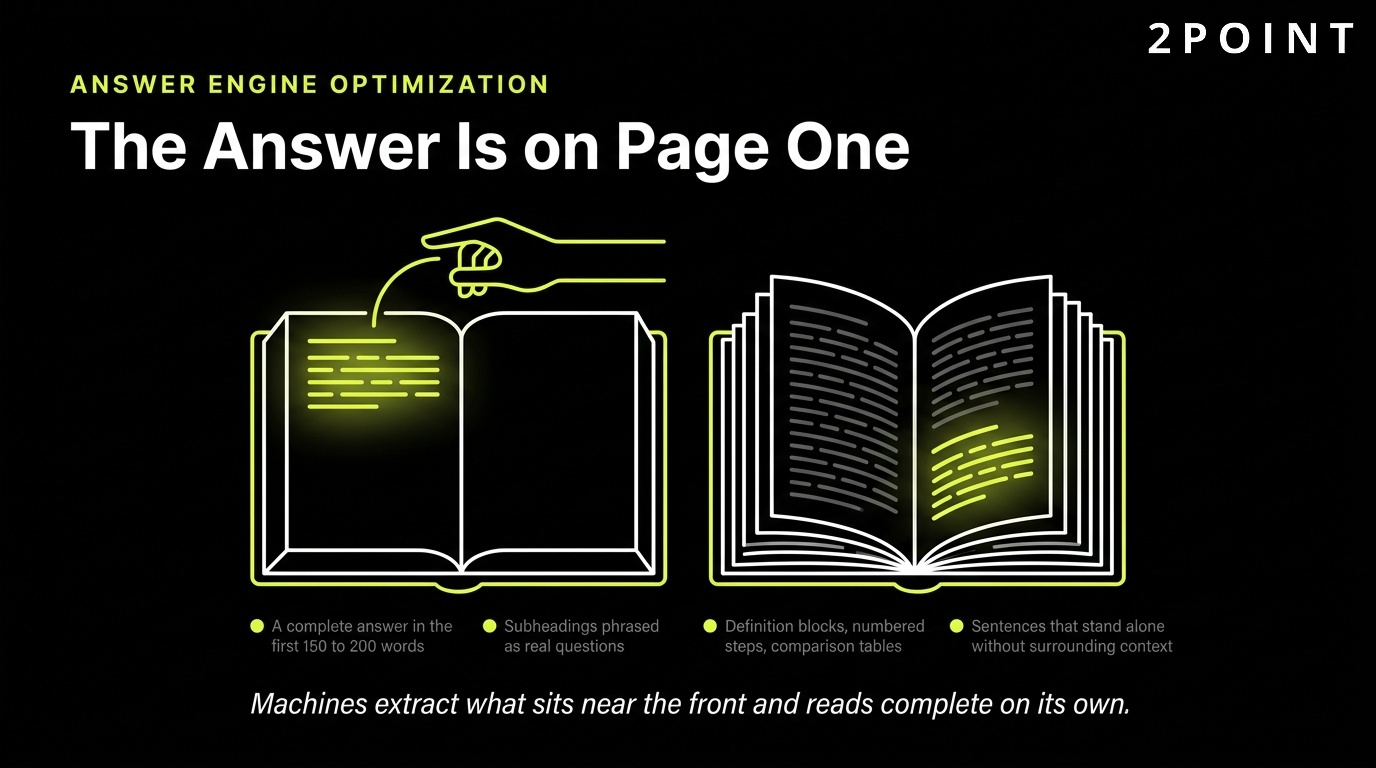
Answer engine optimization (AEO) refers to the practice of structuring content so that AI systems can extract direct answers from it and attribute those answers to your site. An AEO audit evaluates how well your content is formatted for machine extraction, not just human reading.
The following checklist covers the key AEO signals your audit should evaluate on high-priority pages:
- Direct answer formatting: Does each page answer its primary question within the first 150 to 200 words, in a clear, complete sentence or structured list?
- Question-answer content structure: Are subheadings phrased as questions that users actually ask, with the directly following paragraph providing a concise answer?
- Featured snippet optimization: Does the page include a definition block, numbered step list, or concise comparison table that Google could extract as a featured snippet?
- Entity clarity: Does the page explicitly identify all named entities (people, organizations, places, products) using consistent naming that matches their schema markup?
- Natural language patterns: Is the content written in complete, declarative sentences that work as standalone answers rather than requiring surrounding context for interpretation?
- Context markers: Does the page signal its publication date, author identity, and topical scope in machine-readable formats?
- Voice search compatibility: Are key answers phrased conversationally, in the way a person would speak rather than keyword-stuffed for traditional search?
Pages that score well on these criteria are significantly more likely to be cited in AI Overviews and referenced by AI chatbots. Your audit should evaluate the top 20 to 30 highest-traffic pages against this checklist and identify the specific formatting changes needed to improve each page’s AEO readiness. For a deeper understanding of how the role of SEO in digital marketing has expanded to encompass these new channels, review how AI visibility fits into your broader organic strategy.
Author Authority and E-E-A-T Signals
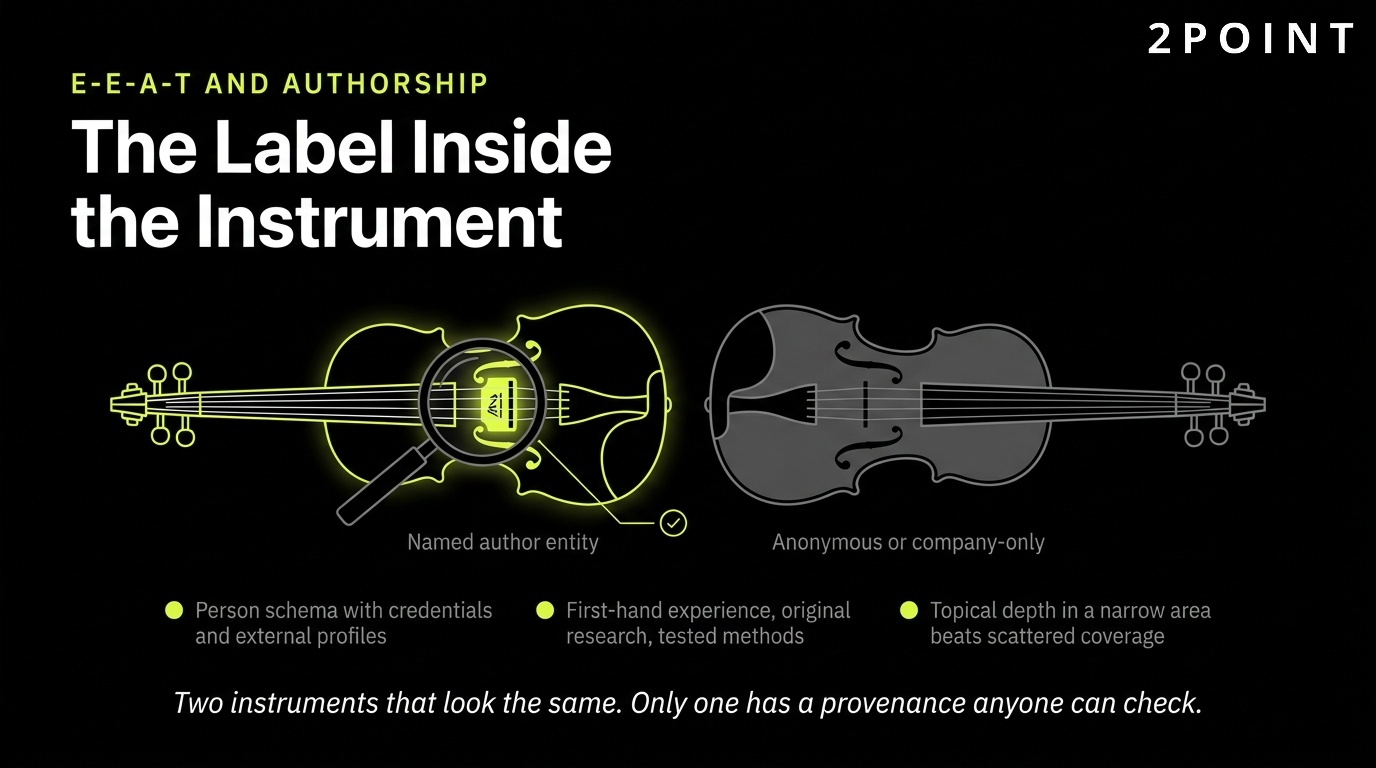
Google’s E-E-A-T framework (Experience, Expertise, Authoritativeness, Trustworthiness) has become one of the most important quality evaluation systems for both traditional rankings and AI citation eligibility. An E-E-A-T audit examines the signals your site sends about its authors, its organizational credibility, and the trustworthiness of its claims.
Author entity markup is the technical foundation of E-E-A-T implementation. Every piece of content on your site should have a named human author, and that author should have a profile page that is marked up with Person schema. The profile should include the author’s credentials, professional background, publication history, and links to authoritative external profiles (LinkedIn, industry publications, academic profiles). This creates a machine-readable entity that AI systems can evaluate when deciding whether to cite the author’s content.
Expertise demonstration requires more than credentials. Google’s guidelines emphasize first-hand experience as a distinct signal. Content that describes personal experience, original research, tested techniques, or proprietary data provides experience signals that secondary content (content written without direct experience of the subject) cannot match. Your audit should identify high-priority pages where experience signals are missing and flag them for revision.
Topical authority clustering strengthens E-E-A-T at the site level. A site that covers a narrow topic comprehensively demonstrates expertise more effectively than a site that covers many topics superficially. Review your content catalog to identify whether your site has depth in its core topic areas or whether it has scattered coverage across many loosely related subjects. Topical depth is an E-E-A-T advantage that compound over time as you add more content to each cluster.
Citation Confidence and Content Attribution
AI systems make citation decisions based on confidence: how confident is the system that a given source accurately represents the information it is being asked to provide? Your content attribution practices directly affect this confidence calculation.
Source credibility signals include outbound links to authoritative sources for factual claims, clear differentiation between opinions and verified facts, specific data points with publication dates and source attribution, and consistent citation formatting that machine systems can parse. Content that makes factual claims without supporting citations scores lower on citation confidence metrics than content that provides verifiable evidence for its claims.
Fact-checking markup using the ClaimReview schema type allows you to explicitly mark fact-checked claims within your content. While this schema is primarily used by journalism and fact-checking organizations, it signals a commitment to accuracy that AI systems recognize and reward. For content in health, finance, legal, or other Your Money Your Life (YMYL) categories, explicit accuracy signals are particularly important.
Reference quality matters as much as quantity. A single link to a peer-reviewed study or official government source provides stronger citation confidence than ten links to low-authority blogs. Your audit should review the outbound link quality of your most important pages and identify opportunities to replace weak citations with stronger, more authoritative ones. This practice strengthens both your E-E-A-T signals and your readers’ trust in the accuracy of your content.
On-Page Optimization Beyond Keywords
On-page SEO auditing in 2026 goes far beyond checking whether target keywords appear in title tags. A thorough on-page audit evaluates how well each page communicates its topic, satisfies user intent, and competes with the specific pages ranking above it for each target query. The goal is to ensure that every element of a page works together to signal relevance, quality, and value.
Title Tags and Meta Descriptions That Earn Clicks

Title tags remain one of the highest-weight on-page ranking signals. In 2026, effective title tags balance keyword inclusion with click-through appeal. Google displays approximately 50 to 60 characters of a title tag on desktop and slightly fewer on mobile, so your audit should flag any titles that exceed these limits and verify that critical keywords and brand names are not being truncated.
Effective titles use emotional triggers and specificity to differentiate themselves in competitive search results. A title like “SEO Audit Guide” competes with hundreds of similar results. A title like “SEO Audit: The Complete 2026 Checklist to Fix Your Rankings” communicates specificity (complete, 2026), benefit (fix your rankings), and format (checklist) in a way that earns clicks from users who are ready to take action. Your audit should evaluate each page’s title against the actual titles of ranking competitors and identify differentiation opportunities.
Meta descriptions are not a ranking signal, but they function as ad copy that determines click-through rate from search results. A good meta description presents a clear value proposition, includes the target keyword naturally (since Google bolds matching search terms), and ends with an implicit or explicit call to action. Audit for missing, duplicate, or truncated meta descriptions across your site’s most important pages first, then work through lower-priority pages systematically.
Header Hierarchy and Content Structure Audit

Every page should have exactly one H1 tag that includes the primary target keyword and accurately describes the page’s primary topic. Pages with multiple H1 tags, H1 tags that do not match the page’s main topic, or H1 tags that omit keywords are common findings in on-page audits and represent straightforward fixes with meaningful ranking impact.
The H2 through H6 hierarchy should create a logical outline of the page’s content. H2s represent major sections, H3s represent subsections within those major sections, and so on. Headers should never be used purely for visual formatting purposes, such as making text larger or bolder. Headers communicate content structure to both users and search engines, and a well-organized header hierarchy helps Google understand which topics a page covers and how they relate to each other.
Skimmability is an important content quality signal. Users scan pages before committing to read them, and well-structured headers allow users to quickly assess whether a page addresses their specific question. Pages that use dense, unbroken prose without subheadings have higher bounce rates and lower dwell times than structured pages. Your on-page audit should flag content that lacks appropriate subheadings and recommend a restructuring that makes the content more scannable.
Accessibility considerations in header structure directly intersect with SEO. Screen readers use header hierarchy to navigate page content, and an inconsistent or illogical hierarchy creates accessibility problems that also signal content quality issues to search engines. Ensure that no header levels are skipped (jumping from H2 to H4 without an H3) and that all headers make sense as standalone labels for their content sections.
Content Intent Alignment and Comprehensiveness
Search intent alignment is the most important on-page optimization factor in 2026. Google’s systems are highly accurate at detecting mismatches between what a user’s query implies they want and what a page actually delivers. Ranking a transactional page for an informational query, or an informational page for a transactional query, produces poor engagement metrics that cause rankings to drop over time.
The four primary intent types require different content formats. Informational intent queries expect comprehensive guides, definitions, and educational content. Navigational intent queries expect direct access to specific brands or tools. Transactional intent queries expect product pages, pricing information, and conversion-oriented content. Commercial investigation intent queries expect comparisons, reviews, and evaluation frameworks. Your audit should verify that each high-priority page’s format, depth, and calls to action match the intent type of its target queries.
Topic coverage gap analysis compares your page’s comprehensiveness against the pages currently ranking in the top five positions for each target keyword. If ranking competitors consistently address subtopics that your page omits, those gaps represent both a user satisfaction problem and an algorithmic signal that your coverage is less complete. Tools like content gap analyzers and manual SERP analysis both help identify these opportunities.
Content freshness requirements vary significantly by industry and topic type. A guide to programming fundamentals may remain accurate for years. A guide to enhancing SEO through content marketing needs updates at least annually to reflect algorithm changes. Your audit should categorize content by freshness sensitivity and flag pages that have not been updated within the appropriate timeframe for their topic type.
Image Optimization and Visual Content SEO
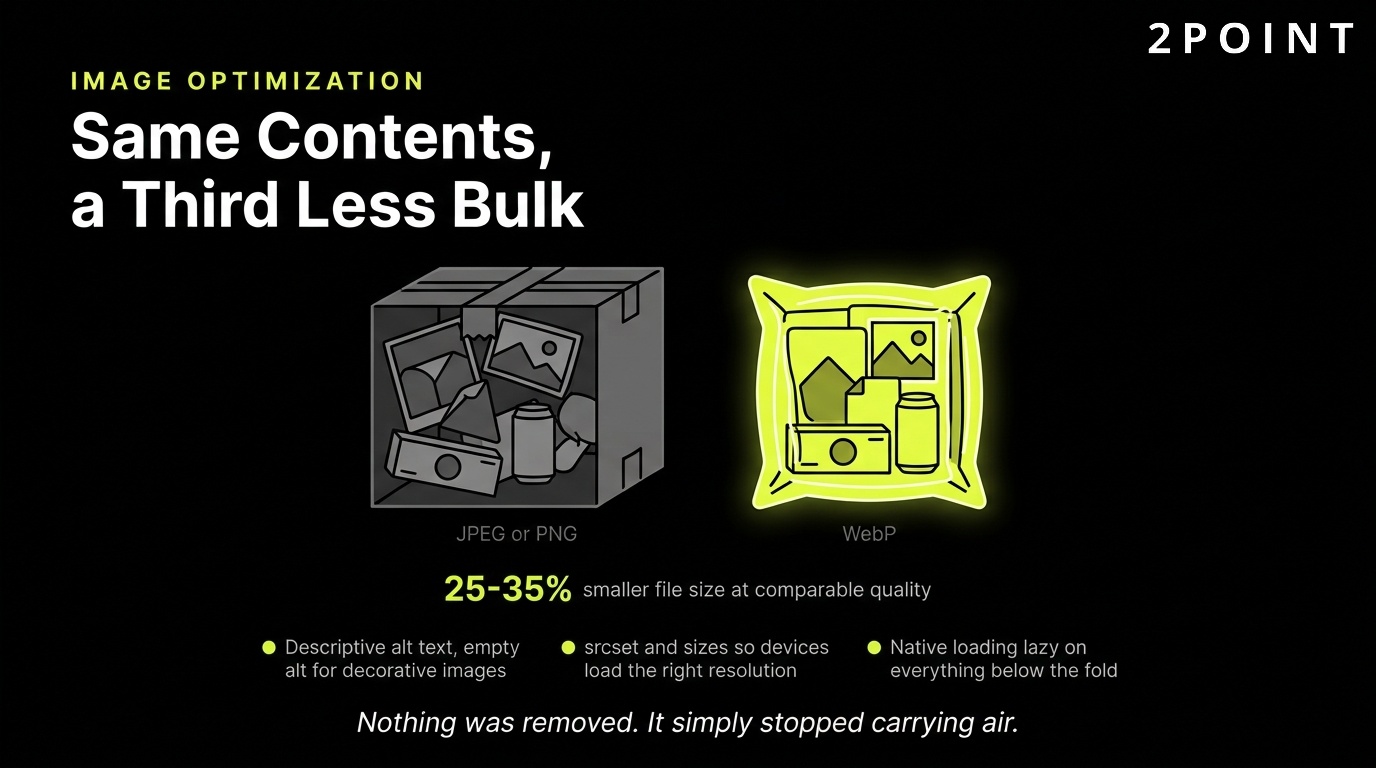
Images are among the most commonly neglected elements in on-page audits, yet they affect both page speed (and therefore Core Web Vitals) and content discoverability through image search. A complete on-page audit includes systematic evaluation of all images on high-priority pages.
Alt text serves a dual purpose: it describes images to users who cannot see them, satisfying accessibility requirements, and it provides keyword context to search engines that cannot interpret visual content. Every meaningful image should have descriptive alt text that includes relevant keywords naturally without stuffing. Decorative images should have empty alt attributes (alt=””) so that screen readers skip them. Audit for images with missing alt text, generic alt text (“image001.jpg”), or keyword-stuffed alt text that reads unnaturally.
Image format selection affects page speed significantly. WebP images offer 25 to 35% smaller file sizes than equivalent JPEG or PNG images at comparable quality levels. AVIF offers even greater compression but has slightly lower browser support as of 2026. Your audit should identify pages with oversized or poorly compressed images and recommend format conversion as part of Core Web Vitals optimization.
Responsive image implementation using srcset and sizes attributes allows browsers to load the appropriately sized image for each device rather than downloading a full-resolution image and scaling it down in the browser. This is a common performance issue on sites where images were added by content editors without technical optimization workflows in place. Lazy loading with the native loading=”lazy” attribute should be applied to all below-the-fold images to reduce initial page load weight.
Backlink Profile Analysis and Off-Page Factors
A backlink audit evaluates the quality, relevance, and diversity of the external links pointing to your website. In 2026, Google’s link evaluation has become significantly more sophisticated, and the metrics that matter have shifted considerably from the domain authority numbers that dominated link conversations in earlier years.
Domain Authority Metrics That Actually Matter in 2026
Third-party domain authority metrics like Moz’s DA and Ahrefs’ DR are useful directional indicators, but they are proxy metrics that do not directly reflect Google’s evaluation of link quality. Your backlink audit should move beyond these vanity metrics and focus on the factors that Google’s systems actually evaluate.
Referring domain quality is evaluated by topical relevance first and authority second. A link from a mid-authority website that covers exactly your industry topic is worth more than a link from a high-authority website in an unrelated industry. Your audit should classify backlinks by topical relevance and identify whether your link profile is dominated by topically relevant sources or scattered across unrelated domains.
Anchor text distribution analysis reveals whether your link profile looks natural or manipulative. A natural link profile has a majority of branded anchors (your company name or URL), a significant portion of generic anchors (“click here,” “read more”), some partial match keyword anchors, and a small percentage of exact match keyword anchors. Profiles dominated by exact match keyword anchors are a manipulation signal that can trigger algorithmic or manual penalties.
Link velocity patterns matter for assessing link profile health over time. A sudden spike in new links, followed by a long plateau, may indicate a link building campaign rather than organic interest. Steady, gradual link growth is the most natural pattern and carries the lowest risk. Your audit should graph link acquisition over time and flag any unusual patterns for investigation. Understanding these SEO challenges is essential for building a sustainable backlink strategy.
Toxic Backlink Identification and Disavowal

Toxic backlinks are links from sites that use manipulative tactics, have been penalized by Google, or have no topical relevance to your site’s subject matter. In 2026, Google’s systems have become better at automatically discounting low-quality links rather than penalizing sites for receiving them, but highly concentrated patterns of toxic links, particularly those associated with known private blog network (PBN) footprints, can still trigger ranking suppression.
PBN footprints are recognizable patterns: sites with thin content, multiple unrelated topic jumps across their history, hosting on known spam IP ranges, or link profiles consisting almost entirely of outbound links to commercial sites. When a significant portion of your backlinks show these characteristics, manual review is warranted. Tools like Semrush’s Backlink Audit, Ahrefs’ toxic score filter, and Majestic’s Trust Flow metrics all help identify potentially problematic links.
The disavowal decision requires careful judgment. Google’s John Mueller has confirmed that the disavow tool should be used only for links you genuinely believe could cause harm, not as a routine cleanup exercise. Unnecessary disavowal can accidentally remove legitimate links. Reserve disavowal for clear spam, PBN links, and link schemes you participated in or that were conducted in your name. For ambiguous links, the safer approach is to monitor their impact rather than disavow them preemptively.
Negative SEO, where competitors build toxic links to your site to trigger penalties, remains a concern in 2026, though Google’s automatic discounting has reduced its effectiveness. Monitor your backlink profile for sudden influxes of new links from irrelevant or low-quality domains, particularly after launching a new campaign or publishing content that gains attention in your industry. Early detection makes disavowal much simpler than addressing a large accumulation of toxic links after the fact.
Competitor Backlink Gap Analysis
A competitor backlink gap analysis identifies external sites that link to your competitors but not to you, representing specific link building opportunities that you know are achievable because they have already been achieved by similar sites. This is one of the most actionable outputs of a backlink audit.
Start by identifying your top three to five organic competitors for your most important keyword targets. Run all of them through a backlink analysis tool to generate a complete list of their referring domains. Compare that list against your own referring domains to identify sites that link to competitors but not to you. Prioritize these opportunities by topical relevance and domain authority.
The quality of opportunities varies significantly. Some links in a competitor’s profile came from relationships, industry memberships, or directory submissions that are easy to replicate. Others came from earned media coverage or original research that requires a content investment to replicate. Your gap analysis should categorize opportunities by acquisition method and difficulty level, so your link building roadmap is realistic and strategically prioritized.
Content gap opportunities are often revealed by backlink patterns. If a competitor has 50 links to a specific resource page on their site, that page type clearly earns links in your industry. Creating a superior version of that content type and promoting it to the same sources is the classic link building strategy known as the Skyscraper Technique. Your audit should surface these content-link patterns and feed them directly into your content planning calendar.
Internal Link Equity Distribution
Internal links distribute PageRank, the authority signal that flows from pages with many external links to pages they link to. An internal link equity audit ensures that the authority your site earns from external backlinks flows to your most commercially important pages rather than being trapped in high-traffic but low-conversion content like blog posts or resource pages.
Orphan pages are pages with no internal links pointing to them. They receive no PageRank from the rest of the site and no crawl frequency benefit from being linked internally. Crawl your entire site and identify all pages that have zero internal links. For pages that should be indexed and ranked, add appropriate internal links from relevant content. For pages that serve no ranking purpose, consider consolidating them with related content or removing them entirely.
Hub page strategy uses high-authority pages as distribution centers for PageRank. A hub page covers a broad topic and links to more specific pages within that topic cluster. External links earned by the hub page flow to the specific pages through those internal links, boosting the ranking ability of content that may not independently attract many external links. If your site lacks topic hub pages, your audit should recommend their creation and define which pages should link from and to each hub.
Broken internal links waste crawl budget and create negative user experiences. Every internal link that returns a 404 error is a missed opportunity to pass PageRank and a frustrating dead end for users. Your crawl data should include a complete list of broken internal links, prioritized by the authority of the linking page. High-authority pages with broken internal links represent the highest-priority fixes. Anchor text diversity for internal links also matters: using varied, descriptive anchor text for links to the same destination page helps Google understand the breadth of topics that page covers.
SEO Audit Tools: Choosing Your Tech Stack
The quality of your audit is directly constrained by the quality of your tools. In 2026, the SEO tool landscape includes enterprise platforms, specialized crawlers, and lightweight scanners, each suited to different audit scenarios. Choosing the right combination for your specific needs determines how efficiently you can diagnose and fix issues. You can also find guidance on how to use SEO tools effectively to maximize the value of your tech stack.
What Makes an Audit Tool “Audit-Grade” in 2026
Not every SEO tool is suitable for conducting a thorough site audit. Audit-grade tools share several distinguishing characteristics that separate them from basic keyword research or rank tracking tools.
The criteria for an audit-grade tool include dedicated audit features with systematic crawling and issue detection, coverage of multiple SEO dimensions (technical, on-page, off-page), actionable scoring with specific recommendations rather than just raw data, integration with reputable data sources, AI-assisted analysis for prioritization and pattern recognition, and exportable reports suitable for client delivery or stakeholder review.
Free website scanners (many of which return results within seconds) are useful for quick health checks but lack the depth and crawl completeness required for a professional audit. They typically sample a small number of pages, miss complex technical issues, and provide generic recommendations that do not account for site-specific context. Professional audits require professional tools, and understanding the pricing for SEO audits helps set appropriate budget expectations when investing in proper tooling and expertise.
Comprehensive Platform Tools: SEMrush, SE Ranking, and Ahrefs
Enterprise SEO platforms offer the broadest coverage for multi-dimensional audits. The three market leaders in 2026 each have distinct strengths that make them suitable for different use cases.
| Platform | Core Audit Strength | Database Size | Best For | Price Tier |
|---|---|---|---|---|
| SEMrush | Comprehensive: on-page, off-page, technical, social, and page performance in one scan | 43+ trillion backlinks, 25+ billion keywords | Full-service agencies and enterprise teams | Premium |
| SE Ranking | Balanced technical and on-page with competitive data | Growing index, strong keyword data | Small to mid-size agencies seeking value | Mid-range |
| Ahrefs | Industry-leading backlink analysis and content gap tools | 35+ trillion backlinks, extensive crawl coverage | Link building and content strategy audits | Premium |
SEMrush’s Site Audit tool is particularly notable for covering on-page, off-page, technical, social signals, and page performance factors in a single automated scan, making it the most comprehensive single-tool audit option available. SE Ranking provides comparable audit depth at a significantly lower price point, making it an excellent choice for agencies managing multiple client audits within budget constraints.
Ahrefs excels specifically in backlink analysis, with the most complete and frequently updated link index available to third-party tools. For audits where the backlink profile is the primary concern, Ahrefs provides unmatched depth. Many professionals combine Ahrefs for link analysis with SEMrush or SE Ranking for technical and on-page auditing, creating a complementary two-tool stack that covers all audit dimensions thoroughly.
Specialized Audit Tools: Screaming Frog, DeepCrawl, and Sitebulb
Specialized crawlers provide technical audit depth that platform tools cannot match, particularly for large sites with complex architectures. These tools excel at deep technical discovery tasks that require unlimited crawl access and granular data extraction.
Screaming Frog SEO Spider is the industry-standard desktop crawler for technical audits. The paid version crawls unlimited URLs, integrates with Google Search Console and Google Analytics for combined data analysis, performs JavaScript rendering via an integrated Chromium engine, analyzes log files to reveal actual Googlebot crawl behavior, and supports custom extraction rules using XPath and regex. For auditors who need the deepest possible technical data from a single crawl, Screaming Frog is the benchmark tool.
Sitebulb distinguishes itself with exceptional visualization features. It generates interactive site architecture diagrams, internal link graphs, and prioritized issue lists with detailed explanations that make audit findings accessible to non-technical stakeholders. This makes it particularly valuable for agencies that need to present audit findings to clients who may not have SEO backgrounds.
DeepCrawl (now Lumar) operates as a cloud-based crawler suited to enterprise sites where desktop tool limitations on crawl size become a constraint. It supports scheduled automated audits, making it useful for continuous monitoring rather than one-time audit projects. For very large sites with hundreds of thousands or millions of URLs, cloud-based crawlers eliminate the local computing resource constraints that desktop tools face.
Quick Scan and Reporting Tools: Woorank and SEOptimer
Quick scan tools occupy a different niche than deep audit platforms. They are designed for fast, accessible audit reports rather than exhaustive technical discovery, making them appropriate for specific use cases where speed and accessibility matter more than depth.
Woorank and SEOptimer both generate comprehensive-looking reports within minutes, covering technical SEO basics, mobile optimization, page speed, accessibility, security, and social media presence. These reports are well-suited for agency prospecting (generating quick audits to demonstrate value to potential clients) and for monthly monitoring reports on small sites that do not require full technical crawls.
White-label reporting features in both tools allow agencies to brand audit reports with their own logos and color schemes, making them suitable for client-facing deliverables. Security scanning integration in these tools flags HTTPS issues, mixed content warnings, and SSL certificate problems that non-technical clients often need to address but may not discover through traditional SEO auditing alone.
The appropriate use case for quick scan tools is precisely defined: they are supplements to comprehensive audit platforms, not replacements for them. A site that receives a clean bill of health from a quick scanner may still have significant issues that only a full technical crawl would reveal. Use quick scanners for their intended purpose, initial assessments and high-level monitoring, and reserve deep audit platforms for substantive diagnostic work.
The Complete Audit Process: Step-by-Step
Understanding individual audit components is valuable, but knowing how to sequence them into a coherent, efficient process is what separates effective auditors from those who produce reports without actionable clarity. This section provides a complete process workflow, from pre-audit preparation through final deliverable creation.
Pre-Audit Preparation and Access Setup
Every audit begins before the first crawl is run. The pre-audit preparation phase determines the quality of data available throughout the rest of the process and prevents mid-audit interruptions caused by access issues or missing baseline information.
Access requirements for a complete SEO audit include Google Search Console with at least three to six months of historical data, Google Analytics 4 for traffic and conversion data, read access to the site’s CMS for template-level review, FTP or server access if log file analysis is planned, and authentication credentials for password-protected staging environments if applicable. Confirm all access before beginning any tool configuration or crawl setup.
Before running your first crawl, review the site’s robots.txt file manually. Your crawl tool should respect the same rules Googlebot follows, so understanding what the robots.txt permits and restricts helps you configure crawl settings appropriately. If the robots.txt blocks sections of the site you need to audit, document this limitation and, if appropriate, request temporary crawl access for the audit period.
Establish baseline metrics from Google Search Console: current index count, top-performing pages by clicks and impressions, Core Web Vitals scores, and any existing manual actions or security issues. These baselines provide the context needed to interpret crawl findings and prioritize issues by their likely traffic impact. Client questionnaires for agency audits should collect information about recent site migrations, recent algorithm updates that affected traffic, known technical debt, and business priorities that should influence audit focus.
Initial Crawl, Index Status, and Architecture Review
The initial crawl is the primary data collection event of any technical SEO audit. Configure your crawler to mimic Googlebot’s behavior as closely as possible: use Googlebot as the user agent, set crawl speed to a rate your server can handle without disruption, and enable JavaScript rendering if the site uses significant client-side rendering.
After the crawl completes, your first analysis should cross-reference crawl data with Google Search Console index coverage data. The crawl shows what URLs exist on the site; Search Console shows what Google has actually indexed. Discrepancies between these two data sets reveal the most critical issues. URLs that exist in your crawl but not in Google’s index warrant immediate investigation.
Interpret Search Console’s index coverage categories systematically. “Excluded” URLs fall into several subcategories: noindex directives (intentional or accidental), canonical tags pointing elsewhere, redirect targets, crawl anomalies, and content quality exclusions. Each subcategory requires a different response. Accidental noindex directives need immediate correction. Quality exclusions need content improvement. Understanding the specific reason for each exclusion type prevents misapplied fixes.
URL structure evaluation should examine the logical organization of your site’s URL taxonomy. Clean, hierarchical URLs (domain.com/category/subcategory/page) are easier for Google to interpret than flat or parameter-heavy URL structures. Site depth analysis measures how many clicks it takes to reach every page from the homepage. Pages deeper than four clicks receive significantly less crawl frequency, which means important content at excessive depth may be crawled infrequently and rank below its potential. Identifying crawl budget waste, such as infinite pagination loops, session ID parameters creating duplicate URLs, or faceted navigation generating millions of URL variants, is a critical early step that shapes the rest of the audit.
Issue Prioritization Framework and Triage
A comprehensive audit of even a moderately sized site will generate hundreds of individual issues. Without a clear prioritization framework, audit findings become an overwhelming list that paralyzes rather than guides action. Effective triage separates issues by both impact level and fix complexity.
The recommended prioritization order for most websites follows this sequence:
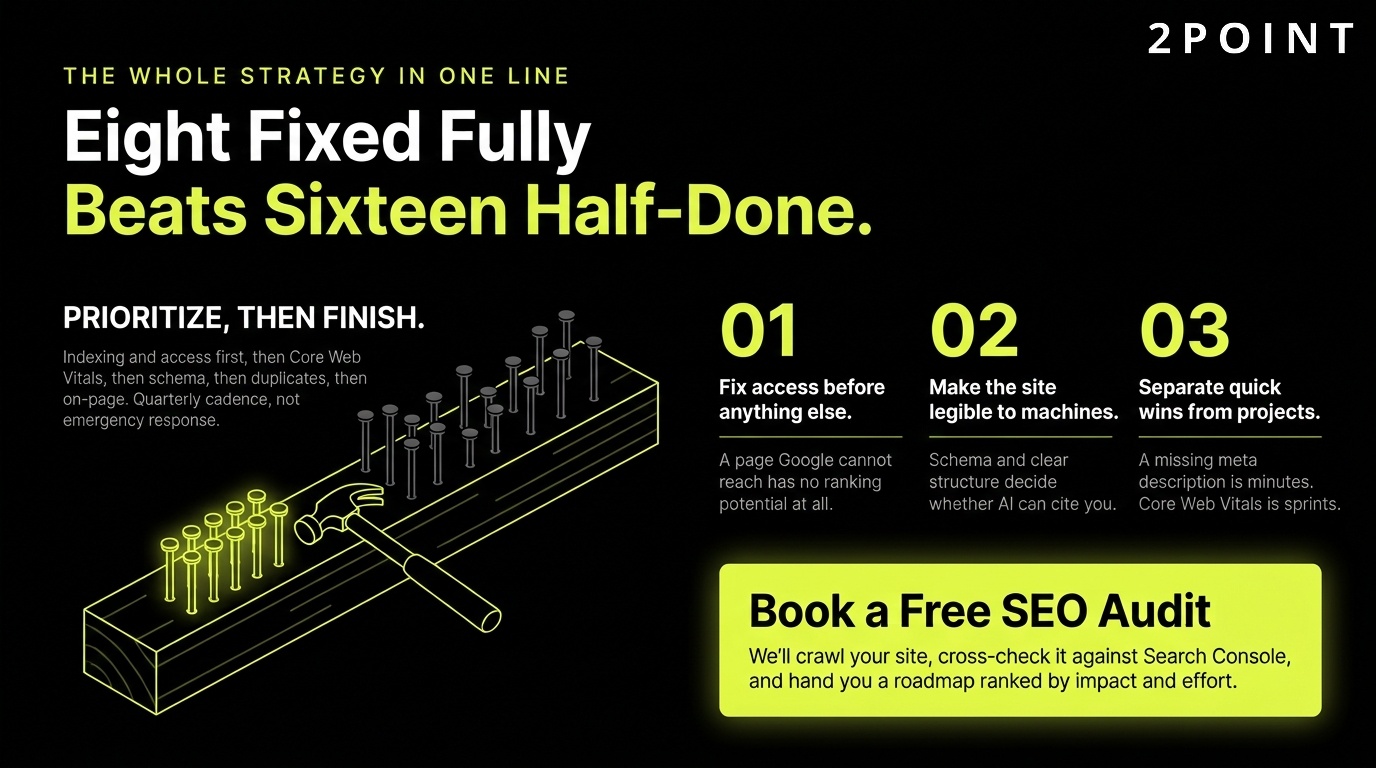
- Indexing and access issues: Pages that cannot be accessed or indexed by Google have zero ranking potential regardless of other optimizations. These are always the highest priority.
- Core Web Vitals failures: Performance issues that cause CWV scores to fall below Google’s thresholds have documented ranking impact and also affect conversion rates directly.
- Schema and structured data gaps: Missing or invalid schema reduces AI visibility and rich result eligibility, affecting click-through rates even for pages that rank well.
- Duplicate content issues: Duplicate content dilutes ranking signals and wastes crawl budget, and canonical tag corrections are typically straightforward to implement.
- On-page optimization gaps: Title tag, meta description, header, and content alignment issues are important but rarely cause complete ranking failures on their own.
Separate quick wins from long-term projects. A missing meta description is a quick win: it can be fixed in minutes and delivers measurable click-through rate improvement. Improving Core Web Vitals for a JavaScript-heavy e-commerce site is a long-term project requiring developer resources and multiple sprint cycles. Presenting these together in an audit report without clear separation creates confusion about urgency and timelines. Managing client or stakeholder expectations about fix timelines is as important as identifying the issues themselves.
Creating Actionable Audit Deliverables
The value of an audit is entirely determined by the quality of the deliverables it produces. An audit report that lists hundreds of issues without context, prioritization, or clear next steps delivers frustration rather than value. Professional audit deliverables have a defined structure that makes findings immediately actionable.
A complete professional SEO audit report includes the following components:
- Executive summary: A one to two page overview of key findings, their estimated impact, and the three to five highest-priority actions. Written for non-technical stakeholders.
- Technical crawl analysis: Full crawl data with documented findings categorized by issue type, severity, and affected URL count.
- On-page audit findings: Specific evaluation of the site’s most commercially important pages, with per-page recommendations for title tags, content gaps, schema, and internal links.
- Backlink profile assessment: Referring domain quality analysis, toxic link identification, competitor gap opportunities, and internal link equity review.
- Structured data evaluation: Schema coverage by page type, validation results, rich result eligibility assessment, and AEO readiness scoring.
- Prioritized action roadmap: Issues ranked by impact and complexity, with estimated effort for each fix and recommended ownership (developer, content team, SEO specialist).
Report structure best practices emphasize clarity over comprehensiveness. A 20-page report with crisp findings and clear recommendations is more valuable than a 100-page report that requires the reader to work to understand what matters most. Include screenshots, annotated diagrams, and before/after comparisons wherever they make findings clearer. The goal is to make it as easy as possible for the people responsible for implementing fixes to understand exactly what needs to change and why it matters.
For organizations exploring professional audit support, 2POINT provides full-service SEO audit engagements that cover all components described in this guide, delivered with the clear prioritization frameworks that translate findings into measurable organic performance improvements.
Conclusion: Your SEO Audit Is a Competitive Advantage
An SEO audit in 2026 is not a single event. It is an ongoing diagnostic practice that keeps your website competitive as search algorithms evolve, user behavior shifts, and AI-powered answer systems claim an increasing share of search interactions. The sites that treat auditing as a quarterly discipline rather than an emergency response mechanism consistently outperform those that audit only after traffic drops have already occurred.
The scope of what a modern audit must cover reflects the genuine complexity of today’s search landscape. Technical foundations, JavaScript rendering, schema markup, AI readiness, on-page optimization, and backlink quality are not separate disciplines to be addressed in isolation. They are interconnected systems, and weaknesses in any one area limit the effectiveness of investments in all the others. A site with exceptional content but crawlability problems earns no rankings for that content. A site with strong backlinks but failing Core Web Vitals loses rankings to faster competitors. A site with excellent traditional rankings but no structured data misses the AI citation opportunities that increasingly shape brand visibility.
The 72% website failure rate for critical technical factors is not a statistic to be alarmed by in the abstract. It is a specific competitive opportunity for your site right now, because most of your competitors are not addressing these issues systematically either. “Clean” technical infrastructure combined with “legible” structured data creates a compound competitive advantage that grows over time as your site earns consistent visibility in both traditional search results and AI answer systems.
Completion beats comprehensiveness when resources are limited. Fully resolving eight priority issues delivers more value than partially addressing sixteen. Pick the highest-impact items from your audit findings, fix them completely, measure the results, and iterate. The most actionable first step you can take today is to run a baseline crawl of your site this quarter, compare the findings against the frameworks in this guide, and commit to addressing your top three critical issues before the next quarter begins. That single cycle of diagnosis, action, and measurement is how consistent organic growth actually happens.
Frequently Asked Questions About SEO Audits
What is an SEO audit?
An SEO audit is a systematic evaluation of a website’s ability to rank in search engines and appear in AI-powered answer systems. It covers technical infrastructure, on-page optimization, content quality, backlink profile, structured data, and AI readiness. The audit identifies specific issues and prioritizes them so that fixes deliver the maximum possible impact on organic visibility.
How often should I run an SEO audit?
A full technical SEO audit should be conducted at least quarterly. High-traffic or frequently updated sites benefit from monthly technical crawls supplemented by quarterly comprehensive reviews. After a site migration, major redesign, or significant algorithm update, an immediate audit is essential regardless of the regular schedule.
How long does an SEO audit take?
The time required depends on site size and audit scope. A small site under 500 pages can be audited thoroughly in one to three days. A mid-size site of 500 to 10,000 pages typically requires three to seven days. Enterprise sites with more than 10,000 pages may require two to four weeks for a comprehensive audit including log file analysis and stakeholder interviews.
What is the difference between a technical SEO audit and a full SEO audit?
A technical SEO audit focuses exclusively on crawlability, indexation, site speed, Core Web Vitals, JavaScript rendering, and structured data. A full SEO audit includes all technical elements plus on-page optimization, content quality evaluation, backlink profile analysis, and AI readiness assessment. Technical audits are faster and suitable for targeted diagnostics; full audits are more appropriate for comprehensive strategic planning.
Can I do an SEO audit for free?
Basic SEO auditing can be done for free using Google Search Console, Google PageSpeed Insights, and limited free tiers of tools like Screaming Frog (up to 500 URLs) and Ahrefs Webmaster Tools. However, free tools have significant limitations in crawl depth, backlink data access, and issue prioritization. Professional audits requiring full data access need paid tools with costs ranging from a few hundred to several thousand dollars per month depending on the platform.
What is the most common SEO audit finding?
Missing or poorly implemented meta tags, broken internal links, and pages blocked from indexing by accidental noindex directives are among the most frequently found issues in site audits. Core Web Vitals failures, particularly Interaction to Next Paint (INP) for JavaScript-heavy sites, are increasingly common findings as of 2026. Most sites have at least several critical issues regardless of how well-maintained they appear.
SEO audit vs. website audit: what is the difference?
A website audit typically evaluates design, usability, accessibility, security, and conversion rate optimization in addition to SEO factors. An SEO audit focuses specifically on factors that affect search engine visibility and organic traffic. The two types overlap significantly on technical performance and content structure, but a website audit has a broader scope that includes user experience design elements that do not directly affect search rankings.
What is an SEO audit report and what should it include?
An SEO audit report is a documented deliverable summarizing audit findings and recommended actions. A professional report includes an executive summary, technical crawl analysis with categorized issues, on-page audit findings for high-value pages, backlink profile assessment, structured data evaluation, and a prioritized action roadmap. The most effective reports separate quick wins from long-term projects and assign clear ownership to each recommended fix.
Does an SEO audit improve rankings?
An SEO audit itself does not improve rankings. Implementing the prioritized fixes identified by the audit improves rankings. Sites that audit thoroughly and implement recommendations consistently see organic traffic improvements within three to six months for technical fixes and six to twelve months for content and authority improvements. The audit is the diagnostic step; implementation is where ranking improvements actually occur.
What tools are used for an SEO audit?
Professional SEO audits use a combination of platform tools like SEMrush, Ahrefs, or SE Ranking for comprehensive multi-dimensional analysis, specialized crawlers like Screaming Frog or Sitebulb for deep technical discovery, and Google’s own tools including Search Console, PageSpeed Insights, and the Rich Results Test for authoritative first-party data. Most thorough audits use at least two tools to cross-validate findings and fill coverage gaps.
How much does an SEO audit cost?
SEO audit pricing varies significantly by scope and provider. Automated report-style audits from online tools range from free to a few hundred dollars. Manual audits by freelance specialists typically cost between $500 and $3,000 for small to mid-size sites. Agency-conducted comprehensive audits for enterprise sites range from $5,000 to $30,000 or more. Reviewing pricing for SEO audits in detail helps you understand what different investment levels actually include.
What is the difference between an SEO audit and ongoing SEO services?
An SEO audit is a time-bound diagnostic assessment that identifies issues and provides a prioritized action plan. Ongoing SEO services involve continuous implementation of optimizations, content creation, link building, and performance monitoring on a monthly retainer basis. Audits are typically conducted at the beginning of an engagement and periodically thereafter to measure progress and identify new issues that have emerged since the previous audit.