


 let’s connect


Quick Answer: When Should You Post on TikTok in 2026?
- The best overall posting window is Tuesday through Thursday, between 2 PM and 6 PM in your audience’s local time.
- The highest single-slot reach occurs during the universal evening window of 7 PM to 9 PM across all days.
- Sunday at 9 AM is the single best-performing time slot according to Buffer’s analysis of 7.1 million posts.
- Sprout Social’s study of nearly 2 billion engagements confirms Tuesday through Thursday as the strongest midweek window.
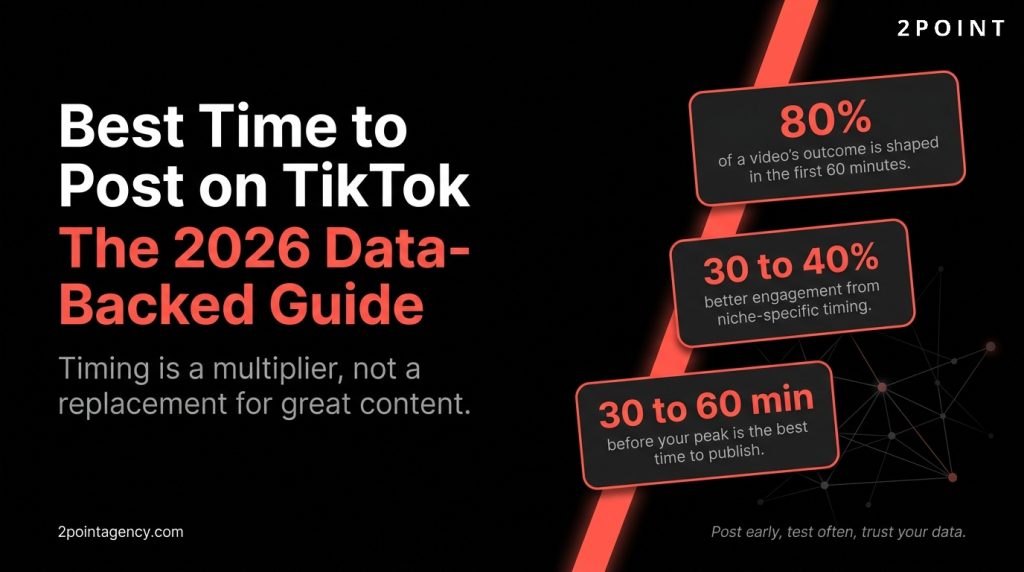
- Niche-specific timing can outperform generic recommendations by 30 to 40 percent.
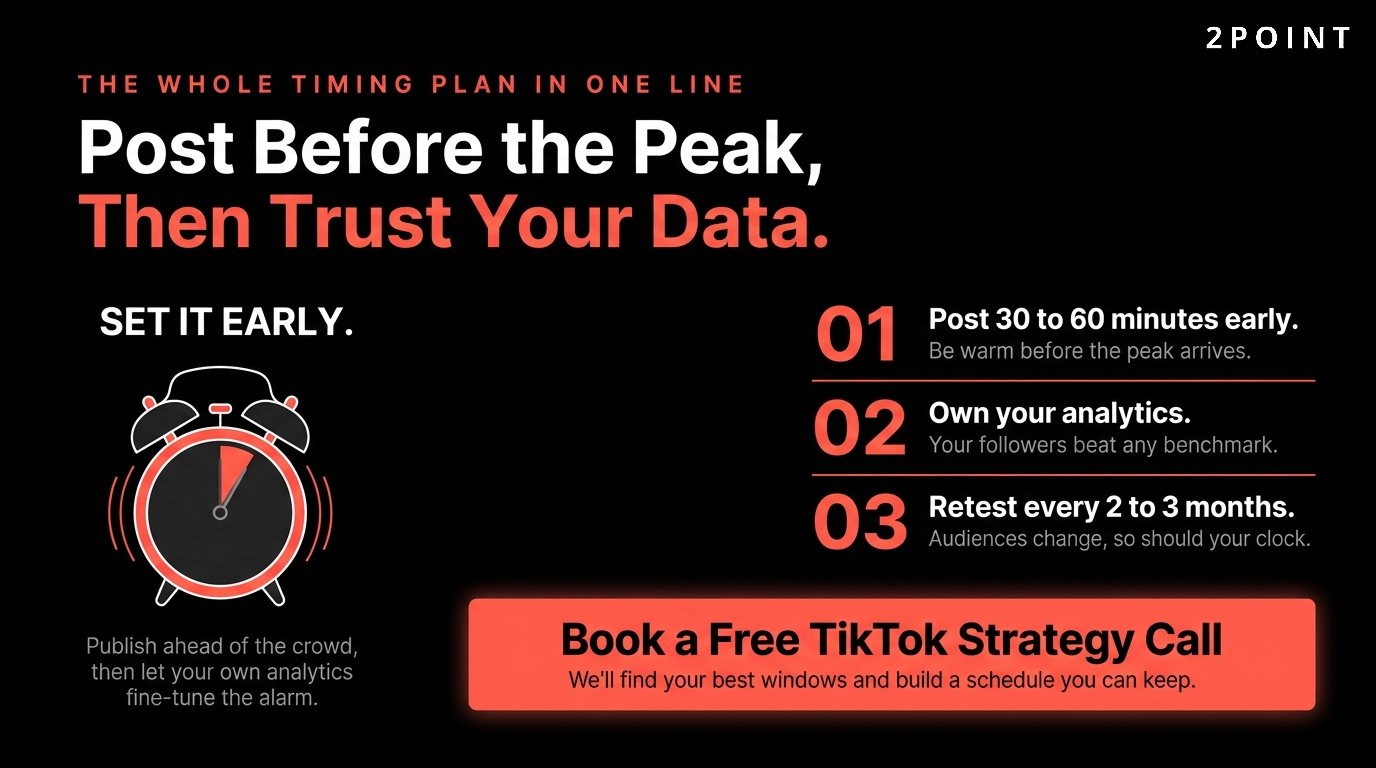
- Post 30 to 60 minutes before your target peak time to give the algorithm time to process and distribute your content.
- Content quality and early engagement velocity matter more than posting time alone.
- The first 60 minutes after posting determine roughly 80 percent of a video’s overall outcome.
Why Understanding TikTok’s Algorithm Makes Posting Times Matter
The best time to post on TikTok is not just a scheduling preference; it is a strategic decision rooted in how TikTok’s algorithm evaluates and distributes content. Unlike platforms that rely heavily on follower relationships and chronological feeds, TikTok uses an interest-based discovery engine that tests every video with a small sample audience before deciding how widely to push it. This makes the timing of your first post more consequential than on almost any other social platform.
When you post at a time when your target audience is actively scrolling, your video collects faster early signals, which signals quality to the algorithm. That early traction directly influences whether your content reaches hundreds of people or millions. Understanding this relationship is the foundation of any smart TikTok posting schedule.
How TikTok’s Algorithm Evaluates New Posts
Every time you publish a TikTok, the algorithm runs an independent evaluation of that specific video. It does not carry forward the reputation of your previous posts or factor in your follower count the way older platforms once did. Instead, TikTok begins by showing your content to a small initial test audience, then measures their response before deciding whether to expand distribution.
The key signals the algorithm monitors include view count velocity, like rate, comment frequency, share rate, and most importantly, video completion rate. According to data cited by Monolit, the first 60 minutes after posting determine roughly 80 percent of a video’s eventual outcome. If those initial signals are strong, the algorithm escalates distribution to progressively larger audiences. If engagement is weak, distribution stalls.
It is also worth noting that eClincher’s 2026 analysis confirms that the algorithm may take up to 24 hours to fully push a video to its potential audience. This means that even a well-timed post needs some patience before you evaluate its performance.
The Critical First Hour: Why Early Engagement Drives Reach
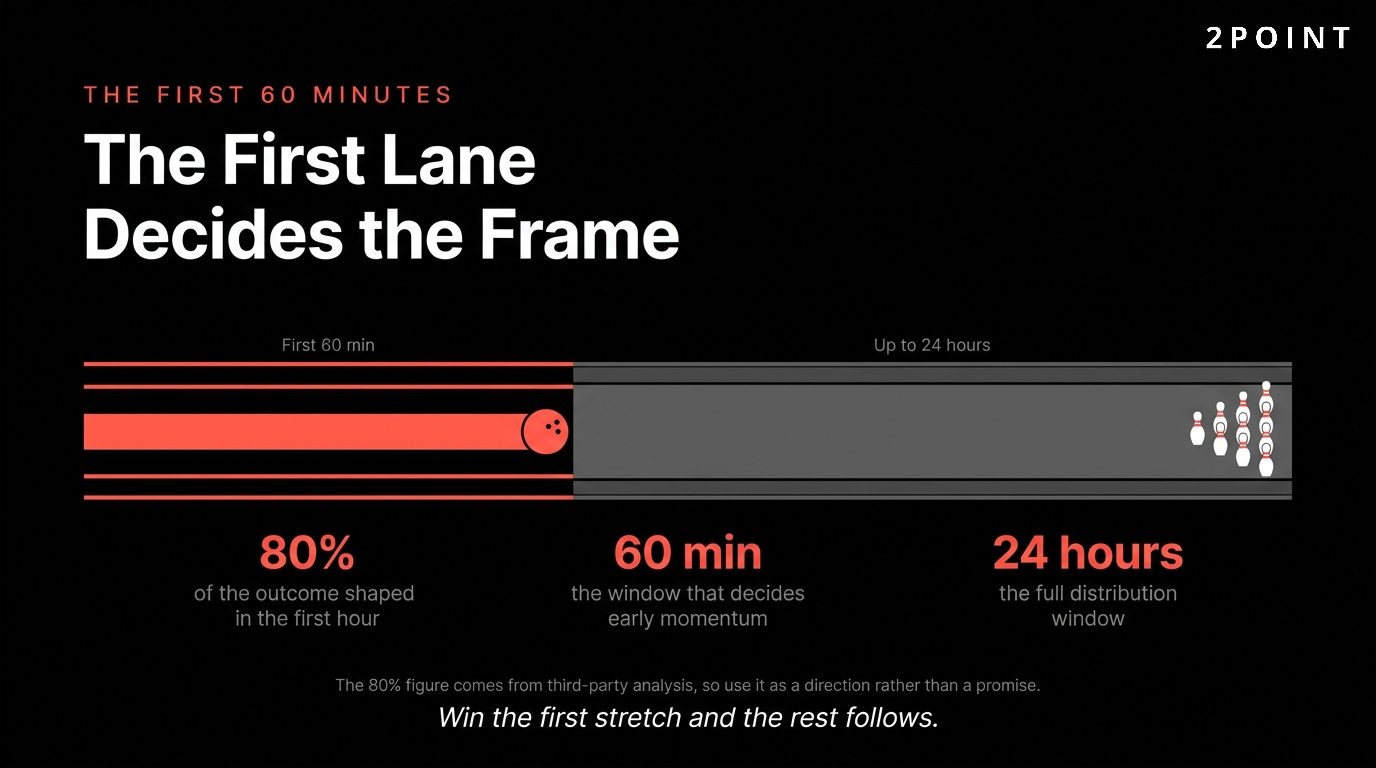
The first 60 minutes after you publish a TikTok function like a performance audition. The platform is watching to see how real users respond to your content, and those early reactions directly determine how aggressively TikTok promotes the video to wider audiences. When you post at a time when your followers are already online and actively browsing, you generate faster likes, comments, and completions, which all send positive signals to the algorithm.
Posting at a time when your audience is asleep or at work means your video sits in distribution limbo during those critical first 60 minutes. The algorithm collects weak early data, reduces distribution, and your video may never recover, even if it would have performed well under better conditions. This is the core reason why the best time to post on TikTok matters so much more than many creators initially realize.
It is important to clarify a common misconception here. Sozee’s analysis of TikTok’s algorithm points out that TikTok’s official documentation does not list posting time as a direct ranking signal. Timing matters indirectly because it determines the quality and speed of your early engagement, not because the platform explicitly rewards posts made at certain hours.
Content Quality vs. Timing: What Matters More?
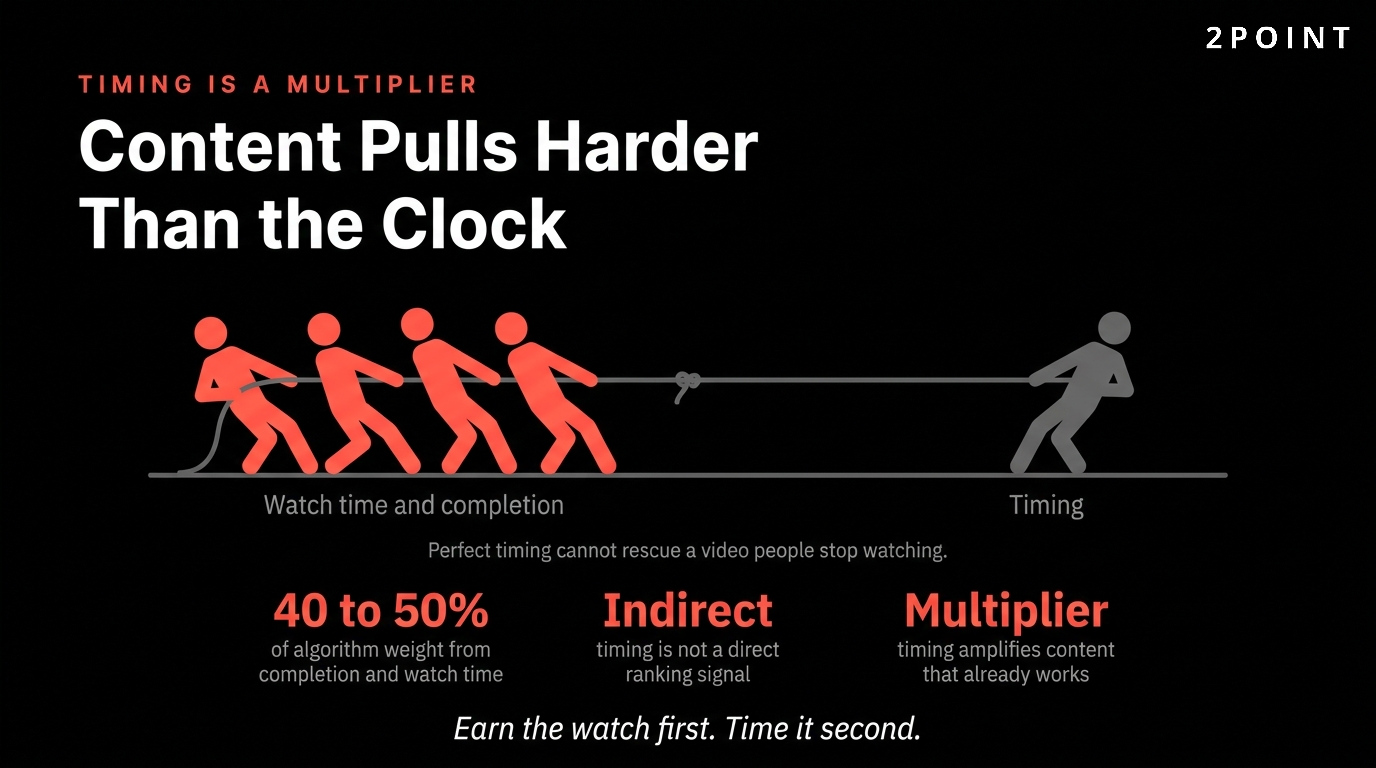
Timing is a multiplier, not a replacement for good content. If your video has a weak hook, low production quality, or fails to hold viewer attention, posting it at the perfect moment will not save it. The algorithm’s weighting of completion rate and watch time is substantial. Conbersa’s niche-specific analysis estimates that completion rate and watch time carry approximately 40 to 50 percent of the algorithm’s decision-making weight. No amount of timing optimization compensates for a video that people stop watching after two seconds.
That said, the relationship between content and timing is not an either-or equation. A strong video posted at a good time performs significantly better than the same video posted at a poor time. eClincher’s research also confirms that viral videos can gain traction hours or even days after posting, further reinforcing that content quality ultimately drives long-term performance, while timing optimizes the launch window.
The Pre-Peak Posting Strategy
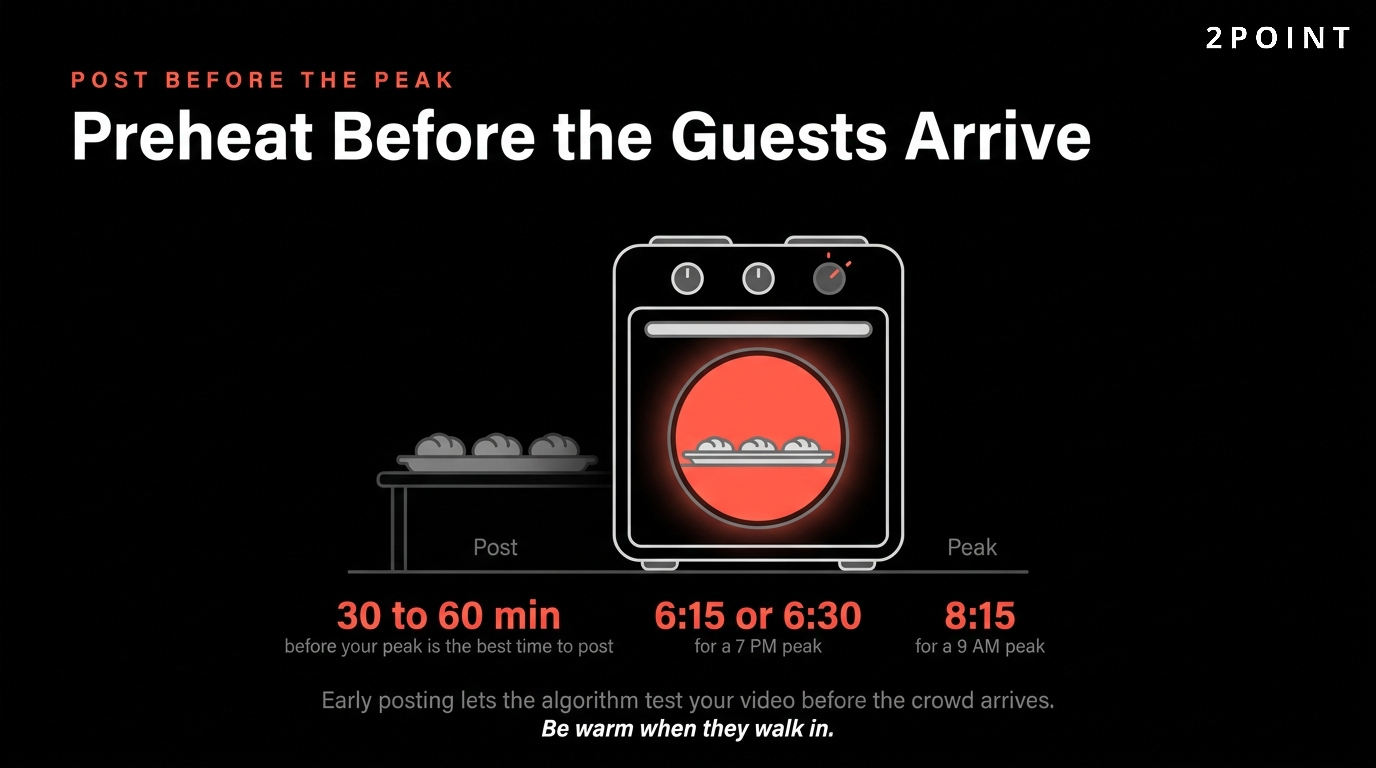
One of the most effective and underused techniques for TikTok timing is the pre-peak posting window. Rather than posting exactly at your target peak time, you post 30 to 60 minutes before it. This head start gives the algorithm time to process, categorize, and begin distributing your video before your target audience is fully online and scrolling.
When your audience hits peak activity, your video has already been through its initial algorithmic evaluation and is primed for rapid engagement. Autoposter’s 2026 posting guide recommends this 30-to-60-minute head start as a practical way to maximize the impact of peak-hour traffic. If your best performing window is 7 PM, publishing at 6:15 PM or 6:30 PM is likely to generate better results than publishing at exactly 7:00 PM.
Data-Backed Best Times to Post on TikTok for a General Audience
The best time to post on TikTok has been analyzed extensively by third-party platforms aggregating millions of posts and billions of engagement events. While no single study tells the complete story, there is meaningful consensus across multiple major 2026 datasets that provides a reliable starting framework for any creator or brand building their TikTok posting schedule.
Overall Best Time Windows Across All Industries
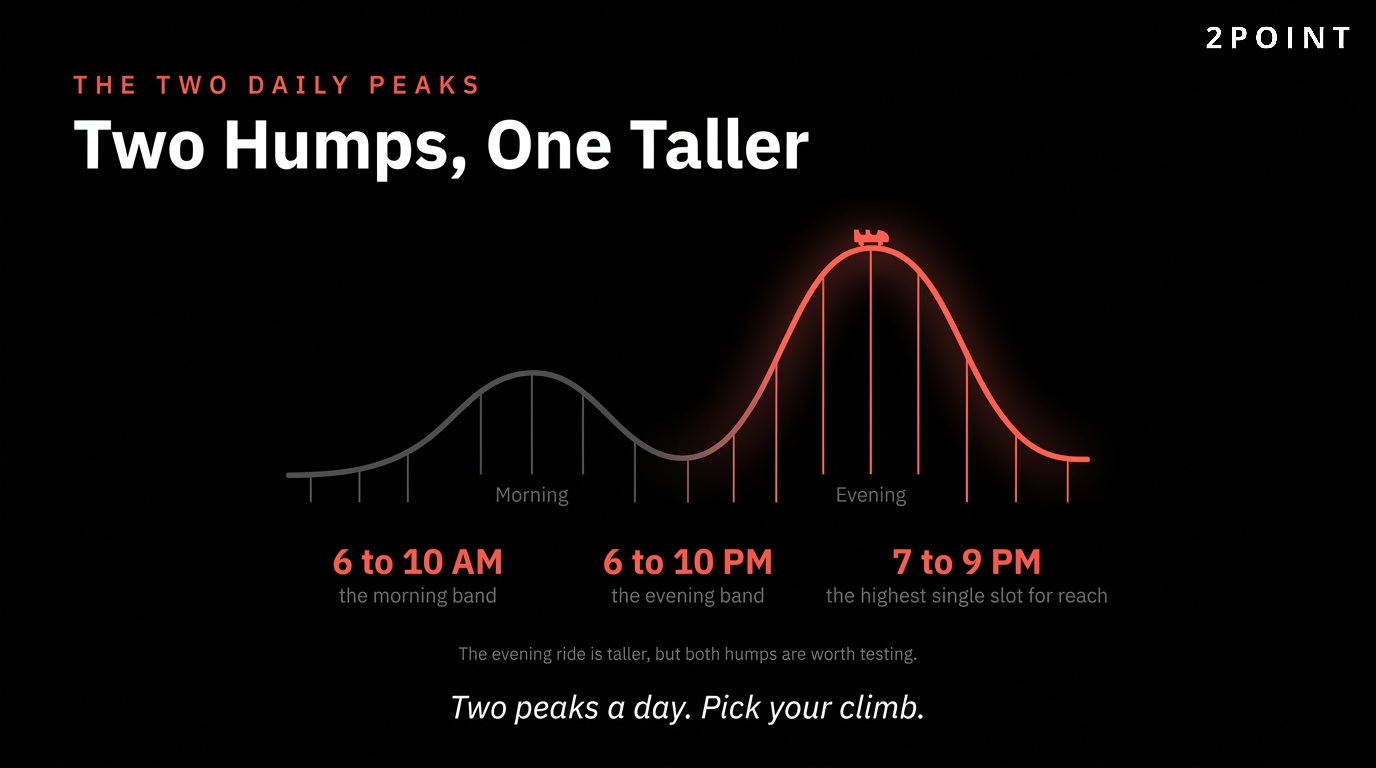
Across industry-agnostic analyses of TikTok performance data, two primary windows consistently emerge as the strongest posting times. The morning window runs from approximately 6 AM to 10 AM, capturing early risers, commuters, and people consuming content before their workday begins. The evening window runs from 6 PM to 10 PM, reaching the largest combined audience as users wind down from work and school.
Outfy’s 2026 analysis identifies these two bands as the strongest general posting windows across all content categories. Conbersa’s study of 3,600 videos across six niches narrows the universal best window to 2 PM to 4 PM Eastern Time. Meanwhile, Go Viral’s research points to 7 PM to 9 PM as the highest single-slot reach window. The evening window tends to outperform afternoons for most content categories because it captures both the post-work and post-school audience simultaneously.
Best Days of the Week to Post on TikTok
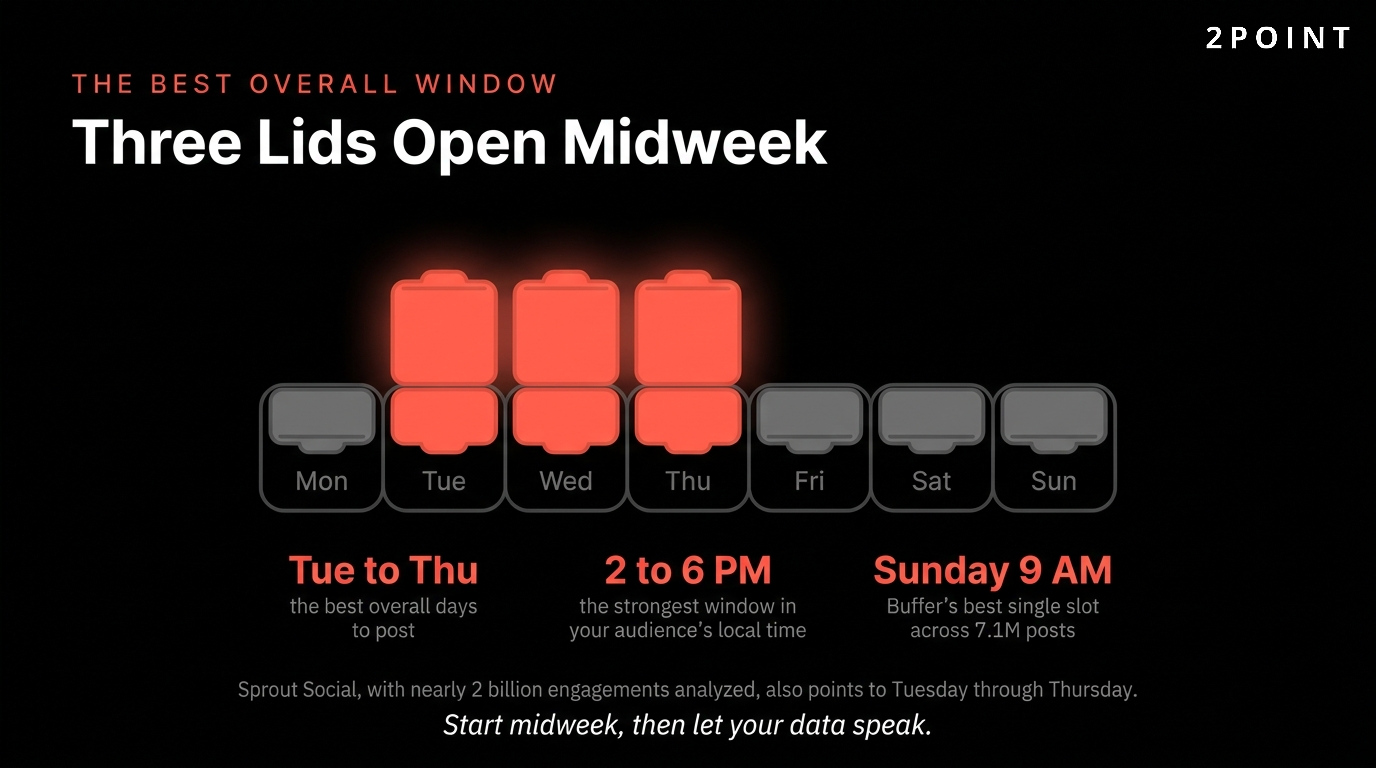
The best days to post on TikTok show more variation across studies than posting times do, but several consistent patterns emerge. Midweek days, particularly Tuesday, Wednesday, and Thursday, perform strongest for business-oriented content and broader general audiences. Sprout Social’s analysis of nearly 2 billion engagements identifies Tuesday, Wednesday, and Thursday as peak days, with Sunday ranking as the weakest overall performer for consistent engagement.
However, Buffer’s analysis of 7.1 million posts reaches a notably different conclusion, identifying Saturday as the single best day to post overall, with Sunday at 9 AM as the top-performing individual time slot. This apparent contradiction is explained by audience type: Sprout Social’s data skews toward business accounts, while Buffer’s broader dataset captures more consumer and lifestyle content where weekend engagement is higher.
The practical takeaway: for B2B, professional, or business-focused TikTok content, midweek is likely your strongest window. For consumer lifestyle, entertainment, and hobby content, weekends carry significant potential, particularly Sunday morning.
Day-by-Day Posting Schedule for TikTok
For creators who want specific time targets for each day of the week, the following schedule synthesizes findings from Hopper HQ’s global analysis and Dash Social’s platform data. These times are expressed in your audience’s local time zone and should be treated as a starting framework, not a guaranteed formula.
| Day of the Week | Recommended TikTok Posting Times | Notes on Audience Behavior |
|---|---|---|
| Monday | 6 AM, 10 AM, 7 PM | Start-of-week motivation content performs well in morning slots |
| Tuesday | 9 AM, 11 AM, 7 PM to 9 PM | Consistently among the strongest days for engagement across studies |
| Wednesday | 7 AM, 11 AM, 8 PM | Midweek peak; strong for educational and informational content |
| Thursday | 9 AM, 12 PM, 7 PM | High business content performance; strong pre-weekend engagement |
| Friday | 5 AM, 1 PM, 9 PM | Evening content benefits from pre-weekend mood; humor performs well |
| Saturday | 11 AM, 7 PM to 9 PM | Buffer identifies Saturday as top overall day; lifestyle content peaks |
| Sunday | 9 AM, 4 PM | Sunday 9 AM is the single best-performing time slot per Buffer’s dataset |
The midweek window of Tuesday through Thursday from 2 PM to 6 PM Eastern represents the strongest consistent performance zone across the majority of analyzed datasets.
Major Studies Compared: Where the Data Agrees and Where It Diverges
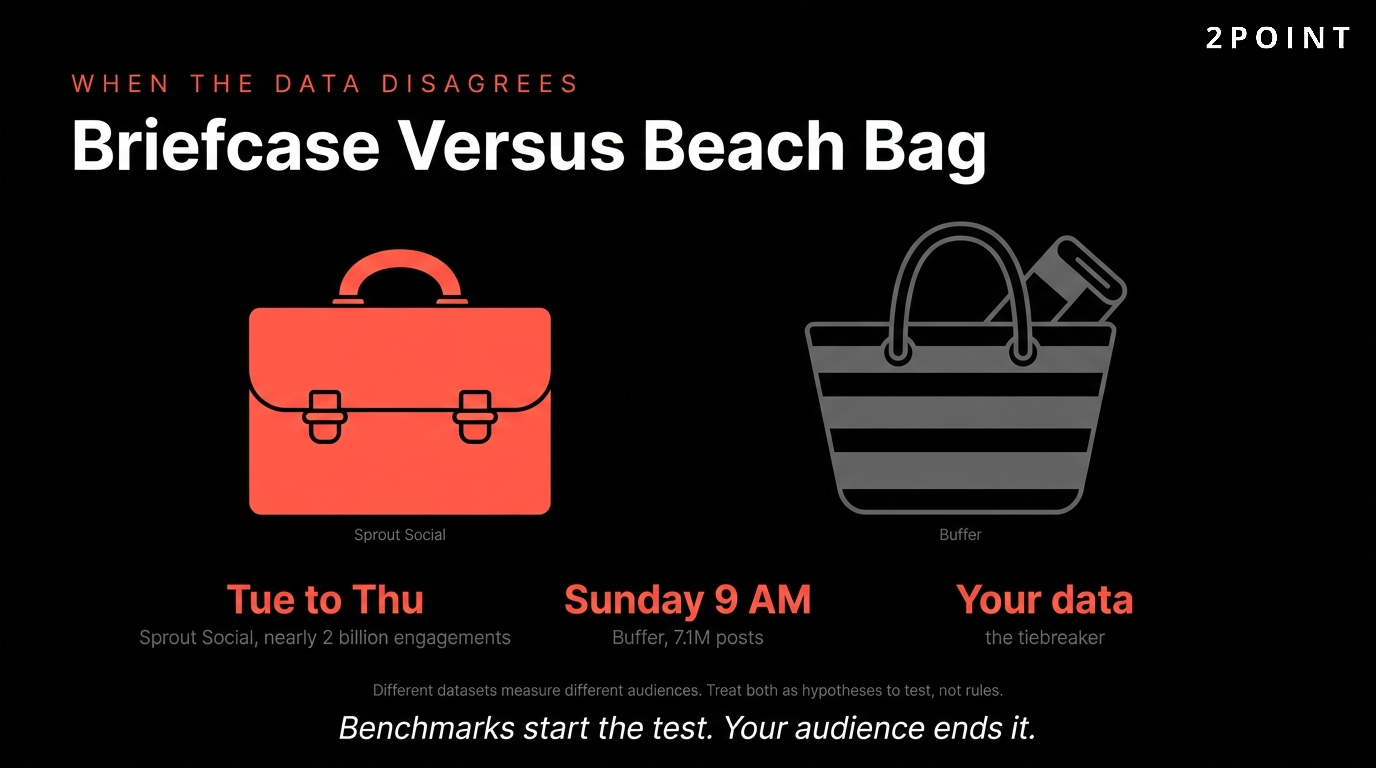
Understanding why TikTok timing studies sometimes contradict each other is just as important as knowing what they recommend. Buffer’s dataset of 7.1 million posts and Sprout Social’s analysis of nearly 2 billion engagements represent two of the largest and most reliable public datasets available. Both agree on the importance of evening hours and the value of midweek posting for general audiences. Where they diverge most notably is on the specific best day, with Buffer favoring the weekend and Sprout Social favoring midweek.
This divergence is best explained by audience composition. Studies that aggregate data across all account types will reflect the behavior of consumer-facing creators and entertainment content, where weekend engagement is naturally higher. Studies that skew toward business and brand accounts will reflect the professional audience’s tendency to engage more during the workweek. Breakreach’s comparative review notes that most studies converge on the 6 PM to 10 PM baseline as a reliable evening window, even when they disagree on specific days. That convergence is the most reliable signal to anchor your initial posting schedule around.
Best TikTok Posting Times by Industry and Niche
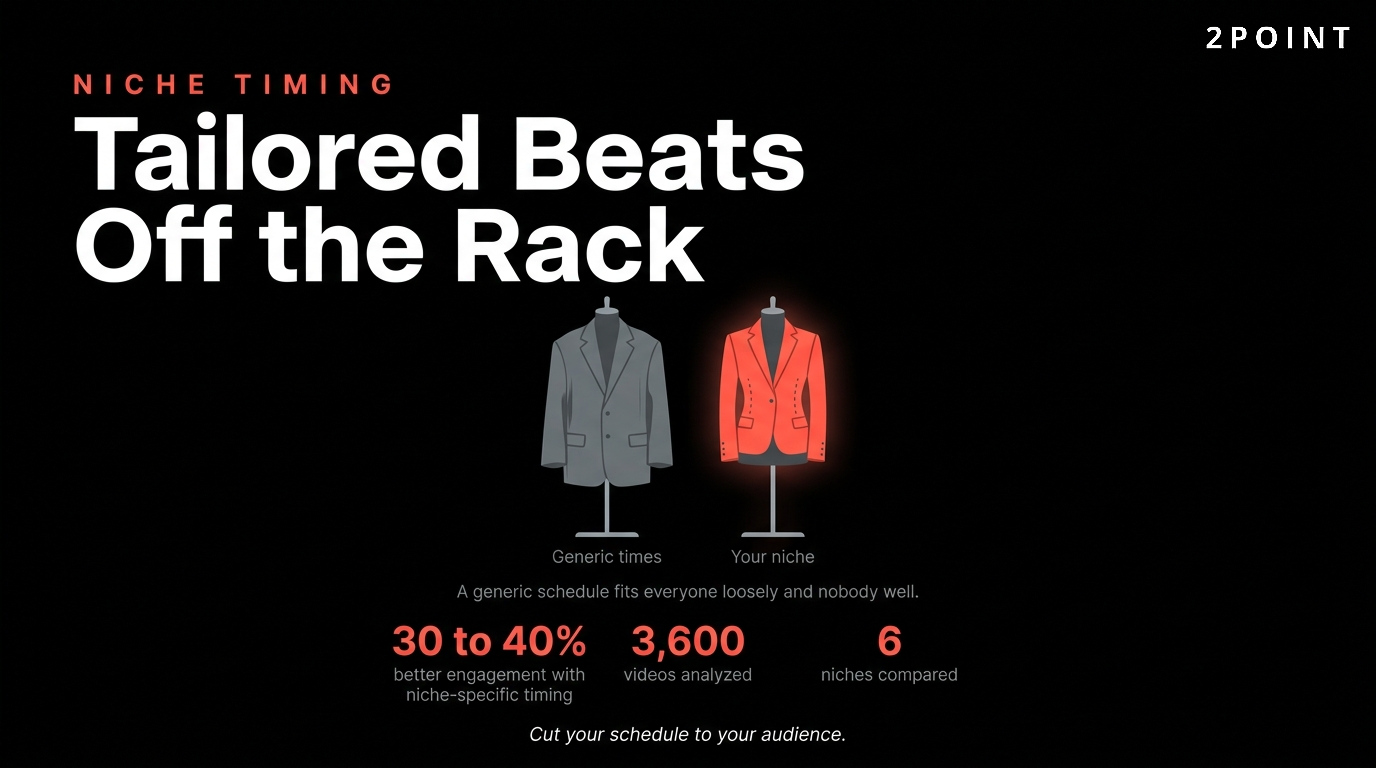
Generic TikTok posting time recommendations provide a useful starting framework, but niche-specific timing data consistently outperforms general guidance when applied correctly. Different content categories attract audiences with fundamentally different daily rhythms. A fitness creator’s audience wakes up early and engages before work. A gaming creator’s audience is most active late at night. Understanding these behavioral patterns is what separates good TikTok timing strategy from great TikTok timing strategy.
Beauty, Fashion, and Lifestyle Posting Times on TikTok
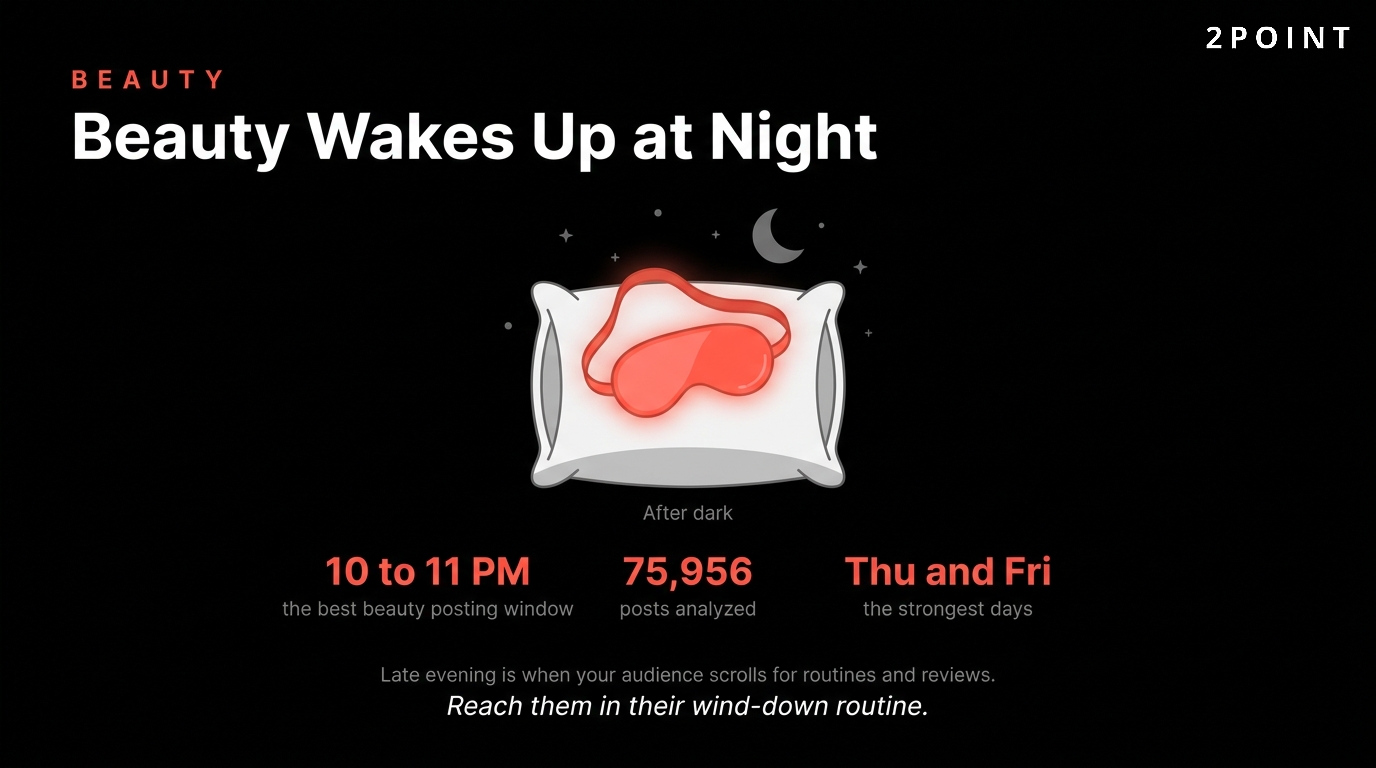
Beauty content on TikTok performs best during late-evening hours, particularly in the 10 PM to 11 PM window. This pattern reflects how beauty audiences consume content: skincare routines, makeup tutorials, and product reviews are often watched during wind-down rituals before bed. Sozee’s niche analysis of 75,956 beauty posts identifies 10 PM to 11 PM as the peak engagement window for beauty brands, which is notably later than general posting recommendations.
Fashion content follows a slightly different pattern, with strong performance during both weekday evenings (7 PM to 10 PM) and weekend mornings (9 AM to 11 AM). This dual-peak structure reflects the fashion audience’s habit of browsing outfit inspiration both during morning leisure time and during evening relaxation. Conbersa’s niche study also identifies Thursday and Friday afternoons as peak engagement periods for fashion and beauty content, suggesting that pre-weekend browsing plays a meaningful role in this category’s performance.
Food, Beverage, and Restaurant Content Timing
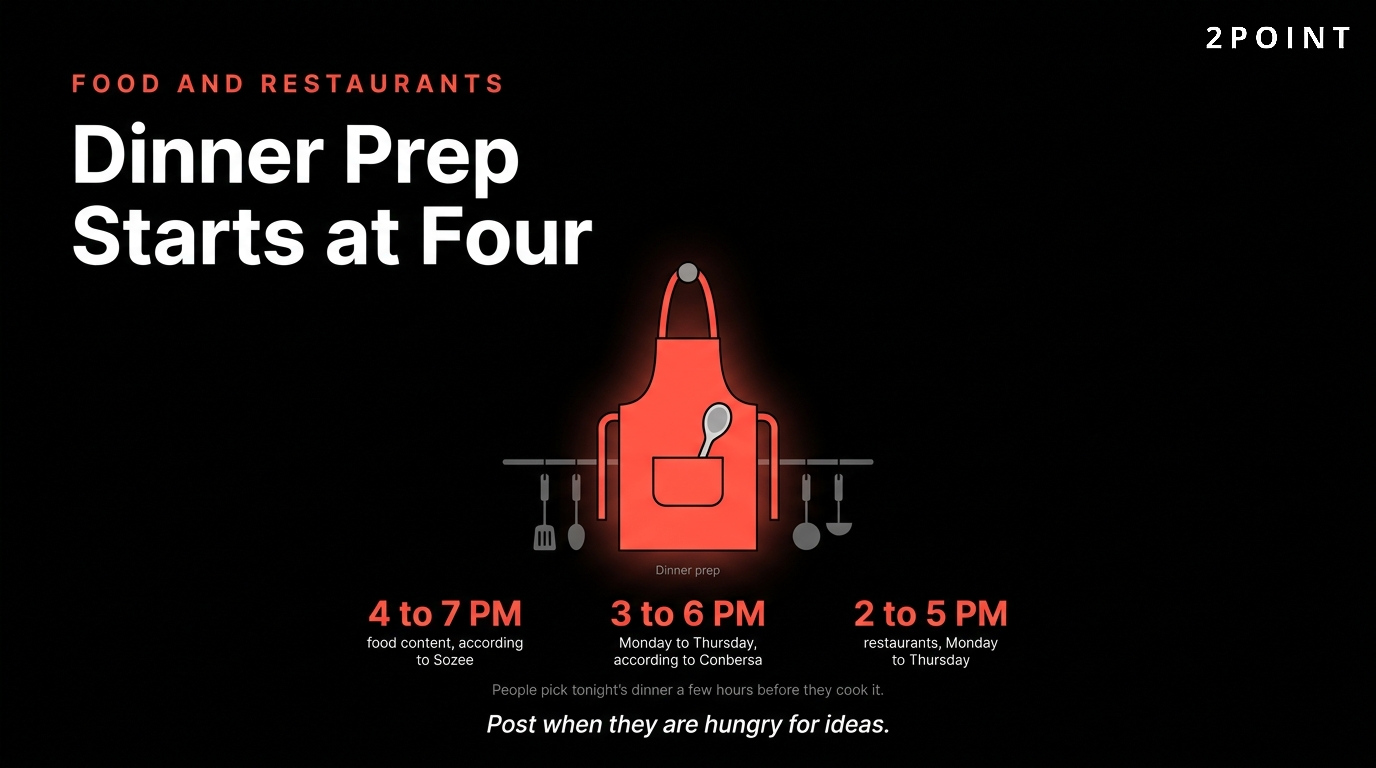
Food and beverage content on TikTok maps closely to hunger cycles and meal-planning behavior. Audiences engage with food content when they are thinking about what to eat, making the pre-meal window an especially valuable time slot. Conbersa’s analysis identifies Monday through Thursday, 3 PM to 6 PM, as the strongest window for food and beverage content, capturing the afternoon snack mindset and early dinner planning.
Sozee’s data pinpoints the 4 PM to 7 PM range as the absolute peak for food content engagement, directly overlapping with the dinner-planning period when audiences are most receptive to recipe ideas, restaurant recommendations, and food inspiration. For restaurant-specific content, Neal Schaffer’s research narrows the ideal window to 2 PM to 5 PM on Monday through Thursday, capturing the late-afternoon decision-making window before evening dining plans are finalized.
Fitness, Gaming, and Entertainment Niche Timing
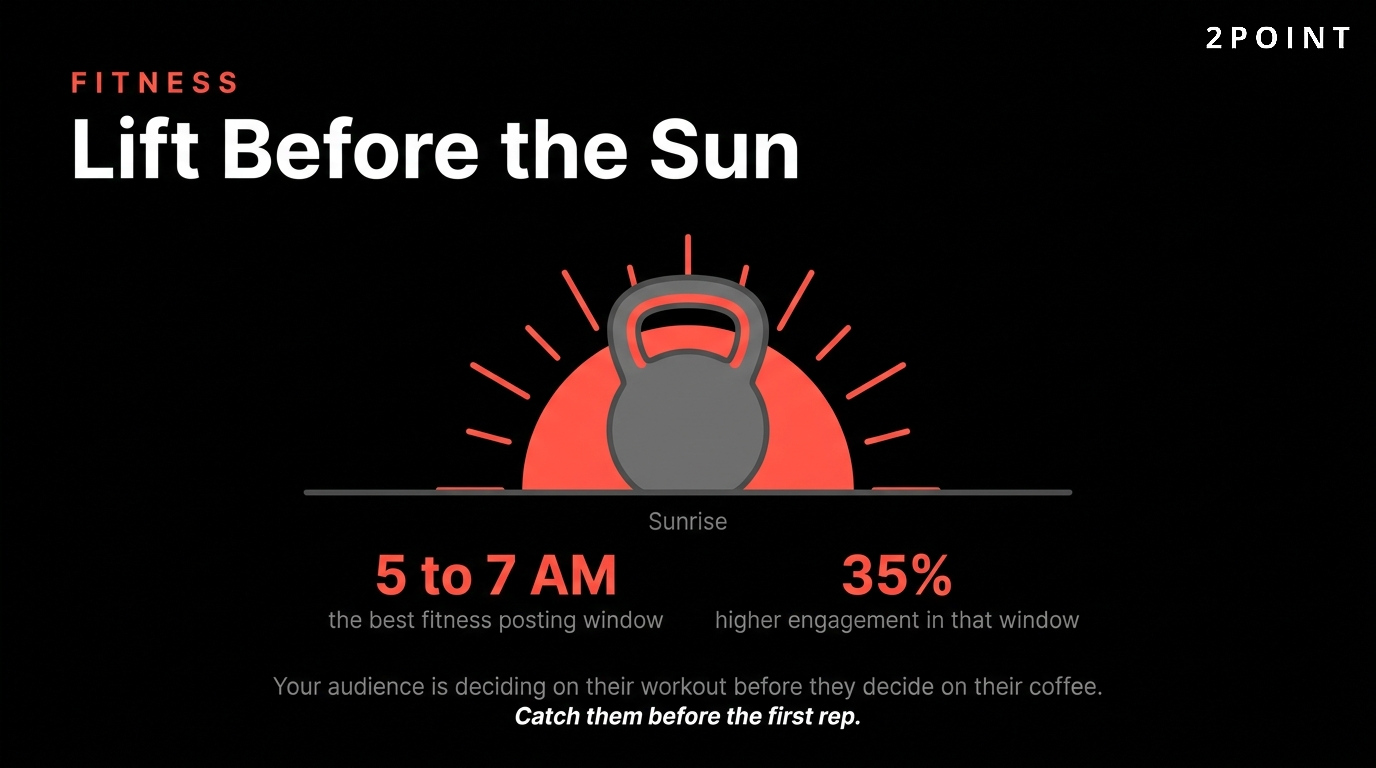
Fitness content demonstrates one of the most distinct timing patterns of any TikTok niche. Fitness audiences skew toward early risers who consume motivational and instructional content before or during their morning workout. Sozee’s niche data identifies the 5 AM to 7 AM window as the peak posting time for fitness creators, and Archive’s analysis reports that fitness creators see approximately 35 percent higher engagement during morning windows compared to other time slots. If you create workout tutorials, nutrition content, or fitness motivation videos, the pre-dawn early morning window is your strongest strategic opportunity.
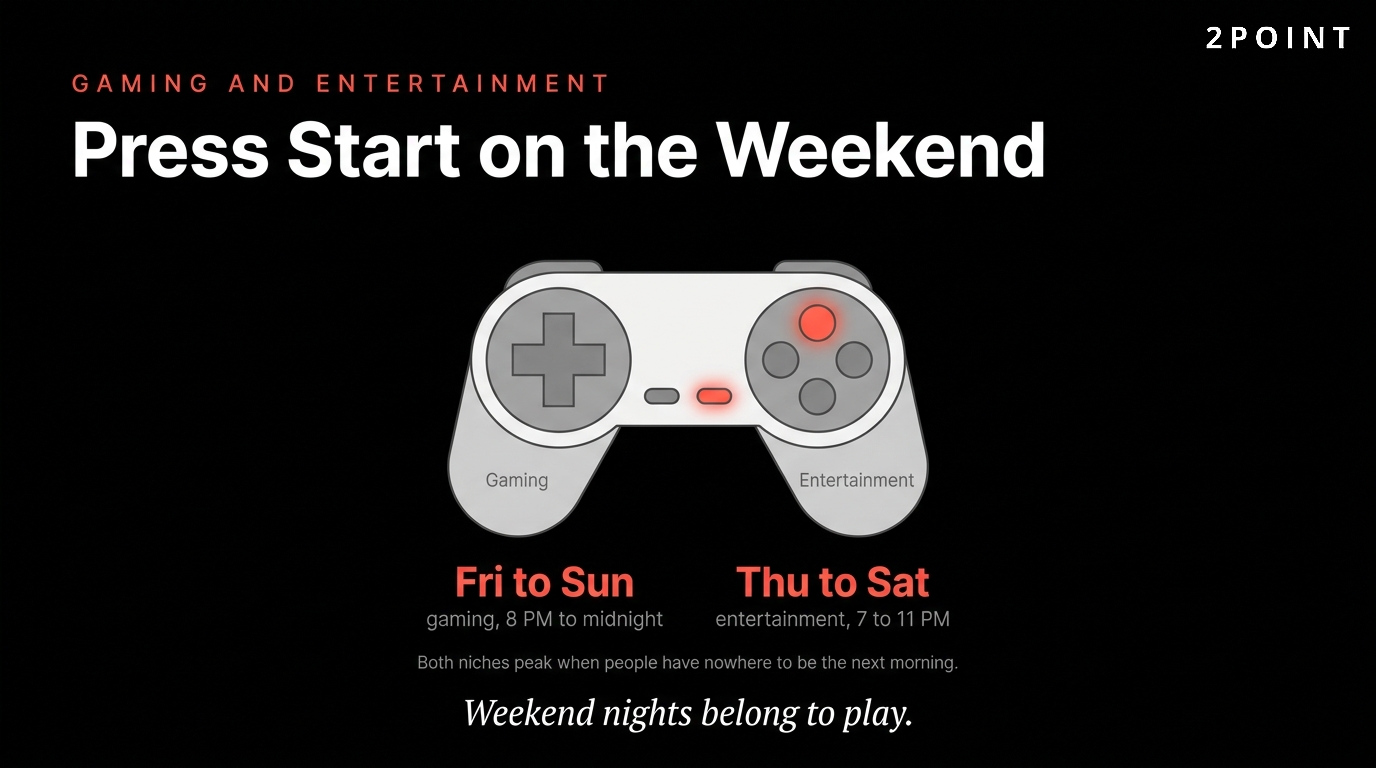
Gaming content follows the opposite pattern. Gaming audiences are night-active, with peak engagement occurring on Friday through Sunday during late evening hours. Conbersa’s study identifies Friday through Sunday as the best days for gaming content, with late evening hours outperforming daytime slots significantly. Entertainment and comedy content benefits from the broadest window of any niche: Thursday through Saturday from 7 PM to 11 PM captures audiences in a relaxed, entertainment-seeking mindset across all demographics.
Business, Finance, Real Estate, and Professional Content Timing
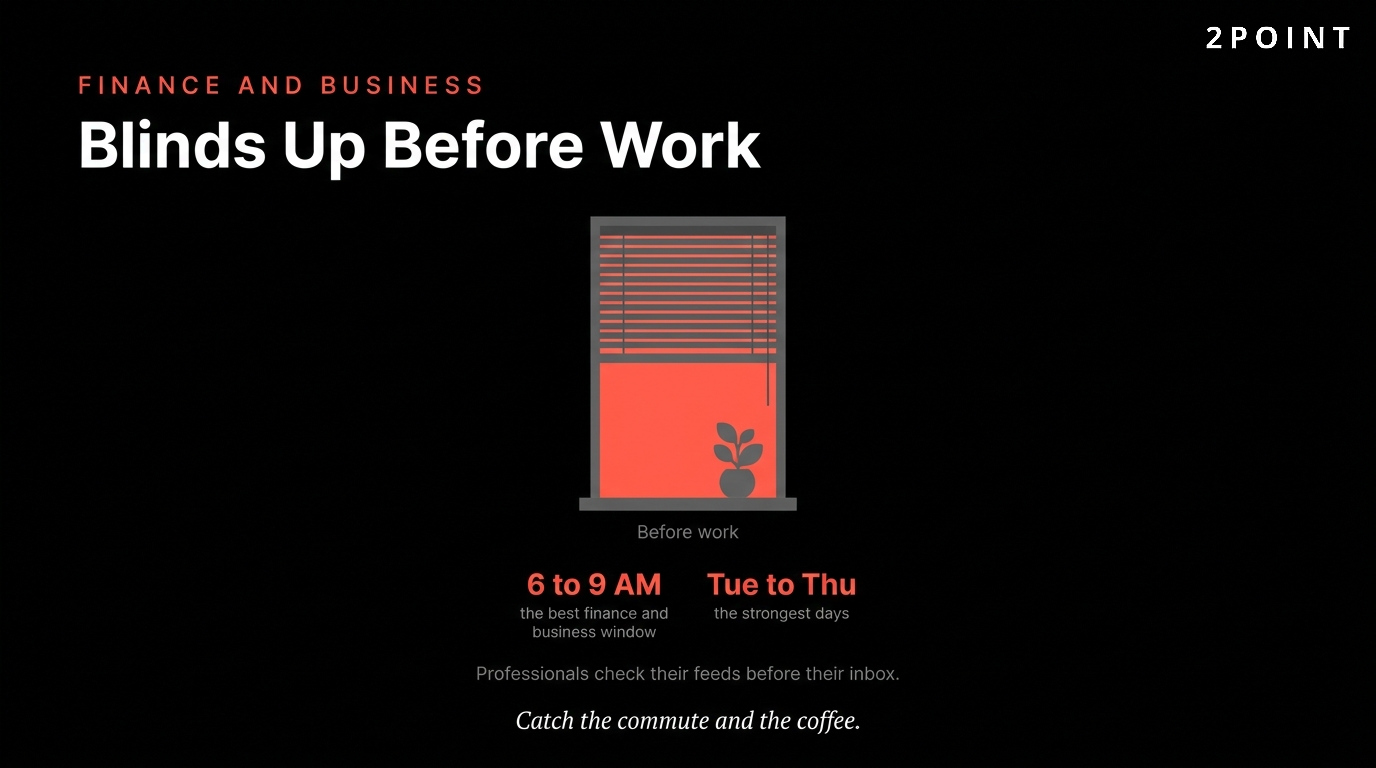
Professional content categories on TikTok attract a fundamentally different audience segment than entertainment niches. Finance content, which includes personal finance tips, investing education, and economic commentary, performs best during early morning hours when professional audiences consume information before their workday begins. Sprout Social’s research confirms early morning peaks for finance content, consistent with the information-consumption habits of career-focused audiences.
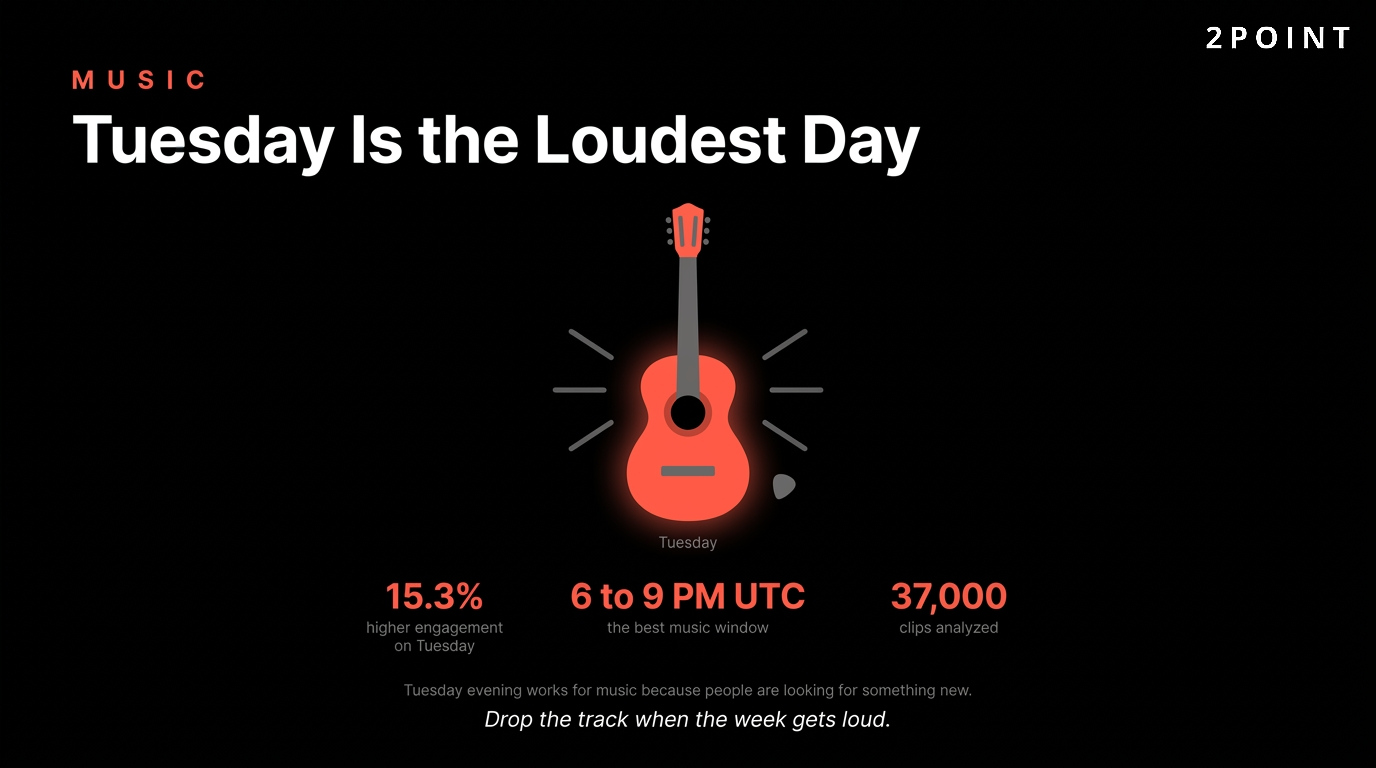
Real estate content displays an interesting hybrid pattern. Sozee’s data shows real estate content performing well at 9 AM with unusually strong weekend numbers, reflecting how potential buyers and renters browse property content during weekend leisure time. Non-profit and cause-based content peaks during workday break periods, specifically 10 AM to 2 PM on Wednesday and Thursday, as identified by Printify’s sector analysis. Music and performance content, based on Opus Pro’s research of 37,000 clips, peaks between 6 PM and 9 PM UTC, with Tuesday showing a 15.3 percent engagement advantage over other weekdays.
| TikTok Content Niche | Best Posting Days | Best Posting Hours | Key Audience Behavior Driver |
|---|---|---|---|
| Beauty and Skincare | Thursday, Friday | 10 PM to 11 PM | Evening wind-down and bedtime routine |
| Fashion and Lifestyle | Thursday, Friday, Saturday | 7 PM to 10 PM (weekdays); 9 AM to 11 AM (weekends) | Outfit inspiration browsing and weekend leisure |
| Food and Beverage | Monday through Thursday | 3 PM to 7 PM | Afternoon hunger and dinner planning |
| Restaurants | Monday through Thursday | 2 PM to 5 PM | Pre-dinner decision-making window |
| Fitness | Monday through Friday | 5 AM to 7 AM | Pre-workout motivation and routine planning |
| Gaming | Friday through Sunday | 8 PM to midnight | Weekend gaming sessions and late-night browsing |
| Entertainment and Comedy | Thursday through Saturday | 7 PM to 11 PM | Relaxed entertainment-seeking mood |
| Finance and Business | Tuesday through Thursday | 6 AM to 9 AM | Pre-work information consumption |
| Real Estate | Weekdays and weekends | 9 AM; weekend afternoons | Property browsing during leisure hours |
| Music and Performance | Tuesday | 6 PM to 9 PM UTC | Evening entertainment discovery |
| Non-Profit and Causes | Wednesday and Thursday | 10 AM to 2 PM | Workday break engagement and cause awareness |
Niche-specific timing data consistently outperforms generic recommendations, with the potential to increase engagement by 30 to 40 percent when aligned correctly with audience behavior patterns.
How to Find the Best Time to Post on TikTok for Your Specific Account
When to post on TikTok depends on your audience, not on industry averages. The most reliable way to identify your ideal posting windows is to combine platform analytics with structured testing. Generic research provides a smart starting point, but your audience’s specific behavior patterns will ultimately determine which times generate the best results for your content.
Using TikTok Analytics to Identify Your Audience’s Peak Activity
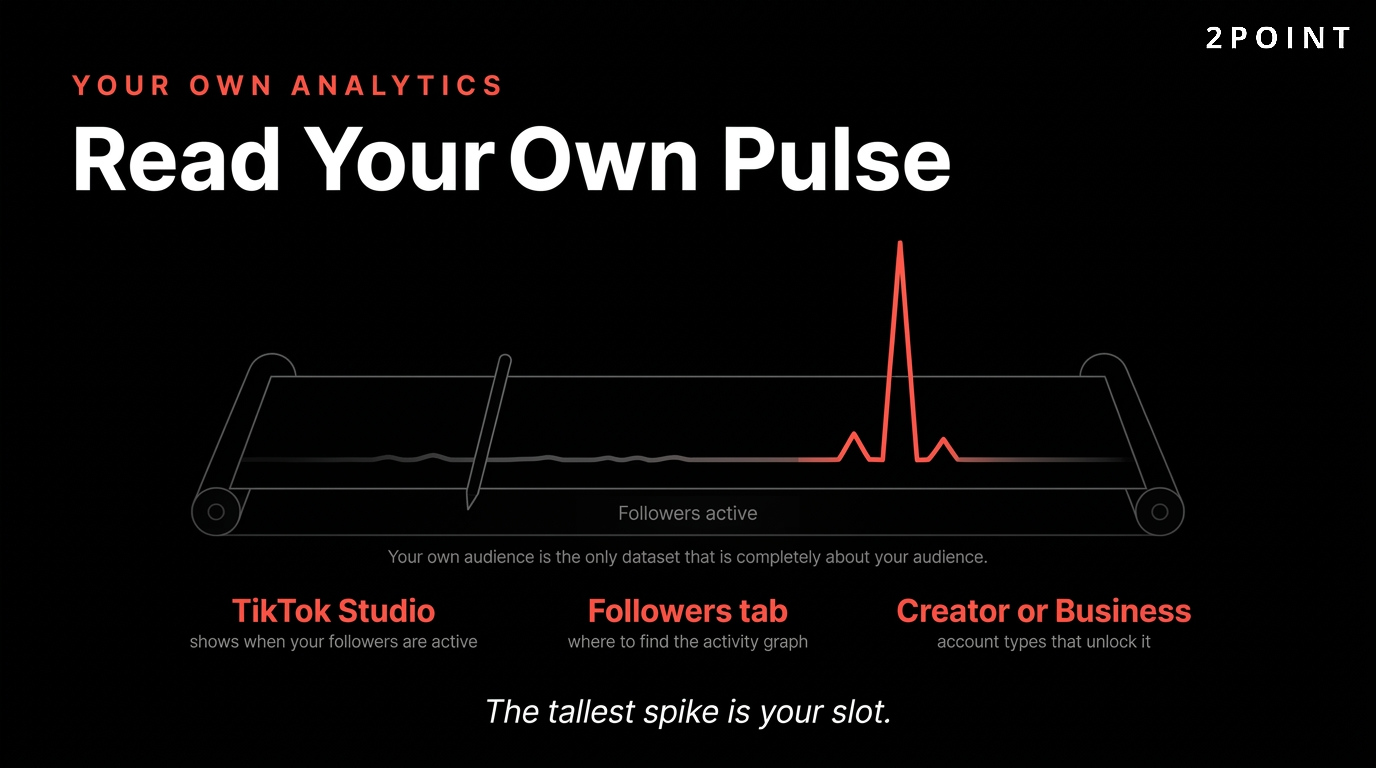
TikTok’s native analytics dashboard, accessible through TikTok Studio, is the most direct tool available for understanding when your specific followers are online. To access it, you need a Creator or Business account. Once inside the platform, navigate to the “Followers” tab within the analytics section, where you will find a graph titled “When Your Followers Are on TikTok.” This graph displays follower activity by hour and by day of week.
Reading this data correctly is essential. Look for the hours when your follower activity graph peaks consistently across multiple days. These hours represent your optimal posting windows, specific to your actual audience rather than an industry average. eClincher’s 2026 analysis emphasizes that your own analytics data should be treated as the primary guide, with industry benchmarks serving only as a secondary reference when you lack sufficient account history to generate meaningful analytics. Good marketing analytics practices always start with your actual audience data before defaulting to general benchmarks.
How to A/B Test Different TikTok Posting Times
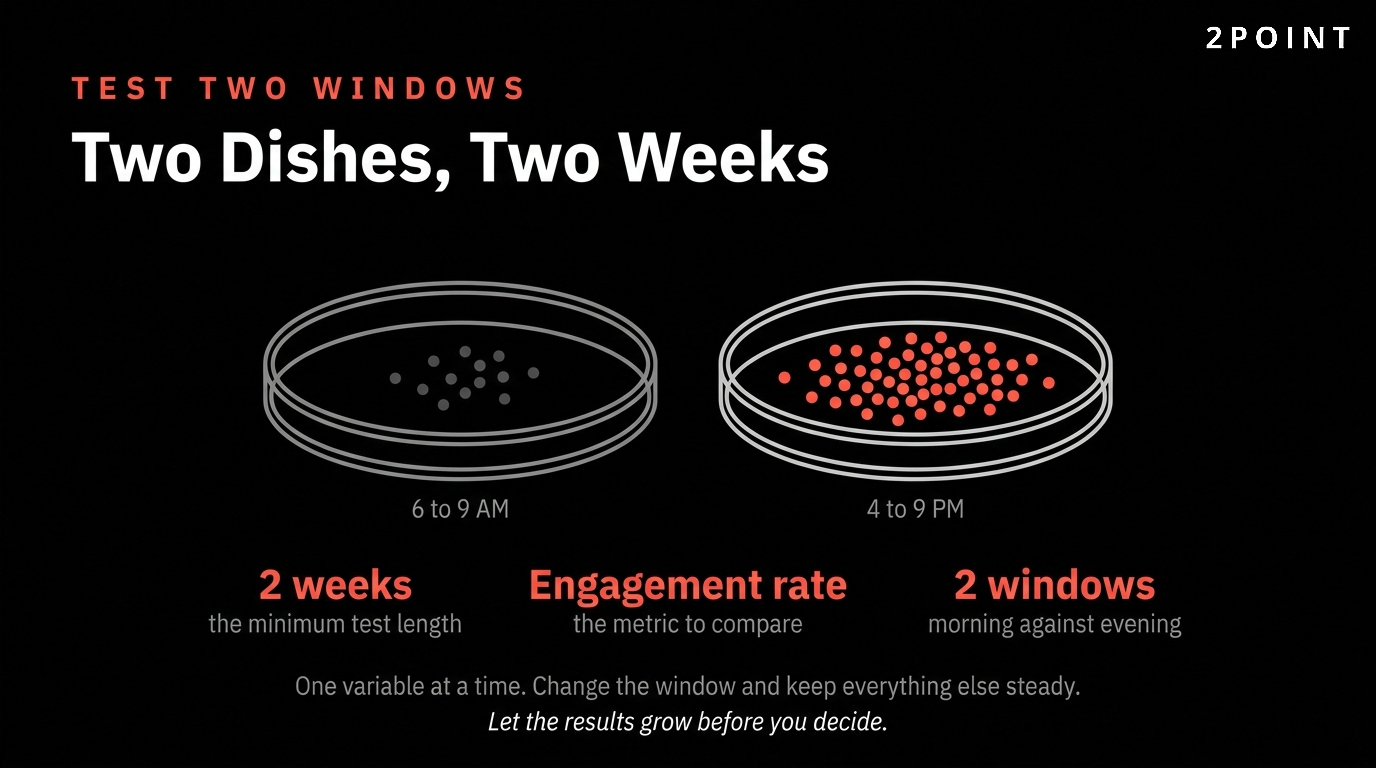
Structured A/B testing is the most reliable method for identifying your personal best posting times. Begin by identifying two distinct time windows you want to compare, such as the morning band (6 AM to 9 AM) versus the evening band (4 PM to 9 PM), as recommended by Monolit’s 2026 posting guide. Post consistently within each window for a minimum of two weeks before drawing conclusions, as short testing periods introduce too much variability.
When evaluating results, focus on engagement rate rather than raw engagement numbers. Total likes and views will naturally fluctuate as your account grows, but engagement rate (engagement divided by views or impressions) provides a normalized comparison. Autoposter’s 2026 guide notes that afternoons from 12 PM to 6 PM serve as the safest default window for creators without enough analytics history to run a structured test. Document both the time you posted and the content type for each test video, since timing effects can interact with content format in ways that influence your results.
Time Zone Considerations for Audiences Across Multiple Regions
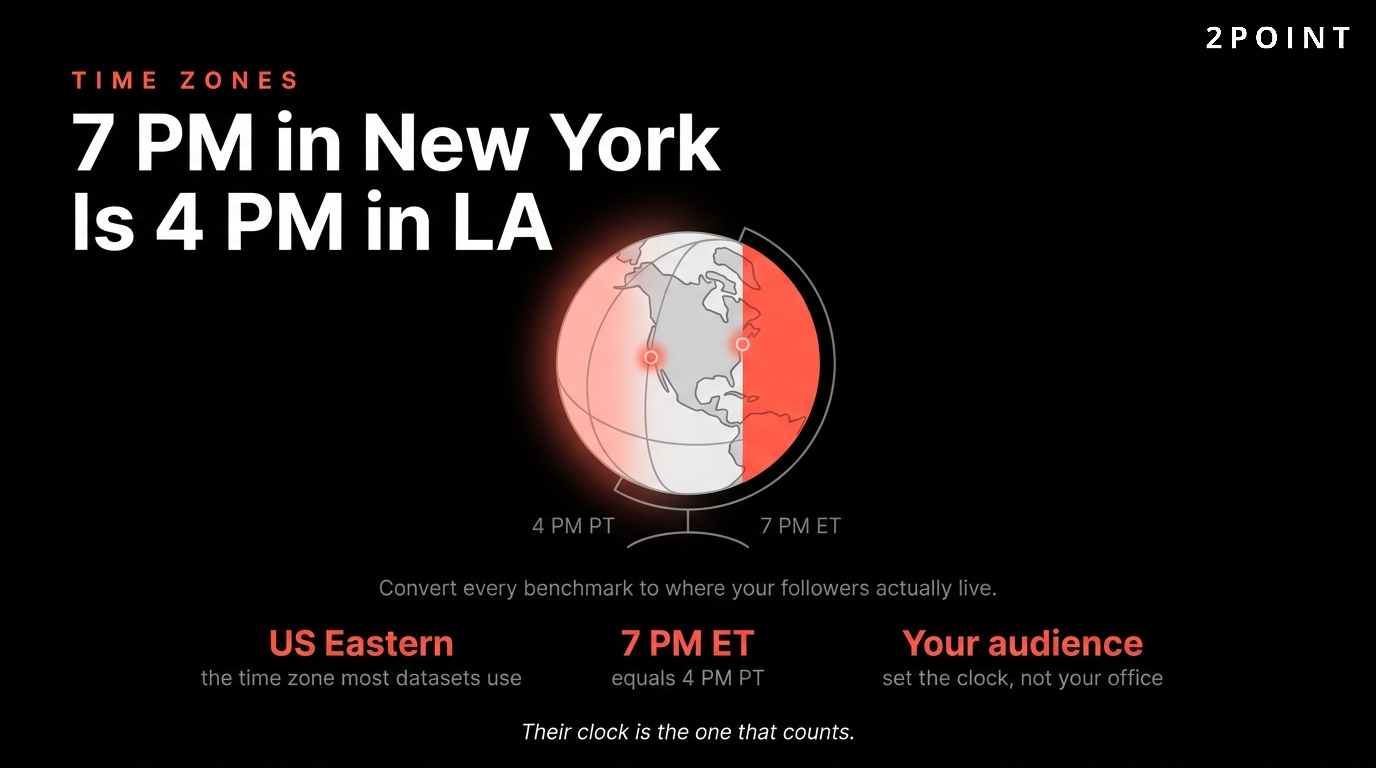
One of the most common sources of confusion around TikTok posting time recommendations is time zone misalignment. Almost all major research datasets, including those from Buffer and Sprout Social, are recorded in US Eastern Time. If your audience is primarily located in another region, you need to convert those recommendations to reflect your audience’s actual local time, not yours as the creator.
Breakreach’s comparative analysis explicitly notes that all major timing datasets are recorded in US Eastern Time, making direct application to non-US audiences inaccurate without adjustment. Wavegen’s research recommends framing optimal times as 7 AM to 9 AM, 12 PM to 1 PM, and 7 PM to 9 PM in your audience’s local time, regardless of where you as the creator are physically located. If your audience spans multiple time zones, identify the largest geographic segment from your analytics and optimize for that segment first. For truly global audiences, posting multiple times across a single day serves different regional peaks simultaneously, though this requires a higher content volume or repurposing strategy.
When to Retest and Refresh Your TikTok Posting Schedule
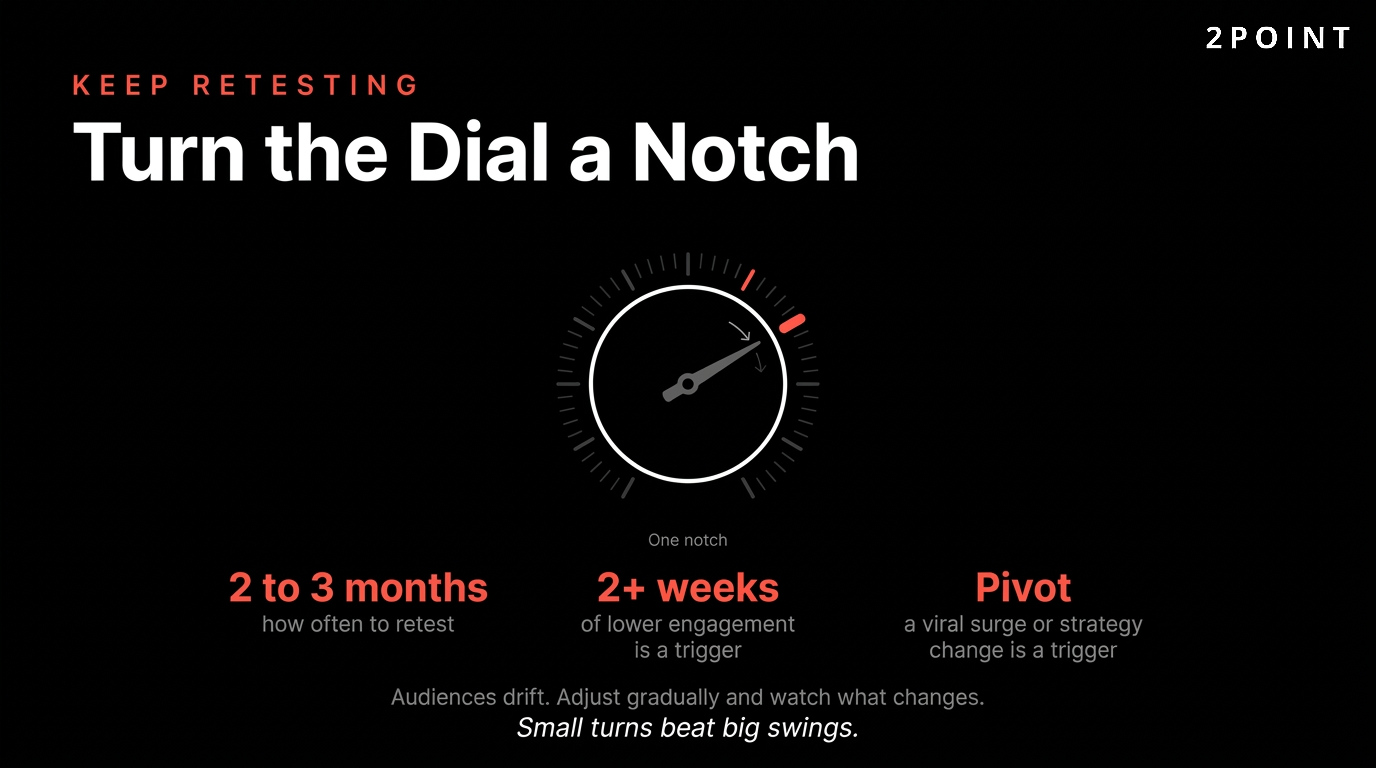
TikTok’s algorithm, your audience demographics, and broader platform behavior all shift over time. A posting schedule that performs well in one quarter may become suboptimal six months later due to changes in your audience’s habits, shifts in the algorithm’s distribution logic, or the evolving composition of your follower base. eClincher’s 2026 research recommends rechecking your optimal posting times every two to three months as a standard maintenance practice.
Beyond the routine schedule, specific triggers should prompt an immediate retest. These include a significant drop in your average engagement rate over two or more weeks, a major influx of new followers from a viral video that may have shifted your audience demographics, or a deliberate pivot in your content strategy. Sozee’s algorithm research also warns against making sudden, dramatic changes to your posting schedule, noting that abrupt shifts can temporarily disrupt how the algorithm distributes your content while it recalibrates to your new patterns. Gradual adjustments are preferable to wholesale schedule overhauls.
How Often Should You Post on TikTok for Maximum Growth?
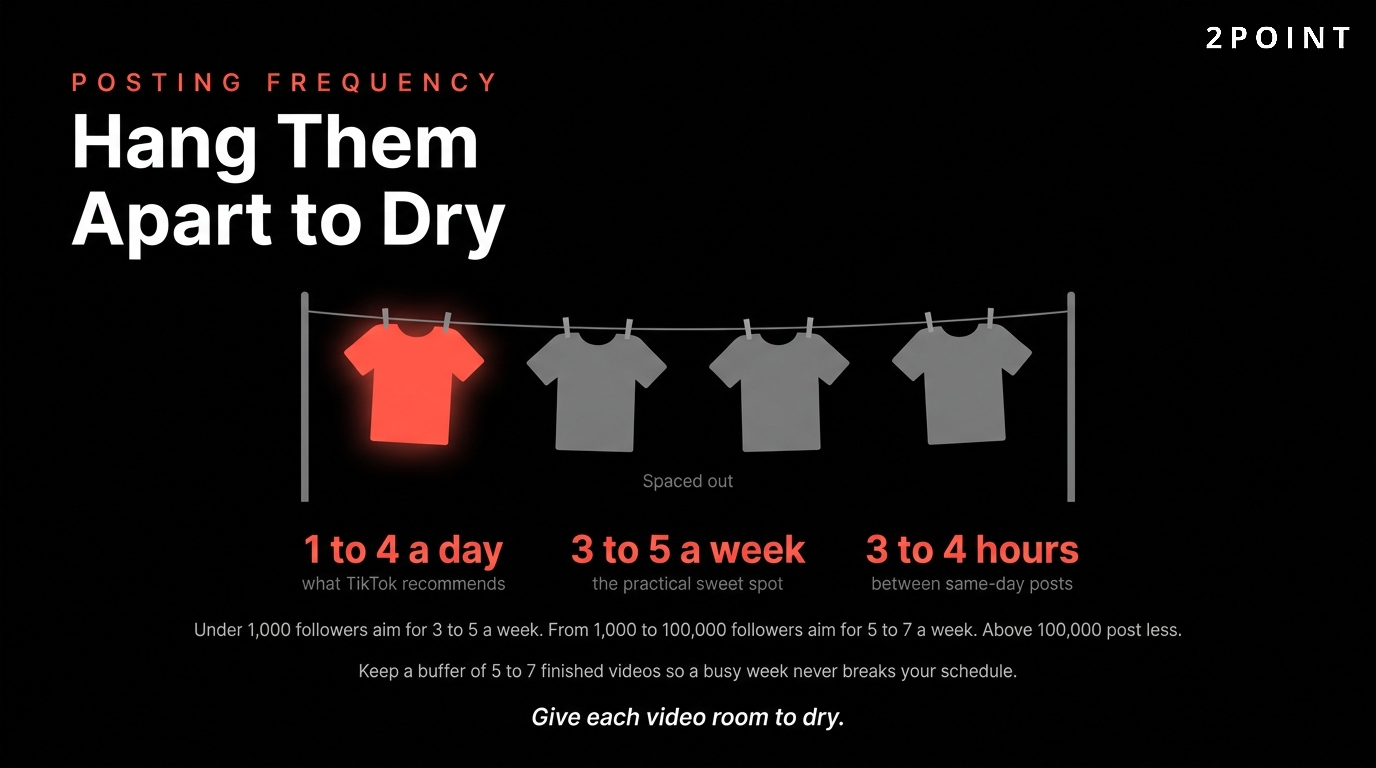
TikTok posting frequency is a question every creator eventually confronts, and the answer varies significantly depending on your growth stage, content capacity, and audience expectations. TikTok’s unique algorithmic structure, where each video is evaluated independently, changes the calculus compared to other platforms where posting too frequently can flood your followers and trigger muted responses.
TikTok’s Official Recommendations on Posting Frequency
TikTok’s own Creator Portal recommends publishing between one and four videos per day for creators who want to maximize platform growth. This is a notably higher frequency than what most social platforms encourage. However, AliDropship’s platform guide notes that this recommendation assumes you can maintain content quality at that volume, which is not realistic for most individual creators or small teams.
The most widely cited practical recommendation from third-party research lands at three to five quality posts per week. Hopper HQ’s analysis and Apaya’s posting guide both converge on three to five posts per week as the ideal balance between distribution opportunity and content quality. This frequency keeps you visible and algorithmically active without forcing you to publish content that falls below your quality standards.
Quality vs. Quantity: Finding the Right Balance for Your TikTok Account
TikTok’s independent video evaluation model means that a great video posted once can outperform ten mediocre videos. Go Viral’s platform research confirms that TikTok evaluates each video on its own merits, which theoretically allows for high-frequency posting without penalizing individual video quality. However, there is a practical limit to how often you can post quality content before quality starts declining.
There is also a subtler risk with high-frequency posting: when you publish two videos in rapid succession, they compete for attention from the same initial test pool of your followers. Sozee’s algorithm research notes that back-to-back videos can effectively cannibalize each other’s early engagement window, since the same audience is split between two pieces of content instead of concentrating its activity on one. Spacing posts by at least three to four hours avoids this overlap. Signs that you are posting too frequently include declining completion rates across your recent posts, dropping comments-to-views ratios, and reduced follower retention between videos.
The Consistency Advantage: Why Regular Posting Builds Momentum
Consistency on TikTok does more than maintain visibility; it actively trains the algorithm to anticipate and distribute your content. Sozee’s research explains that a consistent posting schedule helps the algorithm recognize your patterns and optimize distribution accordingly. When you post unpredictably or abandon your schedule for weeks at a time, you lose the momentum that comes from algorithmic familiarity.
The same research points out that sudden scheduling changes carry a real cost. Switching from posting at 1 PM on Mondays to 3 AM on Thursdays, for example, requires several days of algorithm recalibration before your content returns to normal distribution levels. Building a sustainable content production workflow that you can maintain consistently over months is more valuable than chasing a theoretically perfect posting schedule that you cannot sustain. Good social media campaign management always prioritizes sustainable consistency over sporadic perfection.
Posting Frequency by Growth Stage
How often you should post on TikTok also depends on where you are in your account’s growth trajectory. New accounts with fewer than 1,000 followers benefit most from higher posting frequency because every video is a new opportunity to reach a potential audience and build account credibility. For accounts in this early stage, three to five posts per week is a healthy minimum, with daily posting being an aggressive but viable approach if quality can be maintained.
Accounts in the 1,000 to 100,000 follower range have an established baseline audience and benefit from both frequency and consistency. Five to seven posts per week or daily posting provides enough distribution opportunities to compound growth. Go Viral’s research confirms that more posts create more distribution opportunities in this mid-growth stage. Established accounts with more than 100,000 followers can often sustain strong engagement with fewer posts because their existing audience provides a more robust initial test pool for each new video, though the right frequency at this stage varies significantly by niche and content depth.
Advanced TikTok Posting Strategies for Maximum Engagement
Once you have your foundational posting schedule established, advanced strategies can help you extract additional performance from every video you publish. These techniques go beyond simply picking the right hour and address how to structure your timing decisions for compounding results.
The 30-Minute Head Start Technique for TikTok Timing
As introduced in the algorithm section, posting 30 to 60 minutes before your target peak time is one of the highest-impact adjustments a creator can make with minimal effort. The logic is straightforward: your video needs time to clear the algorithm’s initial processing and categorization before it can be shown to your target audience at scale. Autoposter’s 2026 posting guide explicitly recommends this pre-peak window, and Go Viral’s research corroborates the need for algorithm processing time before peak distribution occurs.
In practice, if your audience peaks at 7 PM, publish your video at 6:15 PM or 6:30 PM. By the time your audience is fully active, your video has already been evaluated by the algorithm, categorized by topic, and queued for distribution. The incoming wave of active users then encounters a video that is already primed and ready, generating faster initial engagement than a video published exactly at peak time. This technique works equally well for morning peaks: if your best morning window is 9 AM, posting at 8:15 AM gives your content the head start it needs.
Multi-Time Zone Posting Strategy for International TikTok Audiences
Creators and brands with audiences that span multiple geographic regions face a timing challenge that single-market creators do not: optimizing for one time zone means posting at a suboptimal hour for every other region. The first step in resolving this is identifying your largest audience segment from your TikTok analytics and anchoring your primary posting schedule to that region’s peak hours.
For accounts with roughly equal audience distribution across two or more major regions, a split-posting strategy works well. This involves publishing the same video or complementary content at peak times for each major region. Conbersa’s niche analysis notes that the generic Tuesday through Thursday, 2 PM to 6 PM window should always be treated as a starting point that gets refined once you have regional audience data. Using social media management tools that support multi-timezone scheduling can significantly simplify this process for brands posting across international markets.
Leveraging TikTok’s Extended Content Discovery Window
One of TikTok’s most distinctive characteristics compared to other social platforms is its extended content discovery window. On Instagram, a post’s performance window is largely determined within the first few hours. On TikTok, the algorithm can continue surfacing a video to new audiences for days or even weeks after the original post date. eClincher’s 2026 analysis confirms that TikTok may take up to 24 hours to fully push a video and that viral gains can accumulate hours or days after initial publication.
This extended window has two important practical implications. First, do not give up on a video that underperforms in its first 24 hours. The algorithm continues testing videos with fresh audience segments over time, and a video that gains a small surge of engagement from a secondary test can sometimes trigger a much broader distribution cycle. Second, older content can be strategically revived through TikTok’s stitch and duet features. Creating a new video that references or builds on an older post can reignite the original’s discovery window, essentially giving previously published content a second algorithmic opportunity. This is an especially effective strategy for evergreen educational or instructional content.
When Timing Matters Less Than You Think: The 80/20 Perspective
Maintaining perspective on timing’s role in your overall TikTok strategy is essential. Breakreach’s comparative analysis makes a pointed observation: timing matters less on TikTok than on any other major social platform, precisely because TikTok’s algorithm is built to surface content based on interest relevance rather than chronological recency. Content quality and the strength of your first 60 minutes decide far more than the hour you chose to post.
Monolit’s 2026 data reinforces this with the finding that the first 60 minutes determine roughly 80 percent of a video’s outcome. The 80/20 principle applies here cleanly: 80 percent of your TikTok success comes from the quality of your content, the strength of your hook, your video’s watch time and completion rate, and your overall consistency. Timing optimization accounts for the remaining 20 percent. This does not make timing irrelevant; a 20 percent performance improvement compounds meaningfully over time. But it does mean that if you are choosing between spending an hour perfecting your content or spending an hour researching the optimal posting minute, the content investment almost always wins.
Common TikTok Posting Time Mistakes That Hurt Your Reach
Even creators who understand TikTok’s algorithm and have researched posting time best practices regularly make avoidable timing mistakes. These errors can silently suppress your reach without any obvious cause, making them worth addressing explicitly.
Blindly Following Generic Best Times Without Testing
The most widespread TikTok timing mistake is treating generic recommendations as fixed rules rather than as starting hypotheses. When a study tells you that 7 PM Tuesday is the best time to post, that finding reflects an average across millions of posts spanning every content category and audience demographic. Applied to your specific account, that average may be significantly off-target.
Conbersa’s niche research demonstrates that niche-specific timing can outperform generic recommendations by 30 to 40 percent when your content aligns with your audience’s actual behavioral patterns. If you are a fitness creator blindly following a general “best time” recommendation that points to 7 PM, you may be missing the 5 AM to 7 AM morning window that is actually delivering 35 percent higher engagement for your niche. Generic recommendations belong in your testing plan, not in your final posting schedule.
Ignoring Your Existing TikTok Analytics Data
Many creators with access to TikTok Studio analytics continue to rely on published industry recommendations rather than consulting their own data. This is a significant missed opportunity. Your analytics show you exactly when your existing followers are active, which is a much more precise signal than any aggregate study can provide. eClincher’s research identifies ignoring the “Follower Activity” graph in TikTok Analytics as one of the most common and consequential mistakes creators make.
Your follower activity data is updated regularly and reflects shifts in your audience’s behavior as your account grows and your audience composition changes. Checking it monthly and incorporating its findings into your posting schedule takes less than ten minutes and consistently outperforms any generic recommendation you could follow. Pairing this with strong social media listening practices can further sharpen your understanding of when and how your audience is engaging with content in your category.
Posting at “Optimal Times” in the Wrong Time Zone
Time zone errors are surprisingly common and entirely preventable. If you create content for a US audience and post at 7 PM Eastern Time, your video reaches East Coast viewers at the ideal moment but arrives for West Coast viewers at 4 PM, a full three hours before their evening peak. Depending on your audience distribution, that misalignment could mean you are missing up to a third of your most engaged followers during their peak activity window.
Wavegen’s research emphasizes that best posting times are always expressed in your audience’s local time, not the creator’s. Breakreach specifically calls out that all major timing datasets default to US Eastern Time, which requires deliberate adjustment for creators targeting non-Eastern audiences. Use your TikTok analytics to identify where your followers are located, then convert your target posting times accordingly.
Sacrificing Content Quality for Perfect Timing
Rushing a video to meet an optimal posting window is a trade-off that almost never pays off. The temptation is understandable: you know that 7 PM Tuesday is your best window and you want every post to hit that slot. But a video that lacks a strong hook, has poor audio quality, or fails to maintain watch time will underperform regardless of when it is published. eClincher’s analysis is clear that engagement metrics consistently matter more than exact posting time, and Conbersa’s data confirms that completion rate and watch time carry 40 to 50 percent of algorithmic weight.
TikTok’s extended discovery window also reduces the pressure of hitting a precise posting window. A high-quality video published at a “suboptimal” time frequently outperforms a rushed video published at peak time, because the quality signals it generates during its extended distribution cycle accumulate more value over time. If your video is not ready, waiting for the next optimal window is almost always the better strategic choice. Building a content buffer, where you have several completed videos ready to publish, eliminates this dilemma entirely and is one of the most effective habits any serious TikTok creator can develop.
Tools and Resources for Optimizing Your TikTok Posting Schedule
The right tools transform TikTok posting time optimization from a time-consuming manual process into a streamlined, data-driven system. Both TikTok’s native features and third-party platforms offer meaningful support for creators and brands looking to maximize their posting schedule effectiveness.
TikTok’s Native Analytics Dashboard for Posting Time Research
TikTok Studio, formerly known as Creator Center, is the platform’s built-in analytics environment and the logical starting point for any posting time research. Accessing it requires either a Creator Account or Business Account (both are free to switch to from a standard personal account). Within TikTok Studio, navigate to the Analytics section and select the “Followers” tab to access the “When Your Followers Are on TikTok” graph.
This graph displays your follower activity by both hour of the day and day of the week, giving you a two-dimensional view of when your specific audience is most active. eClincher’s research recommends using this follower activity data as your primary timing guide. Beyond the follower activity graph, TikTok Studio also shows individual video performance metrics, traffic source breakdowns, and audience demographic data including geographic distribution. These additional data points help you refine both your timing strategy and your content approach. The limitation of native analytics is that historical data is capped and you cannot compare posting time performance across extended periods without exporting data manually.
Third-Party Scheduling and Analytics Platforms for TikTok
Several third-party tools significantly extend TikTok’s native analytics capabilities and add scheduling functionality that makes consistent posting easier to maintain. Popular options include Buffer, Hootsuite, Later, and Metricool. Each offers a combination of post scheduling, optimal time recommendations, cross-platform management, and performance analytics that go beyond what TikTok Studio provides natively.
Buffer’s platform, which analyzed 7.1 million posts to generate its timing recommendations, also offers a built-in “Optimal Timing” feature that calculates suggested posting windows based on your account’s historical performance data. These tool-generated recommendations are valuable because they are personalized to your account rather than derived from industry-wide averages. The primary trade-off with scheduling tools is that some creators report slightly reduced native reach when using third-party schedulers versus posting directly in the TikTok app, though this effect is generally minor and inconsistent. For multi-channel marketing teams managing TikTok alongside other platforms, the workflow efficiency of a centralized scheduling tool typically outweighs any minor performance difference.
Building a Custom TikTok Posting Schedule from Your Data
Creating a personalized posting schedule that consistently outperforms generic recommendations requires combining multiple data sources into a coherent system. The process involves three sequential steps: gathering data, testing hypotheses, and standardizing your schedule based on results.
Start by reviewing your TikTok Studio follower activity data and identifying your top two or three peak activity windows. Cross-reference these with the niche-specific recommendations that apply to your content category. Use this combined starting point to build an initial posting schedule that you will test over a four to six week period. During testing, track engagement rate, completion rate, and follower growth for each time slot independently. After your testing period, standardize the two or three windows that consistently outperform and anchor your content calendar around those slots. Revisit and validate this schedule every two to three months, or whenever you experience a significant change in your account’s growth trajectory or content direction. Using strong marketing performance review practices to evaluate your posting schedule regularly ensures your timing strategy evolves alongside your audience. For teams creating video content at scale, investing in quality video editing tools can help maintain the production quality needed to support a high-frequency posting schedule without sacrificing standards.
Integrating TikTok Timing into a Broader Social Media Strategy
TikTok timing decisions do not exist in isolation. For brands and creators active across multiple platforms, integrating your TikTok posting schedule with your broader social media strategy creates compounding benefits. Content published on TikTok at an optimal time can be repurposed across Instagram Reels, YouTube Shorts, and other short-form video formats, though each platform has its own algorithmic preferences and audience behavior patterns.
When building a cross-platform strategy, avoid the mistake of simply cross-posting TikTok content at the same time across every platform. Each platform’s peak engagement windows differ, and a time that is optimal for TikTok may be suboptimal for Instagram or YouTube. A more effective approach is to publish on TikTok first at your optimal window, assess early performance signals, and then adapt or reshare top-performing content to other platforms at their respective optimal times. This sequenced approach maximizes the lifespan and reach of your content production investment. For teams managing social media campaigns across multiple channels, building TikTok timing into the broader content calendar from the planning stage prevents scheduling conflicts and ensures each platform’s peak windows are respected.
TikTok Posting Strategy Checklist for 2026
Pulling all of these recommendations into a practical, actionable framework is the final step in building a posting strategy that works. The following checklist synthesizes the most important timing, frequency, and optimization decisions covered throughout this guide.
Your Step-by-Step TikTok Timing Implementation Plan
- Convert to a Creator or Business Account: This unlocks TikTok Studio analytics, which are essential for data-driven timing decisions. Without this access, all timing decisions must rely on generic industry data.
- Review your follower activity graph: Navigate to TikTok Studio, select the Followers tab, and document the top two to three hours and days when your audience is most active. Record this data weekly for one month before drawing conclusions.
- Select your content niche category: Identify which niche timing benchmark applies to your content, using the niche table in this guide as reference. Note where your niche’s optimal window aligns with or diverges from your follower activity data.
- Apply the pre-peak posting rule: Subtract 30 to 60 minutes from your target peak window and set that as your actual posting time. If your peak is 7 PM, your posting time is 6:15 PM to 6:30 PM.
- Confirm your audience’s time zone: Check TikTok Studio’s audience location data. Convert all timing recommendations to your audience’s predominant local time, not yours as the creator.
- Build a two-week A/B test: Test your top two candidate time windows against each other with consistent posting frequency and similar content types. Track engagement rate and completion rate, not raw view counts.
- Establish a consistent posting frequency: Commit to three to five posts per week at minimum if you are in an early growth stage. Daily posting is beneficial if quality can be maintained. Space posts at least three to four hours apart.
- Schedule your retest date: Set a calendar reminder for two to three months from today to revisit your posting schedule and validate it against updated follower activity data.
- Build a content buffer: Maintain at least five to seven completed videos ready to publish at any time. This eliminates the pressure to rush content to meet a posting window.
- Review and iterate monthly: Check your video performance data monthly, note which posting windows are generating the highest engagement rates, and gradually shift your schedule toward confirmed top performers.
This systematic approach applies whether you are a solo creator just starting out or a brand managing a high-volume TikTok presence. The process works because it replaces guesswork with structured observation and replaces generic advice with audience-specific evidence. Teams looking for expert support in building and executing a TikTok strategy from the ground up can explore how 2POINT approaches data-driven social media strategy for brands at every stage of platform growth.
Final Thoughts on TikTok Timing in 2026
The best time to post on TikTok is ultimately the time when your specific audience is most active and your content is most likely to generate fast, high-quality early engagement. The general research consensus around Tuesday through Thursday evenings and Sunday morning provides a sound starting framework, but it is a starting point, not a destination.
TikTok’s algorithm rewards early engagement velocity, content quality, and consistency more than any single posting window. The most successful TikTok creators in 2026 share a common approach: they use data to guide their timing decisions, they test and refine continuously, and they never sacrifice content quality for a “perfect” posting moment. Building your TikTok posting strategy on that foundation, combined with the specific timing insights your analytics provide, is what ultimately moves the needle from occasional good performance to consistently strong results.
Frequently Asked Questions About the Best Time to Post on TikTok
What is the single best time to post on TikTok?
Sunday at 9 AM is identified as the single best-performing time slot based on Buffer’s analysis of 7.1 million TikTok posts. For weekday posting, the Tuesday through Thursday window between 7 PM and 9 PM consistently ranks as the strongest general-audience engagement period across multiple major studies.
Does posting time actually affect TikTok reach?
Yes, but indirectly. TikTok’s algorithm does not explicitly reward posts made at certain hours. However, posting when your audience is active generates faster early engagement, which signals quality to the algorithm and triggers broader distribution. The first 60 minutes after posting determine roughly 80 percent of a video’s eventual reach.
What are the best days to post on TikTok?
Sprout Social’s analysis of nearly 2 billion engagements identifies Tuesday, Wednesday, and Thursday as the strongest posting days for general and business-oriented audiences. Buffer’s dataset of 7.1 million posts points to Saturday as the top overall day, with Sunday morning performing exceptionally well for lifestyle and consumer content.
Does the best time to post on TikTok differ by niche?
Yes, significantly. Fitness content peaks between 5 AM and 7 AM on weekday mornings. Beauty content performs best between 10 PM and 11 PM. Food content peaks from 4 PM to 7 PM. Gaming content is strongest on Friday through Sunday evenings. Niche-specific timing can outperform generic recommendations by 30 to 40 percent.
How do I find my personal best time to post on TikTok?
Access TikTok Studio analytics through your Creator or Business account and review the “When Your Followers Are on TikTok” graph under the Followers tab. This shows you exactly when your specific audience is most active by hour and day, which is more reliable than any generic industry recommendation.
Should I convert published best times to my own time zone?
No. All major TikTok timing research datasets are recorded in US Eastern Time, but you should convert those times to your audience’s local time zone, not your own as the creator. If your audience is predominantly on the West Coast, 7 PM Eastern is 4 PM Pacific, which may miss the evening engagement peak entirely.
How often should I post on TikTok?
TikTok’s Creator Portal recommends one to four posts per day, but three to five quality posts per week is the most widely supported practical recommendation. New accounts benefit from higher frequency to build algorithmic momentum, while established accounts can often sustain growth with fewer, higher-quality posts. Space individual posts at least three to four hours apart to avoid competing for the same initial test audience.
Is it better to post at the exact peak time or before it?
Posting 30 to 60 minutes before your target peak time is generally more effective than posting exactly at peak. This pre-peak head start gives the algorithm time to process and begin distributing your video so that it is already in circulation when your audience’s active period begins, generating faster initial engagement.
What happens if I post at a suboptimal time on TikTok?
A video posted at a less active hour will typically generate slower early engagement, which may limit the algorithm’s initial distribution. However, TikTok’s extended discovery window means the algorithm can continue testing videos with new audiences for days after posting. A high-quality video at a suboptimal time often outperforms a weak video at peak time.
Does TikTok’s algorithm change how timing affects performance?
TikTok updates its algorithm periodically, which can shift how timing interacts with distribution. This is why timing recommendations should be retested every two to three months using your own analytics data rather than relying permanently on published industry studies that may reflect older algorithm behavior.
How does TikTok posting time compare to Instagram’s best posting times?
TikTok is more forgiving of timing than Instagram because its interest-based algorithm can surface content days after posting, regardless of when it was published. Instagram’s feed algorithm is more weighted toward recency and follower relationships, making precise timing relatively more important on that platform. On TikTok, content quality and early engagement velocity matter more than the specific posting window.
Can scheduling tools hurt my TikTok reach?
Some creators report minor reach reductions when using third-party scheduling tools instead of posting directly in the TikTok app, but this effect is inconsistent and generally small. For teams managing multiple platforms or high posting volumes, the workflow efficiency of a scheduling tool typically outweighs any marginal performance difference. Tools like Buffer, Later, and Hootsuite have optimized their TikTok integrations significantly in recent years.