
 let’s connect


What Is GMV Max? The Quick Answer
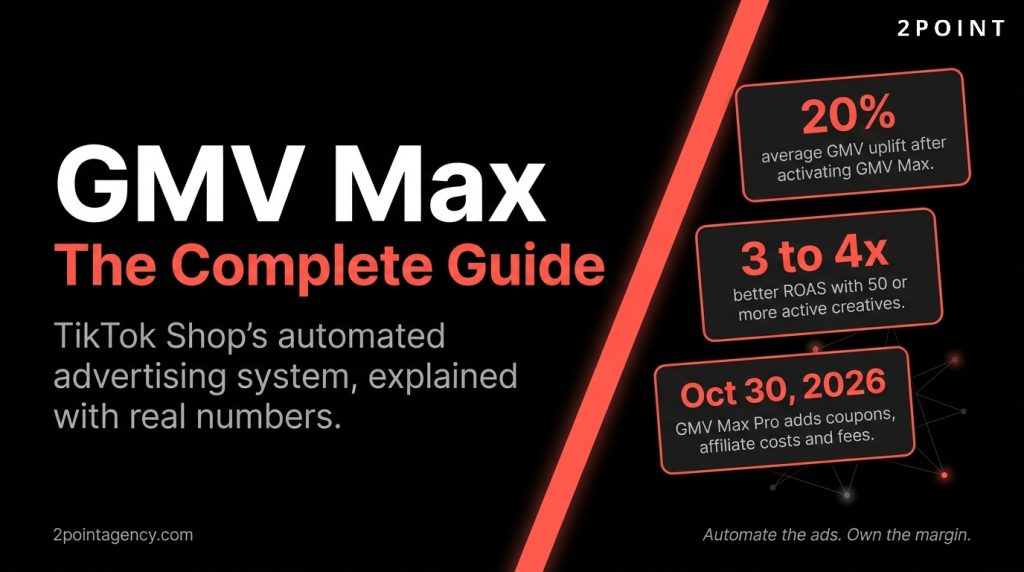
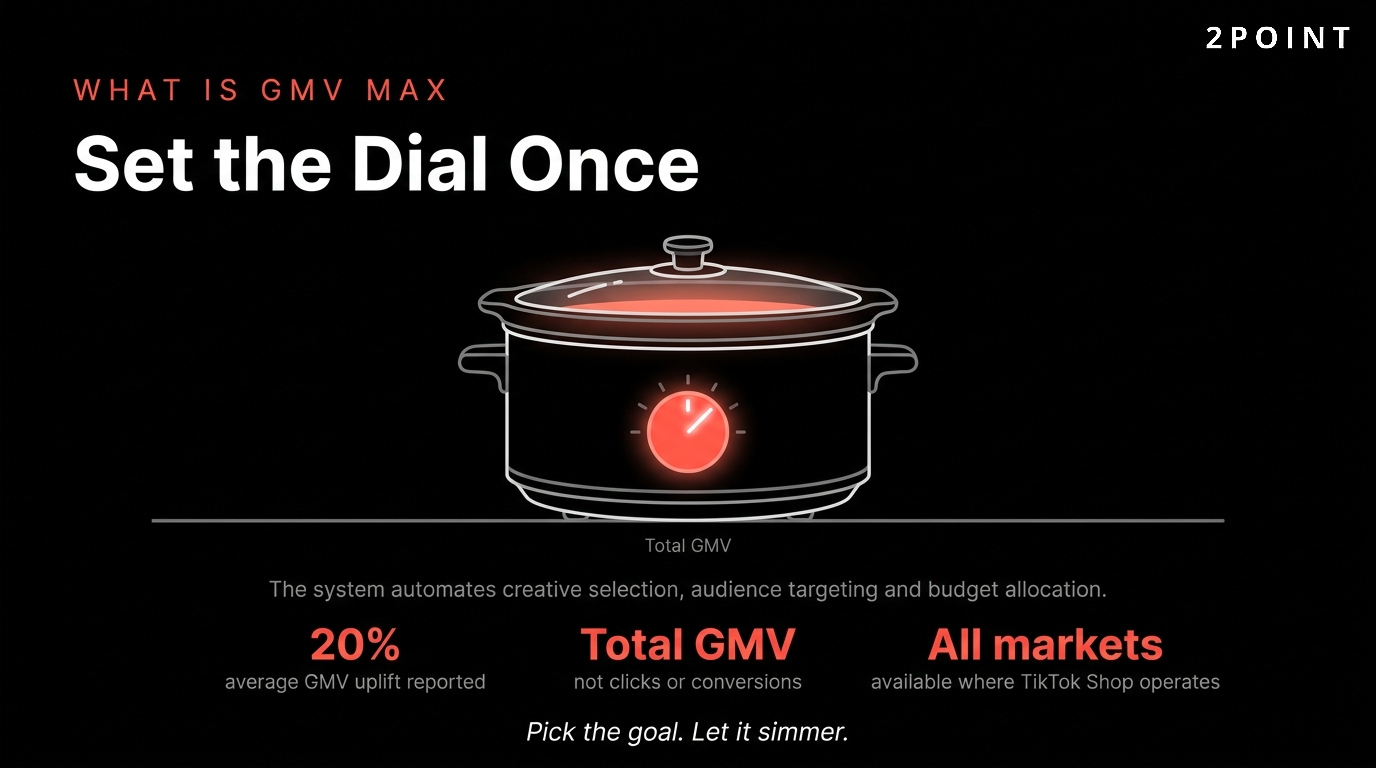
- GMV Max is TikTok Shop’s automated advertising solution that optimizes campaigns for total gross merchandise value rather than clicks or conversions.
- It is available in all markets where TikTok Shop operates as of 2026.
- Two primary campaign types exist: Product GMV Max for catalog promotion and LIVE GMV Max for livestream shopping events.
- The system automates creative selection, audience targeting, and budget allocation without manual intervention.
- TikTok internal data shows advertisers report an average 20% GMV uplift after activating GMV Max campaigns.
- GMV Max uses a same-day attribution model that counts organic and affiliate-driven sales alongside paid conversions.
- GMV Max Pro, announced October 30, 2026, extends optimization to include affiliate costs, coupons, and platform fees beyond ad spend alone.
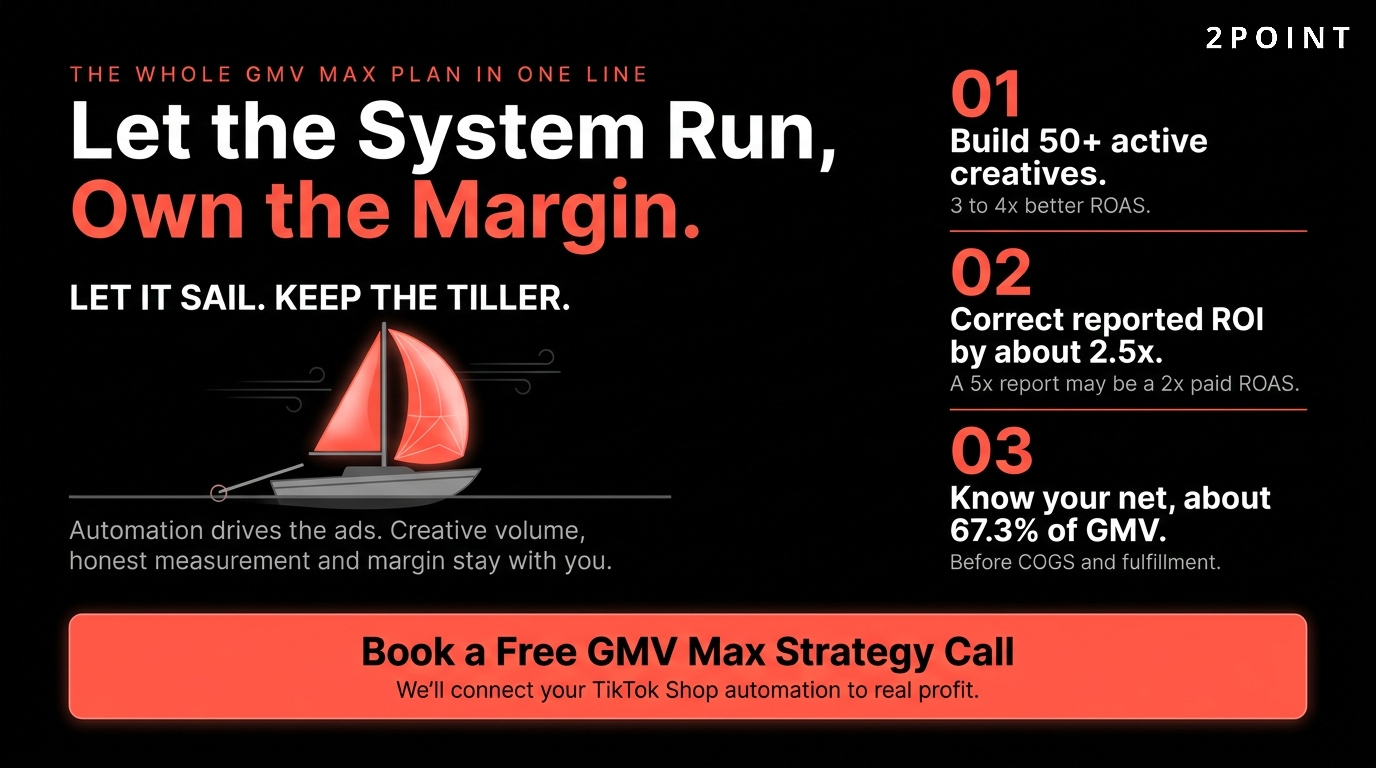
- Accounts with 50 or more active creatives consistently outperform those with fewer assets by a factor of three to four times in ROAS.
The sections below break down every component of the GMV Max ecosystem in detail, from core mechanics and attribution to real-world case studies and profitability math. Whether you are setting up your first campaign or evaluating GMV Max Pro for a complex cost structure, this guide covers what you need to know.
How GMV Max Works: The Complete Automation System
GMV Max represents a fundamental shift in how TikTok approaches commerce advertising. Rather than asking advertisers to manually tune bids, choose audiences, and rotate creatives, the system absorbs those decisions into a single automated engine. Understanding how each component of that engine operates helps you work with it more effectively rather than against it.
The Core Optimization Engine
Unlike traditional TikTok ads that optimize for click-through rates, video views, or even individual conversions, GMV Max optimizes purely for gross merchandise value. The system treats every dollar of revenue as the signal it cares about most. When the algorithm must choose between two placements or two creative formats, it selects the option most likely to generate total GMV rather than the option with the highest engagement rate or the cheapest click.
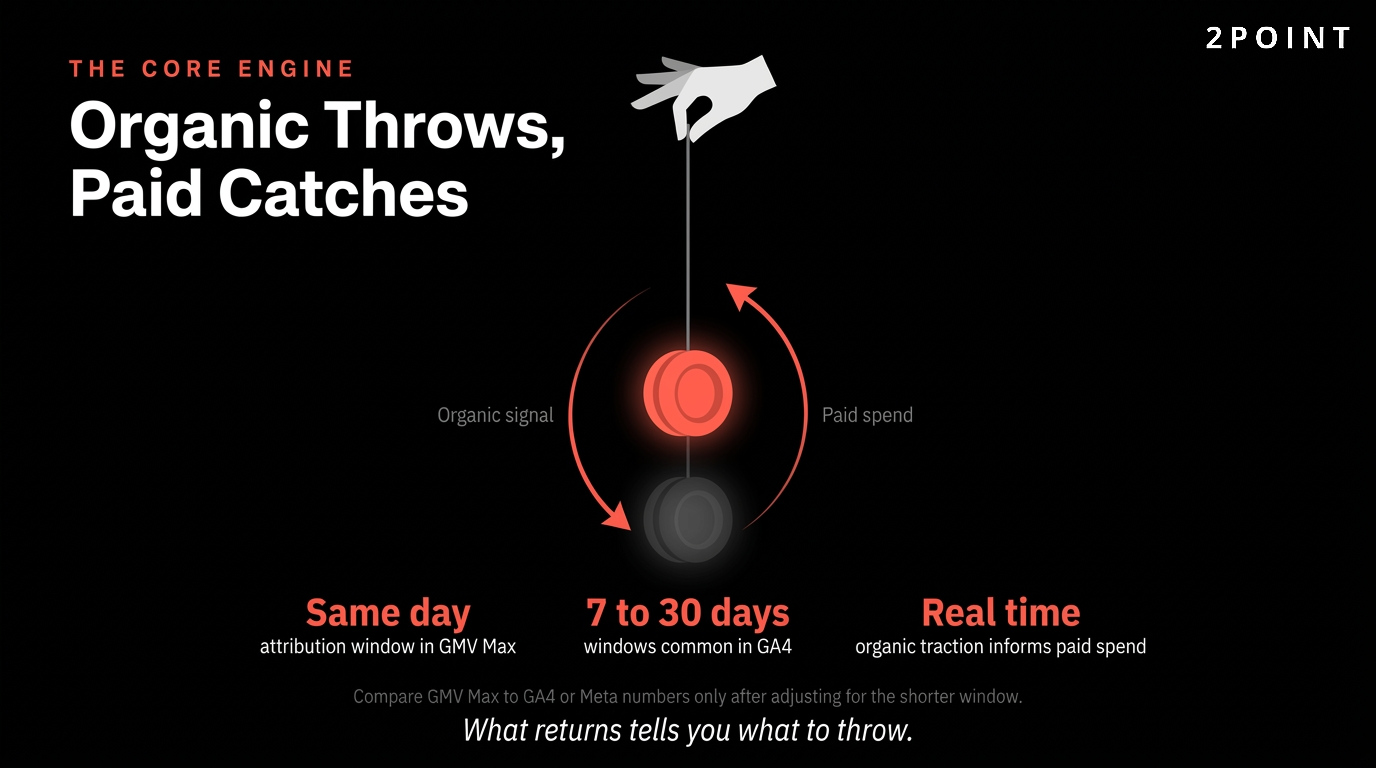
The engine automatically selects products to feature, creative assets to serve, and placement options across TikTok’s inventory. It draws on signals from both organic and paid traffic to inform those decisions in real time. If a product is gaining organic traction in the For You feed, GMV Max will often amplify paid spend on that same product because the organic signal confirms demand. This feedback loop between organic and paid performance is one of the system’s most powerful and least discussed features.
One critical technical point for anyone comparing GMV Max data to other platforms: GMV Max uses a same-day attribution model, which is a dramatically shorter window than the 7-to-30-day attribution windows common in Google Analytics 4. This means revenue attributed in GMV Max reporting often reflects purchases that happened the same day as the ad impression, creating a very tight and responsive optimization loop. It also means direct comparisons to GA4 or Meta attribution numbers require careful adjustment.
Creative Asset Automation
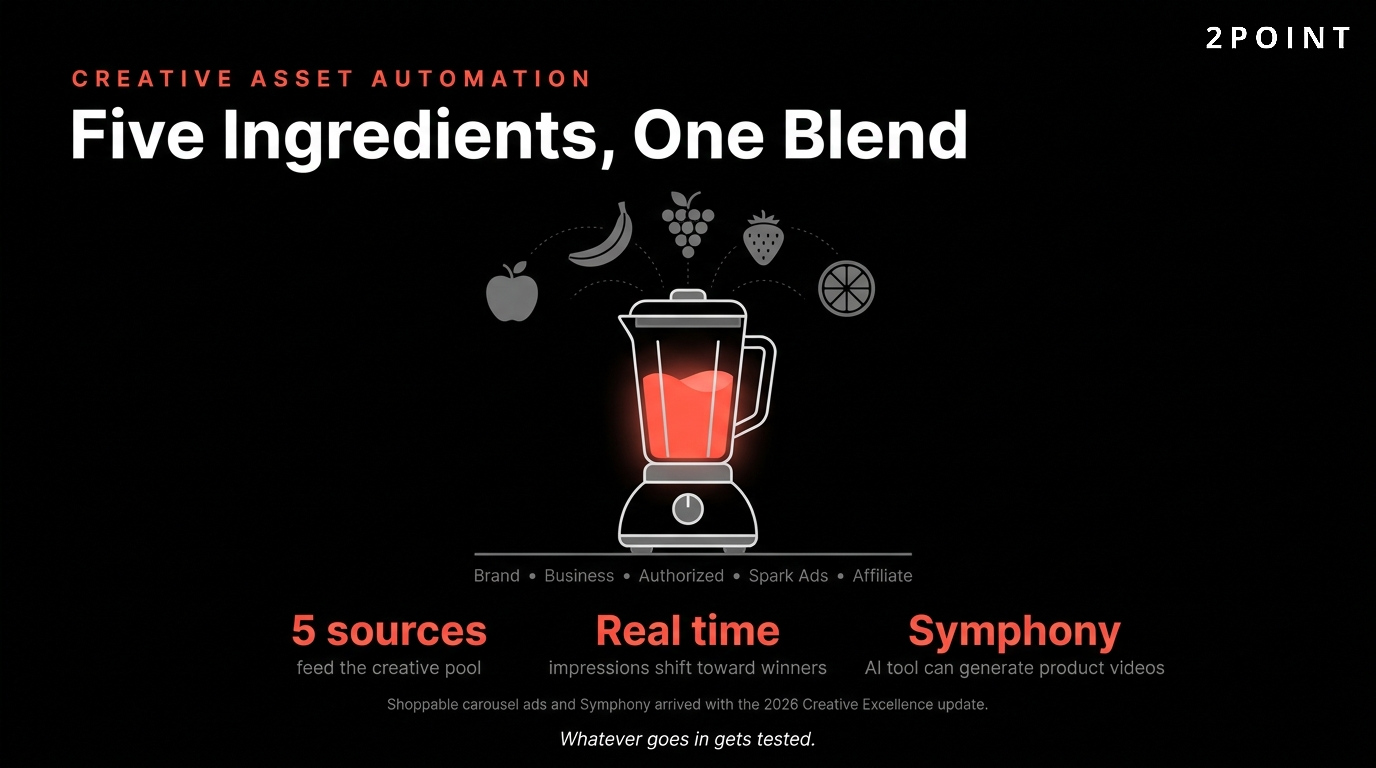
The creative layer of GMV Max is one of its most sophisticated components. The system automatically pulls from every available video source connected to the campaign: official brand accounts, business accounts, authorized TikTok accounts, Spark Ads posts, and affiliate creator content. This means a brand with an active affiliate program is feeding the algorithm a constantly refreshing library of creative material without lifting a finger.
Once the asset pool is populated, GMV Max tests hooks, formats, and calls to action across audience segments simultaneously. Rather than a traditional A/B test where you wait for statistical significance before declaring a winner, the system continuously reallocates impressions toward better-performing assets in real time. Underperforming creatives are automatically deprioritized without any manual intervention required. For teams that previously spent hours rotating ad sets and pausing weak performers, this automation alone represents a significant reduction in management overhead.
The 2026 Creative Excellence update added two meaningful capabilities to this layer. First, shoppable carousel ads are now available within the GMV Max format, allowing multi-product display within a single ad unit. Second, TikTok Symphony, the platform’s AI video generation tool, can now auto-generate product videos for use within GMV Max campaigns. This matters for brands that struggle to produce enough raw creative content. Accounts with 50 or more active creatives see three to four times better ROAS than accounts running fewer than 20, so any tool that expands the creative library has a direct measurable impact on campaign performance.
Budget and ROI Target Settings
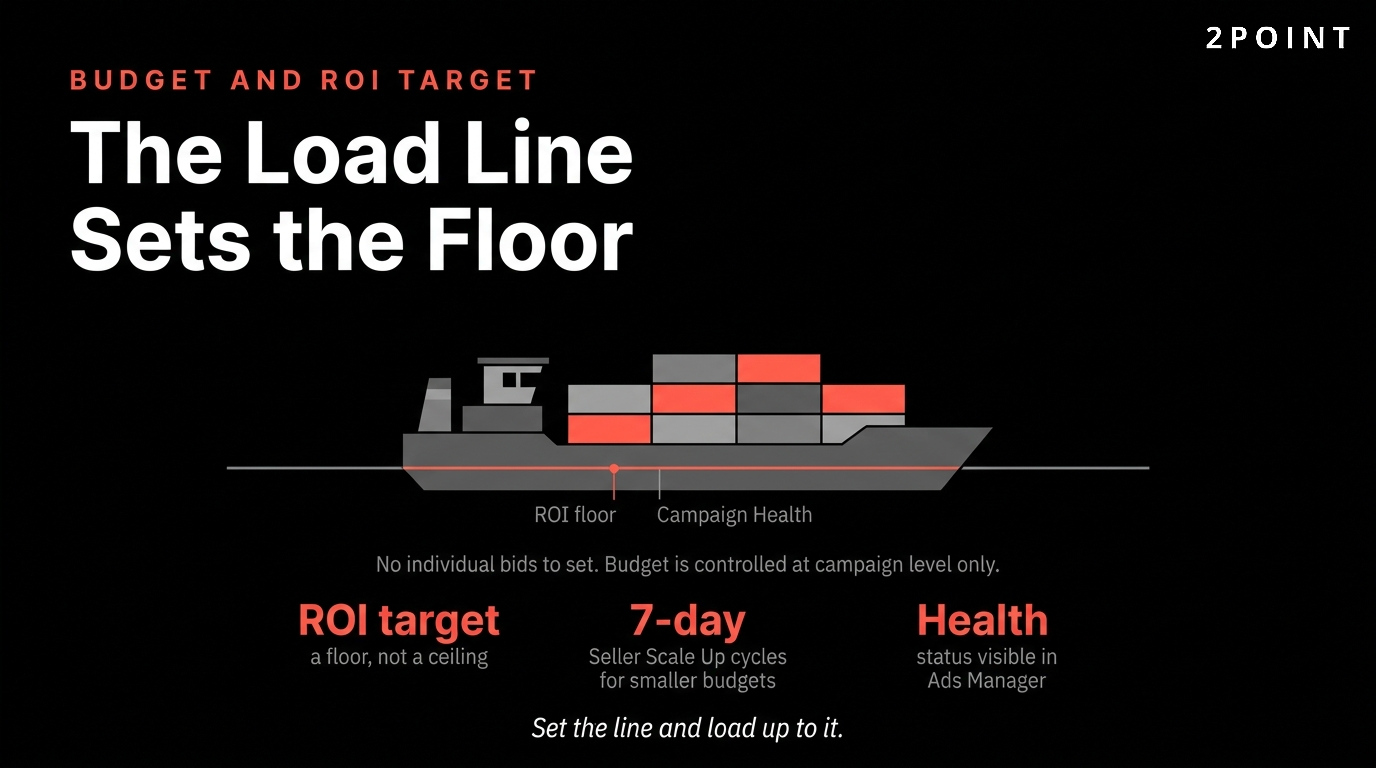
The budget management approach in GMV Max operates differently from manual campaign structures. Merchants set an ROI target, which functions as a performance floor, and GMV Max automatically spends within that range to maximize total GMV output. The system allocates budget toward whichever products, placements, and audience segments it predicts will generate the highest GMV at or above the target ROI. Advertisers do not set individual bids for placements or audiences because those decisions are fully delegated to the algorithm.
A significant 2026 addition is the Seller Scale Up feature, which introduces seven-day optimization cycles designed specifically for smaller budgets. Previously, GMV Max required relatively substantial daily spend to generate enough conversion data for the algorithm to optimize effectively. The seven-day cycle gives the system more time to accumulate that signal, making the tool more accessible to brands that cannot immediately commit to high daily budgets. Campaign Health Status is now also visible directly in TikTok Ads Manager, giving advertisers a dashboard view of whether their campaigns are in a healthy optimization state without needing to interpret raw performance numbers manually.
Budget optimization happens continuously without requiring daily management. The system can shift spend from a low-performing product to a trending one within hours, responding to real-time demand signals that no manual manager could monitor at the same frequency.
The Attribution Model Explained
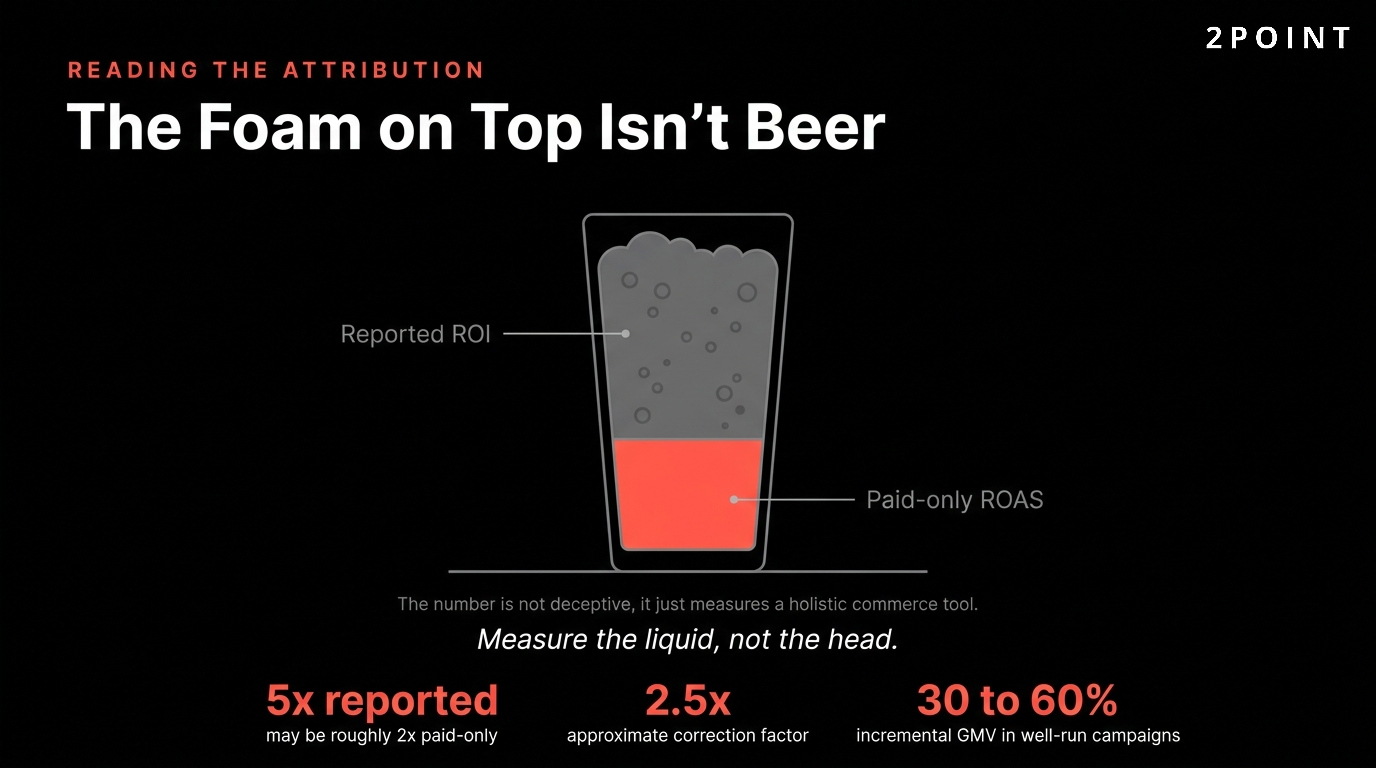
The attribution model underpinning GMV Max is both its greatest strength and its most common source of confusion. GMV Max counts all orders from promoted products, including orders driven by organic content views and affiliate-driven sales, toward campaign metrics. This blended attribution approach means the reported ROI inside GMV Max almost always looks higher than the true incremental return generated by paid spend specifically.
To understand why this matters, consider a brand where affiliates are already driving strong organic sales. When GMV Max runs, it counts affiliate sales that would have happened anyway as campaign conversions. The resulting ROI figure includes revenue that the paid campaign did not actually cause. Expert analysis suggests applying approximately a 2.5x correction factor to GMV Max’s reported ROI to estimate true incremental ROAS. A campaign reporting 5x ROI under GMV Max attribution may reflect an actual paid-only ROAS closer to 2x.
This is not a flaw designed to deceive advertisers. It reflects TikTok’s view that GMV Max is a holistic commerce tool, not a pure paid advertising product. Well-run campaigns show 30 to 60% incremental GMV versus the organic baseline, meaning the paid component does add meaningful lift above what organic alone would generate. The key is understanding what the reported number represents so you can make sound budget decisions.
GMV Max Pro: The 2026 Evolution Beyond Ad Spend
Standard GMV Max changed how TikTok Shop brands think about advertising automation. GMV Max Pro changes how they think about profitability. The two tools address different layers of the same problem, and understanding the distinction between them is essential before deciding which one fits your operation.
What Makes GMV Max Pro Different
Announced on October 30, 2026, GMV Max Pro represents the next evolution of TikTok’s commerce advertising system. The core innovation is that it expands the optimization boundary beyond ad spend to include coupons, affiliate costs, and platform commissions. Standard GMV Max knows how much you are spending on ads and optimizes delivery accordingly. It does not know how much you are paying your affiliate creators, what discount you offered buyers via coupon, or what cut TikTok takes from each transaction. GMV Max Pro brings all of those variable costs into the optimization equation.
This distinction matters enormously for brands with complex cost structures. A brand running a 20% coupon alongside a 13% affiliate commission alongside ad spend is operating in a very different margin environment than a brand selling at full price with no affiliate program. Standard GMV Max treats both situations identically because it only sees the ad spend side. GMV Max Pro sees enough of the full cost picture to optimize toward something closer to actual business profitability rather than top-line GMV. The ROI calculations now incorporate creator commissions from the affiliate program, coupon discount costs, and applicable platform fees alongside the ad budget, giving the algorithm a more complete signal to work with.
How GMV Max Pro Handles True Costs
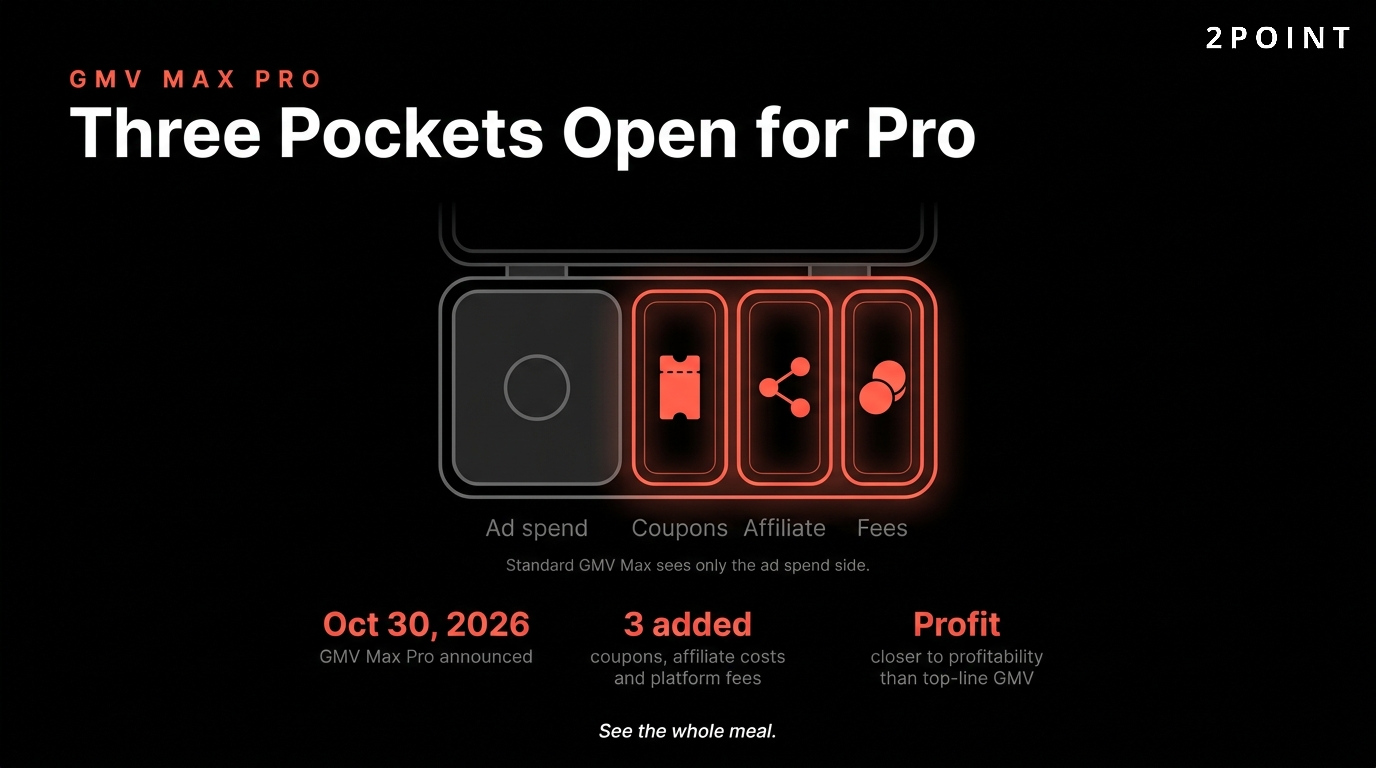
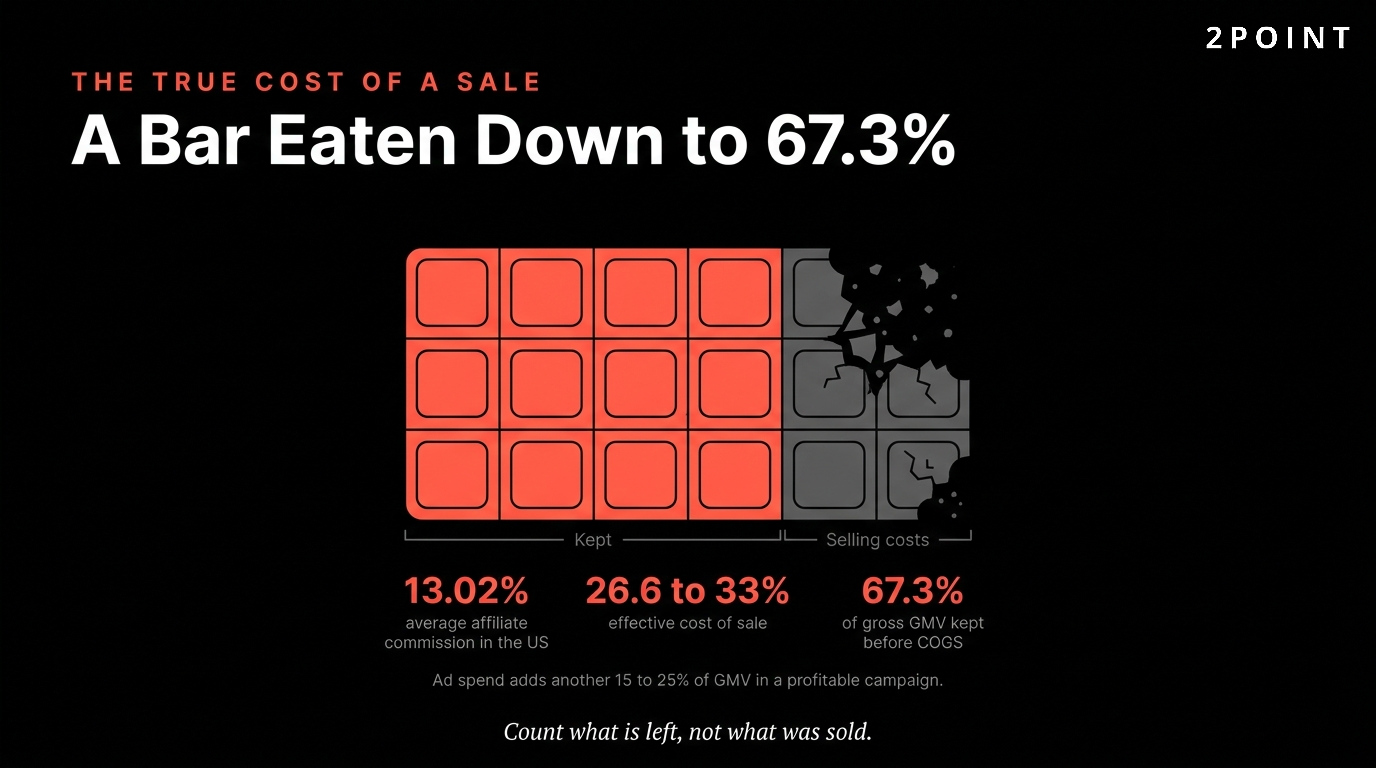
The practical problem GMV Max Pro solves is one that experienced TikTok Shop sellers know well. Standard GMV Max could push aggressively toward sales that looked profitable before deductions but turned negative after affiliate payouts were applied and coupon discounts were subtracted. The system was optimizing for a revenue number that did not reflect actual margin. The standard US TikTok Shop affiliate commission averages 13.02%, which results in an Effective Cost of Sale ranging from 26.6% to 33% when combined with platform fees and payment processing. At that level of variable cost, optimizing only on ad spend leaves a significant margin gap unaddressed.
GMV Max Pro closes that gap by incorporating coupon costs, affiliate program costs, and platform commissions into the optimization target alongside ad budget. The system can now favor sales scenarios where the total cost structure supports profitability, not just scenarios where ad spend efficiency looks strong. It is worth noting one important limitation that remains: GMV Max Pro still does not see cost of goods sold. The system cannot access a seller’s product cost data, so true net margin optimization still requires the seller to reconcile COGS internally. GMV Max Pro gets you much closer to profitable optimization, but the final margin calculation remains a manual step. This tool is particularly valuable for brands running high-discount strategies or working with high-commission creators, where variable cost management is the difference between a profitable channel and an expensive one.
Availability and Eligibility for GMV Max Pro
As of late 2026, GMV Max Pro is in a limited rollout phase. It is available only to some advertisers in supported markets and scenarios, which means eligibility is not universal even in markets where TikTok Shop operates fully. Access varies by ad account history, campaign setup, and product category. TikTok has not published a specific eligibility checklist, which means the best path to access is confirming with your TikTok Shop representative or checking within TikTok Ads Manager for the option to appear in your account.
TikTok is gradually expanding access based on account performance signals and market readiness. Early access appears to favor accounts with established GMV Max track records and consistent campaign health scores. If GMV Max Pro is not yet available in your account, running clean, well-optimized standard GMV Max campaigns is the best way to position yourself for early access as the rollout expands.
When to Upgrade to GMV Max Pro
Not every TikTok Shop brand needs GMV Max Pro immediately. Standard GMV Max is sufficient for brands with simple, consistent pricing structures and low affiliate commission rates. The upgrade becomes most compelling in specific situations. If your discount strategies vary significantly by product, with some items running deep promotions and others at full price, Pro’s ability to account for coupon costs makes the optimization meaningfully more accurate. If you are running an affiliate program where commissions vary by creator tier or product category, standard GMV Max cannot see those differences while Pro can factor them in.
The clearest signal that GMV Max Pro is worth pursuing is a persistent gap between reported ROI and actual profitability. If your GMV Max dashboard consistently shows strong ROI but your accounting tells a different story after affiliate payouts and coupon costs, Pro is designed to close exactly that gap. Brands running 20% or deeper discount strategies are particularly well-positioned to benefit because the coupon cost variable has an outsized impact on true margin at that discount level.
Product GMV Max vs. LIVE GMV Max: Choosing Your Campaign Type
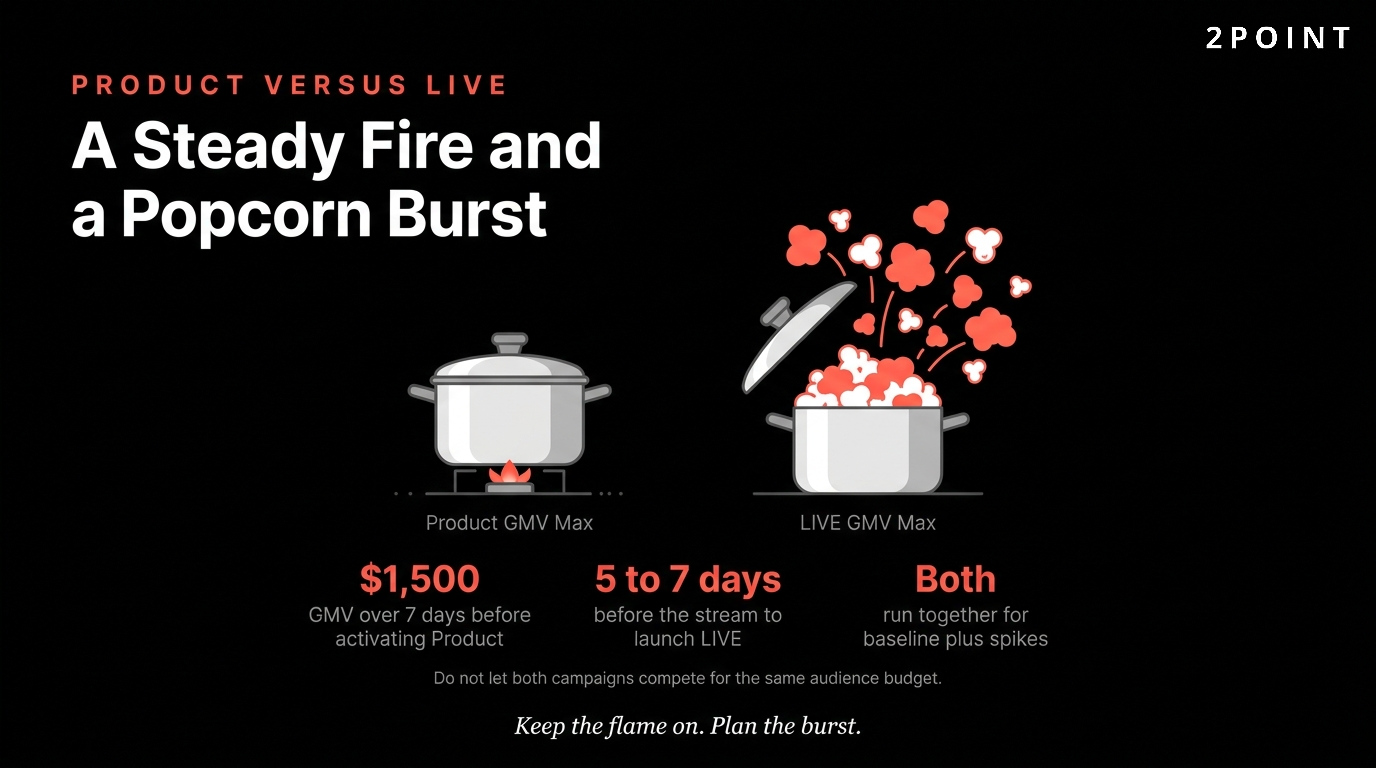
TikTok Shop’s GMV Max ecosystem contains two distinct campaign types, each designed for a different commerce scenario. Choosing correctly between them, or combining them strategically, determines how effectively the automation works for your specific business model.
Product GMV Max: Catalog-Level Automation
Product GMV Max is designed for continuous catalog promotion. It runs persistently rather than around specific events, automatically choosing which products to feature, which creative assets to deploy, and which placement options to use across TikTok’s ad inventory. The system manages all of these decisions based on what it predicts will generate the most GMV for the account as a whole, not for any single product in isolation.
TikTok’s setup guidelines recommend a minimum threshold of $1,500 in GMV over the past seven days before activating Product GMV Max for a given product. This threshold exists because the algorithm needs conversion data to optimize effectively. Products with zero or near-zero sales history give the system very little to work with, which produces slower and less reliable optimization in the early stages. That said, technically any product can be promoted regardless of initial GMV scale. The practical advice is to give the system products with some demonstrated demand so it has real signal to amplify.
Product GMV Max is the right choice for brands with established product-market fit on TikTok Shop, existing organic or affiliate sales momentum, and a catalog broad enough that manual selection of promoted products would be time-consuming. It is essentially a persistent revenue engine that runs in the background while your team focuses on product development and content creation.
LIVE GMV Max: Livestream Event Promotion
LIVE GMV Max optimizes livestream traffic specifically to maximize gross revenue during live shopping events. Rather than running continuously like Product GMV Max, it is structured around discrete broadcast events and is typically launched five to seven days before the scheduled livestream. This pre-launch window allows the system to build audience awareness and warm potential viewers before the event goes live, increasing the likelihood of real-time purchase activity during the broadcast itself.
The optimization focus of LIVE GMV Max is different from its Product counterpart. While Product GMV Max is evaluating which products and creatives convert best over time, LIVE GMV Max is building toward a moment, optimizing for traffic and viewer engagement in the days leading up to the event and then for purchases during the live window. This event-oriented structure makes it particularly well-suited for product launches, flash sales, and seasonal shopping moments where a concentrated burst of revenue matters more than steady-state catalog performance.
Strategic Use Cases for Each Campaign Type
Many successful TikTok Shop brands run both campaign types simultaneously rather than choosing one exclusively. The strategic logic is straightforward: Product GMV Max handles the baseline revenue that keeps the business operating day to day, while LIVE GMV Max drives the event-based spikes that generate outsized GMV in short windows. These campaigns are complementary rather than competitive when managed correctly.
The key coordination principle is timing. LIVE GMV Max campaigns should be scheduled so their pre-launch build-up period does not compete for the same audience budget as Product GMV Max campaigns serving the same products. Some brands establish a cadence where Product GMV Max runs continuously at a moderate budget, with LIVE GMV Max layered on top in the week before a scheduled livestream. Post-event, the LIVE campaign ends and Product GMV Max resumes full budget responsibility. This rhythm creates consistent revenue with periodic spikes rather than relying entirely on live events or entirely on catalog automation.
Account and Product Restrictions to Know Before Starting
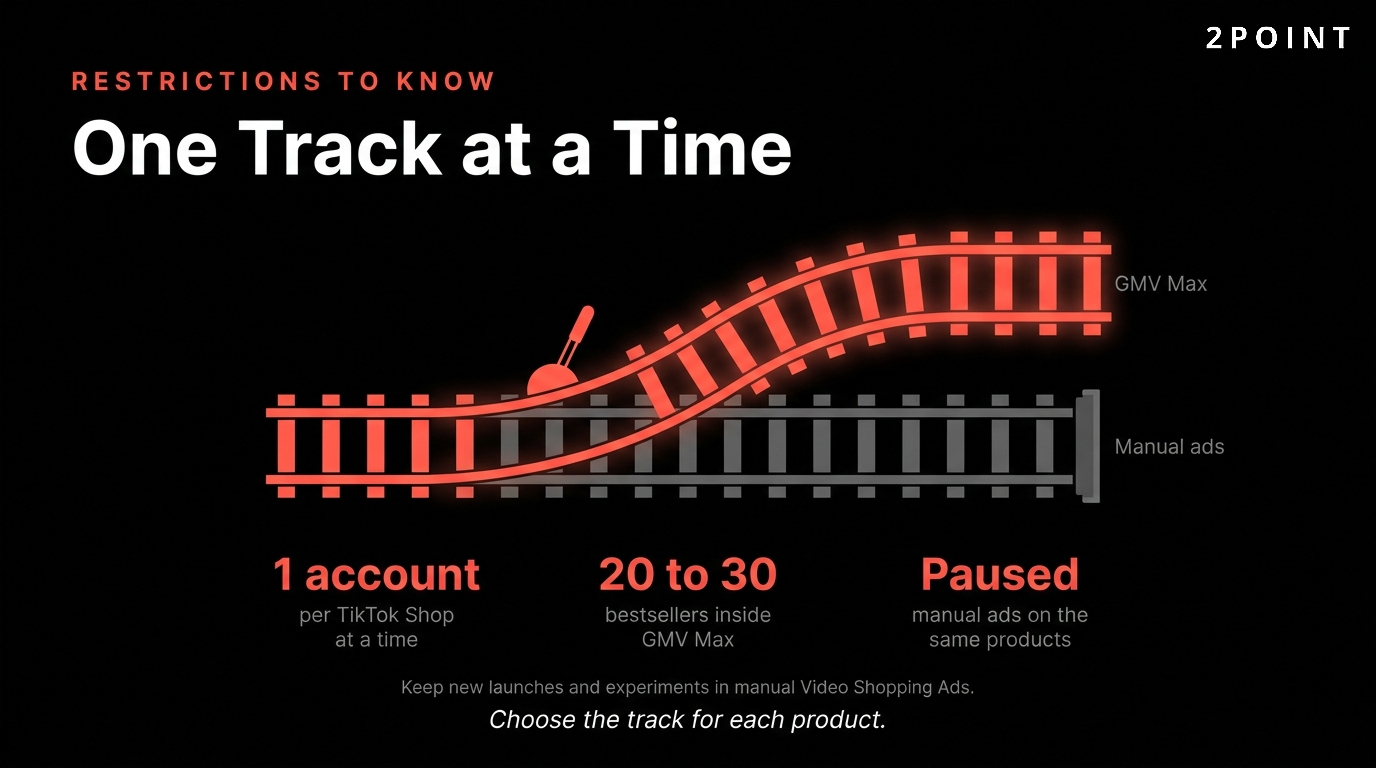
Several important restrictions govern how GMV Max campaigns can be structured, and misunderstanding them is a common source of unexpected campaign behavior. First, GMV Max access is limited to one ad account per TikTok Shop at a time. If a second ad account becomes the primary linked account, the previous account’s GMV Max campaigns will pause automatically. For brands managing multiple ad accounts, this is a critical operational consideration.
Second, and more consequential for many brands, creating a GMV Max campaign for specific products automatically pauses any Video Shopping Ads or Product Shopping Ads featuring those same products across all ad accounts connected to the shop. This is not a soft conflict, it is a hard system rule. You cannot run manual product ads and GMV Max for the same products simultaneously. A widely used workaround is to place the top 20 to 30 bestsellers inside GMV Max for automated optimization while managing new product launches or experimental SKUs manually in Video Shopping Ads. This way, proven performers benefit from automation while emerging products receive the hands-on attention that early-stage optimization often requires.
Real Performance Data: What GMV Max Actually Delivers
Performance claims for any advertising tool should be evaluated carefully, particularly when the platform itself is producing the benchmark data. The following section presents both official TikTok data and third-party analysis so you can triangulate realistic expectations rather than relying on any single source.
Official TikTok Benchmark Data
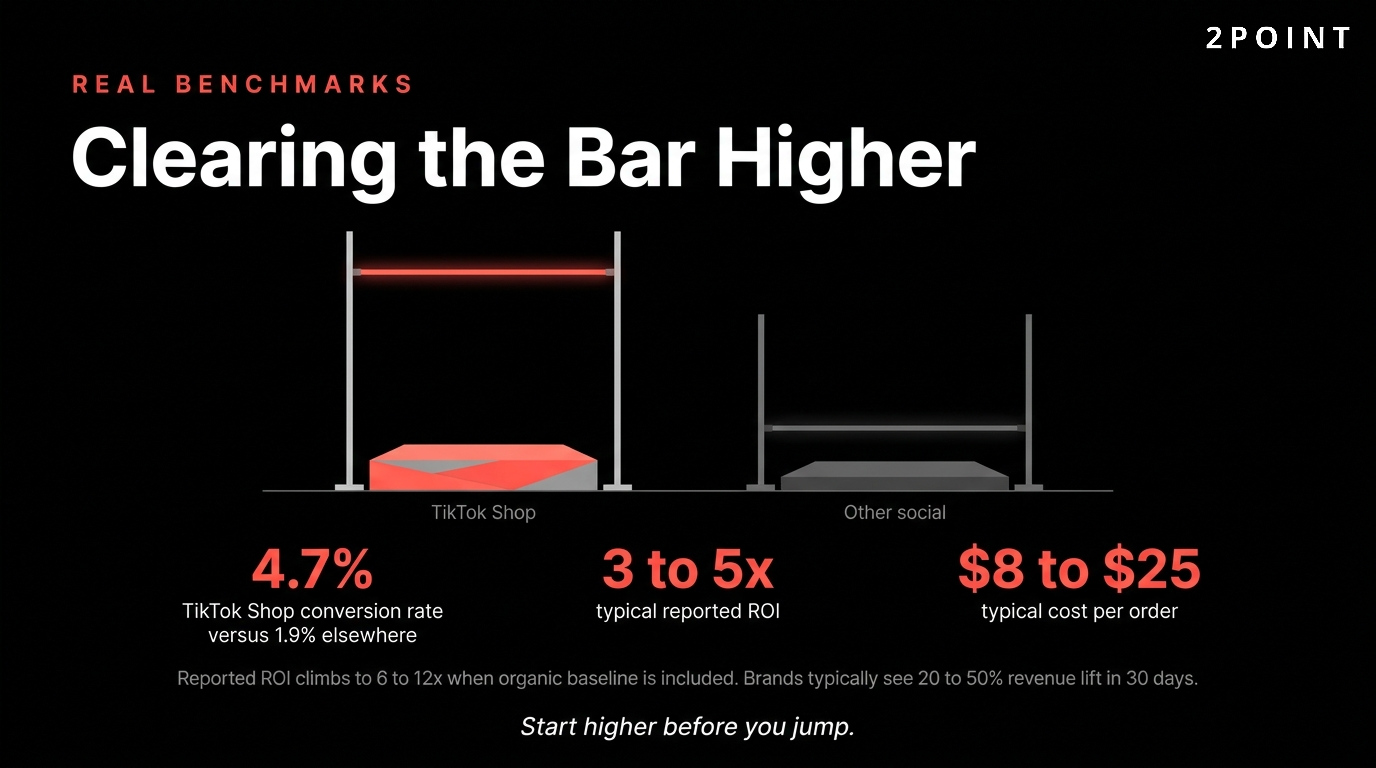
TikTok’s internal data shows advertisers using GMV Max report an average 20% uplift in GMV, with brands specifically leveraging creative automation averaging 30% uplift. These figures come from TikTok’s own measurement, which uses the blended attribution model discussed earlier, so they represent total GMV lift including organic and affiliate components rather than purely paid-driven incremental revenue. That context is important for interpreting the numbers accurately.
One platform comparison figure that holds up well under independent scrutiny is TikTok Shop’s conversion rate. TikTok Shop converts at an average 4.7%, compared to approximately 1.9% for other social commerce platforms. This gap reflects the native shopping experience TikTok has built, where product discovery, content consumption, and purchase completion all happen without leaving the app. GMV Max benefits from this elevated baseline conversion rate because it is operating within an already high-converting environment.
Performance varies significantly based on two primary factors: creative volume and account maturity. Brands entering GMV Max with thin creative libraries and new TikTok Shop accounts will see slower and less impressive results than brands with established organic presence, diverse creative assets, and existing affiliate networks. Results compound when GMV Max is layered on top of a strong organic content strategy rather than used as a standalone substitute for it.
ROI and ROAS Benchmarks for GMV Max Campaigns
Setting realistic ROI expectations requires distinguishing between what GMV Max reports and what paid spend actually generates. In real-world scenarios, GMV Max typically delivers a reported ROI of three to five times, with cost per order ranging from $8 to $25 depending on product category. Reported ROI climbs significantly higher, often reaching six to twelve times, when high organic and affiliate baseline GMV is included in the blended attribution figure.
The practical implication is that headline ROI figures in case studies and testimonials almost always reflect blended attribution. A brand reporting 10x ROI from GMV Max almost certainly has a high organic baseline that is being counted toward campaign performance. This does not mean the tool is not delivering value, it means the value needs to be measured in total revenue lift over the organic baseline rather than as a pure paid advertising efficiency metric. Brands typically see 20 to 50% revenue lift within the first 30 days of GMV Max activation, which is a more grounded way to frame the tool’s impact. When evaluating whether GMV Max makes financial sense for your brand, tracking your pre-GMV Max revenue baseline and measuring the percentage lift after activation gives you a more reliable picture than comparing reported ROAS to other channel benchmarks.
Creative Volume and Its Direct Impact on GMV Max Performance
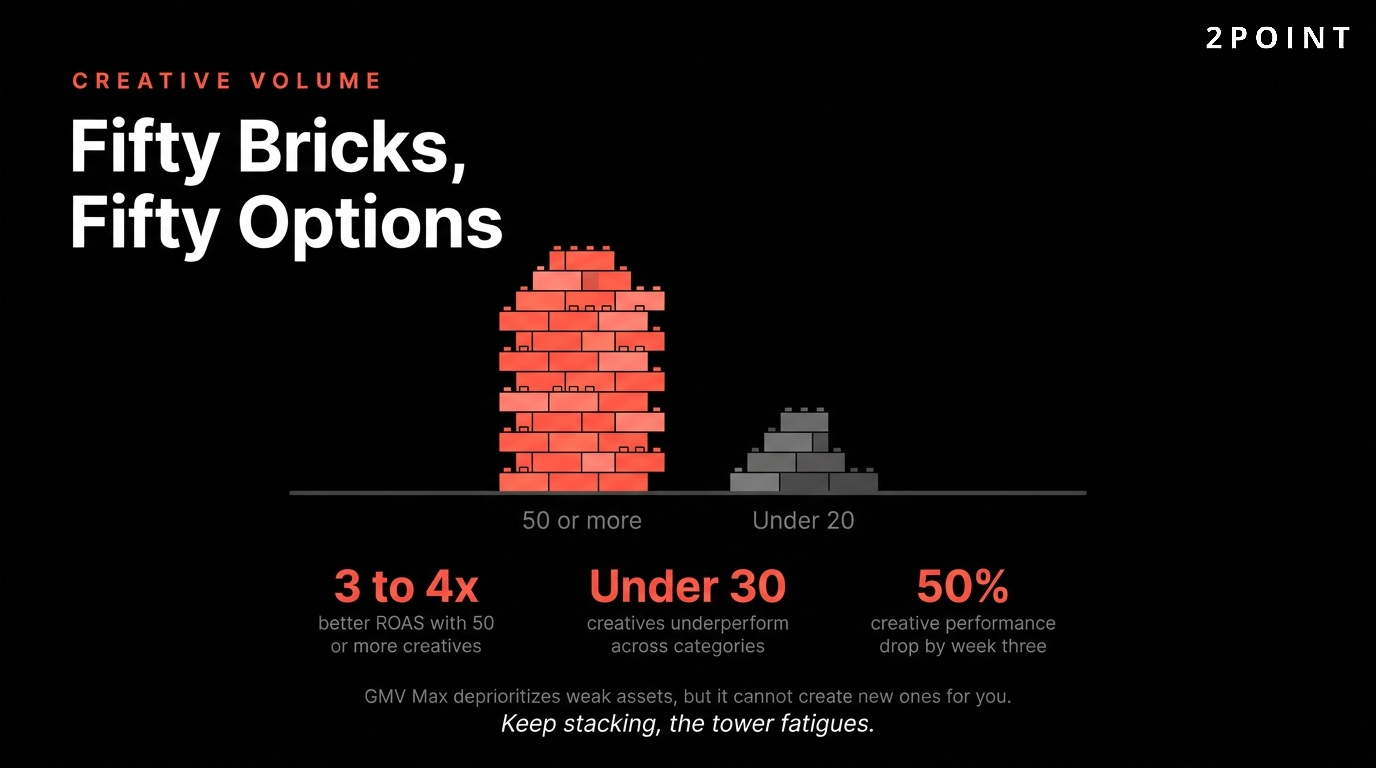
The relationship between creative volume and GMV Max performance is one of the most actionable insights available for brands preparing to launch. Accounts with 50 or more active creatives see three to four times better ROAS than accounts running fewer than 20, and brands running fewer than 30 active creatives consistently underperform across categories. This is not a marginal difference. It is the difference between a campaign that breaks even and one that scales profitably.
The mechanism behind this relationship is straightforward. GMV Max can only optimize what you give it. With 15 creatives in the pool, the algorithm has limited variation to test across audience segments, formats, and placements. Some of those 15 creatives will be clearly stronger than others, but the system still has to show something to users, and weaker assets will inevitably receive some impressions. With 50 or more creatives, the algorithm has genuine variety to work with. It can find the right hook for a fitness-oriented viewer, the right format for a price-sensitive shopper, and the right call to action for a first-time buyer, all using different assets from your library.
Creative performance typically drops 50% or more by week three due to audience fatigue, even in well-performing campaigns. GMV Max handles this decay by automatically deprioritizing weak performers, but it cannot create new content to replace them. This means brands need a systematic creative refresh cadence running in parallel with their GMV Max campaigns. Teams that treat creative production as a one-time setup task consistently underperform teams that treat it as an ongoing operational function.
Time to Results and Scaling Trajectory
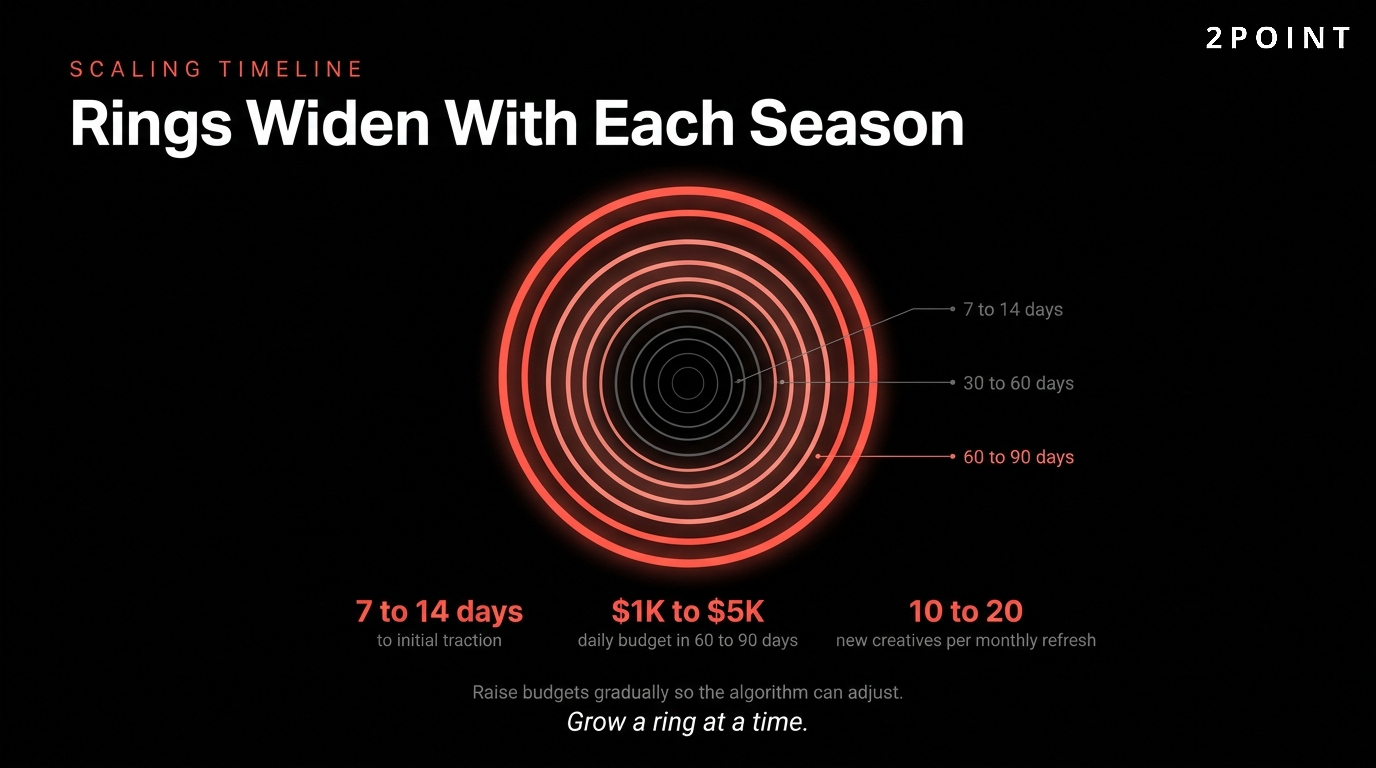
Most brands see initial traction from GMV Max within the first seven to fourteen days, though the quality and scale of that early traction depends heavily on the account’s starting conditions. Brands entering with warm audiences, existing affiliate partnerships, and diverse creative libraries see meaningful results faster than brands starting from scratch. The thirty-to-sixty-day window represents a more typical horizon for reaching optimized performance that reflects the algorithm’s mature understanding of your products and audience.
Timing relative to your brand’s existing momentum matters enormously. GMV Max campaigns launched during periods of organic viral activity can generate dramatically accelerated results because the algorithm has strong real-time signals to amplify. The same campaign launched during a quiet organic period will optimize more slowly. This suggests that the best time to activate GMV Max is not simply when you have enough budget, but when you have enough organic and affiliate momentum for the algorithm to work with. Scaling from $1,000 per day to $5,000 per day typically takes sixty to ninety days with consistent creative refresh and gradual budget increases that give the algorithm time to adjust without disrupting its optimization learning.
GMV Max Case Studies: Success Stories Across Industries
Real-world results provide the most useful calibration for performance expectations. The following case studies span different categories, budget levels, and strategic approaches, offering a range of reference points for brands evaluating GMV Max.
+1 Supplements: Performance Supplement Brand Results
The supplement brand +1 Supplements used GMV Max to drive measurable improvements across every core performance metric. The campaign achieved a 3.5x ROI, a 100% increase in product orders compared to other advertising platforms, and a cost per acquisition 50% lower than alternative channels. These results are particularly notable in the supplement category, which is highly competitive and subject to strict creative content guidelines that limit certain claims and imagery.
The +1 case demonstrates that GMV Max’s creative automation can navigate category-specific constraints effectively. Rather than requiring manual management of compliant creative variants, the system identified which content formats resonated most with health-conscious buyers and allocated spend accordingly. The 50% lower CPA compared to other channels is the figure most useful for benchmarking, as it reflects pure paid efficiency rather than blended GMV attribution. For brands in regulated categories that struggle with creative compliance at scale, the case suggests GMV Max’s automation can actually simplify that challenge by handling creative selection from a compliant pool rather than requiring constant manual oversight.
Portland Leather Goods: From Zero to One Million Dollars in 20 Days
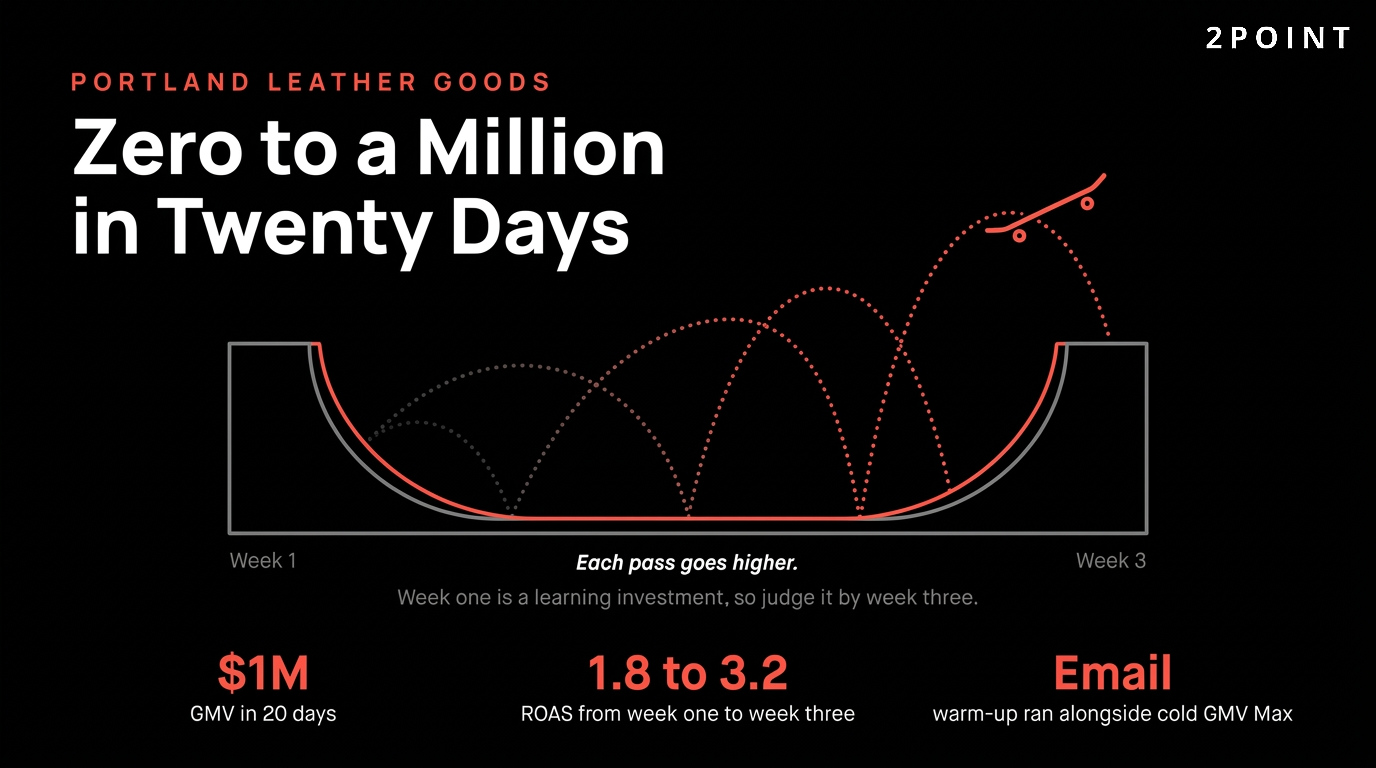
Perhaps the most cited GMV Max scaling story is Portland Leather Goods, which went from zero to $1 million in GMV within 20 days using aggressive cold audience GMV Max campaigns coordinated with an email list warm-up strategy. The campaign began with cold audience ROAS at 1.8:1, which is below the break-even point for many brands but was treated as an acceptable investment in audience building. By week three, that ROAS had climbed to 3.2:1 as the algorithm refined its targeting and the warmed email audience began converting at higher rates.
Several strategic decisions made this result possible beyond simply activating GMV Max. The brand entered the campaign with a substantial email list that could be used to create warm custom audiences. GMV Max ran against cold audiences while email sequences ran simultaneously to known buyers, creating a pincer movement that maximized reach without depending entirely on the algorithm to find buyers from scratch. The ROAS progression from 1.8:1 to 3.2:1 across three weeks illustrates a pattern common to well-structured GMV Max launches: the first week is a learning investment, the second week shows measurable improvement, and the third week reflects the algorithm approaching mature optimization. Brands that judge GMV Max performance by week-one numbers often make premature decisions based on incomplete data.
Topicals: Measuring the Cross-Channel Halo Effect
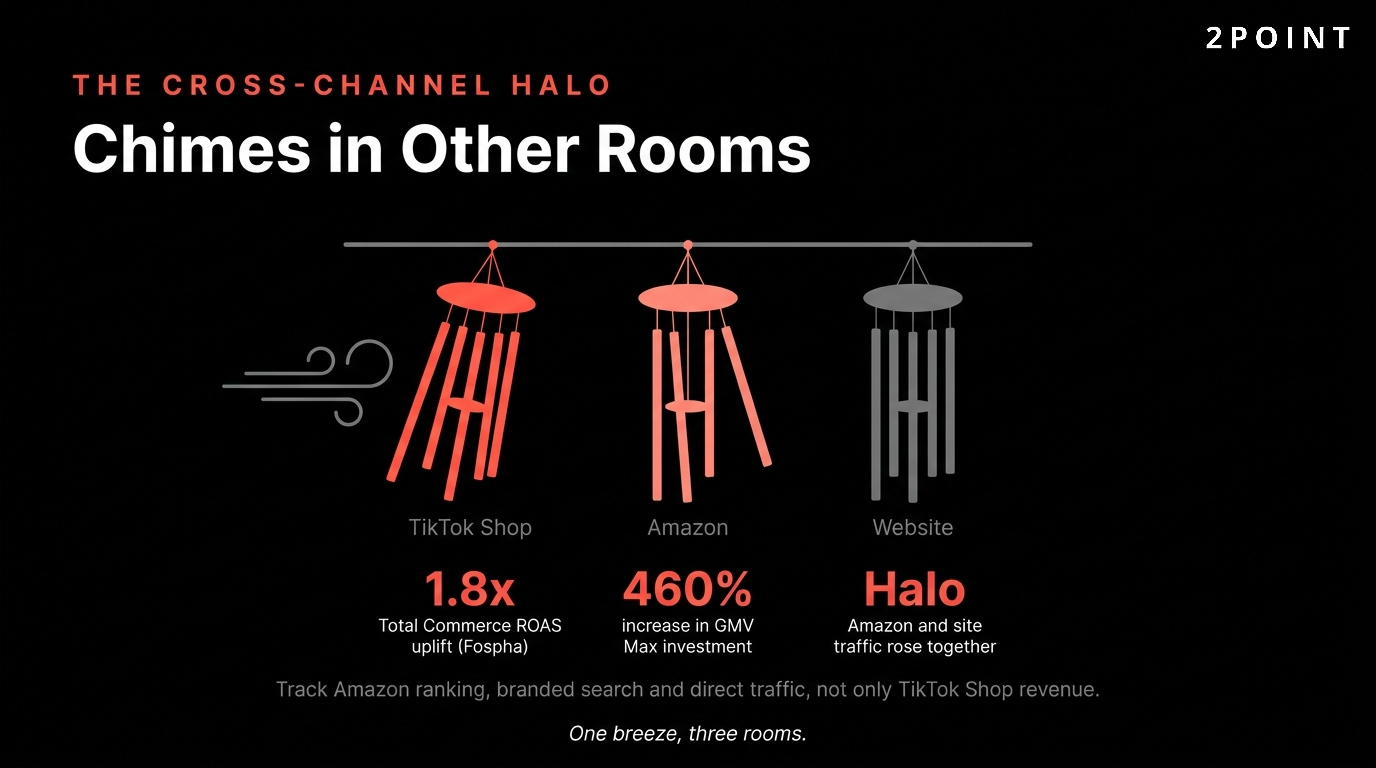
The Topicals case study offers one of the most compelling arguments for GMV Max that extends beyond TikTok Shop revenue figures alone. Using Fospha’s measurement methodology, Topicals documented a 1.8x Total Commerce ROAS uplift attributable to GMV Max activity, alongside a 460% increase in GMV Max investment as the tool became their primary TikTok strategy driver. More significantly, the brand observed correlated increases in Amazon sales and direct-to-consumer website traffic during periods of elevated GMV Max activity.
This cross-channel halo effect is increasingly documented across TikTok Shop advertisers and reflects the awareness-to-purchase journey that TikTok’s platform enables at scale. When GMV Max drives significant impressions and engagement within TikTok, some portion of exposed users do not purchase immediately on TikTok Shop. Instead, they search for the brand on Amazon, visit the brand’s website, or search Google. Those conversions show up in other channels’ attribution but were initiated by TikTok exposure. The Topicals case demonstrates why measuring GMV Max in isolation, using only TikTok Shop revenue, systematically undervalues the tool’s total business impact. Brands evaluating GMV Max ROI should also monitor Amazon ranking changes, branded search volume, and direct website traffic as leading indicators of this broader effect. This kind of measurement approach is central to achieving maximizing ROI from your digital advertising investment.
Multi-Category Performance Benchmarks
Looking across multiple GMV Max case studies, a consistent pattern of performance emerges across different verticals and budget levels. The table below summarizes key data points from documented campaigns.
| Brand / Category | Daily Budget | Campaign Duration | Total GMV | Reported ROI |
|---|---|---|---|---|
| Streetwear Brand | $800/day | 90 days | $216,000 | 4.5x |
| +1 Supplements | Not disclosed | Not disclosed | Not disclosed | 3.5x |
| Portland Leather Goods | High (undisclosed) | 20 days | $1,000,000 | 1.8x to 3.2x |
| Hey Dude | High (undisclosed) | Month 1 | $4-5M | Not disclosed |
| Turnaround Case | Not disclosed | Not disclosed | ~$125,000 | 12% to target (5x growth) |
The key takeaway from these benchmarks is that GMV Max delivers consistent GMV growth across categories and budget levels, with ROI typically ranging from 3.5x to 4.5x under standard blended attribution when creative assets and account maturity are sufficient.
The True Economics of GMV Max: Understanding Real Profitability
Revenue figures from GMV Max campaigns tell only part of the economic story. The full picture requires understanding the cost structure layered beneath gross merchandise value and knowing how to adjust reported metrics to reflect actual business profitability.
The Complete Cost Structure Breakdown
TikTok Shop economics involve multiple variable cost layers that stack on top of each other and compound in ways that can surprise brands accustomed to simpler direct-to-consumer margins. The table below maps the full cost structure for a typical US TikTok Shop operation.
| Cost Component | Typical Rate | Notes |
|---|---|---|
| Affiliate Creator Commission | 13.02% average | Varies by creator tier and negotiation |
| TikTok Shop Platform Fee | 5-8% | Varies by category and market |
| Payment Processing | 1-3% | Standard payment gateway fees |
| Coupon and Discount Costs | Variable | Often 10-25% for active promotions |
| Effective Cost of Sale (ECS) | 26.6-33% | Combined pre-ad cost burden |
| GMV Max Ad Spend | 15-25% of GMV | Profitable campaign range |
| Net Revenue After All Costs | ~67.3% of gross GMV | Before COGS and fulfillment |
The key takeaway from this cost structure is that brands retain approximately 67.3% of gross GMV after all variable selling costs, before accounting for product cost and fulfillment, which means true profit margin requires healthy gross margins on the product itself to survive TikTok Shop’s layered cost environment.
This cost reality is why achieving maximum ROI on TikTok Shop requires treating ad spend as just one variable in a broader profitability equation. Brands that optimize ad spend in isolation while ignoring affiliate commission rates and coupon costs often find that strong GMV Max performance still produces thin or negative margins. The right approach is to set your GMV Max ROI target based on what the business can actually afford after all variable costs are accounted for, not simply based on what ROAS figure looks impressive in a report.
Interpreting Reported ROI vs. Actual Profitability
The gap between GMV Max’s reported ROI and actual profitability comes from two sources: blended attribution that includes organic revenue, and gross GMV figures that do not reflect net revenue after costs. Applying approximately a 2.5x correction factor to GMV Max’s reported ROI gives a more accurate estimate of true incremental ROAS from paid spend. This means a reported 5x ROI more likely represents a 2x paid ROAS when organic and affiliate attribution is stripped out.
Similarly, multiplying reported GMV by 0.67 gives an approximation of actual net revenue after affiliate commissions, platform fees, and payment processing. A campaign reporting $100,000 in GMV likely represents approximately $67,000 in net revenue before COGS and fulfillment costs. When reading case studies that report headline GMV figures without cost context, applying this adjustment gives you a much more grounded basis for comparison to your own economics. This level of analytical rigor is what separates brands that use GMV Max profitably from those that run impressive-looking campaigns that underperform at the margin level. Platforms and vendors naturally emphasize the most favorable metric, so building your own reconciliation model is essential for sustainable scaling.
What GMV Max Pro Still Cannot See
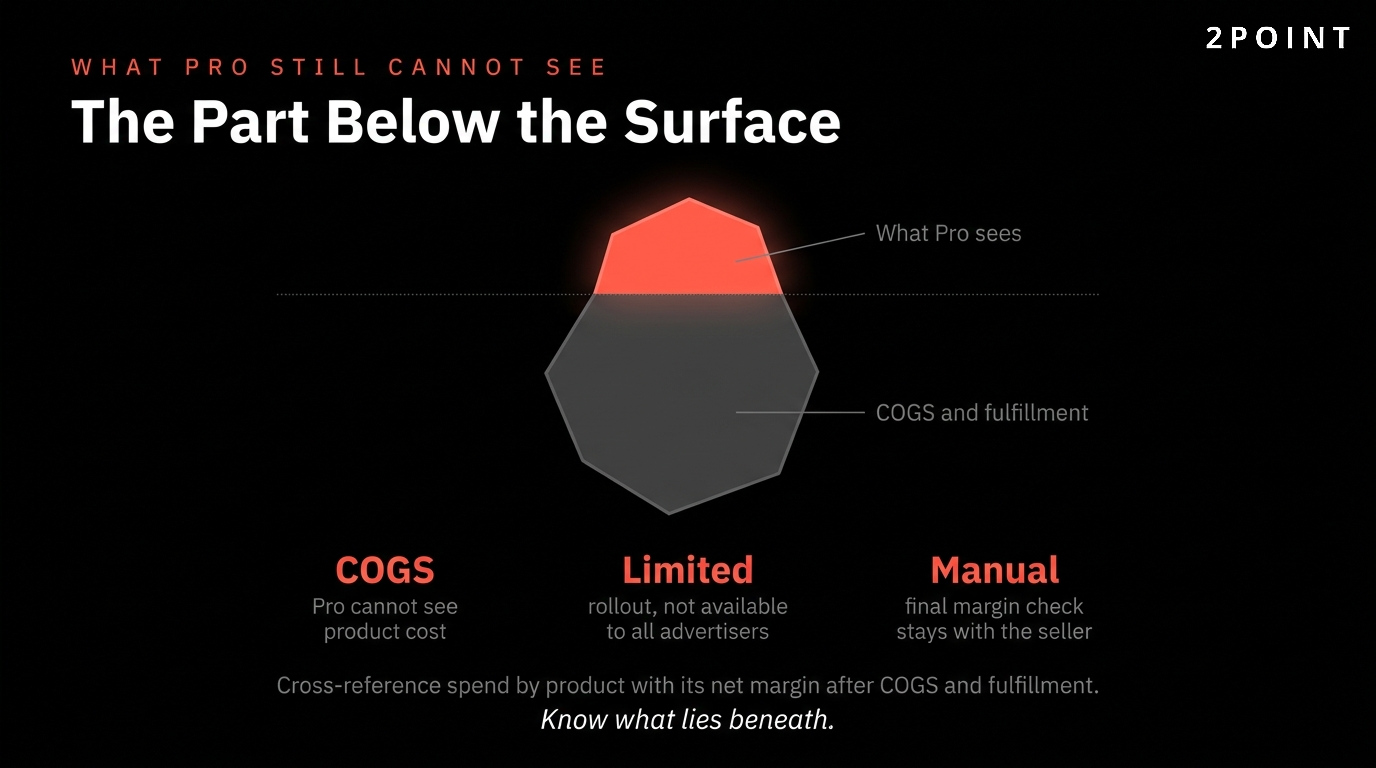
Even with GMV Max Pro’s expanded cost visibility, significant blind spots remain. The system cannot access your cost of goods sold, so it has no way to know whether the products it is prioritizing for promotion are your highest-margin SKUs or your lowest. It also does not see fulfillment costs, return rates by product, or customer lifetime value differences between segments. These factors can dramatically affect which products are actually worth promoting aggressively versus which should be deprioritized despite strong surface-level GMV performance.
The practical implication is that internal reconciliation remains essential even with GMV Max Pro. Sellers should regularly cross-reference GMV Max’s campaign prioritization against their own margin data to identify cases where the algorithm is spending heavily on low-margin products that look attractive from a revenue standpoint but dilute overall profitability. Building a simple dashboard that maps GMV Max spend by product to that product’s actual net margin after COGS and fulfillment costs will surface these misalignments quickly. GMV Max Pro narrows the gap between algorithmic optimization and true profitability, but closing it completely still requires the seller’s active involvement in interpreting results through a margin lens.
How to Set Up a GMV Max Campaign: A Step-by-Step Guide
Setting up GMV Max correctly from the beginning significantly affects early performance. The steps below walk through the complete setup process with practical guidance at each stage.
Prerequisites Before Launching Your First GMV Max Campaign
Before activating GMV Max, confirm that the following prerequisites are in place. Skipping any of these steps will limit the system’s ability to optimize effectively from the start.
- Your TikTok Shop is fully connected to TikTok Ads Manager with the ad account designated as the primary linked account for your shop.
- Your product catalog is complete and accurate, with correct pricing, inventory counts, and product descriptions. GMV Max pulls directly from this catalog, so errors propagate into the campaign automatically.
- You have at least 20 creative assets ready to upload, though 50 or more is the target for best performance. These should include a mix of video lengths, hooks, and formats.
- Your TikTok Pixel is correctly installed and firing accurately on the checkout completion event. GMV Max relies on conversion signal for optimization, and a misconfigured pixel will produce garbage-in, garbage-out results.
- Products you plan to run in GMV Max have generated at least $1,500 in GMV over the past seven days if following TikTok’s recommended setup guidelines.
- You have established a minimum viable ROI target based on your actual cost structure, not an aspirational figure. Setting an ROI target that is too high will starve the campaign of delivery; setting one too low will generate volume at unprofitable margins.
Campaign Creation: Walkthrough of the Core Settings
Once prerequisites are confirmed, the campaign creation process moves through TikTok Ads Manager with the following sequence.
- Select Campaign Objective: Navigate to TikTok Ads Manager and choose “GMV Max” as your campaign type. This option appears under the Shop category rather than the standard awareness or conversion objectives. If the option is not visible, your ad account may not yet have GMV Max access, and you should contact your TikTok Shop representative.
- Connect Your TikTok Shop: Select the TikTok Shop you want to promote. Only shops where your ad account is designated as the primary linked account will appear as options. Confirm this connection is active before proceeding.
- Select Campaign Type: Choose between Product GMV Max and LIVE GMV Max based on your campaign goal. If running a continuous catalog promotion, select Product GMV Max. If preparing for a scheduled livestream, select LIVE GMV Max and set the event date parameters accordingly.
- Set Your Daily Budget: Enter your daily budget. GMV Max does not use ad group-level budgets, only campaign-level daily budget, so this single figure controls your maximum daily spend across all products and placements. Start conservatively if this is your first campaign and scale once performance data confirms the system is optimizing effectively.
- Define Your ROI Target: Enter your target ROI. This is the minimum acceptable ROI for the campaign. GMV Max will attempt to maximize GMV while hitting this target. If the target is set higher than the market can support, delivery will be limited. Most brands start with a target slightly below their ideal to allow the algorithm room to generate data, then raise it once the campaign is performing.
- Add Creative Assets: Upload your video creative pool. Add every eligible asset, including Spark Ads from your organic posts and any authorized affiliate content. More assets in the pool means more optimization options for the algorithm. Do not curate aggressively at this stage; let the system identify winners rather than pre-selecting them manually.
- Select Products: For Product GMV Max, you can allow the system to select products automatically from your full catalog, or you can specify a subset. For most brands, allowing full catalog access produces the best results because the algorithm can identify hidden performers that manual selection would miss. Exceptions include new product launches or items you need to exclude for inventory or compliance reasons.
- Launch and Monitor: Publish the campaign and monitor Campaign Health Status in TikTok Ads Manager over the first 24 to 48 hours. Early delivery metrics will show whether the campaign is entering the optimization phase normally or encountering delivery issues that need addressing.
The First 30 Days: What to Watch and When to Intervene
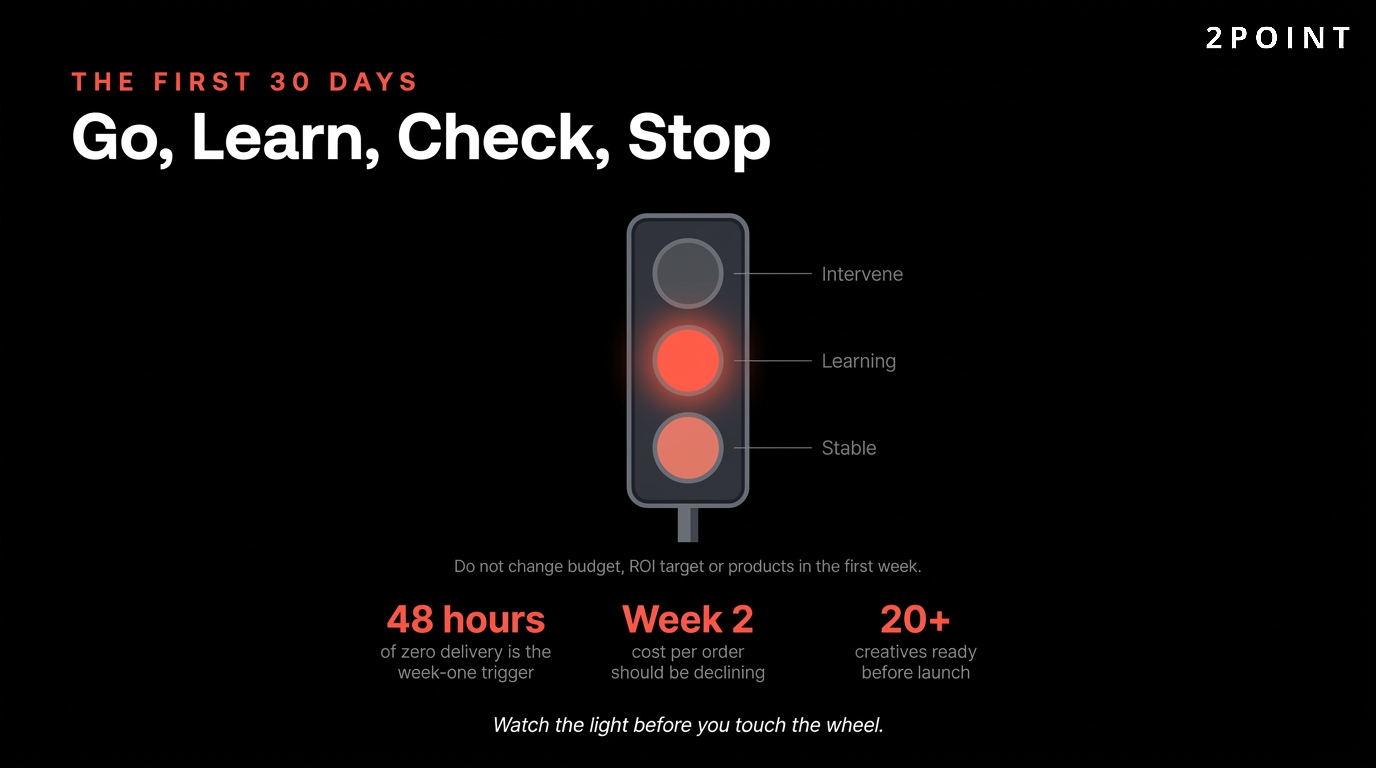
The first thirty days of a GMV Max campaign require patience combined with active monitoring. The algorithm needs time to accumulate conversion data and refine its optimization. Brands that make significant changes in the first week, reducing budgets dramatically, changing ROI targets frequently, or pausing and restarting campaigns, disrupt the learning process and extend the time to mature performance.
The following table outlines what to monitor in each week of the first month and when intervention is appropriate.
| Week | Focus Metric | Expected State | Intervene If |
|---|---|---|---|
| Week 1 | Delivery rate and impressions | Learning phase, variable performance | Zero delivery for 48+ hours |
| Week 2 | Cost per order trend | CPO declining as algorithm optimizes | CPO increasing, not decreasing |
| Week 3 | ROAS and GMV trend | Performance approaching target ROI | ROAS below target ROI floor consistently |
| Week 4 | Creative performance and fatigue signals | Stable performance, some creative decay | Overall GMV declining week over week |
The key takeaway from this monitoring framework is that weeks one and two should be treated as a learning investment rather than a performance evaluation period, with meaningful optimization decisions deferred until week three when the algorithm has sufficient data to reflect its actual capabilities.
GMV Max on TikTok Shop: Maximizing Your Ad Campaigns for Scale
Running GMV Max effectively requires more than correct setup. The brands generating the strongest results are applying a set of strategic practices that work with the algorithm’s strengths rather than around its limitations. This section covers the advanced strategies that separate average GMV Max performance from exceptional results.
Creative Strategy for Sustained GMV Max Performance
Given the documented three to four times ROAS advantage of accounts with 50 or more creatives, building and maintaining a large creative library is the single highest-leverage activity available to GMV Max advertisers. The challenge is that creative production feels like a fixed cost to many brands when it needs to function as an ongoing operational expense. Teams that budget for a one-time creative shoot before launch and then pause production consistently hit performance walls at week three when their initial asset pool fatigues.
The most effective creative strategy for GMV Max combines three content streams. The first is owned brand content: polished product videos, lifestyle creative, and testimonial formats produced or directed by the brand. The second is organic repurposing, where high-performing organic TikTok posts are authorized as Spark Ads and fed into the GMV Max asset pool. The third, and often most scalable, is affiliate creator content. Brands with active affiliate programs on TikTok Shop receive a constant stream of authentic creator videos that can be authorized for ad use. This creator content often outperforms polished brand creative because it matches the native format of the platform. Combining all three streams and refreshing each regularly gives GMV Max the diverse, high-volume creative library it needs to maintain maximum reach across audience segments.
Affiliate Program Integration for GMV Max Success
The relationship between TikTok Shop’s affiliate program and GMV Max performance is more direct than many brands realize. Affiliates create organic content that generates baseline GMV, which GMV Max uses as a signal for which products have demonstrated demand worth amplifying. Affiliates also create video content that can be authorized for use as GMV Max creative assets. And affiliate sales are counted within GMV Max’s blended attribution, contributing to the reported ROI figure that the system uses to evaluate campaign health.
This means investing in affiliate recruitment and relationship management produces compounding returns within GMV Max. More affiliates mean more organic sales signal, more creative content for the ad pool, and higher blended attribution GMV that makes campaigns appear healthier to the algorithm. Brands that treat the affiliate program as a separate organic initiative rather than an integrated component of their GMV Max strategy are leaving significant performance on the table. The optimal setup has an active, diverse affiliate roster creating consistent content that GMV Max can test across paid audiences, with the affiliate channel and paid channel feeding each other’s data continuously. For brands looking to amplify this further, consider monitoring your social media visibility to identify which affiliate content formats drive the most organic engagement before authorizing them as GMV Max assets.
GMV Max Alongside TikTok Search Ads: When to Run Both
TikTok Search Ads represent a meaningfully different placement from the in-feed inventory that GMV Max primarily occupies. Search ads appear when users actively search for products or keywords within TikTok, capturing intent-driven demand. GMV Max, by contrast, intercepts users in their passive browsing state through the For You feed. These two placements reach users at different moments in their discovery-to-purchase journey, which makes them complementary rather than redundant.
Brands generating high organic and GMV Max-driven awareness often find that TikTok Search Ads capture the follow-on demand they create. Users who see multiple exposures to a product through GMV Max campaigns may later search for it directly on TikTok. Without a Search Ads presence, that high-intent search traffic goes to competing listings or exits the platform entirely. Running Search Ads alongside GMV Max captures this lower-funnel demand that awareness-stage campaigns activate but cannot always close. This layered approach mirrors the full-funnel strategy familiar from Google’s ecosystem, where broad reach campaigns generate awareness that search campaigns then convert. Brands following this model often see their overall conversion rates improve significantly because each channel handles the stage of the journey it is best suited for.
GMV Max ROI Optimization: Advanced Targeting and Budget Controls
While GMV Max operates with high automation, several levers remain available to advertisers who want to refine performance beyond default settings. Product selection is the most impactful. Rather than including your entire catalog in a single GMV Max campaign, consider segmenting by product margin tier. High-margin products can tolerate a lower ROI target and higher daily budget because each sale contributes more to actual profitability. Lower-margin products require a tighter ROI target to remain profitable after all costs. Running separate campaigns or adjusting product inclusion to reflect margin differences gives the algorithm better-calibrated targets to work toward.
Budget pacing is another control point often overlooked. GMV Max will spend up to your daily budget ceiling, but it does not have to spend the full amount every day. During periods of demonstrated strong performance, consider increasing your daily budget ceiling to allow the algorithm to capture additional GMV while conditions are favorable. During periods of creative fatigue or seasonal softness, reducing the budget ceiling conserves spend while you refresh creative assets. This dynamic approach to budget management, responsive to real performance signals rather than fixed to a static daily number, is one of the most effective ways to improve ROAS consistency over time. Connecting your real-time inventory to your campaign management workflow also prevents the common problem of spending aggressively on products that are running low in stock.
GMV Max vs. Manual TikTok Shop Ads: Which Approach Wins?
The practical question most TikTok Shop brands face is not simply what GMV Max is, but whether it outperforms the manual campaign management approach and when each approach is more appropriate. The answer depends on the brand’s situation rather than a universal preference for either method.
Performance Comparison: Automation vs. Manual Management
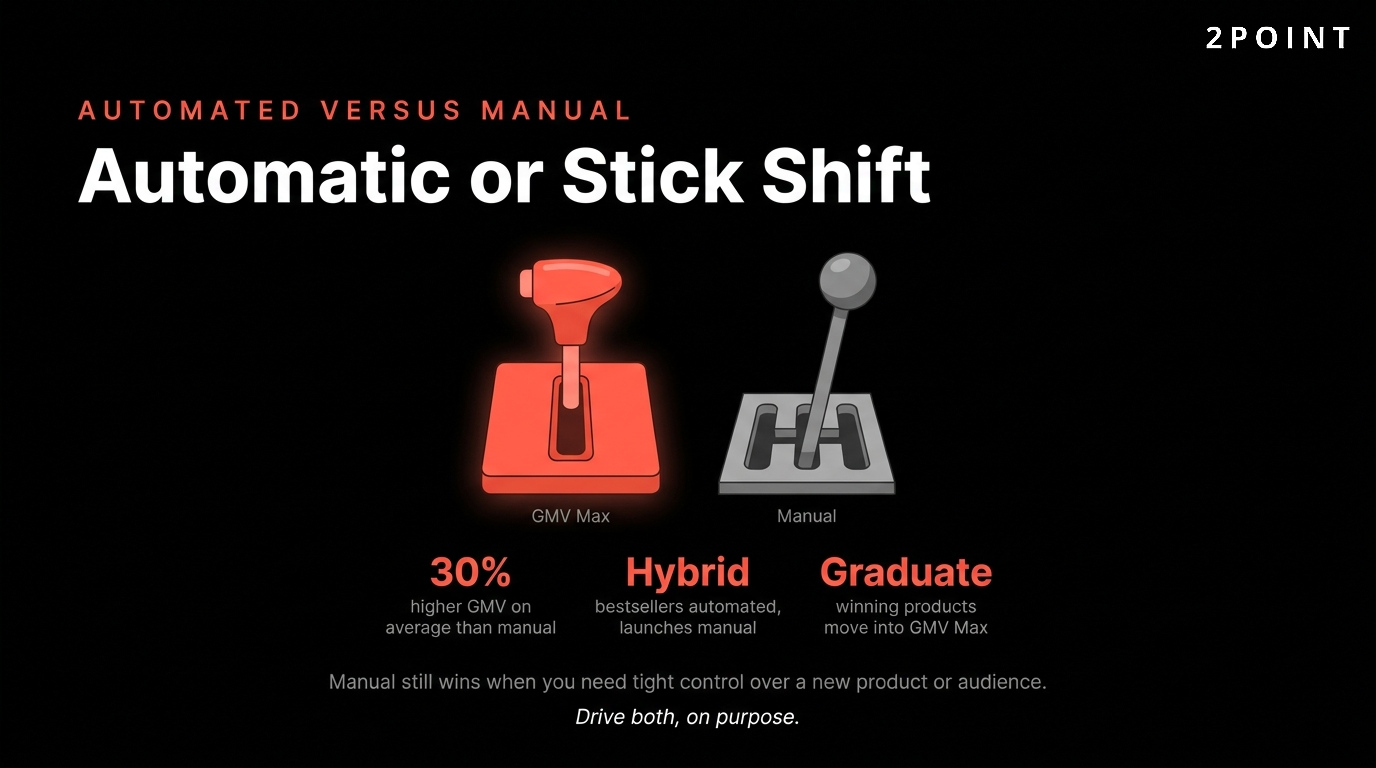
The table below compares GMV Max to manual TikTok Shop ad approaches across the dimensions most relevant to brand decision-making.
| Dimension | GMV Max Automated | Manual TikTok Shop Ads |
|---|---|---|
| Optimization Target | Total GMV (blended attribution) | Specified objective (clicks, conversions, views) |
| Creative Management | Automated selection and rotation | Manual A/B testing required |
| Audience Targeting | Algorithm-driven, no manual input | Manual audience definition |
| Management Time Required | Low (monitoring and creative refresh) | High (daily optimization tasks) |
| Learning Curve | Low setup, trust-based operation | High technical knowledge required |
| GMV Performance vs. Baseline | 30% higher GMV on average | Baseline reference |
| Control Over Spend | Campaign-level budget only | Ad group and ad-level controls |
| New Product Testing | Limited (conflicts with same-product manual ads) | High (purpose-built for specific targeting) |
| Best For | Established products, scaling revenue | New launches, specific audience testing |
The key takeaway from this comparison is that GMV Max outperforms manual approaches for established products at scale while manual campaigns remain more appropriate for new product launches and targeted audience experiments where precise control matters more than algorithmic efficiency.
The Hybrid Approach: Running Both Simultaneously
The most sophisticated TikTok Shop advertisers do not choose between GMV Max and manual campaigns, they use both deliberately for different purposes. The common hybrid structure places proven bestsellers inside GMV Max for automated optimization at scale, while keeping new product launches and category experiments in manually managed Video Shopping Ads or Product Shopping Ads. This division respects the system restriction that prevents running manual ads and GMV Max for the same products simultaneously, while extracting the strengths of each approach.
When a new product launched via manual campaign demonstrates sufficient demand, typically evidenced by consistent daily sales and strong conversion rates, it graduates to GMV Max inclusion. This graduation process creates a natural talent pipeline from experimental to scaled, with GMV Max serving as the high-efficiency optimization layer for products that have already proven their market fit. Teams using this hybrid model report that it reduces overall management overhead while maintaining the ability to test and develop new products with appropriate manual attention. If you are exploring how to structure this approach within a broader digital strategy, the team at 2POINT can help you build a framework that connects GMV Max performance to your full-funnel paid media investment.
Common GMV Max Mistakes and How to Avoid Them
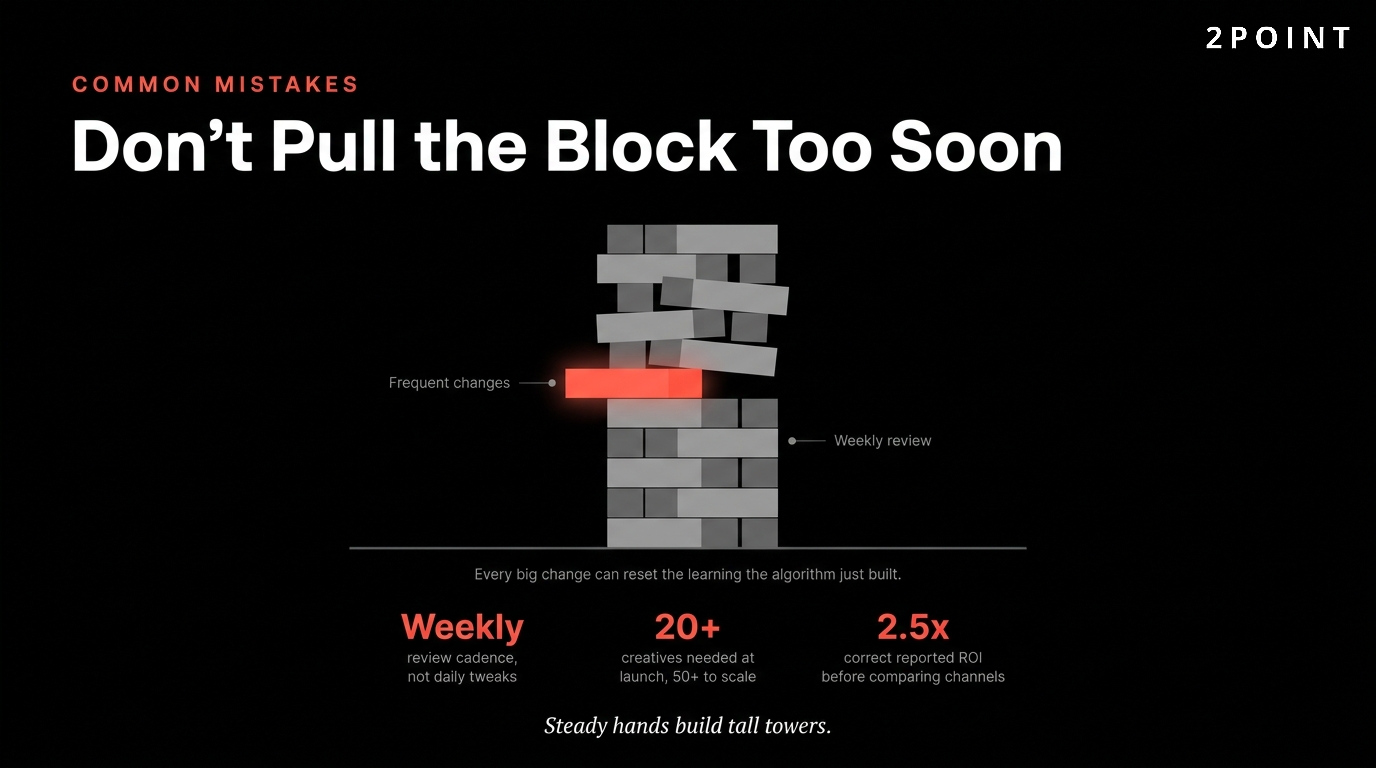
The most common GMV Max errors fall into predictable categories. Understanding them before you encounter them prevents the kind of wasted spend and missed optimization that sets campaigns back by weeks.
Mistakes in Setup and Early Campaign Management
The most costly setup error is launching GMV Max without sufficient creative volume. Brands that upload eight to ten videos and expect the algorithm to deliver strong results are setting themselves up for underperformance. The system needs variety to find what works. Launching with fewer than 20 creatives is technically possible but practically limiting. Treat creative volume as a minimum viable launch requirement, not an enhancement to add later.
The second common setup mistake is setting an ROI target that is unrealistically high for the account’s current maturity. New accounts without established conversion history cannot support the same ROI targets that mature accounts with rich audience data can achieve. Starting with a moderate ROI target and raising it gradually as the algorithm learns your audience is significantly more effective than starting high and watching the campaign fail to deliver because the target is unachievable with available data.
Mistakes in Ongoing Management
The most damaging ongoing management mistake is making frequent changes to running campaigns. Each significant change, whether to budget, ROI target, or product selection, can reset or disrupt the algorithm’s optimization learning. Brands that adjust campaigns daily based on short-term fluctuations consistently underperform brands that allow the system to run for meaningful periods before evaluating results. Establish a review cadence of weekly performance analysis rather than daily adjustments, and reserve intervention for situations where something is clearly wrong rather than simply variable.
Neglecting creative refresh is the second most common ongoing error. Brands that set up their initial creative pool and do not add new assets for weeks will see performance decline predictably as audience fatigue accumulates. Building a systematic monthly or bi-monthly creative refresh into the campaign calendar, with a target of adding 10 to 20 new assets per refresh cycle, maintains the performance level that strong creative volume delivers. Using video marketing best practices to structure each refresh ensures that new assets introduce genuine variety rather than simply duplicating formats that are already well-represented in the pool.
Mistakes in Measurement and Reporting
Accepting GMV Max’s reported ROI as the definitive measure of campaign value without applying the incremental adjustment is probably the most widespread analytical error. Brands that compare GMV Max’s blended ROI directly to their Facebook Ads paid ROAS are comparing fundamentally different metrics. The GMV Max number includes organic revenue; the Facebook number typically does not. This apples-to-oranges comparison can make GMV Max look dramatically better or worse than it actually is relative to other channels, depending on how much organic baseline GMV exists.
The correct measurement approach treats GMV Max’s reported figure as a starting point, applies the 2.5x correction factor to estimate incremental ROAS, monitors total revenue lift above the pre-GMV Max baseline, and also tracks cross-channel halo effects in Amazon and direct-to-consumer metrics. This multi-layered measurement framework is more work than reading a single dashboard number, but it provides the accurate picture needed for sustainable budget allocation decisions. It is also the approach that separates brands building long-term profitable TikTok Shop businesses from those chasing impressive-looking short-term metrics that do not translate to actual margin improvement.
The Future of GMV Max: What TikTok’s Product Roadmap Signals
TikTok’s investment in GMV Max as a core commerce infrastructure product is evident from the pace of feature releases in 2026. GMV Max Pro, Creative Excellence with Symphony integration, Seller Scale Up, Campaign Health Status dashboards, and the expansion of supported market access all arrived within a twelve-month window. This velocity signals that TikTok views GMV Max not as a finished product but as a continuously evolving platform for commerce automation.
Emerging Features and Announced Enhancements
Several features announced or in testing as of late 2026 will shape how GMV Max operates going forward. TikTok Search Impression Share metrics, announced alongside GMV Max Pro in October 2026, give advertisers a new visibility into how much of relevant search traffic their campaigns are capturing. This metric enables a more sophisticated approach to budget allocation between GMV Max and Search Ads placements, ensuring brands are present across both discovery and intent-driven moments within TikTok’s ecosystem.
Smart Creative enhancements continue expanding. AI-generated product videos through Symphony are already available within GMV Max, and TikTok’s roadmap points toward more sophisticated AI-assisted creative formats that can generate content variations without human production input. For brands that struggle to maintain the 50-plus creative threshold that drives optimal performance, AI-assisted generation could dramatically lower the resource barrier to achieving that volume. The implication is that brands who build their content strategy infrastructure now, with workflows designed to intake and authorize a high volume of diverse creative formats, will be better positioned to leverage these AI tools effectively as they mature.
GMV Max’s Role in TikTok’s Broader Commerce Vision
GMV Max is not just an advertising product. It is the operational center of TikTok’s broader social commerce ambition. TikTok’s model aspires to collapse the discovery-to-purchase journey into a single seamless platform experience, where content, community, and commerce are indistinguishable from each other. GMV Max is the monetization engine that makes that model viable for brands, automating the complexity of operating within that environment at scale.
As TikTok Shop expands into new markets and product categories, GMV Max will likely follow and adapt to local commerce behaviors and regulatory environments. Brands that invest in learning to operate GMV Max effectively in their current markets are building institutional knowledge that will transfer to new market expansions. The brands that build strong GMV Max operational expertise now will have a significant head start over competitors who wait until the tool becomes more conventional. For brands looking to build that expertise with experienced guidance, working with a team like 2POINT that understands the nuances of TikTok’s commerce ecosystem can accelerate the learning curve significantly, ensuring that strategy, creative production, and measurement all align with how the system actually works rather than how it appears to work on the surface.
Conclusion: Building a Sustainable GMV Max Strategy
GMV Max represents a genuine shift in how TikTok Shop advertising operates, moving from manual campaign management toward a system where the algorithm handles creative selection, audience targeting, and budget allocation simultaneously. The results documented across industries, from supplements to fashion to beauty, consistently show that the automation delivers meaningful GMV lift when the right inputs are in place: sufficient creative volume, correct attribution interpretation, realistic ROI targets, and active coordination with the broader affiliate and organic content ecosystem.
The brands that succeed with GMV Max long-term are not those that treat it as a set-and-forget tool. They are the brands that understand what the system can and cannot see, maintain rigorous creative refresh cycles, interpret reported metrics with appropriate corrections for blended attribution, and use GMV Max Pro where cost structure complexity demands it. They also measure performance holistically, tracking cross-channel halo effects in Amazon and direct-to-consumer channels rather than evaluating success solely through TikTok’s own reporting dashboard.
As GMV Max Pro expands access and new features like AI-generated creative and Search Impression Share metrics mature, the operational advantage will increasingly belong to brands that have built the right infrastructure around the tool: diverse creative pipelines, active affiliate programs, margin-aware ROI targets, and measurement frameworks that connect TikTok performance to total business outcomes. The investment required to build that infrastructure is real, but the competitive advantage it creates in an increasingly crowded TikTok Shop marketplace is equally real.
If you are ready to build a GMV Max strategy that connects automation to actual profitability rather than just reported metrics, the team at 2POINT brings the platform expertise, creative strategy, and measurement rigor to make that happen across your TikTok Shop operation and broader digital advertising portfolio.
Frequently Asked Questions About GMV Max
What does GMV Max mean on TikTok Shop?
GMV Max is TikTok Shop’s automated advertising campaign type that optimizes for gross merchandise value rather than traditional metrics like clicks or conversions. The system automatically selects products, creative assets, audiences, and placements to maximize total revenue from promoted products. It uses a blended attribution model that counts organic and affiliate sales alongside paid conversions.
How much does it cost to run a GMV Max campaign?
GMV Max does not have a fixed minimum spend requirement, but performance data suggests meaningful optimization requires at least $100 to $200 per day in budget. TikTok’s Seller Scale Up feature introduced seven-day optimization cycles for smaller budgets in 2026. Brands typically see best results at $500 or more per day, where the algorithm accumulates sufficient conversion data to optimize effectively.
Is GMV Max the same as Performance Max on Google?
GMV Max and Google Performance Max share a philosophical similarity in that both use automation to manage creative, targeting, and budget across multiple placements simultaneously. However, they operate on fundamentally different platforms with different attribution models, inventory types, and optimization targets. GMV Max is specifically designed for TikTok Shop’s social commerce environment, while Performance Max operates across Google’s search, display, shopping, and video inventory.
What is the difference between GMV Max and GMV Max Pro?
Standard GMV Max optimizes campaign delivery based on ad spend and GMV outcomes using blended attribution. GMV Max Pro, announced in October 2026, extends optimization to include affiliate creator costs, coupon discount costs, and platform commissions alongside ad spend. Pro moves the optimization target closer to actual business profitability rather than top-line GMV, making it more valuable for brands with complex variable cost structures.
Can I run GMV Max and manual TikTok Shop ads at the same time?
You can run both types simultaneously, but not for the same products. Creating a GMV Max campaign for specific products automatically pauses any Video Shopping Ads or Product Shopping Ads for those same products across all connected ad accounts. The common workaround is to place proven bestsellers in GMV Max while managing new product launches and experiments in manual campaigns separately.
How accurate is GMV Max’s reported ROI?
GMV Max’s reported ROI uses blended attribution that includes organic and affiliate sales alongside paid conversions, which inflates the number relative to true paid-only ROAS. Expert analysis recommends applying approximately a 2.5x correction factor to estimate true incremental ROAS from paid spend. A reported 5x ROI likely reflects a true paid ROAS closer to 2x after organic attribution is removed.
How many creatives do I need for GMV Max to perform well?
TikTok Shop data shows accounts with 50 or more active creatives achieve three to four times better ROAS than accounts with fewer than 20. Brands running fewer than 30 active creatives consistently underperform across categories. Creative performance also declines by 50% or more by week three due to audience fatigue, so ongoing monthly creative refresh is essential to maintaining performance levels.
What is the minimum GMV needed to start using Product GMV Max?
TikTok’s setup guidelines recommend that products generate at least $1,500 in GMV over the past seven days before being added to Product GMV Max campaigns. This threshold ensures the algorithm has sufficient conversion signal to optimize from. Products below this threshold can technically be included but will optimize more slowly and less reliably in the early campaign stages.
Does GMV Max work for new TikTok Shop accounts with no sales history?
GMV Max can be activated on new accounts, but performance will be significantly limited without existing sales data, organic traffic, and affiliate activity for the algorithm to learn from. New accounts typically need four to six weeks of organic and affiliate sales history before GMV Max campaigns produce reliable optimization. Investing in affiliate recruitment and organic content before activating paid GMV Max campaigns accelerates the account seasoning process.
What is LIVE GMV Max and how does it differ from Product GMV Max?
LIVE GMV Max is designed specifically for TikTok Shop livestream events, optimizing for traffic and revenue during scheduled broadcasts. It is typically launched five to seven days before a live event to build viewership. Product GMV Max, by contrast, runs continuously for catalog promotion rather than around specific events. Many brands use both types simultaneously, with Product GMV Max managing baseline revenue and LIVE GMV Max driving event-specific sales spikes.
How do I know if GMV Max Pro is available for my account?
GMV Max Pro is in a limited rollout phase as of late 2026 and is available only to some advertisers in supported markets and scenarios. The best way to check eligibility is to look for the Pro option within your TikTok Ads Manager campaign creation flow or to contact your TikTok Shop account representative directly. Access appears to be prioritized for accounts with established GMV Max track records and consistent campaign health scores.
How long does it take for GMV Max to start showing results?
Most brands see initial traction within seven to fourteen days, with mature optimization typically reached within thirty to sixty days. The first week should be treated as a learning investment where the algorithm accumulates conversion data. Meaningful performance evaluation is best deferred until week three when the system has enough signal to reflect its actual optimization capabilities. Brands with established organic and affiliate momentum tend to see results faster than those starting from scratch.