let’s connect


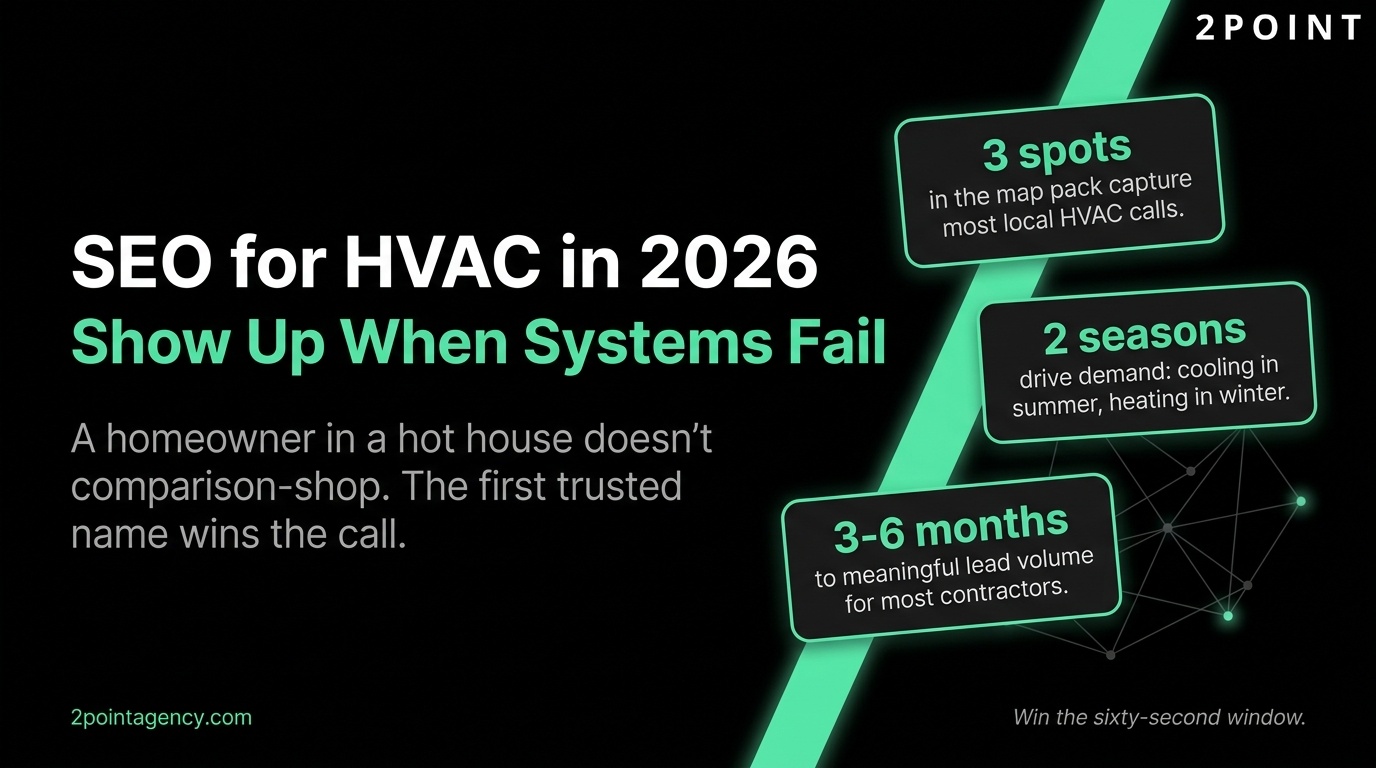
It is the first real heatwave of July. A homeowner’s AC quits, the house is already past 85 degrees, and patience runs out fast. They grab their phone, type “AC repair near me,” and call the first company in the map pack.
That sixty-second window is where SEO for HVAC contractors is won or lost. A homeowner in a hot house does not comparison-shop, and the call they place often becomes a maintenance plan, then a full system replacement years later. Winning that moment is what HVAC SEO delivers.
At 2POINT, we help heating and cooling companies show up the second a system fails. If you run one, this is for you.
What Is HVAC SEO?
HVAC SEO is the practice of optimizing your Google Business Profile, website, and reviews so your company appears in the local map pack, organic results, and AI answers when nearby homeowners search for heating and cooling help.
The goal is narrow. You own the map pack for high-intent AC repair and furnace repair near-me searches, then turn that visibility into booked calls. That tight focus is what separates SEO for HVAC contractors from broad, unfocused marketing.
Why SEO Beats Paying for HVAC Leads
HVAC is one of the most competitive and expensive categories in local search, which is exactly why organic visibility pays off.
This is where the best SEO for HVAC contractors earns its keep. Rankings and reviews keep sending calls long after the work is done, while paid channels stop the second you stop feeding them.
Homeowners Search for the Second the AC or Furnace Fails
A dead system is an emergency, so these searches convert faster than almost any other local query. The homeowner wants a technician today, not next week, and whoever shows up first and looks trustworthy usually gets the call before a second company is even considered.
Paid Clicks Are Brutally Expensive in HVAC
Emergency HVAC terms are among the priciest clicks in all of local services, because every contractor in town bids on the same words.
Organic visibility lets you compete for those searches in two ways.
- Rank in the map pack and organic results without paying per click.
- Keep those rankings working after the ad budget is spent.
That is the smarter long game for HVAC contractor SEO.
You Own the Leads Instead of Renting Them
Pay-per-lead platforms sell the same lead to several companies at once, so you race rivals on price and speed the moment it lands. Leads from your own rankings and reviews work differently.
They are yours alone, with no per-lead fee and no reselling, which makes each one worth more.
The Map Pack Drives More Calls Than Any Other Feature
Finally, look where the calls come from.
Three businesses sit in the map pack above the regular results, and that block captures most local HVAC calls. Ranking there runs on your profile, proximity, and reviews, which makes it the single highest-return move you can make in HVAC.
The HVAC Search Journey, and the Seasons That Drive It
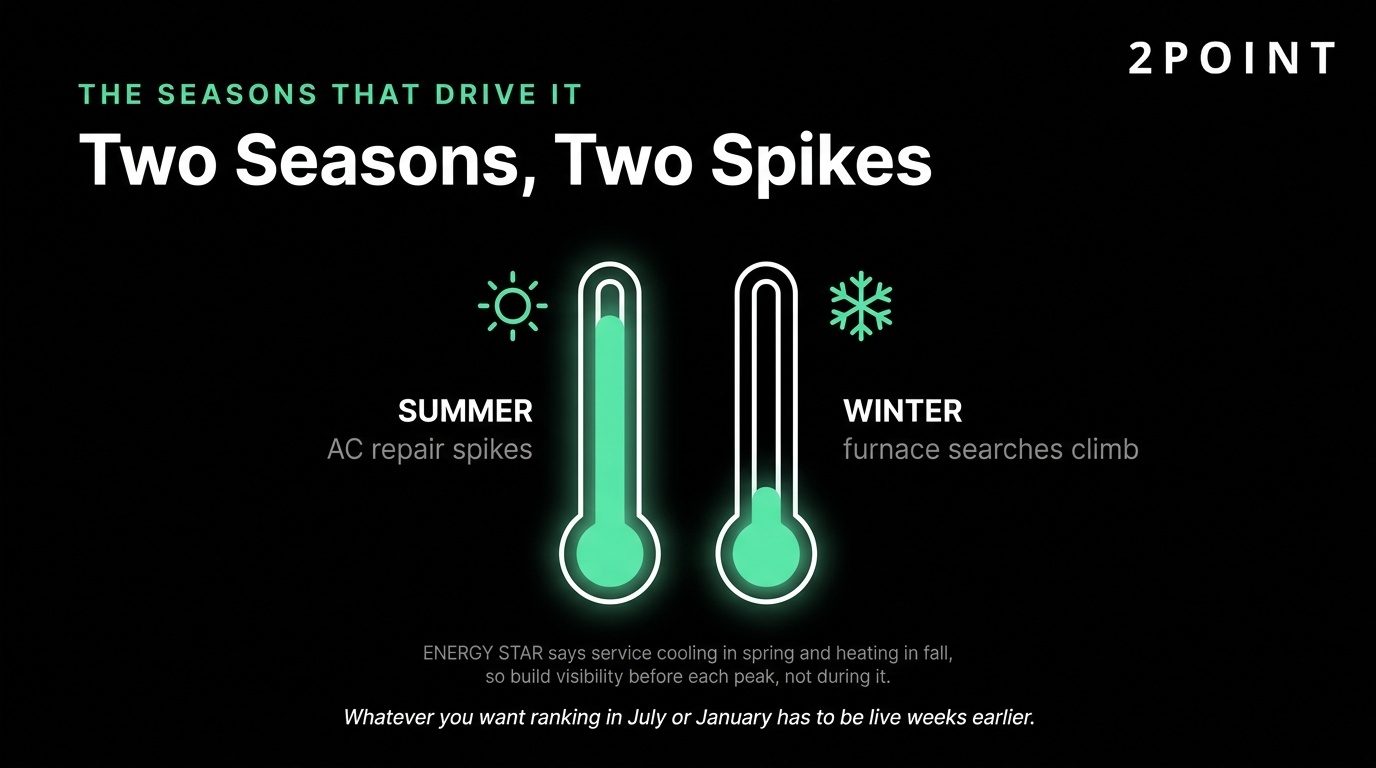
HVAC demand swings hard with the weather, so your visibility has to be built before each season peaks, not during it.
ENERGY STAR advises homeowners to service the cooling system in spring and the heating system in fall, precisely because contractors get slammed once the season hits. That rhythm is your content calendar.
Whatever you want ranking in July or January has to be live and indexed weeks earlier.
Summer: AC Repair and Replacement Spike
Late spring through summer is peak cooling demand, when AC repair and replacement searches surge together. The window is narrow, so prepare for it early.
- Publish and refresh your cooling pages before the first heatwave, never during it.
- Get them indexed and ranking while demand is still building.
Beat the rush, and you own the searches your competitors are still scrambling to catch.
Winter: Furnace and Heat Pump Searches Climb
October through January is peak heating demand, when furnace and heat pump searches climb fast. The same early-prep rule applies.
- Have your heating content live and ranking by early fall.
- Line up emergency furnace pages before the first hard freeze.
That way, you capture the season’s first cold snap, which is often the busiest call day of the winter.
The Emergency, Near-Me Search (Map Pack)
Underneath the seasons, the emergency near-me search runs all year.
It is decided in the map pack by your Google Business Profile, your reviews, and how close you sit to the searcher.
This is the exact moment a complete, active profile earns its keep, since a homeowner with no heat calls the first trustworthy name they see.
The AI Answer (“Best HVAC Company in [City]”)
Increasingly, the journey starts with a question to a machine. More homeowners now ask ChatGPT or Gemini for the best HVAC company in their city and act on the shortlist it returns.
To make that list, you have to be citable, which is the job of answer engine optimization, a new front door that is opening fast.
The Three Pillars of HVAC Local SEO
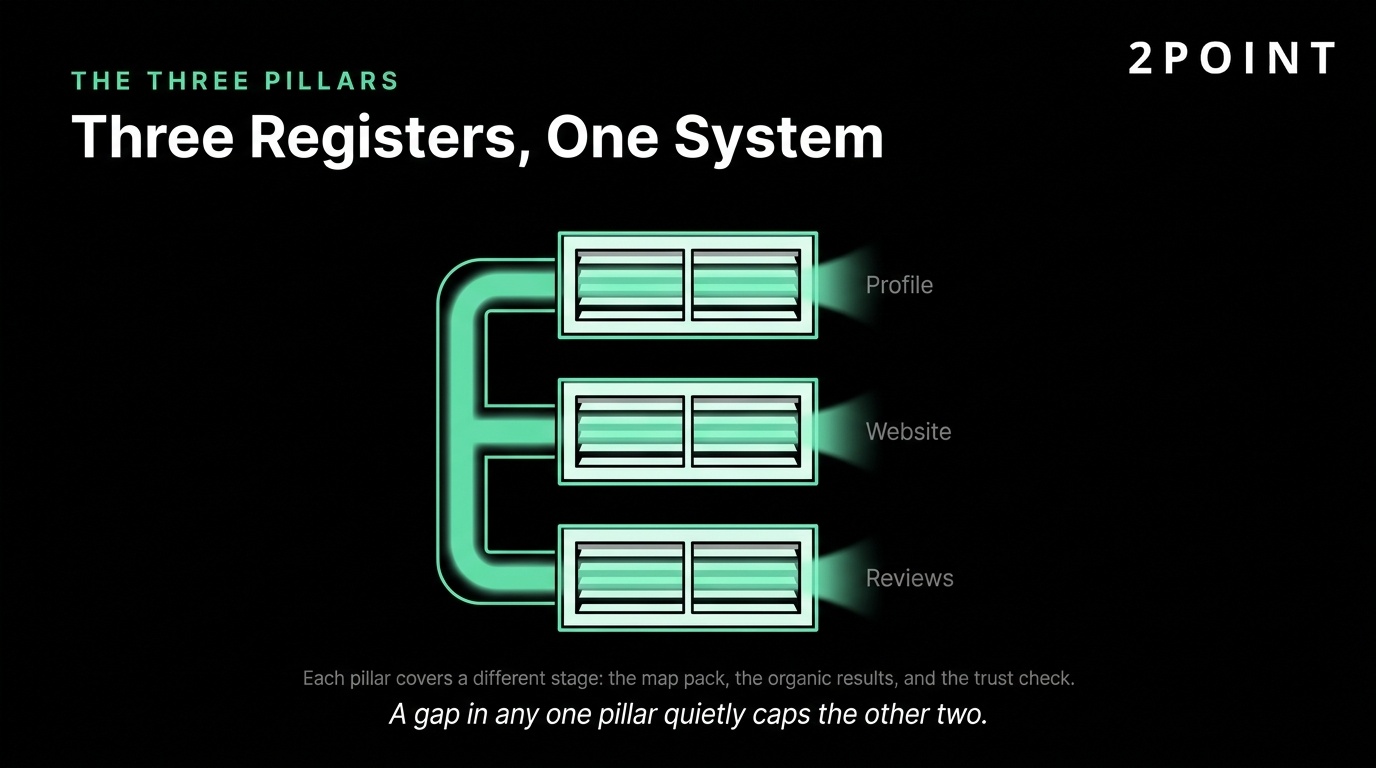
Everything that drives HVAC calls sits under three pillars. Your Google Business Profile, your website, and your reviews and local authority.
Each covers a different stage of the journey you just mapped, and together they span the map pack, the organic results, and the trust check. That combined coverage is the core of local SEO for HVAC contractors, and a gap in any one pillar quietly caps the other two.
Pillar 1: Your Google Business Profile
For an HVAC company, the profile outranks the website in importance because it powers the map pack where emergency calls are won.
Google’s tips for ranking locally confirm that complete, accurate profiles are what its systems match to searches. So treat the profile as a living page you keep up to date, not a one-time setup you claim and forget.
Categories and Service-Area Setup
Start with how Google files you.
- Set HVAC Contractor as your primary category, then add each service you offer as its own item.
- If you have no storefront, configure a service-area business, hide the street address, and define the cities or zip codes you cover.
Keep those areas honest, since padding them with regions you rarely serve can confuse Google and hurt your visibility.
Photos, Posts, and Q&A
Then keep the profile alive. Upload real photos of jobs and crew rather than stock, post seasonal updates as demand shifts, and answer the questions homeowners leave on your profile.
An active profile signals a real, working business, which is exactly what Google wants to put in front of a searcher in a hurry.
Reviews
Recency, detail, and owner responses matter far more than raw review count.
A steady stream of recent, specific reviews beats a big burst followed by months of silence, because Google reads the rhythm as much as the total.
Ask at the end of every completed job, while the fixed system is right there.
Pillar 2: Your Website, Service, and Location Pages
Next comes your website, where research-stage searches and AI engines find the details a profile cannot hold.
The profile wins the emergency, but the website wins the planned replacement, the higher-ticket job. Thin, one-page sites rarely rank for service-plus-city queries, so structure carries this pillar, and three page types do the work.
One Page Per Service
Give each core service its own page.
- AC repair and AC installation are kept separate, since the searchers want different things.
- Furnace repair, heat pump service, and seasonal maintenance, each on its own page.
One page trying to rank for everything ranks for nothing, while a focused page can own its search and hand AI engines a clean answer to cite.
City and Neighborhood Pages That Are Genuinely Local
Location pages earn rankings with real local substance, not boilerplate with the town name swapped in.
Mention the neighborhoods you serve, the common system types in local housing stock, and the climate quirks you actually deal with. Google discounts doorway pages, so write each one as if a local homeowner will read it, because one will.
Fast, Mobile, Click-to-Call, and Quote Forms
Most HVAC searches happen on a phone, in a hurry, often in an overheated house.
So strip out every step between the visitor and the call. A click-to-call button, a short quote form, and a page that loads fast turn that visitor into a booked call before they bounce back to the map pack and dial a competitor.
Pillar 3: Reviews, Citations, and Local Links
Finally, authority tells Google you are an established local business rather than a name it just met. For a contractor, it comes from reviews, consistency, and community presence far more than from fancy link building, which keeps this pillar within reach of a small team with no agency budget.
Build Review Velocity and Respond to Every Review
Ask every satisfied customer for a review at the end of the job, and reply to every review, good or bad, by name.
Review velocity and owner responses both work as ranking and trust signals at once, and the replies to hard reviews matter most, since future customers read them to see how you handle a problem.
Consistent NAP, Citations, and Local Links
Keep your name, address, and phone number identical everywhere they appear.
- Claim the key directories for your trade and area, then audit them quarterly for drift.
- Earn links from suppliers, trade associations, and community sponsorships, which carry real local weight.
Mismatched listings quietly drag rankings down, which is why consistent listings across directories are worth getting exactly right.
Technical SEO for HVAC Sites
You do not need to be a developer, but a few technical basics decide whether Google can rank your site at all. Think of them as the ductwork behind your marketing. Invisible when they work, and the whole system fails when they do not.
These two are where HVAC sites most often lose ground.
Core Web Vitals and Mobile Speed
Because HVAC searches skew mobile, often from someone sweating in a hot house, a slow site quietly loses jobs.
Google’s Core Web Vitals documentation sets clear targets: largest contentful paint under 2.5 seconds, interaction to next paint under 200 milliseconds, and cumulative layout shift under 0.1.
It frames these as part of what its ranking systems reward, so compress your images, test on a real phone, and cut whatever drags the page down.
Crawlability and Schema (LocalBusiness, Service, FAQ)
Next, make sure Google can reach and read your pages. Confirm they crawl and index cleanly, then label them with structured data.
The Schema.org HVACBusiness type, paired with Service and FAQ markup, helps engines read your business, services, and answers without guessing, and qualifies you for rich results.
Validate it before you publish, since markup that oversells the page earns nothing.
HVAC Keyword Strategy: Services Times Cities Times Seasons

The fastest way to plan HVAC keywords is a grid. Take every service you offer, cross it with every city you serve, then time each one to its season.
That grid becomes your page plan, your content calendar, and your priority list at once, and it keeps the best SEO for HVAC contractors pointed at terms that actually convert rather than vanity phrases.
Build the Service-and-City Grid
Start with the grid itself. List your services down one axis and your cities or zip codes across the other, and every cell, like furnace repair in [city], is a page you could build.
You will not build them all, and you should not. Rank the cells by job value and intent, then work from the top down.
Capture Emergency and Seasonal Demand
Then layer timing on top. Add emergency AC repair and same-day pages for urgent work, since those carry the highest intent you can capture.
Time seasonal terms to match, cooling ahead of summer and heating ahead of winter. That demand is predictable, so build and index those pages before the season hits, never during the rush.
Target Financing and Maintenance-Plan Terms
Finally, chase the high-value buyers. Terms like HVAC financing and maintenance plan reach homeowners planning a bigger purchase, not just a one-off fix. These convert into installs and recurring-revenue agreements, which makes each of these pages worth far more per visit than a single repair search, so give them real detail.
Content That Wins HVAC Customers
Content earns rankings and trust when it answers the questions homeowners ask before they ever call.
Two types do most of the heavy lifting, and each catches the customer at a different point.
Service Pages That Answer Cost and Process Questions
Your service pages should answer what a job costs, how long it takes, and what to expect on the day.
Those are the exact questions that decide the call, so answer them plainly. Clear, honest detail converts better than vague sales copy, and it gives AI engines something concrete to lift when a homeowner asks.
Seasonal and How-To Blog Content
The blog catches homeowners earlier, while they are still diagnosing.
Posts like “why is my AC blowing warm air” or “furnace not igniting,” published ahead of each season, reach them the moment the problem starts. Many read, realize the fix is not a DIY job, and call you, so end each post with a clear next step.
Optimize for AI Search (AEO and GEO)
Homeowners increasingly get their shortlist from an AI assistant, so your content has to be easy for those engines to lift and cite. The encouraging part is that the work overlaps almost entirely with the local SEO you are already building.
You are not starting a second program; you are just pointing the first one at a new surface.
Start by leading your pages and FAQs with a direct, self-contained answer, the kind an engine can quote without rewriting, and keep the structure clean underneath it. Then check your robots.txt, since access is what most contractors get wrong.
- Allow GPTBot, so ChatGPT can reach and cite your content.
- Allow Google-Extended, so Gemini can use your pages for grounding.
- Leave Googlebot unblocked, since AI Overviews ride your normal indexing rather than a separate crawler.
Get those three right, and strong classic SEO keeps you eligible across all of them.
How Long Does HVAC SEO Take, and What Does It Cost?
HVAC SEO is a build, not a switch, so set honest expectations on timeline and budget before you start. Neither is fixed, and your market decides where you land, but both follow patterns you can plan around, which keeps you from quitting right before the results arrive.
Timeline
Most HVAC contractors see meaningful lead volume in roughly three to six months, with leading a competitive metro taking longer.
The order of results is the predictable part. Profile and review work can lift map-pack visibility within weeks, while new service pages take months to rank, which is exactly why the game plan starts with your profile.
Cost
Plan for a monthly retainer rather than a one-time fee, since the work is ongoing.
Treat any flat price you see published with skepticism, because quoted ranges vary wildly and rarely describe the same scope of work. What actually moves your number is threefold.
How competitive your market is, how many services and areas you cover, and how much your site needs fixing. Judge a quote by what the work includes and the reporting behind it, not the sticker, and remember one recovered install season can cover a year of the investment.
Red Flags to Avoid
A few common traps waste your money, and the worst can get your listings penalized. Check for these before you sign anything.
- Pay-per-lead lock-in, which resells your lead to competitors and keeps the customer relationship for the platform, not you.
- Fake or incentivized reviews, which break Google and FTC rules and leave your profile one audit away from suspension.
- Doorway city pages that swap the town name into identical boilerplate, a pattern Google recognizes and discounts.
- Ranking guarantees, since Google itself warns that no one can promise a number-one position.
Any one of these in a sales pitch tells you how the rest of the engagement will go. Keep looking.
Ready to Fill Your Schedule Year-Round?
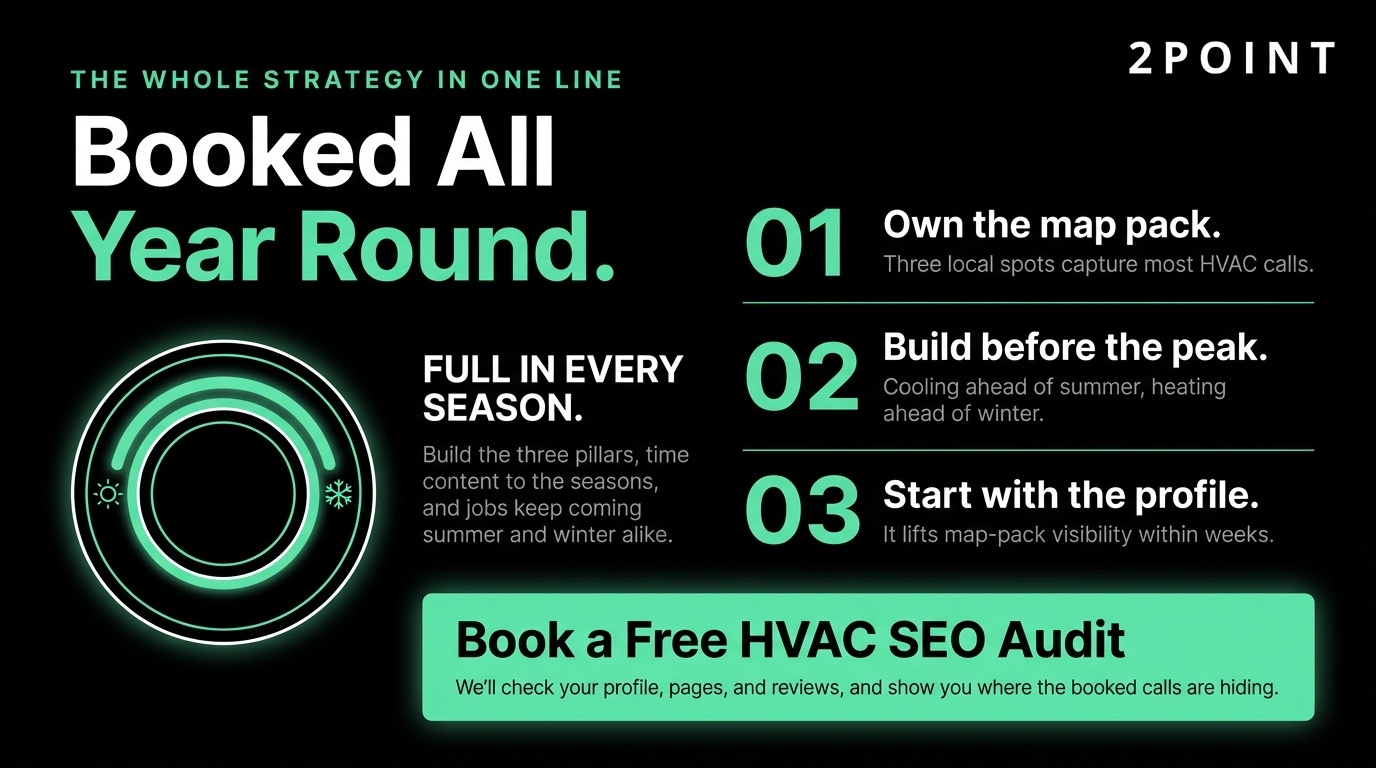
If you do one thing this week, claim and complete your Google Business Profile and start asking every happy customer for a review. That single lever drives more calls than anything else, and it is free. Build the three pillars on top, time your content to the seasons, and jobs keep coming summer and winter alike.
When you want a hand, our managed SEO team runs it. Strong HVAC SEO is one trade in our wider home services SEO playbook.
FAQs
How long does SEO take for an HVAC company?
Most HVAC contractors see meaningful lead volume in three to six months, with competitive metros taking longer.
Profile and review work moves fastest, often lifting map-pack visibility within weeks, while new service pages take longer to rank. Treat HVAC contractor SEO as an ongoing routine, and time seasonal content ahead of each peak.
Is SEO better than Google Ads for HVAC?
They serve different needs, and many companies run both. Google Ads deliver instantly, but HVAC clicks are among the priciest in local services and stop when you pause spending.
Build local SEO for HVAC contractors underneath the ads, then lean less on paid as your rankings and reviews compound at no cost per click.
How do I rank for “AC repair near me”?
Near-me searches are decided in the map pack, so focus on your Google Business Profile, proximity, and reviews. Set the right primary category, list AC repair as a service, keep hours current, and build steady, recent reviews.
Back it with a fast mobile AC repair page and consistent local listings.
How should HVAC SEO change with the seasons?
HVAC SEO should shift ahead of demand, not during it.
Publish and refresh cooling pages before the first heatwave and heating pages before the first cold snap, lean into emergency AC terms in summer and furnace terms in winter, and prepare how-to content a month or two early so it ranks in time.
How much does HVAC SEO cost?
Plan for a monthly retainer rather than a one-time fee, since the work is ongoing. Ignore flat prices published online, because your number depends on local competition, your service and area count, and how much your site needs fixing.
Given HVAC ticket values, well-run SEO for HVAC contractors usually pays for itself within a few jobs.