

 let’s connect


What Is Guerrilla Marketing? A Direct Answer
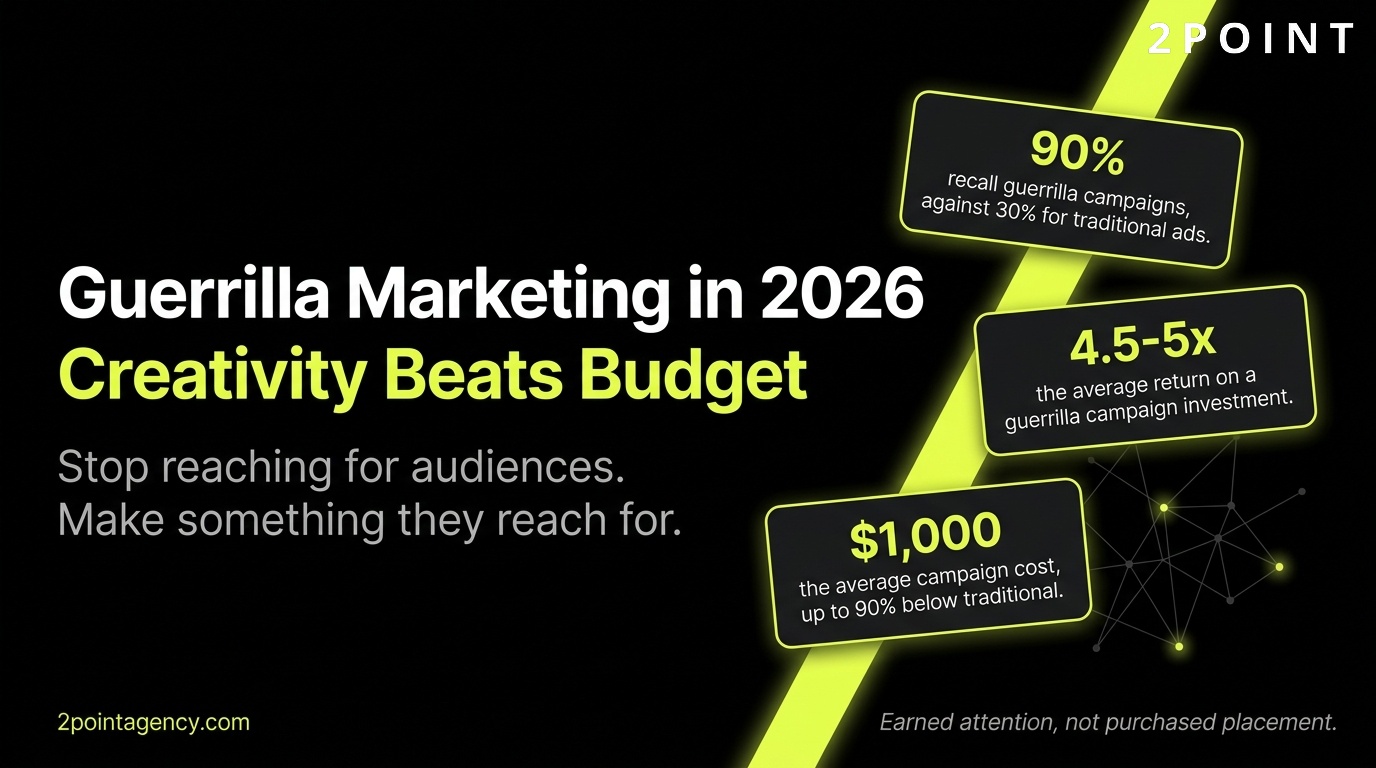
- Guerrilla marketing is an unconventional promotional strategy using creativity and surprise to generate buzz without large media budgets.
- It places unexpected brand experiences in public spaces where consumers are caught off guard.
- 90% of consumers remember guerrilla campaigns, compared to just 30% for traditional advertising.
- The average guerrilla marketing campaign delivers a 4.5 to 5x return on investment.
- Guerrilla tactics can cost up to 90% less than traditional advertising while generating equal or greater reach.
- The term borrows from guerrilla warfare: small teams, fast movement, and strikes in unexpected places.
- In 2026, guerrilla marketing integrates augmented reality, artificial intelligence, and social media amplification.
- It works for businesses of every size because the competitive advantage is creative thinking, not budget size.
Understanding Guerrilla Marketing: Core Concepts and Evolution
The Definition and Psychology Behind Guerrilla Marketing
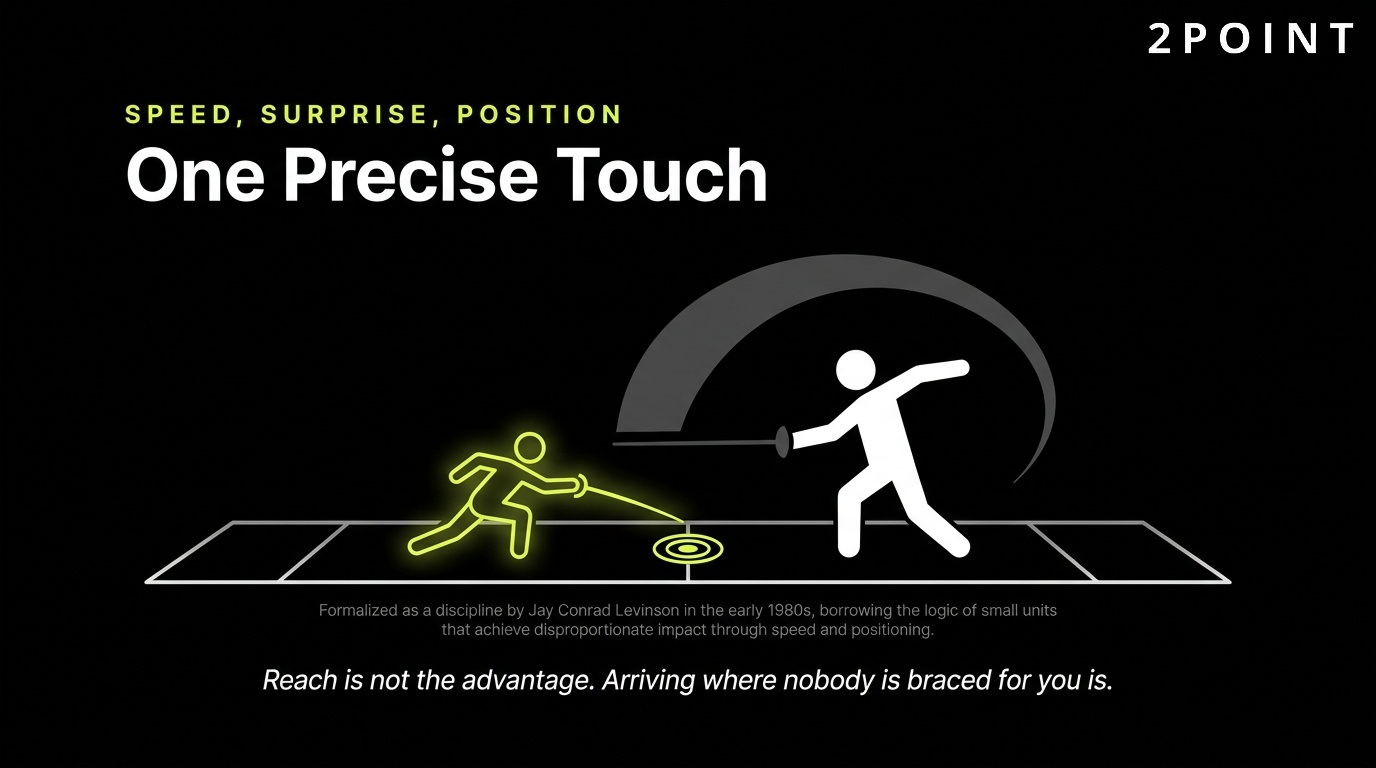
Guerrilla marketing is an unconventional promotional strategy that borrows its core logic from guerrilla warfare. Just as small military units achieve disproportionate impact through speed, surprise, and strategic positioning, guerrilla marketing campaigns achieve outsized brand visibility by placing experiences where consumers least expect them. The strategy was formalized as a marketing discipline in the early 1980s by Jay Conrad Levinson, and it grew steadily in popularity through the early 2000s as brands recognized the diminishing returns of conventional media spend.
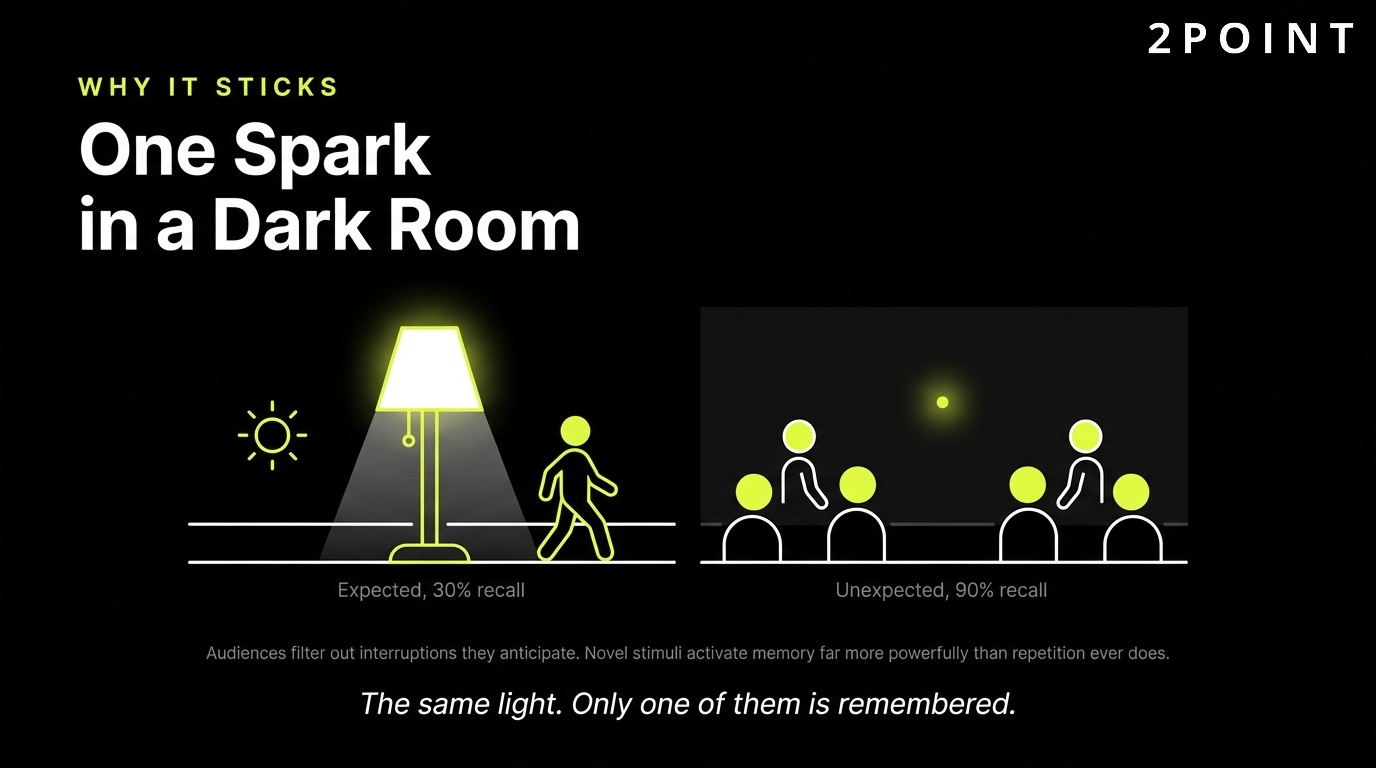
The psychological mechanism is the engine behind why guerrilla marketing works so durably. Traditional advertising places messages in environments where consumers anticipate them: television commercial breaks, roadside billboards, social media feed placements. Because audiences expect these interruptions, they filter them out mentally and physiologically. Guerrilla marketing works by breaking that pattern. Novel, unexpected stimuli activate the hippocampus more powerfully than anticipated ones, which means brand experiences delivered through surprise are encoded into long-term memory far more reliably than those delivered through repetition alone.
It is also worth distinguishing guerrilla marketing from stealth marketing, a related but distinct concept. In stealth marketing, consumers may not realize they are experiencing a promotional interaction at all. Guerrilla marketing is typically overt: the brand association is clear, the campaign is intentional, and the audience understands they have encountered something designed to promote a product or service. The difference matters both ethically and strategically, as transparency in brand attribution strengthens the memorability effect rather than undermining it.
Key Principles That Make Guerrilla Marketing Work
The defining characteristic of guerrilla marketing is not low cost. It is outsized impact relative to spend. Many practitioners incorrectly treat guerrilla tactics as simply “cheap advertising,” but that framing misses the point entirely. A guerrilla campaign executed without creativity, strategic placement, or emotional resonance will underperform even the most basic traditional media buy. The low cost is a byproduct of the approach, not its goal.
The core principles that consistently produce results are: creativity prioritized over budget, a genuine surprise element that disrupts routine, strategic placement in high-traffic environments where the target audience is already present, shareability built into the concept from day one, and emotional resonance that gives people a reason to talk about what they experienced. The most effective guerrilla campaigns earn attention rather than buying it. They show up somewhere people do not expect them, with something those people cannot ignore.
This shift in philosophy is more radical than it first appears. Most marketing frameworks are built around the idea of reaching audiences: identifying where your target customers consume media, and placing messages in those spaces. Guerrilla marketing inverts this completely. The goal is to create something audiences reach for, something so surprising or genuinely interesting that people seek it out, share it, and discuss it without being prompted. That dynamic is fundamentally different from impression-based advertising, and it explains why the memorability and word-of-mouth statistics for guerrilla campaigns outperform traditional channels so dramatically.
The 2026 Evolution: Digital Integration and Social Amplification
Guerrilla marketing has undergone a significant structural transformation over the past decade. What began as primarily physical, one-time activations in public spaces has evolved into multi-channel campaigns designed from the ground up for digital amplification. The single biggest driver of this change is social media. Before platforms like TikTok, Instagram, and X (formerly Twitter) reached their current scale, a guerrilla activation was experienced only by those physically present at the location. A remarkable stunt in Times Square might be seen by fifty thousand people. In 2026, that same stunt, if designed with shareability in mind, can reach millions of social media viewers within hours of launch.
This reality has changed the optimization calculus for every guerrilla campaign. Visual impact, photographic clarity, and unambiguous brand attribution in photos and videos are now strategic requirements, not aesthetic preferences. If a campaign is not TikTok-worthy or LinkedIn-shareable, it will underperform in the 2026 environment, regardless of how clever the physical execution might be. The offline experience is the seed; the social amplification is the harvest.
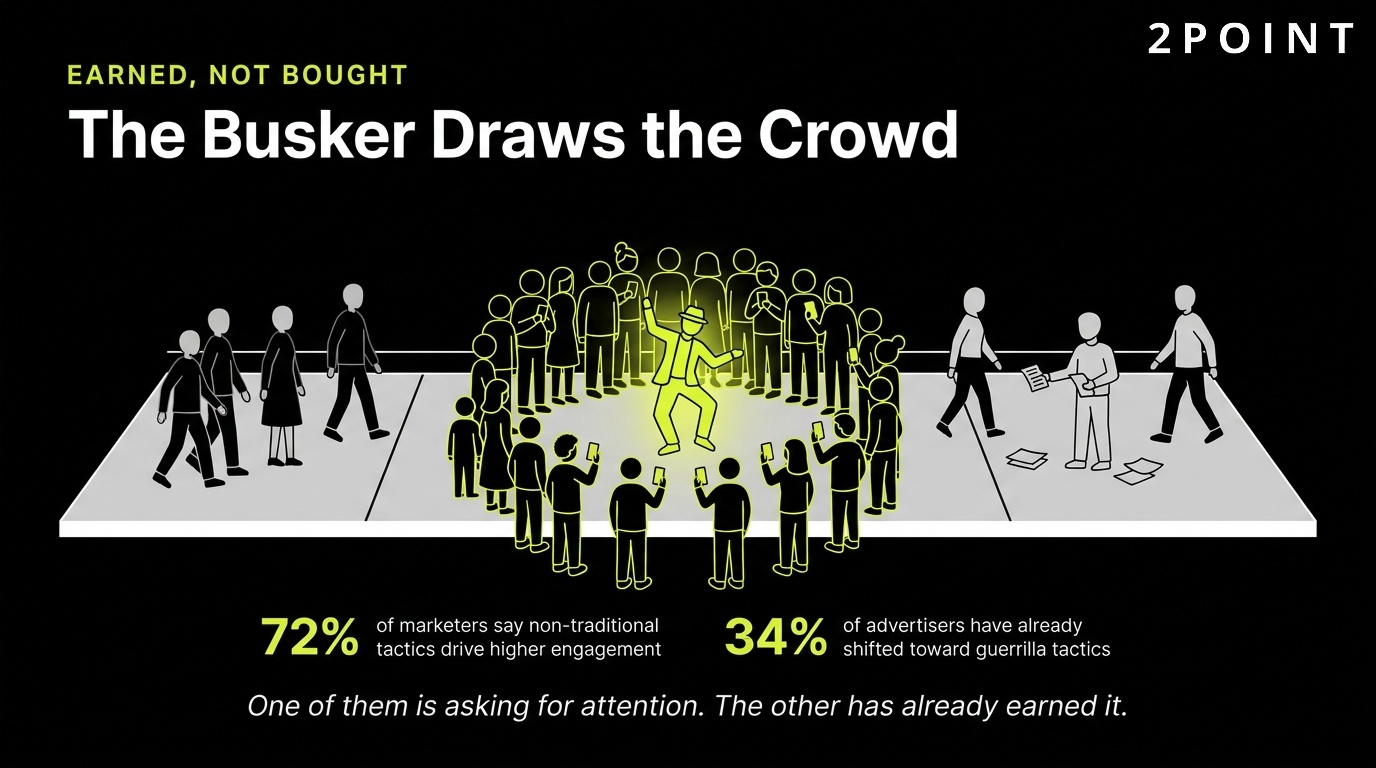
Digital integration has also introduced dynamic capabilities that traditional guerrilla marketing never had. Weather-responsive ads, personalized messaging triggered by location data, and real-time alignment with trending topics are all now part of the advanced guerrilla marketer’s toolkit. Campaigns can now adapt in real time to maximize relevance and shareability rather than relying on a single fixed execution. This adaptability is what separates modern guerrilla marketing from its earlier, more static form. Notably, 72% of marketers report that non-traditional tactics drive higher engagement than standard digital ads, and 34% of advertisers have already shifted toward guerrilla marketing tactics as a primary or supplementary strategy.
Guerrilla vs. Traditional Marketing: A Comparative Analysis
Understanding where guerrilla marketing sits relative to traditional advertising helps practitioners make smarter decisions about when to deploy each approach. These are not competing philosophies so much as different tools with different strengths, and the most sophisticated campaigns often combine both.
| Comparison Factor | Guerrilla Marketing | Traditional Marketing |
|---|---|---|
| Average Campaign Cost | ~$1,000 | Tens of thousands to millions |
| Consumer Memorability | 90% recall | 30% recall |
| Word-of-Mouth Generation | 5x more than traditional | Baseline benchmark |
| Primary Mechanism | Earned attention through surprise | Paid placement in expected spaces |
| Audience Reach | Physical presence plus social amplification | Paid media distribution network |
| Message Control | Moderate (dependent on audience interpretation) | High (exact message delivered) |
| Scalability | High when social-first design is used | High with increased budget |
| Best Use Case | Brand awareness, launch events, differentiation | Consistent brand presence, direct response |
The key takeaway from this comparison is that guerrilla marketing excels at memorability, cost efficiency, and word-of-mouth generation, while traditional marketing excels at message precision and scalable distribution. The strongest offline marketing programs leverage both approaches in coordination. Guerrilla marketing is a specific channel with specific strengths, not a shortcut or a cheap substitute for a real marketing strategy.
Types and Tactics of Guerrilla Marketing Campaigns
Outdoor and Indoor Guerrilla Marketing
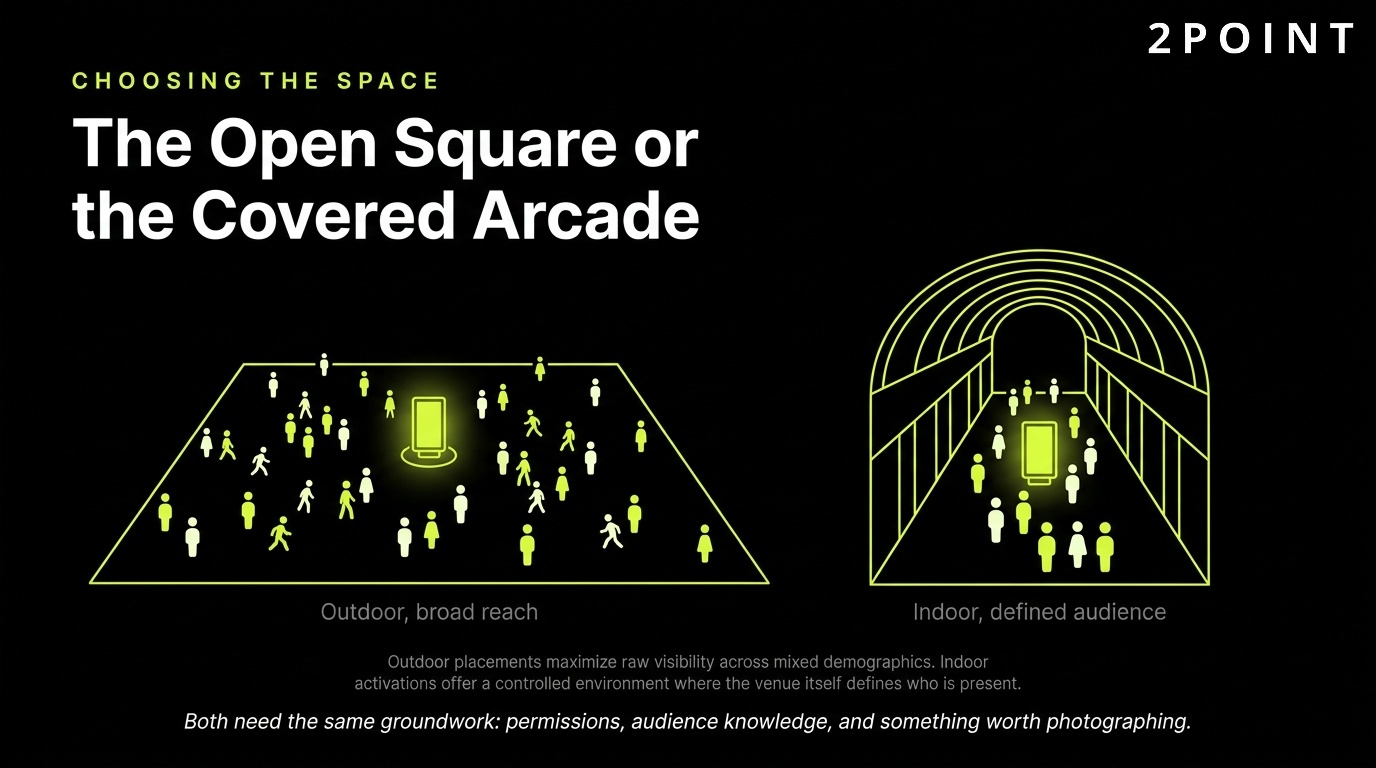
Outdoor guerrilla marketing places unusual objects, experiences, or brand messages in outdoor environments, most commonly urban areas with high pedestrian traffic. The goal is to insert the brand into the physical landscape in a way that stops people mid-stride. Classic executions include oversized replicas of everyday objects placed in parks or city squares, creative modifications to existing street infrastructure like benches or crosswalks, and temporary street art that transforms blank walls into brand canvases. IKEA’s famous campaign placing branded sofas and lamps at bus stops is a textbook example: the brand inserted its product into the exact moment of consumer frustration (waiting for public transit) and demonstrated its value proposition without saying a word.
Indoor guerrilla marketing operates in enclosed public spaces: train stations, shopping centers, university campuses, museums, and airports. These environments offer a controlled setting with captive audiences and more predictable demographic profiles. Flash mobs are among the most effective indoor guerrilla tactics. By staging a sudden, unexpected performance in a busy indoor space, brands create a memorable moment that those present cannot ignore and are immediately compelled to film. Indoor activations allow for tighter demographic targeting because the audience is defined by the venue they have chosen to enter.
The practical benefits of each format differ in important ways. Outdoor placements maximize raw visibility and broad demographic reach, making them ideal for brand awareness objectives. Indoor activations offer greater control over the environment and the audience, making them better suited for campaigns targeting specific consumer segments. Both formats require the same foundational planning: securing appropriate permissions, understanding the audience using that space, and designing an experience worth photographing and sharing.
Ambush, Street, and Ambient Marketing
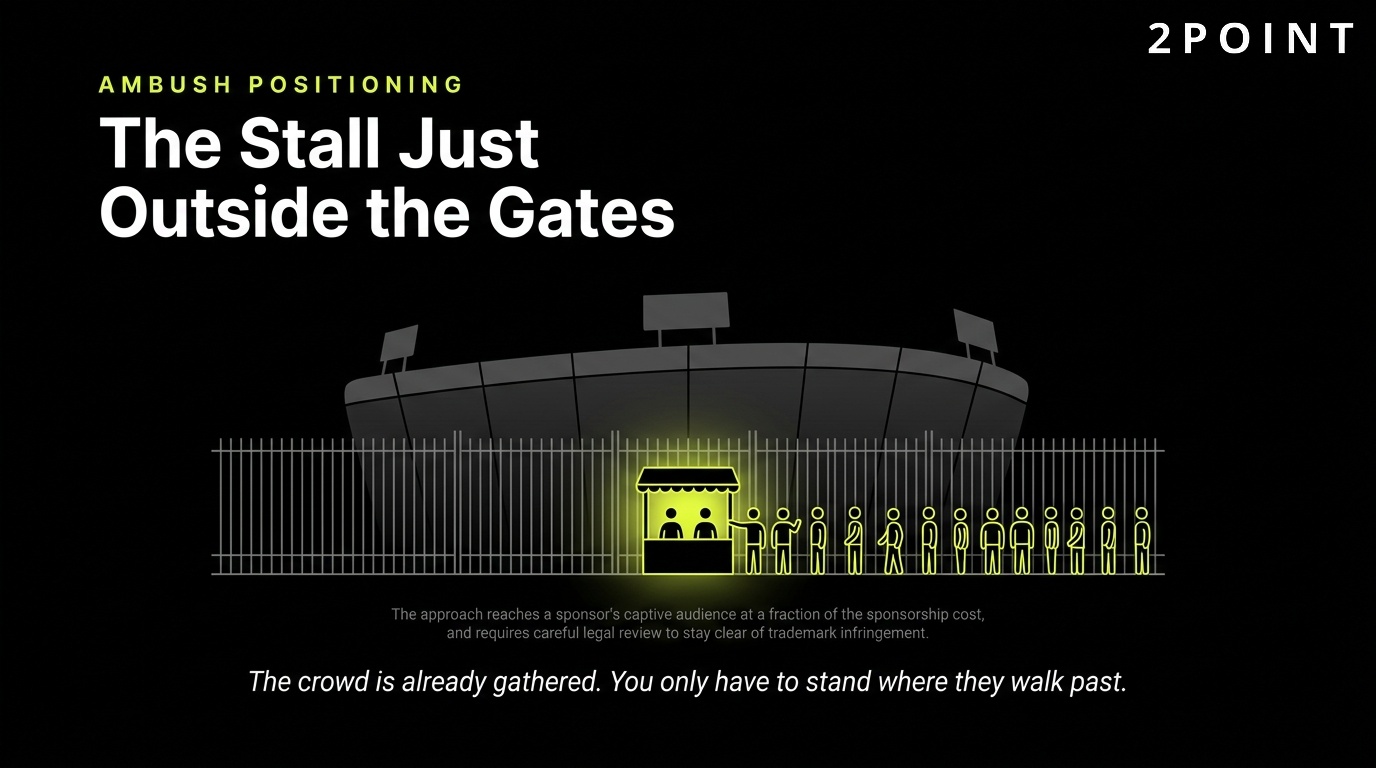
Ambush marketing involves associating a brand with a major event or cultural moment without purchasing official sponsorship rights. The classic execution is a pop-up experience, branded activation, or street team presence positioned just outside a major sporting event, concert, or festival. Ambush marketing allows a brand to access a competitor’s or event sponsor’s captive audience while generating a memorable event experience at a fraction of the sponsorship cost. The approach requires careful legal review to avoid crossing into trademark infringement territory, but when executed correctly, it produces substantial visibility at a fraction of the sponsorship cost.
Street marketing focuses on direct, live interaction with consumers in public spaces. Red Bull’s famous space jump campaign, which had Felix Baumgartner freefall from the stratosphere, is the extreme end of street marketing: a live promotional stunt of such scale that it became a global media event in its own right. Most street marketing operates at a more accessible scale: brand ambassadors engaging passersby with product samples, branded interactive installations in city centers, or live performances that incorporate product placement naturally. The benefits are immediate visibility, authentic human interaction, and the creation of genuinely unique experiences that people remember. Street marketing draws instant attention and creates unforgettable first encounters with a brand.
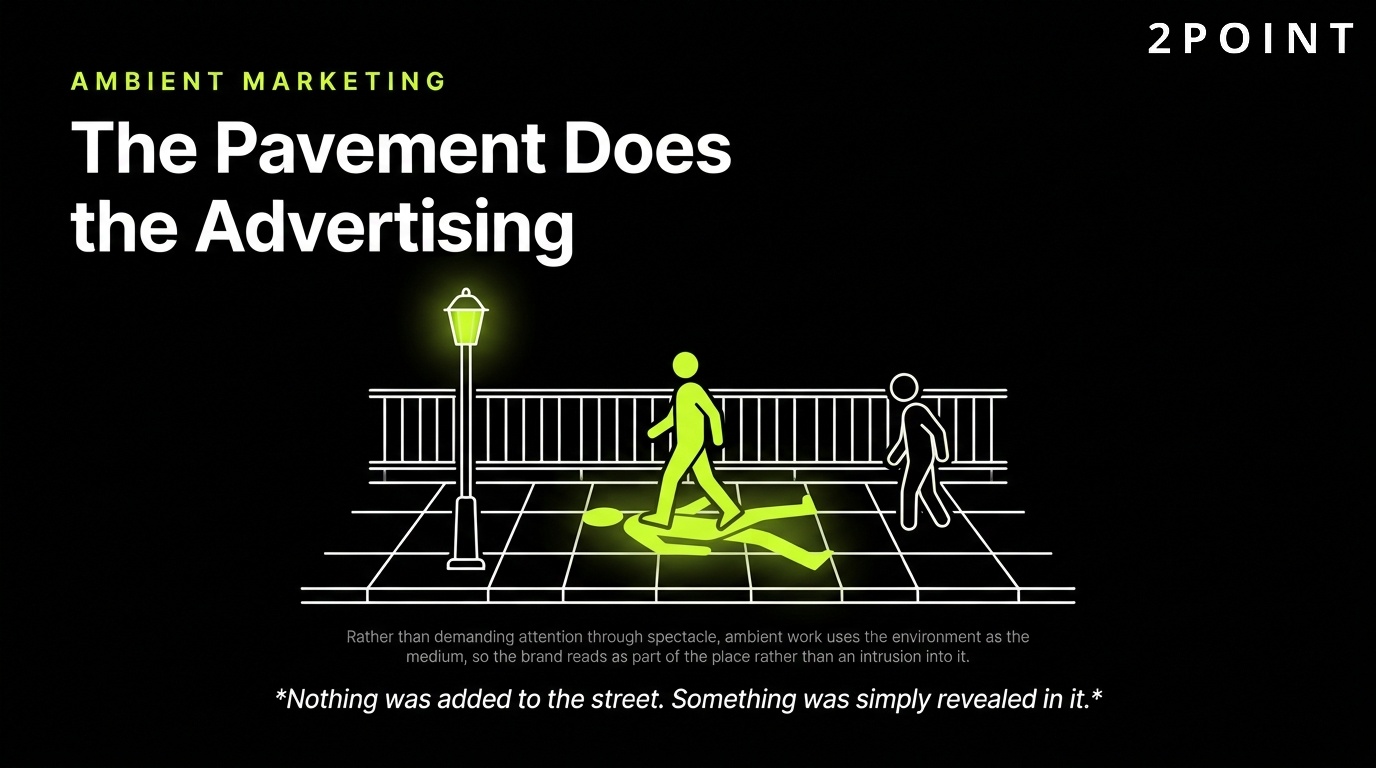
Ambient marketing takes a more subtle approach, designed to blend seamlessly into the natural environment while still communicating a brand message with precision. Rather than demanding attention through spectacle, ambient marketing uses environmental context as the medium. A classic example is a fitness brand using shadows cast by sunlight on a sidewalk to create the illusion of a person exercising. The brand appears to be part of the environment rather than an intrusion into it, which generates a different but equally powerful kind of memorability. Combining all three approaches within a single campaign, ambush positioning for traffic, street teams for direct engagement, and ambient elements for sustained presence, creates a comprehensive guerrilla presence around a single brand moment.
Viral, Stealth, and Grassroots Tactics
Viral marketing campaigns are engineered specifically to generate organic sharing on social media platforms. The content at the center of a viral campaign, typically a video, image, or interactive experience, must possess qualities that motivate people to share it with their own networks: humor, emotional resonance, shock value, genuine utility, or a combination of these. The business logic is straightforward: 63% of consumers who experience a guerrilla marketing campaign will share it with others. When the content is genuinely compelling, each share extends brand reach exponentially without additional media spend. This is why low-cost viral campaigns can outperform multi-million-dollar traditional media buys on pure reach metrics.
The trust dimension of viral marketing is equally significant. 50% of Gen Z and Millennials trust peer recommendations and user-generated content more than branded content. When a friend shares a video of a remarkable brand experience, the trust transfer from the friend to the brand is immediate and powerful in a way that no paid advertisement can replicate. This peer recommendation dynamic is why viral guerrilla content routinely outperforms traditional advertising in driving purchase intent.
Stealth marketing operates at the subtler end of the spectrum, placing products or brand messages in contexts where consumers may not immediately recognize the promotional intent. This might involve product placement in organic-seeming social media content or actors using products in public settings without identifying themselves as brand representatives. Grassroots marketing sits at the most accessible end of the guerrilla spectrum: low-cost, community-driven tactics like flyer distribution, community board postings, local event sponsorships, and neighborhood-level word-of-mouth campaigns. Small and local businesses frequently rely on grassroots tactics as their primary marketing channel because they are inexpensive, personally delivered, and naturally aligned with community trust dynamics.
Most Effective Guerrilla Marketing Tactics in 2026
The most effective guerrilla marketing tactics in 2026 share a common design principle: they are conceived with organic social sharing as the primary success metric. Physical presence in a public space generates direct impressions, but the social media amplification of that physical presence is what creates scalable reach. The tactics that best combine both dimensions are:
- Projection advertising: High-resolution branded imagery projected onto building facades at night, generating immediate spectacle and social documentation.
- Large-scale murals: Permanent or semi-permanent brand art in high-foot-traffic neighborhoods that becomes a destination in its own right.
- Street team activations: Trained brand ambassadors at relevant events providing product experiences and generating user-created content.
- Sidewalk stencil campaigns: Temporary branded messaging at street level placed along routes leading to launch events or retail locations.
- Live experiential stunts: Unexpected public performances, demonstrations, or spectacles tied to a clear brand narrative.
- LED mobile billboard activations: Truck-mounted digital displays that bring brand messaging directly to specific neighborhoods or event proximities.
- Brand ambassador programs: Community-embedded representatives who naturally incorporate brand messaging into authentic peer conversations.
- Poster campaigns: High-impact visual placements in transit environments and urban spaces designed for photographic documentation.
The common thread across all effective 2026 tactics is that shareability is engineered into the concept from the first planning conversation, not added as an afterthought after execution. Campaigns that look impressive in person but photograph poorly or lack clear brand attribution in digital images consistently underperform their potential.
How AR and AI Are Transforming Guerrilla Marketing Strategies
AR Integration in Guerrilla Marketing Campaigns
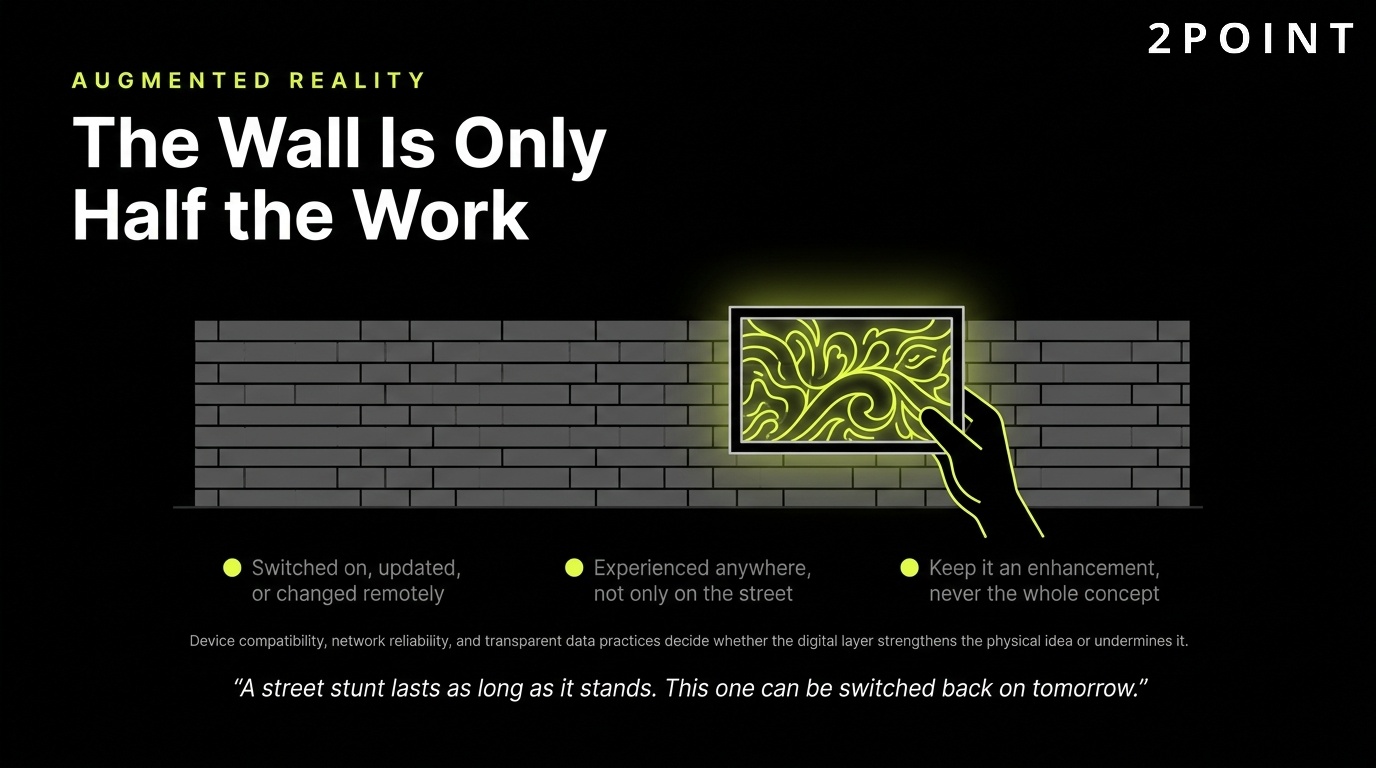
Augmented reality has become one of the most powerful tools available to guerrilla marketers in 2026, and its rise is not accidental. AR is pivotal in elevating guerrilla marketing beyond traditional tactics because it creates an entirely new category of brand experience: one that exists simultaneously in the physical and digital worlds. By overlaying digital content onto physical environments through smartphone cameras and dedicated AR devices, brands can craft interactive experiences that engage consumers on multiple sensory levels at once. The technology has an extraordinary natural alignment with guerrilla marketing’s core principle of creating something people cannot ignore. AR activations create immersive experiences that are impossible to replicate with physical installations alone.
Practical applications of AR in guerrilla campaigns span a wide range. A brand can transform an ordinary wall into an animated mural that only comes to life when viewed through a smartphone. A retailer can allow consumers to virtually try on products while standing in a public space, generating both personal engagement and immediate social documentation. An entertainment brand can scatter hidden AR content across a city, rewarding exploration with exclusive experiences only discoverable through the campaign’s dedicated app. These are not novelty applications of technology for its own sake. They are strategic deployments of a medium that aligns perfectly with the unconventional, surprise-driven nature of guerrilla marketing. The interactive element substantially extends the time consumers spend engaged with the brand, which deepens memory encoding and strengthens purchase intent in ways that passive advertising cannot achieve.
The rise of AR in guerrilla marketing also addresses one of the perennial challenges of physical-only activations: longevity. A traditional street stunt lasts as long as the installation remains in place. An AR component can be switched on and off remotely, updated with new content in real time, and experienced by anyone globally who downloads the associated application. This transforms a locally executed campaign into a potentially global brand experience, dramatically expanding the return on a single creative concept.
AI-Powered Personalization and Predictive Analytics in Guerrilla Campaigns
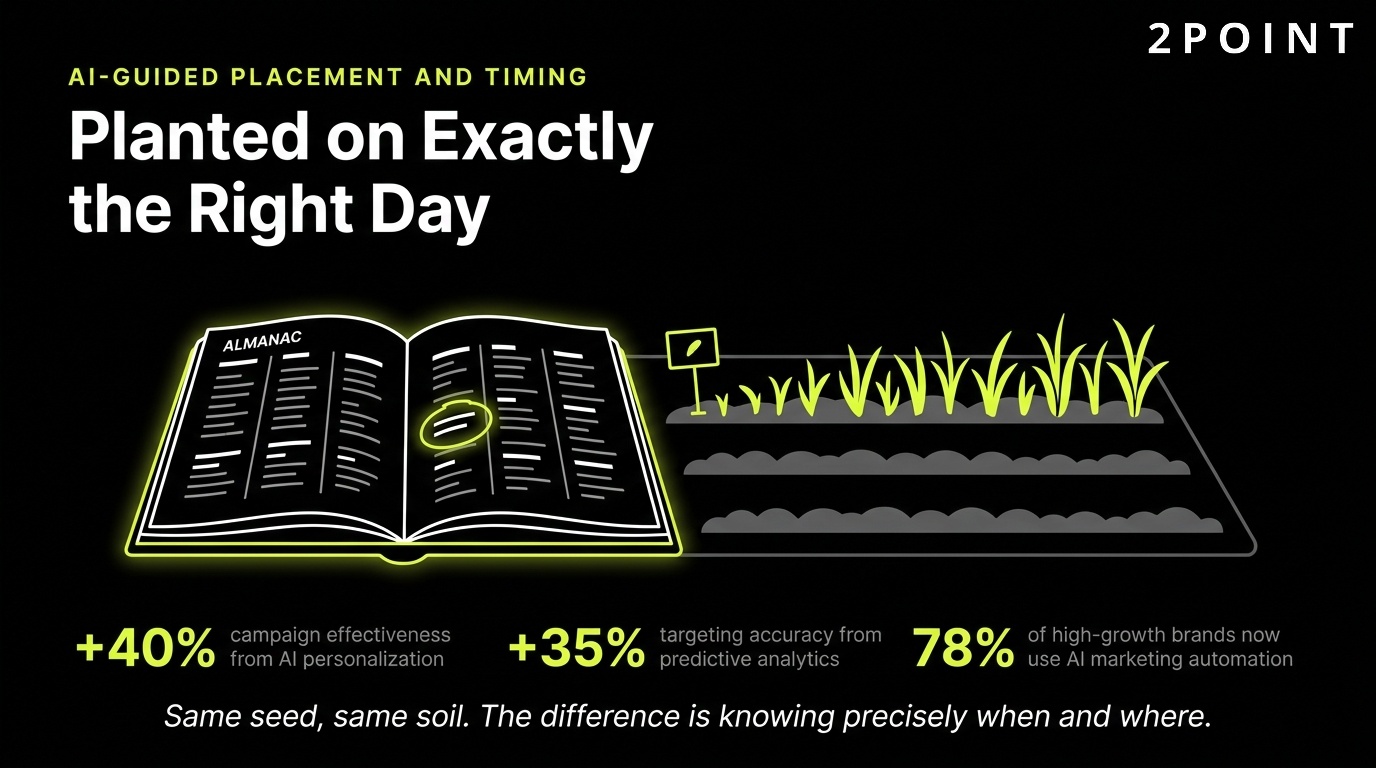
Artificial intelligence transforms guerrilla marketing through three primary mechanisms: hyper-personalization of messaging, predictive analytics for campaign optimization, and automated content creation at scale. These capabilities make guerrilla campaigns more precise, more responsive, and more scalable than was possible even five years ago. AI-driven personalization increases campaign effectiveness by 40% compared to non-personalized equivalents, which is a meaningful improvement in any marketing context but is particularly powerful in guerrilla marketing where the surprise element already generates above-average engagement.
AI-driven audience segmentation allows brands to identify precisely where their target consumers are, when they are most receptive, and what kind of content they are most likely to share. This intelligence informs location selection, timing, format choice, and messaging tone for every guerrilla activation. Predictive analytics improve targeting accuracy by 35%, meaning brands can concentrate their guerrilla investments in the spaces and moments most likely to generate the outcomes they are pursuing. AI-powered chatbots boost customer interactions by 40% in the follow-up phase, capturing and nurturing the attention that a guerrilla activation generates.
The broader adoption context is also telling. 78% of high-growth brands now use AI-driven marketing automation to increase engagement. For guerrilla marketers, AI serves as both a planning tool and a real-time optimization engine. Campaigns can be adjusted dynamically based on social media response data, weather conditions, and trending conversations, ensuring that the investment continues to generate returns even as the external environment shifts. This responsiveness is one of the clearest advantages AI brings to a discipline that has historically relied on a single fixed execution.
Technical Challenges and Implementation Considerations for AR Guerrilla Marketing
The integration of AR and AI into guerrilla marketing introduces a set of technical and logistical challenges that brands must address proactively. Device compatibility is perhaps the most immediate practical barrier. Not all smartphone models support the same AR capabilities, and campaigns designed for the latest hardware may deliver a degraded or non-functional experience for users on older devices. Network reliability is an equally significant concern. AR experiences that require real-time data loading will fail to impress or engage audiences in areas with poor connectivity, and a failed digital experience can undermine the positive impression that the physical activation was designed to create.
Privacy concerns and data security represent a more complex challenge because they operate at the intersection of technology, regulation, and consumer trust. AR campaigns that collect location data or behavioral information require transparent communication about data practices and strict compliance with applicable privacy regulations. Consumers who feel their privacy has been compromised will not share a brand experience positively, which directly undermines the viral amplification that makes guerrilla marketing so effective.
Balancing digital elements with physical interactions is the final and most nuanced challenge. An AR layer that overwhelms the physical experience, or demands too much technical proficiency from casual passersby, will reduce participation rates and limit social sharing. The most successful AR guerrilla campaigns treat the technology as an enhancement to a compelling physical concept rather than as the concept itself. Cost implications also deserve honest acknowledgment: AR development for custom applications can require significant investment, and smaller brands must evaluate whether the incremental reach and engagement justify the production expense relative to simpler but equally creative physical activations.
Guerrilla Marketing ROI: Performance Statistics and Budget Realities
Cost Efficiency and Budget Realities for Guerrilla Marketing Campaigns
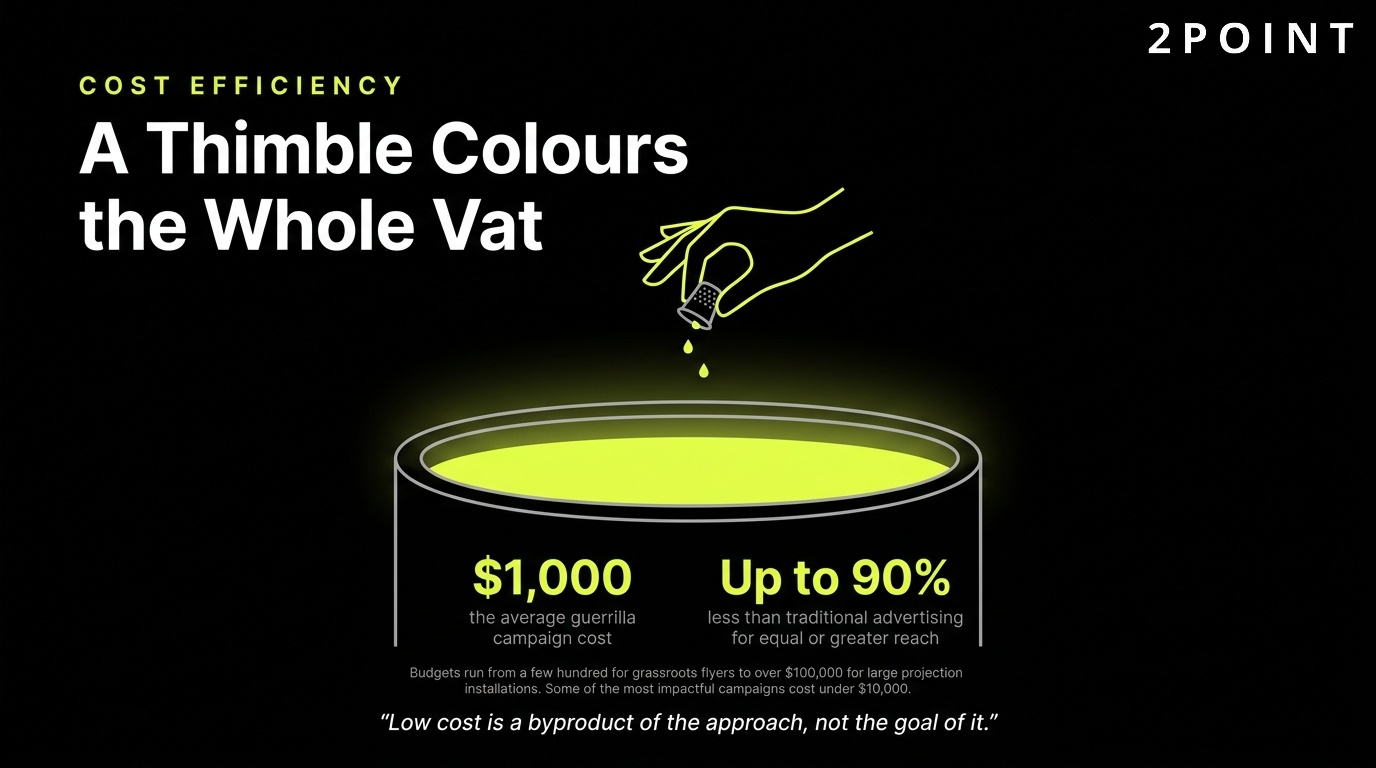
The cost argument for guerrilla marketing is compelling by almost any standard. Implemented effectively, guerrilla tactics reduce marketing costs by almost 90% compared to traditional advertising while generating comparable or superior awareness metrics. The average guerrilla campaign costs approximately $1,000, though this figure requires important context: budgets across the full spectrum of guerrilla executions range from a few hundred dollars for grassroots flyer campaigns to well over $100,000 for large-scale projection installations with significant logistics and production requirements.
Several factors determine where a specific campaign falls within that range. Location permits in major urban markets can represent a significant portion of total campaign cost, particularly for activations in heavily regulated cities or on private property. Production quality affects cost substantially: a hand-painted mural costs differently from a high-resolution digitally printed installation. Campaign duration matters too, as multi-day or multi-week activations require ongoing staffing and maintenance. Technology integration, particularly AR development, adds costs that purely physical campaigns avoid. And team size, including creative, production, and activation staff, is a variable that scales with campaign ambition.
Some of the most impactful guerrilla campaigns in recent history were executed for under $10,000, while others required substantial six-figure investments to deliver the spectacle their concept demanded. The critical insight is that creative quality, not production budget, is the primary predictor of guerrilla marketing success. A brilliant, inexpensive idea will consistently outperform an expensive but predictable one because surprise and originality are the mechanisms that generate the sharing and memorability metrics that justify the investment. Understanding your marketing mix is essential when allocating budget between guerrilla and conventional channels.
Return on Investment and Revenue Impact
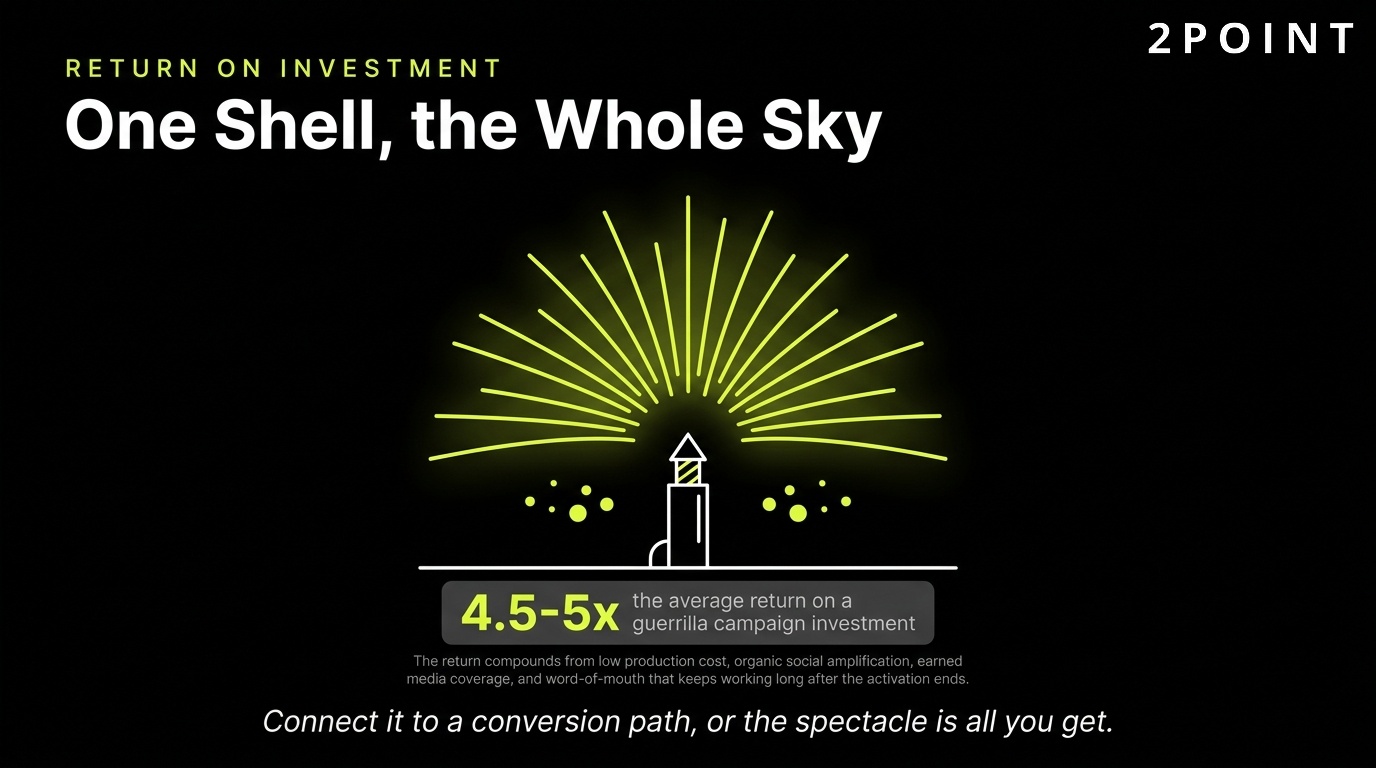
The ROI data for guerrilla marketing is among the most favorable of any marketing channel when campaigns are executed with strategic discipline. The average guerrilla campaign generates a 4.5 to 5x return on initial investment. This figure reflects the compounding effect of multiple value-generation mechanisms operating simultaneously: low upfront production costs, organic social amplification that extends reach without additional spend, earned media coverage from journalists and bloggers, and the sustained word-of-mouth that continues generating brand conversations long after the physical activation has ended.
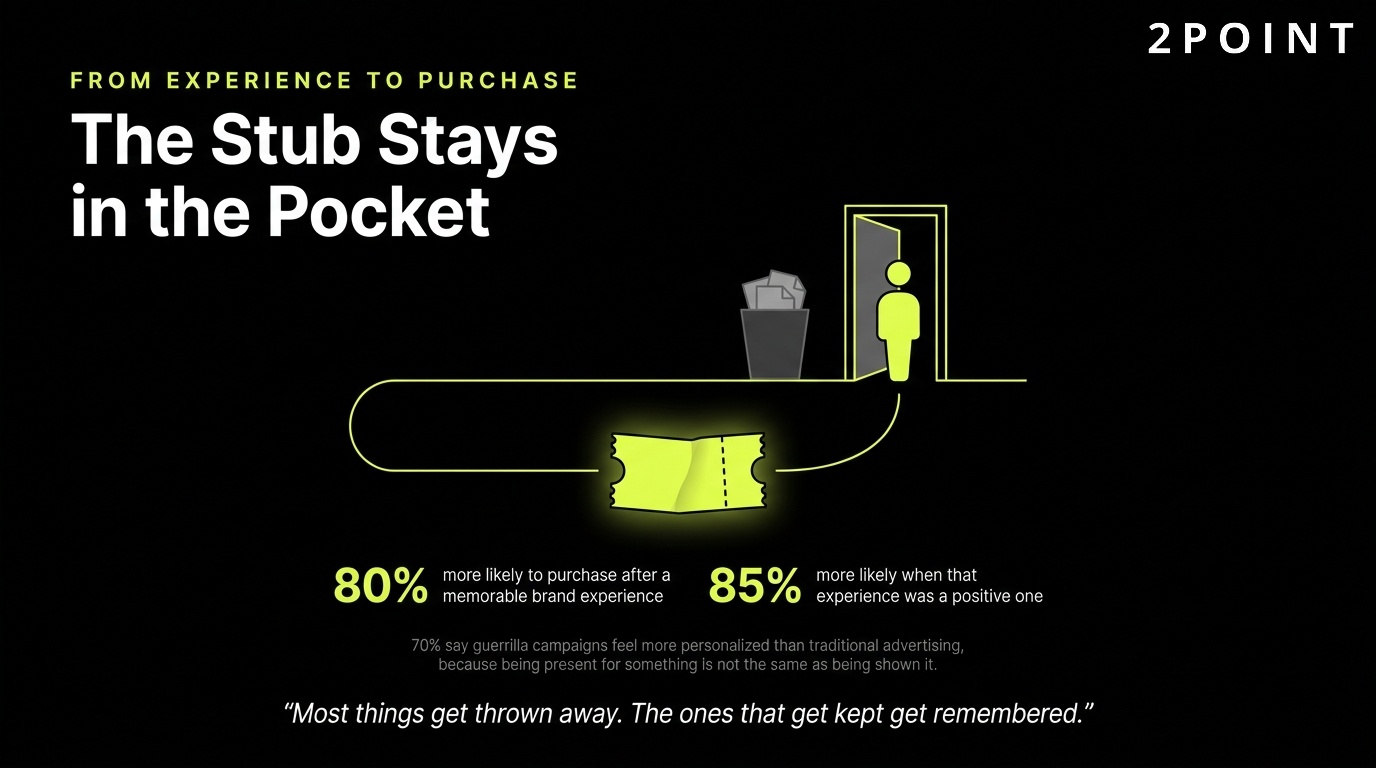
The purchase behavior data reinforces the revenue impact case. 80% of consumers are more likely to purchase a product they associate with a memorable brand experience, and 85% are more likely to buy when that experience was positive. These are not marginal improvements in purchase probability. They represent a substantial shift in consumer intent that translates directly into revenue outcomes when campaigns are aligned with products that can immediately capture the interest generated. Connecting guerrilla activations to a clear conversion pathway, whether that is a product launch, a promotional offer, or a brand experience that leads to a retail visit, is what separates campaigns that generate buzz from those that generate revenue.
Measurement presents a genuine challenge in guerrilla marketing, particularly for physical activations that predate digital tracking. Modern campaigns address this through a combination of unique URLs and QR codes embedded in physical installations, branded hashtags that allow social mention tracking, pre and post-campaign brand awareness surveys, foot traffic data for location-based activations, and earned media monitoring. The discipline to establish clear KPIs before launch, not after, is what allows brands to make an honest assessment of ROI rather than relying on anecdotal success stories. Setting clear marketing goals before the campaign launches is non-negotiable for accurate ROI measurement.
Consumer Engagement and Memorability Metrics
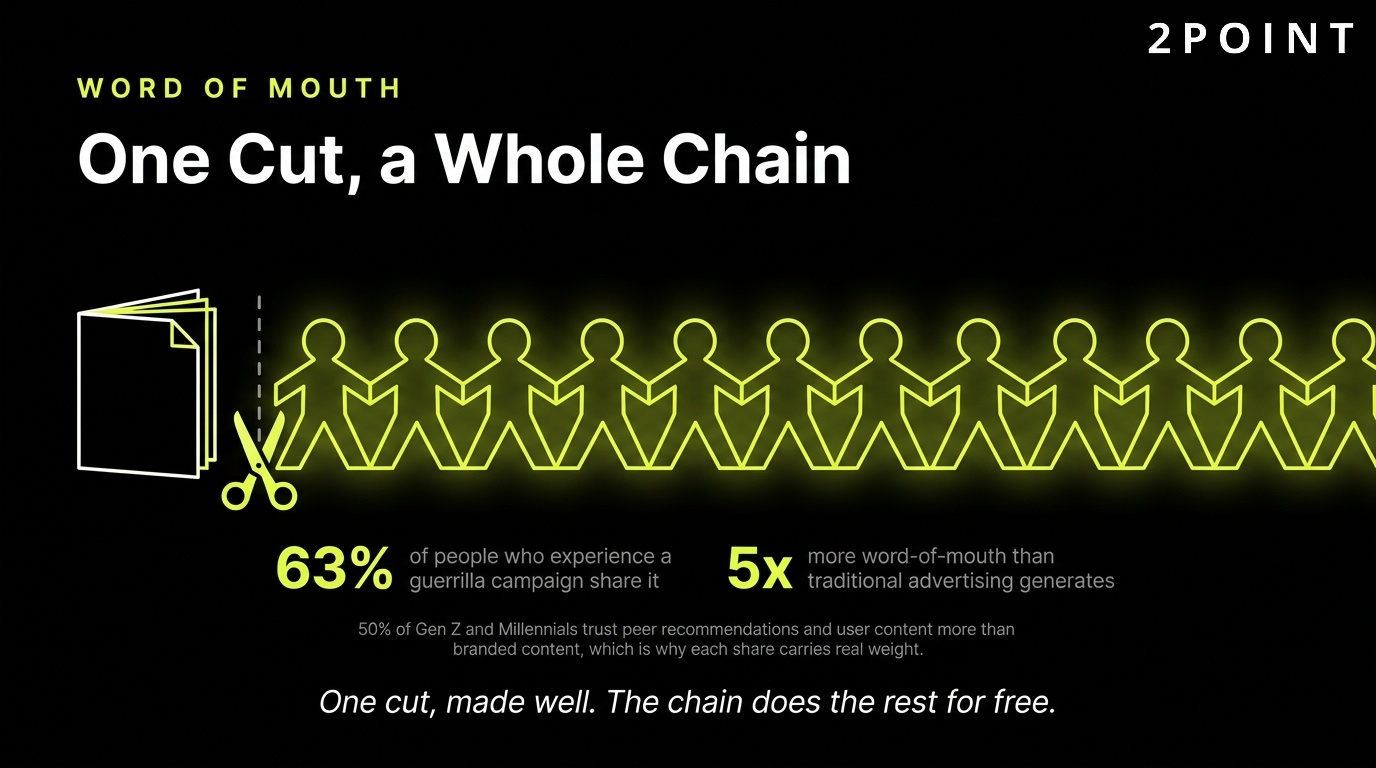
The engagement and memorability statistics for guerrilla marketing consistently outperform every comparable traditional marketing channel by a wide margin. The headline figures are well-established: 90% of consumers find guerrilla campaigns memorable, compared to just 30% for traditional advertising. That is a three-to-one memorability advantage, and it compounds across every downstream metric that marketers track. 70% of consumers believe guerrilla campaigns feel more personalized than traditional advertising, which reflects the experiential nature of the medium. Being physically present for a brand activation feels fundamentally different from seeing an advertisement, even when the rational content of both communications is identical.
The word-of-mouth generation statistics are equally striking. Guerrilla marketing generates five times more word-of-mouth conversations than traditional advertising, and 63% of consumers who experience a guerrilla campaign actively share it with others. This sharing behavior, driven by the intrinsic interest of the experience rather than any incentive from the brand, is the source of guerrilla marketing’s disproportionate reach relative to investment. When over six in ten experiencers become voluntary brand advocates, the effective media buy extends far beyond the initial physical footprint of the activation. Building brand awareness through earned sharing is categorically different from purchasing impression volume.
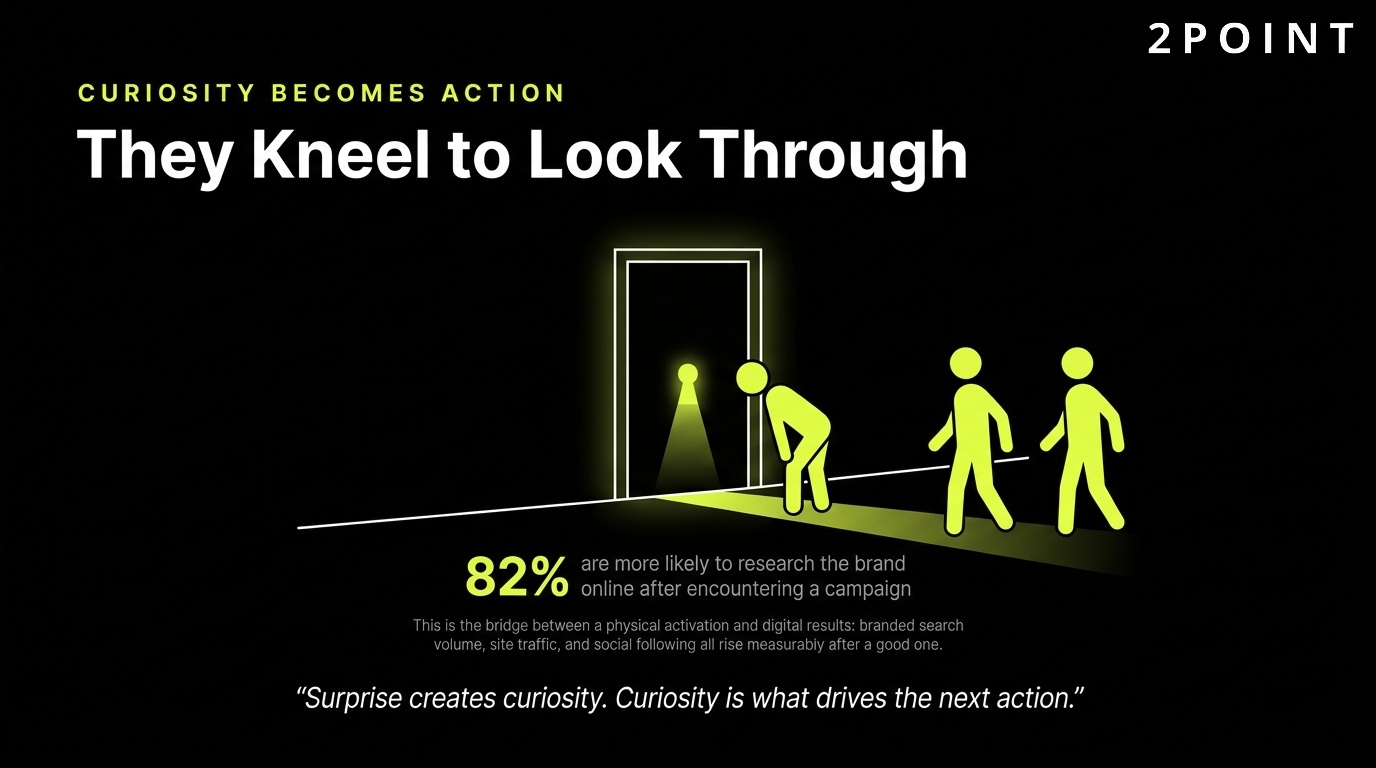
The research behavior data adds another layer of strategic value. 82% of consumers who encounter a guerrilla campaign are more likely to research the brand online afterward. This is the connective tissue between a guerrilla activation and digital marketing results. A well-executed street stunt drives measurable increases in branded search volume, website traffic, and social media following, creating attribution bridges that allow digital marketers to quantify the downstream value of physical activations. The psychological mechanism is simple: surprise and delight create curiosity, and curiosity drives action. Understanding this chain is central to designing campaigns that move people through the full purchase journey rather than simply generating awareness at the top of the funnel. Strong customer engagement strategies can capture and convert this downstream interest into measurable business outcomes.
Comparative Effectiveness Across Demographics
Guerrilla marketing does not perform uniformly across all demographic segments, and understanding these differences is essential for designing campaigns that reach the right audiences most effectively. The strongest performance data consistently points to Gen Z and Millennials as the demographic groups most responsive to guerrilla tactics. This is not surprising given that these are the audiences most immersed in social media culture, most likely to share brand experiences with their networks, and most likely to trust peer recommendations over branded content. 50% of Gen Z and Millennials trust peer recommendations and user-generated content more than branded content, making the word-of-mouth amplification effect that guerrilla marketing generates particularly powerful in reaching these segments.
Organic word-of-mouth is five times more effective than paid advertising in driving brand consideration among these cohorts. For brands targeting Gen Z and Millennial consumers, this data makes a compelling case for guerrilla marketing as a primary channel rather than a supplementary one. Older demographics respond to guerrilla marketing as well, particularly to large-scale physical installations and experiential activations, but the social amplification dynamic is less pronounced because sharing behavior on social platforms decreases with age. Campaigns targeting broader age ranges benefit from designing activations that are physically spectacular enough to generate direct impressions regardless of whether individuals share them on social media.
Guerrilla Marketing Case Studies: Campaigns That Dominated 2025 and 2026
A24 and Timothée Chalamet’s “Marty Supreme” Campaign
The promotional campaign for A24’s “Marty Supreme,” a period ping-pong drama starring Timothée Chalamet, stands as one of the most sophisticated and widely studied guerrilla marketing case studies of 2025. The film faced formidable competition in a crowded Christmas release window, and A24 responded with a multi-layered guerrilla strategy that demonstrated how modern guerrilla marketing operates as a coherent integrated system rather than a collection of individual stunts.
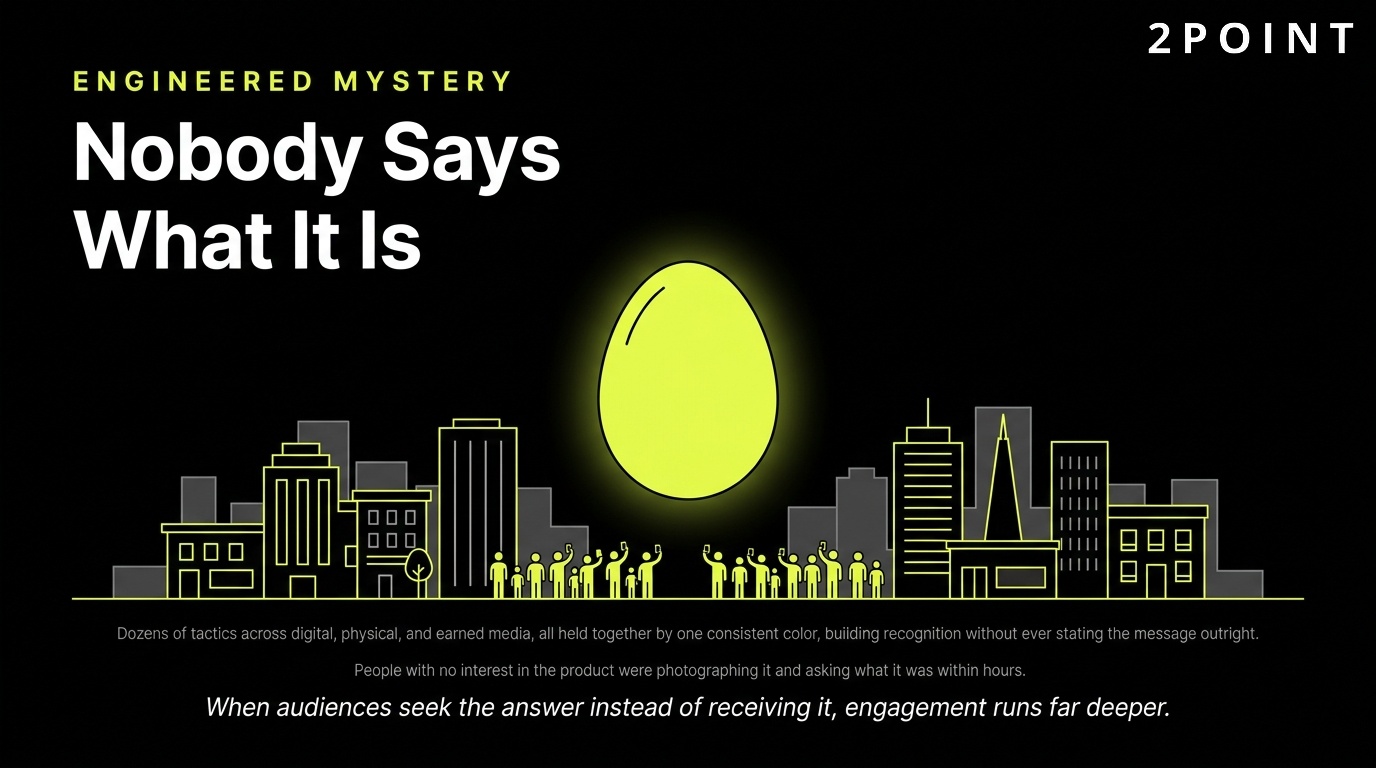
The campaign’s centerpiece was an 18-minute “leaked” video featuring Chalamet pitching absurd promotional ideas to A24 executives, including painting the Statue of Liberty orange and deploying a giant orange blimp over major cities with no accompanying explanation or brand attribution. The blimp, enormous, vibrantly colored, and offering zero context for curious observers, appeared in urban airspace and generated immediate speculation across social media platforms. The activation achieved what million-dollar television campaigns cannot in the current attention economy: genuine intrigue. People who had no interest in seeing a ping-pong drama were photographing the blimp, posting it online, and asking “what is that?” within hours of its appearance.
The strategic coherence that elevated this campaign above typical guerrilla stunts was its consistent orange color branding, applied across dozens of tactics spanning digital, physical, and earned media, maintaining a unified visual identity that built cumulative recognition without requiring explicit brand messaging. The mystery drove engagement in a specific and powerful way: audiences became active participants, seeking out information about the film themselves rather than being pushed toward it by conventional advertising. When audiences seek information rather than receiving it, engagement depth increases substantially. The lessons here translate directly to any brand: unified visual identity, engineered mystery, and letting audiences discover rather than delivering messages to them.
Lessons from “The Drama” Film Campaign Misstep
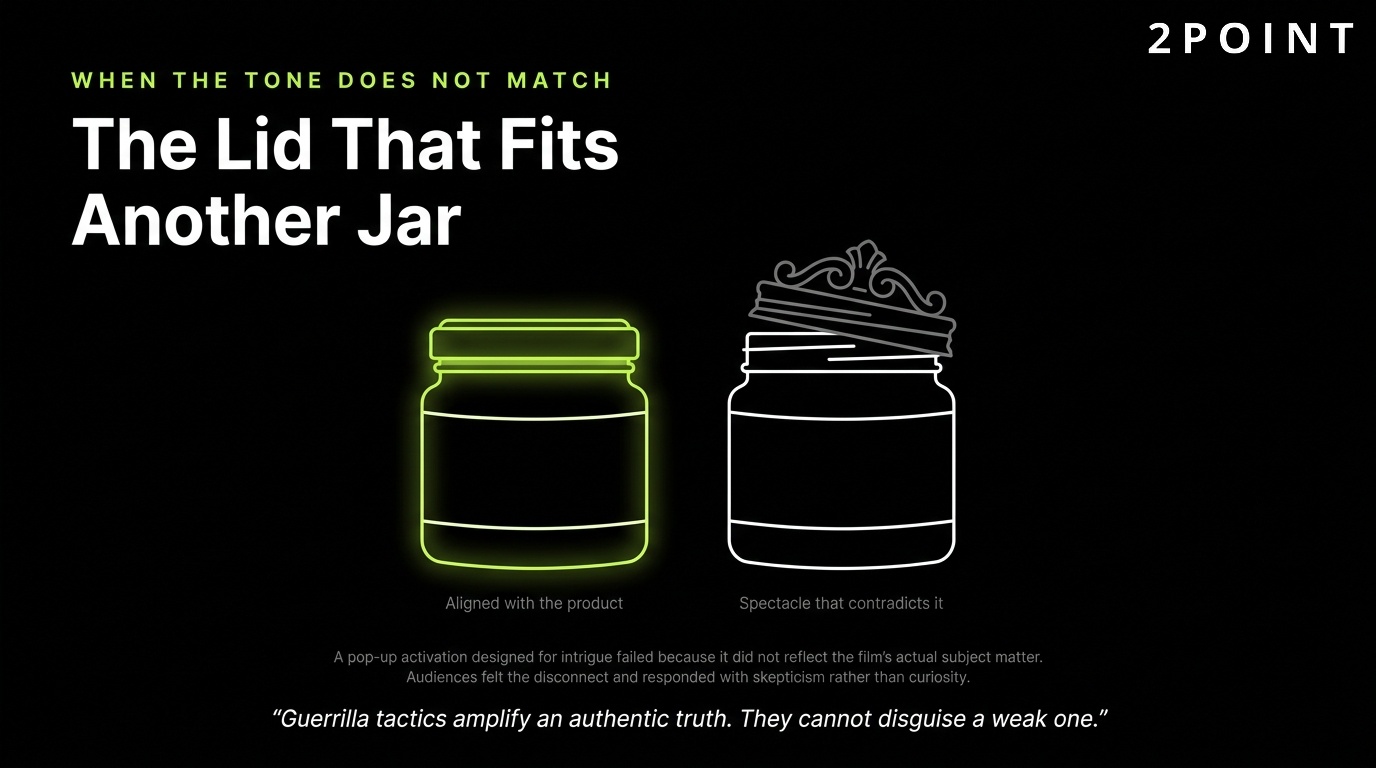
Not every guerrilla marketing campaign generates the outcomes its creators intended, and studying failures is often more instructive than analyzing successes. The promotional campaign for “The Drama,” a film activation that included a pop-up chapel experience in Las Vegas, provides a valuable cautionary case study in the consequences of misalignment between campaign execution and product essence.
The pop-up chapel was designed to create intrigue and surprise, both legitimate guerrilla marketing objectives, but it failed because it did not authentically reflect the film’s subject matter or thematic content. The tone mismatch generated criticism that undermined the campaign’s ability to build positive brand association for the film. Audiences and critics who encountered the activation felt the disconnect between the stunt and the product it was promoting, which produced confusion and skepticism rather than the curiosity and engagement the campaign needed to succeed.
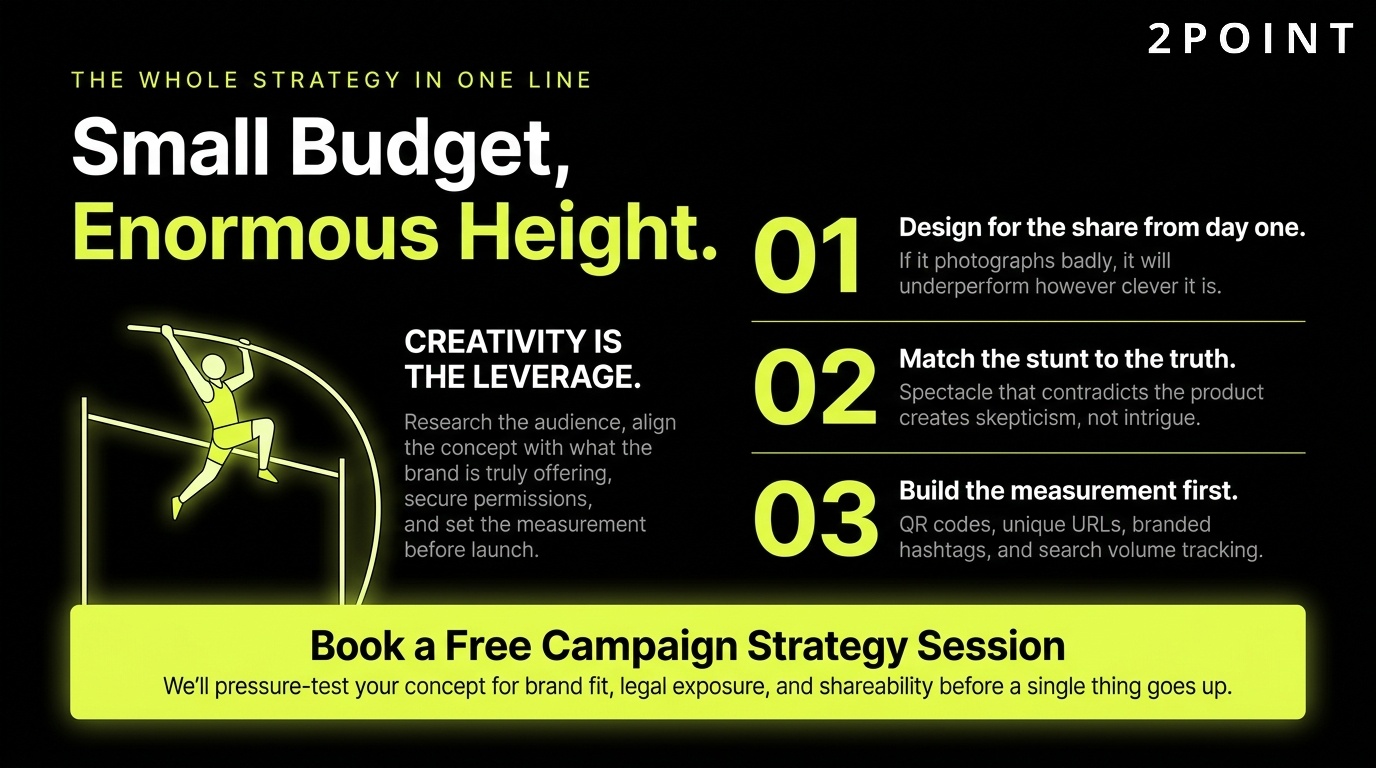
The core lesson is fundamental to guerrilla marketing practice: the power of guerrilla tactics comes from amplifying an authentic brand truth, not from masking a weak concept with spectacle. A surprising activation that is tonally aligned with the product it promotes generates curiosity that converts into genuine interest. A surprising activation that contradicts the product’s essence generates confusion that converts into disengagement. Understanding the product deeply, including its themes, its intended audience, and the emotional experience it offers, must precede all creative development. Guerrilla marketing cannot rescue a poorly understood product from obscurity. It can only accelerate what is already true about a brand into broader cultural awareness.
Historical Successes: Sony Ericsson and Fiji Water
Two campaigns from the early history of modern guerrilla marketing remain instructive reference points because the principles that made them work are unchanged in 2026. Sony Ericsson’s 2002 campaign for its camera phone launch deployed trained actors across ten major cities with a simple brief: approach strangers, hand them the device, and ask them to take a photo. The actors did not identify themselves as brand representatives. The product did the demonstration itself. The campaign was remarkable for its time because it let product experience replace product advertising. Thousands of consumers physically handled the device and experienced its camera quality firsthand, generating immediate tactile brand engagement impossible to replicate through any traditional advertising medium.
Fiji Water’s “Fiji Girl” moment at the Golden Globes demonstrates a different but equally effective guerrilla principle: strategic placement without sponsorship. A model holding a tray of Fiji Water bottles was positioned in the background of celebrity photographs at the red carpet event, which Fiji Water did not sponsor. The photobombing strategy generated brand visibility across thousands of celebrity images shared on social media following the event, delivering the reach of a major sponsorship without any of the associated cost. The model’s expression, slightly detached and directly facing the camera while celebrities posed, became a social media moment in its own right, amplifying the brand recognition far beyond what a straightforward product placement would have generated.
Both campaigns share a principle that remains central to guerrilla marketing in 2026: insert the brand into moments that already have audience attention, rather than attempting to create audience attention from scratch. The most durable guerrilla campaigns align with existing cultural moments and audiences rather than competing against them for attention. Sony Ericsson found its audience in the street. Fiji Water found its audience at an existing spectacle. Both achieved remarkable returns by placing the brand inside a moment rather than asking audiences to come to the brand.
What Makes Guerrilla Marketing Campaigns Go Viral: Common Success DNA
Across the full range of guerrilla marketing campaigns that have achieved viral reach, from Blair Witch Project’s ambiguous documentary-style promotion in the late 1990s to A24’s orange blimp in 2025, a consistent set of structural characteristics predicts success. Campaigns that go viral share three traits: low perceived cost, high weirdness relative to category norms, and a built-in reason for audiences to create their own content. The last trait is perhaps the most important and the most frequently underestimated in the planning process.
Mystery is one of the most reliable drivers of organic engagement. Blair Witch thrived on ambiguity. The Marty Supreme blimp offered no explanation. When people encounter something they cannot immediately categorize or explain, their curiosity becomes an active information-seeking behavior. They search, they post, they ask friends, they share. Each of these actions generates organic brand impressions at zero additional media cost. Designing campaigns around mystery that audiences are motivated to solve transforms passive observers into active brand promoters.
The practical implication is a reframe of the fundamental marketing objective. Instead of asking “how do we reach our audience?” the productive guerrilla marketing question is “how do we create something our audience will reach for?” People share experiences, not advertisements. They share things that make them look clever, curious, or culturally informed for sharing them. When a campaign makes the sharer look good for sharing it, organic distribution follows naturally. This principle applies across every format and budget level, from a brilliantly written sidewalk stencil to a city-scale projection installation. The most successful guerrilla campaigns stop trying to reach audiences and instead become something audiences actively seek.
Strategic Implementation: How to Plan and Execute a Guerrilla Marketing Strategy
Who Should Use Guerrilla Marketing and When
Guerrilla marketing was originally conceived as a competitive tool for small businesses with limited advertising budgets to stand alongside larger, better-resourced competitors. That origin is still visible in its most natural applications: local businesses with creative teams and meaningful community presence, startups looking to generate awareness without the capital for traditional media buys, and independent operators who can move quickly and experiment without corporate approval chains. Some of the most memorable guerrilla campaigns in recent history were created by small brands or independent operators who combined sharp strategic thinking with creative courage and moved fast enough to capitalize on cultural moments before larger competitors could respond.
Large brands have also found significant value in guerrilla tactics, particularly for breakthrough moments that their standard media placements cannot generate. A global brand’s regular advertising may be so familiar to its audience that additional spend produces diminishing returns on awareness and engagement. A guerrilla activation creates the surprise and novelty that cuts through even heavy prior brand exposure. The strategic use case for large brands is typically specific: product launches where maximum attention concentration is needed, competitive moments where differentiation is the priority, or cultural events where a brand wants to create earned media presence without purchasing official sponsorship.
Guerrilla marketing is appropriate in most situations where the brand has creative flexibility, the target audience is reachable in public or digital spaces, and the campaign concept is tonally aligned with what the brand is actually offering. It is less appropriate in highly regulated industries where campaign messaging must meet strict compliance standards, in contexts where surprising consumers could generate fear or offense rather than delight, or in situations where the brand needs to control the exact message delivered without the interpretive variability that physical and experiential activations introduce. Understanding your personalized marketing approach helps clarify where guerrilla tactics fit within a broader strategy.
Campaign Planning: Best Practices and Strategic Considerations
Effective guerrilla marketing campaign planning requires the same strategic discipline as any other significant marketing investment. The unconventional nature of the execution does not excuse unconventional planning. The following framework covers the essential planning elements that consistently separate successful campaigns from those that fail to generate returns:
- Research your target audience deeply. The better you understand what your target audience finds share-worthy, curious, or emotionally resonant, the more likely your concept is to land. Conversely, the deeper your audience knowledge, the less likely your campaign is to backfire by triggering an unintended reaction. Map where your audience physically moves, what platforms they use to share experiences, and what cultural references will make them feel the campaign was made specifically for them. A social media plan built around your audience’s actual sharing behavior is a prerequisite for any digital amplification strategy.
- Embrace creativity and innovation as the primary competitive advantage. A familiar concept, even one executed with high production quality, rarely earns the word-of-mouth that justifies guerrilla marketing investment. Give your creative team explicit permission to pitch bold, uncomfortable ideas. The best guerrilla concepts often feel too weird in the room before they become brilliant in the field. Pressure-test bold ideas for brand alignment and feasibility, but resist the instinct to sand off every rough edge before they get to the street.
- Consider timing and cultural context with precision. A well-timed guerrilla campaign aligned with a current event, cultural season, or trending conversation is far more likely to be organically shared than the same campaign launched without contextual relevance. The same idea at the wrong cultural moment can fall completely flat or generate a negative reaction. Campaign timing decisions should incorporate not just calendar planning but real-time cultural listening.
- Establish measurement infrastructure before launch. Define your KPIs before the campaign goes live. Decide how you will track social mentions, earned media coverage, branded search volume, foot traffic changes, and any direct attribution metrics like QR code scans or unique URL visits. The measurement architecture should be in place on day one, not assembled retrospectively from whatever data happens to be available.
- Secure all necessary permissions and legal clearances in advance. Public space activations often require city permits. Ambush marketing tactics near branded events require legal review. AR campaigns that collect user data require privacy compliance documentation. Failing to secure these elements before launch can result in activation shutdown, fines, or reputational damage that negates all campaign value.
Connecting guerrilla tactics to broader multi-channel marketing planning ensures that the buzz generated by a guerrilla activation converts into sustainable audience growth rather than a single spike in awareness that fades without leaving a lasting impression.
Format Selection and Location Strategy for Guerrilla Marketing
Format selection in guerrilla marketing is determined by four variables: who your target audience is and where they move through the world, the timeline available for campaign planning and execution, the budget allocated for production and activation, and the primary objective the campaign must achieve. These four inputs, combined honestly, point clearly toward the formats most likely to succeed. Ignoring any one of these variables produces campaigns that are either strategically mismatched or operationally unfeasible.
Brand awareness objectives favor high-visibility, long-duration formats. Large-scale murals in high-foot-traffic neighborhoods generate thousands of daily direct impressions and become established local landmarks that people photograph and share repeatedly over weeks or months. Projection advertising delivers high-impact nighttime visibility without permanent installation. Direct engagement objectives favor formats that put brand representatives in physical proximity to potential customers: street teams at relevant events, pop-up experiences that invite participation, interactive installations that require consumer input. Launch event objectives favor formats concentrated along approach routes and in the immediate vicinity of the launch itself: sidewalk stencils, poster campaigns, and street team presence that builds anticipation rather than communicating a completed message.
Location is the single most consequential decision in any guerrilla marketing campaign, because the physical environment is both the medium and the message. The strategy of catching people where they already are, and inserting the brand naturally into that moment, requires deep knowledge of the spatial behaviors of your target audience. A campaign targeting young urban professionals should be designed around transit hubs, lunch routes, and the neighborhoods where they socialize. A campaign targeting families should prioritize parks, school proximity areas, and weekend retail districts. The goal is to make the brand feel like a natural part of the environment the audience already inhabits, capturing attention without feeling intrusive or out of place.
Digital Integration and Amplification Strategy for Guerrilla Campaigns
The most significant predictor of guerrilla marketing success in 2026 is how effectively the physical activation connects to digital amplification. A stunning street installation that generates no social sharing has a strictly limited reach. The same installation, designed with a compelling digital hook and amplified through coordinated social media, email, and community outreach, reaches audiences that are orders of magnitude larger. Pairing a physical stunt with coordinated social media, email, and SMS follow-up keeps the buzz alive for days or weeks beyond the initial activation.
Platform selection for amplification should reflect where the target audience is most active. TikTok is currently the highest-velocity platform for guerrilla content to achieve viral reach, particularly for visually compelling or surprising physical activations. Instagram excels for high-quality photography of large-scale installations, murals, and ambient campaigns. LinkedIn is the platform of choice for B2B guerrilla marketing that targets professional audiences. YouTube accommodates longer-form documentation of complex experiential campaigns. Reddit’s community structure allows detailed campaign content to be discovered and discussed by highly engaged niche audiences. Selecting the right combination of platforms and creating content native to each platform’s format and culture is essential for maximizing organic amplification. A comprehensive social media marketing budget and strategy should be part of every guerrilla campaign plan.
Branded hashtags, challenges, and calls to share user-generated content transform passive observers into active campaign participants and brand amplifiers. The more engagement a campaign receives on social platforms, the more likely platform algorithms are to distribute it to non-followers, creating an expanding organic reach curve. The follow-up phase is where the return on guerrilla marketing investment is secured. Converting attention into owned audience relationships through email list growth, social media following increases, and CRM capture is the mechanism that allows a single guerrilla activation to generate value far beyond its initial campaign window. Attention without conversion is ultimately wasted marketing investment, regardless of how impressive the awareness metrics appear. Investing in strong customer-centric marketing follow-up processes ensures that the audiences guerrilla campaigns attract become long-term brand relationships.
Risks, Ethics, and Legal Considerations in Guerrilla Marketing
Managing Reputational and Legal Risk
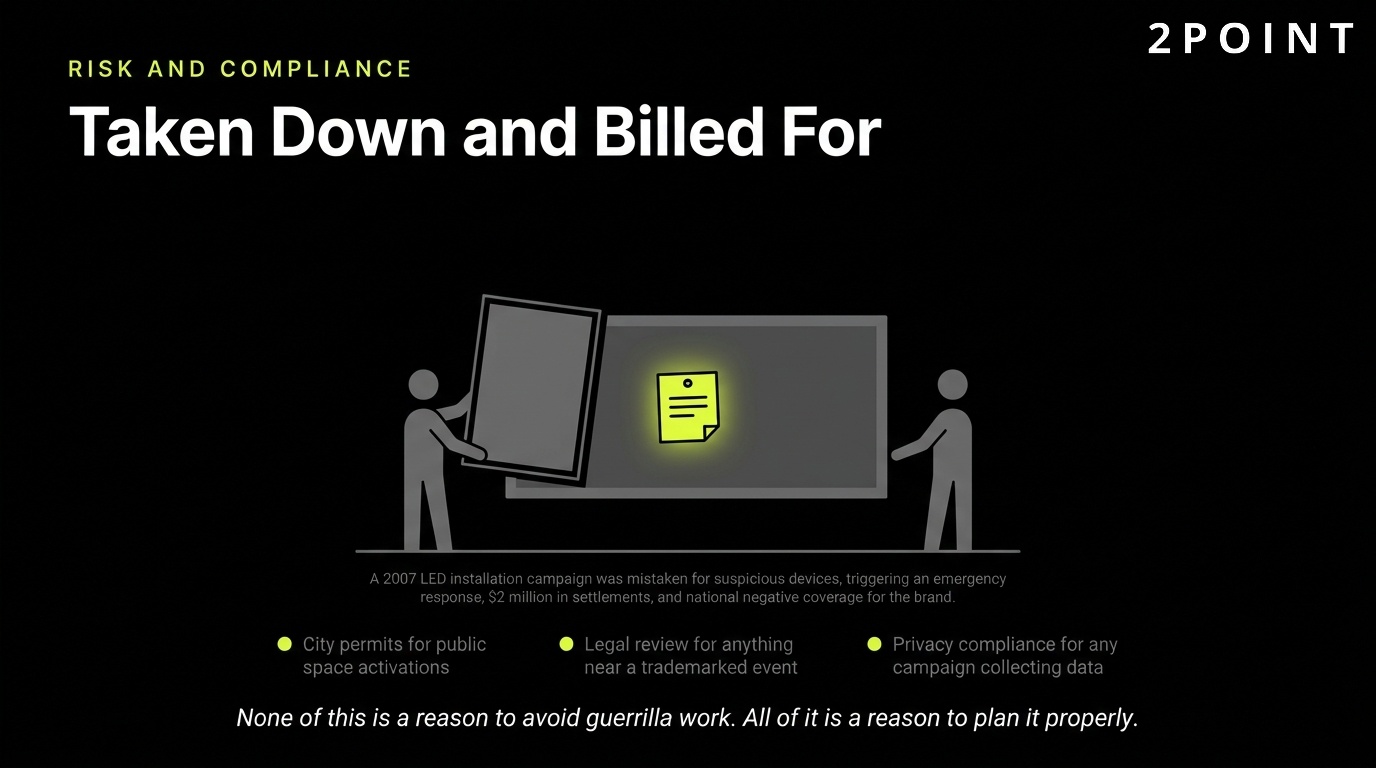
Guerrilla marketing’s power comes from operating at the edges of conventional expectations, and that positioning carries real risks that brands must manage deliberately. The most common risk is miscalculation of audience response. A campaign designed to be surprising and delightful can be perceived as alarming, offensive, or intrusive by audiences who encounter it without the context its creators assumed they would have. The Boston “Lite-Brite” incident of 2007, in which LED advertising installations for a Cartoon Network promotion were mistaken for suspicious devices and triggered a terrorism response, remains the defining cautionary tale. The campaign cost Turner Broadcasting $2 million in settlements and generated national negative press for both the brand and the network.
Legal risks are equally significant and more predictable. Public space activations require permits in most jurisdictions, and activations without permits can be shut down by authorities and result in fines that eliminate any campaign ROI. Ambush marketing near trademarked events can trigger intellectual property claims if the execution is too closely associated with event branding. AR campaigns that collect location or behavioral data must comply with GDPR, CCPA, and applicable local privacy regulations. Stealth marketing campaigns that fail to disclose commercial intent may violate FTC guidelines in the United States and equivalent consumer protection regulations in other markets. None of these risks are reasons to avoid guerrilla marketing, but all of them are reasons to involve legal counsel in the planning process before committing to execution.
Ethical Considerations and Community Impact
Beyond legal compliance, ethical guerrilla marketing requires genuine consideration of community impact. Campaigns that damage public property, create hazards, disrupt communities, or exploit sensitive cultural contexts generate the kind of negative press that no ROI calculation can offset. The distinction between “surprising” and “imposing” is real and consequential: the best guerrilla campaigns create moments that communities find charming, interesting, or genuinely generous. The worst ones leave communities feeling violated or disrespected.
Ethical guerrilla marketing also requires honesty in brand attribution. While mystery and ambiguity are legitimate tactical tools, campaigns that actively deceive consumers about their commercial nature cross an ethical line that damages brand trust when the truth emerges. The social media environment makes eventual disclosure inevitable in almost every case, and brands that were honest about their intent from the start emerge from viral moments with stronger reputations than those that tried to obscure them. Sustainable branding is built on authentic interactions, not manufactured deception, even when the manufacturing is clever.
Low-Cost Guerrilla Marketing Strategies for Small Businesses and Startups
Accessible Tactics with High Impact Potential
Low-cost guerrilla marketing strategies are the category most immediately relevant to small businesses, startups, and independent operators who need to compete for attention without the media budgets available to established brands. The encouraging reality is that the most impactful guerrilla campaigns are rarely the most expensive ones. The creativity, cultural fit, and timing of the execution consistently matter more than production budget in determining how far a campaign travels and how strongly it resonates with its intended audience.
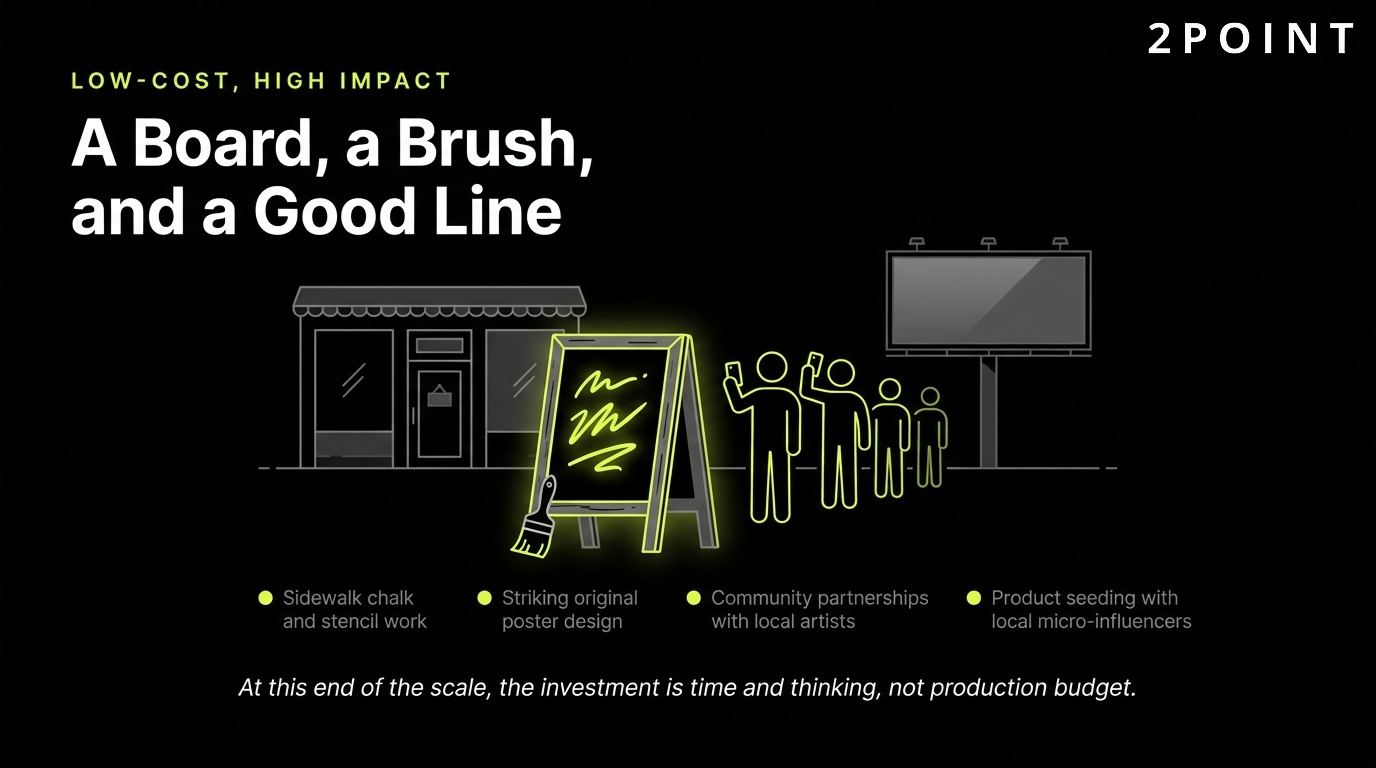
The most accessible low-cost guerrilla tactics include: sidewalk chalk art and stenciling (inexpensive materials, no permit required in most jurisdictions, high visibility in pedestrian zones), creative poster and flyer campaigns using striking original design (low production costs, wide placement options, easily tracked with QR codes), social media challenges built around user-generated content (zero production cost if the challenge concept is compelling enough to spread organically), strategic product seeding with local micro-influencers who have authentic relationships with the target audience (low cost relative to large-scale influencer contracts, high trust transfer), and pop-up experiences in unexpected locations that create a genuine community event around the brand.
The principle that connects all of these tactics is this: at the low-cost end of guerrilla marketing, the investment is primarily time and creative thinking rather than production budget. Brands that invest seriously in creative development, even when that means extensive brainstorming and iteration around a simple concept, consistently outperform brands that spend more but think less. Growth opportunities for startups frequently come from precisely this kind of creative leverage: achieving brand recognition that should require millions of dollars through ideas that cost almost nothing to execute.
Building a Viral Loop Through Community and Peer Networks
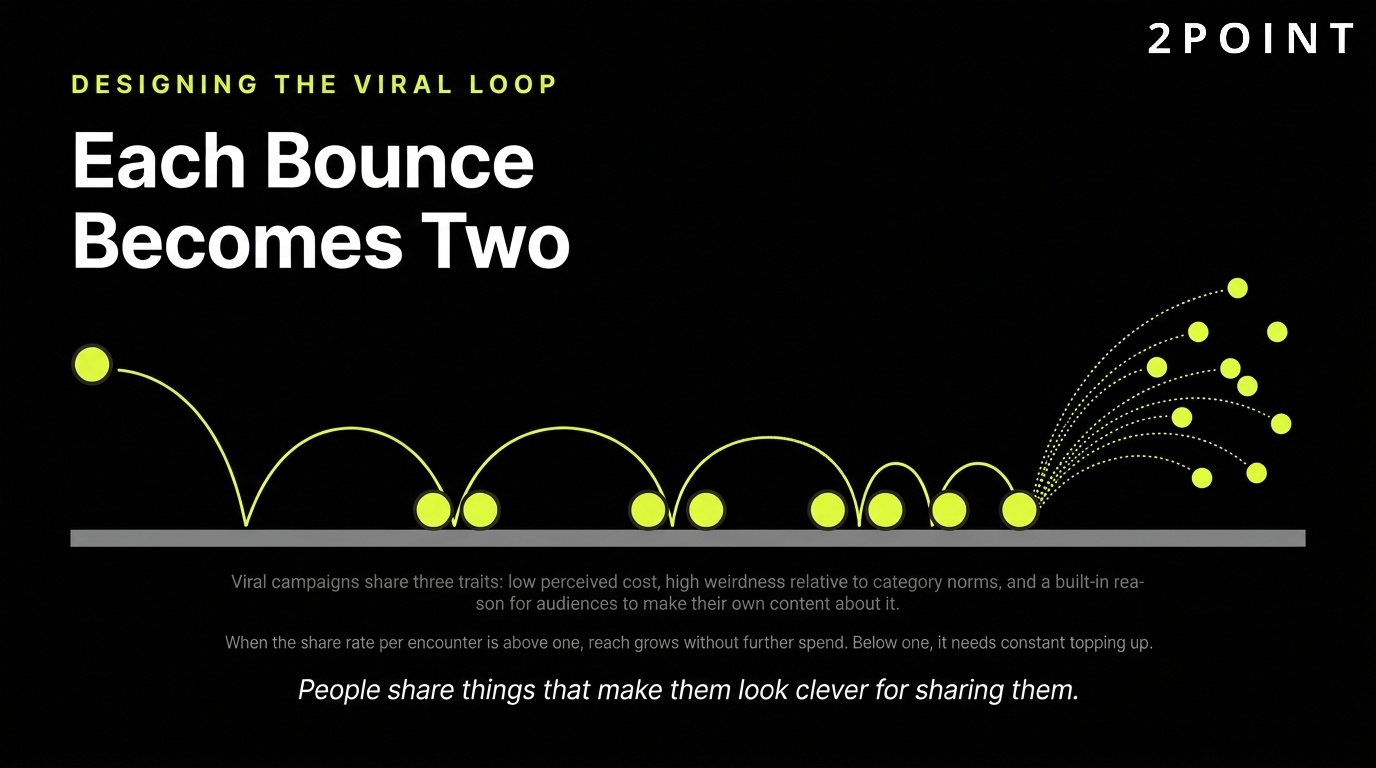
The most scalable low-cost guerrilla strategy is one that builds a viral loop: an activation designed so that each person who encounters it has a natural, motivated reason to share it with at least one other person in their network. When the share rate per encounter exceeds one, the campaign grows organically without additional investment. When it falls below one, the campaign requires ongoing spend to maintain visibility. Designing for viral loops means asking, at every stage of concept development: “Why would someone who sees this feel compelled to tell someone else about it?”
Community partnerships are among the most underutilized low-cost guerrilla tools available to small businesses. Collaborating with local artists, neighborhood organizations, community events, and complementary businesses allows a brand to borrow existing trust and audience attention from established community relationships. A coffee shop that sponsors a local artist’s mural on its exterior wall creates a piece of public art that the artist’s audience will share, the neighborhood will discuss, and local press may cover. The brand investment is a fraction of what a traditional outdoor advertising placement would cost, and the community goodwill generated is something no traditional billboard can create.
Digital channels provide the amplification infrastructure that allows community-level guerrilla activations to reach audiences far beyond the immediate geographic area. When a remarkable local event is documented on TikTok or Instagram and resonates with a broader audience, the local brand behind it gains national or even international visibility at no additional cost. This dynamic has fundamentally democratized brand building in ways that benefit small businesses disproportionately, provided they design their activations with both local impact and digital shareability in mind. The combination of local authenticity and digital reach is precisely where small brands can compete with, and sometimes decisively beat, their larger competitors. Aligning these efforts with clear marketing goals ensures that low-cost guerrilla efforts contribute measurably to business growth rather than generating buzz without direction.
Viral Marketing and Experiential Marketing: Where Guerrilla Tactics Converge
The Relationship Between Viral Marketing and Guerrilla Strategy
Viral marketing and guerrilla marketing share deep structural overlap in 2026, to the point where the distinction between them has become genuinely blurry in practice. Both disciplines prioritize organic reach over paid distribution. Both rely on creating content or experiences so compelling that audiences choose to share them without being prompted or incentivized to do so. The difference, if one exists at this point, is primarily one of medium: viral marketing originated as a digital-first concept, while guerrilla marketing originated as a physical-first concept. In practice, the most effective modern campaigns combine both, using physical activations to generate content that goes viral digitally.
The convergence is visible in how campaign success is now measured. Physical guerrilla activations are routinely evaluated by their social media metrics: the number of organic posts, the reach of associated hashtags, the number of earned media mentions, and the growth in brand social following during and after the activation window. These are fundamentally viral marketing metrics applied to physical marketing executions. This cross-pollination has made both disciplines stronger: guerrilla marketing is now more scalable because of digital amplification, and viral marketing is now more memorable because of its physical anchoring. Linking guerrilla tactics to broader engagement strategies maximizes the downstream value of each activation.
Experiential Marketing as the Premium Expression of Guerrilla Principles
Experiential marketing represents the highest-investment, highest-engagement expression of guerrilla marketing principles. Where basic guerrilla tactics aim to generate a surprising encounter that people photograph and share, experiential marketing aims to create an immersive brand experience that people participate in deeply and remember for years. The principles are identical: strategic placement, surprise, emotional resonance, and shareability. The execution is more elaborate, more resource-intensive, and more targeted to specific audience segments.
Experiential campaigns often incorporate elements from multiple guerrilla formats simultaneously: a street marketing presence, an ambient environment that transforms a space, AR overlays that deepen the experience, and brand ambassador teams that guide participants through the activation. The result is a multi-layered encounter that engages participants for minutes or hours rather than seconds. The memorability and brand sentiment data from experiential campaigns consistently exceeds that from simpler guerrilla executions, which justifies the increased investment for brands pursuing sustained relationship building rather than one-time awareness spikes.
The democratization of experiential marketing tools, particularly AR development platforms and modular pop-up construction systems, has made more sophisticated experiential activations accessible to mid-size brands that previously could not afford large-scale experiential production. This trend is accelerating, and the competitive advantage it offers to brands willing to invest in creating genuine experiences rather than purchasing standard media placements is significant. For brands exploring these options, understanding where experiential marketing fits within a complete marketing strategies framework ensures that experiential investments are aligned with broader business objectives rather than pursued as standalone spectacle.
Guerrilla Marketing in 2026: The Competitive Advantage of Unexpected Creativity
Guerrilla marketing in 2026 occupies a unique and valuable position in the modern marketing landscape. It is simultaneously one of the oldest and most consistently effective approaches to brand building, and one of the most rapidly evolving disciplines in response to new technologies and shifting consumer behaviors. The fundamental principles that Jay Conrad Levinson articulated in the early 1980s remain as valid today as they were then: creativity over budget, surprise over repetition, earned attention over purchased placement, and emotional resonance over rational argument. What has changed is the infrastructure available to amplify those principles to previously impossible scale.
The statistics make a compelling case on their own terms. A 4.5 to 5x average return on investment, 90% consumer memorability, and five times the word-of-mouth generation of traditional advertising are outcomes that any marketing discipline would be proud to claim. The fact that these outcomes are achieved at a fraction of the cost of conventional media buys makes guerrilla marketing not just effective but genuinely disruptive of the traditional advertising value equation. For brands that invest in creative thinking, strategic placement, and digital amplification, the competitive advantage available through guerrilla tactics is substantial and durable.
The challenges are real and deserve honest acknowledgment. Guerrilla marketing requires creative courage that many organizations find genuinely difficult to sustain. It requires legal and community diligence that is easy to skip in the excitement of a great concept. It requires measurement discipline that many practitioners resist because it makes accountability unavoidable. And it requires integration with digital amplification strategies that demands cross-functional collaboration between physical marketing teams and digital specialists who may operate in entirely separate organizational structures.
For businesses ready to invest in the creative thinking and strategic discipline that guerrilla marketing demands, the rewards are compelling. Campaigns that cost a fraction of traditional media buys generating equivalent or superior awareness, memorability, and word-of-mouth. Brand experiences that consumers choose to share rather than skip. Cultural moments that position a brand as genuinely interesting rather than simply present. These are outcomes worth pursuing, and the framework for achieving them is well-established for brands willing to do the work.
Teams looking to develop guerrilla marketing campaigns that combine physical impact with digital amplification and measurable business results benefit from working with strategic partners who understand both the creative and analytical dimensions of the discipline. 2POINT brings this integrated perspective to every campaign, helping brands design activations that are as strategically rigorous as they are creatively bold.
Frequently Asked Questions About Guerrilla Marketing
What is guerrilla marketing in simple terms?
Guerrilla marketing is an unconventional promotional strategy that uses creativity and surprise to promote a brand in public spaces without relying on large advertising budgets. Instead of placing messages where consumers expect ads, guerrilla marketing creates unexpected experiences that people remember and share. The term comes from guerrilla warfare, referencing the use of small, agile tactics to achieve outsized results against more powerful opponents.
How much does a guerrilla marketing campaign cost?
The average guerrilla marketing campaign costs approximately $1,000, though actual costs vary widely depending on the scope of execution. Simple grassroots tactics like flyer campaigns or sidewalk art can cost a few hundred dollars, while large-scale installations with technology integration can exceed $100,000. The key advantage is that guerrilla tactics cost up to 90% less than traditional advertising while often generating superior memorability and engagement.
What is the difference between guerrilla marketing and traditional marketing?
Traditional marketing places messages in environments where consumers expect them, such as television commercials, billboards, and social media ads, relying on paid media placement for distribution. Guerrilla marketing places unexpected experiences in environments where consumers do not anticipate brand interaction, relying on surprise and creativity to earn attention organically. Guerrilla marketing generates 90% consumer memorability versus 30% for traditional advertising and five times more word-of-mouth at significantly lower cost.
Is guerrilla marketing legal?
Guerrilla marketing is legal when executed with appropriate permits, permissions, and compliance with local regulations. Public space activations typically require city permits, and ambush marketing near branded events requires legal review to avoid trademark infringement. AR campaigns that collect user data must comply with applicable privacy laws such as GDPR and CCPA. Securing legal clearances before execution is essential, as unauthorized activations can result in fines, campaign shutdown, and reputational damage that eliminates any campaign ROI.
What types of businesses benefit most from guerrilla marketing?
Guerrilla marketing was originally designed for small businesses competing against larger, better-resourced competitors, and it remains highly effective for startups, local businesses, and independent operators with limited advertising budgets. Large brands also use guerrilla tactics for product launches, competitive differentiation, and breakthrough awareness moments that conventional media spend cannot generate. The strategy is effective across business sizes because creative thinking, not budget size, is the primary competitive advantage.
How do you measure the ROI of a guerrilla marketing campaign?
Guerrilla marketing ROI is measured through a combination of direct and indirect metrics: unique URLs and QR code scans embedded in physical installations, branded hashtag tracking for social mentions, pre and post-campaign brand awareness surveys, earned media monitoring, and foot traffic data for location-based activations. Establishing these measurement systems before the campaign launches is critical, as retrospective measurement misses significant portions of total campaign impact. The average guerrilla campaign generates a 4.5 to 5x return on investment when measured comprehensively.
What is the difference between guerrilla marketing and experiential marketing?
Guerrilla marketing is a broad category of unconventional promotional tactics focused on surprise and creativity in public spaces, while experiential marketing is a premium subset focused on creating immersive, multi-sensory brand experiences that participants engage with deeply over a longer period. Guerrilla marketing encompasses simple activations like street art and flash mobs; experiential marketing typically involves larger-scale, more resource-intensive productions. Both share the core principles of earned attention, emotional resonance, and shareability.
Does guerrilla marketing work for B2B brands?
Guerrilla marketing works for B2B brands when the tactics are adapted to professional audience contexts. Trade show ambush activations, LinkedIn-native viral content, creative direct mail campaigns that surprise recipients, and memorable presence at industry events are all effective B2B guerrilla formats. The key adaptation is selecting tactics that reach business decision-makers in the contexts where they are most receptive, which may differ significantly from the public spaces and social platforms that work best for consumer brands. Reviewing proven B2B marketing strategies ensures that guerrilla tactics are calibrated for professional audience expectations.
How has social media changed guerrilla marketing?
Social media has transformed guerrilla marketing from a locally experienced, one-time activation into a globally amplified brand moment. Before platforms like TikTok, Instagram, and X reached their current scale, a guerrilla stunt was seen only by those physically present. Today, a remarkable activation designed with shareability in mind can reach millions of viewers within hours at no additional media cost. This shift has made visual impact, photographic clarity, and clear brand attribution in images and videos as strategically important as the physical execution itself.
What are the biggest risks of guerrilla marketing?
The most significant risks of guerrilla marketing are tonal miscalculation that generates offense or alarm rather than delight, legal exposure from unpermitted activations in public spaces, privacy compliance failures in technology-enabled campaigns, and brand-content misalignment where the campaign does not authentically represent what the brand is offering. All of these risks can be managed through thorough audience research, legal review, transparent data practices, and deep pre-launch alignment between creative concept and brand essence.
What is viral marketing and how does it relate to guerrilla marketing?
Viral marketing is the strategy of creating content or experiences so compelling that audiences share them organically across their own networks, generating exponential reach without additional media spend. It originated as a digital-first concept but has converged significantly with guerrilla marketing in practice, since the most effective guerrilla activations are designed to generate viral social media sharing. In 2026, the two disciplines are often implemented as a single integrated strategy where physical guerrilla tactics create the content that viral marketing distributes at scale. 63% of consumers who experience a guerrilla campaign share it with others, making viral amplification a natural outcome of strong guerrilla execution.
How do augmented reality and AI enhance guerrilla marketing campaigns?
Augmented reality enhances guerrilla marketing by enabling brand experiences that blend physical and digital elements, creating interactive moments impossible with physical installations alone. AR campaigns can be updated remotely, experienced globally through mobile devices, and designed to engage participants for far longer than passive visual displays. Artificial intelligence enhances guerrilla marketing through predictive analytics that improve location and timing decisions by up to 35%, hyper-personalization of messaging that increases campaign effectiveness by up to 40%, and real-time optimization that allows campaigns to adapt dynamically to social media response and changing external conditions.