


 let’s connect


What Is Plastic Surgery SEO and Why Does It Matter in 2026?
Plastic surgery SEO is the specialized practice of optimizing a cosmetic or reconstructive surgery practice’s online presence to rank higher in Google search results and local Map Pack listings. It combines technical website optimization, local search strategies, reputation management, and medically credible content creation to attract qualified patients who are actively searching for procedures.
- Plastic surgery SEO targets patients at high-intent search moments, not passive audiences.
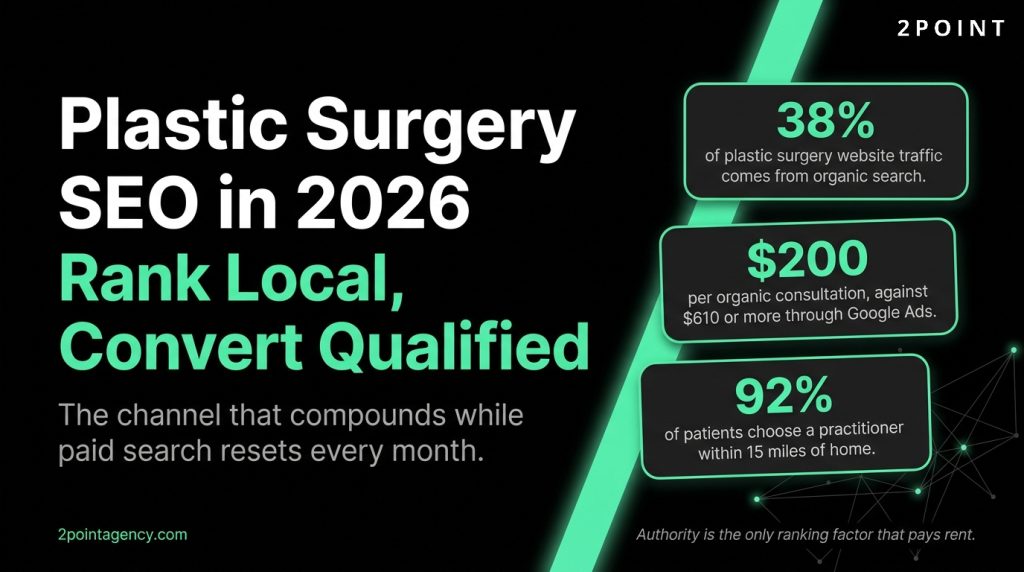
- Organic search drives 38% of plastic surgery website traffic, making it the single largest traffic channel.
- Organic search generates consultations at approximately $200 per patient, versus $610 or more through Google Ads.
- 92% of patients choose practitioners within 15 miles, making local ranking a direct revenue driver.
- 28.5% of all searchers click the first organic Google result, rewarding top-ranked practices disproportionately.
- In 2026, AI Overviews appear on virtually every procedure query, requiring both traditional SEO and generative engine optimization.
- Meta’s January 2025 lower-funnel advertising ban for healthcare removed a major paid social option, elevating SEO’s strategic importance.
- A well-executed SEO strategy compounds in value over time, unlike paid ads that stop the moment budget runs out.
The bottom line: plastic surgery SEO is no longer a supplementary marketing tactic. In 2026, it is the most stable, cost-effective, and scalable patient acquisition channel available to cosmetic and reconstructive surgery practices.
The Economic Case for Plastic Surgery SEO: Why Organic Outperforms Paid
Every marketing investment a plastic surgery practice makes should be evaluated against one core question: what is the cost to acquire a qualified consultation? When you analyze the data across paid and organic channels, the economics consistently favor a well-executed SEO strategy, particularly in an environment where advertising restrictions have narrowed the paid landscape significantly.
Patient Acquisition Cost Analysis: SEO vs. Paid Advertising
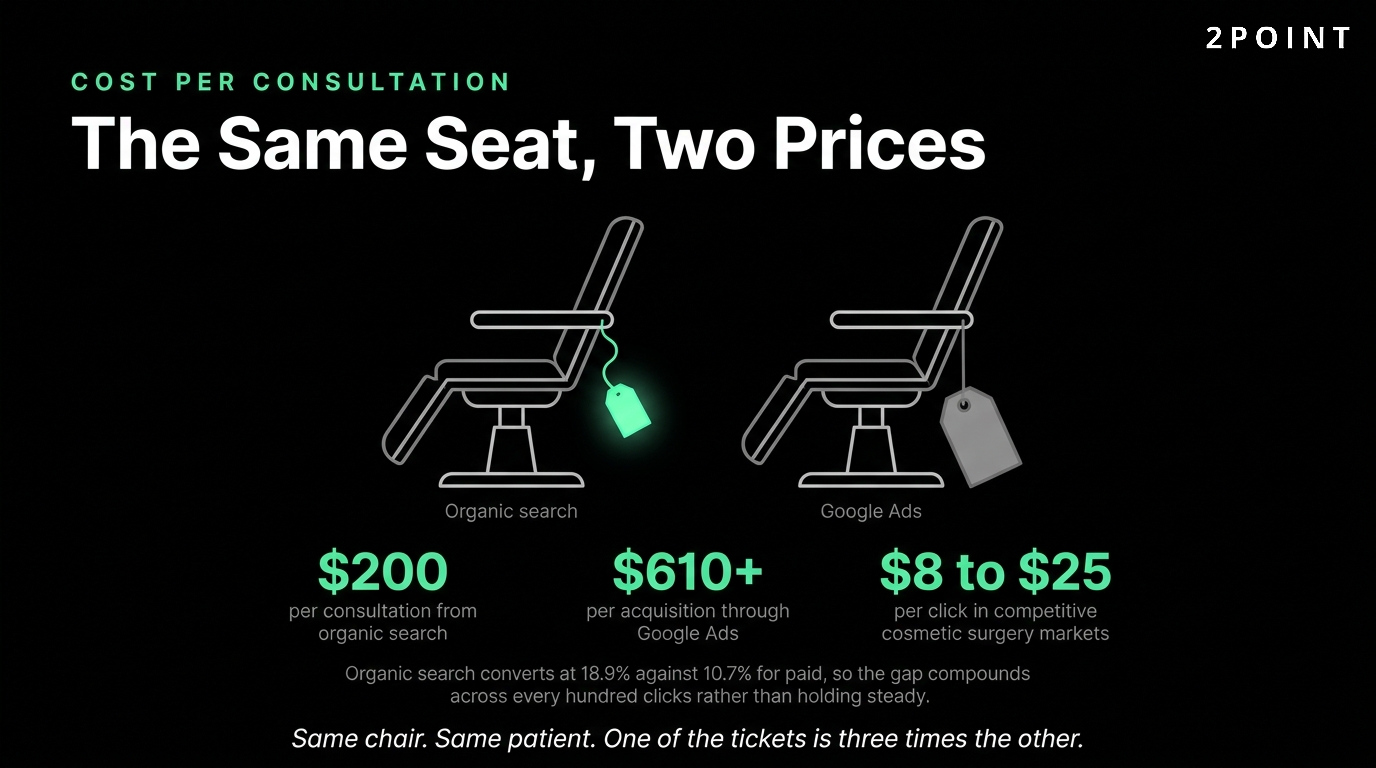
The financial case for plastic surgery SEO begins with a simple comparison. Organic search generates consultation requests at approximately $200 per patient, while Google Ads typically cost $610 or more per acquisition. Pay-per-click costs in the cosmetic surgery space range from $8 to $25 per click depending on the procedure and market, and those clicks convert at roughly 10.7% compared to organic search’s 18.9% conversion rate. That gap in conversion efficiency compounds significantly when multiplied across hundreds of monthly clicks.
The competitive paid advertising landscape has become even more restrictive. Meta’s January 2025 lower-funnel advertising ban for healthcare advertisers eliminated a previously reliable channel for driving consultations through social media. Google Local Services Ads, which carry a trust badge and appear at the very top of search results, remain ineligible for plastic surgery practices in most markets due to category restrictions. This convergence of restrictions means that organic search is not just cost-effective; it is increasingly the only scalable channel without significant compliance risk.
One important nuance to set expectations correctly: SEO is not an overnight solution. Implementation of foundational elements typically takes two to four weeks, and stable competitive rankings generally emerge within six to twelve months. Practices that understand this timeline and commit to the full investment cycle consistently outperform competitors who treat SEO as a short-term campaign rather than a long-term asset.
Search Volume by Procedure Category: Where the Demand Actually Is
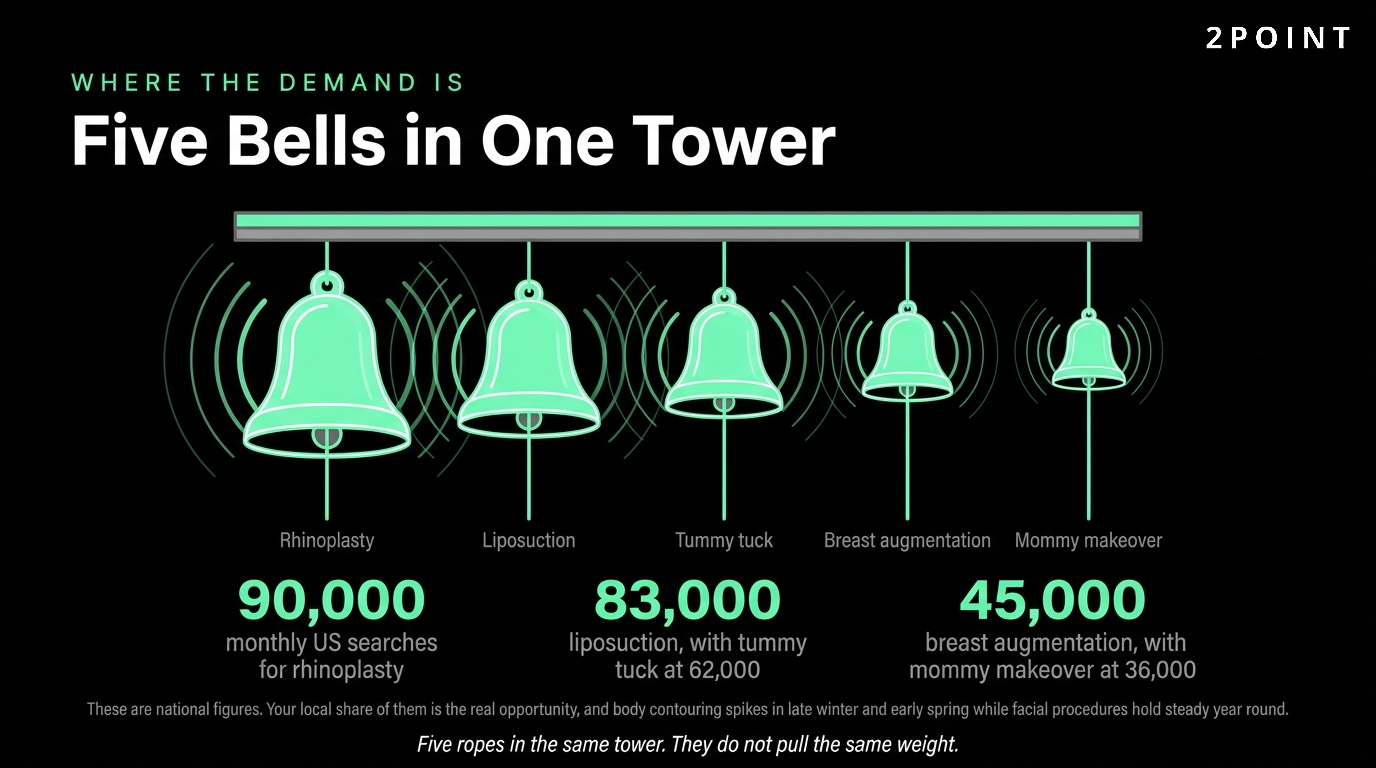
Understanding the search landscape by procedure helps practices prioritize their SEO investments toward the highest-volume and highest-value opportunities. Monthly US search volumes vary considerably by procedure. Rhinoplasty leads with approximately 90,000 monthly searches, followed by liposuction at 83,000, tummy tuck at 62,000, breast augmentation at 45,000, and mommy makeover at 36,000. These are national-level numbers; local market share of these searches represents the real opportunity for individual practices.
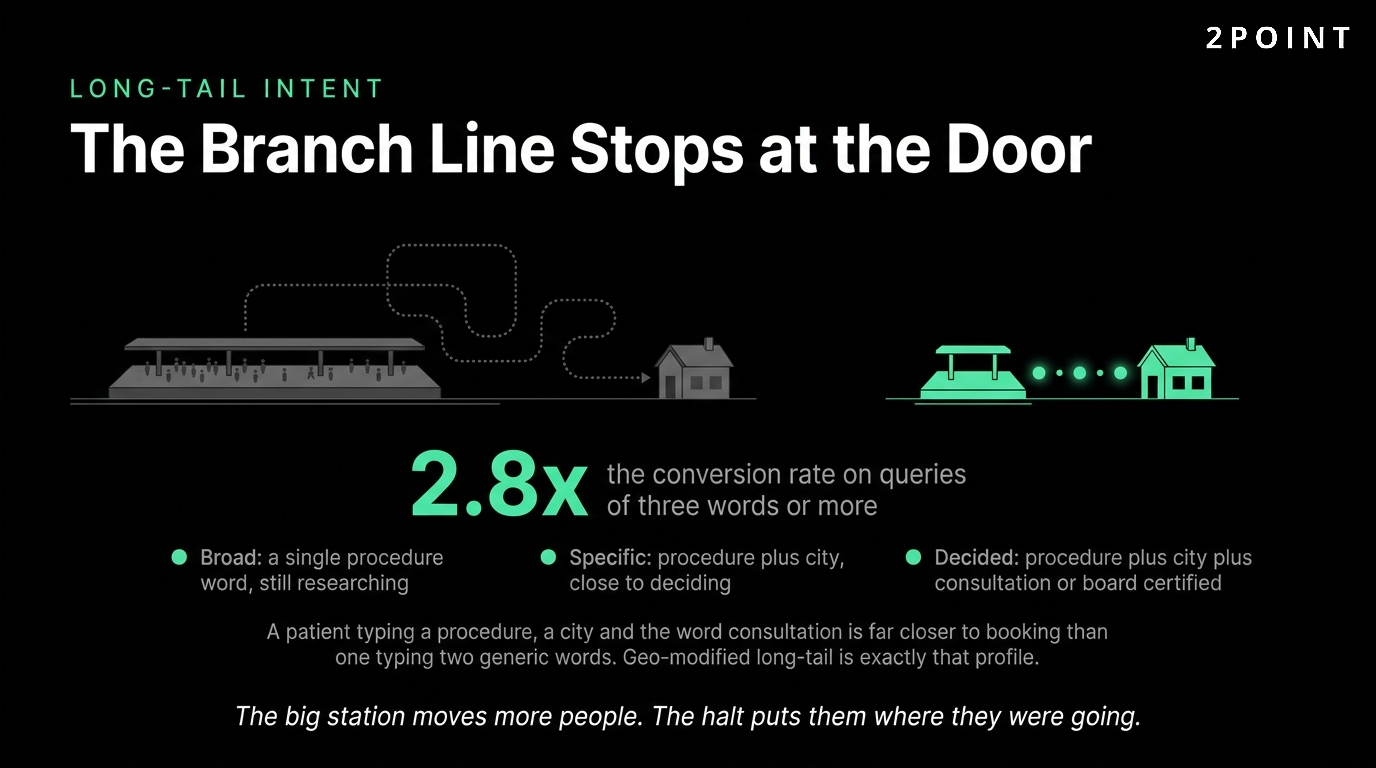
The most important keyword insight for plastic surgeons is the long-tail advantage. Queries containing three or more words convert at 2.8 times the rate of shorter, broader searches. A patient typing “rhinoplasty surgeon Boston consultation” is considerably closer to booking than one typing “nose surgery.” Geo-targeted keyword combinations such as “breast augmentation Beverly Hills” or “tummy tuck Chicago board certified” capture local intent at the exact moment of decision.
Seasonal patterns also influence procedure-specific demand. Body contouring procedures such as liposuction and tummy tucks see search spikes in late winter and early spring as patients plan for summer. Facial procedures tend to have more consistent year-round demand. Understanding these rhythms allows practices to align content publishing, review generation efforts, and GBP post activity with the natural ebb and flow of patient intent.
The Compounding Value of Organic Rankings
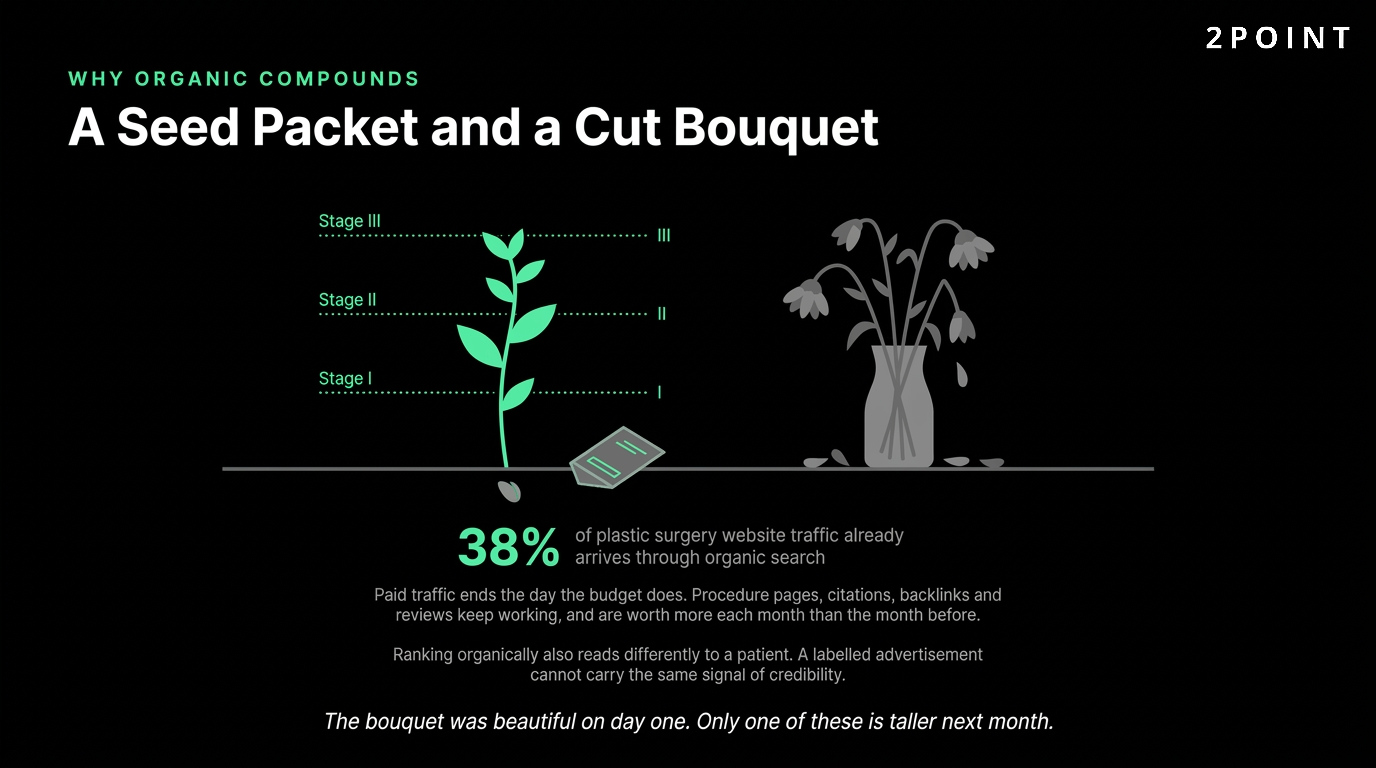
The most financially significant difference between SEO and paid advertising is not the cost per acquisition at any single moment; it is the trajectory over time. Paid advertising generates patients as long as the budget runs, and then stops completely. Organic rankings, once earned, continue delivering traffic and consultations without ongoing per-click costs. The infrastructure of quality procedure pages, backlinks, citations, and reviews becomes more valuable month over month, not less.
There is also a brand authority benefit that does not appear directly in acquisition cost calculations. Practices that rank organically at the top of search results are perceived differently by prospective patients than practices that appear only in the paid ad section. Organic visibility signals credibility and authority in a way that labeled advertisements cannot replicate. That perception influences conversion rates, review rates, and even word-of-mouth referrals.
A 24-month comparison between sustained paid campaign investment and SEO investment consistently favors SEO in total practice growth, even accounting for the slower ramp-up period. Organic search already accounts for 38% of plastic surgery website traffic, and that percentage grows as practices build authority. Compounding is the mechanism that makes SEO the superior long-term investment.
Platform Restrictions Driving the Shift Toward SEO
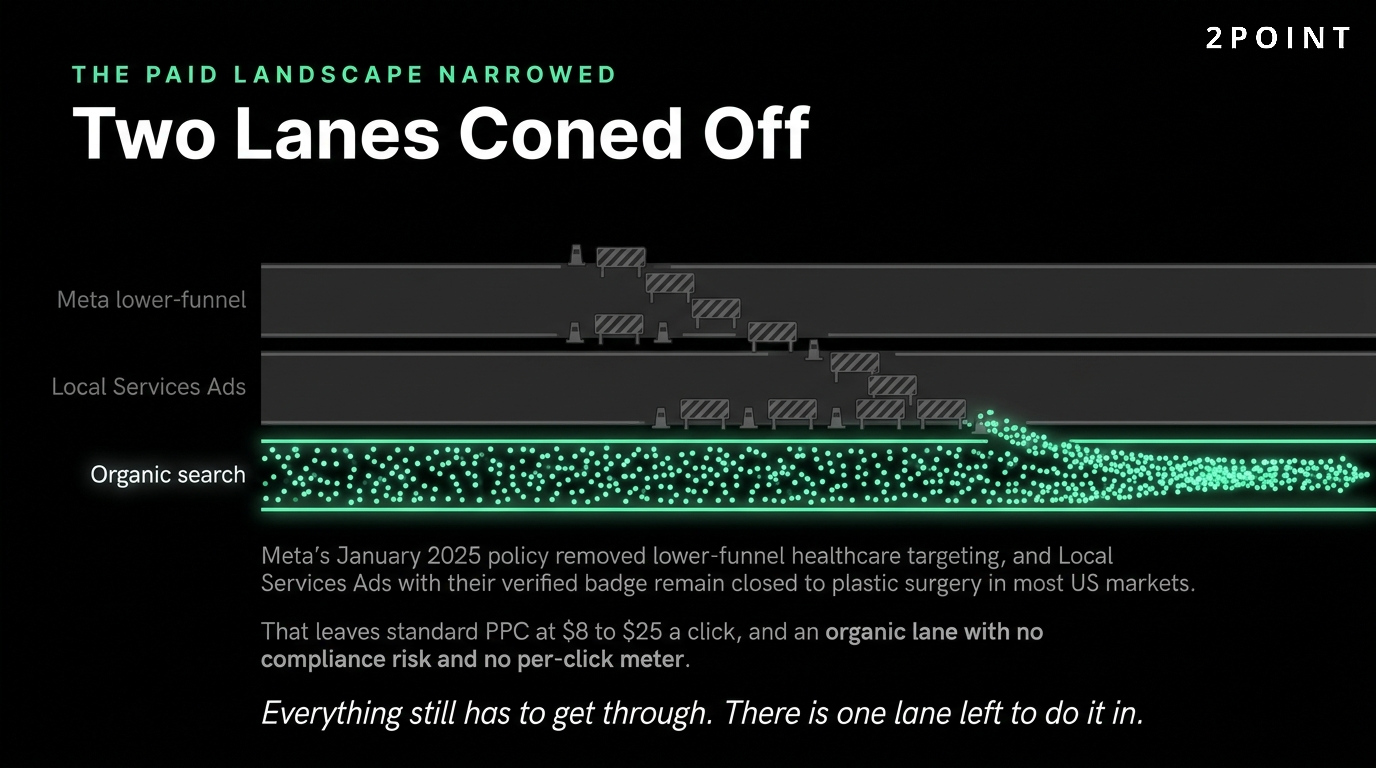
The advertising environment for plastic surgery practices has become meaningfully more constrained over the past two years. Meta’s January 2025 policy update restricted healthcare advertisers from running lower-funnel ads targeting users based on health-related behaviors and interests. For practices that had relied on before-and-after content and procedure-targeted social campaigns, this represented a significant reduction in paid social reach and performance.
Simultaneously, Google Local Services Ads remain unavailable to plastic surgery practices in most US markets. LSAs, which display verified business badges and appear above standard paid search ads, have become a dominant patient acquisition tool for dentists, chiropractors, and other healthcare providers. Plastic surgeons largely cannot access this channel, leaving standard PPC as the only paid search option, at costs ranging from $8 to $25 per click in competitive markets.
Rising paid advertising costs in major metros like New York, Los Angeles, Miami, and Chicago further compress the ROI on paid campaigns. In these markets, understanding how to choose the best SEO strategy for your business is not a nice-to-have consideration; it is a financial necessity. Organic search stands as the most stable, most compliant, and most scalable patient acquisition channel available to practices navigating these restrictions.
Core SEO Foundation and Site Architecture for Plastic Surgery Practices
Before local optimization, content strategy, or AI-readiness can matter, a plastic surgery website must have a technically sound foundation. The architecture of the site determines how effectively every other SEO investment translates into rankings. Practices that build correctly from the start avoid years of remediation work on sites that are fundamentally difficult for search engines to crawl, understand, and rank.
The One-Page-Per-Procedure Model: Why It Works
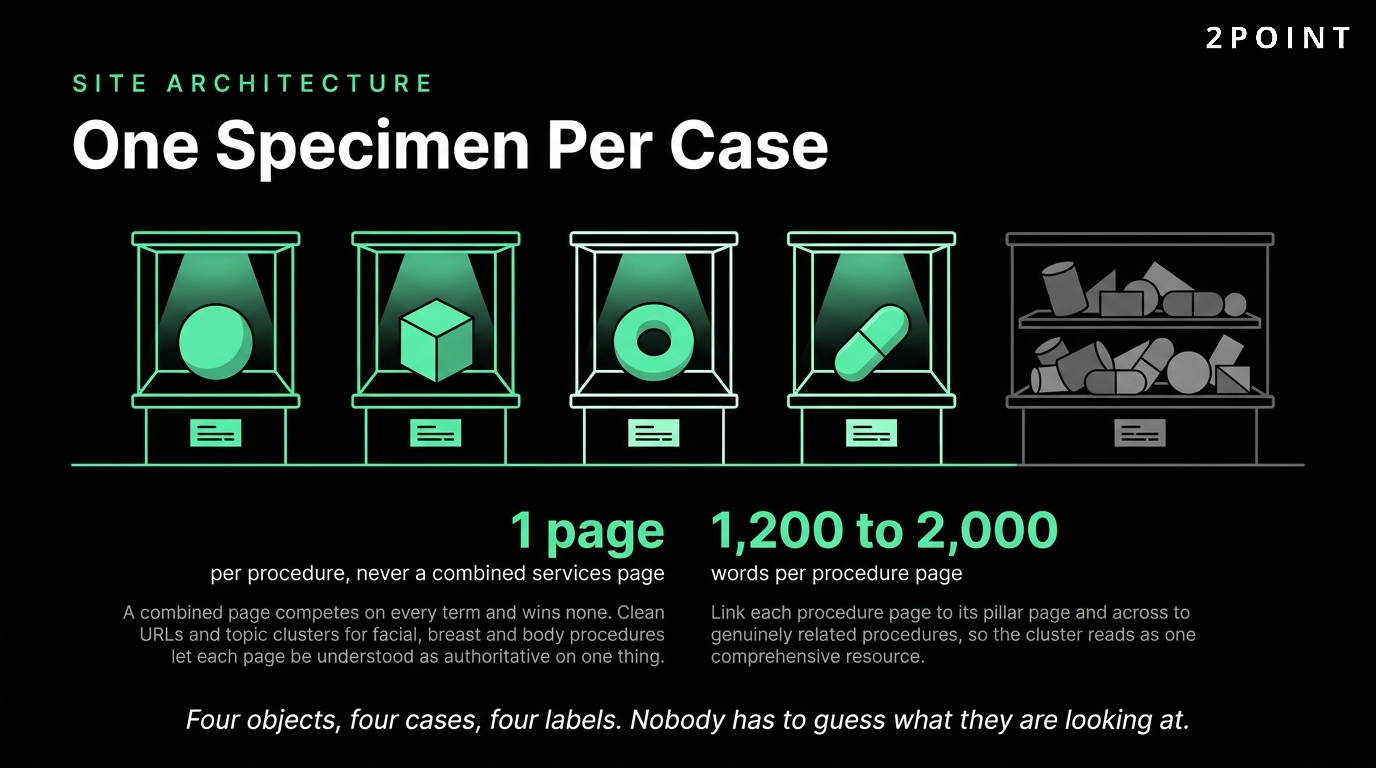
The single most impactful structural decision a plastic surgery website can make is dedicating one page to each procedure. Combined service pages that list multiple procedures on a single URL compete for ranking on all of those terms and win on none. Dedicated procedure pages of 1,200 to 2,000 words consistently outperform combined pages because they allow Google to understand the page as singularly authoritative on a specific topic.
Proper URL structure matters alongside page depth. Clean, descriptive URLs such as /rhinoplasty, /breast-augmentation, and /tummy-tuck communicate topic relevance to both search engines and patients. Topic clustering organizes these pages under logical categories: facial procedures, breast procedures, and body procedures each form their own cluster. Internal links between related procedures within the same cluster reinforce thematic authority across the category while guiding patients toward adjacent services they may consider.
This architecture also enables a powerful internal linking strategy. A pillar page for “facial procedures” can link to individual rhinoplasty, facelift, blepharoplasty, and chin augmentation pages, while those individual pages link back to the pillar and to one another where relevant. This creates a web of topical authority that signals to Google that the practice is a comprehensive resource on cosmetic surgery, not a thin website with scattered content.
Technical SEO Essentials for Medical Websites
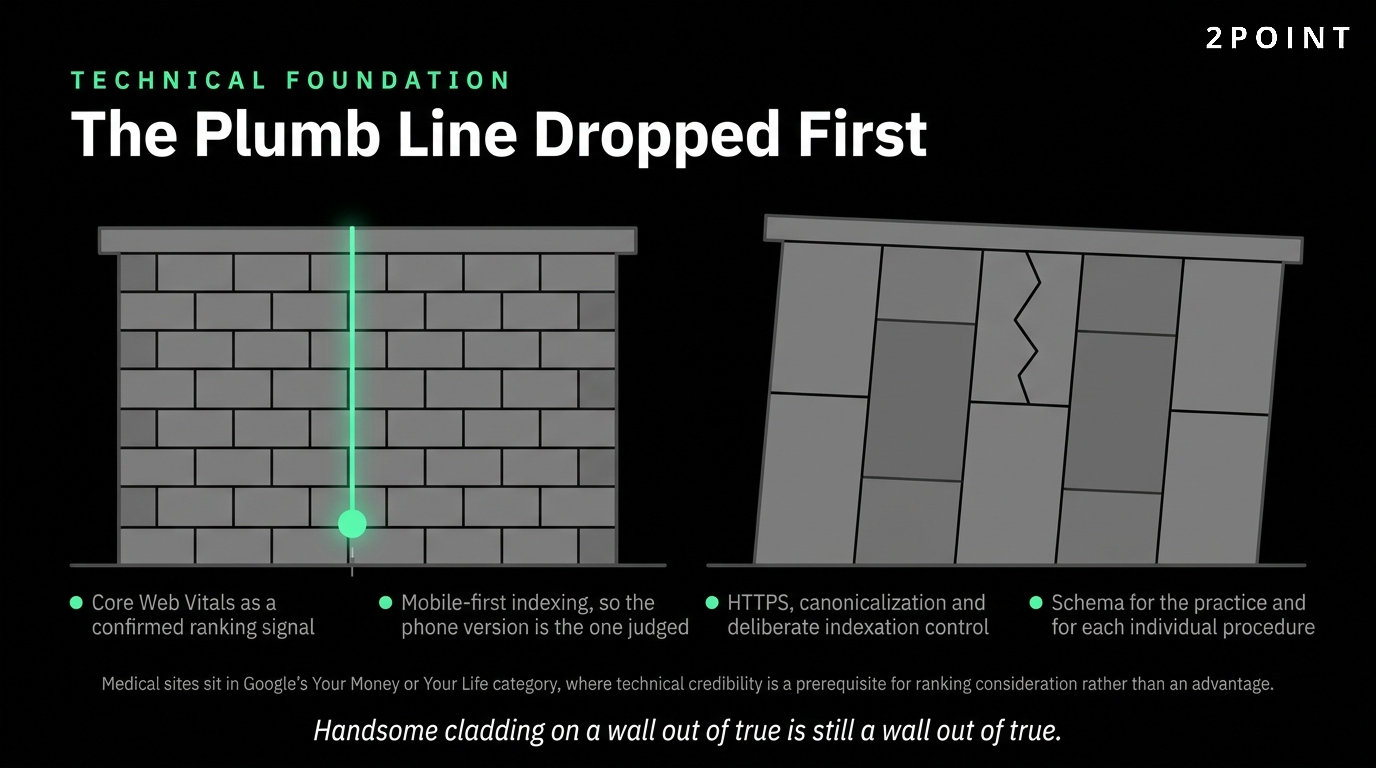
Medical websites face unique technical SEO requirements because they operate in what Google classifies as “Your Money or Your Life” (YMYL) content categories. Technical credibility becomes a prerequisite for ranking consideration. Core Web Vitals compliance, which measures loading performance, interactivity, and visual stability, is now a confirmed ranking signal that directly affects how Google evaluates the user experience a medical site delivers.
Approximately 50% of plastic surgery website traffic arrives via mobile devices, and Google uses mobile-first indexing, meaning the mobile version of a site is what Google primarily evaluates for ranking. A site that looks excellent on desktop but performs poorly on mobile is effectively penalized in search results. Schema markup for medical practices and individual procedures helps search engines display rich results such as star ratings, FAQ accordions, and breadcrumb navigation directly in SERPs.
HTTPS is non-negotiable for medical sites. Beyond being a ranking signal, it is a patient trust signal. Visitors arriving at a non-secure medical website are shown browser warnings that immediately undermine credibility. Proper canonicalization prevents duplicate content issues, particularly important for practices with multiple location pages or similar procedure content. Indexation control, through robots.txt and noindex directives, ensures Google focuses its crawl budget on the pages that actually matter for patient acquisition.
Entity-Based Authority Building for Surgeons
Google has progressively shifted from purely keyword-based matching to entity-based understanding, where it recognizes people, organizations, and topics as interconnected entities in a knowledge graph. For plastic surgeons, this means that being recognizable as a legitimate medical entity matters as much as including keywords on a page. When Google can confidently identify a surgeon as a board-certified physician affiliated with recognized medical organizations, it extends greater trust to that surgeon’s content.
Building entity authority involves creating technical connections that Google can verify. Links from the American Society of Plastic Surgeons, state medical board listings, hospital affiliation pages, and academic institution profiles all signal to Google that the surgeon is a real, credentialed professional. Structured data markup that explicitly states board certifications, medical specialties, and professional affiliations reinforces these connections at a machine-readable level.
Surgeon knowledge graph optimization takes this further by ensuring the surgeon’s name, credentials, and practice appear correctly in Google’s entity database. A surgeon with a robust entity footprint sees benefits across all content they are associated with: their procedure pages rank more easily, their reviews carry more weight, and their content is more likely to appear in AI-generated summaries. The relationship between entity authority and SEO’s role in digital marketing is direct and measurable.
Keyword Research Strategy for Surgical Practices
Effective keyword research for plastic surgery practices goes beyond identifying high-volume terms. It requires distinguishing between high-intent queries, where the patient is close to booking a consultation, and informational queries, where the patient is still in the research phase. Both deserve content, but they require different page types, different conversion approaches, and different success metrics.
Competitor keyword gap analysis is one of the highest-leverage research activities available. By identifying which procedure terms competitors rank for that a practice does not yet target, practices can find immediate content opportunities with proven search demand. Tools that surface keyword difficulty alongside search volume help prioritize where to invest content creation effort, with medium-difficulty, high-intent terms often representing the best near-term opportunities.
For practices with multiple locations, tracking keyword rankings by geographic area is essential. A rhinoplasty page optimized for Chicago rankings may need distinct optimization signals compared to a page targeting suburban Naperville. Long-tail conversion advantages make location-specific keyword targeting particularly valuable: queries of three or more words convert at 2.8 times the rate of shorter terms, and geo-modified long-tail queries represent exactly this high-conversion profile. Using the right SEO tools effectively makes this research systematic rather than guesswork.
Local SEO for Plastic Surgeons: How to Dominate the Google Map Pack
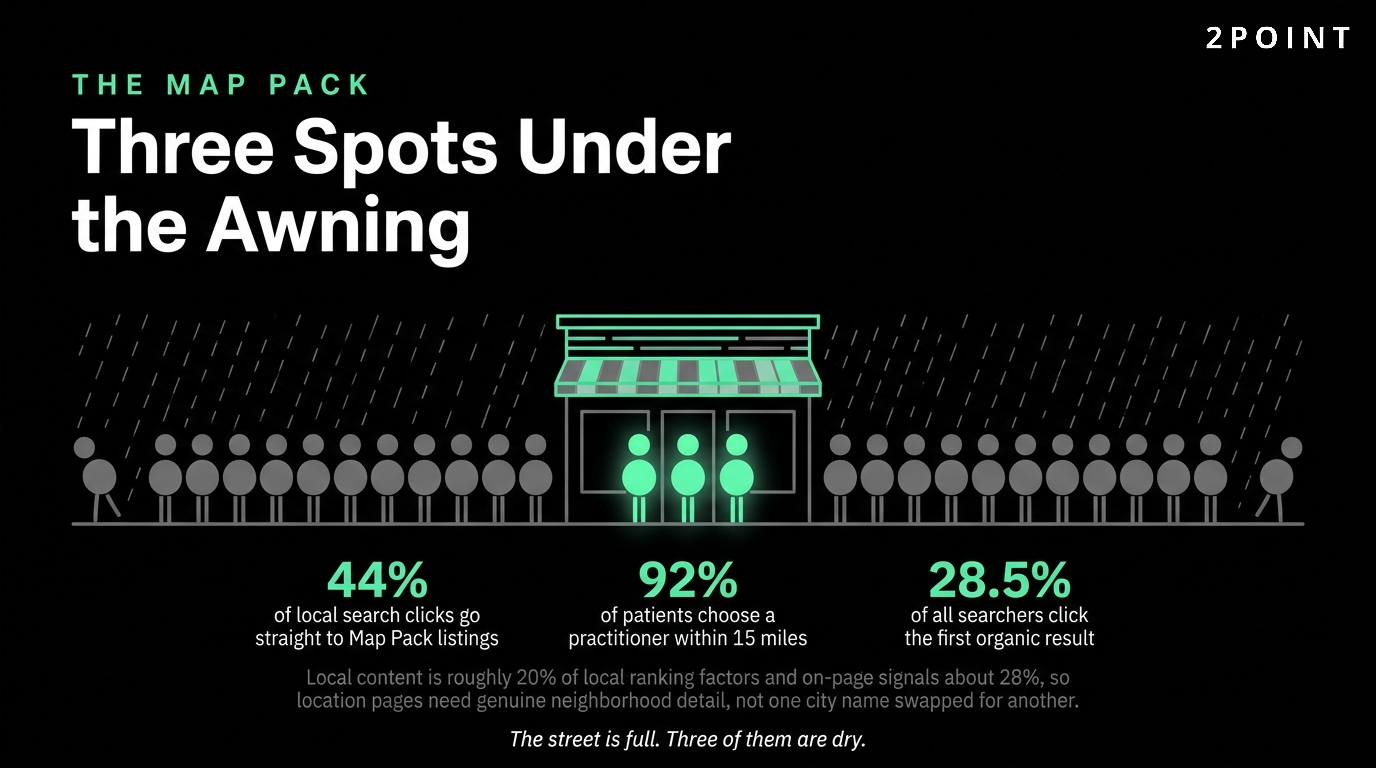
Local SEO for plastic surgeons is the discipline that determines whether a practice appears in the three-listing Map Pack that appears at the top of location-based search results. 44% of local search clicks go directly to Map Pack listings, making this placement a primary patient acquisition asset. Understanding the three core local ranking factors and optimizing each systematically is the difference between appearing in the Map Pack and being invisible to local searchers.
Google Business Profile Optimization for Cosmetic Surgery Practices
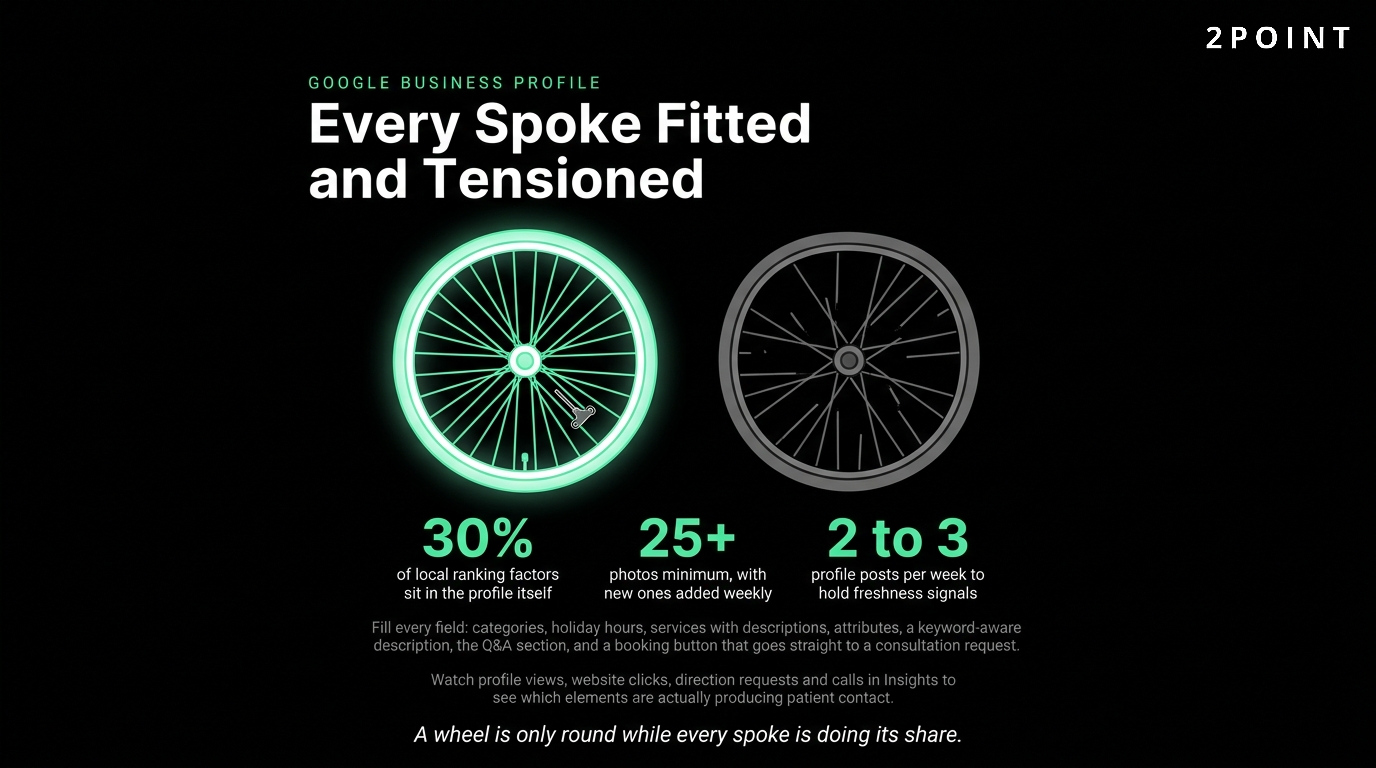
Google Business Profile (GBP) is the single most influential factor in local search rankings, accounting for approximately 30% of local ranking factors. A fully optimized GBP begins with selecting the correct primary and secondary business categories. “Plastic surgeon” as a primary category, supplemented by procedure-specific categories where available, helps Google understand the full scope of services offered.
Profile completeness directly affects ranking. Every available field should be populated: business hours including holiday hours, services list with descriptions, attributes that signal accessibility and amenities, and a keyword-rich business description that naturally incorporates primary procedures and location terms. The photo strategy deserves particular attention: practices should upload a minimum of 25 high-quality photos across categories including interior, exterior, staff, and procedure-specific imagery, and should add new photos at least weekly to signal active profile management.
GBP Posts function as a secondary content channel that keeps the profile active and engaging. Posting procedure spotlights, seasonal promotions, patient education content, and event announcements two to three times per week maintains the freshness signals Google uses to evaluate profile activity. The Q&A section allows practices to preemptively answer common patient questions while naturally incorporating procedure and location keywords. Booking button integration and appointment URL setup create a direct conversion path from the Map Pack listing to a consultation request, capturing patients at the precise moment of decision.
Given that 92% of patients choose practitioners within 15 miles of their location, the practice that wins the Map Pack for its area wins a disproportionate share of local patient volume. GBP Insights monitoring, which tracks profile views, website clicks, direction requests, and phone calls over time, provides the data needed to understand which profile elements are driving the most patient interactions. Leveraging local SEO for visibility starts here, with a profile that communicates authority, completeness, and active patient engagement.
NAP Consistency and Citation Building Across Medical Directories
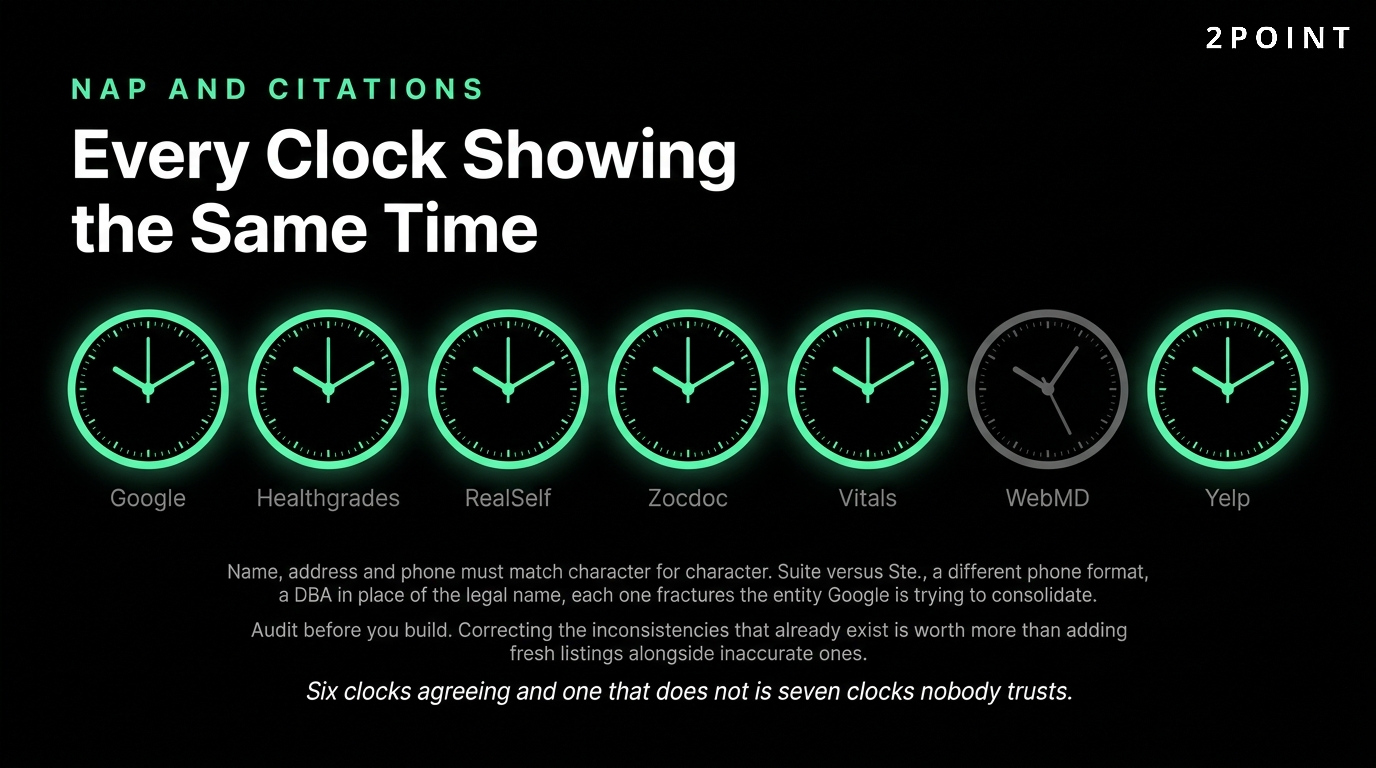
NAP, which stands for Name, Address, and Phone number, must be identical across every online platform where a practice appears. Even minor variations, such as “Suite 100” versus “Ste. 100” or different phone number formats, can fracture Google’s ability to consolidate a practice’s entity signals. When Google cannot confidently associate all citations with a single entity, the ranking authority those citations represent becomes diluted. NAP consistency is foundational to local SEO for plastic surgeons because it determines how effectively citation volume translates into ranking power.
Priority citation sources for plastic surgery practices include both general business directories and healthcare-specific platforms. The most important are Healthgrades, RealSelf, Zocdoc, Vitals, WebMD, Yelp, and Bing Places. Each of these platforms has significant domain authority and is frequently visited by patients during the research process, making them valuable both for local SEO signals and for direct referral traffic.
Citation audits should be conducted before any new citation building effort begins. Identifying and correcting existing inconsistencies is more impactful than adding new citations that coexist with inaccurate old ones. The audit process involves searching for the practice name and phone number across major directories, documenting all variations found, and systematically updating each listing to match the canonical NAP. Ongoing monitoring using citation management tools prevents new inconsistencies from appearing as the practice’s online footprint grows. Understanding the importance of SEO in driving traffic means recognizing that citations are one of the foundational mechanisms through which local authority is built and communicated to search engines.
Local Content Strategy That Moves Plastic Surgery Rankings
Local content accounts for approximately 20% of local ranking factors, and on-page signals more broadly represent approximately 28% of what determines local rankings. Location-specific landing pages are the primary vehicle for capturing this ranking signal. A well-structured location page for a practice serving multiple cities goes beyond simply changing the city name in the text. It integrates genuinely local information: neighborhood-specific references, locally relevant patient concerns, and connections to the community the practice serves.
Local business schema markup, embedded on location pages with geo-coordinates that match the practice’s physical address, provides machine-readable confirmation of the practice’s location to search engines. Blog content that addresses locally relevant topics, such as “What to Expect During Recovery from a Rhinoplasty in Chicago’s Winter” or “How to Choose a Board-Certified Plastic Surgeon in the Houston Medical Center Area,” creates location relevance signals that generic procedure content cannot replicate.
The balance between procedure authority and geographic specificity is critical. A page that is entirely focused on local flavor without substantial procedure expertise will not rank for competitive procedure terms. A page that is dense with procedural information but contains no local signals will struggle to rank for location-based searches. The winning formula integrates both: comprehensive, expert procedure content that also demonstrates clear relevance to the specific geographic market the practice serves.
Proximity and Service Area Optimization for Surgical Practices
Proximity, which refers to how close a practice’s physical location is to the searcher, is one of the three core Google local ranking factors alongside relevance and prominence. Google cannot be directly manipulated on the proximity dimension, but practices can optimize strategically around it. For practices in competitive urban markets, proximity to the center of the city or the densest concentration of target patients matters significantly.
Multi-location practices face unique challenges in optimizing for proximity without creating duplicate content penalties. Each physical location should have its own GBP listing, its own location page on the website, and its own citation profile. These pages must be substantively different from one another, not template copies with city names swapped. Service area pages for practices that serve patients from surrounding communities without having a physical presence in those areas should clearly designate the geographic coverage while linking to the primary location’s full information.
Virtual consultation offerings have expanded the geographic reach of plastic surgery practices meaningfully. Patients who live farther away may book a virtual initial consultation before committing to travel for an in-person visit. Content and GBP descriptions that acknowledge virtual consultation availability help practices capture searchers from a broader geographic radius. However, local SEO rankings remain governed by physical proximity for most searches, making the primary location’s optimization the central priority for the local marketing strategy.
Review Management as a Ranking System for Plastic Surgery Practices
In the context of local SEO for plastic surgeons, reviews are not simply reputation management tools; they are active ranking signals that Google evaluates in determining Map Pack placement. Reviews account for approximately 17% of local ranking factors, making a systematic approach to generating and managing them as strategically important as any technical optimization effort.
Review Velocity as the Primary Local Ranking Signal
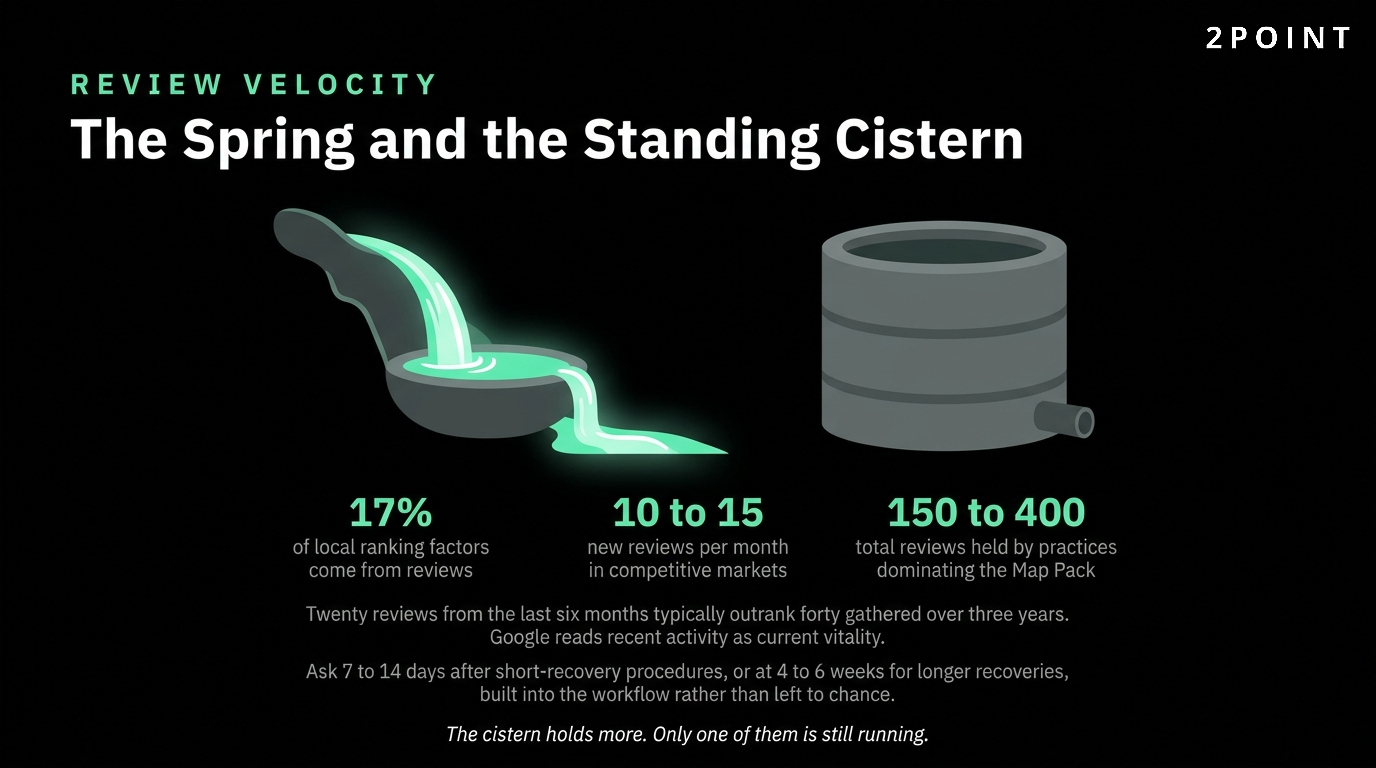
Review velocity, the rate at which new reviews arrive, matters more than total review volume when it comes to local ranking influence. A practice with 40 reviews accumulated over three years will typically rank below a competitor with 20 reviews generated in the past six months, all else being equal. Google interprets recent review activity as a signal of current business vitality and patient satisfaction. A target of 10 to 15 new reviews per month is appropriate for practices in competitive markets aiming to maintain Map Pack placement.
Building review generation into the patient experience workflow removes the dependency on patients voluntarily leaving feedback. The optimal request timing varies by procedure type: elective cosmetic procedures with short recovery times see the best response rates when requests are sent seven to fourteen days post-procedure, when patients are experiencing early results and positive emotions. More complex procedures with longer recoveries may see better engagement at the four to six week mark.
A multi-platform review strategy ensures that the practice builds authority across all the platforms patients actually use during their research. Google reviews carry the most direct local ranking weight, but RealSelf reviews are heavily weighted by cosmetic surgery patients specifically, and Healthgrades reviews influence ranking on healthcare-specific searches. Recent reviews consistently outweigh older reviews in ranking algorithms, making the ongoing generation system more valuable than any historical volume advantage.
Review Quality and Keyword Integration
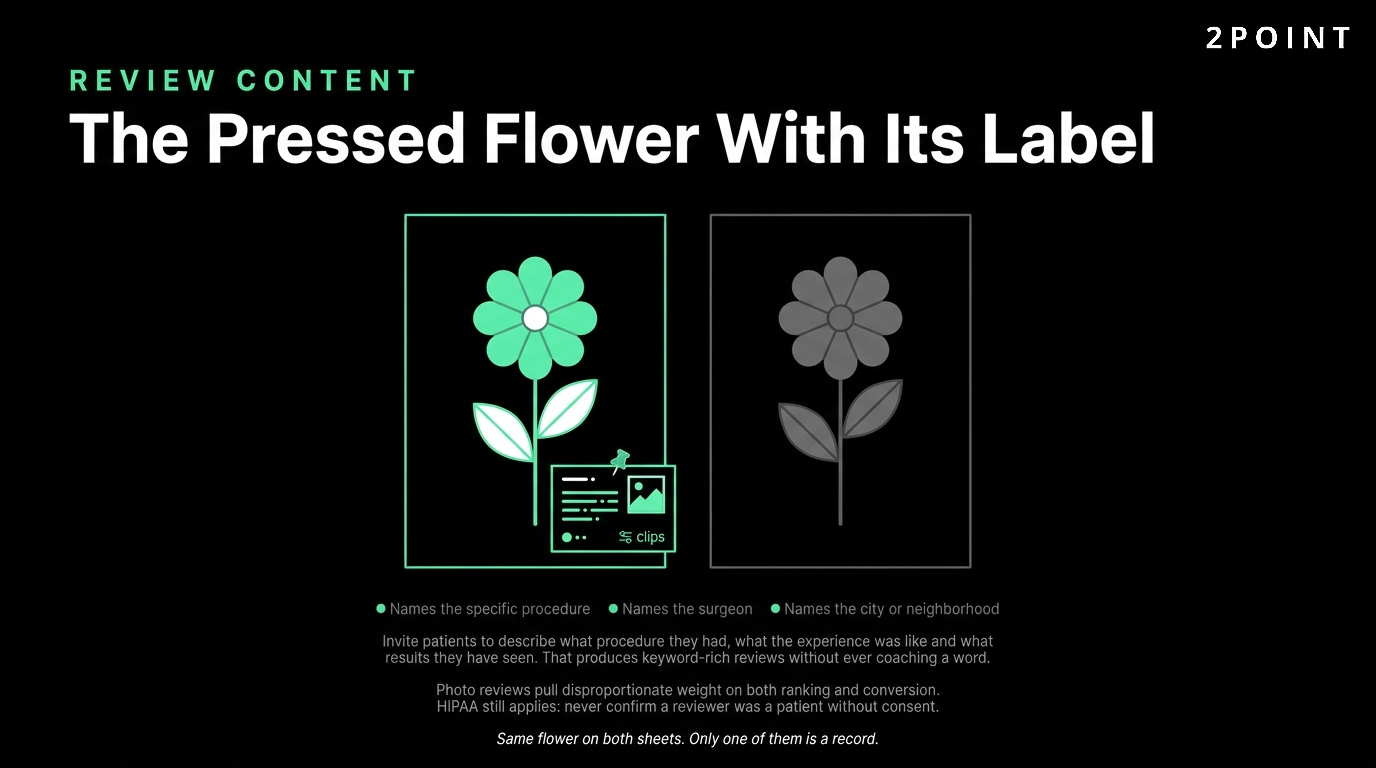
The content of reviews influences local rankings, not just the star rating and volume. Reviews that mention specific procedures, the surgeon’s name, and location-relevant terms provide Google with additional keyword signals that reinforce the practice’s relevance for those searches. A review that says “I had my rhinoplasty done by Dr. Smith in Beverly Hills and the results exceeded my expectations” carries more local SEO value than a review that says “great experience, highly recommend.”
Encouraging detailed, specific feedback without coaching patients to include particular keywords requires a thoughtful approach. Post-procedure communication that invites patients to share “what procedure you had, what your experience was like, and what results you’ve seen so far” naturally produces more keyword-rich reviews without crossing into manipulation. Photo reviews carry disproportionate impact on both rankings and conversion: patients who see before-and-after photos alongside written reviews convert at higher rates, and Google treats photo-accompanied reviews as stronger engagement signals.
HIPAA compliance considerations apply to the review solicitation process. Practices cannot publicly confirm that a reviewer was a patient without explicit consent, and responses to reviews must avoid disclosing any protected health information. However, the process of asking satisfied patients to leave reviews is fully compliant, and well-structured post-procedure communication templates make this systematic without requiring individualized legal review for each message. Understanding how SEO impacts online visibility includes recognizing that reviews are a visible, patient-facing signal that influences both ranking and the conversion decisions of patients reading them.
Response Strategy for Maximum Review Impact
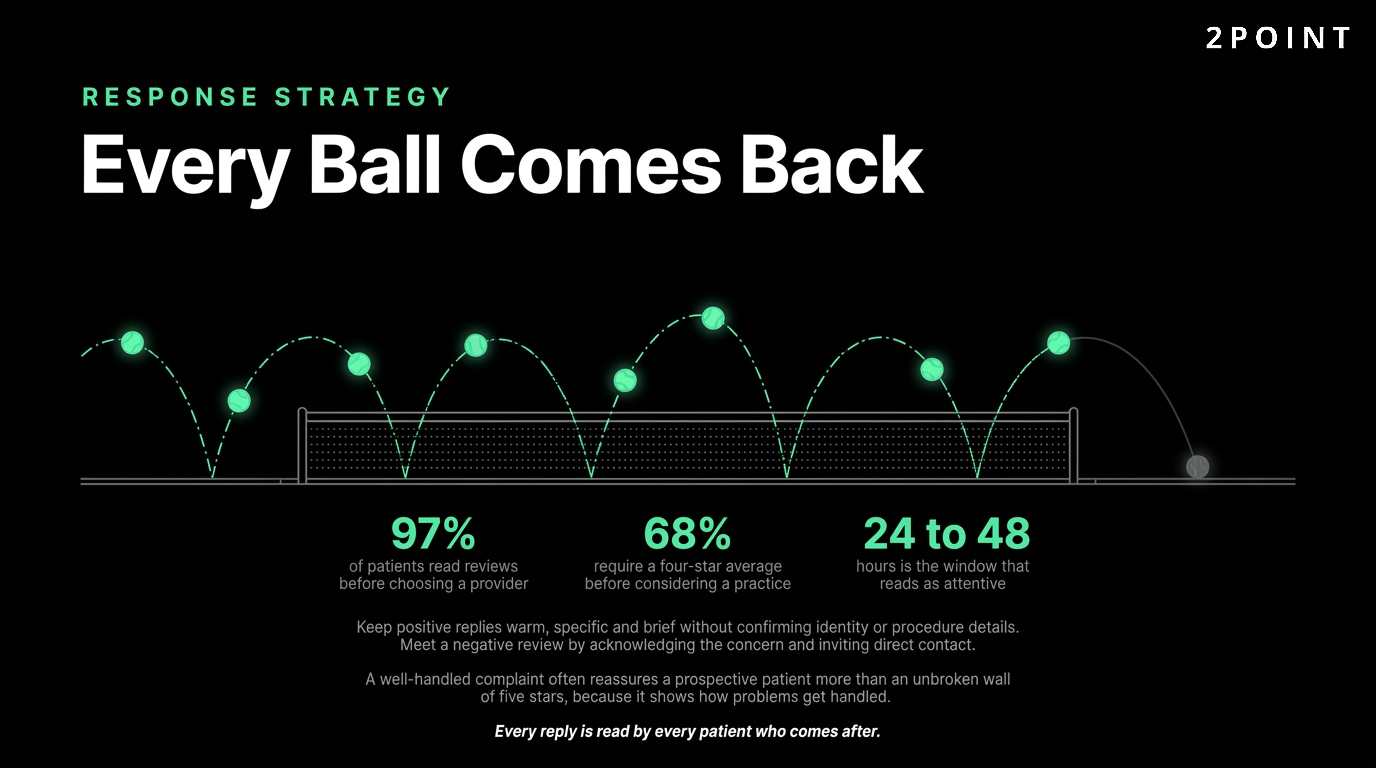
Responding to reviews, both positive and negative, is a confirmed local ranking signal and a critical conversion tool for prospective patients who read reviews before making a contact decision. Practices that respond to all reviews demonstrate active engagement with their patient community, which Google interprets as a quality signal. Response time matters: reviews that receive responses within 24 to 48 hours signal a practice that is attentive and professionally managed.
Positive review responses should be warm, specific, and brief. Referencing the general topic of the review without confirming the patient’s identity or procedure details keeps responses HIPAA-compliant while still feeling personalized. Negative review responses require a different approach: acknowledging the concern without defensiveness, expressing genuine interest in resolving the situation, and inviting the patient to contact the practice directly. A well-handled negative review response often reassures prospective patients more effectively than an unbroken string of five-star reviews, because it demonstrates how the practice handles problems.
Research consistently shows that approximately 97% of patients read online reviews before selecting a healthcare provider, and 68% require a minimum of a four-star average before considering a practice. These numbers underscore why the response strategy matters beyond rankings: every response is visible to all future patients reading that review. A practice that responds thoughtfully, promptly, and professionally to every piece of feedback creates a compelling public record of patient-centered care that converts browsing patients into consultation requests.
Building to Competitive Review Thresholds
Benchmarking against local competitors reveals the review volume required to compete effectively in a given market. In highly competitive markets, practices dominating Map Pack positions typically hold between 150 and 400 reviews. For a practice starting from a low baseline, reaching this threshold requires a sustained, systematic review generation effort integrated into the patient experience at every touchpoint.
Accelerating from zero or few reviews to a competitive volume requires prioritizing outreach to the most satisfied and vocal patient segments first. Patients who refer others, who comment positively during follow-up appointments, or who engage with the practice on social media are the highest-probability review generators. A phased approach, starting with re-engagement outreach to past patients before focusing on current patients, can build volume more quickly than waiting for the current patient flow alone to generate reviews.
| Review Platform | Primary Benefit for Plastic Surgery SEO | Patient Research Behavior | Ranking Signal Weight |
|---|---|---|---|
| Google Business Profile | Direct local Map Pack ranking influence | Universal, first-stop research | Highest |
| RealSelf | Cosmetic surgery-specific authority and referral traffic | Deep research phase for cosmetic patients | High for cosmetic procedures |
| Healthgrades | Healthcare-specific credibility and directory ranking | Insurance and credential verification | Moderate, citation value |
| Yelp | General consumer trust and business visibility | Secondary research checkpoint | Moderate |
| Zocdoc | Appointment booking integration | Active booking intent | Moderate, referral value |
Google Business Profile reviews carry the highest weight for local Map Pack rankings, but a diversified review presence across healthcare and general platforms builds the citation authority that supports broader organic visibility.
Procedure Page Optimization and Content Architecture for Cosmetic Surgery SEO
Cosmetic surgery SEO wins or loses on the quality and structure of individual procedure pages. These pages are simultaneously the most competitive targets in plastic surgery search and the most direct path to consultation bookings. A page that ranks well but fails to convert wastes its ranking. A page that converts well but cannot achieve ranking wastes its content. The winning approach builds pages that accomplish both objectives through a coherent structure informed by both SEO best practices and patient psychology.
Essential Content Components for Procedure Pages
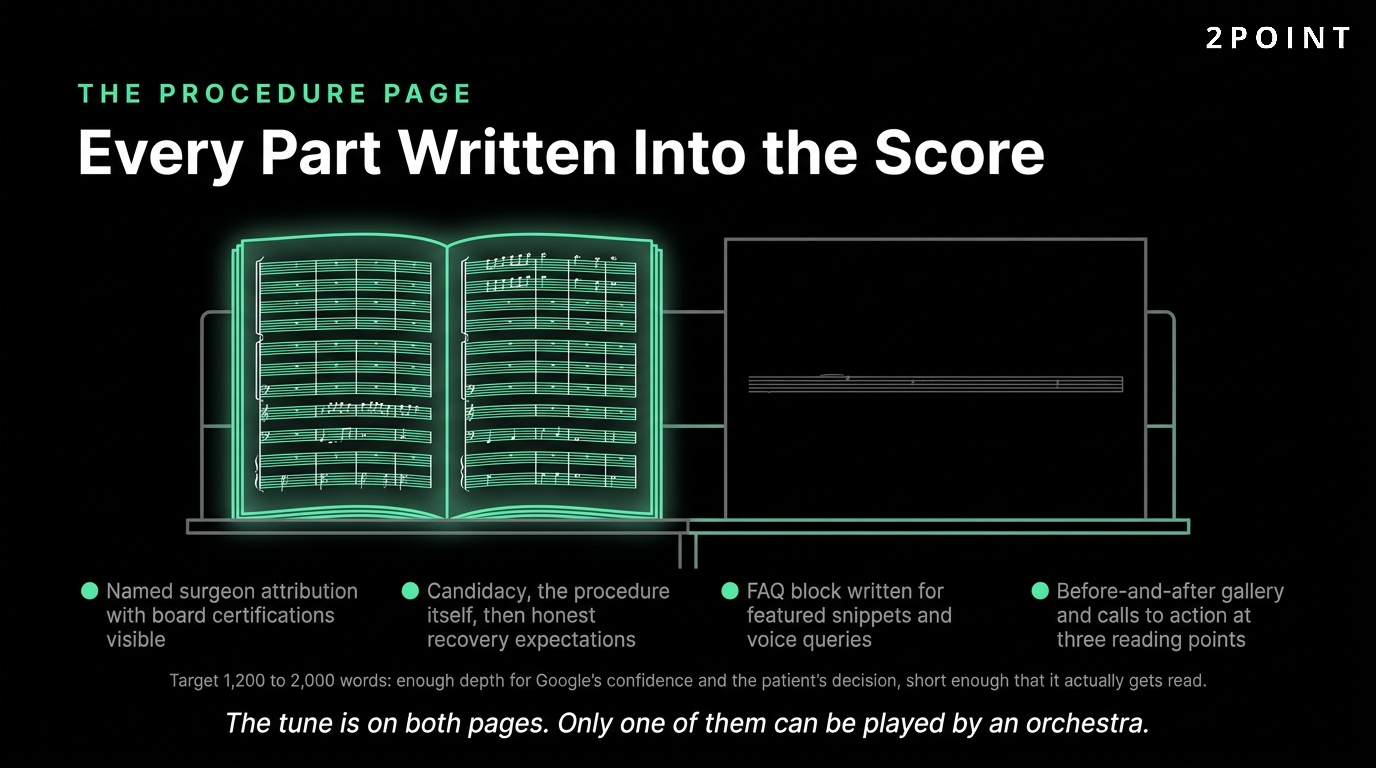
The structure of a high-performing procedure page follows patient decision-making logic. Patients searching for specific procedures are typically in one of two mental states: gathering enough information to determine whether they are a candidate, or evaluating which surgeon to trust with their procedure. A patient-first content structure addresses both: it begins with what the patient can expect from the procedure and its results, moves through candidacy criteria and realistic outcomes, covers the surgical process itself, and concludes with recovery expectations and next steps.
E-E-A-T signals, which Google uses to evaluate Experience, Expertise, Authoritativeness, and Trustworthiness for medical content, must be integrated throughout. Every procedure page should carry clear author attribution to the operating surgeon, with their board certifications, years of experience, and professional affiliations visible. FAQ sections embedded within procedure pages target featured snippets and voice search queries while providing genuinely useful patient information. Before-and-after galleries, integrated with page speed considerations, provide the visual proof patients require before contacting a practice.
Clear calls to action need to appear at multiple points within the page without disrupting the content flow. A fixed consultation request button, a mid-page CTA after candidacy information, and a final CTA after recovery details accommodate patients who are ready to contact at different reading stages. Target page length of 1,200 to 2,000 words provides sufficient depth for both search engine confidence and patient education without crossing into content that patients will not read.
Title Tags and Meta Descriptions That Drive Clicks
Title tags for procedure pages should follow a clear formula that incorporates the primary keyword, the geographic market, and the practice or surgeon name. A structure such as “Rhinoplasty in Chicago | Dr. [Surgeon Name] | [Practice Name]” communicates relevance, location, and identity within the character limits Google displays in search results. Title tags should be kept under 60 characters to prevent truncation on both desktop and mobile search results pages.
Meta descriptions do not directly influence rankings, but they significantly influence click-through rate, which does affect rankings through engagement signals. The most effective meta descriptions for plastic surgery procedure pages highlight a specific differentiator, such as board certification, years of experience, or a unique procedural approach, and include a direct invitation to take action. A meta description that reads “Chicago’s board-certified rhinoplasty specialist. Natural-looking results, personalized consultations. Contact us to schedule yours.” outperforms a generic description of what the page contains.
Avoiding duplicate title tags across location-specific pages is essential for multi-location practices. Each location’s procedure pages should have unique titles that incorporate the location-specific city name, preventing internal competition between pages targeting the same procedure in different markets. A/B testing meta descriptions using Google Search Console data, comparing click-through rates across different message approaches, allows practices to optimize toward whichever framing resonates most with their patient audience.
Internal Linking and Topic Clustering for Surgical Websites
Topic clustering organizes a plastic surgery website’s content into logical subject groups that signal thematic authority to search engines. A pillar page for “Facial Procedures” provides comprehensive coverage of all facial surgical and non-surgical options, then links to individual procedure pages for rhinoplasty, facelift, blepharoplasty, and other specific treatments. Each of those individual pages links back to the pillar and cross-links to related procedures, creating a cluster of interconnected content that collectively demonstrates deep expertise in facial plastic surgery.
Contextual internal linking, placed within the natural flow of procedure content, carries more ranking value than links placed in footers, sidebars, or navigation menus. When a rhinoplasty page mentions that patients often combine nasal reshaping with chin augmentation for improved facial balance, the link to the chin augmentation page is contextually relevant and useful to the patient reading it. This natural link pattern builds topic authority while improving the patient’s ability to explore related services. Topic cluster strategies are among the most effective ways to build broad organic visibility across a full procedure menu simultaneously.
E-E-A-T Signals for Medical Content: Building Trustworthy Procedure Pages
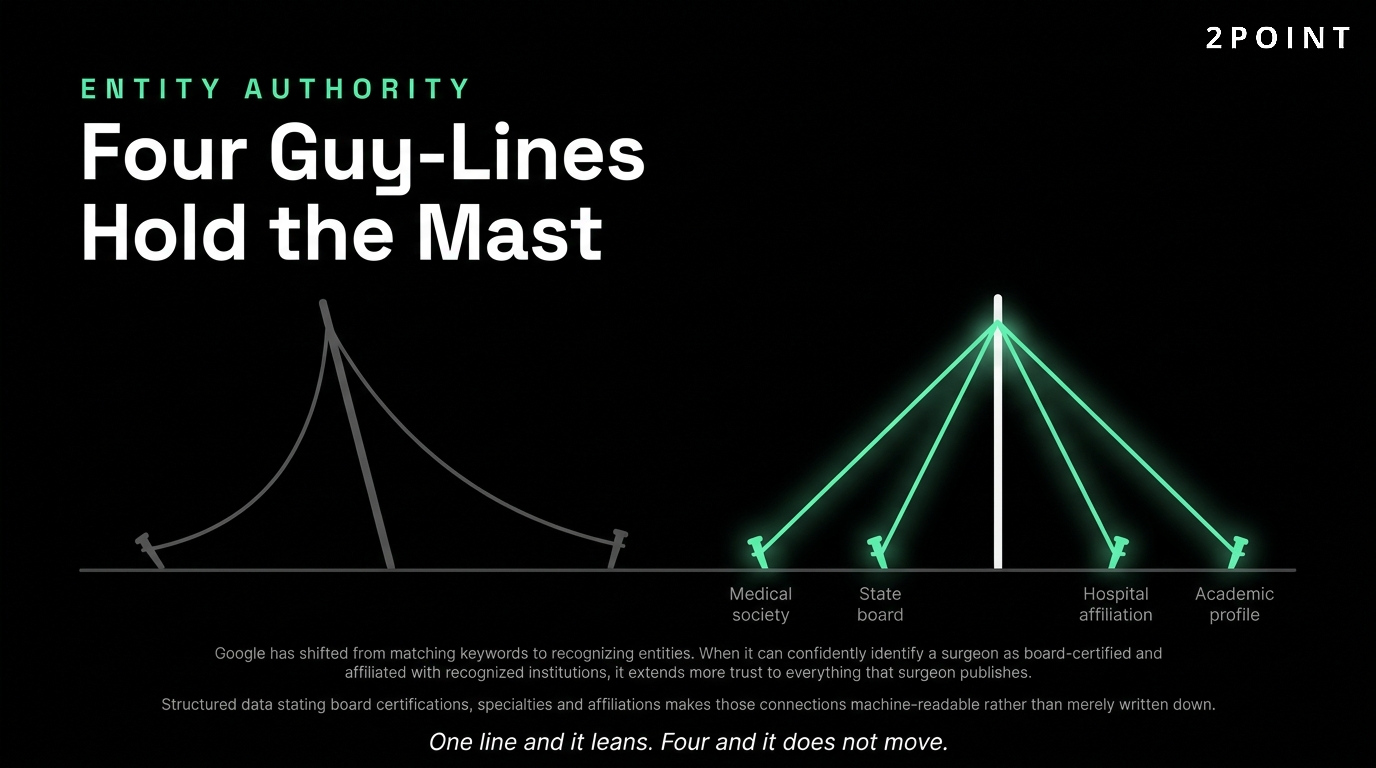
Google’s E-E-A-T framework applies with particular intensity to medical content because the stakes of misinformation are high. For plastic surgery procedure pages, demonstrating Experience, Expertise, Authoritativeness, and Trustworthiness requires deliberate signal integration throughout the content, not just in an “About the Surgeon” page. E-E-A-T requirements for medical content mean that every procedure page needs clear attribution to a named, qualified medical professional.
Board certification badges from the American Board of Plastic Surgery, fellowship memberships in organizations such as the American Society of Plastic Surgeons, and hospital admitting privileges all function as E-E-A-T signals. These credentials should appear visually on procedure pages, not just on an about page. Publication citations, where a surgeon has authored or been quoted in medical literature or mainstream healthcare media, add authoritative backlink signals. Patient safety information and honest descriptions of realistic outcomes, rather than promotional language promising unrealistic results, align with Google’s preference for medically responsible content.
Professional association affiliations function as both E-E-A-T signals and entity authority builders. Links from established medical associations and professional organizations carry significant weight in Google’s evaluation of a surgeon’s authority. Creating and maintaining complete, accurate profiles on these association sites, with links back to the practice website, builds the external authority signals that underpin competitive organic rankings in high-stakes medical search. Building a strong branding strategy alongside E-E-A-T signal building ensures that authority is communicated consistently across both digital and physical patient touchpoints.
Plastic Surgery Website Optimization: Performance and Conversion Excellence
Plastic surgery website optimization encompasses everything that happens after a patient finds the practice in search results. The website must load quickly, display correctly on every device, demonstrate credibility immediately, and guide patients efficiently toward requesting a consultation. Technical performance and conversion design are inseparable in this context: a slow, difficult-to-navigate website hemorrhages the patients that SEO efforts delivered.
Mobile Optimization and Page Speed for Medical Websites
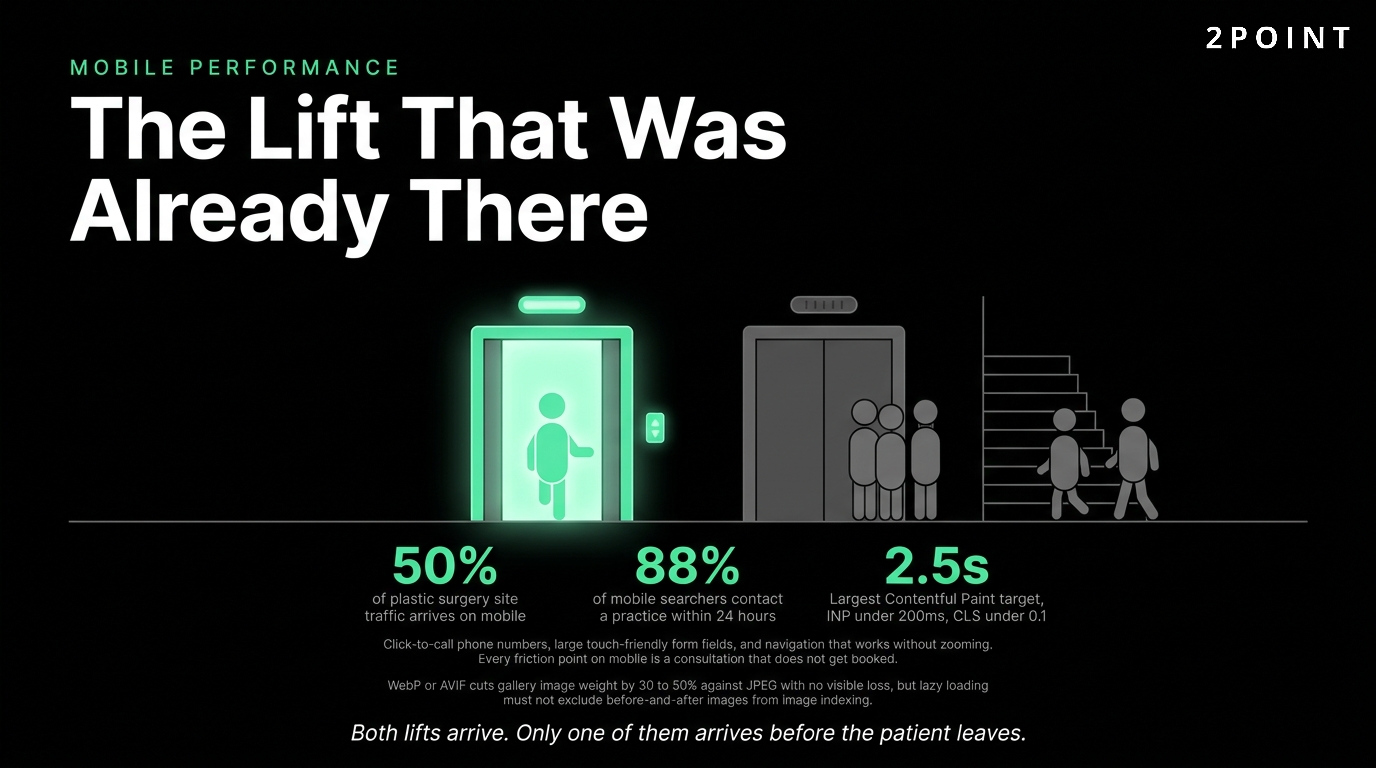
With 50% of plastic surgery website traffic arriving via mobile devices, mobile optimization is not a supplementary concern but the primary performance standard. Google’s mobile-first indexing evaluates the mobile version of a site as its canonical version for ranking purposes, meaning that mobile performance deficiencies directly suppress search rankings. Core Web Vitals targets for medical websites include Largest Contentful Paint under 2.5 seconds, Interaction to Next Paint under 200 milliseconds, and Cumulative Layout Shift below 0.1.
88% of mobile searchers who find a medical practice contact the practice within 24 hours, making mobile conversion optimization directly connected to consultation volume. Phone numbers must be click-to-call enabled. Contact forms must be touch-friendly with large input fields. Navigation must work intuitively on small screens without requiring zooming or horizontal scrolling. Every friction point in the mobile experience represents lost consultation bookings.
Image optimization is particularly important for plastic surgery websites, which rely heavily on visual content. Next-generation image formats, appropriate compression levels, and properly sized images for different viewport widths keep page speed high without sacrificing the visual quality that convinces patients to book. Lazy loading ensures that images below the fold do not delay the initial page load, though it must be implemented carefully so that before-and-after gallery images are not excluded from Google’s image indexing. Creating an SEO-friendly website for a plastic surgery practice means making performance a design requirement, not an afterthought.
Before and After Gallery Optimization
Before-and-after galleries are among the most important conversion assets on a plastic surgery website and among the most technically challenging to implement without hurting performance. High-quality patient photos are essential for convincing prospective patients that results are achievable and that the surgeon’s aesthetic judgment matches their goals. The technical challenge is delivering these images at sufficient quality to be compelling while maintaining the page speed that both rankings and user experience require.
Image compression using modern formats such as WebP or AVIF reduces file sizes by 30 to 50% compared to JPEG without perceptible quality loss at normal display sizes. Separate gallery pages for each procedure, rather than embedding all galleries within individual procedure pages, keep individual page weights manageable while providing a dedicated resource patients can browse extensively. Alt text for gallery images should describe the procedure type, technique, and result in clinical language, providing keyword-relevant descriptive text without referencing patient identities.
HIPAA compliance requires explicit written patient consent before displaying photos online, including in galleries accessed without login. Each gallery image should be covered by a signed photo release specific to online use. Schema markup for medical images can help galleries appear in Google Images results, extending the practice’s visual reach beyond the website itself. The goal is a gallery experience that loads quickly, displays beautifully, and converts viewers into consultation requesters.
Conversion Elements That Work Alongside SEO
The tension between aggressive conversion optimization and SEO-friendly user experience is real but manageable. Pop-ups that appear immediately on page load can trigger negative user experience signals that Google measures. Pop-ups triggered by exit intent or scroll depth, appearing only after a visitor has had a chance to engage with the content, carry fewer UX penalties while still capturing departing visitors. Consultation CTAs should appear at logical reading breaks rather than interrupting content flow.
Online booking integration provides a direct conversion pathway that reduces the friction between intent and action. When patients can see available consultation times and book directly from the website, conversion rates improve compared to form-only contact flows that require a callback. Online booking also generates a positive ranking signal: Google interprets booking interactions as a strong engagement metric that indicates users are finding value in the website. Lead magnets such as procedure guides, pricing range booklets, and candidacy self-assessments capture email addresses from patients who are not yet ready to book, enabling nurture sequences that convert over time.
Phone number visibility and click-to-call functionality on mobile deserve prominent placement throughout the site. Many cosmetic surgery patients, particularly those considering higher-investment procedures, prefer to call rather than complete a form. A phone number that is immediately visible, clickable on mobile, and connected to a tracked line provides both a conversion pathway and the data needed to measure organic search’s contribution to phone consultation volume. The combination of well-placed CTAs, booking integration, and phone accessibility creates a website design that serves both ranking and revenue objectives simultaneously.
Security and Trust Signals for Medical Websites
HTTPS with a valid SSL certificate is the baseline security requirement for any medical website. Beyond the minor ranking signal it provides, SSL is essential for patient trust. Browsers that display “Not Secure” warnings on medical sites cause patients to abandon the page immediately, regardless of the quality of the content beyond that point. Trust badges from security scanning services, privacy policy statements, and HIPAA compliance disclosures all reinforce the perception that the practice handles patient information responsibly.
Secure contact forms with spam protection ensure that patient inquiries are protected and that the practice’s contact infrastructure is not weaponized by spam bots. Patient portal integration, where practices offer secure access to medical records and communications, adds both a trust signal and a competitive differentiator in markets where patients have multiple surgeon options. Third-party security scanning with visible badges from recognized security providers such as Sucuri or McAfee Secure provides additional reassurance for patients sharing sensitive personal information.
How security signals affect medical site rankings is a matter of both direct and indirect impact. Direct impact comes from HTTPS as a confirmed (if minor) ranking factor. Indirect impact comes from the reduction in bounce rates and the increase in time-on-site that a secure, trustworthy site experience produces. When patients trust the site enough to explore it fully, engage with galleries, read procedure content, and complete contact forms, the resulting user behavior signals reinforce the site’s quality in Google’s evaluation. Security and trust are foundational to the SEO-friendly website framework, not additions bolted on after the fact.
AI Search and Generative Engine Optimization for Plastic Surgery Practices
The search landscape for plastic surgery in 2026 is no longer defined exclusively by the ten blue links of traditional search results. AI Overviews from Google, direct answers from ChatGPT and Perplexity, and AI-generated summaries on Bing have changed how patients discover and evaluate surgical practices. Practices that optimize only for traditional SEO are missing a growing share of discovery moments. Generative engine optimization (GEO) has become a parallel discipline that plastic surgery practices must address alongside traditional search optimization.
Understanding GEO vs. Traditional SEO for Cosmetic Surgery

Generative engine optimization (GEO) refers to the practice of structuring content and building authority in ways that cause AI search engines to cite, summarize, and recommend a practice’s content in their generated responses. Traditional SEO focuses on ranking in position one through ten in organic search results. GEO focuses on being included in the AI-generated overview that now appears above those organic results on a significant and growing percentage of searches.
AI Overviews now appear on effectively 100% of plastic surgery procedure queries in 2026. When a patient searches “rhinoplasty recovery time,” they are now likely to see a Google AI Overview summarizing recovery information from multiple sources before they see any individual website links. The patient who finds their answer in the AI Overview may click through to one or two sources for more detail, but the practices cited in the overview get the credibility association whether or not the patient clicks through. AI assistant tools now drive a significant and growing share of local healthcare recommendations, making GEO a patient acquisition channel in its own right.
The patient journey has changed materially as a result. Patients now often form opinions about which practices are authoritative before they ever visit a practice’s website directly. A practice that is consistently cited in AI summaries across multiple procedure topics builds a pre-awareness advantage that translates into higher brand recall and higher consultation conversion rates when patients do make direct contact. Practices that appear only in AI Overviews aggregating generic information from multiple sources without clear attribution lose this advantage.
Optimizing Content for AI Citation in Medical Search
AI search engines cite content that is clear, definitive, factually accurate, and well-structured. The content formats that AI engines prefer are those that already serve as good web content for humans: concise answers to specific questions, clearly delineated sections with descriptive headings, and information organized in a logical sequence. The key distinction between content optimized for traditional SEO and content optimized for AI citation is specificity. AI engines select content that provides a definitive answer, not content that provides a nuanced exploration of multiple possible answers.
FAQ sections within procedure pages are particularly well-suited for AI citation because they directly match the question-and-answer format that AI engines generate. A FAQ on a rhinoplasty page that asks “How long does rhinoplasty recovery take?” and answers “Most patients return to work within 7 to 10 days. Swelling resolves gradually over 6 to 12 months, with final results visible at the one-year mark” provides exactly the kind of definitive, citation-worthy content that appears in AI Overviews and AI assistant responses.
Promotional content, vague claims, and marketing language are actively filtered out by AI citation algorithms, which prefer factual, evidence-based information. Procedure pages and blog content that prioritize accurate patient education over self-promotional messaging position a practice’s content as citation-worthy. Including references to clinical literature, medical organization guidelines, and statistical data further increases AI citation probability. The SEO services that understand GEO integration alongside traditional ranking optimization provide a meaningful advantage in this evolving landscape.
Authority Building for AI Recognition in Healthcare Search
AI search engines use authority signals that overlap significantly with traditional SEO authority metrics but apply them differently. Backlinks from respected medical publications, mentions in authoritative healthcare journalism, and references in peer-reviewed or professional society content all increase the probability that AI engines will cite a practice’s content. Authority building for AI recognition starts with the same foundational work as traditional link building but extends into earned media and publication strategies that go beyond conventional link acquisition.
Surgeon profiles on medical association websites, hospital staff pages, and academic institution directories create the entity network that AI engines use to verify expertise. A surgeon whose name appears across ASPS, their hospital’s website, their medical school’s alumni directory, and in press coverage of their clinical work is a well-established entity that AI engines can confidently cite. Publishing educational blog posts, procedure guides, and patient-facing explanations of surgical techniques that are subsequently linked to by medical blogs and health journalism outlets builds the citation network AI engines draw from. Backlinks account for approximately 13% of local ranking factors, and their contribution to AI citation authority extends this value further.
Monitoring AI Search Visibility for Your Practice
Tracking AI search visibility requires different approaches than traditional rank tracking. Rank tracking tools that monitor positions one through ten in organic search do not capture whether a practice is being cited in AI Overviews or AI assistant responses. Specific tools for AI visibility monitoring, including AI search citation trackers and manual query testing across Google AI Overviews, Perplexity, and ChatGPT, are necessary components of a complete measurement stack for 2026 SEO.
Manual testing involves querying the AI tools that patients are most likely to use with the specific questions patients ask: “What should I expect after rhinoplasty?”, “Who are the best plastic surgeons for breast augmentation in [city]?”, and “Is a mommy makeover safe?” Tracking which practices, sources, and content types are cited across these queries identifies where a practice’s content is appearing and where competitors have established AI presence. Comparing AI visibility to traditional organic rankings reveals gaps in the content and authority strategy that may not be apparent from rank tracking alone.
Adapting content based on AI citation patterns is an iterative process. When queries related to a specific procedure consistently produce AI citations from competitor content or generic medical databases rather than the practice’s own pages, it signals that the practice’s content on that topic lacks the definitiveness or authority needed for AI citation. Rewriting those pages to lead with clear, definitive answers and adding credential-backed attribution often shifts citation patterns over subsequent months of AI reindexing. The combination of traditional SEO and GEO monitoring provides a comprehensive view of organic visibility in 2026’s multi-surface search environment. Understanding SEO metrics and KPIs now necessarily includes AI visibility as a measurement dimension alongside traditional ranking and traffic data.
Measuring Plastic Surgery SEO Results and Demonstrating ROI
The most sophisticated plastic surgery SEO strategy produces no value if its results cannot be measured, communicated, and connected to practice revenue. Measurement is what transforms SEO from a marketing expense into a business investment with a calculable return. Practices that implement robust measurement frameworks can optimize their SEO spend in real time, identify which procedure areas offer the best organic performance, and make evidence-based decisions about where to invest additional content and authority-building resources.
Essential SEO Metrics for Plastic Surgeons
The measurement framework for plastic surgery SEO spans three distinct layers: search visibility, website engagement, and business conversion. Search visibility metrics include local pack rankings for priority procedure-plus-city keyword combinations, organic ranking positions for procedure pages, Google Business Profile insights including views, website clicks, direction requests, and phone calls, and share of voice relative to primary local competitors. These metrics confirm that the SEO investment is producing the intended search presence.
Website engagement metrics connect search visibility to actual patient behavior on the website. Organic traffic by landing page and procedure category reveals which content is attracting the most search-referred visitors. Time on page and scroll depth for procedure pages indicate whether patients are engaging with the content or bouncing immediately. Session-to-contact rate for organic traffic channels shows how effectively the website converts search visitors into potential patients. Setting up properly structured measurement in Google Analytics 4, with custom events for form interactions, phone number clicks, and booking confirmations, is the infrastructure that makes these insights available. Using SEO metrics effectively requires connecting these data layers into a coherent analytical picture rather than reporting each in isolation.
Connecting SEO to Consultation Bookings
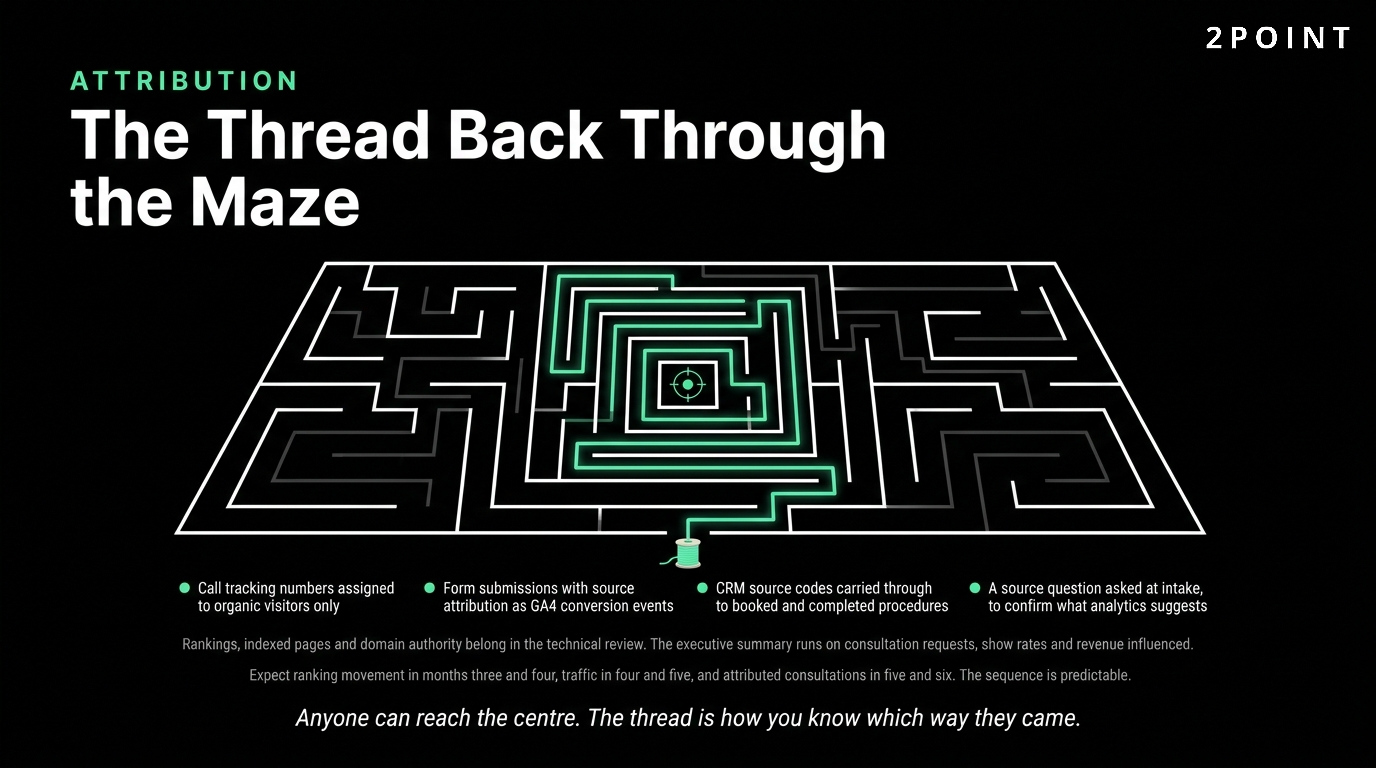
The critical measurement challenge for plastic surgery practices is attributing consultation bookings accurately to organic search. Call tracking numbers assigned specifically to organic search visitors enable attribution of phone consultations to SEO activity, separate from calls generated by paid ads, referrals, or direct website visits. Form submission tracking with source attribution, configured in GA4 using custom conversion events, captures which procedure pages and which keywords produced form-based consultation requests.
CRM integration extends attribution beyond the initial contact. When consultation requests are entered into the practice management system with source codes indicating the originating marketing channel, practices can track not just which channels generate inquiries but which channels generate booked consultations, show rates, and ultimately completed procedures. This full-funnel visibility enables true cost-per-acquisition calculations that compare SEO to other marketing channels on the metric that actually matters: cost per revenue-generating patient.
Patient source attribution at intake, captured through a brief question during the consultation scheduling process or confirmed at the initial appointment, provides a human-verified data layer that complements digital tracking. Patients who say they “found the practice through Google” or “searched for rhinoplasty surgeons in Chicago” confirm the organic attribution that analytics data suggests. Consultation-focused metrics are the North Star measurement for plastic surgery SEO, because consultations are where the SEO investment converts into practice revenue.
Realistic Timeline Expectations for Plastic Surgery SEO
Setting accurate timeline expectations is one of the most important conversations in any plastic surgery SEO engagement. Practices accustomed to the immediacy of paid advertising often expect rapid results from SEO and become discouraged during the natural ramp-up period. Understanding what to expect at each phase of the investment prevents premature discontinuation of strategies that are working but simply require more time to mature.
| SEO Timeline Phase | Typical Duration | Primary Activities | Expected Outcomes |
|---|---|---|---|
| Implementation and Foundation | Weeks 1 to 4 | Technical fixes, GBP optimization, citation audit, content planning | Technical issues resolved, GBP complete, baseline metrics established |
| Initial Traction | Months 2 to 3 | Procedure page publication, review system activation, local citations | Crawl and index improvements, early ranking movements on long-tail terms |
| Early Growth | Months 4 to 6 | Content expansion, link building, review velocity building | First page appearances, organic traffic growth, initial consultation attributions |
| Competitive Rankings | Months 6 to 12 | Authority building, content refinement, competitor gap closing | Top 3 organic rankings for priority terms, stable Map Pack presence |
| Compounding Authority | Year 2 and beyond | Market dominance expansion, GEO optimization, brand authority reinforcement | Category leadership, consistent consultation flow, lower cost per acquisition |
Practices that reach the compounding authority phase see organic search evolve from a patient acquisition channel into a self-reinforcing business asset that grows in value with every additional piece of content, review, and backlink added.
Reporting That Demonstrates Real Practice Value
Monthly reporting for plastic surgery SEO should connect every metric directly to the business outcome it influences. Vanity metrics such as total keyword rankings, total indexed pages, or domain authority scores have their place in technical SEO evaluation but should not anchor the executive summary presented to practice owners. Revenue-connected KPIs, including consultation requests from organic search, consultation show rate by source, and estimated revenue influenced by organic traffic, speak the language that practice owners and practice managers care about.
Competitive benchmarking reports that show where the practice ranks relative to its three to five most direct local competitors on priority procedure terms provide context that isolated metric reports cannot. A rank improvement from position eight to position four is meaningful in isolation but becomes urgent when the reporting shows that the top three positions are held by competitors who have been building their SEO foundations for two or more years. Review velocity and sentiment tracking, showing month-over-month growth in review volume and the trend in average star ratings across all platforms, demonstrates the systematic nature of the practice’s reputation management effort.
The best reporting frameworks for managing plastic surgery SEO campaigns include both the forward-looking metrics that indicate momentum and the lagging metrics that confirm conversion. A practice might see ranking improvements in months three and four, organic traffic growth in months four and five, and consultation attribution from organic search in months five and six. Showing this sequential progression helps stakeholders understand that SEO results follow a predictable sequence, not an unpredictable pattern. Understanding the common challenges in managing SEO campaigns prepares both the agency team and the practice leadership to navigate the ramp-up period with patience and data-informed confidence.
Building a Sustainable Patient Acquisition System Through Plastic Surgery SEO
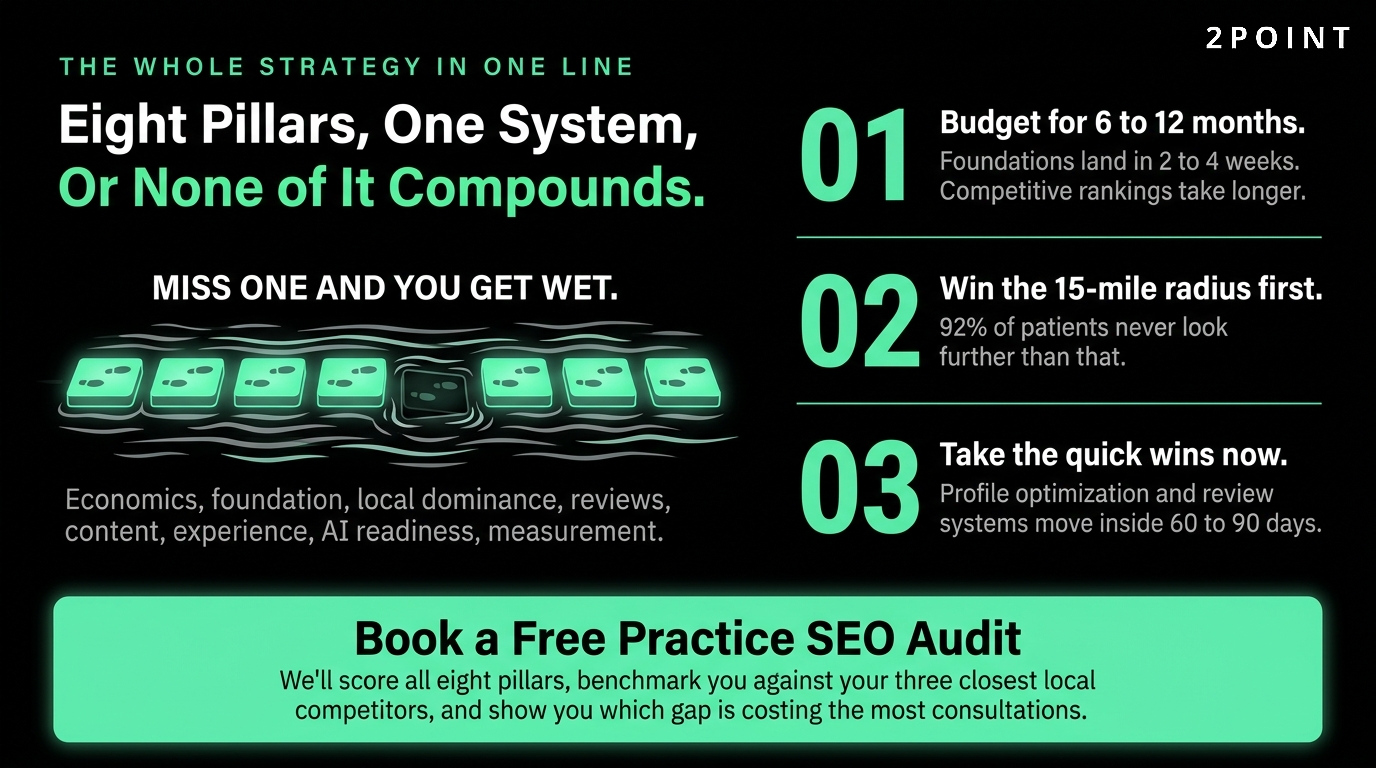
The eight pillars of plastic surgery SEO outlined in this guide are not standalone tactics. They are interconnected components of a patient acquisition system that grows stronger with every passing month of consistent investment. Practices that approach SEO as a collection of isolated techniques see incremental results. Practices that build these components as a unified system see compounding, market-defining growth.
The roadmap for building this system follows a logical sequence:
- Start with economics: Understand the 3x cost advantage of organic acquisition and the 6 to 12 month investment timeline before committing resources. SEO is a long-term capital allocation, not a short-term marketing expense.
- Build the foundation: One page per procedure, technically excellent site architecture, and entity-based authority for the primary surgeon or surgical team.
- Dominate locally: A fully optimized Google Business Profile, consistent NAP citations across healthcare and general directories, and location-specific content that earns Map Pack placement.
- Systematize reviews: A workflow-integrated review generation system targeting 10 to 15 new reviews per month across Google, RealSelf, and Healthgrades, with a consistent response strategy for every review received.
- Optimize content: Procedure pages built to 1,200 to 2,000 words with E-E-A-T signals, structured FAQs, before-and-after galleries, and clear conversion paths throughout.
- Perfect the experience: A mobile-first, Core Web Vitals-compliant website that converts the organic traffic SEO delivers into consultation requests.
- Prepare for AI search: A GEO strategy that makes content citation-worthy for Google AI Overviews, Perplexity, and ChatGPT responses alongside traditional ranking optimization.
- Measure what matters: A full-funnel measurement framework that connects rankings to traffic, traffic to consultation requests, and consultation requests to practice revenue.
The next step for any practice evaluating this framework is an honest audit of where they currently stand across all eight areas. Most established practices will find they have partial strength in two or three areas and significant gaps in the others. Quick wins in GBP optimization and review system activation can produce measurable results within 60 to 90 days while longer-term authority building and content development efforts ramp up in parallel.
Whether building an in-house digital marketing capability or partnering with a specialized agency, the practices that achieve lasting search market leadership share one characteristic: they treat plastic surgery SEO not as a vendor service to be purchased and forgotten, but as a core business function to be strategically managed and continuously improved. Agencies like 2POINT that specialize in this intersection of medical authority and digital marketing strategy bring both the technical depth and the healthcare-industry awareness that plastic surgery practices need to compete effectively in 2026 and beyond.
Plastic surgery SEO in 2026 is not about tricks or shortcuts. It is about building legitimate medical authority, optimizing for how patients actually search across an increasingly fragmented search landscape, and creating digital experiences that earn trust before a patient ever contacts the practice. The practices that do this consistently, systematically, and with a long-term perspective will own the local search markets that others compete for one paid click at a time.
Frequently Asked Questions About Plastic Surgery SEO
What exactly is plastic surgery SEO and how is it different from general SEO?
Plastic surgery SEO is the specialized practice of optimizing a cosmetic or reconstructive surgery practice’s online presence to rank in Google search results and local Map Pack listings. It differs from general SEO through its focus on YMYL content standards, E-E-A-T medical credibility requirements, healthcare-specific citation platforms, and the unique patient decision journey that involves high-stakes emotional and financial considerations.
How long does it take to see results from plastic surgery SEO?
Technical implementation typically takes two to four weeks, with initial ranking improvements appearing in months three to four. Competitive rankings for priority procedure terms generally stabilize between months six and twelve. Compounding authority and category-level market dominance develop over year two and beyond, depending on competition levels in the practice’s geographic market.
Is plastic surgery SEO worth the investment compared to Google Ads?
Yes, in most markets and over a 12-plus month horizon. Organic search generates consultation requests at approximately $200 per patient compared to $610 or more through Google Ads, and organic traffic converts at 18.9% versus 10.7% for paid search. Additionally, organic rankings continue generating patients after the investment is made, while paid ad traffic stops the moment budget is cut.
What is the most important local SEO factor for plastic surgeons?
Google Business Profile optimization is the single highest-weight local ranking factor, accounting for approximately 30% of local ranking signals. A complete, actively managed GBP with consistent photo additions, regular posts, and strong review velocity drives Map Pack placement more directly than any other individual optimization activity.
How many Google reviews does a plastic surgery practice need to rank in the Map Pack?
Practices in competitive urban markets typically need between 150 and 400 reviews to dominate Map Pack positions. More important than the total number is review velocity: 10 to 15 new reviews per month signals active business vitality to Google and consistently outranks practices with higher total counts but stagnant recent review activity.
Does plastic surgery SEO vs. paid advertising perform differently for different procedures?
Yes. High-volume procedures like rhinoplasty (90,000 monthly searches) and liposuction (83,000 monthly searches) have more organic competition but also larger audiences to capture, making SEO investment particularly valuable. Lower-volume specialized procedures often have lower keyword difficulty, allowing smaller practices to rank competitively more quickly while capturing highly qualified patient intent at exactly the moment of decision.
How do AI Overviews affect plastic surgery search visibility in 2026?
AI Overviews now appear on effectively 100% of plastic surgery procedure queries, meaning patients often receive AI-generated summaries before they see traditional organic results. Practices must optimize for generative engine optimization (GEO) alongside traditional SEO to ensure their content and credentials are cited in AI summaries, which influences brand awareness even before a patient clicks to a website.
What is E-E-A-T and why does it matter for plastic surgery websites?
E-E-A-T stands for Experience, Expertise, Authoritativeness, and Trustworthiness, and it is Google’s framework for evaluating medical content quality. For plastic surgery websites, E-E-A-T signals include board certification badges, named surgeon attribution on all procedure pages, medical association memberships, and honest patient safety information. Weak E-E-A-T signals suppress rankings for medically sensitive procedure content.
How does local SEO for plastic surgeons differ from local SEO for other medical specialties?
Plastic surgery local SEO faces unique challenges including ineligibility for Google Local Services Ads, Meta advertising restrictions on lower-funnel healthcare campaigns, and higher patient research intensity given the elective and often significant financial nature of procedures. Patients typically research plastic surgeons more extensively and across more platforms, including procedure-specific platforms like RealSelf, than patients choosing most other medical specialties.
What NAP consistency means for plastic surgery practices and why does it matter?
NAP refers to a practice’s Name, Address, and Phone number as they appear across all online directories and platforms. Inconsistencies between listings, even minor formatting differences, prevent Google from confidently consolidating a practice’s citation authority into a single entity, weakening local Map Pack rankings. Every directory listing must match exactly, including suite numbers, phone formats, and the exact legal or DBA name of the practice.
Can a plastic surgery practice do SEO without hiring an agency?
Basic elements such as GBP optimization, NAP consistency, and review generation can be implemented in-house with proper training and dedicated staff time. However, technical SEO audits, competitive keyword research, content strategy, backlink acquisition, and GEO optimization require specialized expertise that most practice teams lack alongside their clinical and administrative responsibilities. Many practices achieve the best outcomes by partnering with a specialized medical SEO agency for strategy and execution while keeping review management and GBP posting in-house.
How should plastic surgery practices measure the ROI of their SEO investment?
The most meaningful measurement framework tracks from organic search rankings through website traffic, to consultation requests attributed to organic search, to booked consultations, show rates, and completed procedures. Call tracking numbers specific to organic visitors, form submission source attribution in Google Analytics 4, and patient intake source questions together create a full-funnel picture that connects SEO investment directly to practice revenue rather than stopping at vanity metrics like keyword rankings or page views.