

 let’s connect


What Is Senior Living Marketing and Why Does It Matter in 2026?
Senior living marketing refers to the full spectrum of strategies, channels, and tactics that senior housing communities use to attract qualified prospects, nurture family relationships, and maintain healthy occupancy levels in a competitive market. It is not simply advertising — it is a coordinated discipline that blends digital performance, authentic storytelling, reputation management, and seamless sales integration.
Here is what every senior living operator and marketer needs to know right now:
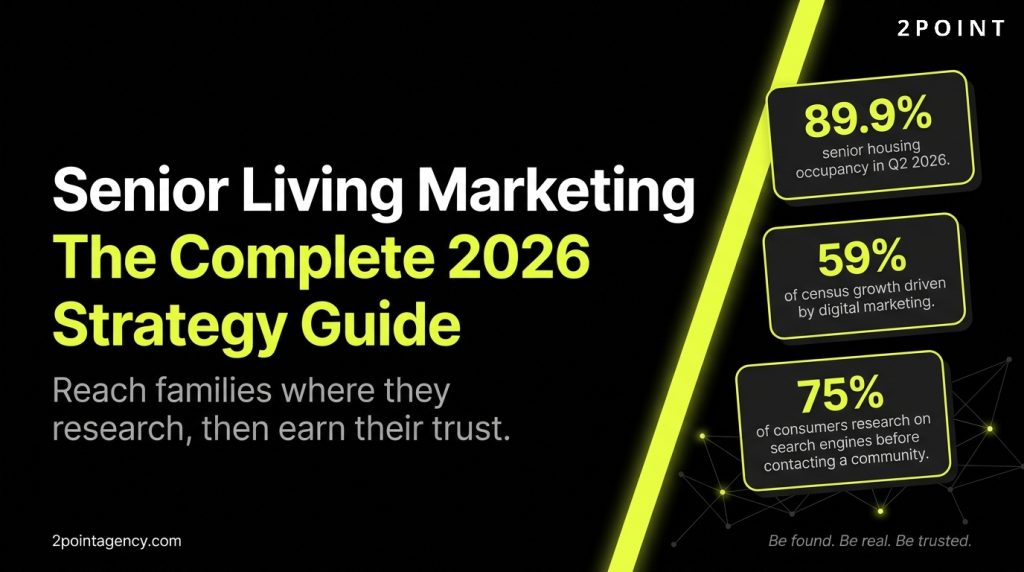
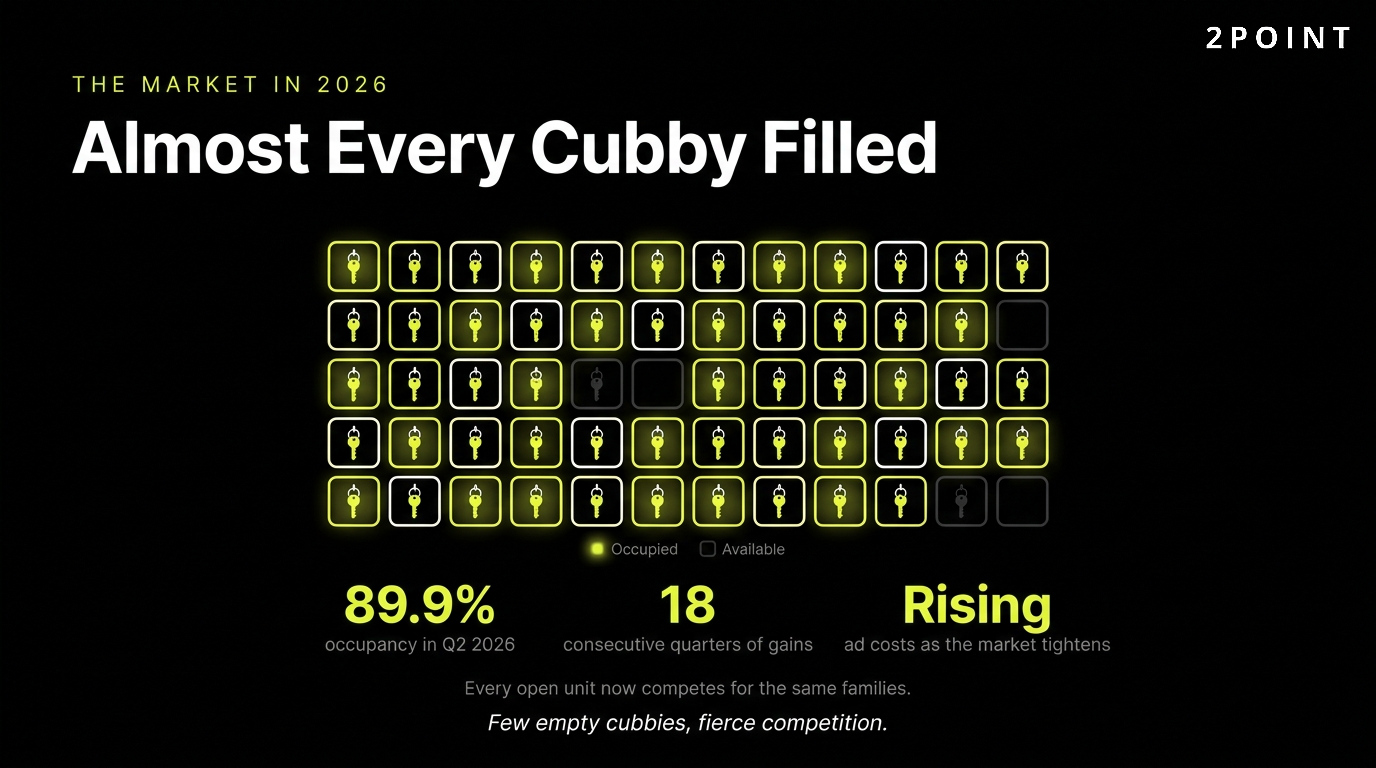
- Senior housing occupancy reached 89.9% in Q2 2026, creating heightened competitive pressure for every available unit.
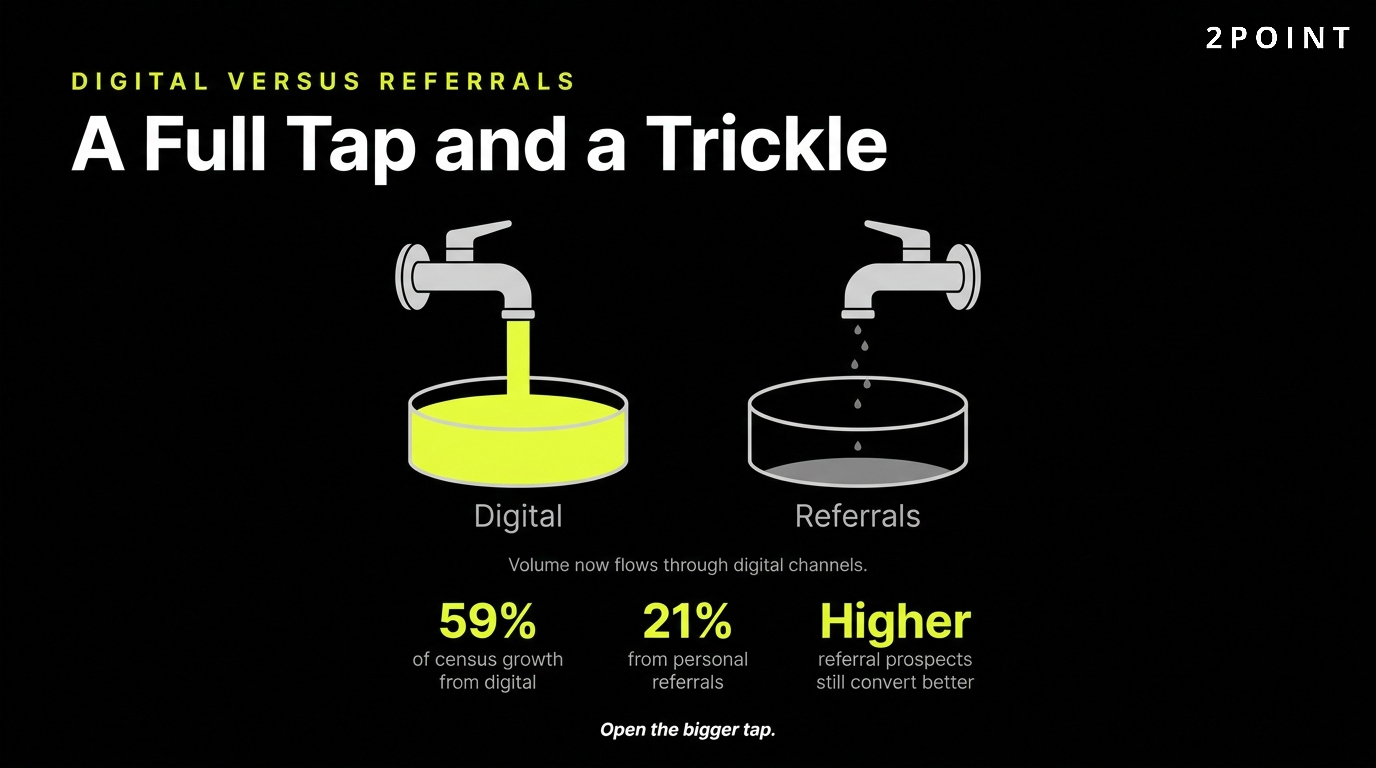
- Digital marketing now drives 59% of census growth, compared to only 21% from personal referrals.
- 75% of consumers research senior living options on search engines before contacting a community.
- There are approximately 6,000 hourly searches for senior living topics in the United States alone.
- Families are no longer calling first — they are researching on mobile devices, watching videos, and reading reviews weeks before making contact.
- AI-powered search platforms like Google AI Overviews and ChatGPT are now first touchpoints, requiring a new content approach.
- The discipline now requires hyperlocal targeting, AI-optimized content, authentic video storytelling, and tight marketing-to-sales alignment.
- Communities that do not meet families where they are — on mobile, in AI search, and across social media — are losing qualified leads before the first conversation.
The sections below break down each of the eight strategic pillars that define effective senior living marketing in 2026, with actionable guidance, industry benchmarks, and channel-specific tactics your team can begin implementing immediately.
How AI-Powered Search Is Transforming Senior Living Marketing
The shift to AI-powered search is not a future trend for senior living marketers — it is the present reality that is reshaping how communities earn visibility, attract qualified traffic, and convert online research into actual tours. Understanding how to operate in this new environment is now a foundational requirement for any effective marketing strategy.
Why Traditional SEO Alone Won’t Win in 2026
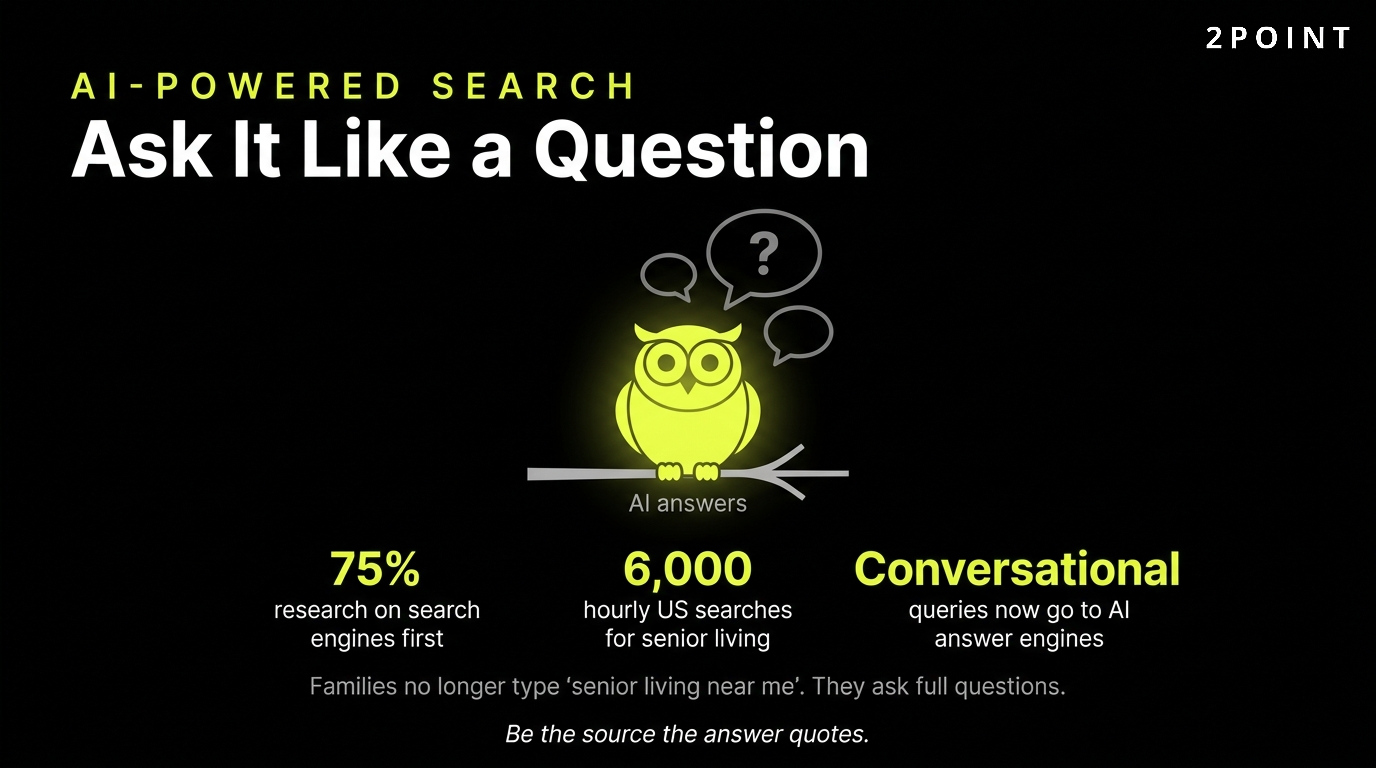
Search behavior in senior living has undergone a fundamental transformation. Where families once typed short, list-based queries like “senior living near me,” they now ask fully formed conversational questions: “Which assisted living community in [city] has the best memory care programming and is closest to downtown?” These queries are not going to a traditional results page — they are being processed by AI Overviews on Google, by ChatGPT, by Perplexity, and by other AI answer engines that synthesize information from multiple sources and present a single, authoritative response.
According to Conversion Logix’s 2026 senior living marketing trends analysis, ad placement on AI platforms is becoming as fundamental as Google search advertising was a decade ago. Communities that rely solely on keyword-stuffed landing pages and backlink building are finding themselves invisible in the channels where high-intent families are actually searching. Traditional SEO remains important as a foundation, but it must now be layered with answer engine optimization, structured content, and AI-ready formatting to maintain reach.
The practical implication is that senior living communities need to think of their websites and content libraries as knowledge bases that AI systems can accurately read, interpret, and cite. This means moving beyond targeting a handful of competitive keywords and instead building comprehensive, authoritative content ecosystems that answer the full spectrum of questions families ask during their research journey.
Structuring Content for AI Discovery
To earn citations from AI platforms, content must be structured so that machines can extract precise, accurate answers without ambiguity. According to Love and Company’s senior living marketing outlook for 2026, communities that organize their websites around clearly defined topics, with dedicated FAQ sections and concise answer formatting, are the ones earning consistent placement in AI-generated responses.
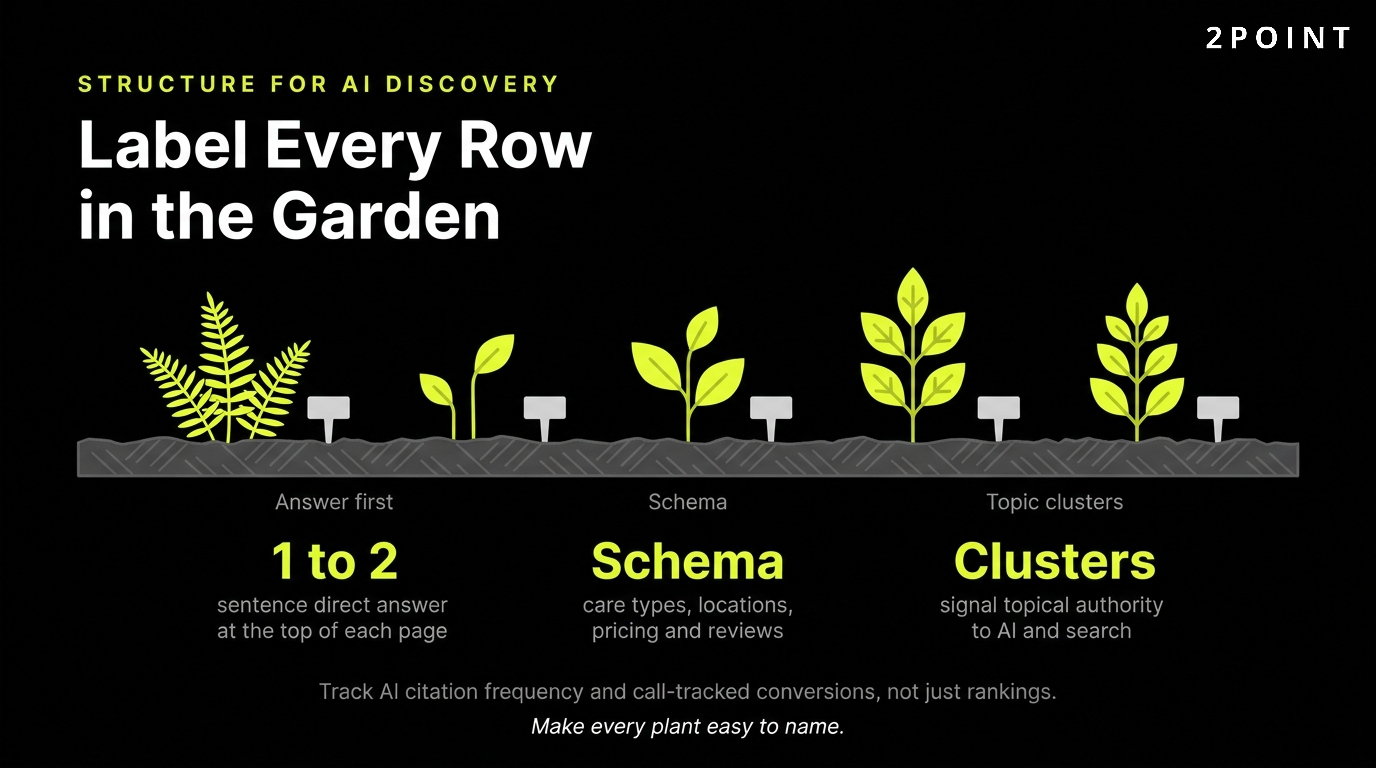
Specific tactics that support AI discoverability include implementing schema markup for care types, locations, pricing ranges, and review data. Each page should open with a direct, one-to-two sentence answer to the question that page is designed to address, followed by supporting detail. Blog posts and resource articles should use clear heading hierarchies so that AI crawlers can identify both the question being answered and the response being offered. Topic clusters — groups of related content linked to a central pillar page — signal topical authority to both traditional search engines and AI systems.
Comprehensive topic coverage matters more than keyword density. If a family is asking about memory care programming, the ideal page does not just mention memory care — it covers activity philosophies, staffing ratios, therapeutic approaches, family communication protocols, and pricing structures. The more completely a page addresses a topic, the more likely it is to become a trusted source that AI platforms reference repeatedly.
AI-Driven Personalization That Actually Converts
Beyond search discovery, AI is transforming the on-site experience that families encounter once they arrive at a community’s website. AI-powered personalization is one of the most significant shifts in senior living marketing for 2026, with leading communities using behavioral signals to serve tailored content experiences based on care type interest, geographic location, urgency indicators, and time spent on specific pages.
When a visitor spends significant time on memory care pages and then navigates to pricing, an AI-personalized experience might surface a memory care cost guide, a video testimonial from a memory care family, and a prompt to schedule a specialized tour — all without the visitor having to request that information explicitly. Creating Results’ 2026 marketing predictions note that branded AI helpers — chatbots and assistants embedded on community websites — are only effective when they are genuinely exceptional. Generic chatbot experiences that frustrate users damage trust more than they help. The standard for AI-assisted interaction has risen significantly, and families now expect responses that are specific, empathetic, and accurate.
Email personalization powered by AI is similarly evolving. Automated sequences that segment by care type, resident age range, timeline to decision, and financial situation can deliver content that feels personally relevant rather than mass-produced. The key is integrating CRM data with marketing automation platforms so that behavioral signals from the website feed directly into communication sequencing.
Measuring Success in an AI-First World
As Conversion Logix highlights, the metrics that defined search marketing success for the past decade — keyword rankings, organic traffic volume, click-through rates from results pages — are increasingly incomplete measures of a community’s digital visibility. When AI platforms answer a family’s question without sending them to a website at all, traditional traffic metrics may actually decline even as awareness and brand recognition grow.
New measurement frameworks for AI-era senior living marketing include tracking AI citation frequency (how often your community is mentioned in AI-generated responses), monitoring the specific questions for which your content earns featured placements, and measuring conversions that originate from AI-referred traffic through UTM parameters and referral source tagging. Phone call tracking becomes especially important here, since many AI-referred visitors will call directly rather than completing a web form. Communities that invest in call tracking and attribution software will have a significant analytical advantage over those relying solely on form submissions and Google Analytics session data.
Building a Hyperlocal Marketing Strategy That Dominates Your Market
In senior living, geography is destiny. Families searching for communities are almost always looking within a specific radius of their own home, their parent’s current location, or a known neighborhood. A hyperlocal marketing strategy recognizes this reality and builds competitive dominance at the neighborhood and zip code level rather than spreading resources across broad regional campaigns.
Why Hyperlocal Beats Regional in Senior Living Marketing
The competitive dynamics of senior housing make neighborhood-level targeting consistently more effective than city-wide or regional campaigns. When a family in a northern suburb searches for assisted living, they are not interested in communities forty minutes away — they want options close enough for regular visits. Conversion Logix’s 2026 market analysis identifies hyperlocal demand as one of the defining characteristics of the current senior living landscape, with search patterns showing strong concentration by zip code and neighborhood.
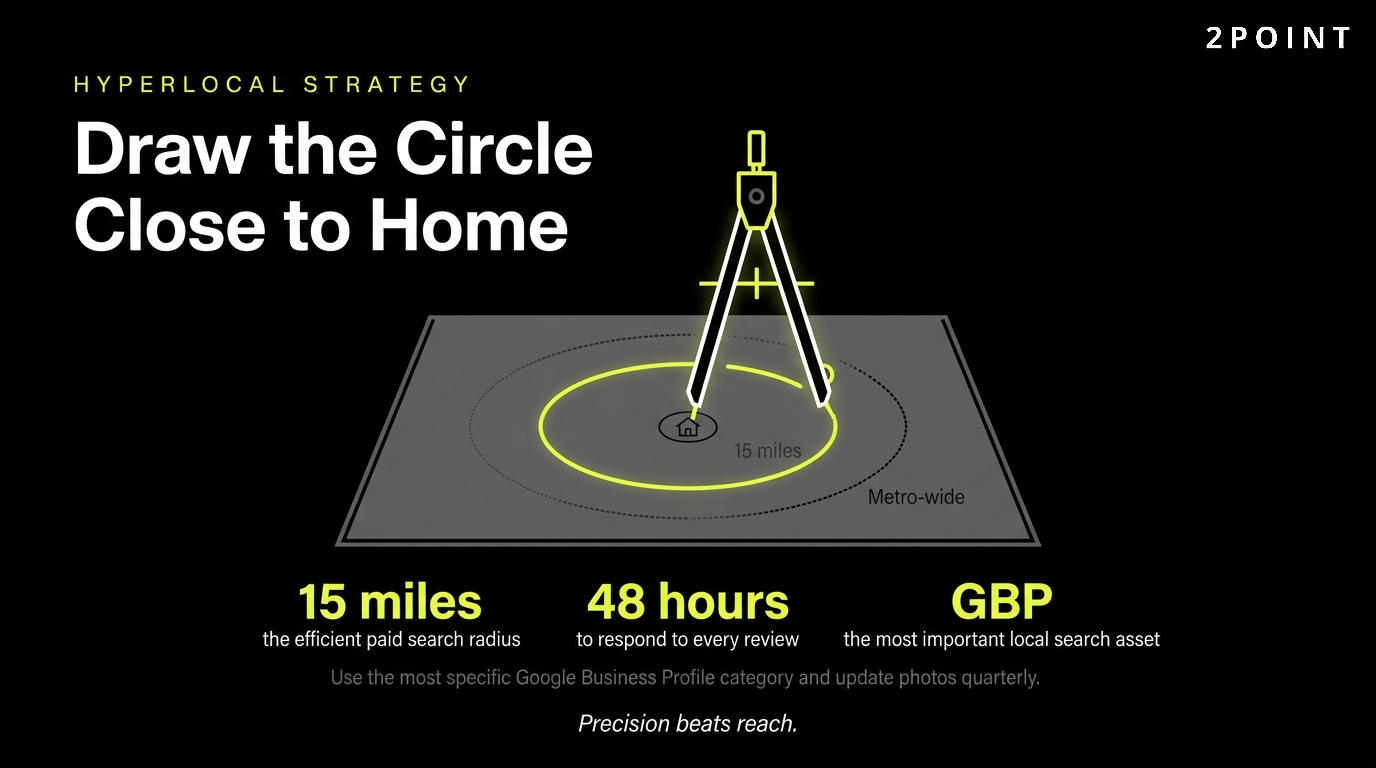
From a budget efficiency standpoint, hyperlocal campaigns produce better cost-per-lead ratios because they eliminate wasted impressions from geographies unlikely to generate qualified prospects. A community investing in paid search, for example, will almost always generate a better return by targeting a fifteen-mile radius than by running a broad metropolitan campaign that includes families too far away to be realistic prospects. The same logic applies to organic content, local citations, and social media targeting: precision outperforms reach when the product is inherently location-dependent.
As local senior housing demand grows and new inventory continues to enter markets, the communities that have already established hyperlocal authority — through Google Business Profile optimization, location-specific content, and neighborhood-level keyword visibility — will have a significant first-mover advantage over those attempting to compete broadly.
Local SEO Essentials: Google Business Profile to Location Pages
The Google Business Profile (GBP) is the single most important local search asset a senior living community can maintain. It surfaces in Google Maps, local pack results, and AI-powered responses to location-based queries. According to CCR Growth’s senior living marketing strategies guide, communities that fully optimize their GBP — with complete service categories, up-to-date photos, accurate hours, and regular post activity — consistently outperform competitors in local search visibility.
Practical GBP optimization steps include selecting the most specific and accurate business category (such as “Assisted Living Facility” or “Memory Care Facility” rather than just “Retirement Community”), uploading high-quality photos that are updated at least quarterly, maintaining a complete and current description that includes primary service keywords naturally, and responding to every review within 48 hours. Collecting and publishing Google reviews on an ongoing basis is discussed in depth in the reputation management section below.
Beyond GBP, every community should have dedicated location pages for each care type it offers, targeting keyword phrases like “assisted living in [City Name]” and “[Neighborhood] memory care.” These pages should not be thin templates — they should include genuine neighborhood-specific content, transportation and hospital proximity information, local landmarks, and community integration details that only a truly local provider could authentically offer. Building citations across directories like Yelp, Caring.com, A Place for Mom, and senior-specific directories reinforces local search authority across the full ecosystem of platforms families use during their research.
Leveraging Community Partnerships and Local Events
Digital hyperlocal marketing is powerful, but it performs even better when supported by real-world relationships that create authentic local presence. Aline’s senior living community marketing ideas resource highlights strategic partnerships as one of the most underutilized tools in many communities’ marketing arsenals.
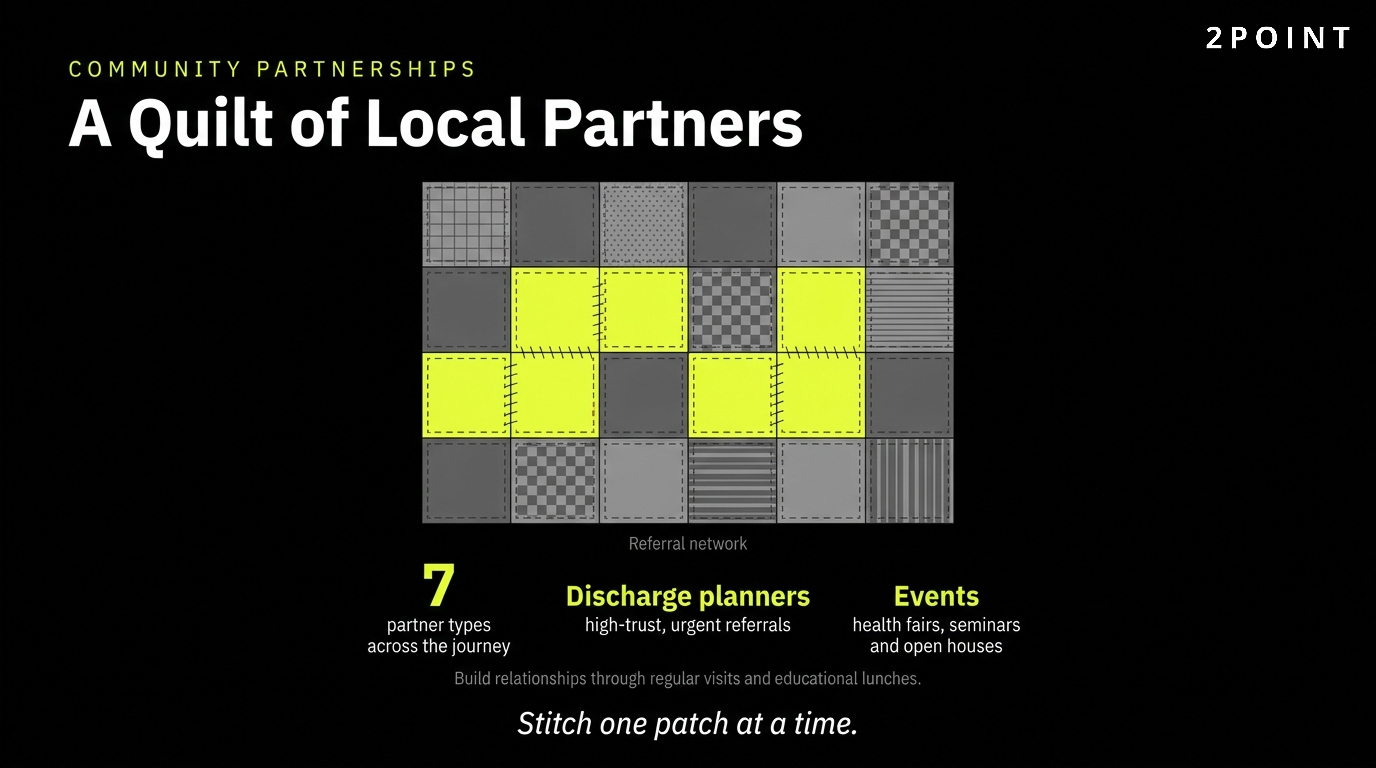
Hospital discharge planners and social workers are among the most valuable referral partners a senior living community can cultivate. They are regularly advising families who need care solutions urgently and who have high trust in those recommendations. Building genuine relationships with these professionals — through regular visits, educational lunches, and responsive communication — creates a referral pipeline that is both consistent and high-quality. Similar partnerships with primary care physicians, geriatric care managers, senior centers, faith communities, and estate planning attorneys each serve different points in the family decision journey and collectively create a comprehensive local referral network.
Community events, whether hosted at the senior living campus or participated in at external venues, serve dual purposes: they generate direct prospect engagement and they build community visibility that strengthens both word-of-mouth referrals and local search authority. Health fairs, educational seminars on topics like fall prevention or estate planning, and open house events are all effective formats that allow prospective residents and families to experience community culture before making a formal inquiry.
Hyperlocal Content: From Neighborhood Guides to Local Stories
Content that speaks specifically to a neighborhood or city carries a credibility and relevance that generic senior living content simply cannot match. When a community publishes a detailed guide to senior-friendly restaurants, parks, and medical facilities within a few miles of their campus, it demonstrates genuine local knowledge and serves as a genuinely useful resource for families evaluating proximity to amenities they care about.
According to CCR Growth, hyperlocal content strategies that perform well in senior living include neighborhood transportation guides (covering bus routes, ride-share availability, and proximity to major roads), hospital and specialty clinic proximity overviews, and “community connection” features that showcase how current residents remain engaged with the surrounding neighborhood through outings, volunteer programs, and local event participation. These stories are authentic, shareable, and genuinely useful — exactly the characteristics that earn both family trust and AI platform citations.
What Senior Living Marketing Actually Costs (And Where to Spend It)
Budget conversations in senior living marketing are often clouded by either unrealistic expectations or vague guidance. The data available in 2026 makes it possible to approach this topic with real specificity, giving operators and marketing directors a defensible framework for allocating resources and setting performance benchmarks.
Industry Benchmarks: Cost Per Lead by Care Type
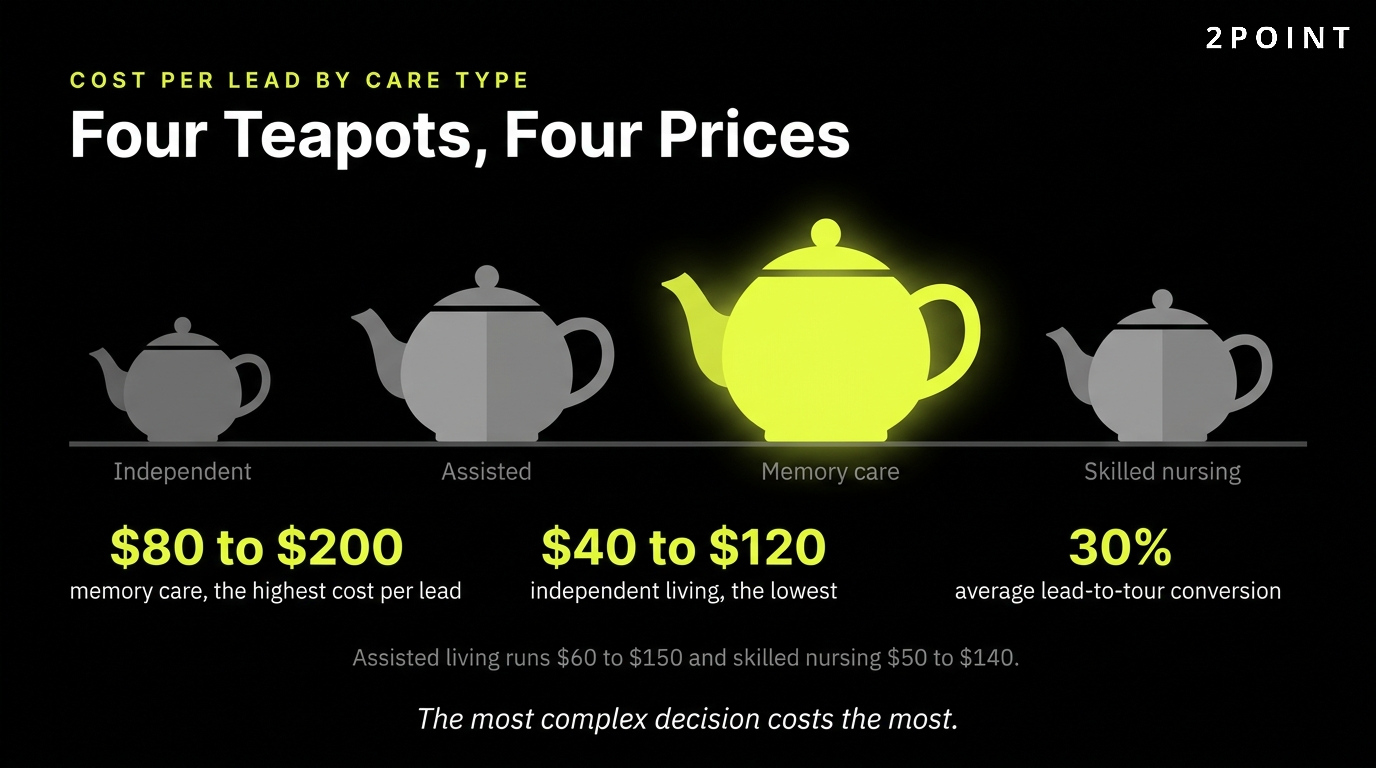
Cost per lead (CPL) varies meaningfully by care type, reflecting differences in search competition, prospect urgency, and conversion complexity. According to US Rengage’s 2026 Senior Living Marketing Benchmarks, the following ranges represent current industry performance across digital channels:
| Senior Living Care Type | Cost Per Lead Range | Key Conversion Factors |
|---|---|---|
| Independent Living | $40 to $120 | Lifestyle appeal, pricing transparency, lifestyle tours |
| Assisted Living | $60 to $150 | Care credibility, family reassurance content, speed of response |
| Memory Care | $80 to $200 | Specialized programming, safety features, staff expertise |
| Skilled Nursing | $50 to $140 | Clinical reputation, discharge planner relationships, insurance acceptance |
The key takeaway is that memory care commands the highest CPL investment due to its specialized nature and the emotional complexity of the family decision process, while independent living offers the lowest CPL with strong lifestyle-driven content. The industry average conversion rate from lead to tour sits at approximately 30%, with tour-to-move-in conversion running between 29% and 34% depending on community performance.
Total Budget Guidelines Based on Occupancy
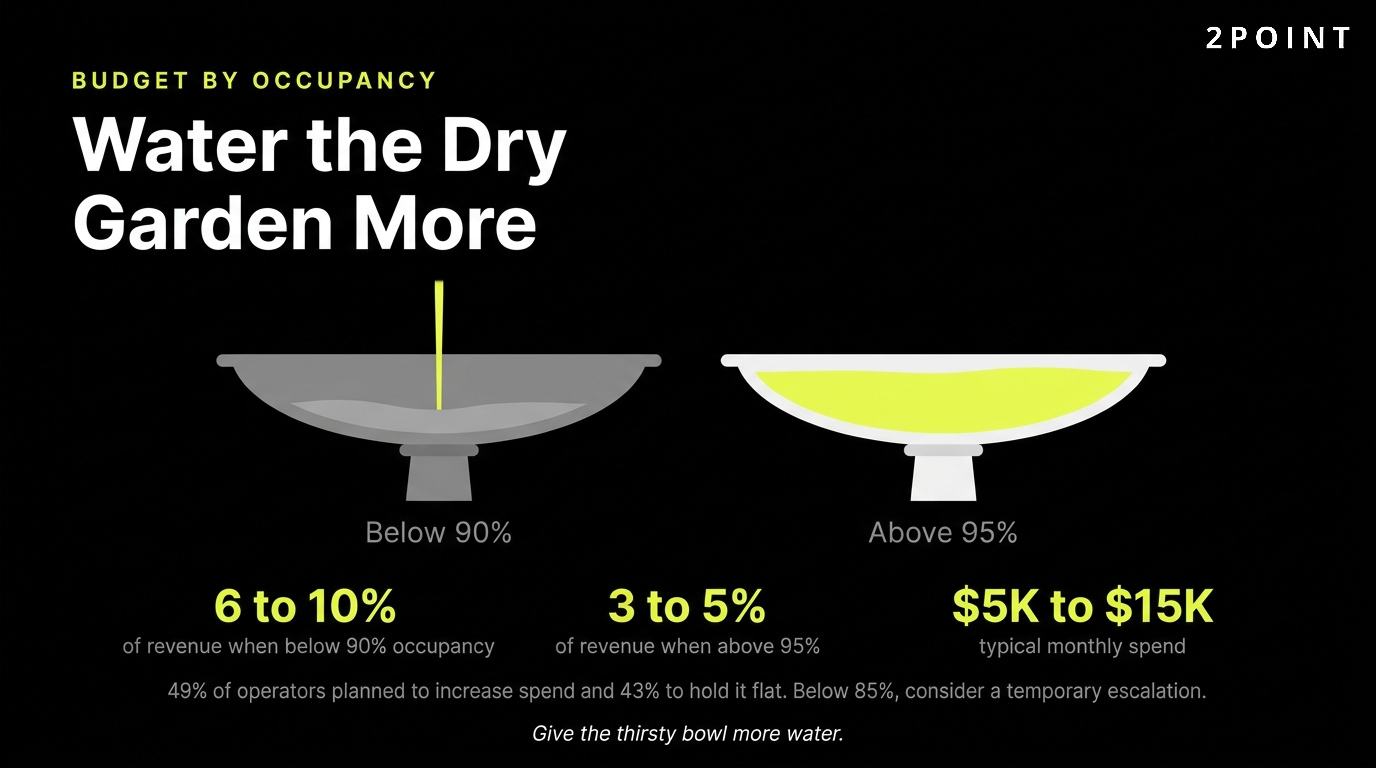
How much a community should invest in marketing is directly tied to its current occupancy level and competitive market dynamics. The general framework supported by industry data is this: communities operating below 90% occupancy should allocate between 6% and 10% of annual revenue to marketing, while those above 95% occupancy can typically sustain performance on 3% to 5% of revenue.
In absolute terms, most independent and assisted living communities are spending between $5,000 and $15,000 per month on marketing, depending on market size, number of units, and competitive intensity. US Rengage’s benchmark data shows that 49% of operators expected to increase marketing spend, while 43% anticipated budgets remaining flat — a clear signal that the industry recognizes the need for sustained investment even as occupancy rates improve. When occupancy drops below 85%, operators should strongly consider a temporary budget escalation rather than waiting for the competitive gap to widen further.
Channel Allocation: Where High-Performing Communities Invest
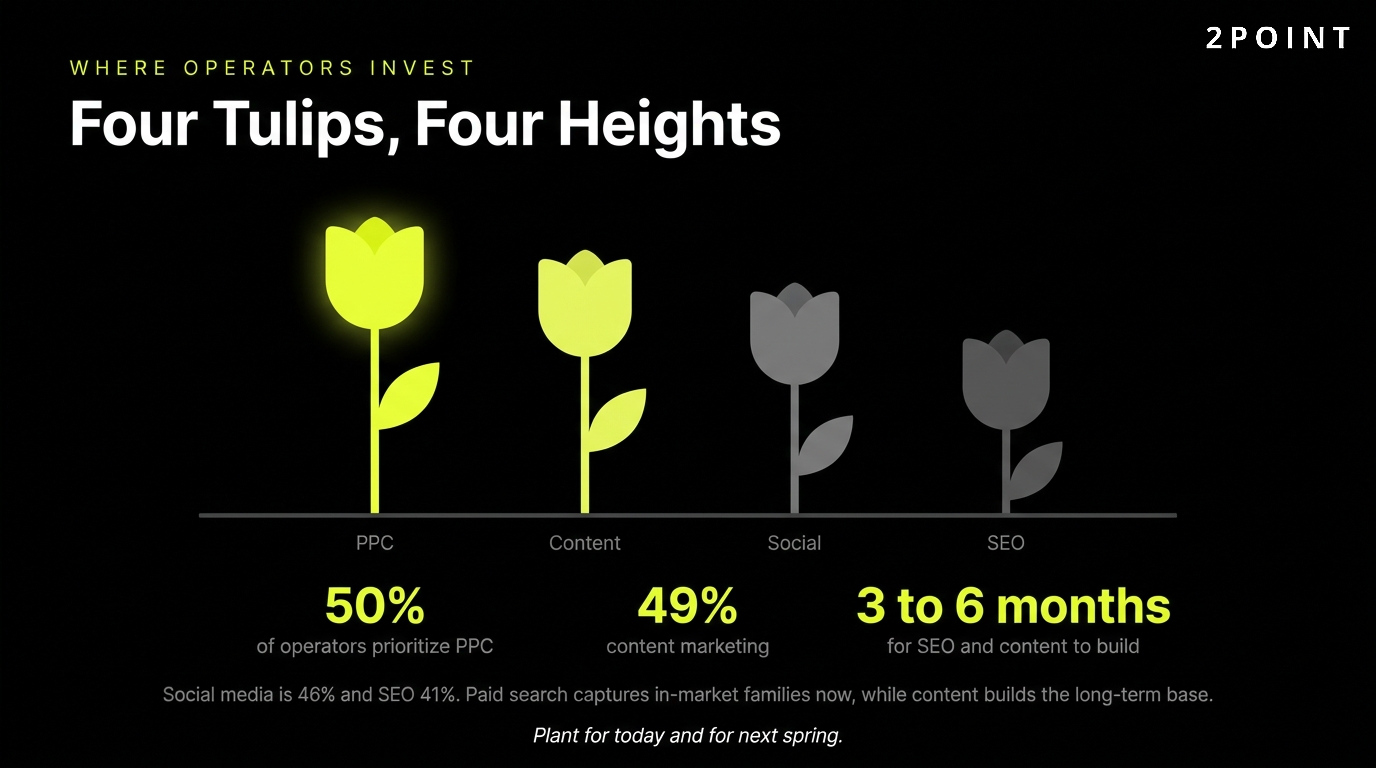
Understanding not just how much to spend, but where to spend it, separates effective senior living marketers from those burning budget on low-return activities. According to Senior Housing News’ operator survey data, high-performing communities concentrate their investment across the following channels:
| Marketing Channel | Operator Priority Rate | Primary Role in Senior Living Funnel |
|---|---|---|
| PPC and Paid Search | 50% of operators | Capturing high-intent, in-market prospects immediately |
| Content Marketing | 49% of operators | Building trust, earning organic search visibility, supporting AI citations |
| Social Media | 46% of operators | Brand awareness, community culture demonstration, adult child engagement |
| SEO | 41% of operators | Long-term organic visibility, local search domination |
The most effective senior living marketing budgets treat paid search as the immediate-response engine for capturing in-market families, while content marketing and SEO build the long-term organic foundation that reduces cost-per-lead over time. A multi-channel marketing approach that integrates these channels consistently outperforms single-channel investment.
ROI Expectations and When to Adjust Spend
Realistic ROI timelines differ significantly by channel. Paid search can begin generating leads within days of launch, making it the right tool for communities facing urgent occupancy needs. SEO and content marketing typically require three to six months before significant organic traffic gains materialize, but the resulting leads carry lower cost and higher intent over time. Social media sits in between: brand awareness builds relatively quickly, but direct move-in attribution from social channels is a longer arc.
The rising competitive pressure created by improving occupancy rates is an important context for ROI expectations. Marketing Essentials notes that the industry reached 89.1% average occupancy following 18 consecutive quarters of gains — meaning the market is highly competitive and advertising costs are rising correspondingly. When a community finds that increasing ad spend is producing diminishing returns, that is often a signal to shift budget toward reputation management and content differentiation rather than simply outbidding competitors for the same high-intent keywords.
Converting Phone Calls and Web Leads Into Move-Ins
Generating leads is only half the equation. The communities that consistently achieve high occupancy are those that convert leads at above-average rates by treating every inquiry — whether it arrives by phone, web form, chat, or email — as the beginning of a relationship that deserves a thoughtful, timely, and human response.
Why Phone Calls Still Matter More Than You Think
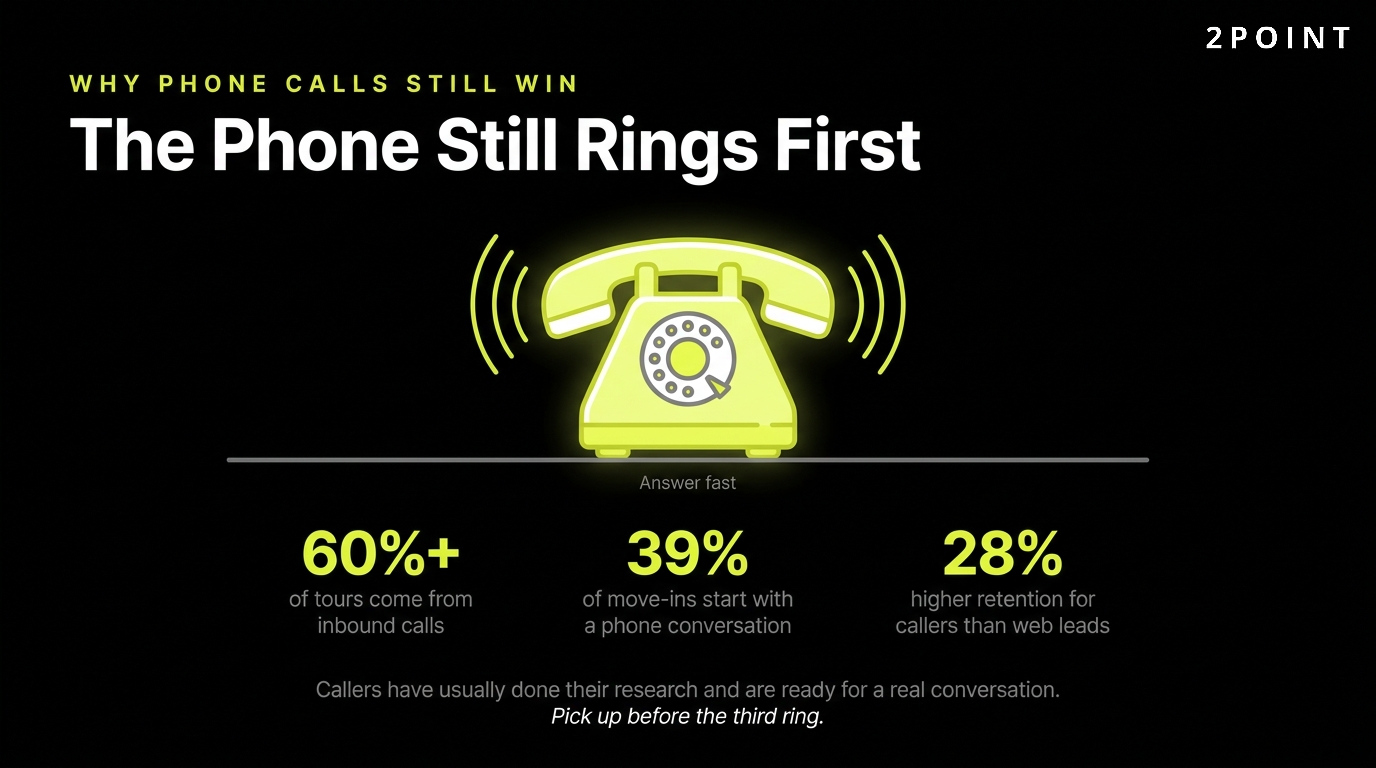
In an increasingly digital world, it may be tempting to focus the majority of conversion optimization effort on web-based leads. The data, however, points to a persistent and powerful role for phone calls in the senior living decision process. According to Invoca’s senior living marketing statistics, more than 60% of tours result from inbound phone calls, and 39% of all move-ins can be traced back to a phone conversation as the originating touchpoint. Even more striking: caller retention rates are 28% higher than web lead retention rates, meaning that families who call are significantly more likely to remain engaged through the full sales cycle than those who complete a contact form.
This data has direct implications for resource allocation. Senior living communities should invest in call tracking software that attributes calls to specific campaigns and keywords, train inquiry teams specifically on phone-based consultation skills, ensure that calls are answered promptly during business hours (and that after-hours calls reach a live person or a highly effective callback system), and treat every inbound call as a high-value sales interaction. The families who call first are often those who are further along in the decision process — they have done their online research and they are ready to have a real conversation. Missing or mishandling those calls represents a costly and largely avoidable loss of qualified prospects.
Web Lead Nurturing: Automation That Feels Human
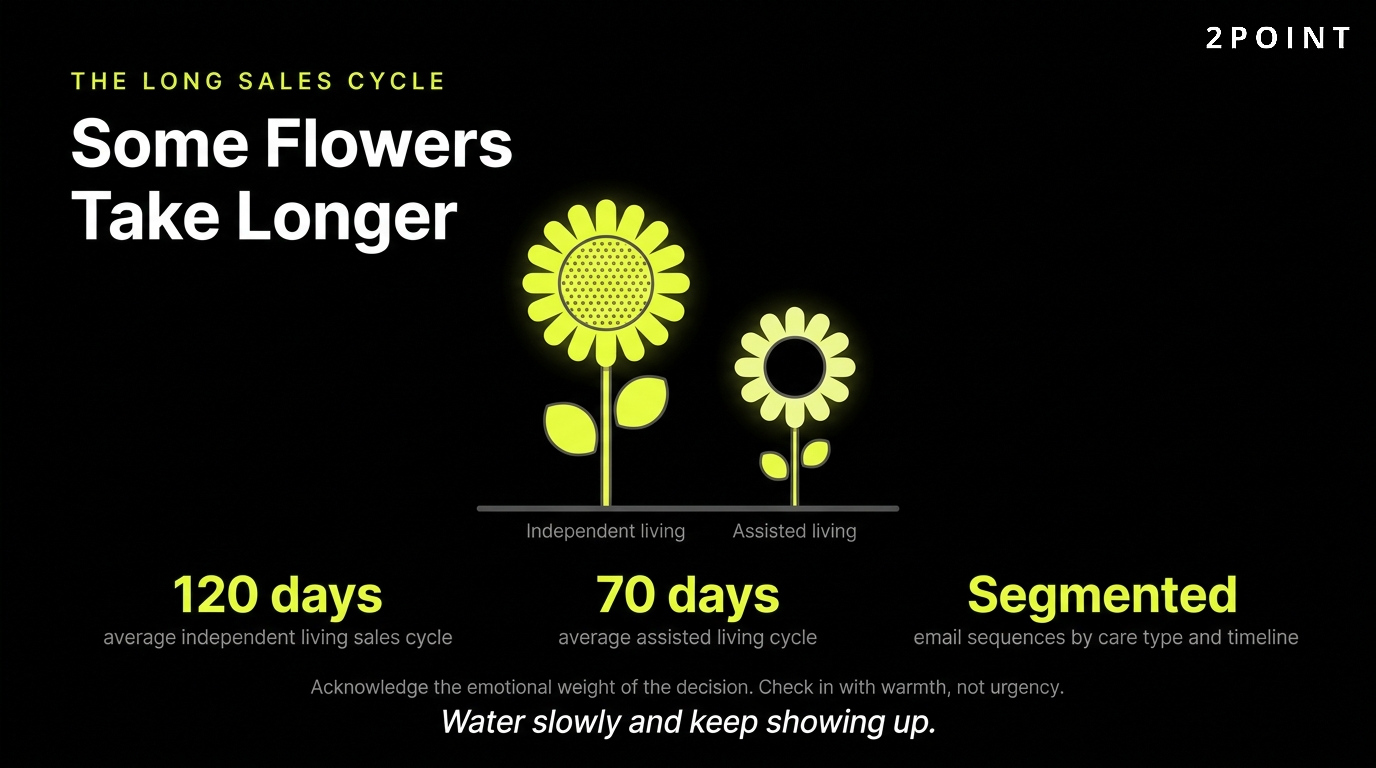
Web leads in senior living operate on significantly longer sales cycles than most consumer purchases. According to US Rengage’s 2026 benchmark data, the average sales cycle for independent living is approximately 120 days, while assisted living averages around 70 days. These are not short windows — they require sustained, thoughtful communication that keeps the community top of mind without overwhelming families who are already navigating an emotionally complex process.
Effective web lead nurturing in senior living relies on email marketing automation sequences that are segmented by care type, timeline, and engagement level. A family that downloaded a memory care guide should receive a different sequence than one that requested pricing for independent living. CRM lead scoring — assigning point values to actions like page visits, email opens, video views, and form completions — allows sales counselors to prioritize follow-up on the leads most likely to convert in the near term while automation handles the longer-term nurturing of earlier-stage prospects.
The tone of nurturing communications matters enormously. Families researching senior living are dealing with worry, guilt, grief, and hope simultaneously. Email sequences that acknowledge the emotional weight of the decision, offer genuinely useful information without a hard sell, and periodically check in with warmth rather than urgency will consistently outperform volume-based follow-up strategies. According to Aline’s digital marketing guide, personalization in every touchpoint — using the prospect’s name, referencing their specific care interest, and acknowledging previous conversations — is a baseline expectation, not a differentiator.
Bridging the Marketing-to-Sales Handoff
One of the most significant sources of lost revenue in senior living operations is the gap between marketing and sales teams. Marketing generates leads; sales follows up. When those two functions operate in separate silos — with different tools, different metrics, different priorities, and limited communication — leads fall through the cracks, follow-up is inconsistent, and valuable lead intelligence is lost.
According to Inertia Digital’s 2026 senior living digital marketing strategies, sales and marketing integration is becoming a non-negotiable operational requirement rather than a best practice aspiration. The most successful communities are creating hybrid roles — marketing and sales counselors who understand both the digital acquisition journey and the relationship-based sales process — and ensuring that lead intelligence flows bidirectionally between marketing platforms and CRM systems.
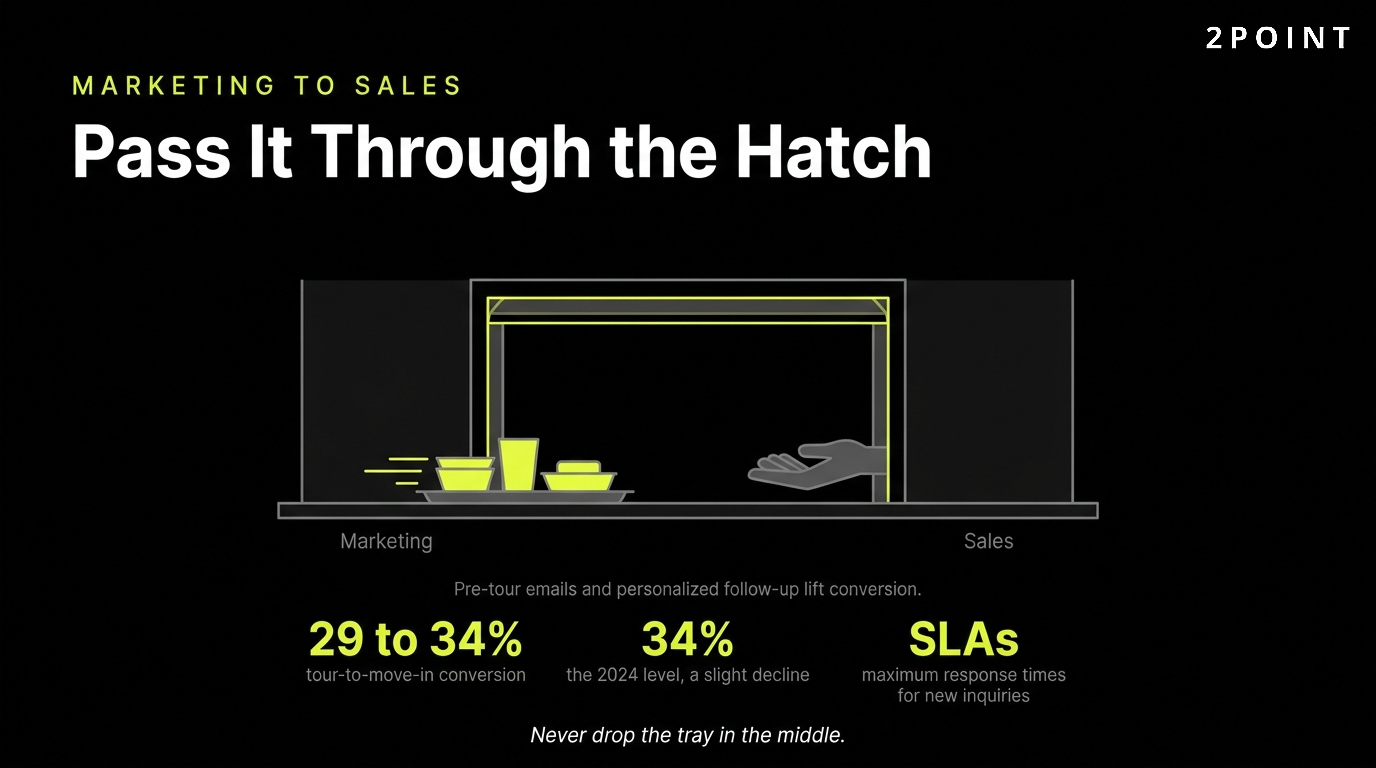
Practical integration steps include establishing shared definitions for lead stages and move-in-ready criteria, creating service level agreements that specify maximum response times for new inquiries, building dashboards that give both marketing and sales teams visibility into the full pipeline from first touch to signed agreement, and conducting regular joint reviews of lead quality and conversion performance. When marketing and sales teams are aligned on both goals and tools, the entire revenue cycle improves.
Tour-to-Move-In Optimization Strategies
The tour-to-move-in conversion rate is one of the most telling indicators of a senior living community’s overall sales health. US Rengage’s 2026 data shows this rate running between 29% and 34%, a slight decline from 34% in 2024 — suggesting that while more families are reaching the tour stage, fewer are converting to move-in without additional support. Improving this rate by even a few percentage points has an outsized impact on annual revenue.
Pre-tour preparation is a consistently underinvested area. A family that receives a personalized email before their visit — acknowledging their specific care concerns, introducing the team member they will meet, and providing practical logistics information — arrives warmer, more trusting, and more open to the experience. During the tour itself, personalizing the experience to the specific care needs and lifestyle interests the family has expressed (rather than delivering a standard script) demonstrates both attentiveness and genuine capability. Post-tour follow-up should be personalized to what was discussed during the visit, not a generic template, and should include a clear and specific next step that makes it easy for the family to move forward.
Social Media Marketing That Reaches Both Seniors and Their Adult Children
Social media marketing for senior living communities operates across a genuinely dual audience: the seniors who may eventually become residents, and the adult children who are most often driving the research and decision process. Effective social media strategy recognizes the distinct preferences, motivations, and platform habits of each group and creates content that serves both without sacrificing authenticity or relevance.
Understanding Your Dual Audience on Social Platforms
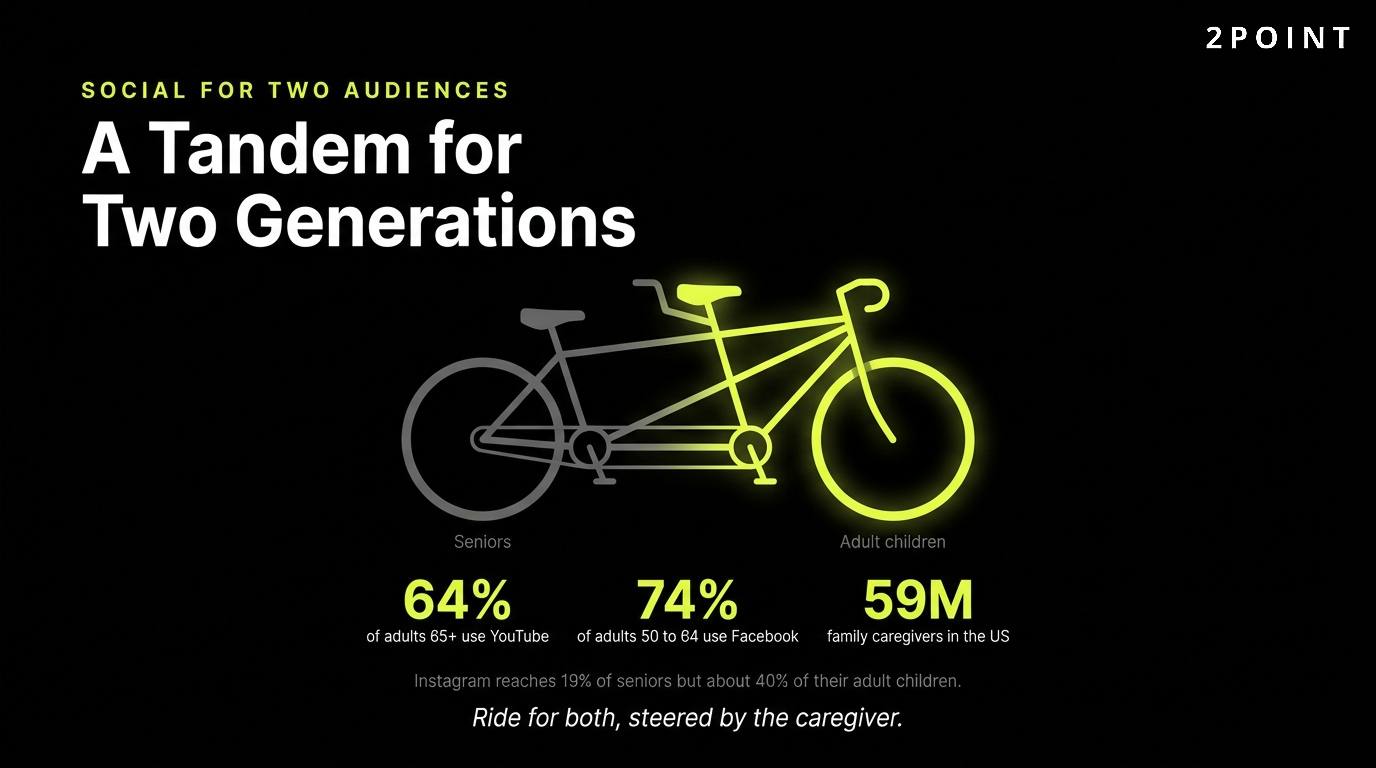
Platform preferences differ significantly between older adults and their adult children, and understanding these differences is essential for allocating social media budget effectively. According to Webtonic’s senior living social media statistics, 64% of adults aged 65 and over use YouTube, making it the leading platform among seniors themselves. Voxie’s senior living marketing analysis notes that 74% of adults aged 50 to 64 — the core adult child demographic — use Facebook actively, making it the dominant platform for reaching family decision-makers.
Instagram tells a more nuanced story: only 19% of adults aged 65 and over use the platform, compared to approximately 40% of those aged 50 to 64. This means Instagram content primarily reaches adult children rather than potential residents directly. With approximately 59 million family caregivers active in the United States, the adult child audience is not a secondary consideration — in many ways, it is the primary social media audience for senior living communities. Content strategy must account for both groups, understanding that the senior’s comfort and lifestyle story matters for their own engagement, while the adult child needs reassurance, competence signals, and evidence of genuine care.
Platform-Specific Content Strategies
Facebook remains the workhorse platform for senior living social media, particularly for reaching family caregivers and adult children in the 50-64 age bracket. The most effective Facebook content for senior living communities includes community event announcements and photo recaps, resident milestone celebrations (with appropriate permissions), family testimonials presented as short written posts or simple videos, and educational content addressing common senior care questions. Facebook’s targeting capabilities also make it effective for paid social campaigns directed at specific geographic and demographic segments.
YouTube serves a different strategic function: it is the platform where families go to do serious research. Virtual community tours, day-in-the-life videos, care team introduction videos, and educational webinar recordings perform well here because they offer substance and depth that short-form content cannot provide. A well-produced YouTube channel also supports SEO efforts, since YouTube is the second largest search engine in the world. Instagram, while reaching a smaller senior living audience, is valuable for showcasing community lifestyle and vibrancy to adult children who want to see evidence that their parent’s life will be rich and engaged rather than diminished. LinkedIn serves a different purpose entirely: it is the right platform for thought leadership content directed at referral partners, industry peers, and healthcare professionals who influence senior care decisions.
Short-Form Video: The 2026 Game-Changer
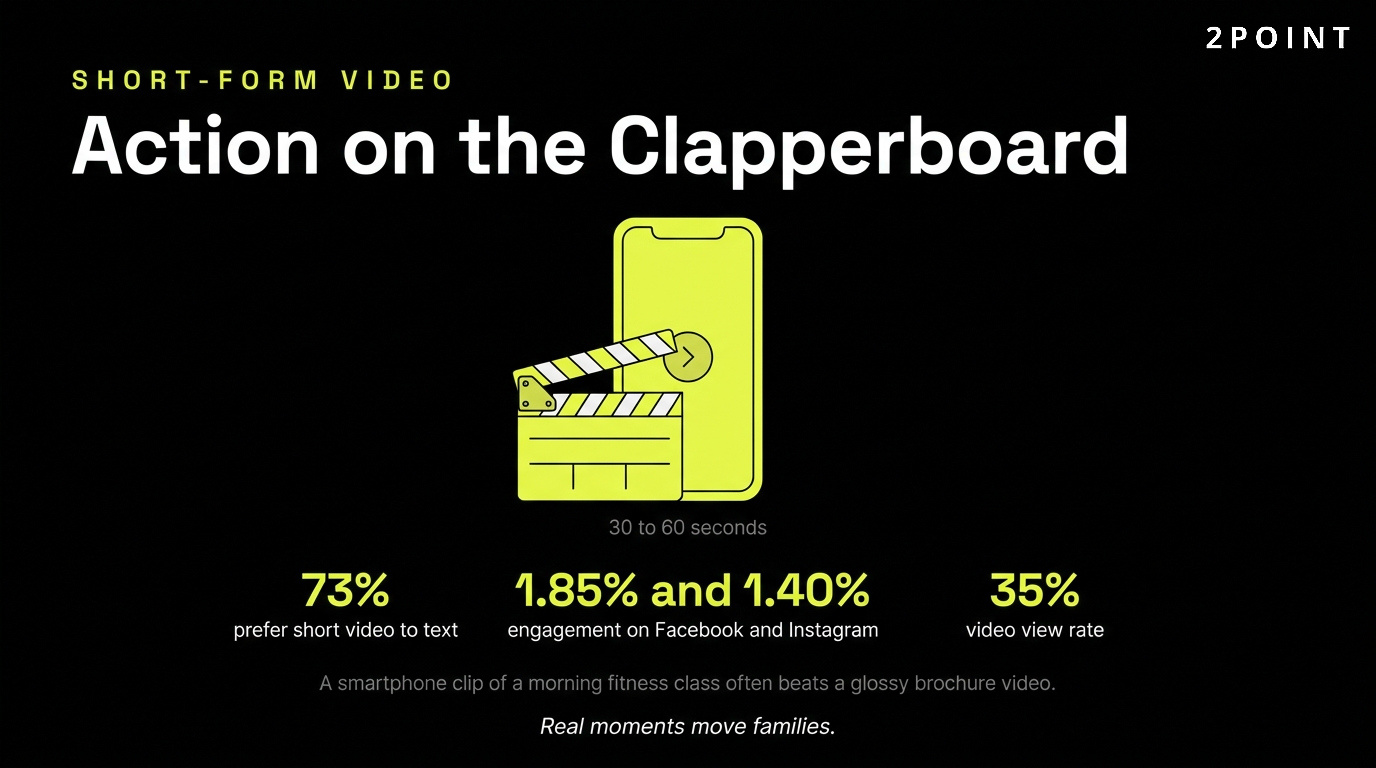
Among all content format trends reshaping senior living marketing in 2026, the rise of short-form video stands out as both the most impactful and the most underutilized by many communities. According to Marketing Essentials’ senior living digital marketing trends report, 73% of consumers prefer learning about senior living services through short video rather than text. That is a consumer preference so strong it effectively mandates a short-form video strategy for any community serious about digital engagement.
Instagram Reels and YouTube Shorts have democratized video production for communities without large marketing budgets. A thirty to sixty second authentic clip of a morning fitness class, a chef preparing a seasonal menu, a resident sharing what she enjoys most about living in the community, or a family caregiver describing their peace of mind can be filmed on a smartphone and edited with free tools. The authenticity of these unpolished clips is frequently an asset rather than a liability — families are more moved by genuine moments than by glossy promotional videos. Solinity’s senior living statistics resource and CU Finder’s assisted and senior living benchmarks document engagement rates of 1.85% on Facebook and 1.40% on Instagram for senior living content, with video view rates reaching 35% — consistently outperforming static image and text content. Thinking carefully about video marketing as part of your content calendar is no longer optional for competitive communities.
Measuring Social Media ROI in Senior Living
Attributing move-ins to social media is one of the most persistent challenges in senior living marketing analytics. The reality is that social media rarely produces a direct, traceable path from a single post to a signed residency agreement. Its role in the decision journey is typically earlier and broader: building awareness, establishing trust, demonstrating community culture, and keeping the community name recognizable when families later search for more specific information.
The metrics that provide the most actionable insight for senior living social media include cost per lead on paid campaigns (the industry average on Facebook and Instagram is $70.81 per lead), website traffic sourced from social channels, engagement rate trends over time, and assisted conversions tracked through multi-touch attribution models. A community that sees significant social-sourced traffic converting later through organic search or direct website visits is getting real value from its social media investment, even if the attribution path is indirect. Building a consistent social media marketing plan with defined content themes, posting frequency, and measurement cadence provides the structure needed to interpret these metrics meaningfully over time.
Creating Authentic Content That Builds Trust Before the First Tour
Authentic content in senior living marketing is not a stylistic preference — it is a strategic necessity. Families making care decisions for a parent or loved one are applying a high degree of emotional scrutiny to every piece of content they encounter. They are looking for genuine evidence of care quality, community culture, and human connection. Generic stock photography, rehearsed testimonials, and corporate marketing language do not pass that scrutiny. Authenticity does.
Why Authenticity Trumps Perfection in 2026
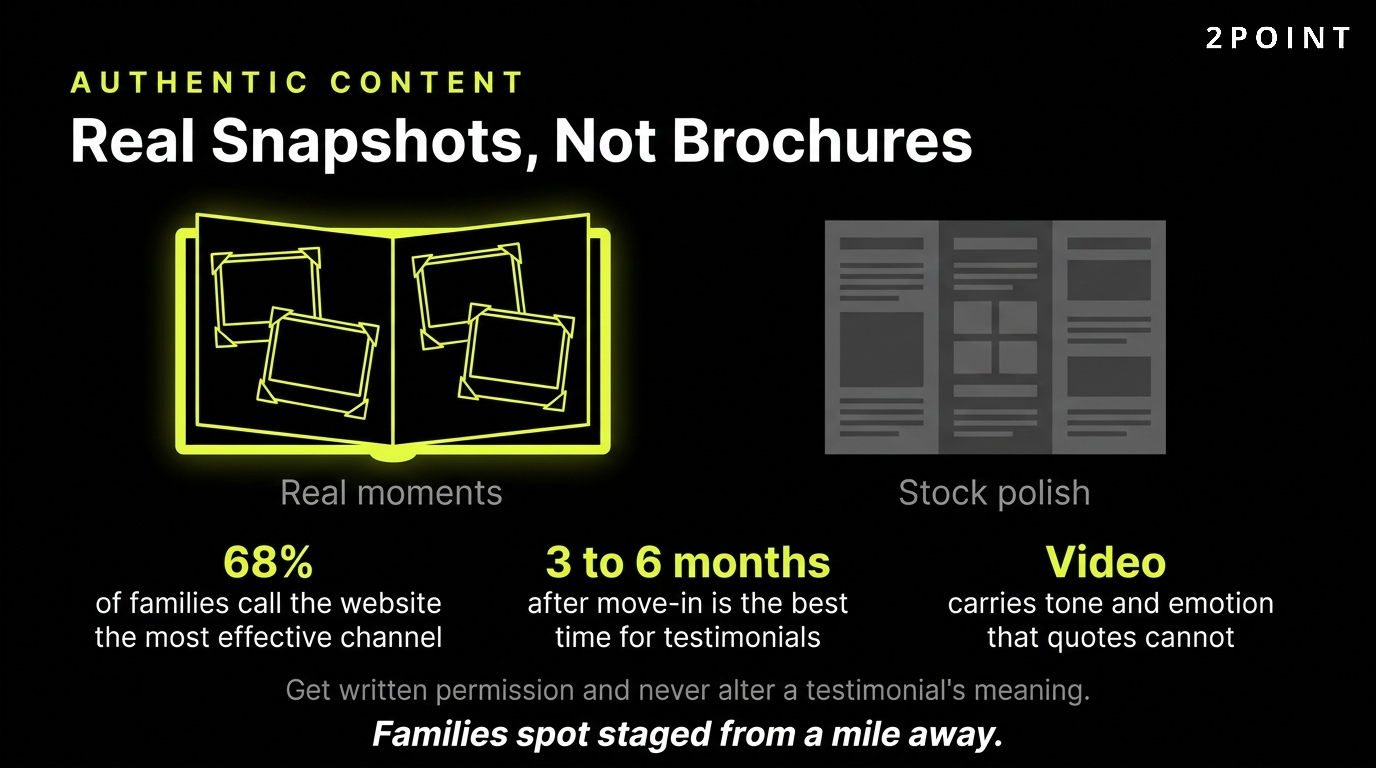
The shift toward authentic, unpolished content is one of the defining characteristics of 2026 senior living marketing predictions from Creating Results. Families who have spent weeks researching communities online have developed a sophisticated ability to recognize staged photography, scripted testimonials, and marketing language that overpromises and underdelivers. When they encounter that kind of content, it does not just fail to persuade — it actively reduces trust.
What performs instead is content that features real residents in genuine moments: sharing a hobby, enjoying a meal with friends, participating in a fitness class, or simply sitting in a garden. Content that includes diverse representation — different ages, backgrounds, care levels, and lifestyles — signals that a community genuinely serves a broad range of people rather than just an idealized demographic. The shift toward more resident voices and day-in-the-life content is accelerating, with communities that make their actual residents the heroes of their marketing consistently outperforming those that lead with building photography and amenity checklists. Building a strong, consistent branding identity rooted in real community values amplifies the impact of authentic content across every channel.
Educational Content That Answers the Hard Questions
Among the most powerful trust-building content categories in senior living is content that addresses the questions families find difficult to ask out loud. “How do I know when it’s time to consider assisted living for my mom?” “What are the warning signs that someone needs memory care?” “How do I talk to my father about moving to a senior living community?” These are the questions that families type into search engines at 11 p.m. while feeling anxious and uncertain. A community that provides clear, compassionate, genuinely helpful answers to these questions is not just generating organic traffic — it is building a relationship of trust before the first contact is ever made.
According to CCR Growth’s senior living strategy guide, educational content that performs best in this category addresses care transition decisions, financial planning for senior housing, navigating family conversations about care needs, understanding different care types and their differences, and managing the emotional dimensions of the transition process. Content that is genuinely educational — not promotional — earns social shares, earns backlinks from referring websites, and earns the kind of trust that converts to tours weeks or months later. This is a core component of any effective personalized marketing strategy for senior living.
Resident and Family Testimonials Done Right
Testimonials are among the most persuasive content elements available to senior living marketers, but their effectiveness depends entirely on how they are collected, presented, and authenticated. According to Invoca’s data, 68% of families identify the community website as the most effective channel in their decision process — which means that testimonials placed prominently on the website carry significant weight in the final decision.
The most effective testimonials in senior living are specific, emotionally resonant, and speak directly to the concerns families most commonly have: care quality, staff warmth, activity engagement, communication with families, and the resident’s happiness and sense of purpose. Video testimonials are particularly powerful because they allow body language, tone, and genuine emotion to come through in ways that written quotes cannot replicate. When collecting testimonials, timing matters: families who are three to six months post-move-in and experiencing a positive adjustment are typically the most willing and effective testimonial contributors. All testimonials should be collected with explicit written permission specifying where and how they may be used, and they should never be altered in ways that change the meaning or tone of what was originally said. Connecting testimonials to customer-centric marketing principles ensures that the voice of the resident, not the community’s self-promotion, drives the narrative.
Content Personalization by Care Type and Journey Stage
Not all families searching for senior living are looking for the same thing, and content that ignores those differences will inevitably feel generic and irrelevant. Inertia Digital’s digital marketing strategy guide and SFGate’s personalized digital marketing analysis both emphasize that care-type-specific content personalization is a significant differentiator in markets where multiple communities are competing for the same families.
Memory care pages should lead with programming philosophy, staff training and certifications, safety features, and family communication protocols — the specific concerns that families navigating dementia diagnoses need addressed first. Independent living pages should foreground lifestyle, social opportunities, dining experiences, fitness programming, and transparent fee structures, because the families considering independent living are primarily evaluating quality of life rather than clinical care levels. Dynamic website content that adapts based on a visitor’s browsing behavior — serving memory care content to someone who has already visited the memory care page and independent living content to someone whose navigation suggests lifestyle interest — represents the next frontier of content personalization that leading communities are beginning to implement in 2026. Pairing this approach with consumer behavior insights ensures that content personalization is rooted in how families actually make decisions, not assumptions about what they should want to know.
Website Optimization and Technical Performance for Senior Living Communities
The senior living website is not simply a digital brochure — it is the primary conversion tool in the entire marketing system. Every strategic investment in SEO, paid advertising, social media, and content marketing ultimately drives families back to the website, where the experience they encounter either builds confidence or erodes it. Website performance, accessibility, and technical health are non-negotiable foundations for any effective senior living digital marketing program.
Mobile-First Design for Senior Living Websites
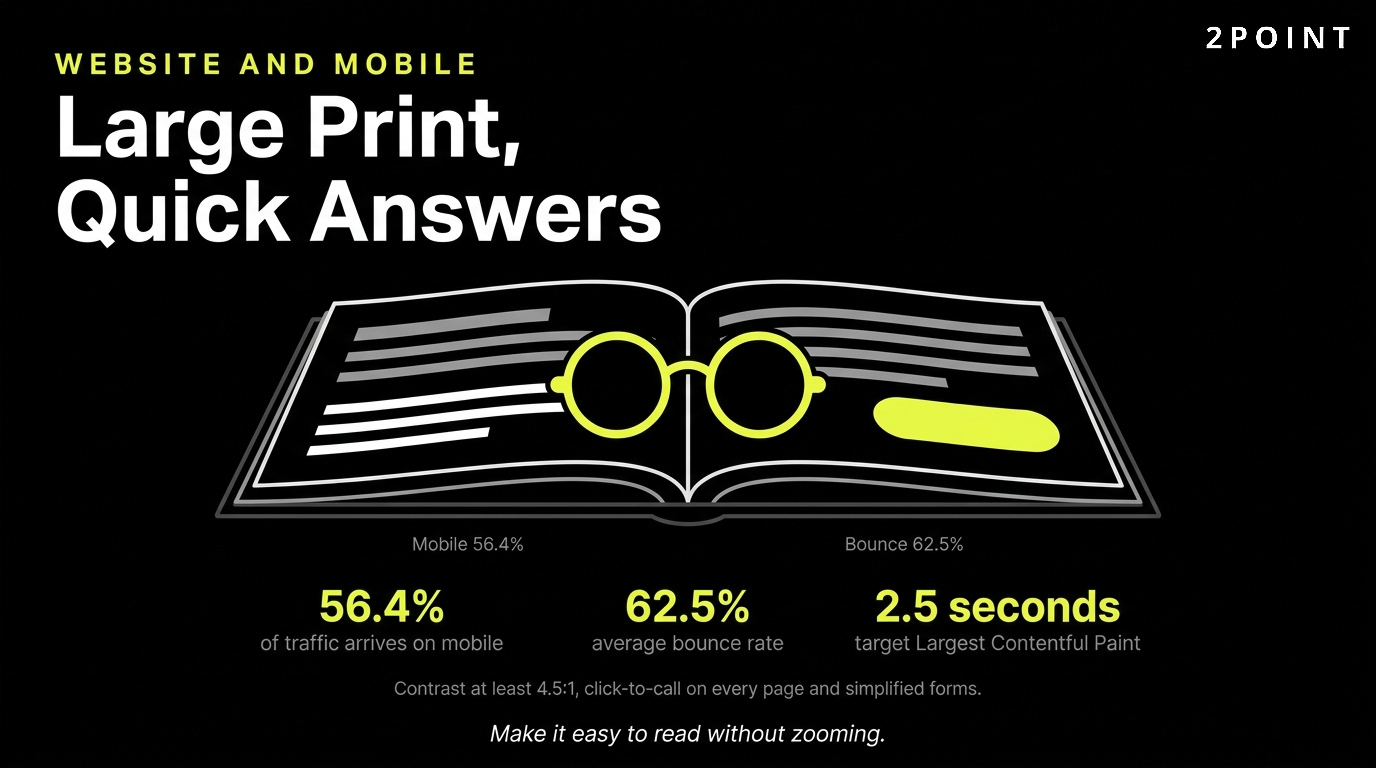
The data on how families access senior living websites is unambiguous. According to CU Finder’s assisted and senior living digital benchmarks, mobile devices account for 56.4% of all senior living website traffic, with desktop at 38.2% and tablet at 5.4%. The majority of users researching senior living options are doing so on a smartphone — often while in the middle of other activities, frequently during emotionally charged moments when they need to find information quickly.
Mobile-first design for senior living means prioritizing large, legible typography that remains readable without zooming, thumb-friendly navigation with large touch targets, click-to-call buttons prominently placed on every page, simplified contact forms that require only essential information, and fast image loading that does not create waiting frustration on cellular connections. The industry average time on site is 2 minutes and 45 seconds, with a bounce rate of 62.5% — meaning that most visitors who do not find what they need quickly will leave without converting. Every design decision should be evaluated first on the mobile experience, then adapted for desktop, not the other way around. Working with an experienced digital marketing agency that understands senior living audience needs can significantly accelerate the transition to a truly mobile-first site architecture.
Accessibility Standards That Serve Everyone
Web Content Accessibility Guidelines (WCAG) compliance is both an ethical imperative and a practical business requirement for senior living websites. The audience that senior living communities serve includes older adults and individuals with varying degrees of visual, motor, and cognitive differences — precisely the population for whom web accessibility standards were designed. Marketing Essentials identifies accessibility as an increasingly important trend in senior living digital marketing, reflecting both regulatory attention and genuine user need.
Practical accessibility implementations include maintaining sufficient color contrast ratios between text and backgrounds (at least 4.5:1 for normal text), providing descriptive alt text for all images and functional graphics, ensuring that all interactive elements are navigable by keyboard for users who cannot use a mouse, confirming that form fields are clearly labeled and that error messages are descriptive rather than cryptic, and testing the site with common screen readers to identify and correct navigation issues. Beyond compliance, accessible design also improves usability for all users — larger font sizes, clearer navigation, and simpler forms benefit every visitor, not only those with specific accessibility needs.
Virtual Tours and Interactive Tools That Convert
Virtual tours have moved from a pandemic-era accommodation to a standard expectation for senior living websites. Solinity’s senior living marketing statistics consistently identify virtual tours as an essential digital strategy for communities competing in today’s market, particularly for attracting prospects who live at a distance from the community or who are conducting preliminary research before committing to an in-person visit.
360-degree photography embedded as an interactive tour provides a significantly more compelling experience than a slideshow of static images. When families can virtually “walk” through a community — exploring apartment layouts, common areas, dining rooms, outdoor spaces, and care environments — they arrive at in-person tours with significantly higher confidence and engagement. Interactive floor plans that allow families to explore different apartment sizes and configurations are particularly effective for independent and assisted living prospects who want to understand the physical space before visiting. Cost calculators and care needs assessments that help families understand what level of care a loved one may need and what it is likely to cost reduce one of the most common barriers to initial contact: uncertainty about whether the community is even financially accessible.
Site Speed, Core Web Vitals, and Technical SEO
The technical foundation of a senior living website — its speed, structural integrity, and search engine readability — is the layer that determines whether all other marketing investments can reach their potential. A community that invests heavily in paid advertising, content marketing, and social media but directs that traffic to a slow, technically broken website is systematically destroying the value of every marketing dollar spent upstream.
Google’s Core Web Vitals — measuring loading performance (Largest Contentful Paint), visual stability (Cumulative Layout Shift), and interactivity (Interaction to Next Paint) — are confirmed ranking factors and directly affect both search visibility and user experience quality. According to CCR Growth’s technical guidance, senior living websites should target a Largest Contentful Paint under 2.5 seconds, minimize layout shifts that disorient users during page loading, and ensure that all interactive elements respond promptly. Structured data markup for care types, locations, pricing ranges, reviews, and business information makes the site significantly more readable by both traditional search engines and AI crawlers. An XML sitemap that is regularly updated and submitted to Google Search Console ensures that new and updated pages are discovered and indexed promptly.
Building and Protecting Your Online Reputation in Senior Living
In an industry where trust is the ultimate purchase motivator, online reputation is not a marketing add-on — it is a core business asset. The families choosing a senior living community for a parent are making one of the most consequential and emotionally charged decisions of their adult lives. The reviews, ratings, and responses they encounter online are frequently the deciding factor between communities that are otherwise comparable in pricing and amenities.
The Review Economy: Why Every Star Matters
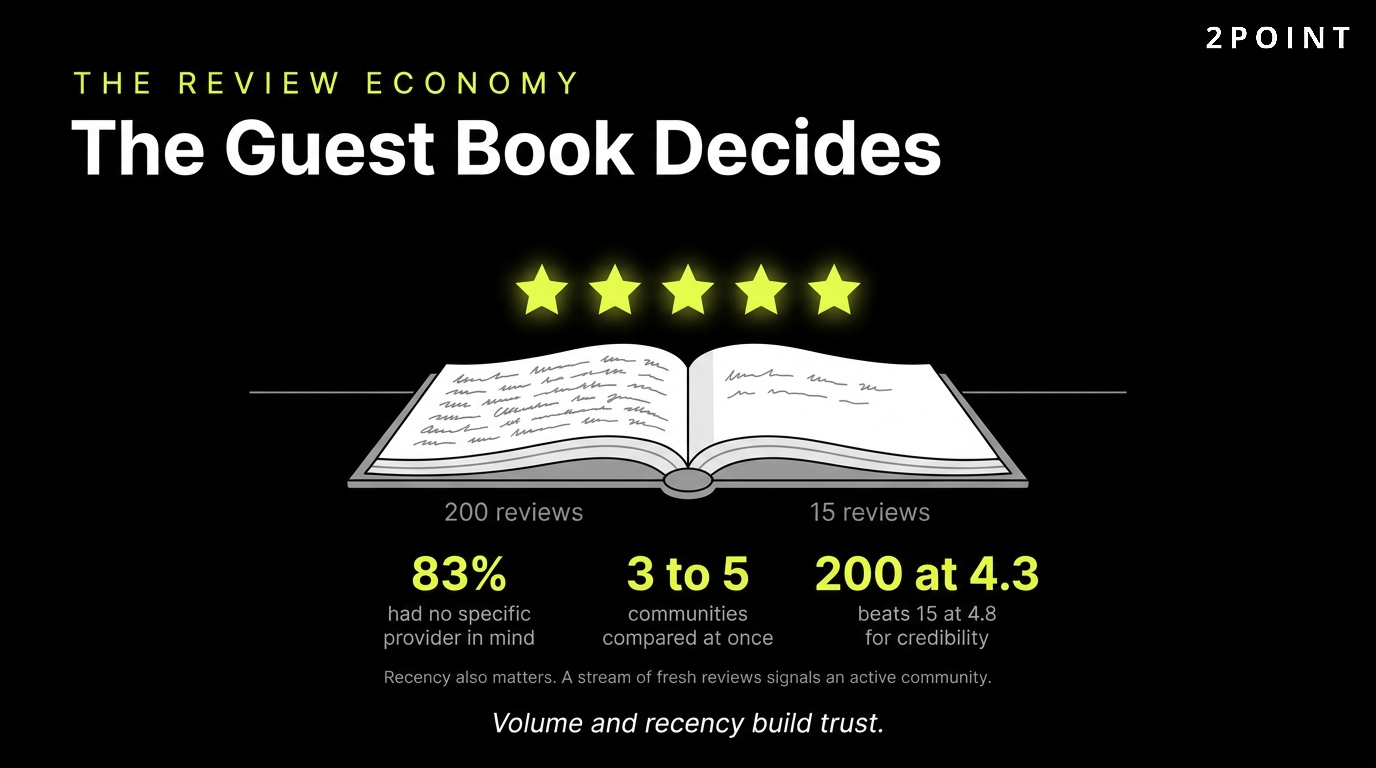
The impact of online reviews on senior living decision-making is quantifiable and substantial. Invoca’s research shows that 83% of nursing home and senior living consumers did not have a specific provider in mind when they began their search — meaning the majority of prospects are genuinely undecided and are using reviews as a primary tool for narrowing their options. When families compare three to five communities simultaneously, as most do, the community with more reviews, higher average ratings, and more thoughtful management responses will consistently appear more trustworthy and responsive than competitors with thinner or more negative review profiles.
Review volume matters alongside rating quality. A community with 200 reviews averaging 4.3 stars will generally outperform a community with 15 reviews averaging 4.8 stars in terms of perceived credibility, because families understand that a larger sample is statistically more reliable. Review recency is also a significant factor: a stream of recent reviews signals an active, well-managed community, while a cluster of old reviews with no new activity raises questions about whether conditions have changed. According to Inertia Digital, a strong online reputation has become one of the most significant differentiators in markets where competing communities are otherwise closely matched on care quality and pricing.
Systematic Review Generation (Without Violating Guidelines)
Building a consistent stream of authentic reviews requires a systematic process, not sporadic requests when staff remembers to ask. The most effective review generation programs in senior living are built around natural timing — identifying moments when families are most likely to feel positive and receptive, and making the review process as simple and frictionless as possible at that moment.
High-receptivity moments typically include the period three to six months after a smooth move-in, following a particularly positive interaction with care staff, after a successful family event or holiday celebration, and when a family member expresses gratitude verbally to a team member. Training staff to recognize and act on these moments — by providing a simple card with a QR code linking directly to the Google review page, or by sending a brief follow-up email with a one-click review link — dramatically increases review submission rates compared to generic “please review us” requests. All review requests must comply with platform policies: Google and other major platforms prohibit incentivizing reviews, requiring only positive reviews, or bulk-importing reviews from external sources. Ethical, timely, and sincere requests to happy families and residents are both the right approach and the most effective one.
Responding to Negative Reviews Effectively
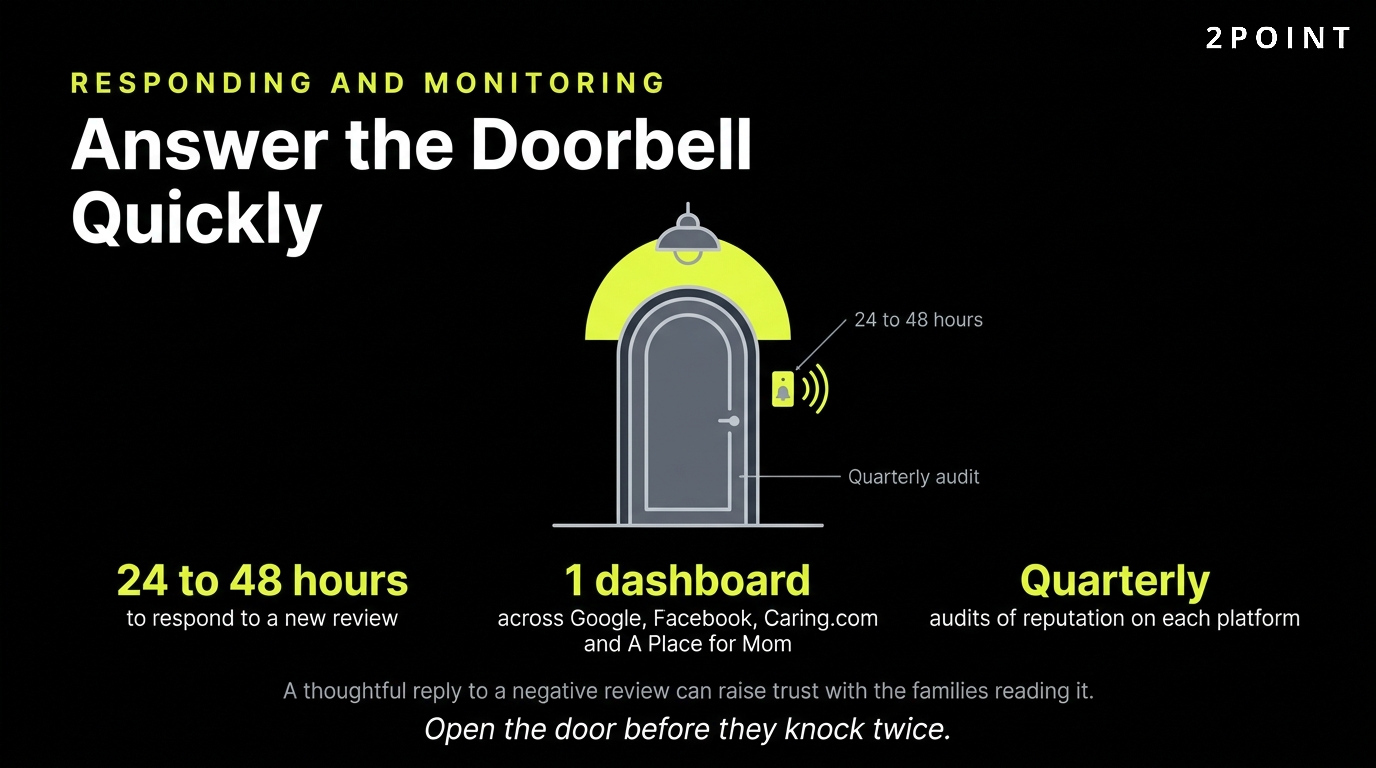
Negative reviews in senior living are both inevitable and, when handled correctly, an opportunity to demonstrate responsiveness, accountability, and genuine care. Research consistently shows that families considering a community pay close attention not just to the content of negative reviews but to how management responds. A thoughtful, empathetic response to a critical review can actually increase trust in a community — it signals that leadership listens and takes concerns seriously.
The response protocol for negative reviews should follow a consistent structure: acknowledge the reviewer’s experience without being defensive, express genuine empathy for any distress caused, invite the reviewer to contact a specific person directly to resolve the issue, and thank them for sharing feedback. What to never do publicly: dispute specific care details that may involve private health information, challenge the reviewer’s credibility, offer explanations that come across as excuses, or make promises that cannot be verified or guaranteed. The goal of a public response is not to win an argument — it is to demonstrate to the dozens of prospective families reading that review that your community responds with professionalism and human concern.
Reputation Monitoring Across Multiple Platforms
Senior living reputation management requires monitoring across a broader ecosystem than most industries face. Google reviews are the highest-priority platform due to their influence on local search rankings and their visibility in AI-generated responses. Facebook reviews directly affect social media credibility. Caring.com and A Place for Mom are specialized directories that families frequently use for direct comparison shopping between communities, and they generate significant review-driven traffic. Senior living-specific directory platforms, Yelp, and even niche forums and social media groups can all surface in a family’s research process.
According to Inertia Digital’s reputation management guidance, communities should use monitoring tools that aggregate mentions and reviews across all major platforms into a single dashboard, set up real-time alerts for new reviews so that responses can be posted within 24 to 48 hours, and conduct quarterly audits of the community’s reputation profile across each major platform. Response time benchmarks matter: a review that sits unanswered for weeks signals indifference, while prompt, personalized responses signal attentiveness. For communities with limited staff time for manual monitoring, reputation management software platforms designed specifically for senior living and healthcare can automate alerts and streamline the response process significantly.
Senior Living Marketing in 2026: Putting It All Together
Senior living marketing in 2026 is not a single strategy — it is an integrated system of eight interconnected disciplines, each of which amplifies the others when executed with consistency and purpose. The communities that will achieve and sustain high occupancy in an increasingly competitive landscape are not those that chase any single tactic, but those that build robust, coordinated marketing ecosystems grounded in data, authenticity, and genuine care for the families they serve.
With occupancy at 89.9% and digital marketing driving 59% of census growth, the competitive pressure on marketing performance has never been greater. Every marketing dollar must work harder, every lead must be followed up faster, and every family touchpoint must reflect both the quality of care the community provides and the genuine human connection that makes senior living meaningful. The eight strategic pillars covered in this guide — AI-powered search, hyperlocal marketing, budget allocation, lead conversion, social media, authentic content, website performance, and reputation management — represent the complete picture of what it takes to market a senior living community effectively in this environment.
The pace of change in senior living marketing is accelerating. Senior Living Smart’s 2026 marketing predictions and Conversion Logix’s trend analysis both point to shorter planning cycles replacing annual marketing plans, with quarterly sprints and continuous testing becoming the operational standard for high-performing communities. AI platforms, search algorithm updates, and shifting consumer behaviors will continue to change the rules of the game — which means that the most valuable capability a senior living marketing team can develop is not mastery of any single channel, but the capacity to learn, adapt, and optimize continuously.
Most importantly, it is worth remembering why this work matters beyond the occupancy metrics and marketing dashboards. Senior living marketing is fundamentally about helping families navigate one of the most difficult and emotionally complex decisions they will ever face. The communities that lead with empathy, speak honestly about what they offer and who they serve best, and use their marketing to build genuine trust rather than manufacture a sales pitch will not only achieve stronger occupancy — they will attract residents and families who are genuinely the right fit for their community culture, creating better outcomes for everyone involved.
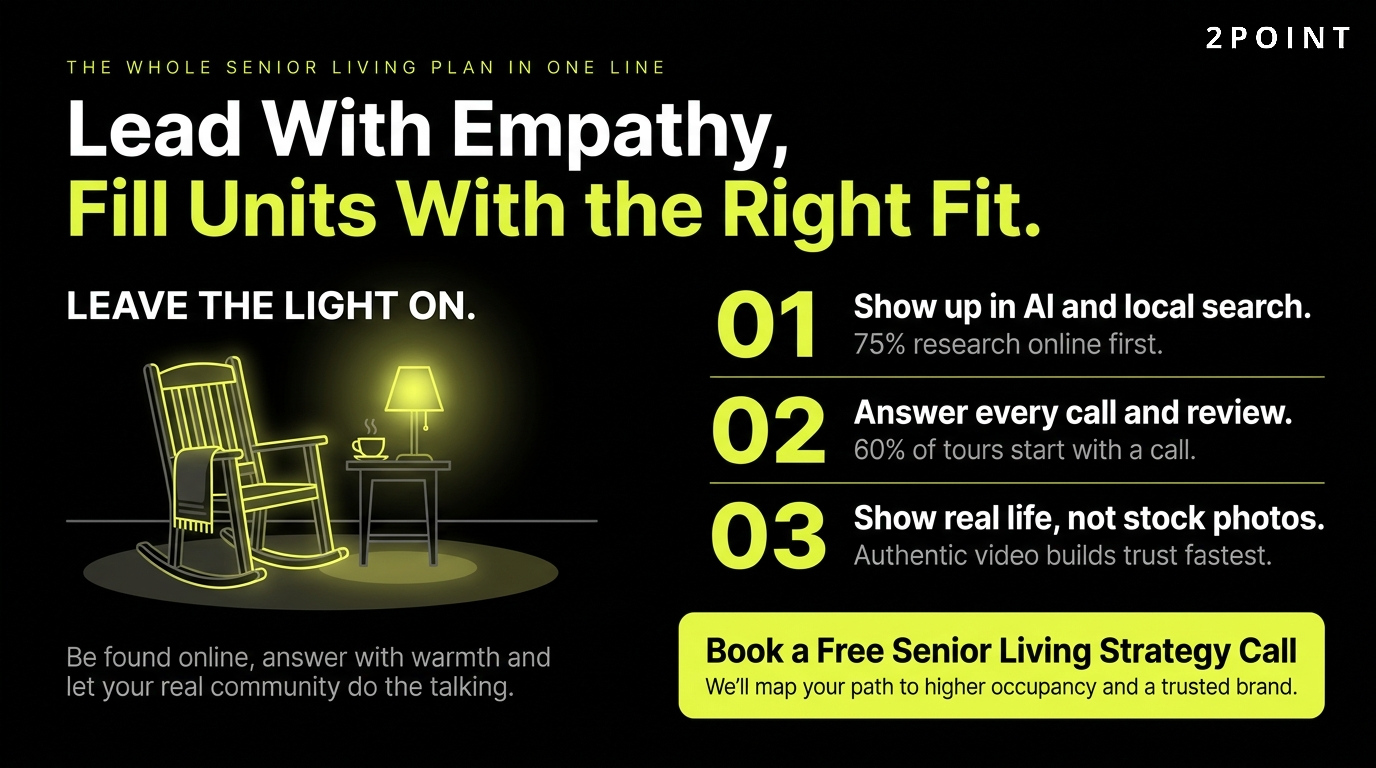
The team at 2POINT works with senior living communities to build integrated marketing strategies that connect authentic storytelling with performance-driven digital execution, helping communities fill more units with the right residents while building the kind of brand reputation that sustains occupancy through every market cycle.
Frequently Asked Questions About Senior Living Marketing
What is senior living marketing?
Senior living marketing is the comprehensive set of strategies, channels, and tactics that senior housing communities use to attract qualified prospects, nurture family relationships, and maintain healthy occupancy. It encompasses digital advertising, SEO, content marketing, social media, reputation management, and sales alignment — all working together to connect communities with families at the right moment in their decision journey.
How much does senior living marketing cost?
Most senior living communities spend between $5,000 and $15,000 per month on marketing, depending on market size, number of units, and competitive intensity. As a general guideline, communities below 90% occupancy should allocate 6% to 10% of annual revenue to marketing, while those above 95% occupancy can typically sustain performance on 3% to 5%. Cost per lead ranges from $40 to $200 depending on care type and channel.
What are the most effective senior living marketing strategies?
The most effective strategies in 2026 combine paid search for capturing high-intent prospects, local SEO and Google Business Profile optimization for hyperlocal visibility, authentic short-form video for social media engagement, educational content that answers difficult family questions, and systematic online reputation management. No single channel outperforms a well-integrated combination of all five working in coordination.
How does digital marketing compare to referrals for senior living census growth?
Digital marketing now drives 59% of census growth in senior living, compared to 21% from personal referrals — a significant reversal from patterns seen a decade ago. This does not mean referrals are unimportant; referral prospects still tend to convert at higher rates. It means that the volume of qualified prospects entering the pipeline through digital channels now substantially exceeds referral-driven volume.
What is the average senior living tour-to-move-in conversion rate?
The industry average tour-to-move-in conversion rate currently sits between 29% and 34%, a slight decline from 34% in 2024. This means that roughly one in three families who complete a tour will sign a residency agreement. Communities that invest in pre-tour preparation, personalized tour experiences, and structured post-tour follow-up consistently achieve conversion rates at or above the top of this range.
How should senior living communities approach AI search optimization?
Senior living communities should structure their website content, FAQ sections, and blog articles so that AI platforms like Google AI Overviews and ChatGPT can accurately extract and present their information. This means using clear heading hierarchies, opening each page with a direct answer to the question it addresses, implementing schema markup for care types and locations, and building comprehensive topic coverage rather than targeting isolated keywords.
Is social media effective for senior living marketing?
Yes, with the understanding that social media’s primary role is building awareness and trust with the adult children who drive most senior living decisions, rather than producing direct, immediately attributable move-ins. Facebook reaches 74% of adults aged 50 to 64 and is the most valuable platform for this audience. YouTube is the leading platform among adults aged 65 and over. Short-form video consistently generates the highest engagement rates across all platforms.
How do senior living communities build online reputation?
Effective reputation building requires a systematic approach to generating authentic reviews at high-receptivity moments in the family journey, responding to all reviews (including negative ones) within 48 hours with empathy and professionalism, and monitoring review platforms including Google, Facebook, Caring.com, and A Place for Mom on an ongoing basis. Review volume, recency, and management response quality all influence how families perceive a community when comparing options.
What is the difference between assisted living marketing strategies and independent living marketing?
Assisted living marketing strategies emphasize care quality, staff expertise, safety features, and family peace of mind because prospects and families are primarily evaluating clinical and care capabilities. Independent living marketing focuses on lifestyle, social programming, dining quality, and transparent pricing because prospects are evaluating quality of life and community fit rather than clinical care levels. Content, messaging, and channel selection should reflect these distinct motivational differences.
Should senior living communities outsource their marketing or handle it in-house?
The right answer depends on community size, budget, available expertise, and competitive market dynamics. Many communities benefit from a hybrid model: in-house team members who know the community deeply handle content creation, testimonial collection, and local relationship building, while specialized agency partners manage paid advertising, technical SEO, and marketing analytics. Reviewing the tradeoffs of outsourcing marketing versus maintaining an in-house team in detail can help operators make the right structural decision for their specific situation.
What metrics should senior living communities track to measure marketing performance?
The most important marketing metrics for senior living include cost per lead by channel and care type, lead-to-tour conversion rate, tour-to-move-in conversion rate, occupancy rate trends over time, online review volume and average rating, website traffic and mobile performance, and revenue attributed to digital versus referral channels. Setting clear marketing goals aligned to occupancy targets ensures that these metrics drive decisions rather than simply filling a dashboard.
How important is website quality for senior living marketing results?
Website quality is foundational to every other marketing investment because all major channels, including paid search, social media, SEO, and referrals, ultimately direct prospects to the website. With 56.4% of senior living website traffic arriving on mobile devices and an average bounce rate of 62.5%, a slow, inaccessible, or difficult-to-navigate site will systematically destroy the value of every upstream marketing dollar spent. Website optimization is not a one-time project but an ongoing priority in any high-performing senior living marketing mix.