


 let’s connect


Shopify vs WooCommerce: Which Platform Should You Choose in 2026?
- Shopify is best for merchants who prioritize ease of use, managed hosting, and fast launch times.
- WooCommerce suits technically capable teams who need complete control, deep WordPress integration, or complex customization.
- Cost is similar at low revenue volumes, but diverges significantly once annual revenue exceeds $250,000.
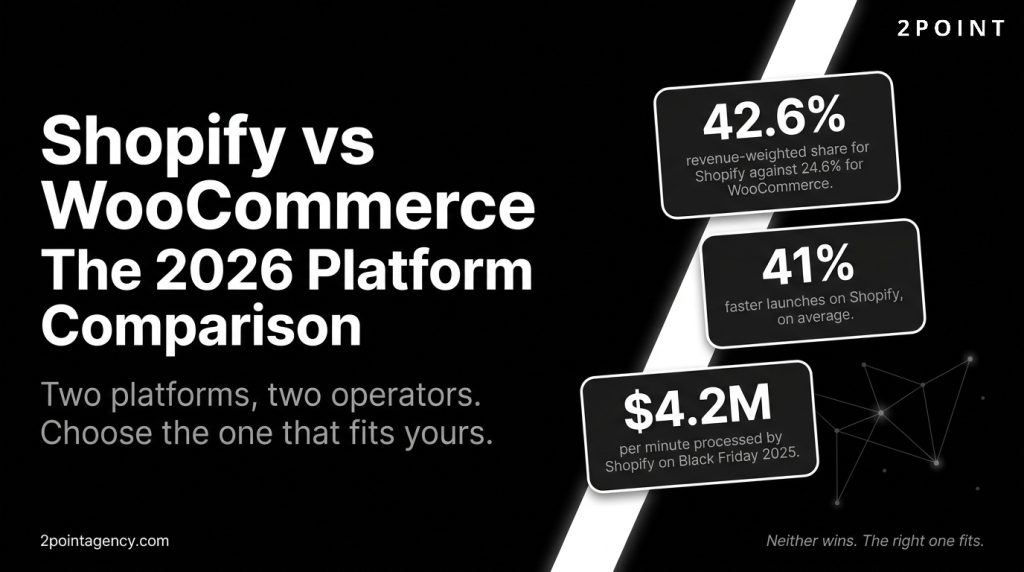
- Shopify powers 28.8% of high-traffic ecommerce sites, while WooCommerce holds a larger but diluted raw installation count.
- WooCommerce has 6.5 million active stores vs Shopify’s 4.8 million, but Shopify’s base skews toward higher-revenue merchants.
- Shopify processed $4.2 million per minute during Black Friday/Cyber Monday 2025 without reported downtime.
- Key decision factors include your technical resources, budget structure, content strategy, and your need for platform control.
- Neither platform is universally superior; the right choice depends entirely on your specific business model and growth stage.
The debate between Shopify and WooCommerce has persisted for years, but 2026 brings sharper data, clearer cost models, and a more defined set of trade-offs than ever before. This guide breaks down every major dimension so you can make a confident, informed decision.
Market Position and Adoption Trends in 2026
Understanding where each platform stands in the market is essential before diving into features and pricing. Market share numbers often get quoted in isolation, which creates a misleading picture of which platform is actually winning and where. The reality depends entirely on how you measure success: raw installation count, revenue-generating stores, or high-traffic merchant share.
Global Market Share: The Numbers That Matter
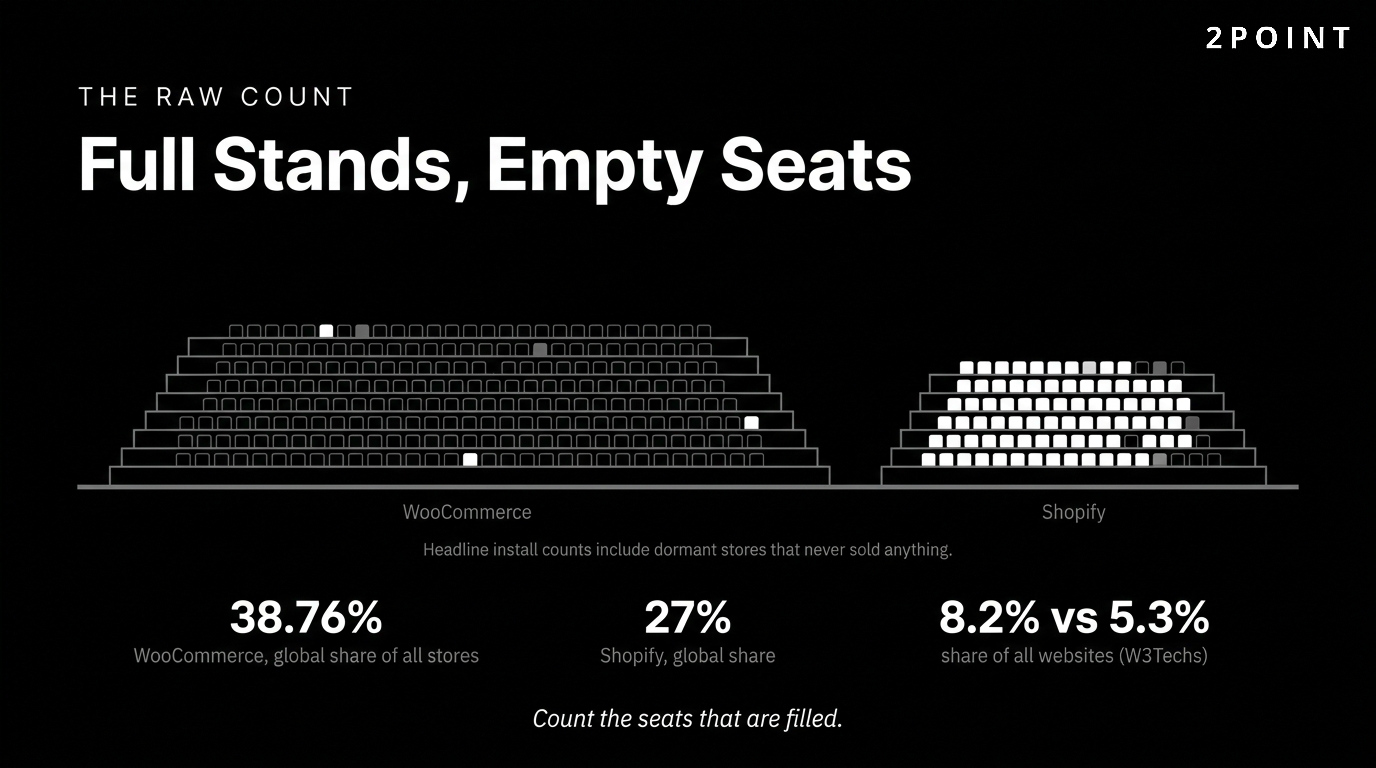
At first glance, WooCommerce appears to dominate. WooCommerce holds 38.76% of the global ecommerce platform market, while Shopify commands 27%, according to GravityKit’s 2026 analysis. But raw installation percentages tell only part of the story.
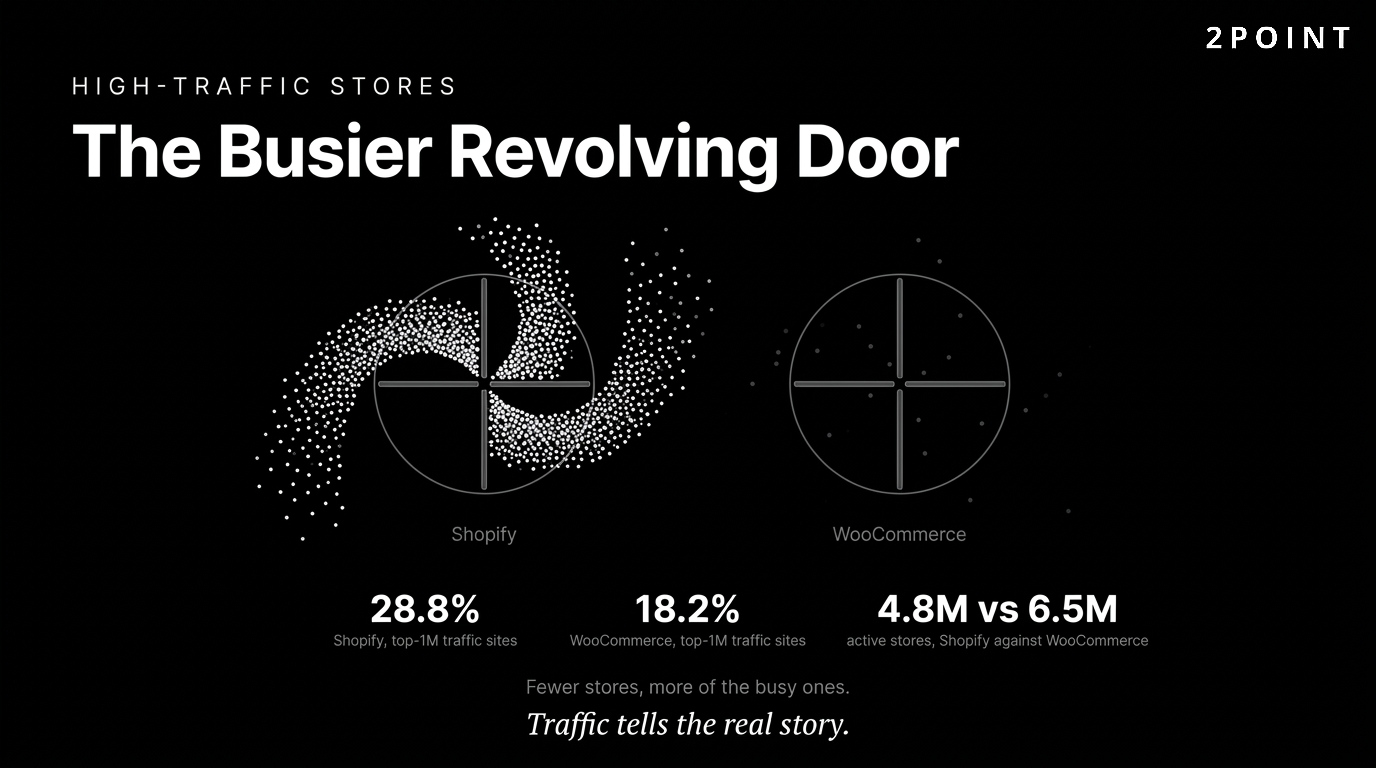
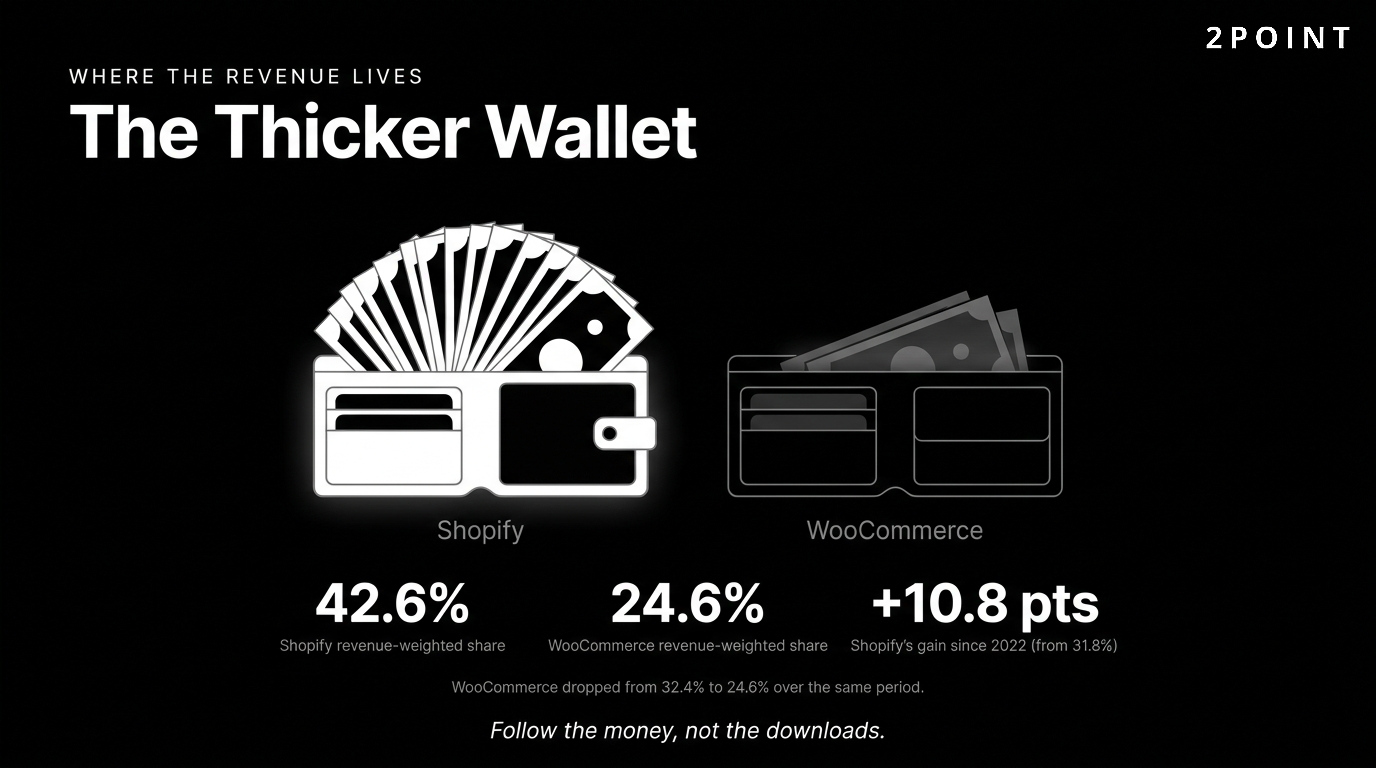
When you filter for high-traffic stores, the picture shifts dramatically. Among sites in the top one million for traffic, Shopify captures 28.8% compared to WooCommerce’s 18.2%. Meanwhile, Shopify now powers 42.6% of ecommerce stores in revenue-weighted metrics, up from 31.8% in 2022, a gain of 10.8 percentage points. That is the largest single-platform gain recorded across the industry during that period.
W3Techs data adds further context. WooCommerce accounts for 8.2% of all websites globally, while Shopify accounts for 5.3%. The gap in raw website count is real, but it reflects a fundamental difference in what these platforms are built for and who uses them.
| Metric | Shopify | WooCommerce |
|---|---|---|
| Global ecommerce market share (all stores) | 27% | 38.76% |
| Revenue-weighted market share (2026) | 42.6% | 24.6% |
| Share of top-1M-traffic ecommerce sites | 28.8% | 18.2% |
| Share of all websites (W3Techs) | 5.3% | 8.2% |
| Active store count | 4.8 million | 6.5 million |
The key takeaway: Shopify dominates among active, revenue-generating merchants, while WooCommerce’s headline number is inflated by dormant or low-activity installations.
Why Shopify Gained 10.8 Points While WooCommerce Declined
Shopify gained 10.8 percentage points from 2022 to 2026, the largest single-platform gain measured in revenue-focused ecommerce metrics. This growth was not accidental. It reflects a convergence of trends that favored Shopify’s core value proposition: fast launch, managed infrastructure, and a cohesive merchant experience.
The direct-to-consumer boom drove thousands of brand-first merchants to Shopify, where they could launch quickly without engineering overhead. International expansion features, including multi-currency support, Shopify Markets, and a growing payment network, made the platform more competitive globally. Meanwhile, WooCommerce dropped from 32.4% to 24.6% in revenue-focused measurements over the same period.
WooCommerce’s slide is partly structural. Maintaining a WordPress-based ecommerce stack requires ongoing developer involvement, security monitoring, and plugin compatibility management. As hosting costs rose and developer rates climbed, the total cost of ownership for WooCommerce became less appealing for merchants without in-house technical teams. Notably, WooCommerce remains strongest in the micro-business segment, holding 48.4% share among businesses with under $127,000 in annual revenue. For larger merchants, the equation shifts.
United States vs Global Market Dynamics
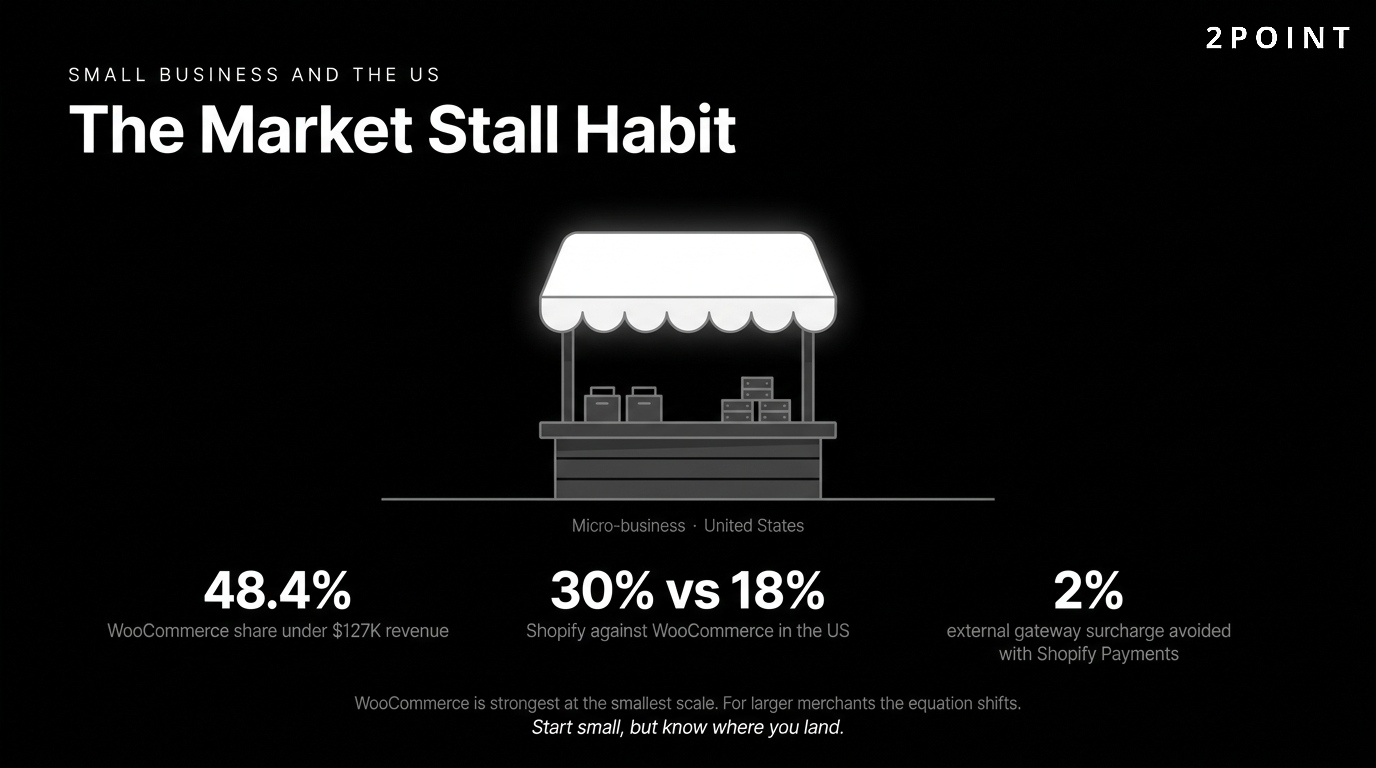
The US market tells a more pronounced version of the global story. In the United States, Shopify holds 30% of the ecommerce platform market compared to WooCommerce’s 18%. The availability of Shopify Payments in the US is a meaningful driver of this advantage. Merchants avoid the 2% external gateway surcharge entirely, reducing total cost and simplifying operations.
Globally, WooCommerce maintains stronger positions in regions where WordPress has deep roots, particularly in parts of Europe, Latin America, and Southeast Asia where local developers and agencies built their practices on WordPress long before Shopify’s international infrastructure matured. Regional payment gateway availability also plays a role. In markets where Shopify Payments is not available, WooCommerce’s flexibility with payment providers gives it a practical edge for local businesses.
Revenue Quality: Why Store Count Misleads
The most important distinction in the market share debate is the concept of revenue quality. WooCommerce’s 36% share includes vast numbers of small WordPress sites where the plugin has been activated but no serious ecommerce operations are running. A WordPress site owner who installed WooCommerce to sell a single digital product and then never used it again still counts as an active installation in raw data.
Shopify’s 28% represents a more concentrated, higher-revenue merchant base. Every Shopify account requires an active paid subscription, which means dormant stores naturally churn out of the data. This subscription model creates a more honest count of stores that are actually operating. Additionally, Shopify stores consistently outperform equivalent WooCommerce stores in checkout conversion rates, which compounds the revenue quality advantage at the merchant level.
Total Cost of Ownership: Beyond the Monthly Fee
Price comparisons between Shopify and WooCommerce are frequently oversimplified. The monthly subscription fee is just one input into a much larger equation that includes hosting, apps, plugins, themes, developer time, and transaction fees. Understanding the full picture across different revenue scales is essential to making a financially sound platform decision.
Pricing Structures Explained: Shopify vs WooCommerce Cost
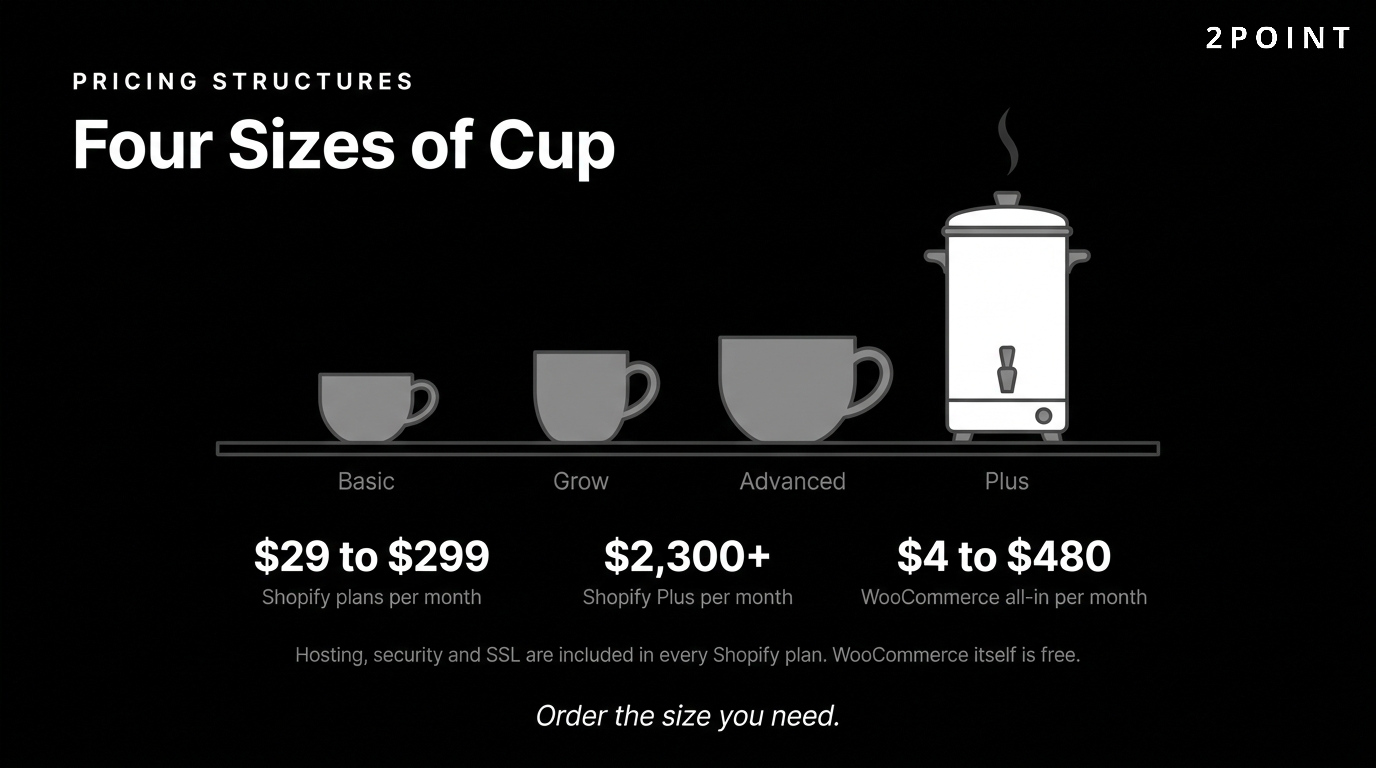
Shopify operates on a subscription model with clearly defined tiers. Shopify plans range from $29 to $299 per month, with powerful features bundled into each tier. Shopify Plus, designed for enterprise merchants, starts at $2,300 per month. Hosting, security, SSL, and core ecommerce functionality are all included in every plan.
WooCommerce itself is free, but the total investment picture is very different. WooCommerce pricing ranges from $4 to $480 per month depending on hosting, plugin choices, and theme selection. The floor is low, but the ceiling can surpass Shopify’s mid-tier plans once you account for managed hosting, premium plugins, and developer involvement.
Transaction fees are a critical differentiator. Shopify charges an additional 2% transaction fee when using external payment gateways, dropping to 1% on the Grow plan and 0.6% on Advanced. WooCommerce never charges platform-level transaction fees, regardless of which payment gateway you use. At scale, this difference alone can amount to tens of thousands of dollars annually.
| Cost Component | Shopify | WooCommerce |
|---|---|---|
| Base platform fee | $29–$299/month (Plus: $2,300+) | Free plugin |
| Hosting | Included | $4–$480/month |
| SSL certificate | Included | Often free via host, or paid |
| Platform transaction fee | 0% (Shopify Payments) or 0.6–2% | 0% (gateway fees only) |
| Theme cost | Free–$350 (one-time) | Free–$100+ (one-time) |
| Apps/plugins budget | $50–$300/month typical | $30–$300/month typical |
| Developer costs | Lower ongoing need | Higher ongoing need |
The key takeaway: Shopify’s pricing is predictable and bundled, while WooCommerce starts cheaper but accumulates costs through hosting, plugins, and development work.
Real-World Cost at $50K, $250K, and $1M Revenue
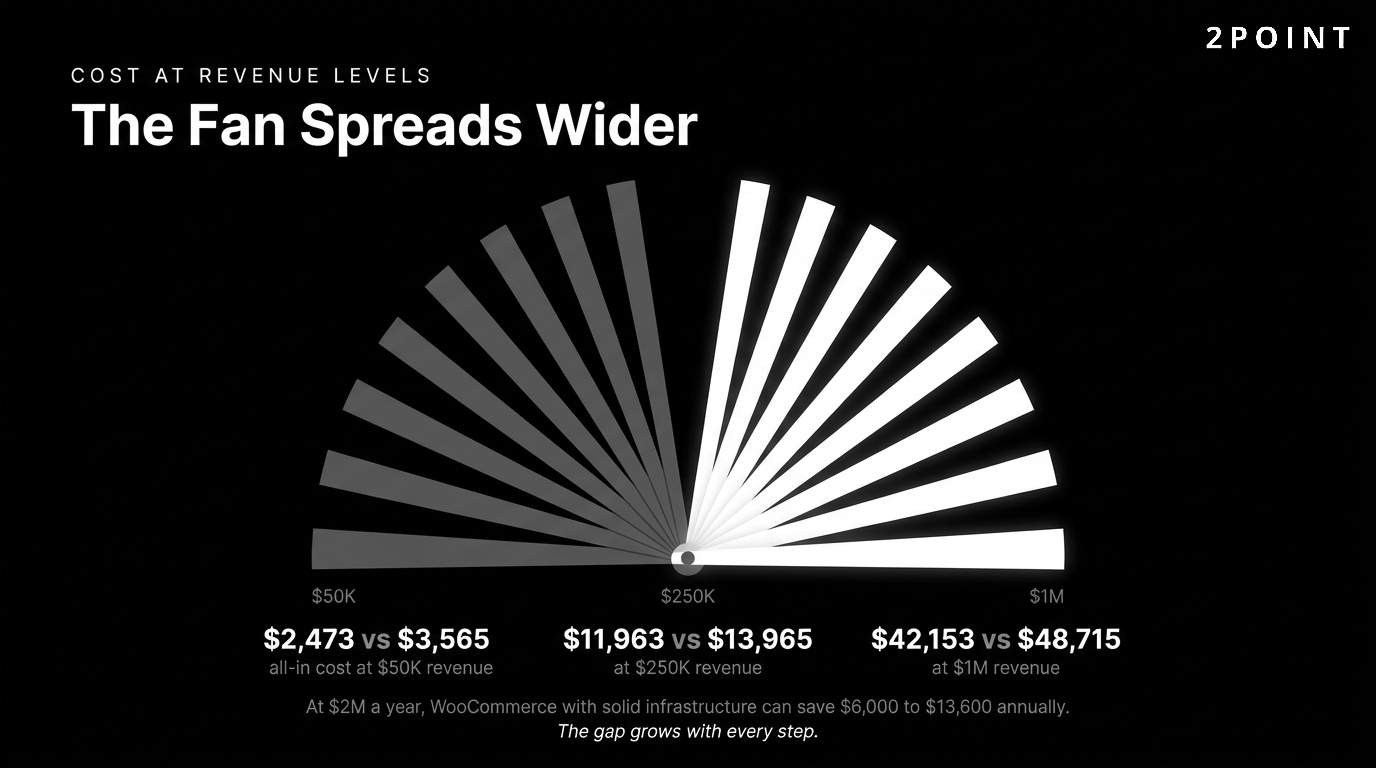
Projecting costs at real revenue milestones removes the guesswork from the platform decision. At the $50,000 annual revenue mark, the difference is modest but already visible. At $50K revenue, Shopify all-in costs total approximately $2,473 versus WooCommerce’s $3,565. The gap reflects WooCommerce’s higher setup and configuration overhead, even at small scale.
At $250,000 annual revenue, both platforms are operating at a meaningful scale and the numbers begin to diverge more sharply. At $250K revenue, Shopify costs approximately $11,963 per year versus WooCommerce’s $13,965. The delta grows partly because Shopify’s Advanced plan provides better transaction rates that offset the higher subscription cost.
At the $1 million revenue level, the comparison gets more nuanced. At $1M revenue, Shopify costs approximately $42,153 versus WooCommerce’s $48,715. However, this is also the range where WooCommerce’s flexibility can produce meaningful savings for merchants who invest in development. A $2 million per year WooCommerce store can save between $6,000 and $13,600 annually compared to an equivalent Shopify setup, assuming the technical infrastructure is properly maintained.
First-Year Costs for New Stores
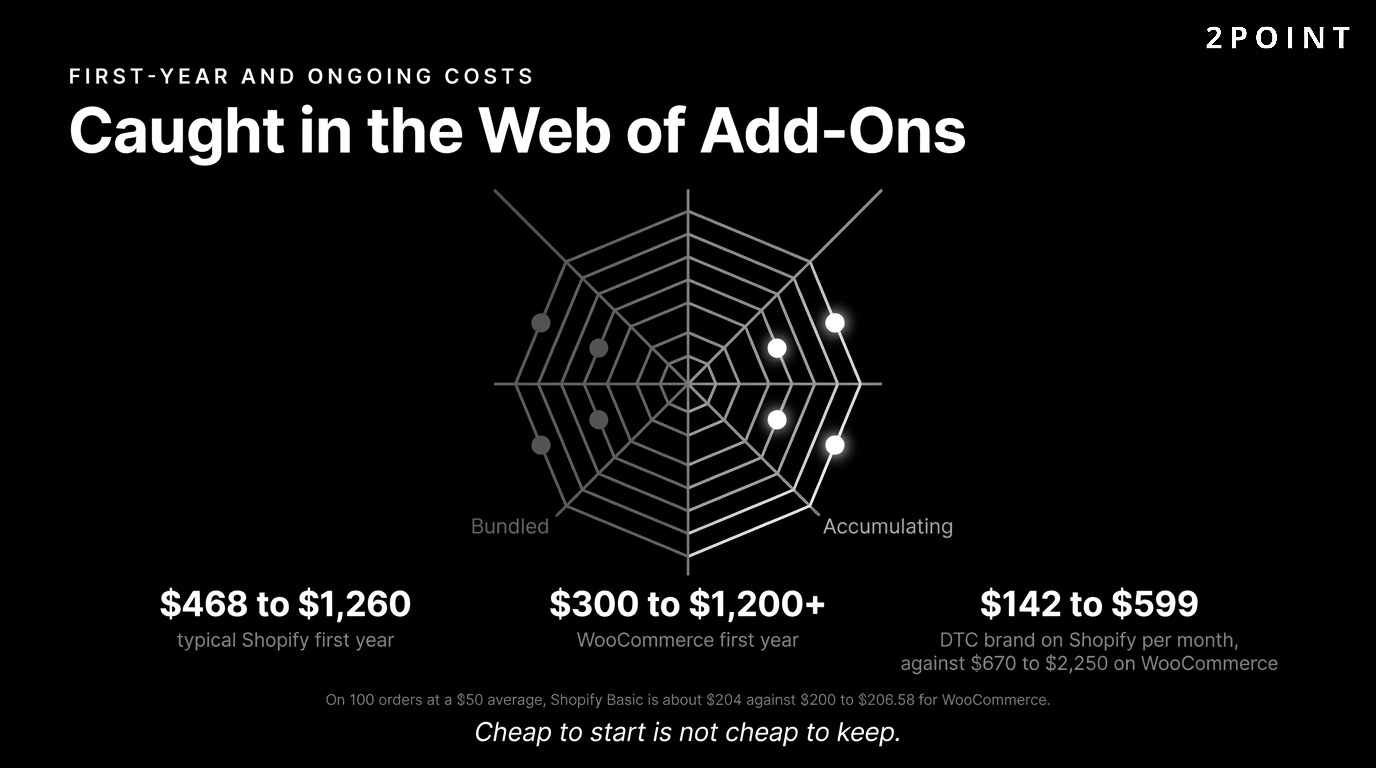
Year-one investment is often the deciding factor for early-stage merchants. A typical Shopify store costs between $468 and $1,260 in the first year, covering the subscription, a premium theme if desired, and a small selection of apps. The bundled nature of Shopify keeps surprises minimal.
A comparable WooCommerce setup runs between $300 and $1,200 or more depending on hosting tier, theme selection, and plugin choices. The lower floor is real, but it assumes DIY configuration and an existing familiarity with WordPress. For merchants who need an agency or developer to set things up, the first-year WooCommerce cost can easily exceed Shopify’s.
At very small scale, the two platforms are nearly equivalent. On 100 orders at a $50 average order value, Shopify Basic costs approximately $204 versus WooCommerce’s $200 to $206.58. The break-even point is surprisingly early, and the choice should not be driven by cost alone at this stage.
Ongoing Monthly Costs: Apps, Hosting, and Maintenance
The recurring cost picture is where many merchants are caught off guard. Shopify with a typical app stack costs between $7,000 and $12,000 per year in total operating expenses. This includes the base subscription, a standard set of marketing and operations apps, and minimal developer costs. WooCommerce with managed hosting and ongoing developer support costs between $8,000 and $15,000 per year.
A growing direct-to-consumer brand on Shopify typically runs between $142 and $599 per month all-in. A properly maintained WooCommerce store runs between $670 and $2,250 per month once you factor in managed hosting, plugin licenses, security tooling, and developer retainer hours. These numbers reinforce a consistent pattern: Shopify’s predictability is a genuine financial advantage for merchants who lack in-house technical resources.
Ease of Use and Launch Speed: Which Platform Gets You Selling Faster?
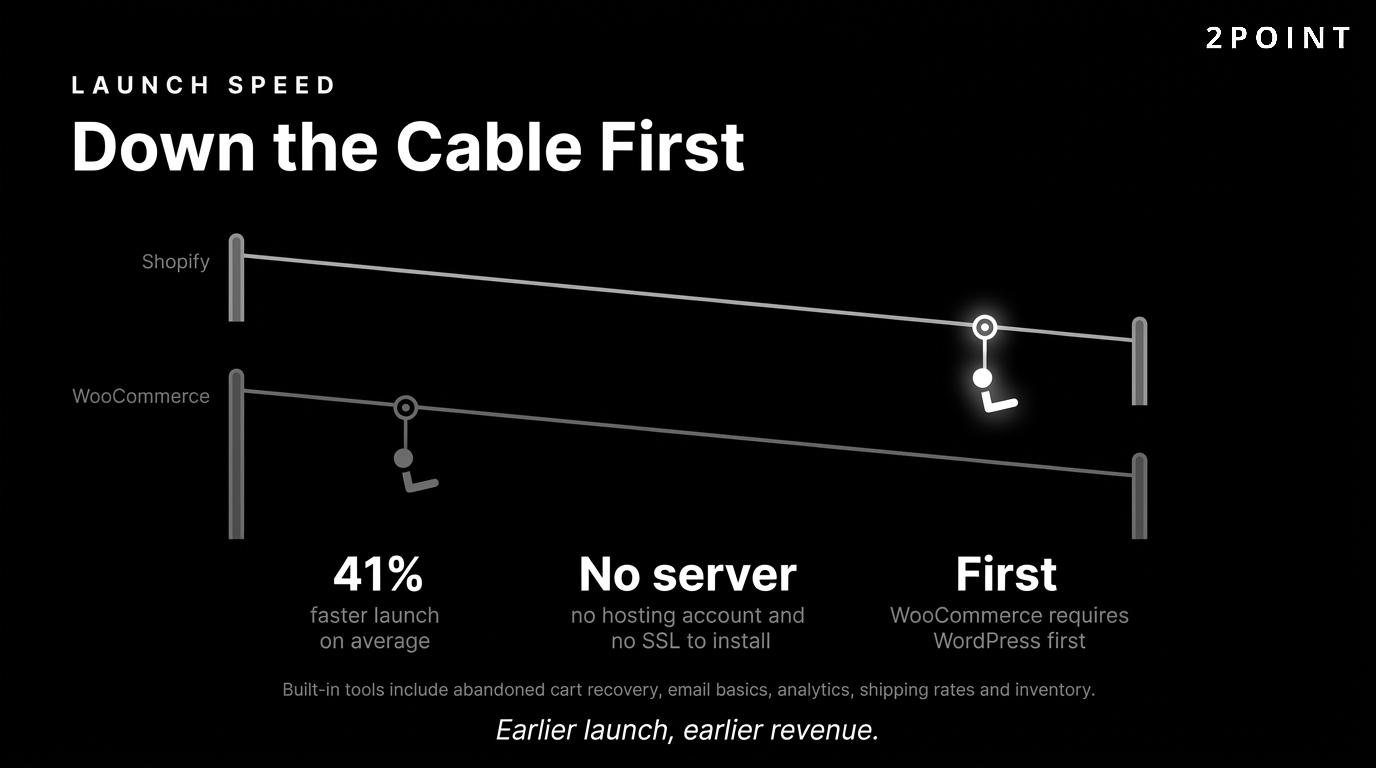
Time-to-market is often undervalued in platform comparisons. For many businesses, particularly those with seasonal windows or time-sensitive product launches, the ability to launch quickly can be worth more than any feature differential. This section examines how the two platforms compare on setup complexity, launch speed, and ongoing maintenance burden.
Shopify’s Plug-and-Play Advantage
Shopify was designed from the ground up for merchants who want to sell, not configure servers. The onboarding flow guides new users through store setup, product listing, payment configuration, and launch readiness without requiring any technical knowledge. Shopify is built specifically for non-technical teams, and that design philosophy shows at every step of the experience.
The hosted infrastructure means there is no server to configure, no hosting account to manage, and no SSL certificate to install. Everything is managed by Shopify. Shopify launches 41% faster than WooCommerce on average, and for merchants who are evaluating both platforms, that speed advantage can translate directly into earlier revenue. As Metorik notes, if you are a beginner and want the easiest, fastest way to launch an ecommerce store, Shopify is the clear choice.
The built-in tools are another advantage. Shopify includes abandoned cart recovery, basic email marketing, analytics, shipping rate calculation, and inventory management without requiring any additional installations. For a non-technical founder, this out-of-the-box capability reduces decision fatigue and shortens the path from idea to live store. If you are thinking about how to design a Shopify website, the platform’s intuitive interface makes even customization accessible without coding.
WooCommerce’s Learning Curve and Setup Requirements
WooCommerce requires a different kind of readiness. WooCommerce requires installing WordPress first, configuring a hosting account separately, managing security settings independently, and handling updates on your own timeline. Each of these steps is manageable, but together they represent a meaningful barrier to entry for merchants without technical backgrounds.
Forbes Advisor notes that WooCommerce is much more complicated than Shopify and requires developer experience to set up and maintain effectively. This is not a criticism of WooCommerce so much as an honest description of its technical profile. The platform rewards investment in expertise, but it asks for that investment upfront.
WooCommerce is approachable if your team already uses WordPress, but updates, compatibility testing, and backup management all become your responsibility. For teams with existing WordPress workflows, this is a natural extension of what they already do. For teams without that foundation, it represents a significant operational addition.
Maintenance and Technical Overhead Comparison
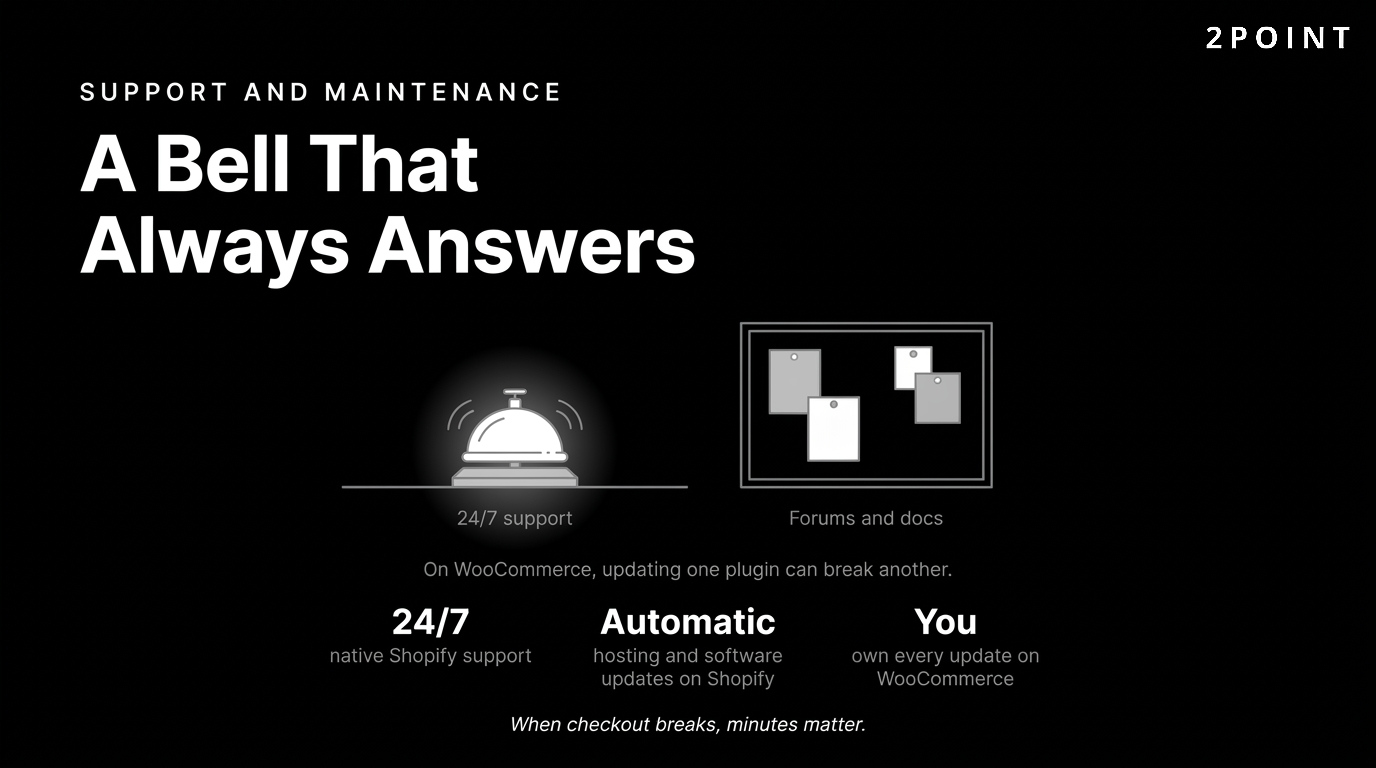
Ongoing maintenance is where the operational divide between the two platforms becomes most visible. Shopify handles all hosting and software updates automatically; on WooCommerce, those responsibilities belong to the store owner. This includes WordPress core updates, WooCommerce plugin updates, theme updates, and updates to every other plugin in the stack. Each update cycle carries a compatibility risk that must be tested before deployment.
Shopify provides 24/7 native customer support, while WooCommerce relies on community forums, documentation, and your hosting provider. For a merchant experiencing a checkout failure at peak sales time, the difference between instant Shopify support and forum-based WooCommerce troubleshooting can be measured in lost revenue. On WooCommerce, plugin compatibility is entirely your responsibility, which means that updating one plugin can break another and discovering that issue can take hours.
When Technical Complexity Becomes an Asset
It would be unfair to frame WooCommerce’s complexity as purely a liability. For the right team, that complexity is precisely what creates value. Developer-led organizations that are building custom workflows, integrating with proprietary systems, or running multiple WordPress properties benefit directly from WooCommerce’s open architecture. The same codebase that requires maintenance also allows unlimited modification.
WooCommerce is approachable and powerful when the team already lives in the WordPress ecosystem. Teams that manage editorial content, run membership sites, or build community platforms alongside ecommerce find that WooCommerce’s WordPress integration eliminates duplication and simplifies the technical stack. When you can manage content, users, products, and memberships in a single platform, the complexity pays for itself.
WooCommerce Customization vs Shopify’s App Ecosystem: Flexibility vs Convenience
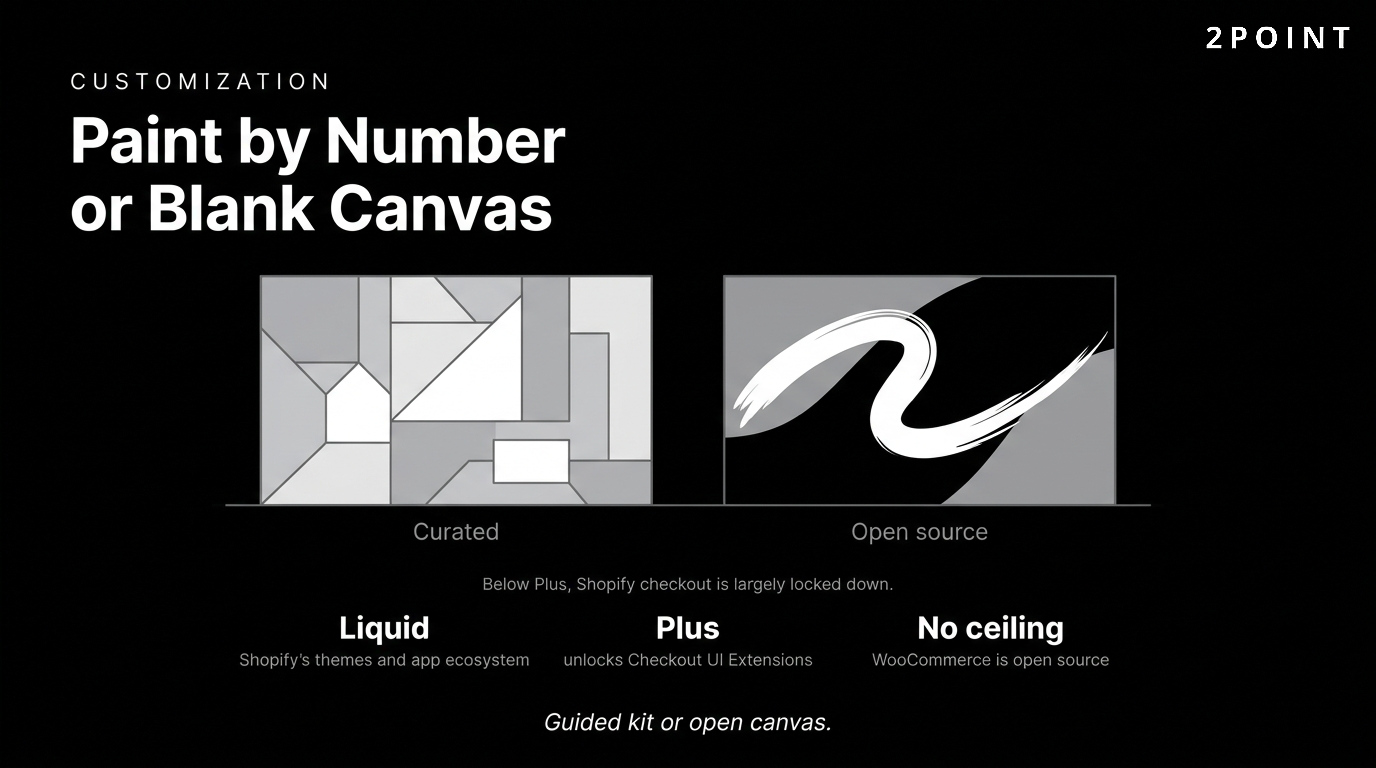
Customization capability is one of the most discussed dimensions of the Shopify vs WooCommerce debate, and for good reason. The depth to which you can modify your store affects everything from user experience to operational efficiency to competitive differentiation. The two platforms take fundamentally different approaches to customization, and understanding those differences is essential to making the right choice.
Shopify’s Ecosystem: Themes, Apps, and Limitations
Shopify’s customization model is curated rather than open. The platform offers a rich library of themes built on the Liquid templating language, a well-organized app marketplace with thousands of third-party integrations, and increasingly powerful no-code customization tools in the theme editor. Shopify is highly customizable through its themes and app ecosystem, and Shopify Plus unlocks even more capability, though the checkout experience remains controlled by the platform.
The app marketplace is both a strength and a dependency. For most common ecommerce needs, there is a Shopify app that handles the job reliably. The review and approval process means apps in the store have been vetted for basic quality and security standards. However, Shopify’s store is more curated and commerce-focused, which means that if your requirements fall outside the mainstream, you may find the platform’s closed nature creates hard limits. When you are exploring a new Shopify store theme, the platform gives you a solid foundation with predictable constraints.
Shopify Plus merchants gain access to checkout extensibility via Checkout UI Extensions, which allows meaningful customization of the checkout flow without touching Shopify’s core code. Below the Plus tier, the checkout is largely locked down. This is a meaningful constraint for merchants who need unusual checkout logic, complex upsell flows, or deeply branded payment experiences.
WooCommerce’s Open-Source Advantage
WooCommerce’s open-source nature is its defining characteristic. WooCommerce offers greater customization because it is open source, giving developers full access to the codebase to build virtually anything. There is no platform ceiling, no gated checkout, and no requirement to route functionality through an approved marketplace. If you can build it in PHP and JavaScript, you can build it on WooCommerce.
WooCommerce provides more customization capability for teams with technical skills, and that capability extends to every layer of the application. Custom post types, advanced taxonomies, bespoke checkout flows, and deep database integrations are all accessible. Data ownership is absolute, with no dependency on a third-party platform for access to your store’s information. WooCommerce wins on customization depth, SEO potential, and data ownership for teams equipped to leverage those advantages.
The plugin ecosystem for WooCommerce is massive, encompassing everything from subscription billing and membership management to complex B2B pricing rules and multi-vendor marketplace functionality. When you need to edit a Shopify website, you work within defined boundaries; on WooCommerce, those boundaries are set only by your development capacity.
Plugin Quality vs App Reliability
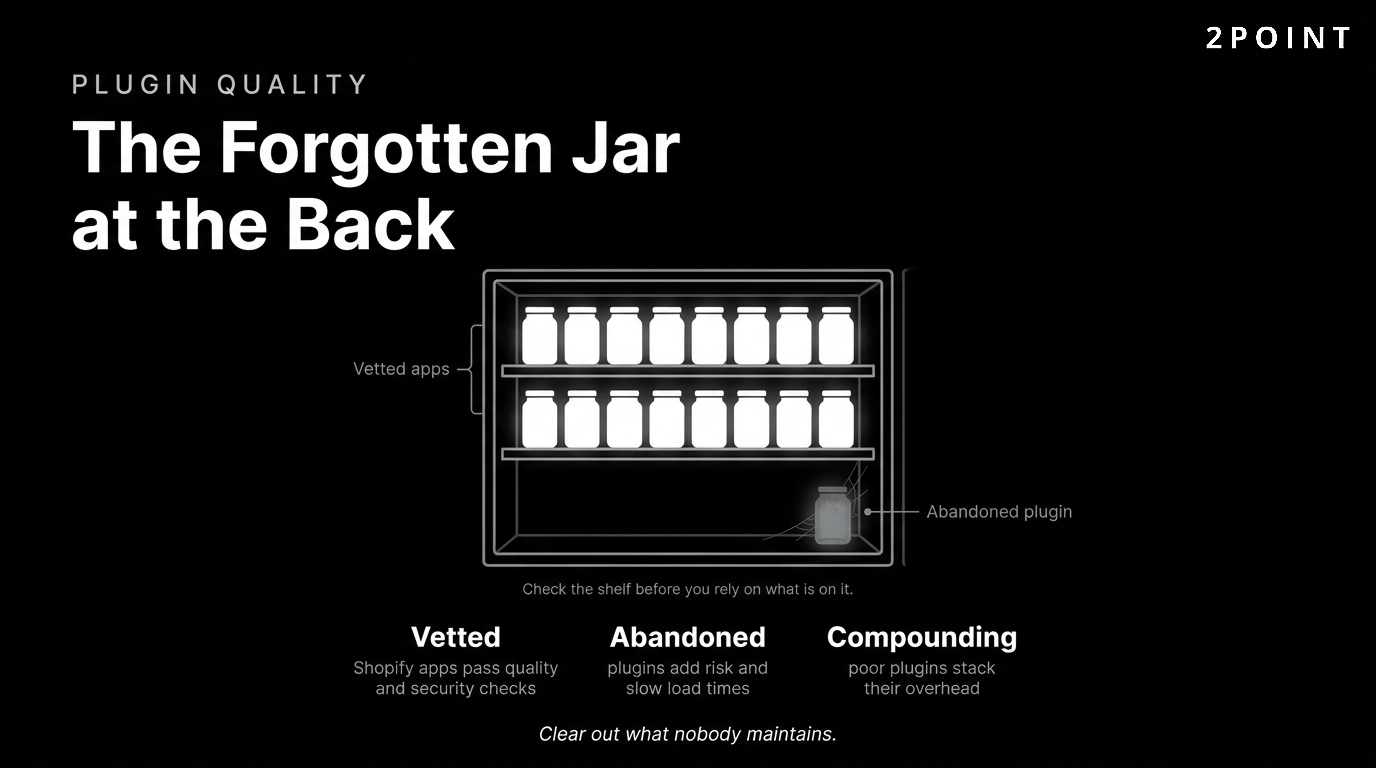
The size of WooCommerce’s plugin ecosystem is impressive, but it comes with a caveat. WooCommerce’s larger ecosystem includes abandoned plugins that can introduce security vulnerabilities and slow load times. When a plugin developer stops maintaining their product, the stores that depend on it are left with two unpleasant choices: continue running outdated, potentially vulnerable code, or invest in finding and migrating to an alternative.
Shopify’s curated app review process reduces but does not eliminate this risk. Apps must pass quality and security checks before publication, and Shopify actively monitors the marketplace for problematic submissions. The result is a smaller but more reliably maintained ecosystem. Performance impact is also worth considering: poorly optimized WooCommerce plugins can compound each other’s overhead, while Shopify’s app architecture keeps performance degradation more contained.
Real-World Customization Scenarios
Abstracting from technical capabilities to real use cases makes the comparison more actionable. B2B merchants who need tiered wholesale pricing, volume discounts, and customer-group-specific catalogs will find WooCommerce far more accommodating. Subscription and membership sites benefit from WooCommerce’s deeper integration with content management. Multi-vendor marketplace builds, complex product configurators, and hybrid content-commerce sites all lean toward WooCommerce.
Shopify excels for straightforward product catalogs, rapid brand launches, and merchants who want a polished storefront without custom development. Its checkout performance, built-in analytics, and app ecosystem handle the overwhelming majority of direct-to-consumer use cases effectively. Choose WooCommerce if you need B2B or wholesale pricing models, complex product configurations, or a store that is tightly integrated with a content-heavy site. Choose Shopify if speed, simplicity, and conversion-optimized infrastructure matter more than deep technical flexibility.
Performance, Speed, and Scalability: Which Ecommerce Platform Handles Growth Better?
Platform performance directly affects conversion rates, search rankings, and customer experience. A slow store loses sales. An overloaded store loses customers permanently. Understanding how Shopify and WooCommerce perform under different load conditions is critical to choosing a platform that supports your long-term growth trajectory.
Page Load Speed and Performance Benchmarks
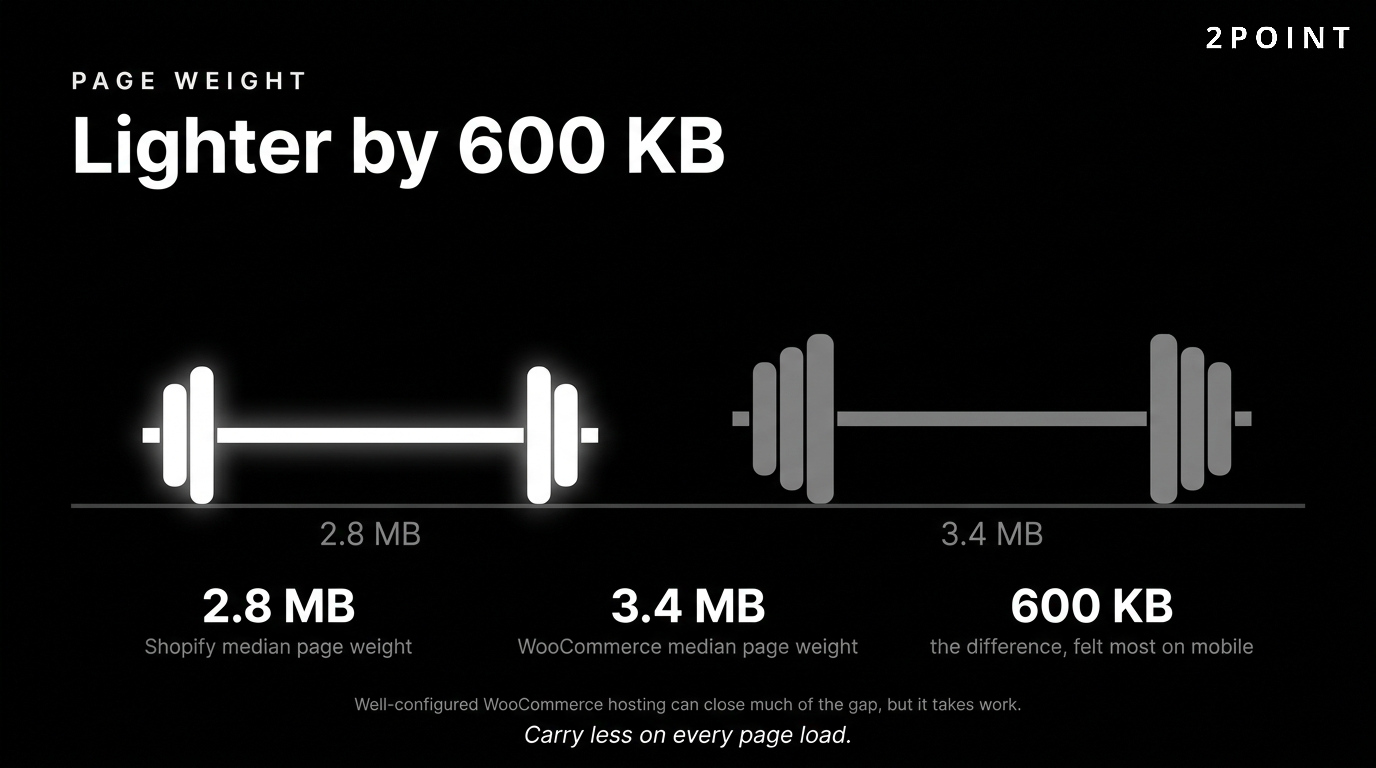
Real-world performance data from 2026 gives Shopify a measurable edge in page weight and load speed. HTTP Archive data from early 2026 shows that Shopify stores transfer a median of 2.8 MB per page load compared to WooCommerce’s 3.4 MB. That 600 KB difference compounds meaningfully on mobile connections and in markets with slower internet infrastructure.
Shopify’s performance advantage comes from its built-in asset pipeline, which automatically minifies JavaScript and CSS, compresses images, and delivers assets through a globally distributed content delivery network. WooCommerce stores can achieve comparable performance with the right hosting configuration, caching plugins, and image optimization tooling, but those optimizations require active configuration and maintenance. For teams focused on Shopify speed optimization, the baseline is already strong, and improvements are incremental rather than foundational.
Mobile performance is increasingly the primary battleground. With mobile commerce accounting for the majority of ecommerce traffic in many categories, the platform that delivers faster, smoother mobile experiences wins. Shopify’s themes are mobile-first by design, and its infrastructure handles mobile asset delivery efficiently. WooCommerce mobile performance depends heavily on theme selection and plugin overhead, with significant variance between well-optimized and poorly optimized setups.
Scaling to High Traffic: Infrastructure Comparison
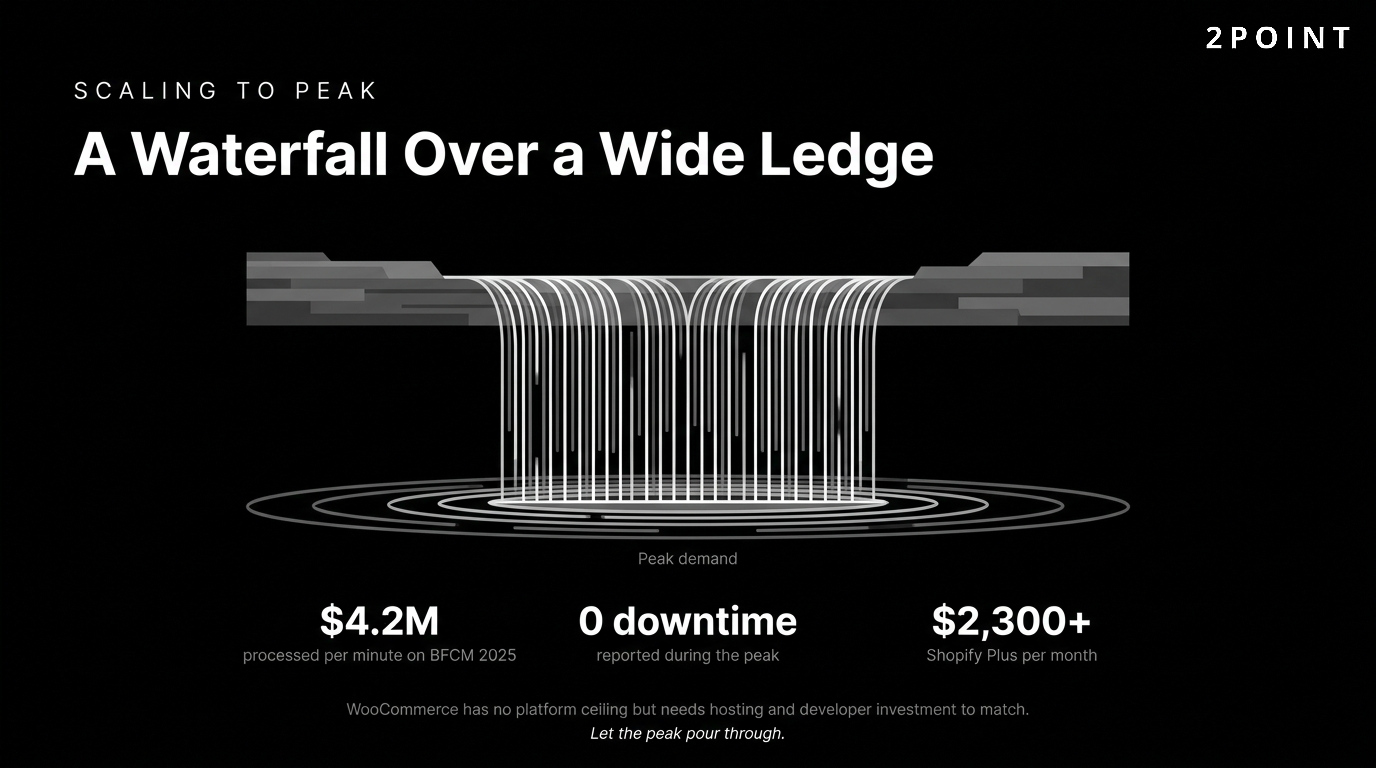
Shopify’s infrastructure is built for traffic spikes of any magnitude. During Black Friday/Cyber Monday 2025, Shopify processed $4.2 million in sales per minute without any reported downtime. This is a remarkable demonstration of infrastructure reliability at peak demand. For merchants whose revenue is concentrated in seasonal events, this assurance is not a minor feature; it is a business-critical capability.
WooCommerce scaling works differently. WooCommerce can scale as far as your hosting and development budget allow, with no platform ceiling. Some of the world’s largest ecommerce operations run on WooCommerce with custom hosting architectures. However, Shopify scales automatically with less setup work, but costs climb through higher plan tiers and Shopify Plus starting at $2,300 per month. The trade-off is simplicity versus control at every scale milestone.
For mid-market merchants transitioning from growth to enterprise, the question of scaling infrastructure often triggers a platform evaluation. If you are approaching that inflection point, understanding when to migrate to Shopify Plus can save significant operational headaches before they materialize.
Hosting Impact on WooCommerce Performance
For WooCommerce, hosting is not a background detail; it is a primary performance driver. The difference between a $4-per-month shared hosting plan and a $200-per-month managed WordPress host is the difference between a site that crawls and one that competes. WooCommerce pricing ranges from $4 to $480 per month, with hosting tier being the single largest variable in that range.
Shared hosting is acceptable for development environments and very low-traffic stores. As soon as a WooCommerce store starts receiving meaningful traffic, the resource contention on shared servers degrades performance noticeably. Managed WordPress hosting providers like Kinsta, WP Engine, and Cloudways offer server-side caching, automated backups, staging environments, and PHP version optimization that bring WooCommerce performance much closer to Shopify’s out-of-the-box standard. For teams that want to speed up their website, the right infrastructure choice is the foundational first step.
CDN integration and caching strategies are also essential for WooCommerce at scale. Plugins like WP Rocket, LiteSpeed Cache, or W3 Total Cache can dramatically improve response times when configured correctly. The key phrase is “when configured correctly.” Each of these tools requires setup investment and periodic reconfiguration as the site evolves.
Conversion Rate Performance
Speed and infrastructure performance ultimately translate into conversion rates. Shopify stores consistently outperform equivalent WooCommerce stores in checkout conversion rates. Shopify’s checkout has been refined through billions of transactions. It is fast, mobile-optimized, familiar to shoppers, and natively integrated with accelerated checkout options like Shop Pay, Apple Pay, and Google Pay.
WooCommerce checkout can be customized extensively, which is both its strength and its vulnerability. A poorly designed WooCommerce checkout can underperform Shopify’s default significantly. A well-optimized WooCommerce checkout built by an experienced developer can match or exceed it. The difference is that Shopify’s performance floor is high by default, while WooCommerce’s floor requires effort to raise. For merchants tracking conversion tracking on Shopify, the platform’s native analytics infrastructure makes measurement straightforward from day one.
SEO and Content Strategy: Which Platform Wins for Organic Growth?
Search engine optimization is a long-term growth lever that compounds over time. The platform you choose today shapes your SEO architecture for years. Both Shopify and WooCommerce are capable of ranking well, but they approach SEO with different toolsets, different constraints, and different strengths. Understanding these differences is especially important for merchants whose customer acquisition strategy is built on organic search.
WordPress’s Content Platform Advantage for WooCommerce SEO
WooCommerce inherits WordPress’s decades-long reputation as the web’s leading content management system. WooCommerce benefits directly from WordPress’s strength as a content platform, which matters enormously if guides, blog posts, and comparison pages are central to your organic growth strategy. The editorial tooling in WordPress is richer than any dedicated ecommerce platform’s blog functionality, with custom taxonomies, flexible URL structures, advanced meta management, and native support for a wide range of content types.
The integration between content and commerce on WooCommerce is seamless. A recipe site that sells ingredients can build its editorial calendar, its recipe archive, and its product pages in a single unified environment. Internal linking between content and products is natural and unconstrained. A brand whose growth depends on guides, tutorials, recipes, and SEO-driven content benefits directly from WordPress’s content tools. The ability to structure URL hierarchies freely, create content silos with taxonomies, and use plugins like Yoast SEO or Rank Math for granular technical control gives WooCommerce a genuine advantage for content-heavy growth strategies.
Custom fields, advanced post types, and flexible page templates mean that WooCommerce stores can build very sophisticated content architectures. A gear review site that sells equipment, a supplement brand with an extensive education library, or a fashion retailer that publishes trend guides all have strong reasons to prefer WooCommerce’s content infrastructure over Shopify’s.
Shopify’s SEO Capabilities and Constraints
Shopify handles the technical SEO fundamentals competently. It generates clean sitemaps automatically, includes meta title and description fields for every page and product, enforces HTTPS across the board, and delivers fast page loads that Google rewards in ranking algorithms. For merchants who need basic to intermediate SEO without deep customization, Shopify’s built-in toolset is sufficient.
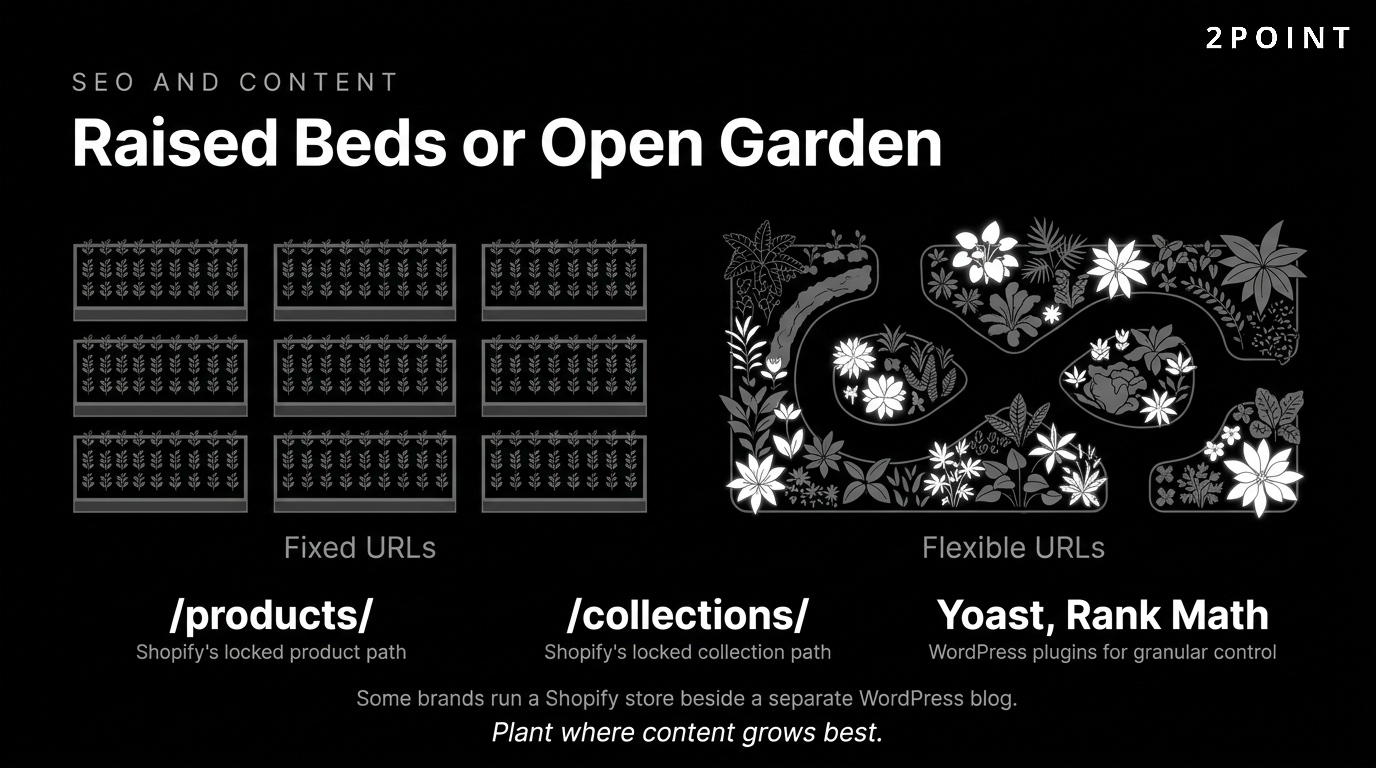
The constraints appear when you need more granular control. Shopify handles technical SEO basics well, but its URL structure is less flexible than WordPress. Product URLs are locked to the /products/ subdirectory, collection URLs to /collections/, and there is no native mechanism to override these structures. For merchants with established URL architectures or specific SEO strategies, this rigidity can require creative workarounds. Learning how to add keywords to a Shopify website is straightforward, but deeper structural SEO work requires accepting the platform’s architectural constraints.
Shopify’s blogging functionality is functional but not feature-rich. It supports basic posts, tags, and categories, but lacks the depth of WordPress’s content management. Some merchants run a Shopify store alongside a separate WordPress blog, using Shopify for commerce and WordPress for content. This architecture works, but it introduces complexity in internal linking, analytics, and site management that a unified WooCommerce setup avoids.
Content-Commerce Integration Strategies
The integration of content and commerce is increasingly important in a search landscape where topical authority and helpful content signals matter. WooCommerce keeps content and commerce in one unified place, which simplifies the management of internal links, content updates, and product cross-references. This unified approach creates a coherent site architecture that search engines can crawl and understand efficiently.
For merchants considering how to structure a content-driven ecommerce strategy, WooCommerce’s native content tools support longer editorial calendars, more complex content hierarchies, and tighter product-to-content associations. When a buyer’s guide links directly to a product page within the same domain and CMS, the relationship between content authority and product relevance is clean and explicit. This kind of architecture is achievable on Shopify too, but it requires more workarounds and is less naturally supported by the platform’s design.
Payment Processing and Sales Features: Transaction Fees and Gateway Flexibility
Payment infrastructure is at the heart of any ecommerce operation. The gateway you use, the fees you pay, and the sales channels you can access all shape your profitability and your ability to serve customers. Shopify and WooCommerce take different approaches to payments, each with meaningful implications for different business models.
Payment Gateway Options and Transaction Fees
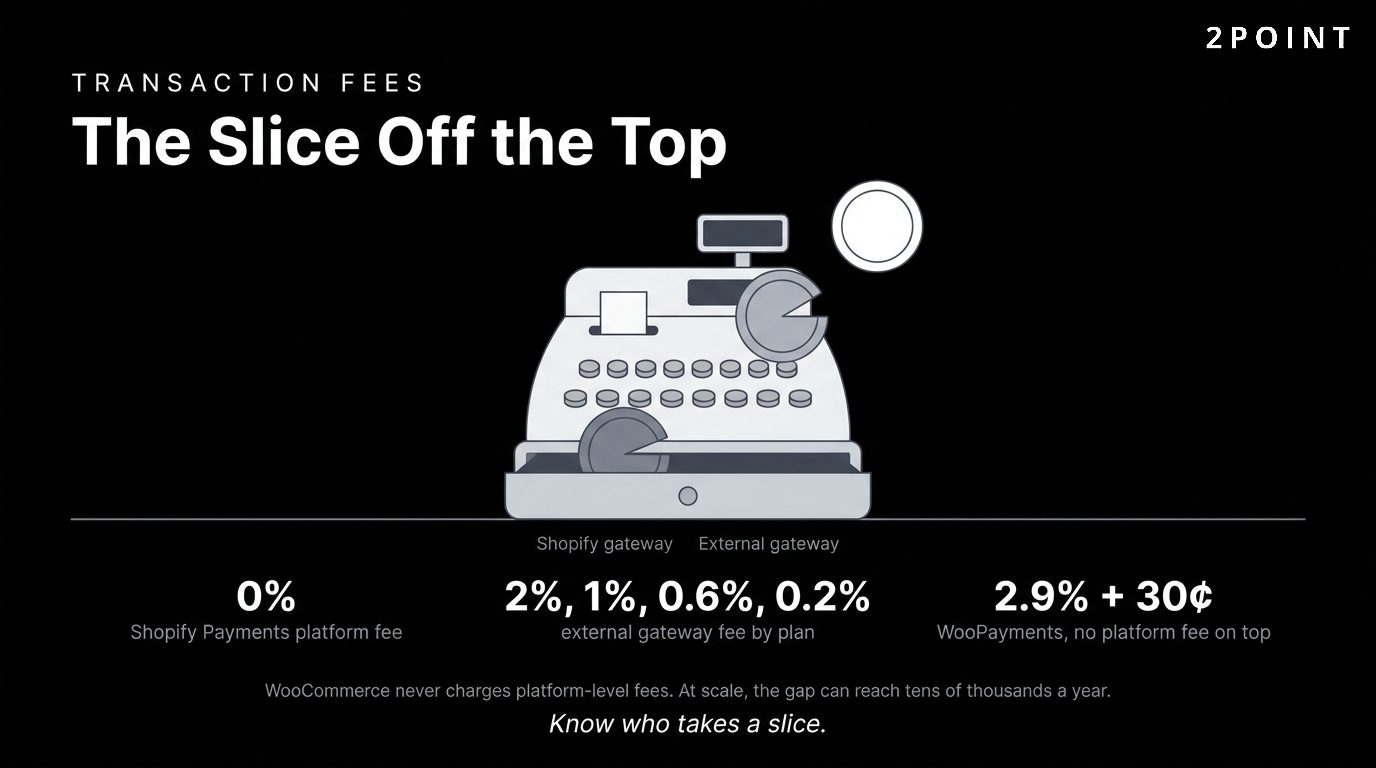
Shopify’s payment strategy revolves around its own first-party gateway, Shopify Payments. Shopify Payments carries no additional transaction fee; using any other gateway adds 2% on Basic, 1% on Grow, 0.6% on Advanced, or 0.2% on Plus. This structure creates a clear financial incentive to use Shopify Payments, which is available in a growing number of countries. For US-based merchants, Shopify Payments is the natural default and eliminates transaction fee concerns entirely.
WooCommerce provides complete flexibility in gateway selection with no platform-level penalty. With WooCommerce, you connect third-party payment gateways such as Stripe, PayPal, or WooPay, and the platform itself charges no transaction fee regardless of which you use. WooCommerce’s own WooPayments plugin offers standard pricing from 2.90% plus 30 cents per transaction, competitive with industry standards and without any platform surcharge on top.
For merchants in regions where Shopify Payments is not available, WooCommerce’s gateway-agnostic model is a significant practical advantage. The ability to integrate with regional processors, local payment methods, and niche gateways without platform penalties gives WooCommerce genuine flexibility that Shopify cannot match in every market. Setting up conversion API tracking on Shopify is well-documented, but the payment gateway ecosystem differences between the two platforms can be a deciding factor for internationally operating merchants.
| Payment Scenario | Shopify Cost | WooCommerce Cost |
|---|---|---|
| Using first-party payment solution | 0% platform fee (Shopify Payments) | 0% platform fee (WooPayments: 2.9% + 30¢) |
| Using Stripe on Basic plan | 2% platform fee + Stripe’s rate | 0% platform fee + Stripe’s rate only |
| Using Stripe on Advanced plan | 0.6% platform fee + Stripe’s rate | 0% platform fee + Stripe’s rate only |
| International/regional gateway | Platform fee applies (plan dependent) | No platform fee ever |
The key takeaway: WooCommerce’s zero-platform-fee model benefits high-volume merchants using non-Shopify gateways, while Shopify Payments eliminates the fee disadvantage entirely for merchants where it is available.
Point-of-Sale and Omnichannel Capabilities
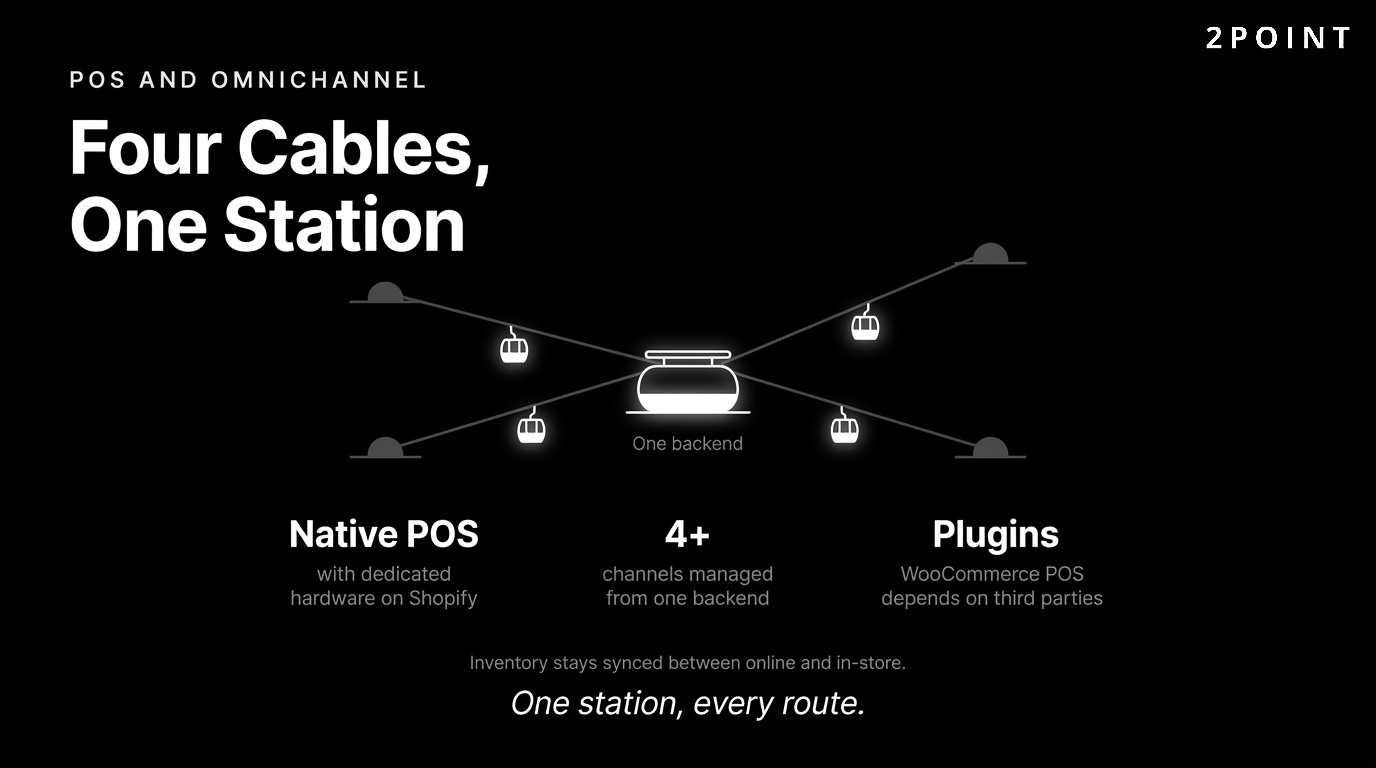
For merchants who sell both online and in physical locations, the point-of-sale story is decidedly one-sided. Shopify offers a fully integrated POS system with dedicated hardware, inventory synchronization between online and physical stores, and a consistent backend for all channels. For omnichannel retailers, this unified infrastructure eliminates the inventory reconciliation problem that plagues merchants using separate systems for in-store and online operations.
WooCommerce POS functionality depends entirely on third-party plugins. Options exist and some are well-regarded, but they lack the deep integration, hardware ecosystem, and official support that Shopify POS provides. For a merchant opening their first physical location alongside an existing WooCommerce store, the POS plugin landscape requires careful evaluation. For a Shopify merchant, the expansion to physical retail is a built-in capability that the platform actively supports.
Multi-channel selling, including integrations with Amazon, eBay, Instagram Shopping, TikTok Shop, and Google Shopping, is natively supported or deeply integrated in Shopify. WooCommerce offers these integrations too, but through third-party plugins with varying levels of reliability and support. The coordination between channels is more seamless on Shopify, particularly for merchants managing inventory across four or more sales channels simultaneously.
Which Is the Best Ecommerce Platform in 2026 for Your Business?
After examining market share, cost, ease of use, customization, performance, SEO, and payment processing, the central question becomes concrete: given your specific situation, which platform is right for you? The answer is not universal, but the decision framework is clear.
Choose Shopify If These Conditions Apply
Shopify is the right choice when speed to market, operational simplicity, and reliable infrastructure matter more than deep customization or technical control. If you are launching a new direct-to-consumer brand, you need to focus on products, marketing, and customers, not server configurations and plugin updates. Shopify gives you a production-ready store with strong defaults and a support team you can call when something goes wrong.
Merchants who sell across multiple channels, including online, in-store, social commerce, and marketplaces, benefit from Shopify’s unified backend. The POS integration, multi-channel inventory sync, and native analytics consolidate what would otherwise require multiple separate tools. For growing brands approaching the enterprise threshold, Shopify’s scaling path through Plus is well-defined and operationally straightforward. If you are already on Shopify and your store is growing rapidly, understanding how Shopify hosting works at scale helps you plan infrastructure costs with confidence.
- You are launching your first online store and want to be selling within days, not weeks.
- Your team has no dedicated developer or WordPress expertise.
- You sell in person and need integrated POS functionality.
- Your growth depends on fast iteration, A/B testing, and app-driven feature additions.
- You need enterprise-grade infrastructure during peak sales events without managing servers.
- Your primary content format is product pages and simple blog posts rather than complex editorial architectures.
- You operate in a region where Shopify Payments is available and want to avoid transaction fees on a preferred gateway.
Choose WooCommerce If These Conditions Apply
WooCommerce is the right choice when customization depth, content integration, or total cost optimization at high volume outweigh the value of simplicity. Teams with WordPress experience who need a tightly unified content-and-commerce environment will find WooCommerce’s architecture naturally suited to their workflows. The same system that powers the product catalog also powers the blog, the documentation library, the membership portal, and the community forum.
B2B merchants with complex pricing structures, wholesale customer groups, and custom quote workflows will find WooCommerce far more accommodating than Shopify. At high revenue scales, the absence of platform-level transaction fees and the flexibility to optimize hosting costs can produce meaningful savings that justify the technical investment. For international businesses in markets where Shopify Payments is unavailable, WooCommerce’s gateway flexibility is a practical necessity rather than just a preference.
- Your team includes developers who already work in the WordPress ecosystem.
- Content marketing is central to your SEO and customer acquisition strategy.
- You need B2B pricing, wholesale tiers, or custom product configurations that exceed Shopify’s native capabilities.
- You operate in markets where Shopify Payments is unavailable and transaction fees on alternative gateways would be significant.
- You are building a marketplace, membership site, or subscription service with requirements that go beyond standard ecommerce.
- Your annual revenue exceeds $2 million and you have the technical team to optimize hosting and reduce platform costs.
- You need complete data ownership and the ability to migrate platforms without vendor lock-in concerns.
When Migrating Between Platforms Makes Sense
Many businesses start on one platform and later find that their needs have outgrown it. The most common migration path is from WooCommerce to Shopify, typically triggered by growth, a need for better infrastructure, or a reduction in technical staff. The reverse migration, from Shopify to WooCommerce, happens when businesses require deeper customization, B2B features, or content integration that Shopify cannot provide within acceptable cost constraints.
Migration decisions should be evaluated holistically, including data transfer complexity, SEO impact from URL changes, app and plugin migration work, and staff retraining costs. The technical effort is significant in either direction, and the decision should not be driven by frustration in a moment of platform stress. A structured evaluation against the criteria above will produce a more durable outcome than a reactive migration. For merchants evaluating the enterprise path, understanding the case for and against choosing to migrate to Shopify Plus is a natural part of this process.
The Hybrid Approach: Shopify for Commerce, WordPress for Content
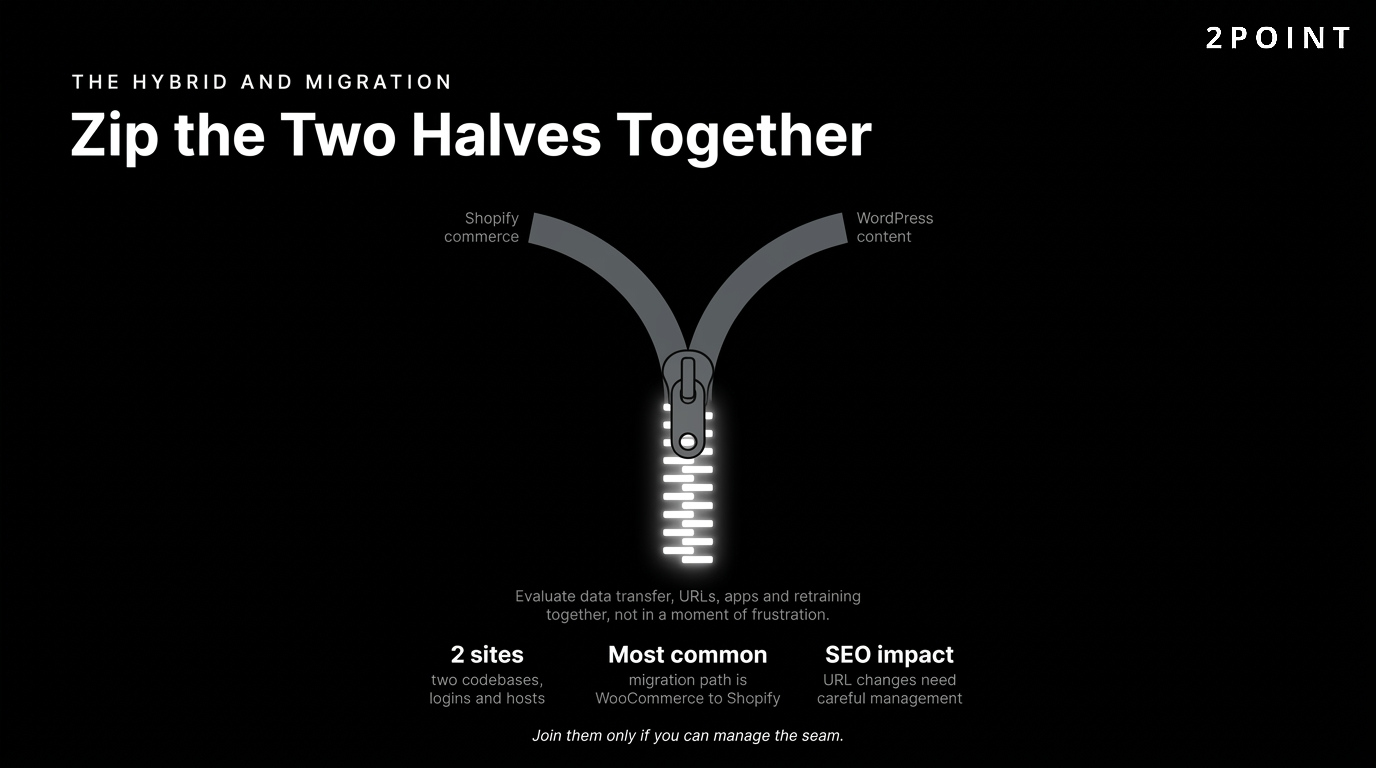
Some businesses find that neither platform perfectly serves all of their needs and opt for a hybrid architecture. Running Shopify as the commerce engine while maintaining a separate WordPress site for content is a recognized approach used by many mid-market brands. This model leverages Shopify’s checkout performance and infrastructure reliability while preserving WordPress’s content management depth and SEO flexibility.
The trade-offs are real. Managing two platforms means two codebases, two sets of logins, two hosting relationships, and more complex analytics integrations. Internal linking between the content and commerce properties requires careful URL management. For teams that are already strong in both platforms, the hybrid model can be very effective. For teams that want simplicity, the operational overhead usually makes a single-platform decision preferable.
Ecommerce Platform Comparison: Side-by-Side Feature Summary
A side-by-side comparison of the two platforms across every major decision dimension provides a consolidated reference for the evaluation process. This summary reflects the full analysis presented throughout this guide and is designed to support rapid decision-making.
| Feature or Dimension | Shopify | WooCommerce | Winner |
|---|---|---|---|
| Ease of setup | Very easy, guided onboarding | Requires WordPress setup and configuration | Shopify |
| Launch speed | 41% faster than WooCommerce | Slower due to prerequisite steps | Shopify |
| Monthly base cost | $29–$299 (all-inclusive) | Free plugin, hosting extra | Tie (depends on scale) |
| Transaction fees | 0% with Shopify Payments; up to 2% otherwise | 0% platform fee always | WooCommerce (without Shopify Payments) |
| Customization depth | Curated, app-dependent, limited checkout | Full open-source access, unlimited | WooCommerce |
| Hosting | Fully managed, included | Self-managed, variable quality and cost | Shopify |
| Maintenance burden | Minimal, automatic updates | High, manual updates and compatibility | Shopify |
| SEO and content | Good basics, limited URL structure | Excellent, full WordPress CMS power | WooCommerce |
| Performance (baseline) | 2.8 MB median page weight | 3.4 MB median page weight | Shopify |
| Scalability | Auto-scaling, proven at massive load | Scales with hosting investment | Shopify (ease); WooCommerce (ceiling) |
| Checkout conversion | Consistently higher conversion rates | Customizable but variable by default | Shopify |
| POS and omnichannel | Native POS with hardware | Third-party plugins only | Shopify |
| Payment gateway flexibility | Penalizes non-Shopify gateways | All gateways equal, no penalty | WooCommerce |
| B2B and wholesale features | Limited natively, apps available | Extensive via plugins and code | WooCommerce |
| Data ownership | Platform-dependent export | Full database access and ownership | WooCommerce |
| Support model | 24/7 official support | Community and hosting provider | Shopify |
| Market share (high-traffic) | 28.8% | 18.2% | Shopify |
The key takeaway: Shopify wins on ease, speed, infrastructure, and conversion by default; WooCommerce wins on customization depth, SEO potential, payment flexibility, and total cost at high revenue scales with technical investment.
Shopify Market Share Growth: What It Means for Platform Longevity
Platform market share matters for more than competitive bragging rights. A platform’s share of the merchant base directly affects app developer investment, theme designer activity, agency expertise availability, and long-term product development resources. Choosing a platform that is gaining momentum reduces long-term platform risk; choosing one that is declining can mean an increasingly constrained ecosystem over time.
What Shopify’s Growth Trajectory Signals for Merchants
Shopify’s consistent growth from 2022 to 2026 reflects compounding platform confidence. When more merchants choose Shopify, more developers build for it, more apps are created, more agencies specialize in it, and the ecosystem deepens. This network effect is self-reinforcing. The 10.8 percentage point gain in revenue-weighted market share is not just a data point; it is a signal that the merchants who matter most for platform economics are choosing Shopify at an accelerating rate.
For a merchant choosing a platform in 2026, Shopify’s trajectory means a deepening app marketplace, more specialized talent availability, and a product team with the financial resources to continue investing in platform improvements. Shopify’s total revenue has grown substantially, funding continued infrastructure investment, international expansion, and merchant tooling development. This is the kind of platform momentum that creates compounding benefits for existing merchants over time.
WooCommerce’s Position in the WordPress Ecosystem
WooCommerce’s position within the WordPress ecosystem is both its greatest strength and its most significant structural constraint. WordPress powers over 40% of all websites globally, and WooCommerce is the dominant ecommerce solution within that ecosystem. That installed base is enormous, and the community of developers, designers, and agencies built around WordPress and WooCommerce represents one of the largest talent pools in web development.
However, the same WordPress ecosystem dynamics that inflated WooCommerce’s store count with dormant installations also contribute to the abandoned plugin problem and the maintenance burden that pushes higher-revenue merchants toward Shopify. WooCommerce’s development is led by Automattic, the same company behind WordPress.com, and the product continues to receive active investment. The question for merchants is not whether WooCommerce will exist in five years; it will. The question is whether its development pace and feature roadmap match their needs.
Platform Risk Assessment for Long-Term Merchants
Long-term platform risk is a legitimate consideration for merchants investing significantly in a commerce infrastructure. Shopify’s risk profile includes vendor lock-in, pricing changes at the platform level, and the dependency on third-party apps for functionality that competitors include natively. WooCommerce’s risk profile includes reliance on a volunteer-driven plugin ecosystem, hosting security vulnerabilities, and the increasing total cost of technical maintenance as developer rates rise.
Neither platform is risk-free. The best mitigation strategy is a clear-eyed assessment of which risks are most relevant to your specific business model and which you are best equipped to manage. A business with strong technical resources can absorb WooCommerce’s maintenance complexity. A business without that capacity is better served by Shopify’s managed model, where platform risks are real but operational risks are substantially reduced.
Making the Final Platform Decision: A Practical Framework
After processing all of the data, comparisons, and use-case analyses in this guide, the decision still comes down to a small number of concrete questions about your business. Answering these honestly will point you clearly toward one platform or the other.
The Five Questions That Determine Your Platform Choice
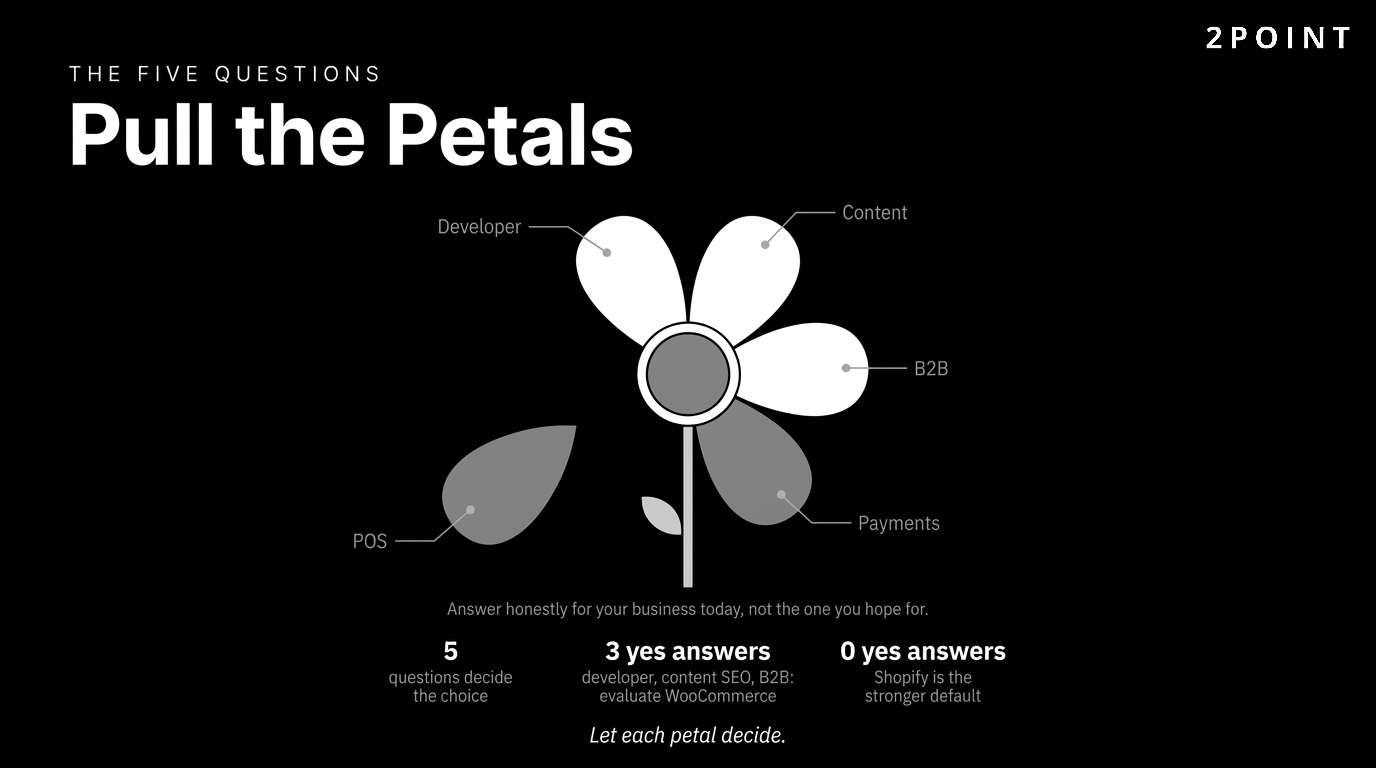
These questions distill the full comparison into a decision framework you can apply immediately. Work through each one with your specific situation in mind, noting which platform each answer favors.
- Do you have an in-house developer or a long-term WordPress agency relationship? If yes, WooCommerce’s complexity is manageable and its flexibility becomes an asset. If no, Shopify’s managed environment eliminates an entire category of operational risk.
- Is content marketing a primary customer acquisition channel for your business? If yes, WordPress’s content management superiority gives WooCommerce a significant long-term SEO advantage. If no, Shopify’s blog functionality is sufficient for most product-focused merchants.
- Do you need B2B pricing, wholesale tiers, or unusual product configurations? If yes, WooCommerce’s open-source flexibility accommodates these requirements far more naturally. If no, Shopify handles standard ecommerce configurations very well.
- Is Shopify Payments available in your primary market? If yes, the transaction fee advantage makes Shopify financially competitive or superior across most revenue ranges. If no, WooCommerce’s gateway flexibility eliminates a meaningful cost disadvantage for Shopify.
- Do you sell in physical locations or need integrated POS capability? If yes, Shopify’s native POS system is significantly more capable and integrated than WooCommerce’s plugin-based alternatives.
How 2POINT Approaches Platform Strategy for Ecommerce Businesses
At 2POINT, platform recommendations are grounded in business-specific analysis rather than preferences for one technology over another. The Shopify vs WooCommerce decision is not abstract for a business choosing its commerce infrastructure; it is a multi-year commitment with real financial and operational consequences. The right choice depends on where the business is today, where it needs to be in three years, and what resources are available to bridge that gap.
2POINT works with merchants across both platforms, applying the same analytical framework outlined in this guide to identify which platform creates the most durable foundation for each client’s specific growth model. For merchants on either platform who want to maximize performance, conversion rates, and organic visibility, the platform decision is just the beginning of a longer optimization journey.
Conclusion: Shopify vs WooCommerce in 2026, Choosing the Right Platform for Your Growth
The Shopify vs WooCommerce debate in 2026 is not a close race. It is a clear separation of two platforms designed for different operator profiles, different technical environments, and different growth strategies. Both are mature, capable, and actively developed. Both have powered businesses to significant scale. The choice between them is not about which is better in absolute terms; it is about which is better suited to your specific situation.
Shopify wins decisively on ease of use, launch speed, managed infrastructure, checkout conversion, POS integration, and support quality. Its market share growth among high-revenue merchants reflects genuine merchant satisfaction with these strengths. The cost structure is predictable, the infrastructure is proven at massive scale, and the barrier to entry is low enough that a motivated founder can have a fully functional store live within hours.
WooCommerce wins decisively on customization depth, SEO and content integration, payment gateway flexibility, and total cost optimization at high volumes with technical investment. For businesses built on content marketing, B2B sales models, or deeply custom product experiences, WooCommerce’s open-source architecture creates competitive advantages that Shopify’s managed environment cannot replicate within reasonable budget constraints.
The practical decision is simpler than the technical comparison suggests. If you can answer “yes” to in-house WordPress expertise, content-driven SEO, or B2B requirements, evaluate WooCommerce seriously. If you answer “no” to all three, Shopify’s combination of reliability, performance, and ecosystem depth makes it the stronger default choice for most businesses launching or scaling in 2026.
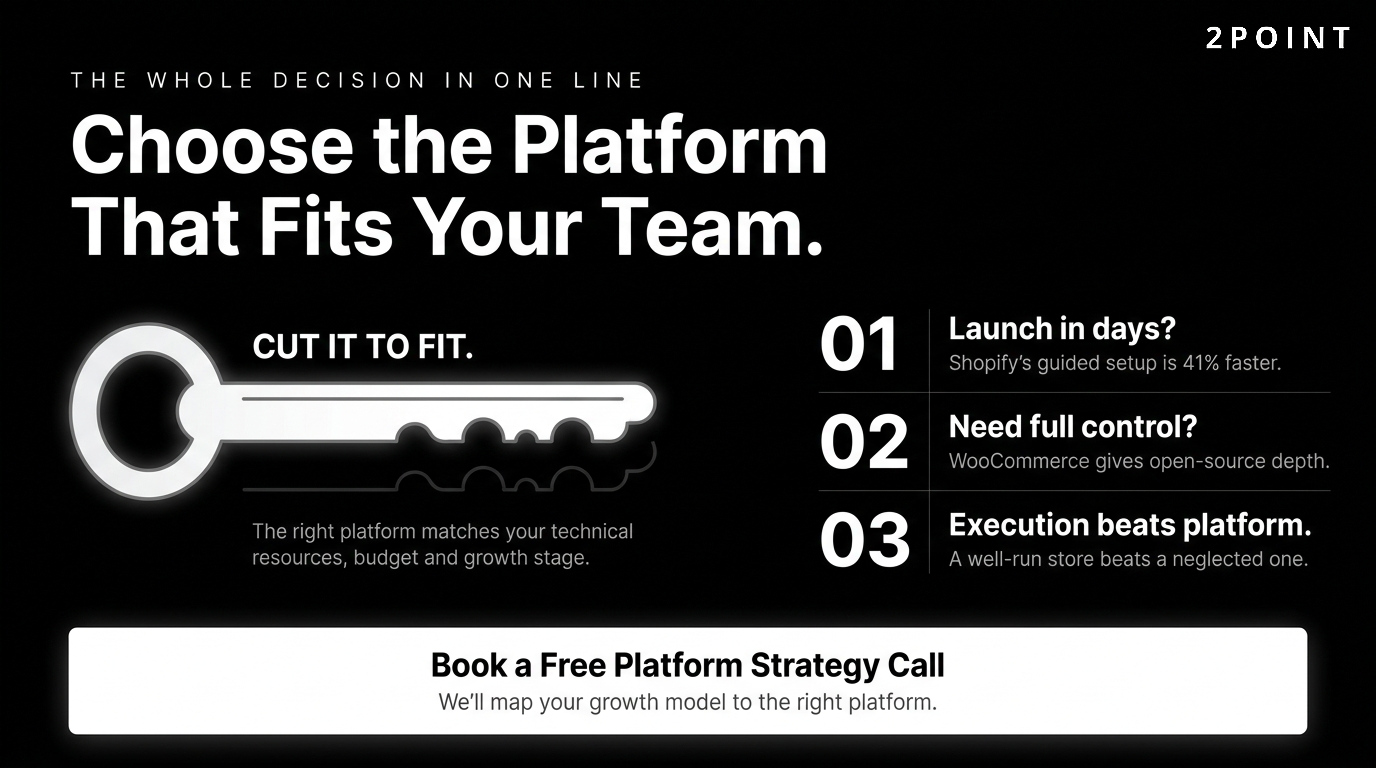
Whatever platform you choose, the quality of execution on that platform matters far more than the platform choice itself. A well-optimized Shopify store outperforms a neglected WooCommerce store. A well-maintained WooCommerce store with a strong content strategy outperforms an underutilized Shopify store. The platform creates the ceiling; your execution determines how close you get to it.
Frequently Asked Questions: Shopify vs WooCommerce
What is the main difference between Shopify and WooCommerce?
Shopify is a fully hosted, subscription-based ecommerce platform that manages all technical infrastructure on your behalf. WooCommerce is a free, open-source plugin for WordPress that requires self-managed hosting, security, and updates. Shopify prioritizes ease and reliability; WooCommerce prioritizes flexibility and control.
Is Shopify or WooCommerce cheaper?
At low revenue volumes, costs are similar, with WooCommerce potentially cheaper if you use basic shared hosting and minimal plugins. At mid to high revenue volumes, the difference narrows due to Shopify’s transaction fees on external gateways versus WooCommerce’s hosting and development costs. At over $2 million in annual revenue with technical resources, WooCommerce can save $6,000 to $13,600 per year compared to Shopify.
Which platform is easier to use, Shopify or WooCommerce?
Shopify is significantly easier to use for non-technical merchants. It launches 41% faster than WooCommerce on average, requires no server configuration, and handles all updates automatically. WooCommerce requires WordPress installation, hosting setup, and ongoing technical management, making it better suited to teams with developer experience.
Does WooCommerce have better SEO than Shopify?
WooCommerce generally offers more SEO flexibility because it is built on WordPress, which provides better content management tools, flexible URL structures, and advanced meta management plugins. Shopify handles technical SEO basics well but restricts URL structure and has less powerful blogging tools. For content-driven SEO strategies, WooCommerce holds a meaningful advantage.
Which platform is better for scaling a large ecommerce store?
Shopify scales automatically with no server management required, as demonstrated by processing $4.2 million per minute during Black Friday/Cyber Monday 2025 without downtime. WooCommerce can scale to any size but requires proportional investment in hosting infrastructure and developer support. Shopify’s scaling path is simpler; WooCommerce’s ceiling is theoretically higher but operationally more complex.
Does Shopify charge transaction fees that WooCommerce does not?
Yes. Shopify charges an additional platform-level transaction fee of 0.6% to 2% when you use any payment gateway other than Shopify Payments. WooCommerce charges no platform-level transaction fees regardless of which gateway you use. This difference becomes financially significant at high transaction volumes.
Is WooCommerce open source while Shopify is not?
Yes. WooCommerce is fully open-source software, meaning you can inspect, modify, and deploy the code without restriction. Shopify is a proprietary, closed-source platform. This means WooCommerce offers unlimited customization potential, while Shopify’s customization is bounded by its approved app ecosystem and templating system.
Which platform is better for B2B ecommerce in 2026?
WooCommerce is generally better suited for B2B ecommerce requiring wholesale pricing tiers, customer-group-specific catalogs, custom quote workflows, and complex product configurations. Shopify has improved its B2B capabilities, particularly on the Plus plan, but WooCommerce’s open-source flexibility accommodates unusual B2B requirements more naturally and at lower development cost.
Can I use WooCommerce without WordPress?
No. WooCommerce is a WordPress plugin and requires a WordPress installation to function. You cannot run WooCommerce independently of WordPress. This means choosing WooCommerce inherently means committing to the WordPress ecosystem, including its hosting requirements, update cycle, and plugin dependencies.
How do Shopify and WooCommerce compare on market share in 2026?
WooCommerce holds the larger raw installation count at 38.76% of ecommerce stores globally versus Shopify’s 27%. However, in revenue-weighted metrics, Shopify commands 42.6% compared to WooCommerce’s 24.6%, reflecting Shopify’s dominance among higher-revenue, actively operating merchants. Among high-traffic sites, Shopify captures 28.8% versus WooCommerce’s 18.2%.
Should I migrate from WooCommerce to Shopify?
Migration from WooCommerce to Shopify makes sense if your team lacks technical resources for ongoing maintenance, your store experiences frequent downtime or security issues, you want native POS integration, or you are spending more on developers and plugins than Shopify’s subscription would cost. The migration process involves data transfer, URL management for SEO, and app replacement, so the decision should be based on a full cost-benefit analysis rather than temporary frustration.
Which ecommerce platform is best for a beginner in 2026?
Shopify is the best ecommerce platform for beginners in 2026. It provides guided onboarding, requires no technical background, includes hosting and security management, and offers 24/7 customer support. A new merchant can launch a fully functional store on Shopify significantly faster than on WooCommerce without any developer involvement.