

 let’s connect


TikTok SEO is no longer a niche tactic for early adopters. It has become one of the most powerful discovery channels available to content creators, brands, and marketers who want to reach audiences actively searching for solutions, inspiration, and information. If you have been treating TikTok purely as a virality machine, you are leaving significant organic reach on the table.
Before diving into strategy, here is a direct answer to the core question this guide addresses:
- TikTok SEO is the practice of optimizing video content so TikTok’s search algorithm surfaces it to users searching for your topic.
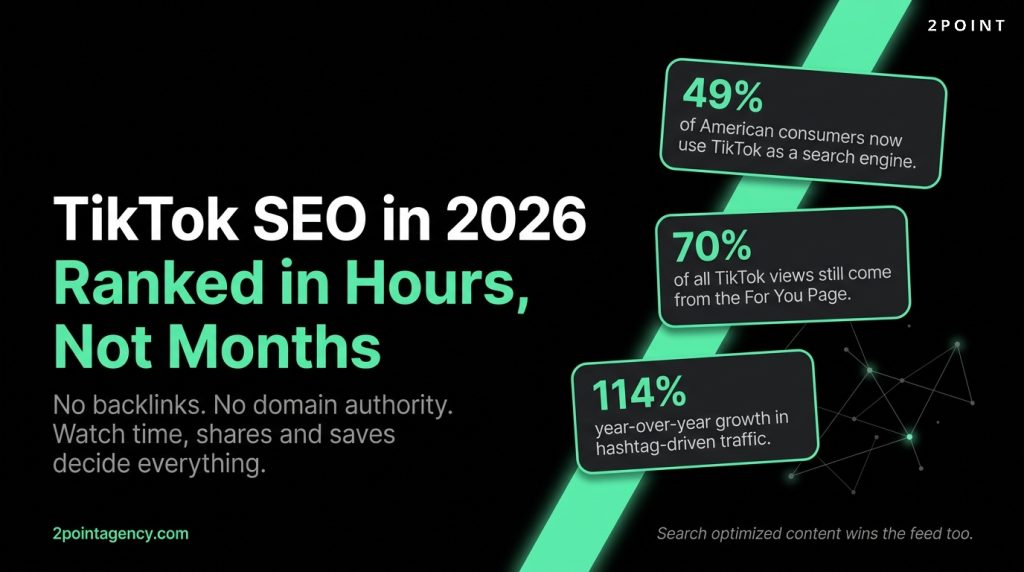
- 49% of American consumers now use TikTok as a search engine, an 8% increase from 2024.
- TikTok ranks videos based on watch time, completion rate, engagement signals, and keyword relevance.
- Keywords must appear in captions, voiceovers, on-screen text overlays, and hashtags to maximize discoverability.
- 70% of all TikTok views come from the For You Page, meaning search-optimized content benefits both search and FYP distribution.
- TikTok SEO operates on a timeline of hours to days, not the months required by traditional Google SEO.
- The platform rewards niche-aligned, community-relevant content over broadly targeted viral attempts.
- Native tools like Creator Search Insights help identify high-demand, low-competition content gaps in your category.
- Success requires keyword placement, video completion optimization, consistent publishing, and strategic engagement engineering.
This guide walks through every layer of TikTok search optimization, from foundational ranking factors to advanced e-commerce and local SEO tactics, with actionable steps you can implement starting today.
How TikTok Became a Search Engine in 2026
Understanding why TikTok SEO matters requires understanding how fundamentally user search behavior has changed. TikTok did not set out to compete with Google. But when hundreds of millions of users started typing questions into its search bar instead of switching apps, the platform became something Google never anticipated: a visual, emotional, and social search engine rolled into one.
The Search Behavior Shift Among Gen Z and Millennials
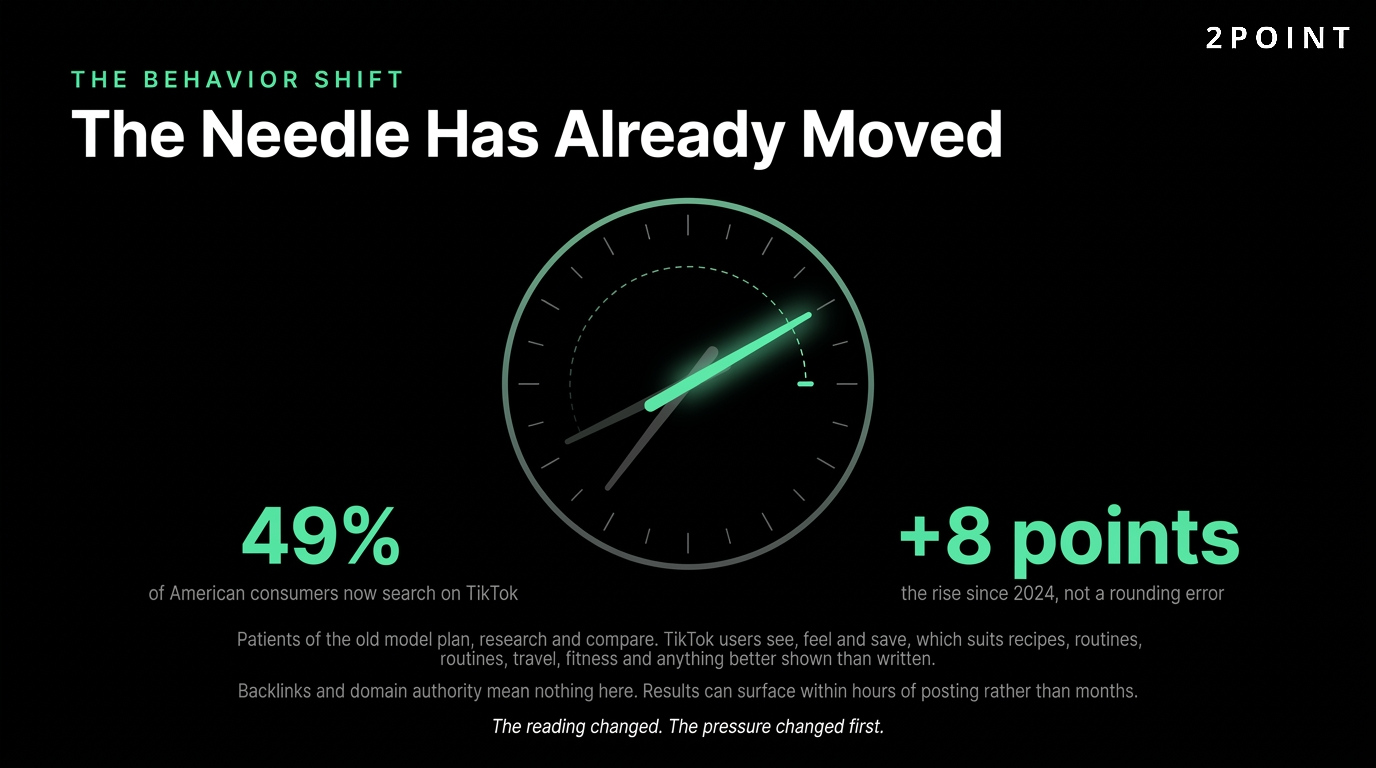
49% of American consumers now use TikTok for search, representing an 8 percentage point jump from 2024. This is not a rounding error. It reflects a genuine behavioral shift in how people, particularly Gen Z and younger Millennials, prefer to discover information. When someone wants to know how to style a specific haircut, find the best ramen spot in their city, or understand a complex financial concept, they increasingly reach for TikTok before Google.
The reason comes down to a pattern that researchers describe as “see-feel-save” discovery. On TikTok, users see a real person demonstrating something, feel the emotional resonance of that experience, and save the video as a future reference. This contrasts sharply with Google’s “plan-research-compare” model, which is text-heavy, linear, and often disconnected from lived experience. Video search feels more authentic, more trustworthy, and more actionable, especially for visual queries like recipes, travel destinations, beauty routines, fitness techniques, and home improvement projects.
For content creators and brands, this behavioral shift has enormous implications. When someone searches TikTok for “best HIIT workout for beginners,” they are expressing clear intent. Appearing in those results is not about luck or timing. It requires deliberate TikTok search optimization applied before, during, and after production.
TikTok vs. Google: How These Platforms Rank Content Differently
| TikTok Search Ranking Factor | Google Search Ranking Factor |
|---|---|
| Watch time and completion rate | Backlinks and domain authority |
| Shares, saves, and rewatches | Page experience and Core Web Vitals |
| Caption, voiceover, and on-screen text keywords | On-page keyword optimization and metadata |
| Niche community alignment | Topical authority and site structure |
| Results appear within hours to days | Results take weeks to months |
| Content lifespan: evergreen with periodic resurfacing | Content lifespan: steady decline without updates |
| Native sounds, effects, and trending formats matter | Page speed and mobile optimization matter |
The most critical distinction for anyone migrating from traditional SEO thinking is that backlinks are irrelevant on TikTok. Instead of earning external authority, you earn internal algorithmic trust through behavioral signals: did viewers watch your video all the way through, share it with a friend, or loop back to rewatch a specific moment? These signals drive TikTok rankings far more than any technical optimization. For those already familiar with SEO best practices from the web world, TikTok requires a meaningful mindset shift.
TikTok search results can appear within hours of posting. A well-optimized video on a trending or high-demand topic can surface in search results the same day it is published. This speed advantage makes TikTok SEO particularly valuable for time-sensitive topics, trending conversations, and brands that need rapid visibility without waiting months for Google rankings to mature.
How TikTok Mentions Now Influence Large Language Models
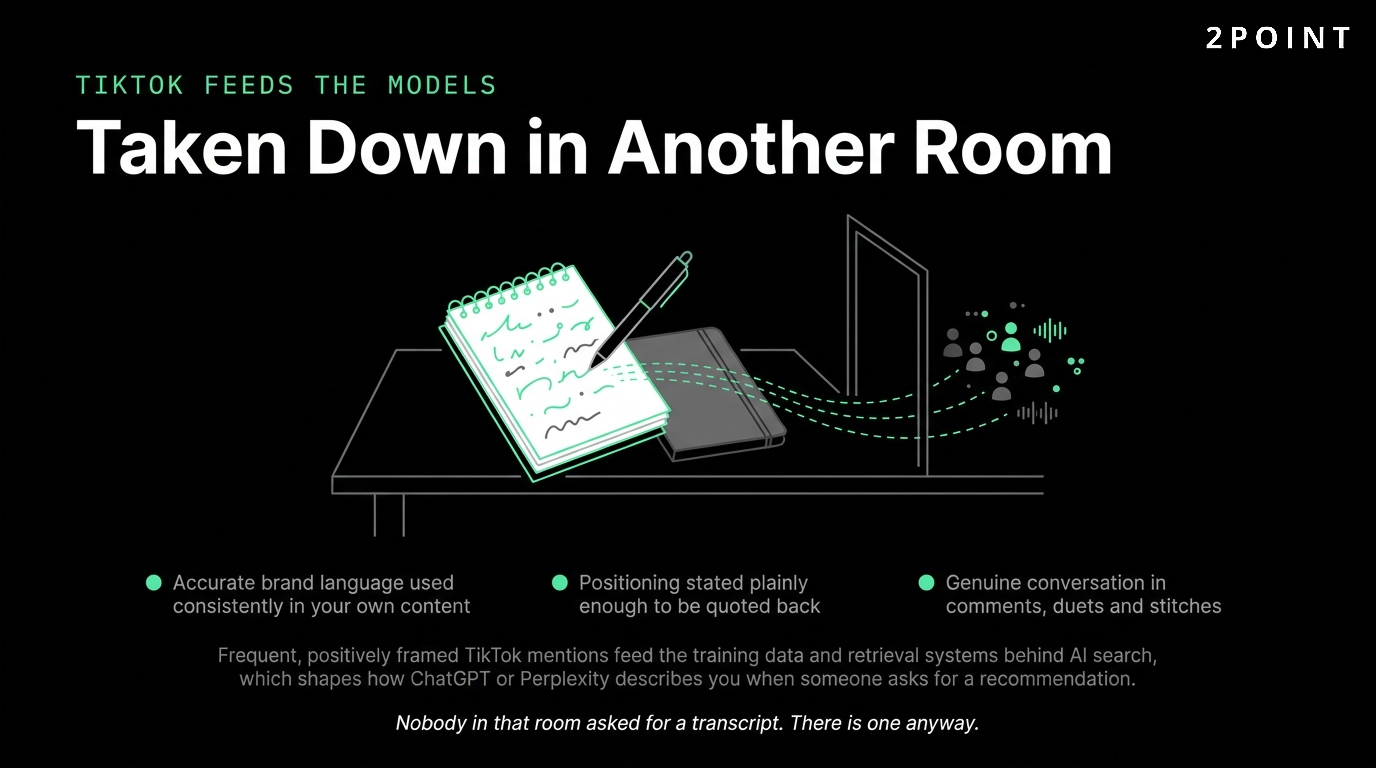
One of the most significant developments in TikTok SEO strategy for 2026 is the discovery that TikTok mentions now influence how ChatGPT and other large language models (LLMs) represent brands. When your brand, product, or content appears frequently in TikTok discussions with positive sentiment, those signals feed into the training data and real-time retrieval systems that power AI search engines. This means TikTok visibility is no longer siloed within the app itself.
For brands investing in branding with SEO across multiple channels, TikTok now acts as a multiplier. A well-optimized video that earns strong engagement and genuine mentions in comments and duets contributes to how AI models describe your brand when users ask ChatGPT or Perplexity for recommendations. Strategic implications include ensuring your TikTok content uses accurate brand language, highlights your unique positioning, and generates enough authentic conversation to influence AI perception over time.
Why the For You Page Algorithm and Search Optimization Reinforce Each Other
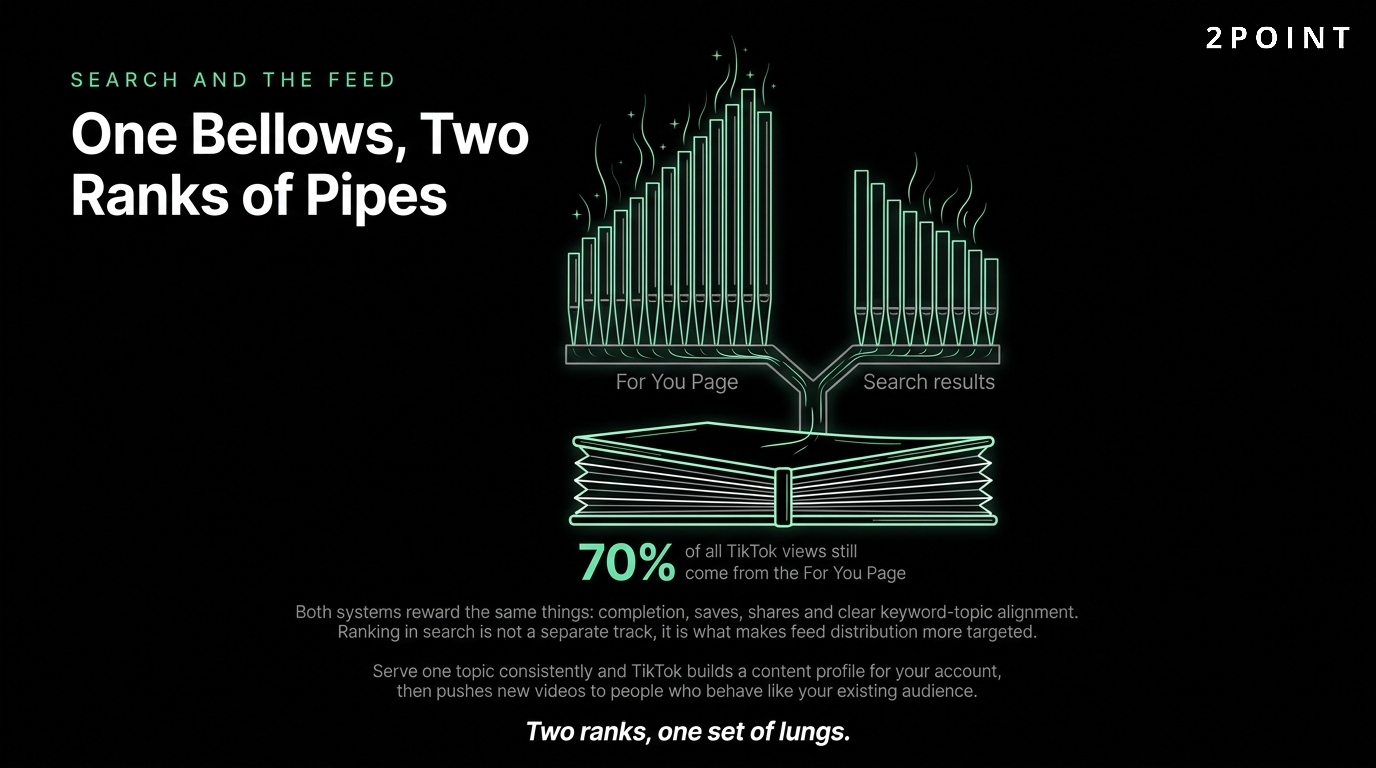
According to Metricool’s 2026 study analyzing over 2.3 million posts, 70% of all TikTok views come from the For You Page. This might seem to undercut the importance of search optimization, but the relationship is actually symbiotic. Content that ranks well in TikTok search tends to perform better on the FYP as well, because both systems reward the same underlying quality signals: high completion rates, strong saves, shares, and keyword-topic alignment.
When TikTok’s algorithm identifies that your content consistently satisfies users searching for a specific topic, it builds a content profile for your account. This profile informs FYP distribution, pushing your videos to users who match the behavioral patterns of people who previously engaged with similar content. Search optimization is not a separate track from FYP optimization. It is the foundation that makes FYP distribution more targeted, more efficient, and more sustainable over time.
TikTok Ranking Factors: What Actually Determines Your Position
TikTok SEO ranking is not a mystery, but it does require understanding a layered set of signals that the algorithm weighs simultaneously. Unlike Google, where hundreds of ranking factors interact in complex ways, TikTok’s core framework is relatively transparent, and the platform has shared meaningful guidance about what it values. The challenge is not understanding the signals conceptually. It is engineering your content to consistently deliver them.
The Three Core Algorithm Signal Categories
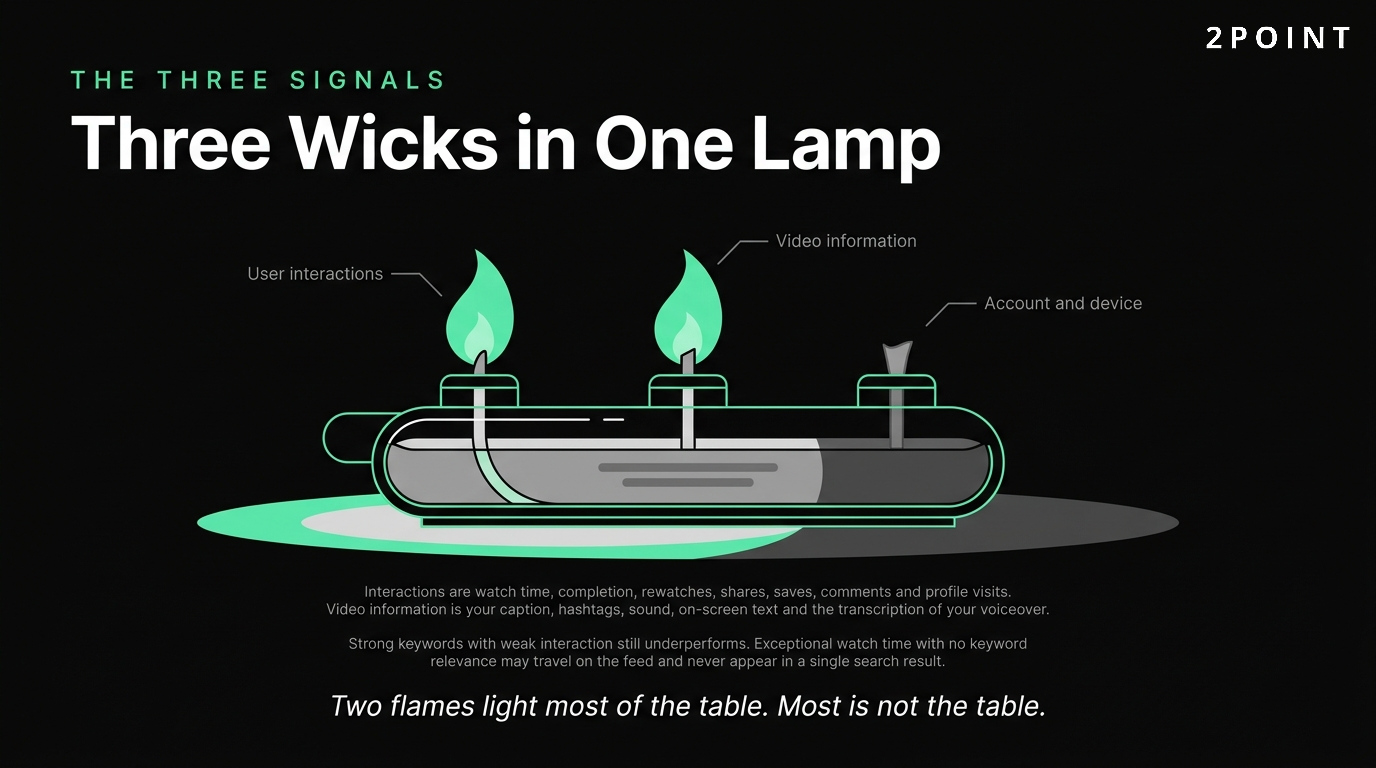
TikTok’s algorithm evaluates content across three primary signal categories: user interactions, video information, and account or device settings. User interactions include watch time, completion rate, rewatches, shares, saves, comments, and profile visits triggered by the video. Video information encompasses captions, hashtags, sounds, on-screen text, and the transcription of your voiceover. Account and device settings include language preferences, geographic location, and device type, which help TikTok calibrate relevance for the viewer.
These three categories interact dynamically. A video with strong keyword signals in its caption will still underperform if user interactions are weak. Conversely, a video with exceptional watch time but zero keyword relevance may go viral on the FYP but will never appear in search results for a specific query. Sprout Social’s algorithm research confirms that all three signal categories must be addressed together for consistent TikTok search performance. Optimizing only one or two dimensions limits your ceiling significantly.
Rewatch Rate: The Hidden Ranking Multiplier
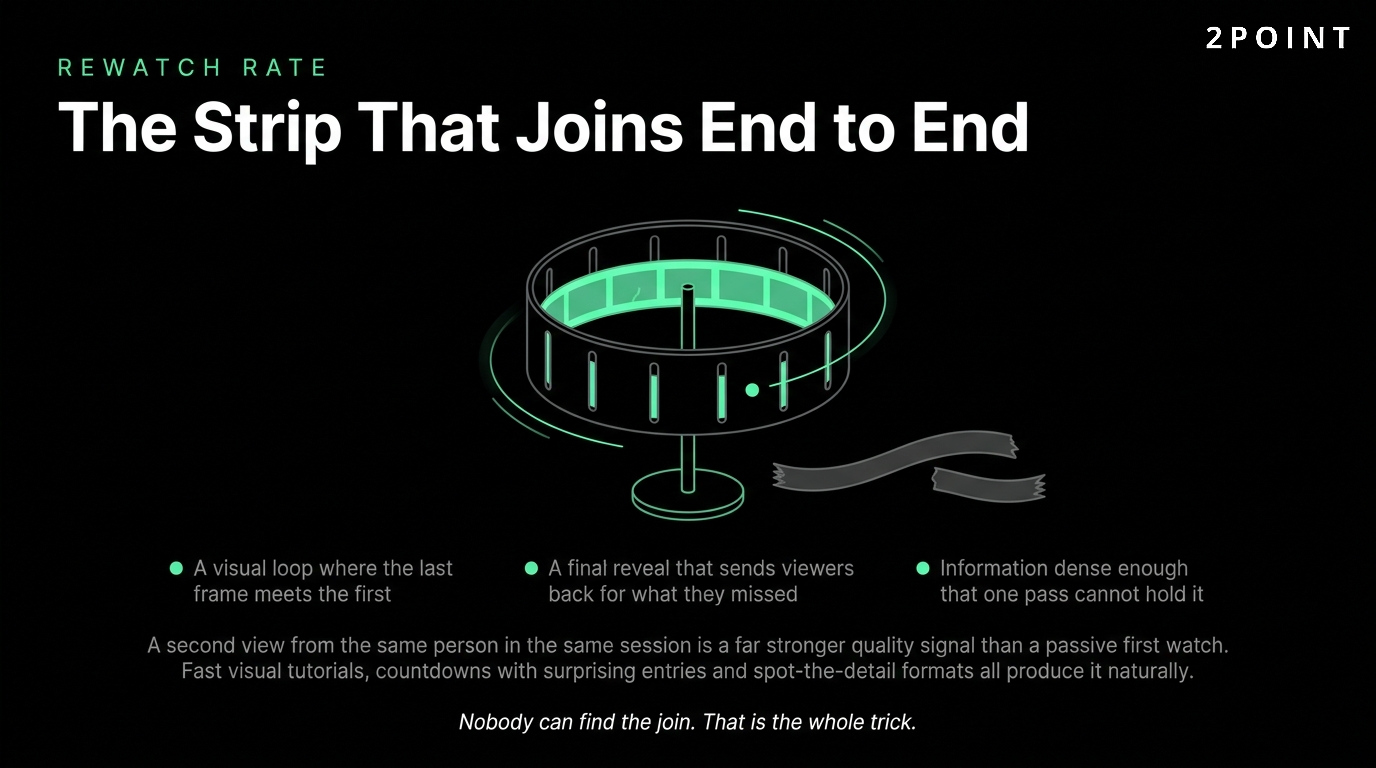
Among all engagement signals, rewatch rate has emerged as one of the most powerful ranking multipliers in TikTok’s 2026 algorithm. TikTok’s updated algorithm places heightened weight on rewatch signals because they indicate that the content delivered something viewers wanted to see again. A second view from the same user in the same session is a far stronger quality signal than a passive first watch.
The strategic response to this is engineering “loopable” moments into your video structure. This can mean creating a satisfying visual loop where the end of the video connects seamlessly to the beginning, delivering a final reveal or punchline that makes the viewer want to catch what they missed, or packing so much dense, useful information into a short runtime that a single viewing is not enough to absorb it all. Tutorial content with fast-paced visual steps, countdown lists with surprising entries, and “spot the detail” formats all generate natural rewatch behavior. Building rewatch potential into your content structure is not just a viral tactic. It is a deliberate TikTok ranking factor optimization.
Video Completion Rate vs. Total Watch Time
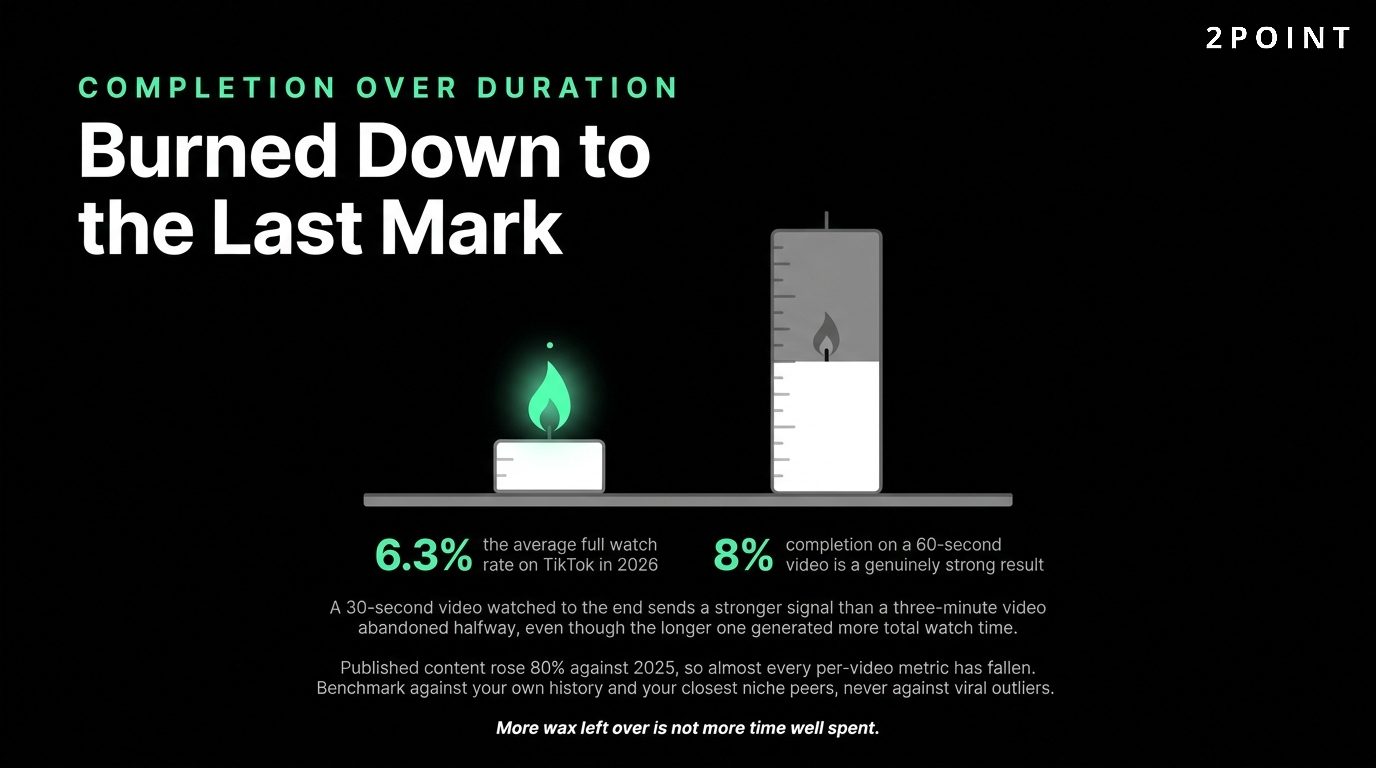
The average full watch rate on TikTok in 2026 sits at just 6.3%, a figure that reflects both the volume of content available and the increasingly selective attention of users. In this environment, completion rate matters more to TikTok’s algorithm than raw minutes watched. A 30-second video watched completely sends a stronger quality signal than a 3-minute video watched halfway through, even though the latter generated more total watch time.
Research from Sotrender points to 60 to 90 second videos as the optimal length for balancing reach with engagement in 2026. Short clips in the 15 to 30 second range tend to achieve higher completion rates because viewers are more willing to commit to a brief format. However, they offer lower monetization potential and less space to deliver keyword-rich informational content. Videos in the 60 to 90 second range represent the sweet spot: long enough to provide genuine value and incorporate SEO-relevant keywords naturally, short enough that motivated viewers complete them. TikTok supports videos up to 10 minutes, but this format is best reserved for tutorial deep dives, documentary-style content, and educational series where the longer runtime is justified by the topic’s complexity.
Niche Relevance Beats Broad Virality in 2026
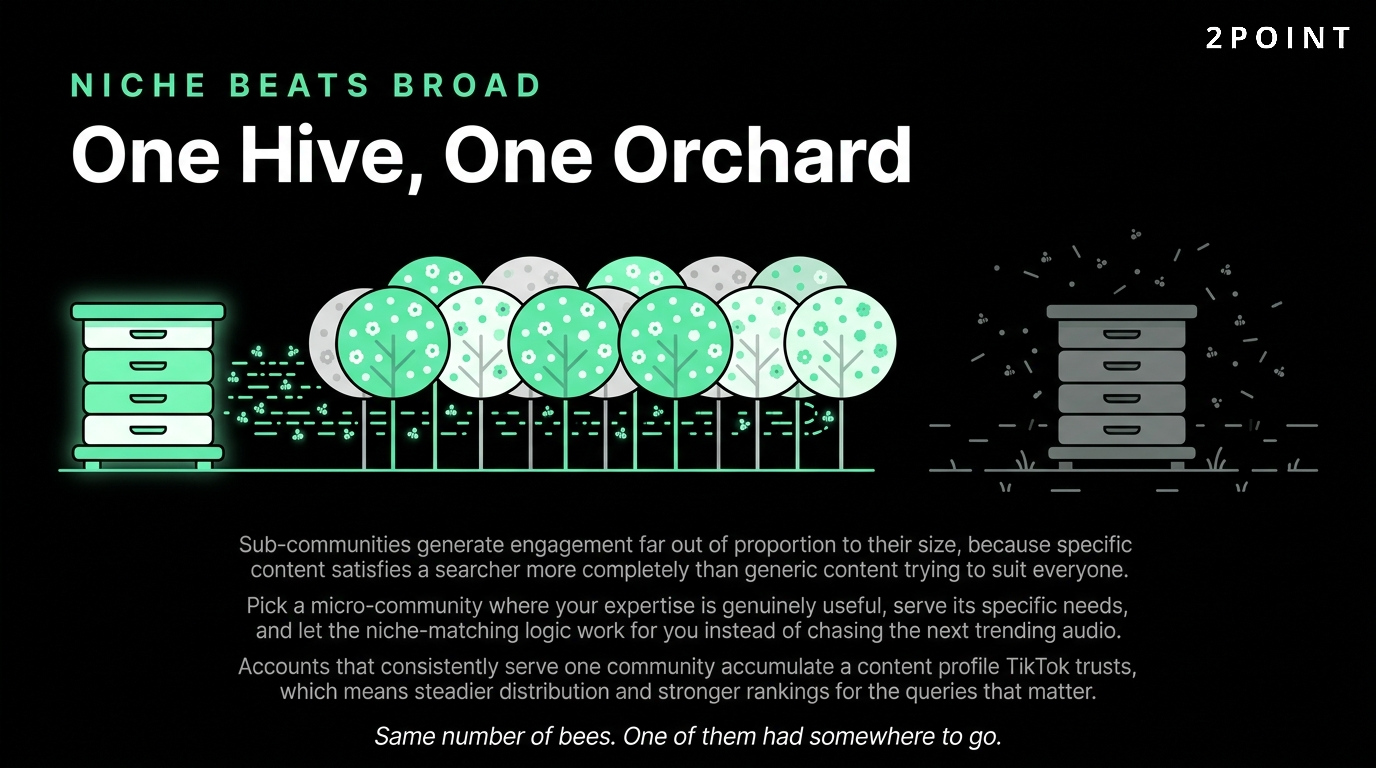
One of the most consequential shifts in TikTok’s 2026 algorithm is its prioritization of community-aligned content over broadly targeted viral attempts. Social Insider’s analysis of TikTok algorithm trends confirms that the platform now rewards depth within niches, with sub-communities like #BookTok, #FitTok, #CleanTok, and #FinTok generating disproportionate engagement relative to their audience size. The algorithm has learned that highly specific content satisfies searchers more completely than broad, generic content trying to appeal to everyone.
This shift has practical implications for your content strategy. Rather than chasing trending audio or attempting to produce the next viral meme, the highest-leverage approach in 2026 is to identify a micro-community where your expertise is genuinely valuable, produce content that deeply serves that community’s specific needs, and allow the algorithm’s niche-matching logic to work in your favor. Accounts that consistently serve a specific community accumulate a content profile that TikTok increasingly trusts, resulting in more reliable distribution and stronger search rankings for relevant queries. This community-first approach also directly informs how you conduct TikTok keyword research, which is covered in depth in the next section.
TikTok Keyword Research: How to Find the Terms That Drive Search Traffic
TikTok keyword research differs from traditional keyword research in important ways. Volume data is less standardized, search intent is more emotionally driven, and the best opportunities often exist in gaps rather than high-competition topics. The good news is that TikTok provides its own native research tools that offer more accurate platform-specific data than any third-party alternative. Mastering these tools, combined with a structured research workflow, gives you a significant edge over creators who rely on intuition alone.
Native TikTok Research Tools Every Creator Should Use
Creator Search Insights is TikTok’s most powerful native research tool for identifying content opportunities. Accessible through the TikTok app under the Creator Tools menu, it shows you what users in your niche are actively searching for, categorized by volume and content supply. When you identify a topic with high search volume but limited existing content, you have found a content gap: a high-priority opportunity to be the definitive resource on that subject. Creator Search Insights also highlights “content you could make,” directly suggesting topics where your account profile matches underserved demand.
The TikTok Creative Center’s Keyword Insights tool, available at ads.tiktok.com, provides trend data on keywords relevant to your industry category, including click-through rate benchmarks and keyword popularity over time. While it is designed for advertisers, it serves organic creators equally well as a research tool. The TikTok search bar’s autocomplete feature also provides real-time signals about what users are searching, though the order of suggestions does not directly indicate search volume. Instead, autocomplete reflects recency and geographic relevance, making it most useful for identifying trending variations and long-tail query patterns. User Growth Academy’s TikTok research guidance recommends using autocomplete as a brainstorming accelerator rather than a primary volume source.
Third-Party TikTok Keyword Tools Compared
Native tools provide the most accurate platform-specific data, but third-party tools add competitive intelligence, volume estimates, and workflow efficiencies that native tools lack. The table below compares the leading options available in 2026.
| TikTok Keyword Tool | Best Use Case | Key Data Provided | Pricing Model |
|---|---|---|---|
| Virlo | TikTok-specific volume and competition | Search volume, keyword difficulty, trend data | Paid, TikTok-first design |
| Keyword Tool.io | Multi-platform autocomplete harvesting | Long-tail variations, autocomplete pulls | Free (limited) and paid tiers |
| SEMrush Social Media Tracker | Competitive hashtag and topic analysis | Competitor content performance, hashtag reach | Paid, part of SEMrush suite |
| Ahrefs Keywords Explorer | Cross-platform keyword validation | Volume estimates, keyword ideas, SERP data | Paid, with 2026 TikTok expansion |
| ContentStudio TikTok Keyword Tool | Quick research without account setup | Keyword suggestions, free access | Free, no signup required |
| kwrds.ai | TikTok-first keyword discovery | Search demand, content angle suggestions | Paid, TikTok-native focus |
The most efficient research workflow combines TikTok’s native Creator Search Insights for gap identification with a third-party tool for volume validation and competitive intelligence. AllyHub’s roundup of TikTok keyword research tools confirms that no single third-party tool matches the accuracy of TikTok’s own data for platform-specific demand, making native tools the foundation and external tools the complement.
The Content Gap Strategy: Where the Highest ROI Lives
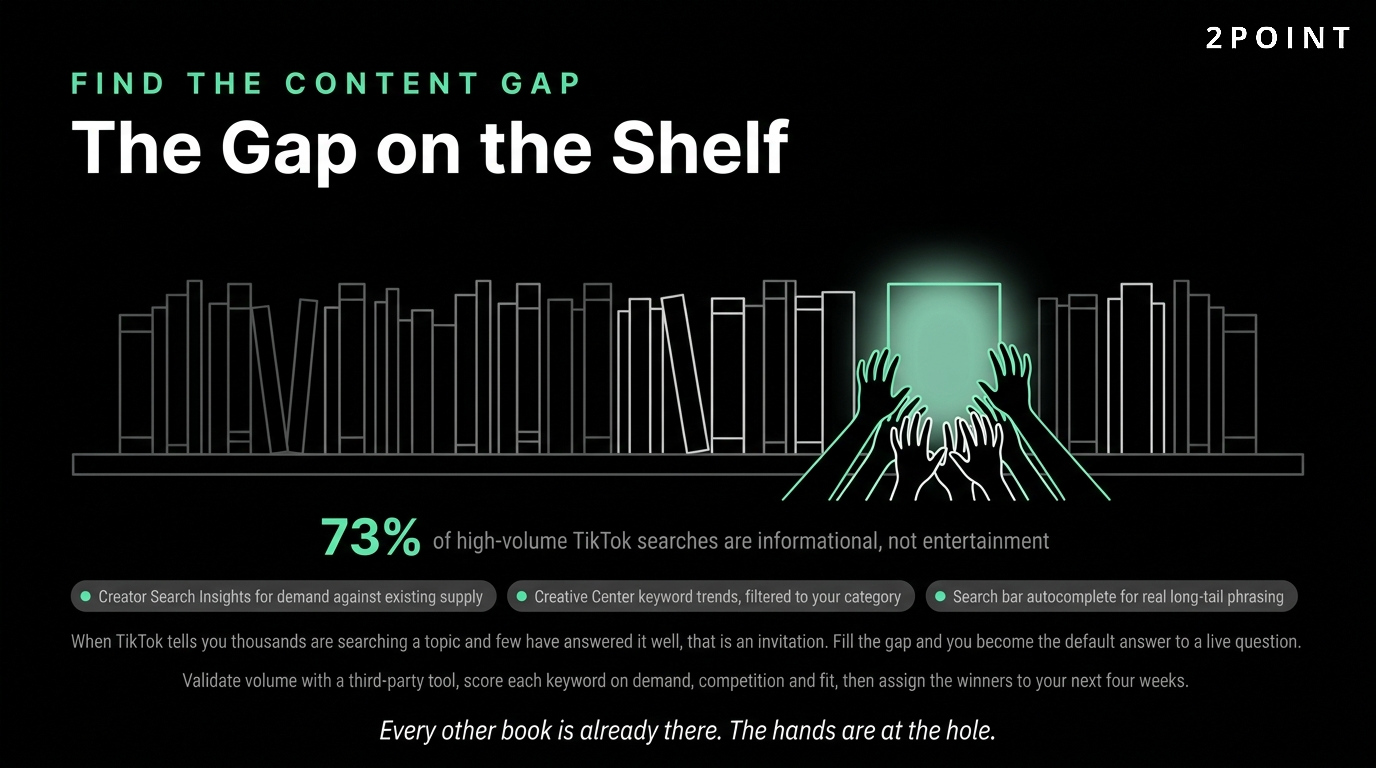
73% of high-volume TikTok searches are informational in nature. Users are not just searching for entertainment. They are looking for answers, tutorials, recommendations, and explanations. This means that informational content built around specific questions and search queries represents the highest-ROI content opportunity on the platform. The content gap strategy takes this insight further by targeting topics where demand is high and existing content supply is low.
Creator Search Insights directly surfaces these gaps by flagging high-volume searches with insufficient content responses. When TikTok tells you that thousands of users are searching a topic and few creators have addressed it well, that is an algorithmic invitation. Creating content that fills that gap positions you as the default answer to an active question, which drives both search ranking and FYP distribution as the algorithm routes those active searchers to your video. This approach also naturally aligns with enhancing SEO with content marketing principles that prioritize need-fulfillment over attention-chasing.
TikTok Keyword Research Workflow: Step by Step
A structured research process ensures you are targeting the right keywords with the right content at the right time. Follow this workflow to build a data-driven content pipeline.
- Start with Creative Center Keyword Trends: Log into TikTok Creative Center and filter keyword trends by your industry category. Identify terms with rising search volume that align with your content expertise. Look for keywords showing week-over-week growth rather than already-peaked terms.
- Cross-Reference with Creator Search Insights: Access Creator Search Insights through the TikTok app and compare against your Creative Center list. Prioritize any keywords that appear in both tools as high-demand AND flagged as content gaps. These represent your highest-priority targets.
- Test Autocomplete Variations: Enter your seed keywords into TikTok’s search bar and record all autocomplete suggestions. These represent real user query patterns and often surface long-tail variations with lower competition than the head keyword.
- Validate Volume with Third-Party Tools: Run your shortlisted keywords through Virlo, Keyword Tool.io, or Keyword Graph’s TikTok research tool to cross-validate volume estimates and identify difficulty levels.
- Map to Content Calendar by Opportunity Score: Score each keyword by combining demand (high volume), opportunity (low competition), and relevance (fits your niche). Assign the highest-scoring keywords to your next four weeks of content. Deviation’s keyword research guide recommends refreshing this process monthly to capture emerging trends before they peak.
This five-step workflow ensures your content calendar is grounded in actual platform data rather than guesswork, giving every video you produce a deliberate SEO foundation before production begins. If you want to use SEO tools effectively across channels, the same data-first discipline applies whether you are optimizing for Google or TikTok.
On-Video Optimization Tactics That Directly Impact TikTok Search Rankings
Keyword research identifies your targets. On-video optimization is how you hit them. Every element of a TikTok video, from the first syllable of your voiceover to the last frame of your caption, is a potential ranking signal. Understanding how each element contributes to TikTok search optimization allows you to layer multiple signals efficiently without making your content feel robotic or keyword-stuffed.
Strategic Keyword Placement Across Every Video Element
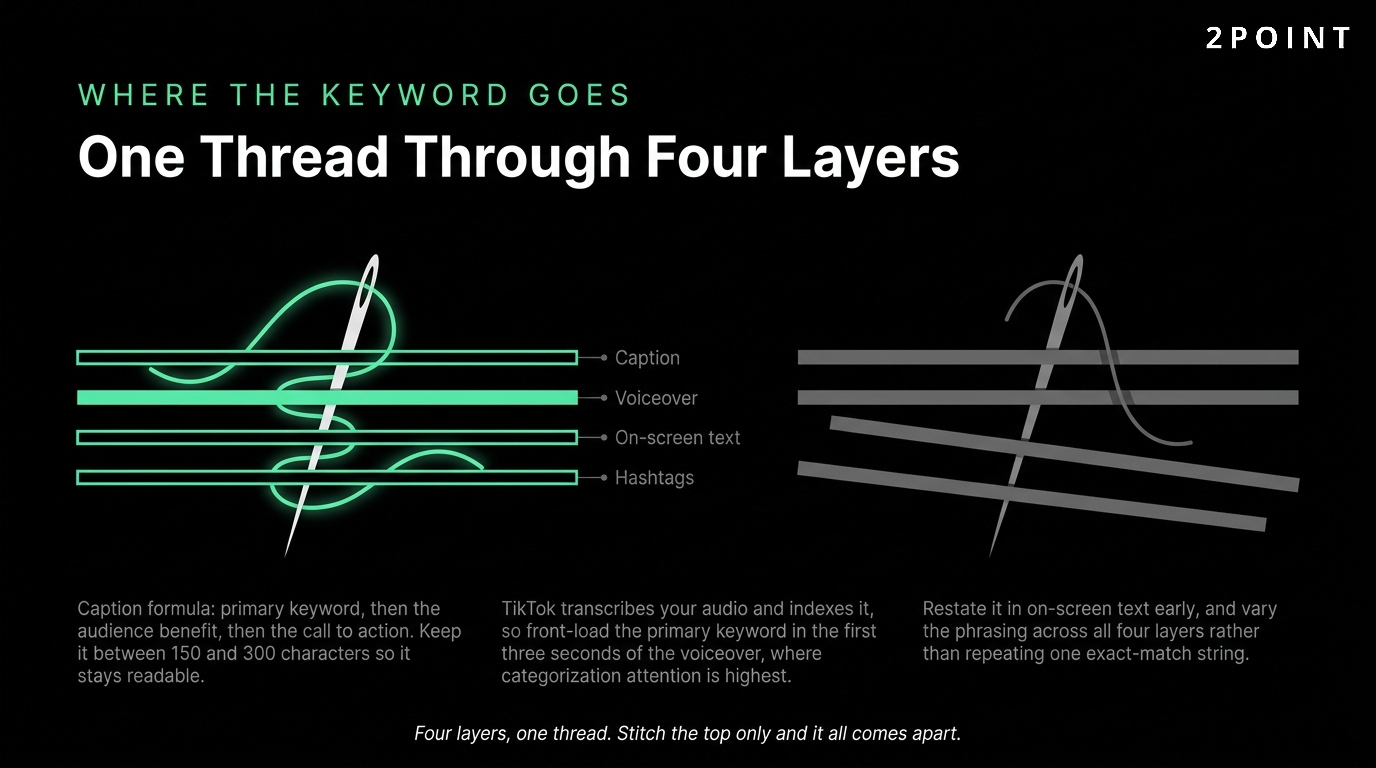
Printify’s TikTok SEO guide recommends a three-part caption formula: primary keyword + audience benefit + call to action. For example, a fitness creator targeting “HIIT workout for beginners” might write: “HIIT workout for beginners: burn fat in 20 minutes without equipment. Save this for your next gym session.” This structure satisfies the algorithm’s keyword-matching logic while delivering a compelling reason for humans to engage. Keep captions between 150 and 300 characters for maximum readability.
Voiceover integration is equally critical and often underutilized. TikTok automatically transcribes audio content and uses that transcription as a keyword signal. This means every word you say is potentially indexed. Front-load your primary keyword in the first three seconds of your voiceover, because this is when TikTok’s algorithm pays the most attention for categorization purposes. Glimpse’s TikTok SEO strategy guide confirms that early keyword placement in voiceovers significantly improves search relevance scores. On-screen text overlays serve a dual purpose: they reinforce keyword visibility for the algorithm and improve accessibility for users who watch without sound, which represents a significant portion of TikTok viewers. Use on-screen text to restate your primary keyword within the first few seconds, and vary your phrasing across caption, voiceover, and overlay to signal broad topical relevance rather than exact-match repetition.
Profile and Bio Optimization for Compounding SEO Value
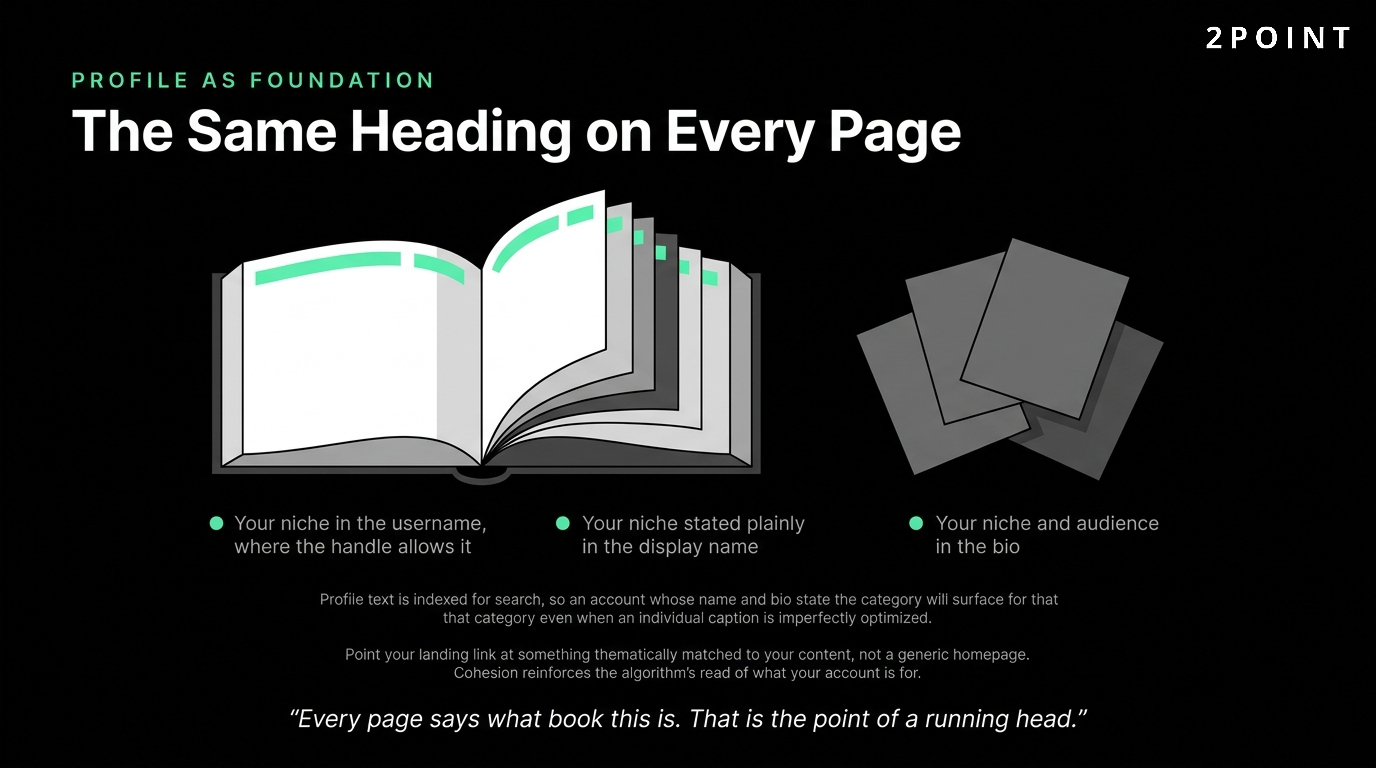
Every video you publish builds on your account’s foundational authority, which means profile optimization multiplies the effect of every individual video’s performance. Your TikTok profile should include your primary keyword or niche description in three places: your username (where possible), your display name, and your bio. TikTok indexes profile text for search, meaning an account with “Vegan Recipes” in the display name and bio will surface in search results for vegan food topics even when individual video captions are not perfectly optimized.
Your profile’s landing page link should align thematically with your TikTok content category. If your TikTok is focused on personal finance, your link should point to a relevant resource, not a generic homepage. This cohesion signals to TikTok that your account has a clear purpose and audience, which reinforces the algorithm’s niche-matching logic and improves your overall SEO profile. This cross-channel alignment also directly supports your SEO-friendly website goals by creating a consistent topical thread from TikTok to your web presence.
Video Length and Format Strategy for Maximum Reach
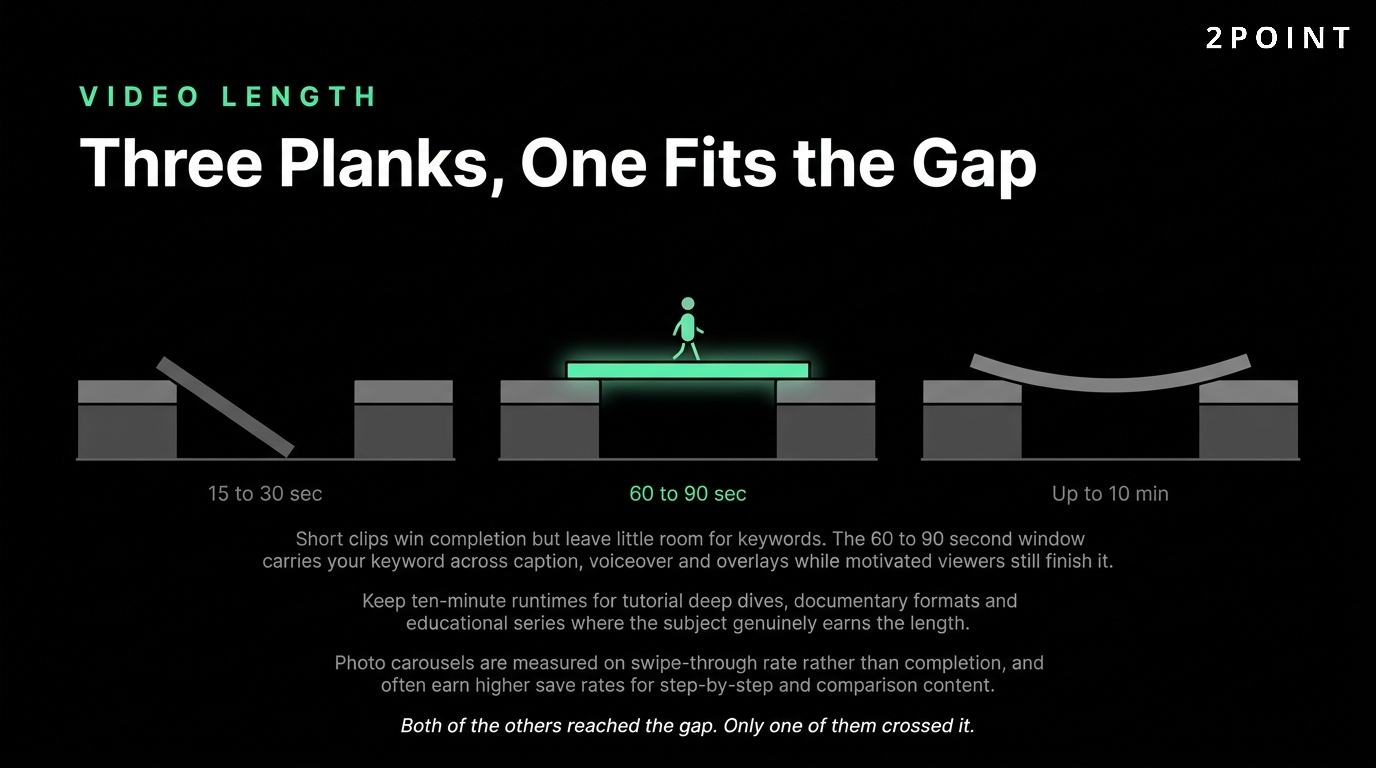
Data from Sotrender’s 2025 algorithm research points to 60 to 90 second videos as the optimal length for balancing search reach with engagement performance in 2026. Short-form content in the 15 to 30 second range generates higher completion rates but offers less keyword real estate and lower monetization potential. Videos in the 60 to 90 second window allow enough runtime to naturally integrate your primary keyword multiple times across caption, voiceover, and overlays without feeling forced, while remaining short enough that completion rates stay competitive.
Photo carousels represent an underutilized format with distinct optimization advantages. Rather than measuring completion rate in seconds, TikTok evaluates carousel performance through Swipe-Through Rate (STR): how many users swipe to see the next card. Buffer’s TikTok algorithm research notes that carousels often achieve higher save rates than video content because users bookmark them as reference material. For keyword-heavy educational content, step-by-step guides, or comparison content, carousels can be a more effective format than video while still generating strong search ranking signals. Sprout Social’s algorithm analysis confirms that format diversity within a consistent content niche signals creative versatility to the algorithm, which can improve overall account distribution.
Native Features as TikTok Ranking Signals
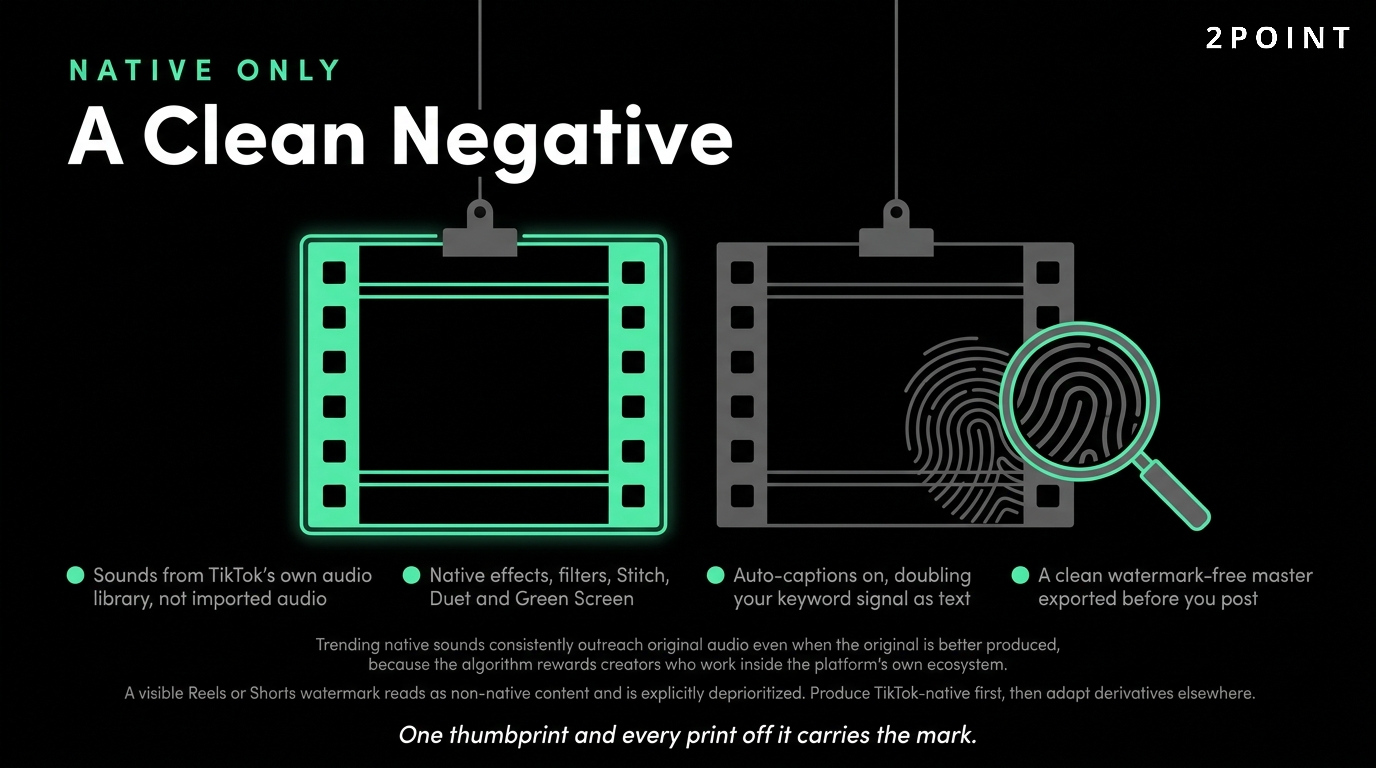
Team5pm’s TikTok optimization guide confirms that TikTok-native sounds, effects, and filters receive preferential algorithmic treatment compared to content using external audio or elements imported from other platforms. The algorithm is designed to reward creators who engage deeply with TikTok’s native ecosystem, which is why using trending sounds from TikTok’s audio library consistently outperforms original audio for reach, even when the original audio is higher production quality. Strategic use of Stitch, Duet, and Green Screen features also signals active platform participation, which correlates with improved distribution.
Auto-captions, TikTok’s built-in transcription feature, are both an accessibility tool and an SEO asset. Enabling auto-captions adds a text layer that TikTok uses for keyword indexing, essentially doubling your keyword signal by transcribing your voiceover into searchable text. One critical rule: never repurpose content from Instagram Reels or YouTube Shorts and post it directly to TikTok with visible watermarks. TikTok’s algorithm explicitly deprioritizes content with competing platform watermarks, interpreting them as indicators of non-native content. Always export a clean, watermark-free master version before posting to TikTok.
TikTok Hashtag Strategy: What the Data Says Actually Works in 2026
Hashtags on TikTok serve a different function than they do on Instagram or Twitter. They are categorization signals for the algorithm, not primarily audience discovery tools. Understanding this distinction transforms how you select and deploy hashtags, shifting your approach from “use as many as possible” to “use the most precise ones possible.”
What the 2026 Hashtag Performance Data Reveals
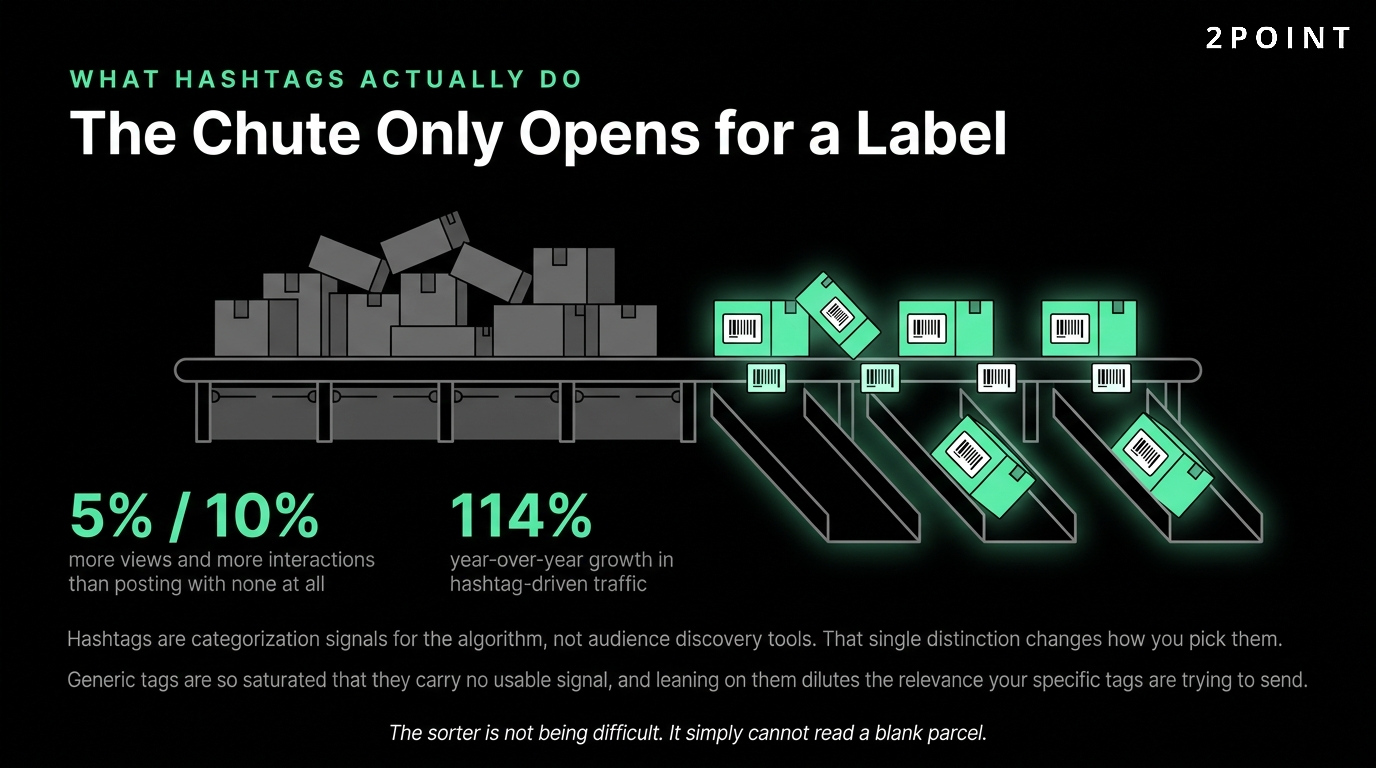
Metricool’s 2026 analysis of over 2.3 million TikTok posts found that hashtags increase views by 5% and interactions by 10% compared to posts without any hashtags. More importantly, the same study found that hashtag-driven traffic grew 114% year-over-year, indicating that TikTok’s search-driven discovery is becoming an increasingly significant traffic source. This growth rate outpaces almost every other discovery mechanism on the platform.
However, the same data reveals that generic tags like #fyp, #viral, #foryoupage, and #trending no longer provide meaningful reach advantages. These tags are so saturated that the algorithm cannot use them as meaningful categorization signals. Using them does not help. In some cases, relying heavily on generic tags actually hurts performance by diluting the relevance signal your more specific tags are trying to send. The shift in 2026 is toward precision over volume, which directly informs the three-hashtag approach.
The Three-Hashtag Rule: Quality Over Quantity
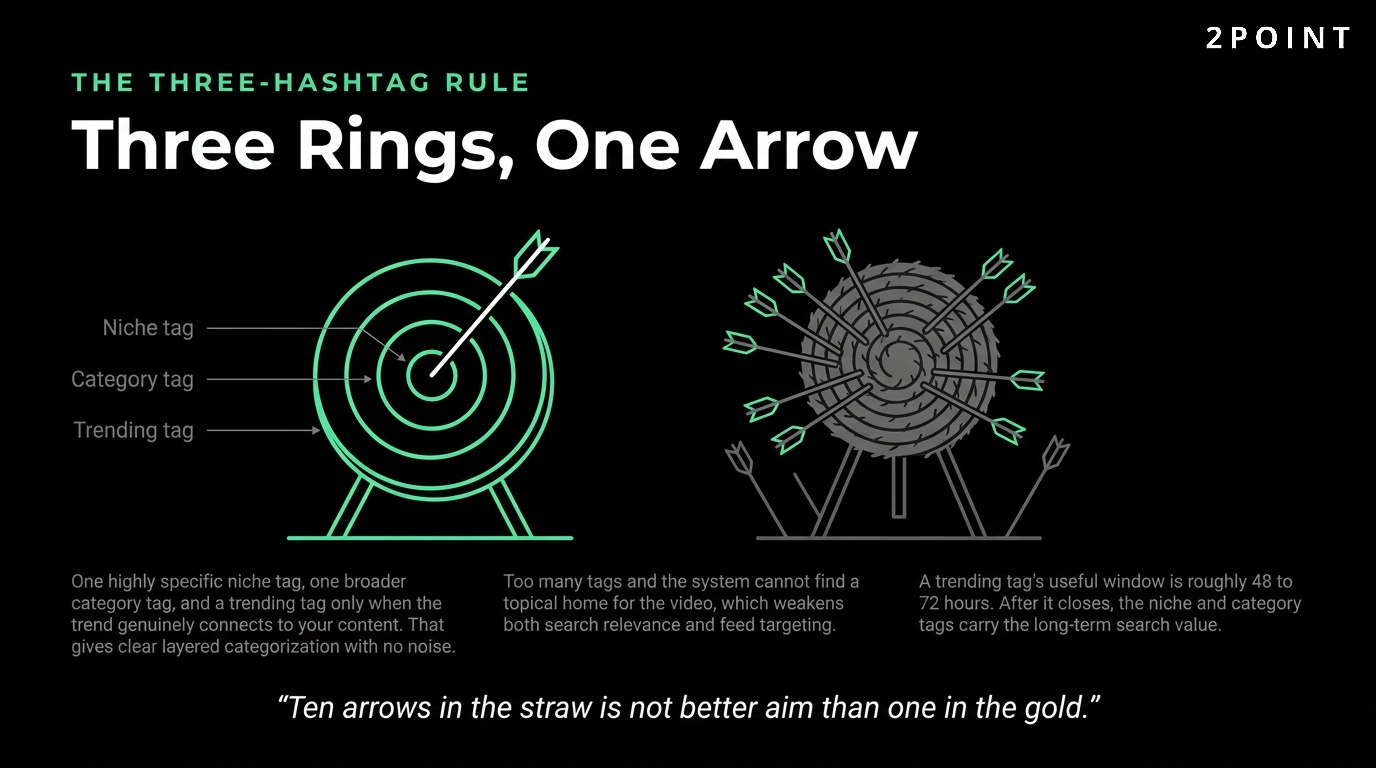
The most consistently recommended hashtag framework for TikTok SEO in 2026 is the three-hashtag strategy. HeyOrca’s 2026 algorithm guide supports limiting hashtags to three highly relevant tags rather than filling posts with 10 or more loosely related ones. When you use too many hashtags, TikTok’s categorization system struggles to identify a clear topical home for your content, which reduces both search relevance and FYP targeting accuracy.
Hootsuite’s TikTok algorithm research confirms that excessive hashtags confuse the algorithm’s classification logic. The recommended mix for the three-hashtag approach is: one highly niche-specific tag (e.g., #ketomealprep), one broader topic or category tag (e.g., #mealprep or #ketodiet), and one trending or seasonal tag (only when it genuinely relates to your content). This structure gives the algorithm clear, layered categorization signals without creating noise. The niche tag targets your most specific audience, the category tag captures a broader search intent, and the trending tag provides a timely relevance boost when applicable.
Balancing Branded Hashtags and Trending Tags
Sprout Social’s TikTok SEO research highlights Cisco’s hashtag approach as a useful case study in branded-tag strategy. By consistently using #cisconetworking alongside category tags like #networkengineer, Cisco built a discoverable content library that serves both branded search (users specifically looking for Cisco content) and topical search (users looking for networking content broadly). This dual-tag approach is replicable for any brand: create a branded hashtag that is short, unique, and reflective of your content identity, then pair it with a relevant topic tag that captures active search traffic.
Trending hashtag adoption requires careful evaluation. Jumping on a trending tag that has no genuine connection to your content provides a temporary impression boost but damages the algorithm’s classification accuracy for your account over time. Only adopt trending tags when the trend authentically connects to your niche. When that alignment exists, trending tags can significantly amplify reach during the trend’s peak window, which is typically 48 to 72 hours. After that window closes, the niche-specific and category tags carry the long-term search value.
Hashtag Research Process for TikTok SEO
Effective hashtag selection requires the same data discipline as keyword research. Start with TikTok Creative Center’s trending content section, filtered by your industry category, to identify which category tags are gaining traction. Examine the top 10 to 15 competitors in your niche and note which hashtags appear consistently in their highest-performing posts. This reveals the category tags that TikTok has already associated with proven content in your space.
Monitor your hashtag performance through TikTok Analytics at the post level. Over time, you will see which specific tags correlate with higher search-driven views versus FYP-driven views. Virlo’s TikTok keyword research platform can assist with tracking hashtag performance trends over time, helping you identify when a once-productive tag has become oversaturated and it is time to rotate in a fresher alternative. Treat your hashtag set as a living document, reviewed and updated monthly based on performance data.
TikTok Engagement Signals: How to Engineer the Metrics That Drive Rankings
Engagement on TikTok is not a monolithic metric. The algorithm assigns different weights to different engagement types, and understanding this hierarchy is critical for designing content that actively earns the signals that matter most for TikTok search ranking and FYP distribution. In 2026, the engagement hierarchy has shifted meaningfully from previous years, and creators who have not updated their understanding are optimizing for the wrong signals.
The Engagement Hierarchy: Shares and Saves Lead the Way
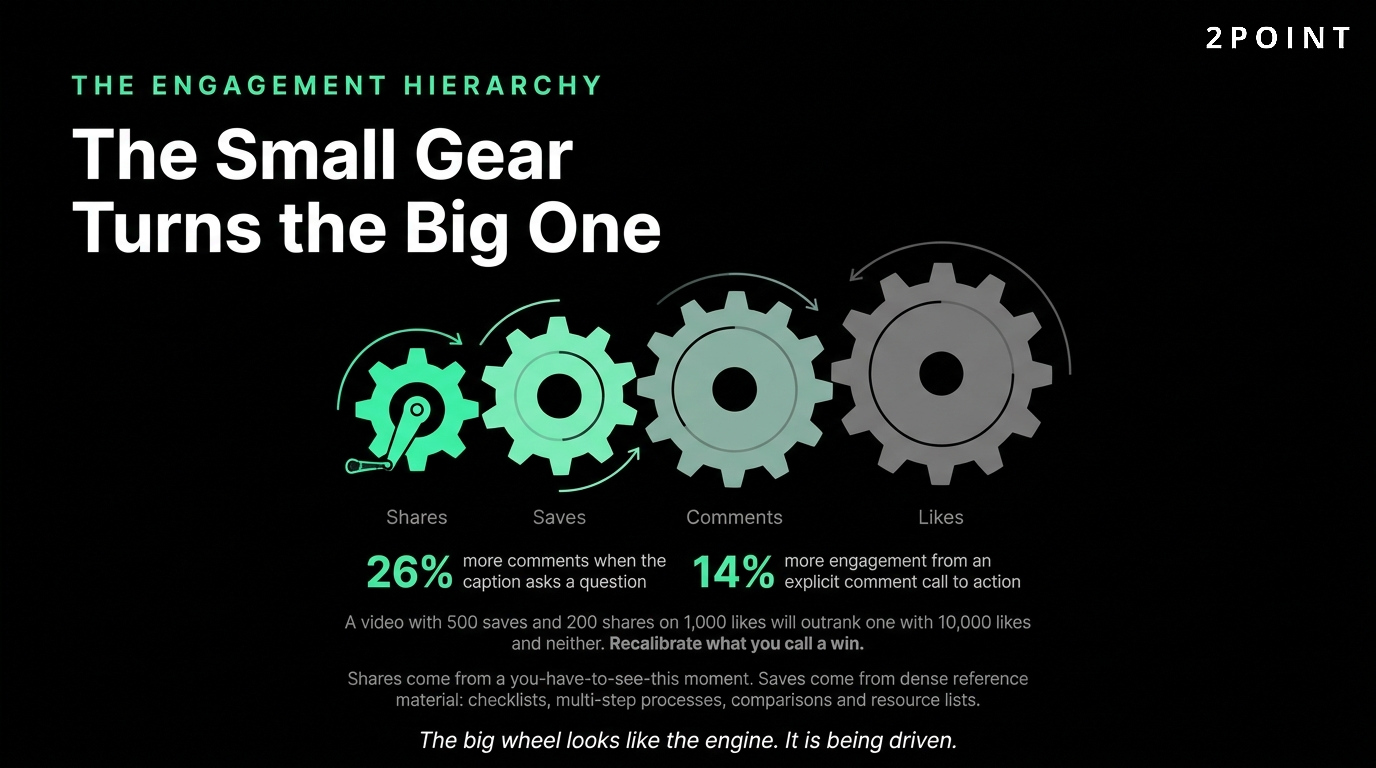
Sotrender’s 2025-2026 algorithm research confirms a significant shift in how TikTok weights different engagement types. Shares now rank as the strongest intent signal in TikTok’s engagement hierarchy. When a viewer shares your video with someone else, they are expressing that your content is worth interrupting another person’s experience to recommend. This active advocacy is a far stronger quality signal than a passive like. HeyOrca’s 2026 algorithm guide places saves as the second strongest signal, reflecting the idea that a viewer found your content valuable enough to bookmark for future reference. Comments rank third, indicating that your content stimulated a response. Likes, while still positive, now represent the weakest signal in the hierarchy.
This hierarchy fundamentally changes how you should measure content success. A video with 500 saves and 200 shares but only 1,000 likes will consistently outperform a video with 10,000 likes but minimal saves and shares in terms of search ranking and sustained FYP distribution. Recalibrate your success metrics accordingly, and design your content to actively earn the high-value signals rather than passively hoping for likes.
Engineering High-Value Engagement Through Content Design
Metricool’s engagement research found that questions in video captions increase comments by 26%, while explicit comment calls to action boost engagement by 14%. These are not subtle differences. They represent actionable content design choices that have measurable, repeatable impact on the engagement signals that drive TikTok rankings. Closing your video with a specific question, such as “Which of these strategies have you already tried?” or “Drop a comment if you want a deeper dive on step three,” consistently generates more comment activity than videos that end without a prompt.
Engineering shares requires a different approach. Shares happen when content delivers a “you have to see this” moment. This can be surprising information that challenges a common assumption, a useful tip that viewers immediately want to send to a relevant friend, or emotionally resonant content that makes someone feel seen. Sprout Social’s engagement strategy guidance recommends building at least one “tag a friend who needs this” moment into every video, whether through explicit prompting or through content so universally relatable that tagging is a natural instinct. Save-worthy content, in contrast, tends to be dense, reference-heavy, and practical: checklists, multi-step processes, comparison breakdowns, and resource compilations all generate high save rates because viewers know they will want to return to them.
2026 Performance Benchmarks in a Saturated Content Environment
Metricool’s 2026 data shows an 80% increase in content published compared to 2025, which has caused virtually every performance metric to decline on a per-video basis. This context is essential for setting realistic goals and evaluating your TikTok SEO performance accurately. With the average full watch rate at 6.3%, achieving even 8% completion on a 60-second video represents a genuinely strong result in the current environment.
“Good” engagement in 2026 is relative to niche size and content format. A micro-community like #CosplayTok operates at a different absolute engagement scale than #FoodTok, but within each community, the relative benchmarks for what constitutes above-average performance are more stable. The most important practice is to benchmark your own content against your own historical performance and against your closest niche competitors, not against viral outliers or cross-niche comparisons. Tracking your search-driven views as a percentage of total views, available through TikTok Analytics, gives you the clearest signal of whether your TikTok keyword research and optimization work is translating into actual search discovery. Learning to interpret SEO metrics accurately is as important on TikTok as it is in traditional search.
Analytics Tools for Tracking TikTok SEO Performance
TikTok’s native analytics suite, accessed through Creator Tools, includes a Search Analytics tab that shows which search queries are driving views to your content. This tab is arguably the most underutilized feature in TikTok’s entire analytics interface. Reviewing it weekly reveals which of your keywords are genuinely connecting with searchers, which videos are earning search placement, and which topics are generating rising search demand in your niche. Use this data to refine your keyword targeting and identify content worth updating or reposting.
For competitive intelligence and broader performance tracking, Printify’s TikTok SEO guide recommends third-party tools like Brandwatch and Sprout Social, which track competitor performance, share of voice, and hashtag reach at a category level. Team5pm’s keyword research guidance suggests reviewing native analytics monthly for trend analysis and weekly for individual video performance. The key distinction to track is the ratio of search-driven views to FYP-driven views across your content library. Videos with a high proportion of search views are your SEO assets. Double down on their topics, update their keywords if search trends shift, and use their proven demand as the foundation for new content expansion.
Publishing Strategy and Content Consistency for TikTok SEO Growth
Even the most meticulously optimized TikTok video can underperform if it exists in isolation. The algorithm rewards accounts that publish consistently within a defined niche, because consistency builds the behavioral data needed for reliable distribution. Publishing strategy is not just about frequency. It is about training the algorithm to understand what your account represents and whom it should reach.
Optimal Posting Frequency: Quality Meets Cadence
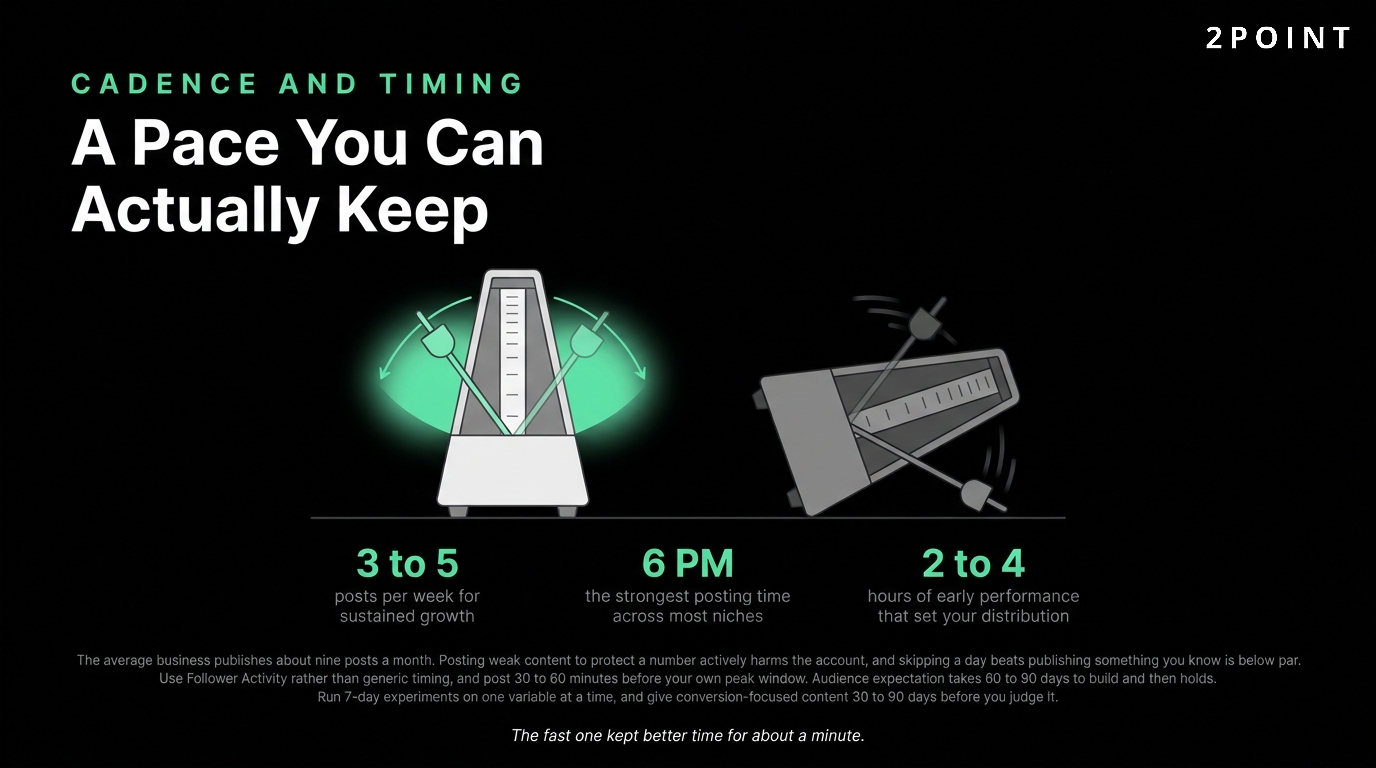
Buffer’s TikTok algorithm research identifies 3 to 5 posts per week as the optimal publishing frequency for accounts focused on sustained growth in 2026. HeyOrca’s benchmark data shows the average business publishes approximately 9 posts per month, which falls within this range. The 3 to 5 per week cadence maintains enough algorithmic momentum to build account authority and content history without sacrificing per-video quality.
In 2026’s saturated content environment, the quality-versus-quantity trade-off has never been more consequential. Posting weak content simply to maintain frequency actively harms your account’s algorithmic profile. A video with low completion rates and minimal engagement sends negative quality signals that can suppress distribution on your subsequent posts. The practice of publishing consistently should be conditional: publish consistently at a cadence that allows each video to meet your minimum quality threshold. If that means posting 3 times per week instead of 5, the lower frequency with higher quality will generate better cumulative results. Skipping a day is always preferable to publishing content you know is below par.
Best Posting Times to Maximize Early Engagement
Metricool’s 2026 study found that 6 PM represents the optimal posting time across most niches, based on a dataset of over 2.3 million posts. Early engagement velocity matters because TikTok uses the first few hours of a video’s performance as a signal for broader distribution. A video that earns strong watch time, saves, and shares within the first two to four hours after posting receives a distribution upgrade that compounds over days and weeks.
However, generic “best time” data has limited value for individual accounts with specific audience demographics and geographic distributions. The most reliable approach is to use TikTok Analytics’ Follower Activity section, which shows when your specific audience is most active by day of week and time of day. Posting 30 to 60 minutes before your peak audience activity window gives the algorithm time to begin testing your content before the highest concentration of your followers comes online. Audience-specific timing will consistently outperform generic benchmarks, making it worth the two or three months of testing required to establish your personal optimal window.
Consistency as an Algorithmic Trust Signal
SEMrush’s TikTok SEO analysis confirms that a regular publishing rhythm trains TikTok’s algorithm to classify your account as an active, reliable content source within your niche. Accounts that publish sporadically, even if individual videos perform well, do not accumulate the same algorithmic trust as accounts that maintain a predictable cadence. This trust manifests as improved default distribution baselines, meaning your videos are tested with larger initial audience samples, which gives them a higher probability of breaking through to broader reach.
The compound effect of consistent publishing on audience retention is equally significant. HeyOrca’s algorithm research notes that audiences who have come to expect content from a specific creator on a predictable schedule show higher engagement rates when new content appears. This behavioral pattern, where existing followers actively seek out and quickly engage with new posts, generates the early engagement signal that the algorithm uses to determine initial distribution scale. Building this expectation with your audience takes 60 to 90 days of consistent publishing, but the distribution baseline improvement that results is one of the most durable performance advantages available on the platform.
Rapid Testing Framework for Content Optimization
Publishing consistently without a feedback loop is how accounts plateau. A structured testing framework transforms your content calendar into a continuous improvement system. Dark Room Agency’s 2026 algorithm tactics guide recommends setting 7-day creative experiment windows for individual content variables, such as hook style, video length, or caption format. Change one variable at a time across a set of otherwise similar videos and compare performance after seven days.
For conversion-focused content, extend your validation period to 30 to 90 days. Short-term performance spikes can be misleading. A video that earns strong search placement may continue driving traffic for months, while a video that goes semi-viral briefly may fade entirely within a week. Use rewatch rate and completion rate as your primary scale signals for short-term experiments: high rewatch and completion consistently predict strong algorithm performance, even before broader distribution kicks in. When a content format or keyword combination demonstrates these signals early, double down with variations. When a format consistently underperforms on these baseline signals, pivot before investing further resources in that direction.
Advanced TikTok SEO Strategies for Brands and Serious Creators
Once the fundamentals of TikTok search optimization are in place, a set of advanced strategies allows you to extend your reach into local markets, e-commerce discovery, cross-platform search, and AI-assisted production. These strategies build on the foundational work covered in previous sections and are most effective when implemented after you have established consistent publishing, keyword research processes, and engagement optimization habits.
Local TikTok SEO: Reaching Nearby Audiences
Glimpse’s TikTok SEO strategy guide covers TikTok’s “Nearby” feed rollout, a feature that surfaces geographically relevant content to users actively browsing local content. For businesses with physical locations, this feed represents a direct discovery channel that functions similarly to local search on Google Maps. Enabling location tags on your posts and referencing your city, neighborhood, or region in captions and voiceovers signals to TikTok that your content is locally relevant. This is a direct TikTok search optimization tactic for businesses that want to appear when users search “[your city] + [your service].”
Beyond location tags, TikTok’s algorithm uses IP address and SIM card data to calibrate content relevance, meaning that even without explicit location tags, content created and posted from a specific geographic area will be preferentially distributed to nearby users. Local businesses should lean into this by creating content that references local landmarks, community events, neighborhood-specific trends, and regional language patterns. This hyperlocal relevance creates a natural content moat that national competitors cannot easily replicate, making local TikTok SEO one of the most accessible competitive advantages for small businesses. For more on this approach, the principles of local SEO for small businesses translate directly to TikTok’s geographic discovery features.
TikTok Shop and E-commerce Search Optimization
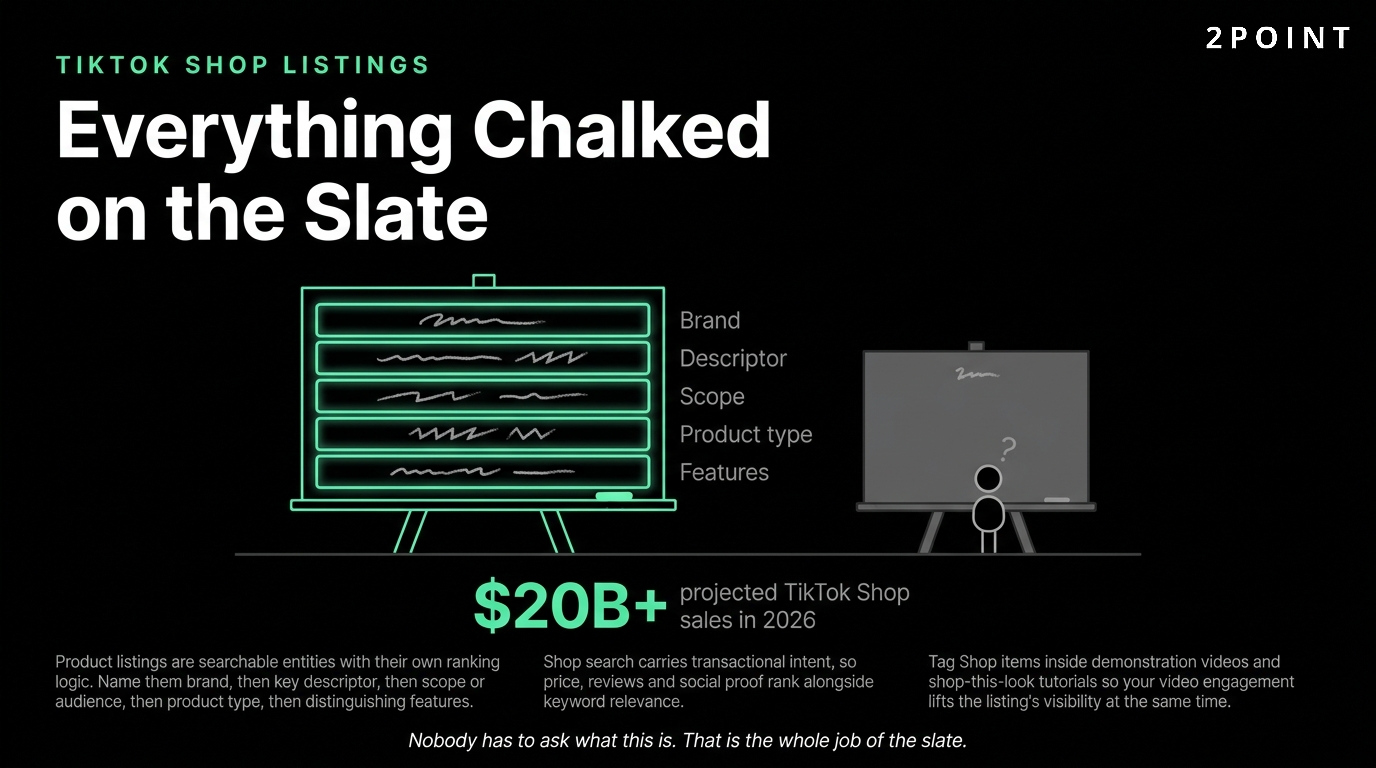
TikTok Shop sales are projected to exceed $20 billion in 2026, making product listing optimization one of the most commercially significant aspects of TikTok SEO for e-commerce brands. Product listings within TikTok Shop are searchable entities that follow their own ranking logic, distinct from video content but influenced by the same underlying engagement and relevance signals. The recommended product listing naming convention follows a structured formula: Brand Name + Key Content Descriptor + Scope or Audience + Product Type + Distinguishing Features. For example: “NovaBrew Co. Premium Small-Batch Cold Brew Coffee Concentrate, 32 oz Unsweetened.”
Product discovery search within TikTok Shop operates differently from general content search. Users searching for products are expressing transactional intent, which means price, reviews, and social proof become ranking factors alongside keyword relevance. Printify’s e-commerce TikTok SEO guidance recommends integrating shoppable content directly into your organic video strategy: product demonstration videos with tagged Shop items, creator reviews with direct purchase links, and “Shop this look” tutorials that bridge content discovery with immediate purchasing. This integration allows your video content’s engagement signals to boost your product listings’ search visibility simultaneously. Brands looking to understand the SEO impact on e-commerce will find TikTok Shop an increasingly important channel to include in that analysis.
How TikTok SEO Amplifies Your Traditional Web Search Rankings
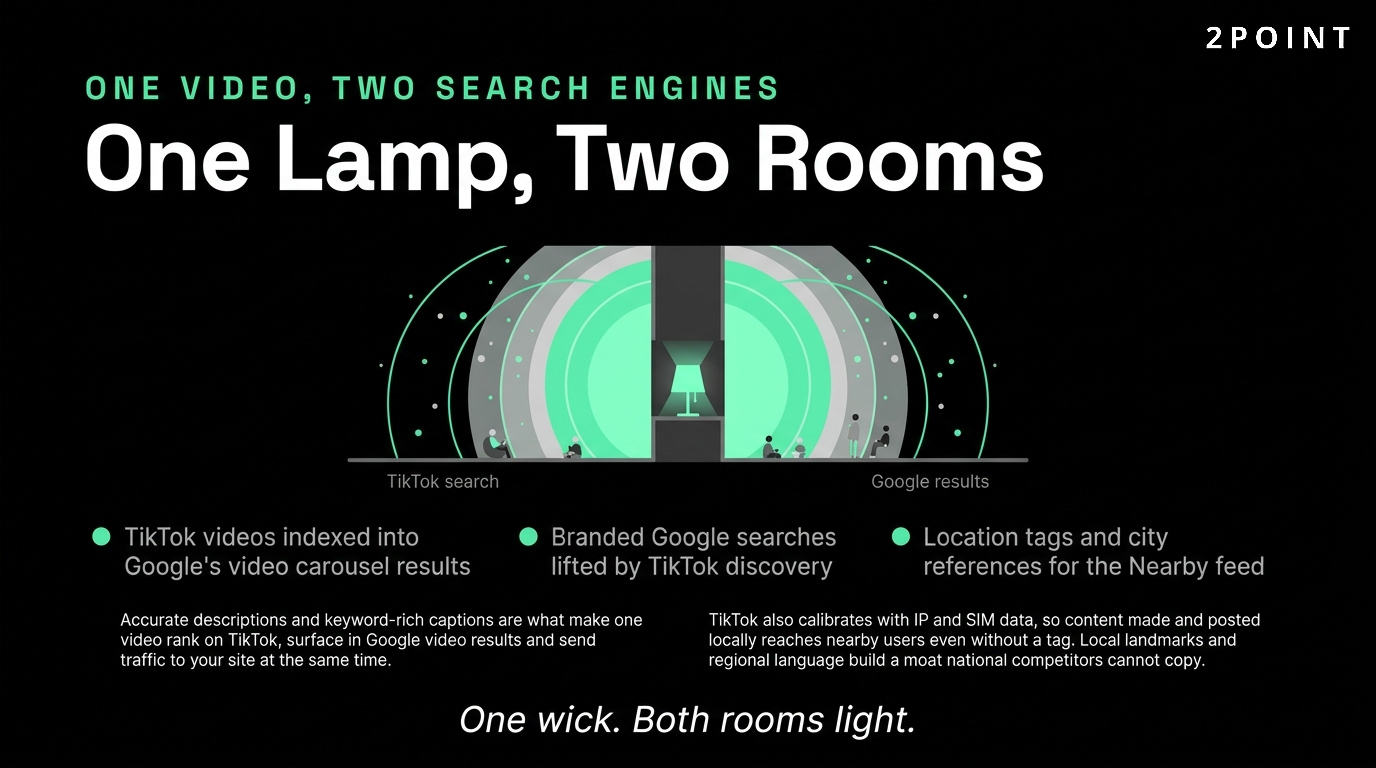
TikTok SEO does not exist in isolation from broader digital marketing. Area10’s 2026 SEO trends analysis notes that optimized TikTok content drives branded Google searches as viewers, after discovering a brand on TikTok, turn to Google to learn more. This branded search lift improves your Google SEO metrics, particularly click-through rate and branded query volume, which are positive signals for Google’s algorithm. The effect creates a virtuous cycle: TikTok visibility drives Google searches, Google searches strengthen your domain authority signals, and stronger web presence supports broader brand credibility that feeds back into TikTok performance.
TikTok videos themselves are also appearing in Google SERPs. Google regularly indexes TikTok content in its video carousel results, particularly for trending topics and how-to queries. This means a well-optimized TikTok video can simultaneously rank in TikTok search, appear in Google’s video results, and drive traffic to your website, all from a single piece of content. Metadata optimization, including accurate video descriptions and keyword-rich captions, is the key to maximizing this cross-platform indexing. For brands building an integrated SEO-integrated web strategy, TikTok is now a genuine complement to traditional web optimization rather than a separate channel requiring entirely different thinking. This also aligns with efforts to boost online sales through SEO by creating multiple discovery pathways to the same destination.
AI-Assisted Content Production for TikTok SEO at Scale
Dark Room Agency’s 2026 tactics guide identifies AI-assisted production as a significant efficiency multiplier for creators managing high-frequency publishing schedules. AI tools are most valuable for generating multiple hook variants from a single content brief, drafting caption options around a target keyword, suggesting metadata and hashtag combinations based on trending data, and producing initial script drafts that human creators then refine and personalize. These are high-volume, low-judgment tasks where AI produces strong raw material quickly.
The areas that require human judgment are tone, authenticity, and cultural sensitivity. TikTok audiences are exceptionally attuned to content that feels generated rather than genuinely human, and the engagement penalty for inauthentic content is severe and immediate. The optimal AI-human production workflow treats AI as the research assistant and first-draft engine, while human creators provide the performance, personality, and nuanced judgment that build genuine audience connection. For export strategy, produce your primary video as a TikTok-native master, then adapt it for Instagram Reels and YouTube Shorts as derivatives, always removing watermarks before cross-posting. This native-first approach preserves your TikTok algorithmic standing while maximizing content ROI across platforms.
Building a Sustainable TikTok SEO Strategy: Synthesis and Next Steps
TikTok SEO in 2026 is not a collection of isolated tactics. It is a system where every element reinforces the others. Keyword research informs content creation. Content creation generates engagement signals. Engagement signals determine search rankings. Search rankings drive consistent traffic. Consistent traffic builds account authority. Account authority improves default distribution for every future video. When this system is working, it compounds in your favor over time.
The Eight Pillars of TikTok Search Optimization
This guide has covered eight core pillars of effective TikTok SEO strategy. TikTok has matured into a genuine search engine, and understanding its fundamental difference from Google is the prerequisite for everything else. TikTok ranking factors, led by watch time, completion rate, rewatch signals, and niche relevance, define the performance targets your content must hit. TikTok keyword research, conducted through native tools like Creator Search Insights and validated by third-party platforms, identifies the specific topics and terms your audience is actively searching. On-video optimization ensures that every element of your video, caption, voiceover, overlays, and hashtags, works together to send clear, consistent keyword signals.
Hashtag strategy in 2026 means three precise, relevant tags rather than ten generic ones. Engagement engineering means designing content to earn shares and saves, not just likes. Publishing strategy means consistent cadence, data-informed posting times, and a rapid testing framework that converts every piece of content into a learning signal. Advanced strategies, including local search optimization, TikTok Shop SEO, cross-platform amplification, and AI-assisted production, extend your reach and efficiency once the fundamentals are solid.
The Quality-Consistency-Community Triangle
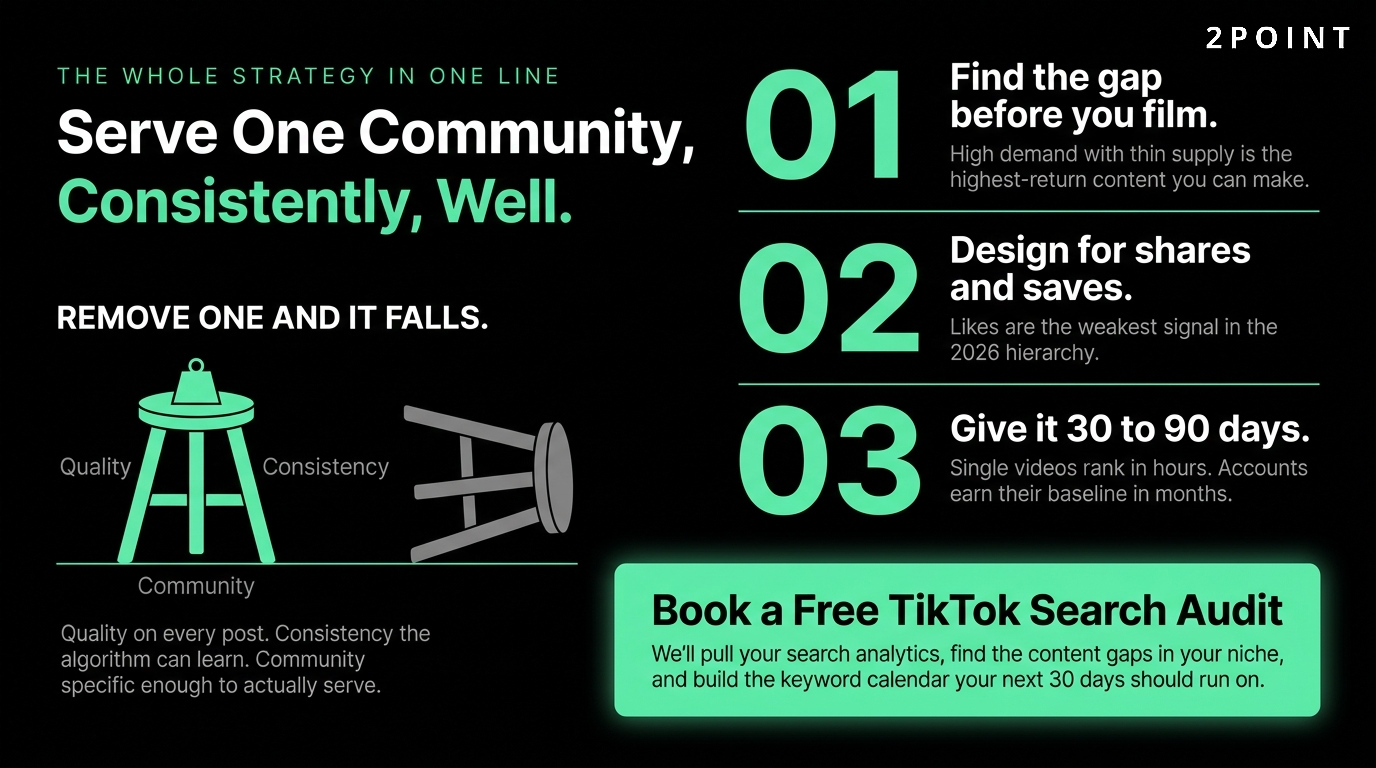
If there is a single organizing principle behind all eight pillars, it is the Quality-Consistency-Community triangle. Quality means every video you publish meets a minimum threshold for watch time and engagement performance. Consistency means your publishing cadence is predictable enough to train the algorithm and build audience expectation. Community means your content serves a specific, identifiable group of people with genuine depth rather than casting broadly and connecting shallowly.
TikTok’s algorithm is fundamentally designed to reward accounts that consistently deliver quality content to a specific community. No individual tactic, no matter how perfectly executed, substitutes for this foundation. The accounts that dominate TikTok search in 2026 are not those with the best hooks or the most trending audio. They are the accounts that their niche communities trust as reliable, knowledgeable, and consistently worth engaging with. Building that trust is the long game, and TikTok SEO is the mechanism through which that trust compounds into sustainable organic reach.
Getting Started: Your TikTok SEO Action Checklist
- Access Creator Search Insights and TikTok Creative Center: Log into both tools and spend one session identifying which search terms in your niche have high demand and low content supply. This session will generate more actionable content ideas than any brainstorming exercise.
- Identify five content gap keywords in your niche: Use the research workflow outlined in Section 3 to prioritize your first five target keywords by opportunity score. These become your content calendar anchors for the next 30 days.
- Optimize your profile and bio: Ensure your display name, bio, and pinned content reflect your primary niche keyword. This foundational step amplifies every video you post.
- Commit to 3 to 5 posts per week for 30 days: Set a sustainable cadence before anything else. Thirty days of consistent publishing generates enough algorithmic data to reveal your account’s performance baseline and identify which content directions deserve scaling.
- Review Search Analytics weekly: Each week, check which search queries are driving views to your content and which videos are earning search placement. Use this data to refine your keyword targeting and identify emerging content opportunities before they peak.
Future-Proofing Your TikTok SEO Investment
TikTok’s search functionality will only expand. The platform is actively investing in search infrastructure, product discovery, and AI-powered content recommendations that blur the line between social browsing and active searching. MiraFlow’s 2026 TikTok SEO analysis projects that Creator Search Insights will continue expanding its data offerings, giving creators increasingly precise visibility into search demand at the niche level.
The content library you build through disciplined TikTok SEO practice compounds in value over time. A well-optimized video published today may continue earning search-driven views a year from now, especially for evergreen informational queries. Unlike purely viral content, which spikes and fades, search-optimized content functions as a permanent asset in your discoverability infrastructure. Team5pm’s optimization guidance emphasizes that this evergreen quality is what separates TikTok SEO from TikTok entertainment strategy: one builds momentum that disappears, the other builds an asset base that grows. Integrating this approach with your broader digital marketing ecosystem, including your website SEO, email list, and other social channels, creates a resilient multi-channel presence that no single platform shift can dismantle. The team at 2POINT works with brands at every stage of this integration, helping connect TikTok search strategy to the broader digital ecosystem for maximum impact.
Frequently Asked Questions About TikTok SEO
What is TikTok SEO and how does it work?
TikTok SEO is the practice of optimizing video content so TikTok’s search algorithm surfaces it to users actively searching for your topic. It works by placing relevant keywords in captions, voiceovers, on-screen text, and hashtags, while also optimizing for engagement signals like watch time, completion rate, shares, and saves that tell the algorithm your content is high quality.
How is TikTok SEO different from Google SEO?
TikTok SEO relies on engagement signals like watch time and shares rather than backlinks and domain authority. TikTok results can appear within hours of posting, while Google SEO typically takes weeks to months. TikTok also prioritizes video content, niche community alignment, and native platform features rather than page experience and site structure.
Do hashtags still matter for TikTok SEO in 2026?
Yes, but precision matters more than volume. Using three highly relevant hashtags outperforms using ten or more generic ones. Hashtags increase views by 5% and interactions by 10% on average, and hashtag-driven traffic grew 114% year-over-year. Generic tags like #fyp no longer provide meaningful ranking benefits.
What is the best video length for TikTok SEO?
Research points to 60 to 90 seconds as the optimal length for balancing search reach with engagement performance in 2026. Short videos of 15 to 30 seconds achieve higher completion rates, while the 60 to 90 second range allows sufficient keyword integration and informational depth without sacrificing completion performance significantly.
How do I find the right keywords for TikTok search optimization?
Start with TikTok’s native Creator Search Insights tool to identify high-demand, low-competition content gaps in your niche. Supplement this with TikTok Creative Center’s Keyword Insights and the search bar autocomplete feature. Validate volume estimates using third-party tools like Virlo, Keyword Tool.io, or ContentStudio’s free TikTok keyword tool.
Does TikTok SEO help with Google rankings too?
Yes, in two direct ways. TikTok videos appear in Google’s video carousel results for relevant queries, extending your content’s search reach to Google users. Additionally, TikTok visibility drives branded Google searches as viewers search for your brand after discovering you on TikTok, which improves your branded query metrics and overall Google SEO signals.
What engagement signals matter most for TikTok ranking?
The 2026 engagement hierarchy places shares as the strongest signal, followed by saves, comments, and likes. Watch time and completion rate are the most important watch-behavior signals. Rewatch rate has also emerged as a significant ranking multiplier, indicating that content quality justifies a second viewing.
Is TikTok SEO worth it for small businesses or local brands?
Yes, particularly for local businesses that can take advantage of TikTok’s “Nearby” feed and location tag features. Including location references in captions, voiceovers, and hashtags helps TikTok surface your content to geographically relevant users, creating a local discovery advantage that national competitors cannot easily replicate. Leveraging local SEO principles on TikTok follows similar logic to local web search optimization.
TikTok SEO vs. Instagram SEO: Which is more effective?
TikTok SEO currently offers faster ranking timelines, a faster-growing search user base (49% of American consumers now use TikTok for search), and stronger AI/LLM influence for brand discovery. Instagram SEO benefits from deeper integration with Google indexing and a more established older demographic. For visual product categories and younger audiences, TikTok SEO typically delivers faster organic discovery results in 2026.
How often should I post on TikTok for SEO benefits?
Three to five posts per week represents the recommended sweet spot for consistent algorithmic trust-building without sacrificing content quality. Publishing weak content to maintain frequency actively harms account performance. Quality at a sustainable cadence consistently outperforms high-frequency posting of below-average content.
Can I repurpose Instagram or YouTube content for TikTok SEO?
You can repurpose content concepts, but you must remove all competing platform watermarks before posting to TikTok. TikTok’s algorithm explicitly deprioritizes content with Instagram or YouTube watermarks, reducing its distribution significantly. Always export a clean, watermark-free master version and consider creating TikTok-native hooks and captions rather than copying them verbatim from other platforms.
How long does it take to see results from TikTok SEO?
Individual optimized videos can appear in TikTok search results within hours to days of posting. Account-level results, including improved default distribution baselines and consistent search placement for target keywords, typically require 30 to 90 days of consistent, optimized publishing. This is significantly faster than Google SEO, which usually requires months to years for competitive rankings.