


 let’s connect


How to Sell on TikTok Shop: Quick Start Guide
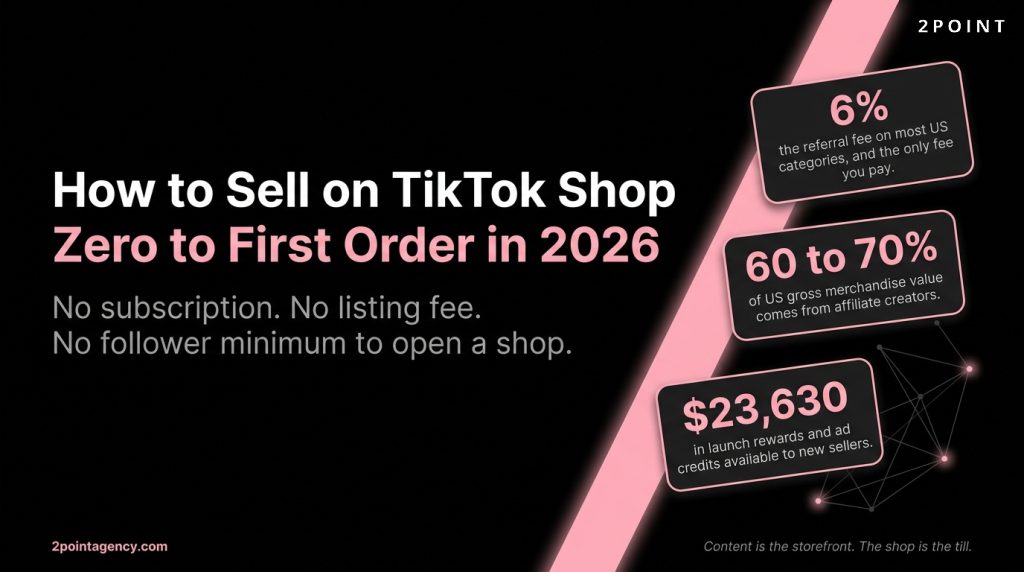
If you want to start selling on TikTok Shop today, here is everything you need to know before you spend a single dollar:
- Register for free at seller.tiktok.com with no follower minimum required to open a shop.
- Verify your identity using a government-issued ID and your Social Security number or ITIN.
- Set up your shop profile, add a product catalog, and configure your payout bank account.
- Choose your primary selling method: shoppable product videos, TikTok LIVE shopping, or affiliate creator partnerships.
- TikTok charges a 6% referral fee per sale in most US product categories.
- There are no monthly subscription fees and no per-listing charges on the platform.
- TikTok Shop is available in the US, UK, and select Southeast Asian markets as of 2026.
- You must be at least 18 years old and a US resident to sell in the American market.
- 60 to 70 percent of US gross merchandise value on TikTok Shop is driven by affiliate creators, making that channel critical for most sellers.
- New sellers can access up to $23,630 in combined launch rewards and ad credits through TikTok’s new seller incentive program.
TikTok Shop launched in the United States on September 12, 2023, and has grown rapidly into one of the most significant social commerce platforms available to independent sellers and brands alike. The sections below walk you through every step of the process, from eligibility and registration to content strategy and scaling with affiliates.
—
TikTok Shop Eligibility Requirements: Who Can Become a TikTok Shop Seller?
Before you invest time in building your storefront, you need to confirm that you meet TikTok’s eligibility requirements. The platform has clear criteria for both individual sellers and business entities, and submitting incomplete or mismatched documentation is the single most common cause of application delays. Understanding the requirements upfront saves you significant frustration.
Individual Seller Requirements for TikTok Shop
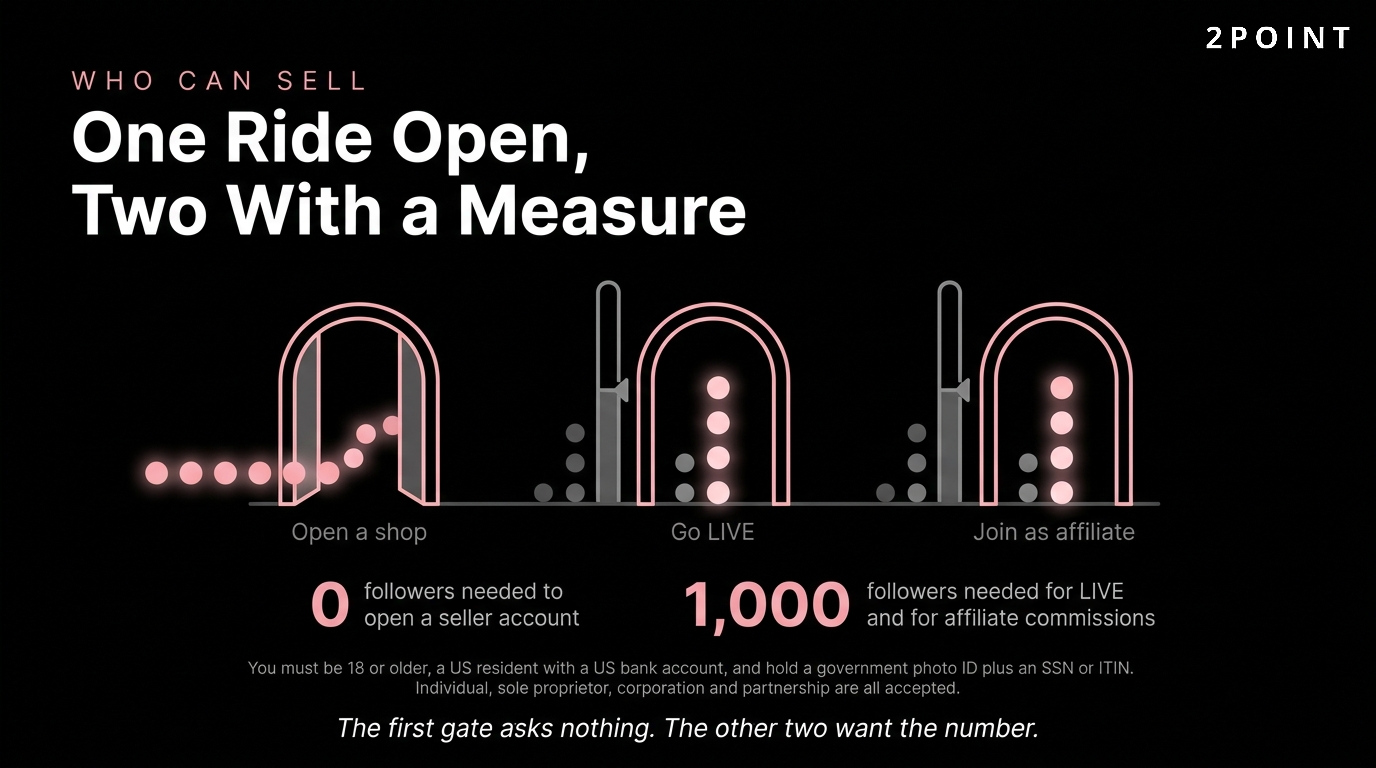
Individual sellers in the United States must meet a straightforward set of baseline requirements to open a TikTok Shop account. The most important thing to know is that there is no follower minimum required to open a seller account, which sets TikTok Shop apart from many creator monetization programs. You can have zero followers on your TikTok profile and still qualify to sell products directly to customers.
Here is what individual sellers need to provide during registration:
- Proof of age 18 or older, verified through identity documents
- US residency, verified through your address and bank account
- A valid government-issued photo ID such as a passport, driver’s license, state identification card, or permanent resident card
- A Social Security number or Individual Taxpayer Identification Number (ITIN)
- A US phone number and email address that are not already associated with another TikTok Shop
- A US bank account to receive payouts
- A completed W9 tax form if you are a US person, or a W8-BEN if you are a non-US person filing individually
One distinction worth noting early: while there is no follower threshold to open a seller shop, the TikTok Shop affiliate program requires creators to have at least 1,000 followers before they can promote products and earn commissions. If you plan to act as both a seller and an affiliate creator, you will need to hit that follower count on the content side.
Business Seller Documentation for TikTok Shop
Businesses registering as TikTok Shop sellers face slightly more documentation requirements, reflecting the additional verification needed to confirm that the legal entity is legitimate and operational. The most critical piece of advice for business applicants: every document you submit must show the exact same business name. Even minor discrepancies, such as “LLC” appearing in one document but not another, or a DBA name used in place of the registered legal name, can trigger rejection and add days to your verification timeline.
Required documentation for business sellers includes:
- Employer Identification Number (EIN) issued by the IRS
- Certificate of Business Incorporation from the state in which the business is registered
- IRS notices or letters that display both the organization name and the EIN (such as the CP 575 letter)
- Business license verification where applicable to your industry
- A US business address that matches the registration documents
Most application delays for business sellers result from name mismatches between the EIN confirmation letter and the incorporation certificate. Review all documents side by side before uploading to ensure the legal business name is identical across every file. Submitting clean, consistent documentation typically means approval within 48 hours rather than multiple review cycles.
Regional Availability and Market Access
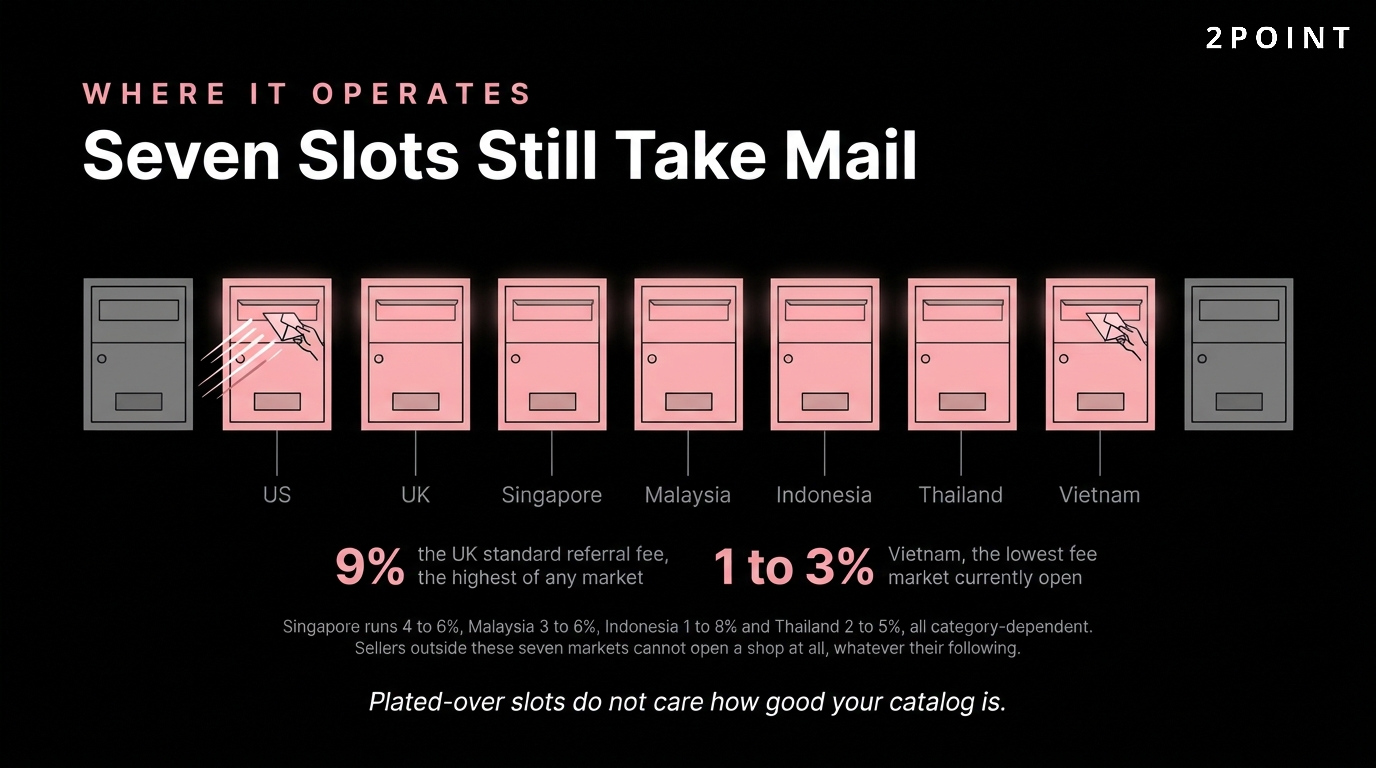
TikTok Shop is not available globally. As of 2026, the platform operates in the following markets: the United States, the United Kingdom, Singapore, Malaysia, Indonesia, Thailand, and Vietnam. If you are located outside these supported regions, you cannot open a TikTok Shop regardless of how large your TikTok following is or how strong your product catalog might be.
Each market operates under its own fee structure and has its own regulatory requirements. For English-speaking sellers, the US market represents the largest individual opportunity by volume. The UK market is the next most accessible for English-speaking brands, though its referral fee structure differs from the US rate. Sellers interested in Southeast Asian markets will find lower fee percentages in some countries, but will also encounter different compliance and localization requirements.
If you are based in the US and considering international expansion, the best approach is to establish a proven domestic selling operation first, then evaluate market-specific requirements for each target country. Building your foundation in a single market before expanding internationally reduces operational complexity and makes it easier to identify what is working before scaling.
Account Setup Prerequisites and New Seller Incentives
Before you begin the registration process, gather everything you need so you can complete the application in a single session. You will need a valid US phone number and email address that are not already linked to an existing TikTok Shop, your identity documents ready to photograph, your tax identification details, and your US bank account information.
You can register either by linking an existing TikTok content account to a new Seller Center profile, or by creating a standalone seller account without connecting a content account. Linking your content account is optional at registration, but doing so allows you to tag products directly in your TikTok videos and access shop analytics within the same dashboard. Most active sellers connect their content account at setup.
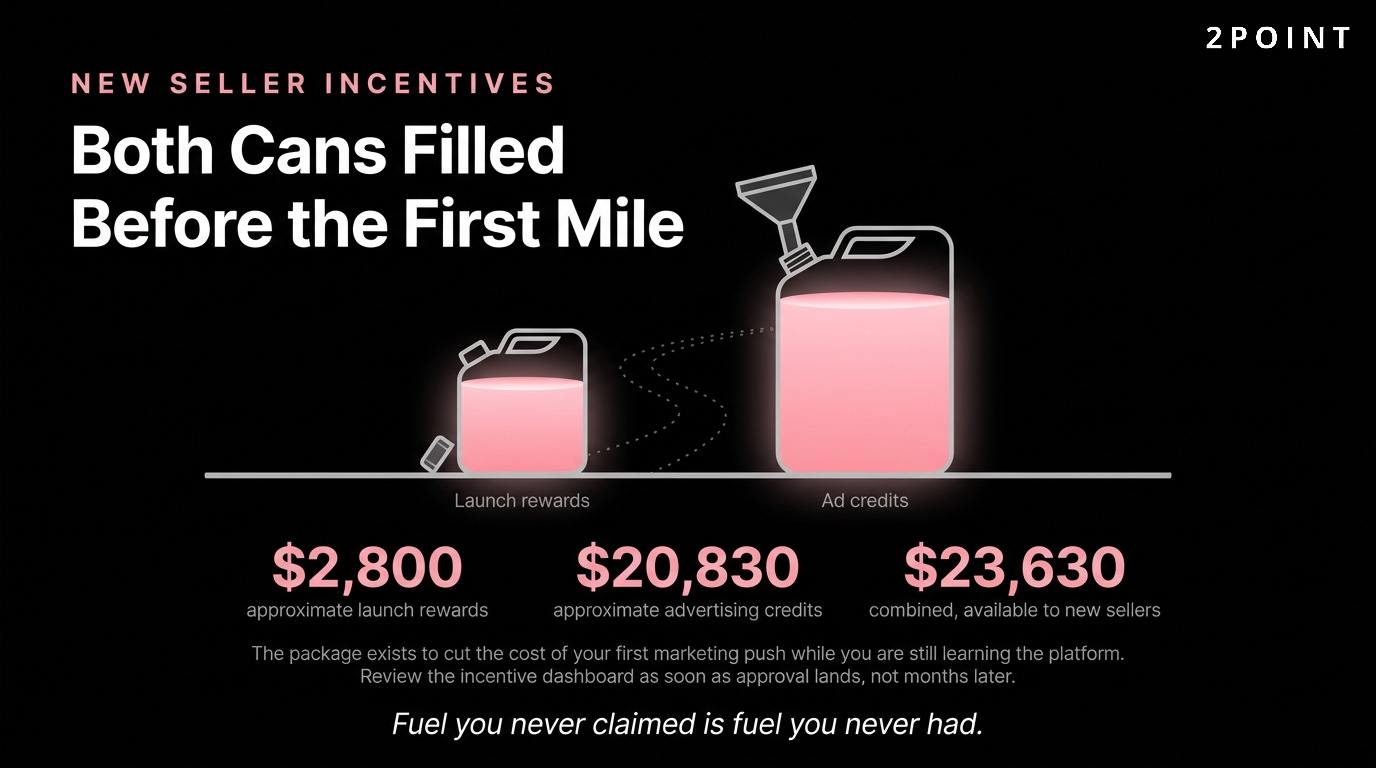
Verification typically completes within 48 hours when documents are clear and complete. Once approved, new sellers gain access to a substantial incentive package. According to TikTok’s Seller Center, new sellers can receive up to $23,630 in combined rewards, broken down as approximately $2,800 in launch rewards and $20,830 in advertising credits. These incentives are designed to reduce the cost of your initial marketing investment and help you generate early sales momentum while you are learning the platform.
—
How to Complete the TikTok Shop Registration Process Step by Step
The registration process for TikTok Shop is straightforward when you approach it in order and have your documents prepared in advance. The following walkthrough covers every stage from initial account creation through to approval and shop launch, so you know exactly what to expect at each step.
Initial Registration Steps at seller.tiktok.com
Start by navigating to seller.tiktok.com and clicking the registration button. You will immediately be prompted to select your region or country, which determines the fee structure, compliance requirements, and currency for your shop. Selecting the wrong region at this stage can cause complications later, so confirm your business location before proceeding.
Next, choose your seller type. TikTok Shop offers four entity options:
- Individual: A person selling without a registered business entity
- Sole Proprietor: A one-person business operating under your own name or a DBA
- Corporation: A legally incorporated business (C-corp, S-corp)
- Partnership: A business owned by two or more people under a formal partnership agreement
After selecting your entity type, you will enter your legal name (or business name), date of birth, residential or business address, and tax identification information. You will also be asked to choose your primary product category, which helps TikTok classify your shop and apply the correct referral fee rate. Enter your shop name during this stage as well. Choose a shop name that is clear, brand-appropriate, and easy for customers to remember, because it will be visible on every product listing and order notification.
Identity and Business Verification During Registration

After completing your basic information, the registration process moves into the identity verification stage. This is where most first-time applicants encounter delays, and the reason is almost always document quality or consistency. Taking a few extra minutes to prepare your submissions properly will save you days of back-and-forth with TikTok’s review team.
For identity verification, upload a clear photograph or scan of your government-issued ID. The image must show all four corners of the document, must be free of glare or shadows, and must be fully legible. For business sellers, you will also upload your Certificate of Incorporation and any IRS correspondence that confirms your EIN.
Common rejection reasons include:
- Blurry or low-resolution images where text is not clearly readable
- Documents where corners are cropped out of the frame
- Expired identification documents
- Name mismatches between different submitted documents
- Using a DBA or trade name instead of the registered legal name
Complete the tax form submission as the final step of verification. US individuals and sole proprietors submit a W9, while non-US individuals submit a W8-BEN. Business entities may need to submit a W9 using the EIN rather than an individual SSN. Confirm which form applies to your specific situation before submitting.
Shop Profile and Payment Setup
Once your identity documents are submitted, you will configure your shop’s operational details. These settings determine how customers experience your brand and how you receive your earnings, so spend time getting them right rather than rushing through them.
Key configuration steps at this stage include:
- Finalizing your shop name (unique to your brand, not already taken on the platform)
- Setting your warehouse or pickup address (where inventory ships from)
- Configuring your return address for customer returns
- Linking a US bank account for payouts
- Choosing your withdrawal method and reviewing associated fees
- Adding a phone number for seller notifications and order alerts
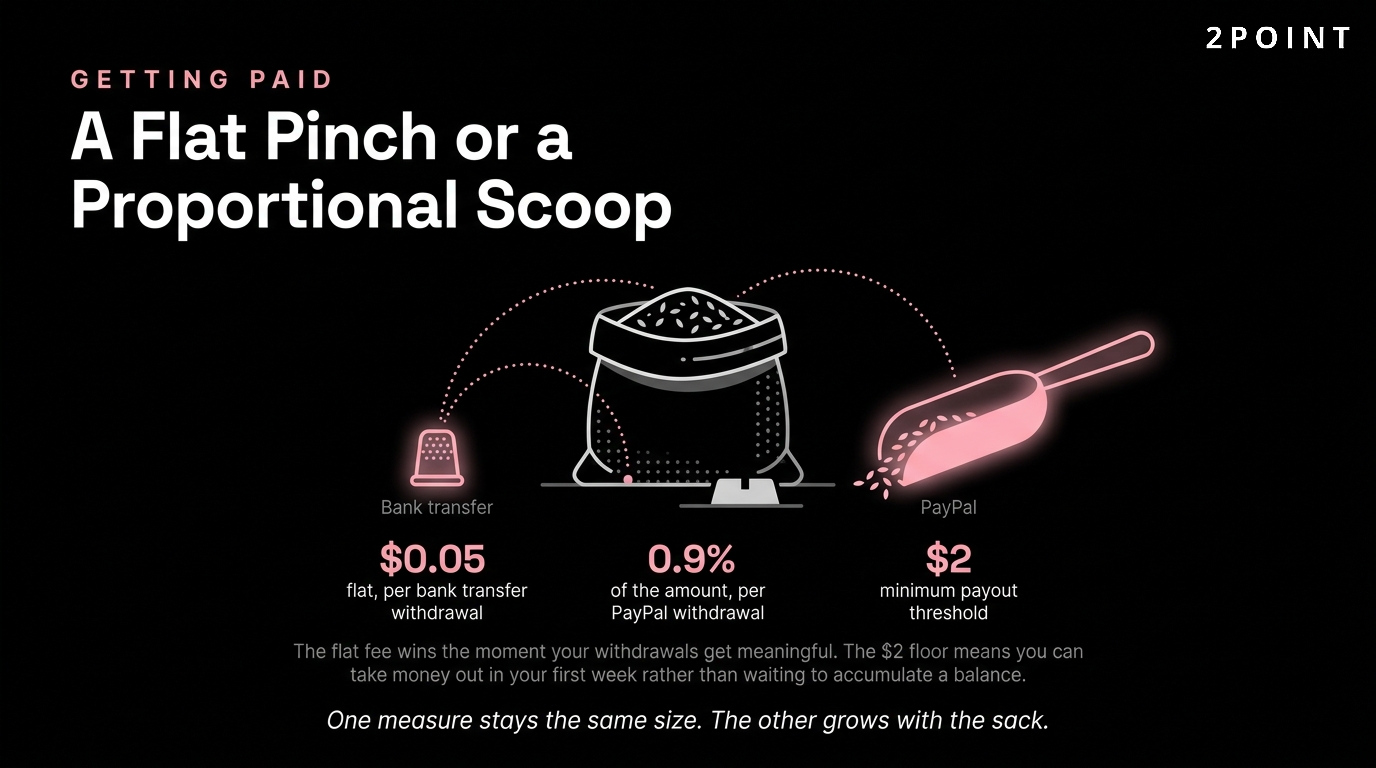
On the payment side, TikTok Shop offers two withdrawal options. Bank transfer withdrawals carry a flat fee of $0.05 per transaction, while PayPal withdrawals carry a 0.9% fee on the withdrawal amount. The minimum payout threshold is $2, which means you can withdraw small balances during your early selling days without waiting to accumulate a larger sum. For most sellers doing meaningful volume, the bank transfer option will be more cost-effective than PayPal over time.
Approval Timeline and First Steps After Launch
With correct and complete documentation, TikTok Shop applications are typically reviewed and approved in under 48 hours. You will receive email updates on your verification status. If your application requires additional information, TikTok will send a notification specifying which documents need to be resubmitted or corrected.
Upon approval, you gain full access to the Seller Center dashboard, which is the central hub for managing products, orders, analytics, promotions, and affiliate partnerships. Your first actions after approval should include:
- Linking your TikTok content account to the shop (if you have one)
- Completing your shop profile with a brand story, shipping policies, and return terms
- Uploading your first product listings before any promotional activity
- Running a test checkout if possible to confirm the purchase flow works correctly
- Reviewing the new seller incentive dashboard to understand how to claim available rewards
One practical tip: submit your application during regular business hours rather than late at night or over weekends. While the review process is automated in part, human review components may process faster when the team is fully staffed. A Monday morning submission is likely to resolve faster than one submitted on a Friday afternoon.
—
Understanding TikTok Shop Fees and Costs Before You Price Your Products
Pricing your products correctly on TikTok Shop requires a clear understanding of every cost that will be deducted before money reaches your bank account. Sellers who do not account for fees accurately end up underpricing their products and eroding their margins. The good news is that TikTok Shop’s fee structure is simpler than most major e-commerce platforms, and it is heavily weighted toward a pay-for-performance model.
The TikTok Shop Referral Fee Structure Explained
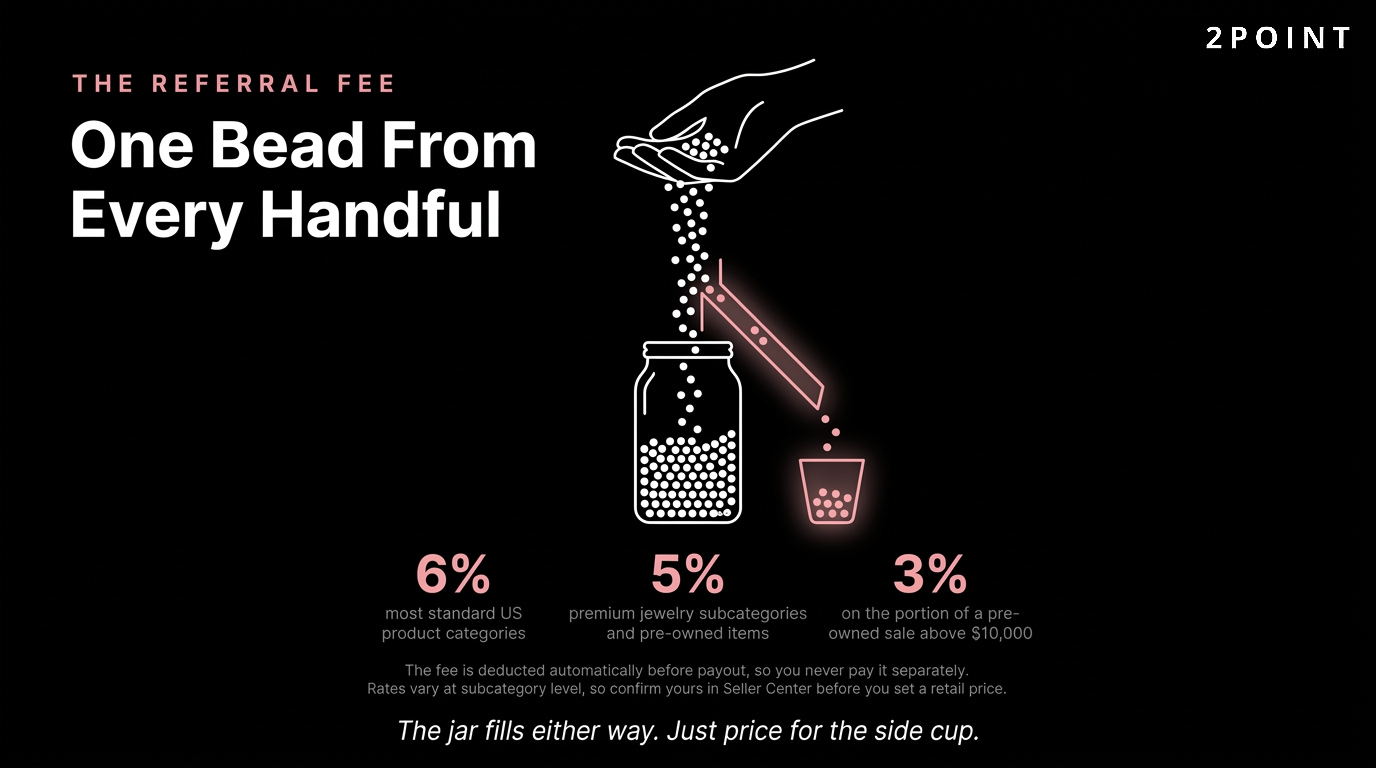
The primary cost of selling on TikTok Shop is the referral fee, which is charged as a percentage of each completed transaction. The standard US referral fee is 6% per transaction, verified as of October 2025. This fee is automatically deducted from your sale proceeds before payout, so you never pay it separately. You receive the net amount after the referral fee has been applied.
Category-specific rate variations include:
- Most standard product categories: 6%
- Premium jewelry subcategories (diamond, gold, jade, platinum, ruby, sapphire, emerald): 5%
- Pre-owned items: 5% standard rate, with 3% on any portion of the sale price over $10,000
- Some electronics and beauty categories in specific markets: reduced rates may apply
Before finalizing your pricing strategy, confirm the exact referral fee rate for your specific product category within the Seller Center. Rates can vary at the subcategory level, and building your pricing model on an incorrect assumption will compound across every sale you make.
No Subscription Fees and No Listing Costs on TikTok Shop
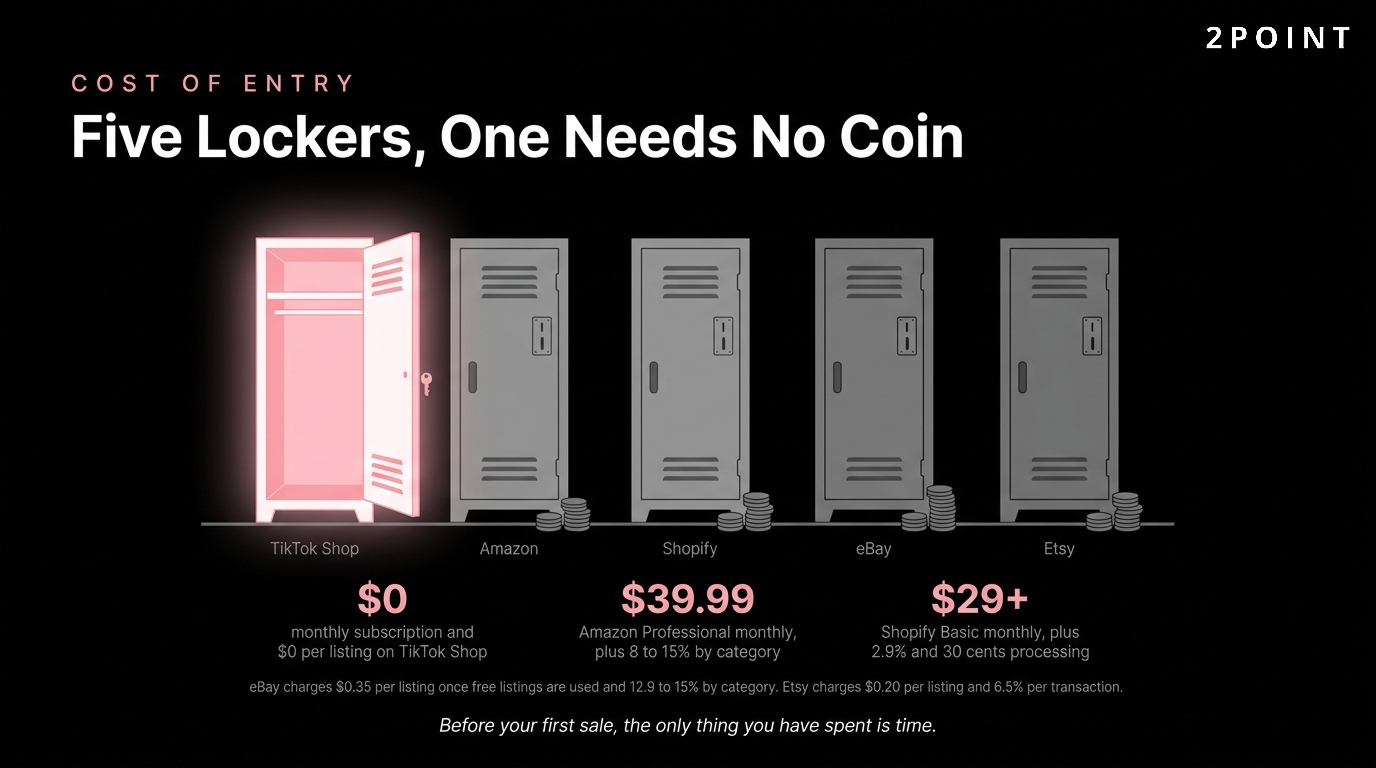
One of the most significant advantages of TikTok Shop for new sellers is the complete absence of monthly subscription fees and per-listing charges. You pay nothing to open your shop, nothing to maintain it month to month, and nothing to add products to your catalog. You only incur costs when you make a sale.
This model contrasts sharply with competing platforms:
| Platform | Monthly Subscription Fee | Per-Listing Fee | Referral/Transaction Fee |
|---|---|---|---|
| TikTok Shop | $0 | $0 | 6% (most categories) |
| Amazon Professional | $39.99 | $0 (with Professional plan) | 8%–15% depending on category |
| Shopify Basic | $29+ | $0 | 2.9% + 30 cents (payment processing) |
| eBay | $0 (basic) | $0.35 after free listings used | 12.9%–15% depending on category |
| Etsy | $0 (basic) | $0.20 per listing | 6.5% transaction fee |
TikTok Shop’s zero-barrier entry model makes it the lowest-risk platform to test product viability, since your only financial exposure before making a sale is the time you invest in setup and content creation.
Additional Transaction Costs Every Seller Must Account For
Beyond the referral fee, several other costs affect your net profitability on TikTok Shop. These are not hidden fees, but they are costs that sellers sometimes underestimate when building their pricing model.
Refund handling is one area that catches new sellers off guard. When a customer receives a refund, TikTok returns the referral fee to the seller, but it retains a refund administration fee of 20% of the original referral fee, capped at $5 per SKU. This means that even on a fully refunded order, you incur a small administrative cost. Building a reasonable return rate assumption into your margin calculations protects your profitability over time.
Other costs to factor into your pricing include:
- Shipping and fulfillment expenses, which are entirely the seller’s responsibility
- Return shipping handling costs depending on your return policy
- Affiliate creator commissions, which range from 5% to 50% and are set by the seller. The typical commission range that sellers offer is 10% to 20%
- Withdrawal fees: $0.05 per bank transfer or 0.9% per PayPal withdrawal
- Optional advertising spend if you choose to run TikTok Shop Ads
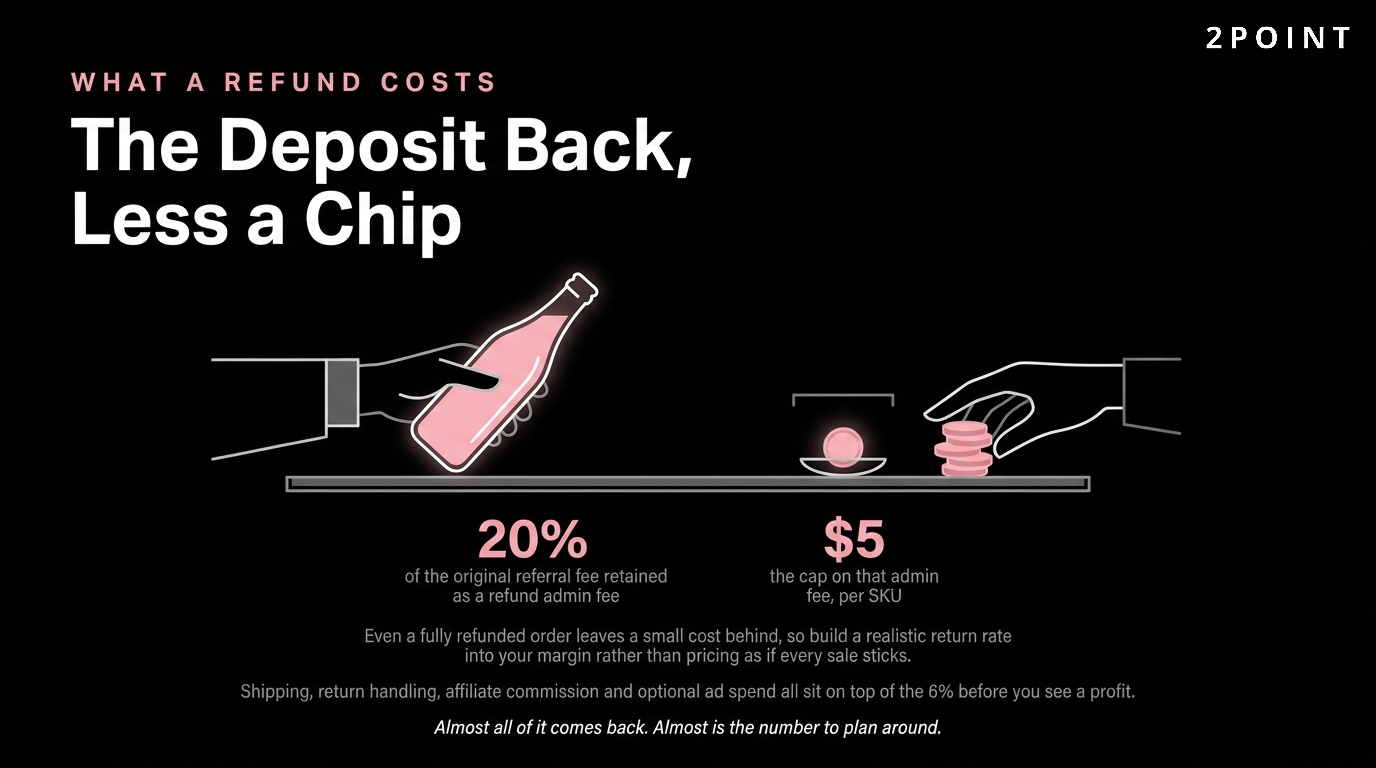
A complete cost model for a typical TikTok Shop sale should account for: product cost, shipping cost, 6% referral fee, affiliate commission (if applicable), and an estimated return rate adjustment. Running this calculation before setting your retail price ensures you are building a sustainable margin, not just chasing gross revenue.
International Fee Comparison Across TikTok Shop Markets
If you are considering selling in multiple markets or planning international expansion, understanding how fees vary by country is important for market prioritization. The following table summarizes referral fee ranges across supported TikTok Shop markets.
| Market | Standard Referral Fee Range | Notes |
|---|---|---|
| United States | 6% (most categories) | 5% for premium jewelry and pre-owned items |
| United Kingdom | 9% standard | 5% for select electronics and beauty |
| Singapore | 4%–6% | Category-dependent |
| Malaysia | 3%–6% | Category-dependent |
| Indonesia | 1%–8% | Wide range based on product type |
| Thailand | 2%–5% | Category-dependent |
| Vietnam | 1%–3% | Lowest fee market currently available |
The UK market carries the highest standard referral fee at 9%, which significantly impacts margin calculations for sellers considering cross-border expansion, while Southeast Asian markets generally offer more favorable fee structures for high-volume categories.
—
How to Add and Optimize Product Listings on TikTok Shop
Your product listings are the foundation of every sale you make on TikTok Shop. Whether a customer discovers your product through a video, a live stream, or direct catalog browsing, the listing they land on needs to communicate value quickly and remove every barrier to purchase. Optimization at the listing level directly impacts your conversion rate and your overall shop performance score within the platform’s algorithm.
The Product Upload Process in TikTok Seller Center
Adding products to your TikTok Shop catalog is done through the Seller Center’s product management section. The process is designed to be accessible even for sellers with no prior e-commerce experience, though taking time to do it carefully pays dividends in both searchability and conversion.
Follow these steps for each product you add:
- Navigate to the Product Management section within Seller Center
- Click “Add New Product” and select the appropriate category and subcategory
- Upload product images (minimum of three angles recommended)
- Enter a product title that leads with the primary keyword customers would search for
- Write a product description using a skimmable format with bullet points for key features
- Set your retail price, factoring in the 6% referral fee, shipping costs, affiliate commissions, and your desired profit margin
- Enter inventory quantities for each product variant
- Configure your shipping options, rates, and estimated delivery windows
- Link the product to any existing TikTok videos where it is featured or will be featured
Accurate inventory tracking is critical from day one. Overselling products you do not have in stock damages your seller score and triggers negative reviews, both of which affect your visibility within TikTok Shop’s ranking system.
Product Photography Best Practices for TikTok Shop
In a platform dominated by video, it might be tempting to invest all of your visual effort in your content creation and treat product photography as an afterthought. Do not make that mistake. Your product images serve as the static representation of your brand in every order confirmation, search result, and catalog view. Poor photography undermines trust even when your videos are excellent.
Follow these photography guidelines for every product in your catalog:
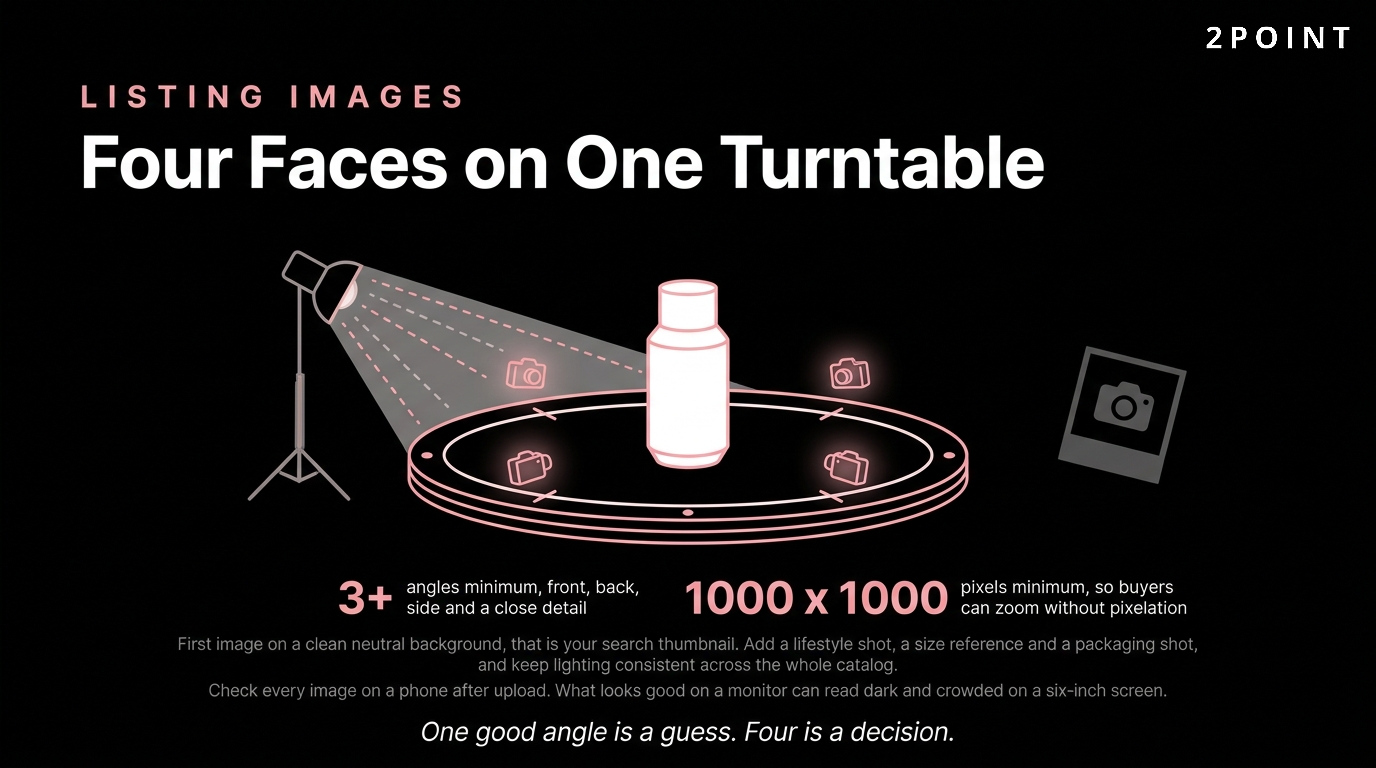
- First image: Clean, white or neutral background with the product clearly centered and fully visible. This is the thumbnail that appears in search results.
- Multiple angles: Include front, back, side, and at least one close-up detail shot for any product where texture, stitching, hardware, or finish is a selling point.
- Lifestyle images: Show the product in real-world use to help customers visualize it in their own lives. These images address the “will this work for me?” question before it becomes an objection.
- Size reference: For any product where scale matters, include an image with a recognizable reference object or a model to establish size clearly.
- Packaging photos: A shot of the packaged product builds buyer confidence and sets realistic delivery expectations, reducing “not as described” complaints.
- Resolution: Use a minimum of 1000×1000 pixels so customers can zoom without images becoming pixelated.
- Lighting consistency: Keep lighting consistent across your entire product line so your catalog looks cohesive and professional.
Because the vast majority of TikTok users shop on mobile devices, view your product images on a phone screen after uploading them. What looks great on a desktop monitor can appear dark or crowded on a 6-inch screen. Mobile-first review of your images is a simple step that catches problems before customers see them.
Writing High-Converting Product Descriptions
A well-written product description answers the questions a customer is already asking before they decide to buy. The goal is not to impress anyone with creative writing. The goal is to eliminate uncertainty and make the decision to purchase feel easy and obvious. Your product descriptions are a key element of your digital content strategy on the platform.
Structure your descriptions using this proven format:
- Opening line: Lead with the single most compelling benefit or the key problem your product solves. Do not open with the product name or a generic greeting.
- Feature bullets: List three to five key product features in short, scannable bullet points. Each bullet should communicate one specific benefit.
- Technical specifications: Include dimensions, materials, weight, care instructions, compatibility notes, or any other spec that a buyer would need to confirm before purchasing.
- Frequently asked questions: Address the two or three questions you receive most often, either in a dedicated FAQ block or woven into the description naturally.
- Urgency or scarcity: If you have genuine limited stock or a time-limited offer, mention it here. Manufactured scarcity erodes trust, but authentic scarcity converts well.
Keep paragraphs short and use white space generously. Most customers will skim your description rather than read it word for word. Format it so that a skimmer still captures your key selling points.
Storefront and Catalog Optimization for Maximum Visibility
Your shop storefront is more than a product container. It is a brand experience that either builds trust or fails to. Customers who visit your storefront directly, whether through your TikTok profile or through a search within the platform, are making a judgment about your brand’s legitimacy and professionalism in seconds. Make those seconds count.
Storefront optimization priorities include:
- Writing a compelling brand story section that explains who you are, what you sell, and why customers should choose you over alternatives
- Highlighting your key differentiators: fast shipping, premium materials, exceptional customer service, or unique product design
- Organizing your catalog into clear categories so customers can browse efficiently without having to scroll through everything at once
- Featuring your best-selling or highest-reviewed products prominently on your storefront homepage
- Keeping inventory quantities accurate and updated in real time to avoid overselling
- Using high-quality banner images that are consistent with your overall brand identity
- Adding relevant keywords to your shop description to improve visibility within TikTok’s internal search
- Displaying clear shipping timelines and return policies so customers know what to expect before they buy
Incorporating social proof into your storefront is one of the highest-impact optimizations available to you. Customer reviews, star ratings, and user-generated content all signal trustworthiness to prospective buyers who have no prior relationship with your brand. Encourage satisfied customers to leave reviews and, where possible, tag your products in their own TikTok content.
—
TikTok Shop Selling Methods: Choosing the Right Strategy to Sell Products on TikTok
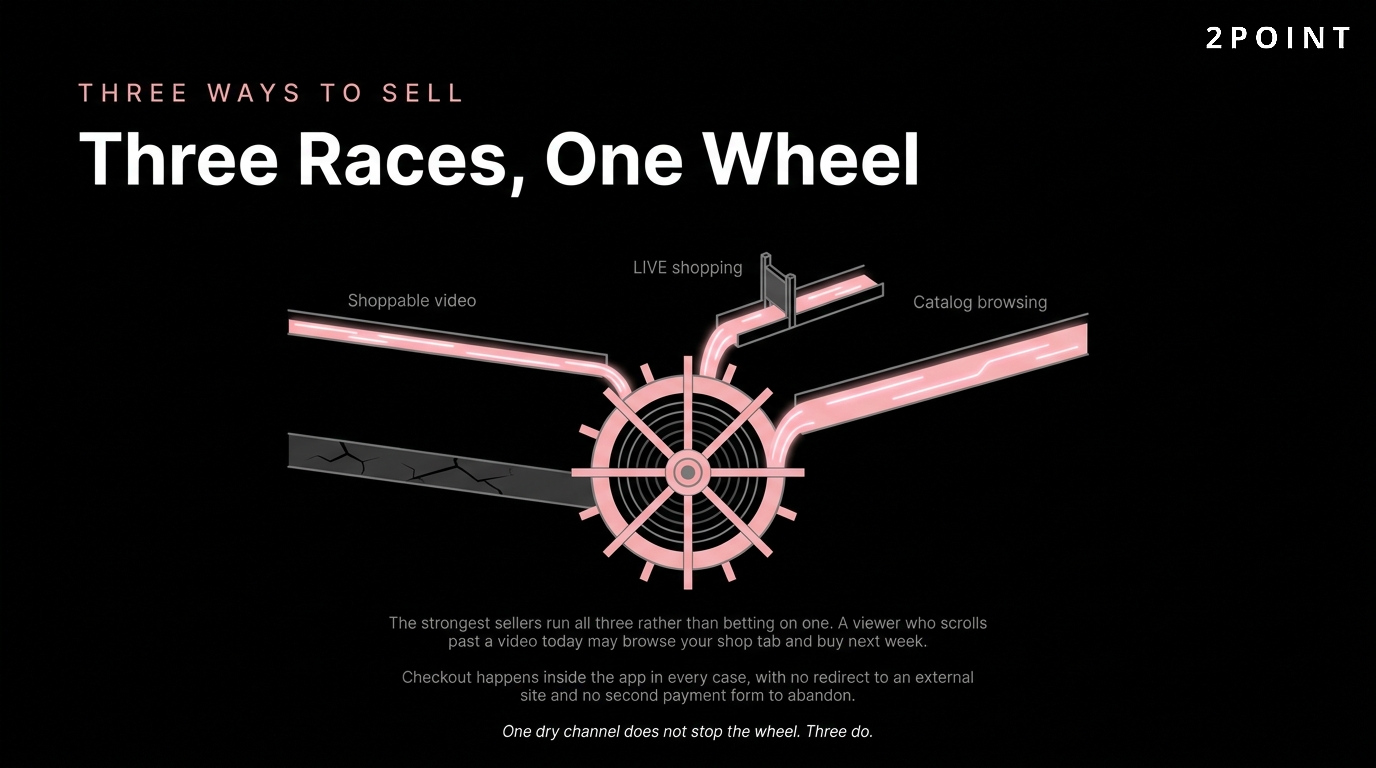
TikTok Shop supports three distinct selling mechanics, and the most successful sellers typically use all three in combination rather than relying on a single approach. Understanding how each method works, and which is best suited to your current resources and goals, allows you to allocate your energy where it will produce the fastest results.
Shoppable Video Strategy: Turning Content Into a Sales Channel
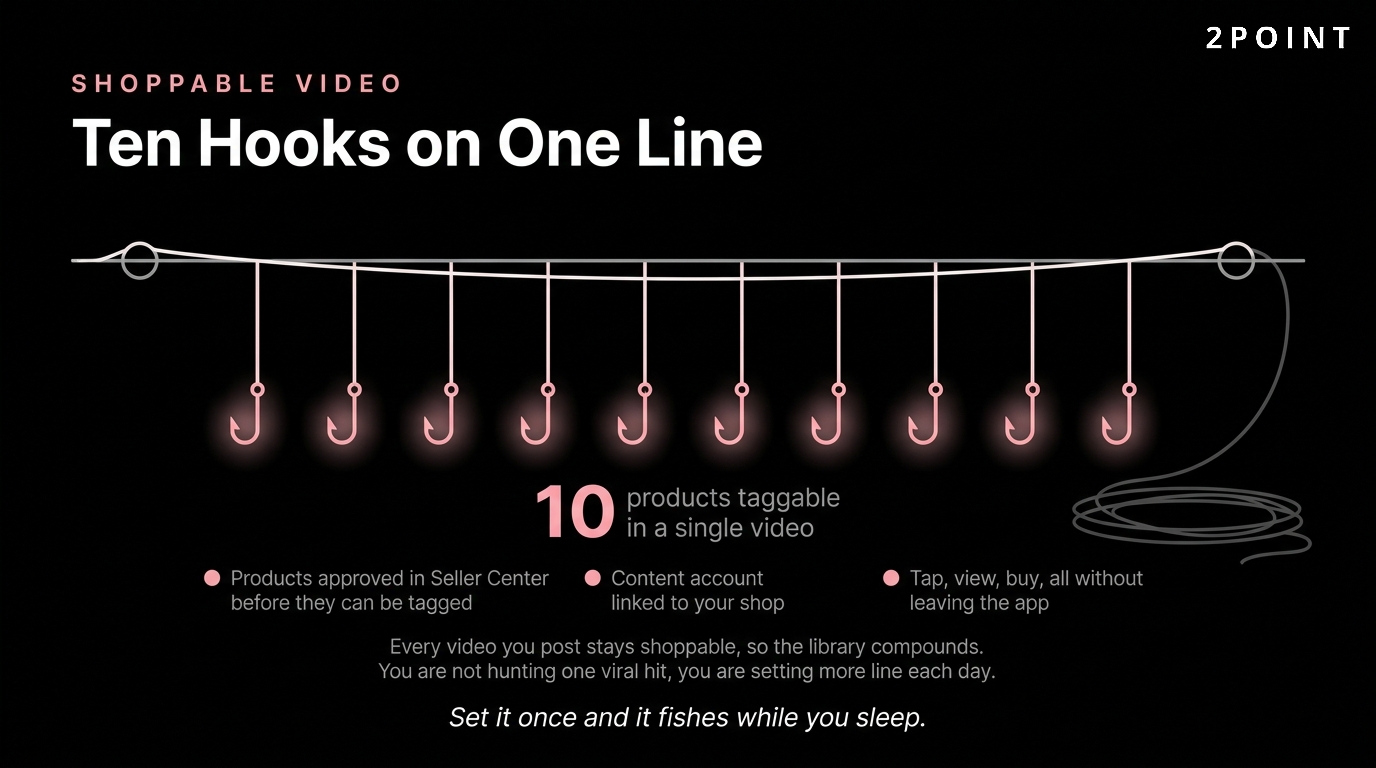
Shoppable videos are the most accessible entry point for new sellers who have an existing TikTok content account. The mechanic is simple: you tag products directly in organic TikTok videos, and a product overlay appears during playback. Viewers can tap the tag, view the product listing, and complete a purchase without ever leaving the TikTok app. The entire discovery-to-purchase journey happens in a single scroll session.
Key operational details for shoppable videos:
- Products must be uploaded and approved in Seller Center before they can be tagged in videos
- Your TikTok content account must be linked to your Seller Center shop
- You can tag up to 10 products in a single video
- TikTok handles the entire checkout and payment processing within the app
- Product tags appear as a small overlay that does not obstruct the video content significantly
The shoppable video approach is best suited to sellers who can commit to a consistent content creation schedule. You do not need every video to go viral. Consistent posting builds cumulative reach, trains the algorithm to distribute your content to relevant audiences, and creates an ever-growing library of shoppable assets working for you around the clock. Think of each video as a salesperson who never sleeps and never asks for a salary.
TikTok LIVE Shopping Mechanics and Best Practices
TikTok LIVE shopping is the format most associated with explosive single-session revenue numbers. During a live stream, sellers can demonstrate products in real time, answer viewer questions, create time-limited offers, and pin specific products for immediate purchase. The combination of real-time persuasion, social proof from other viewers, and frictionless in-app checkout creates conversion dynamics that are difficult to replicate in any other format.
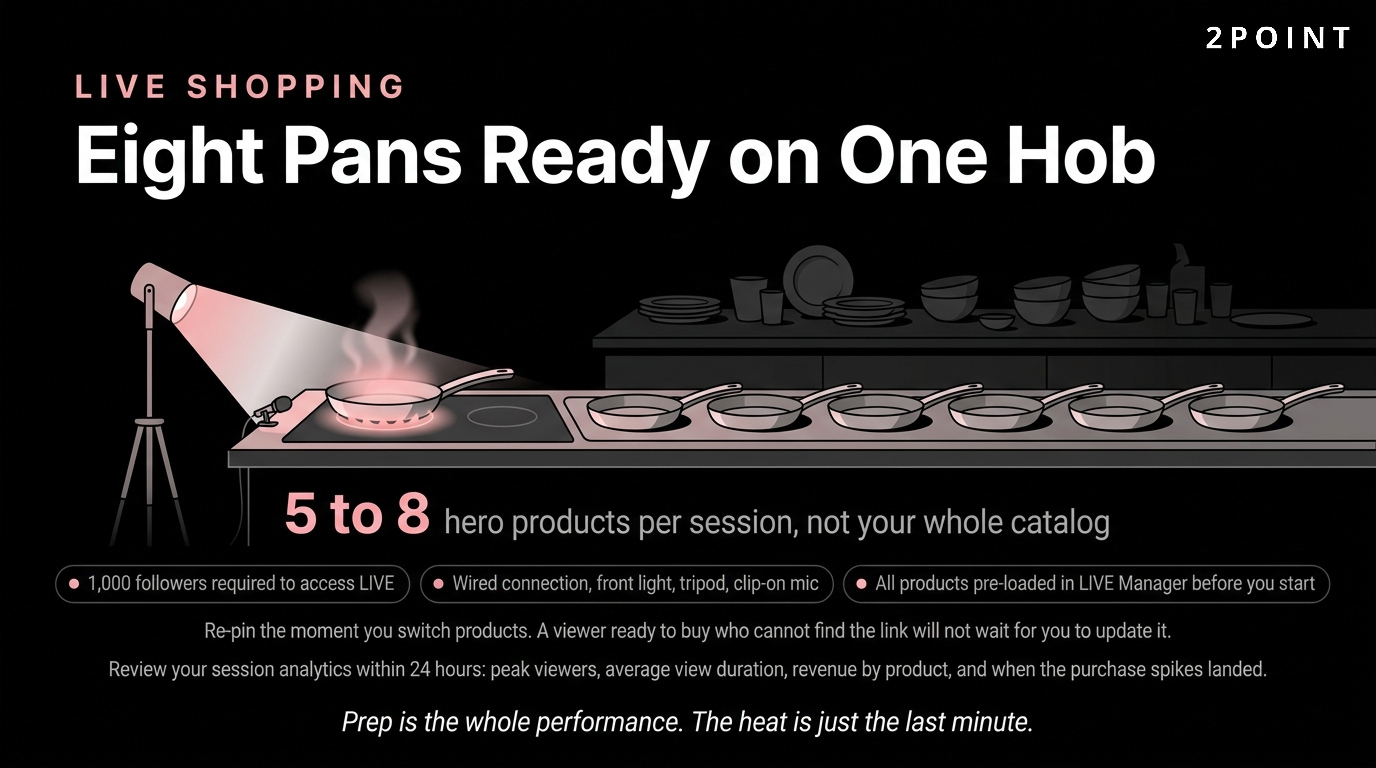
Understanding the technical requirements for LIVE selling is important. The TikTok LIVE feature requires a minimum of 1,000 followers to access, even though there is no follower minimum to open a TikTok Shop seller account. This means new sellers with fewer than 1,000 followers will need to build their audience through regular content posting before they can access this selling format. The investment is worth it: LIVE shopping sessions drive some of the highest average order values and strongest conversion rates on the platform.
Planning a successful LIVE shopping session requires:
- Selecting a focused lineup of five to eight hero products rather than trying to showcase your entire catalog
- Promoting the scheduled live time in advance using teaser videos posted in the days leading up to the broadcast
- Using LIVE Manager to pre-load all products and prepare your talking points before going live
- Pinning each product clearly on screen as you begin demonstrating it
- Demonstrating products in action rather than simply describing them verbally
- Engaging actively with viewer comments and questions throughout the broadcast
- Creating genuine urgency through limited-time pricing or quantity constraints during the session
The more natural and conversational your LIVE sessions feel, the better they typically perform. Viewers who tune into TikTok LIVE shopping are not looking for a polished infomercial. They respond to authenticity, energy, and the sense that they are part of a real-time shared experience.
Product Catalog Browsing as a Standalone Sales Channel
Beyond shoppable videos and LIVE sessions, TikTok Shop also functions as a standalone product catalog that customers can browse directly through your shop tab. This browsing experience operates somewhat like a miniature storefront within the TikTok app, and it is particularly valuable for brands with diverse product lines that benefit from organized category navigation.
Catalog browsing is less dependent on viral content performance than the other two selling methods. Customers who find your products through TikTok’s internal search or through following your profile directly are often already motivated buyers who have moved past the discovery phase. Optimizing your catalog for search within TikTok, using relevant keywords in product titles and descriptions, helps capture this demand without relying entirely on algorithm-driven distribution.
The catalog channel complements video and LIVE strategies rather than replacing them. A viewer who watches one of your product videos but does not purchase immediately may visit your shop tab later and browse before deciding to buy. Maintaining a well-organized, fully stocked catalog ensures that this consideration-to-purchase journey ends with a conversion rather than a dead end.
Selling on TikTok Shop Without Inventory Using Print-on-Demand
For sellers who want to test the TikTok Shop opportunity without committing to inventory investment, print-on-demand partnerships offer a low-risk entry point. Platforms like Printify integrate directly with TikTok Shop, allowing you to create and list custom products (apparel, accessories, home goods) without purchasing stock in advance.
The print-on-demand model works as follows: a customer purchases a product from your TikTok Shop, the order is automatically transmitted to your fulfillment partner, the partner produces and ships the item directly to the customer, and you receive the margin between your retail price and the production cost. You never touch the inventory, never manage a warehouse, and never risk capital on products that do not sell.
This approach is particularly well suited to creators, side hustlers, and new entrepreneurs who want to validate product concepts before scaling into full inventory management. Start with one or two hero designs, test them with organic content, and let real sales data tell you which products deserve investment in larger inventory runs. The goal in the print-on-demand phase is learning, not maximizing margins.
—
TikTok Shop Content Strategy: How to Create Videos That Drive Sales
Content is the engine of TikTok Shop. Without a consistent stream of engaging videos, your products sit in a catalog that nobody visits. With great content, your products reach millions of potential buyers at essentially zero cost per impression. Understanding how to create content that the TikTok algorithm favors, and that converts viewers into buyers, is the most important skill set you can develop as a TikTok Shop seller.
High-Frequency Posting Strategy for Product Sellers
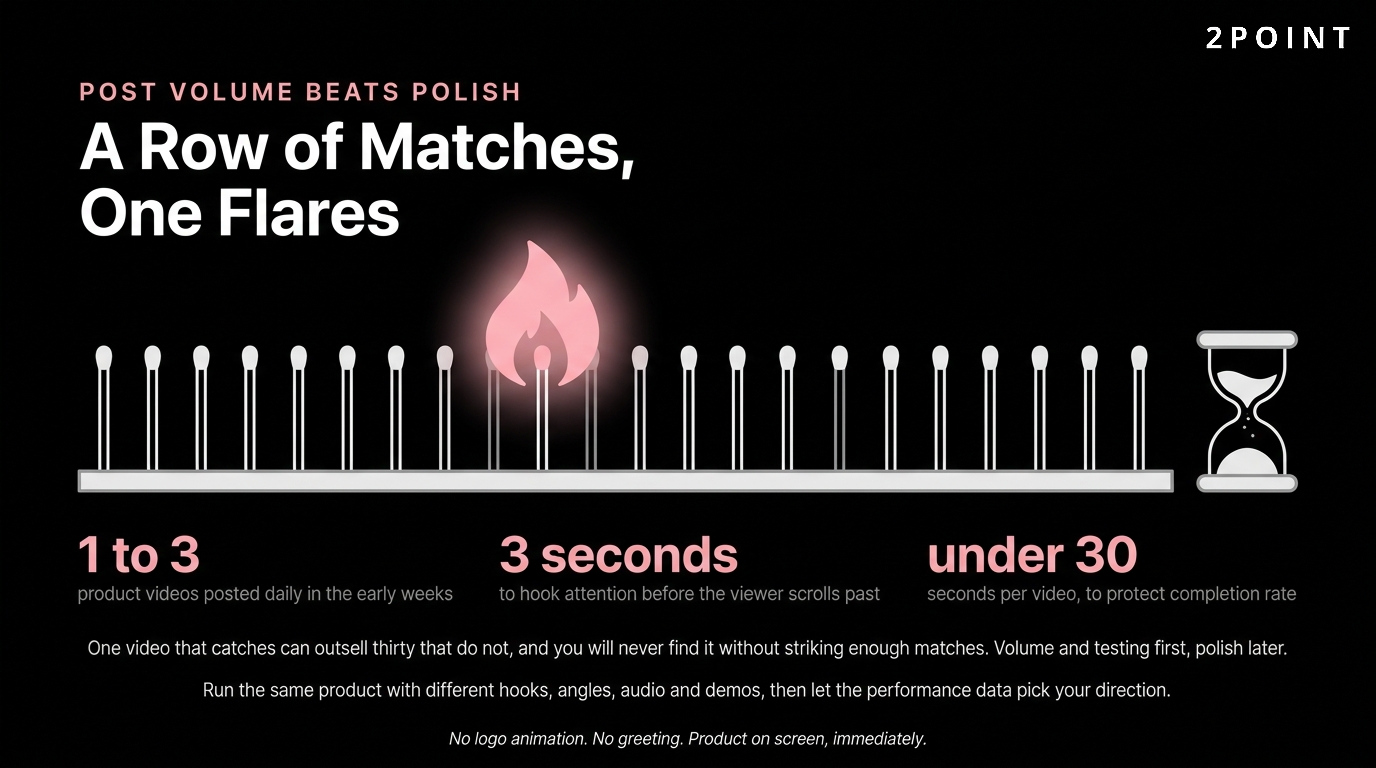
The single most common mistake new TikTok Shop sellers make is posting infrequently and waiting to see results before committing to more content. TikTok’s algorithm rewards consistent posting volume because it gives the platform more data to work with when determining how to distribute your content. Sellers who post one to three product videos daily consistently outperform those who post two or three videos per week, even when per-video quality is higher for the lower-frequency creators.
Your goal in the early weeks should be volume and testing, not perfection. Every video is a data point that tells you something about what your target audience responds to. One viral video can generate more sales in 48 hours than 30 mediocre videos combined, and you will not find that viral video without testing enough approaches to discover what works.
The most important creative principle in TikTok content is the 3-second hook rule: if your video does not capture viewer attention within the first two to three seconds, the viewer has already scrolled past. This means your product needs to appear on screen early, your opening visual needs to be arresting, and your hook line needs to immediately signal relevance to the viewer’s interests or needs. Do not spend your first three seconds on a logo animation, a greeting, or any preamble that delays the substance of your content.
For testing, create multiple versions of the same product video with different opening hooks, different camera angles, different background music, or different demonstration approaches. Run all versions and let performance data guide your content direction. Keep videos under 30 seconds initially to optimize for completion rate, which is a key signal the algorithm uses to measure content quality.
Content Formats That Convert Viewers Into TikTok Shop Buyers
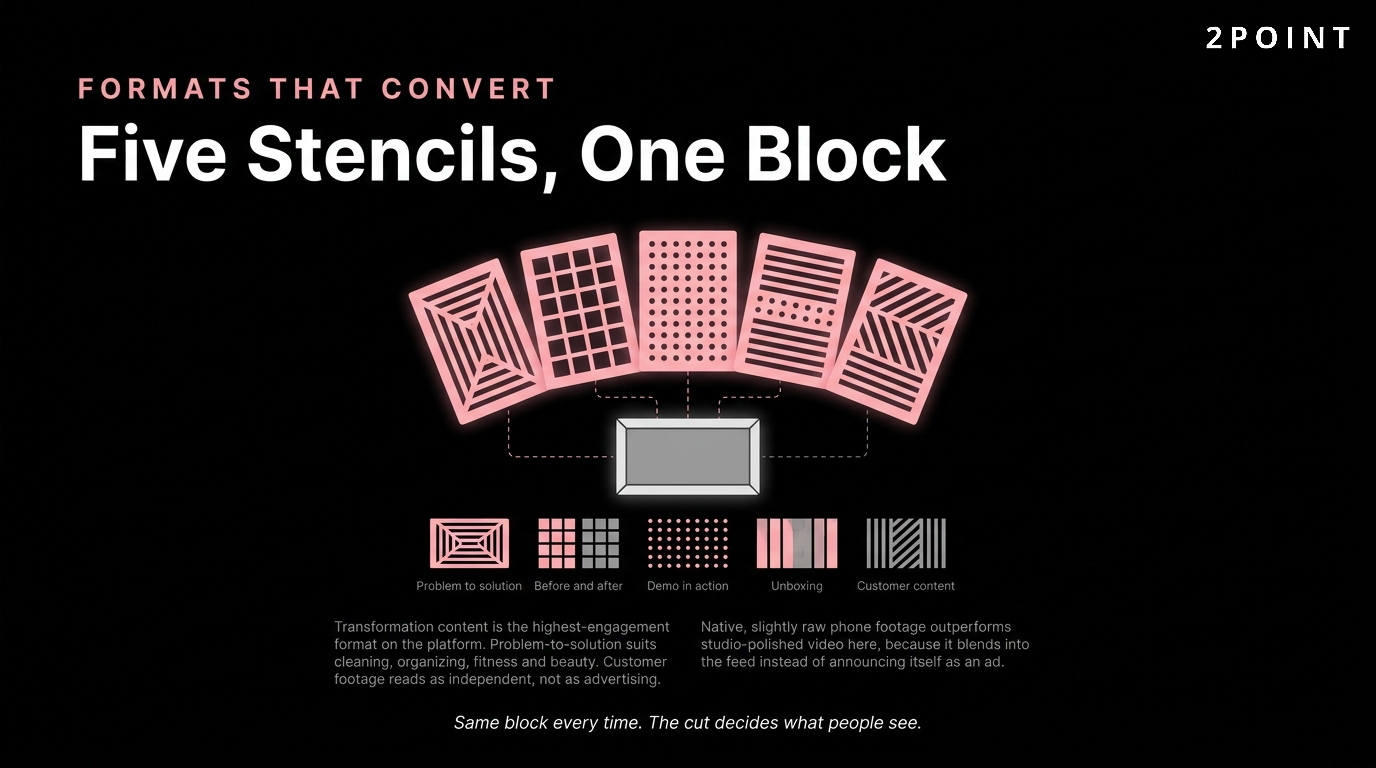
Certain content formats consistently outperform others when the goal is driving product sales rather than simply generating views. Understanding which formats align with which product types allows you to build a content calendar that is both strategically sound and creatively sustainable.
The most effective conversion-focused content formats include:
- Problem-to-solution: Open by showing or describing a specific pain point your viewer likely experiences. Then demonstrate exactly how your product resolves it. This format works exceptionally well for cleaning products, organizational tools, fitness equipment, beauty solutions, and any product that solves a daily frustration.
- Before-and-after: Visual transformation content is among the highest-engagement format on TikTok. If your product produces a visible result, show the before state and the after state with a clear contrast. This format is particularly powerful in beauty, home organization, fitness, and food categories.
- Demo in action: Show the product being used in a realistic, relatable scenario. The more naturally the demo fits into everyday life, the more viewers can picture themselves using it.
- Unboxing and first impressions: Authentic reactions to product unboxing generate strong engagement because they mirror the customer experience and create vicarious excitement about receiving the product.
- User-generated content: Customer testimonials and reviews filmed in native TikTok style carry significant credibility because they read as independent endorsements rather than brand marketing.
On the production side, do not let the pursuit of high production quality become a barrier to posting volume. Native, slightly raw content filmed on a smartphone consistently outperforms polished, studio-quality videos on TikTok because it blends naturally into the user’s feed. A video that looks like it was made by a real person using a product in their own home generates more trust than content that looks like a traditional advertisement.
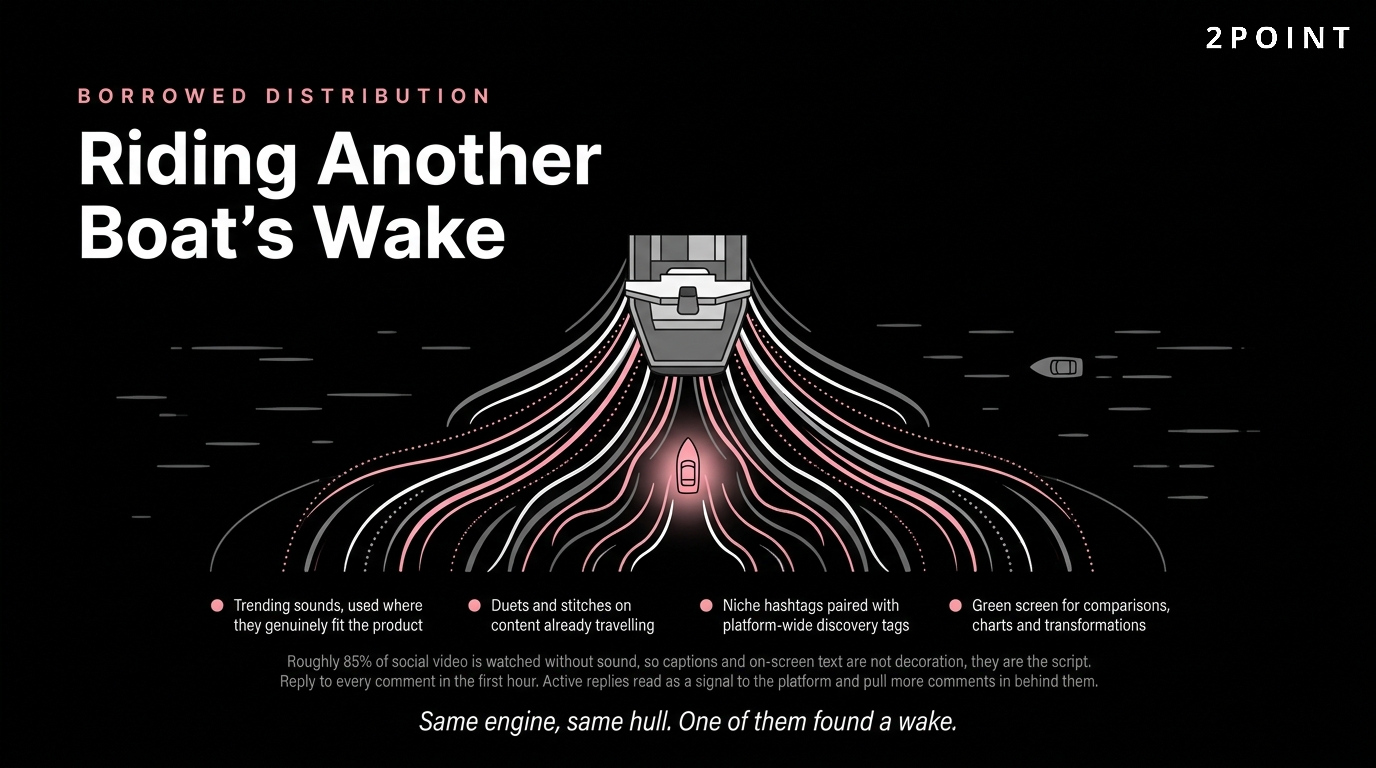
Technical optimization details that improve performance across all formats include adding captions (research indicates that approximately 85% of social media video is watched without sound), using trending audio tracks where relevant to increase For You Page placement probability, and editing within the native TikTok app, which the platform’s algorithm is known to reward with additional distribution.
Leveraging TikTok Features to Maximize Organic Reach
TikTok offers a range of native features that can amplify your content’s reach when used strategically. Rather than ignoring these tools, incorporate them into your regular content workflow to take advantage of the additional distribution signals they send to the algorithm.
High-impact TikTok features for product sellers include:
- Trending sounds: Using popular audio tracks can significantly increase your For You Page placement probability. Monitor TikTok’s trending sounds section regularly and incorporate relevant tracks into your content where they fit naturally with your product or brand tone.
- Hashtags: Use a combination of niche-specific hashtags and broader discovery tags. For example, pair a specific product category hashtag with #TikTokShop to capture both community-specific and platform-wide search traffic.
- Duets and stitches: Engaging with trending content through Duets and Stitches allows you to ride the distribution wave of an already-viral video while adding your own product-relevant perspective.
- Text overlays: Use on-screen text to emphasize key selling points, particularly for viewers watching without sound. Overlays also create visual interest that improves watch time.
- Green screen effects: The green screen effect allows you to use product images, comparison charts, or before-and-after visuals as your video background while you speak directly to camera, combining demonstrative and conversational content styles.
Engagement behavior also functions as an algorithm signal. Responding to every comment on your videos, particularly in the first hour after posting, signals active creator engagement to the platform and typically results in broader distribution. A comment reply that addresses a common question can also generate additional comments, extending the organic reach of your content without any additional spend.
Content Testing and Performance Iteration
Sustainable TikTok Shop success is built on a cycle of testing, measuring, learning, and iterating rather than on one-time creative inspiration. The sellers generating consistent revenue are not necessarily the most talented content creators. They are the most systematic testers who have built a process for identifying what works and scaling it.
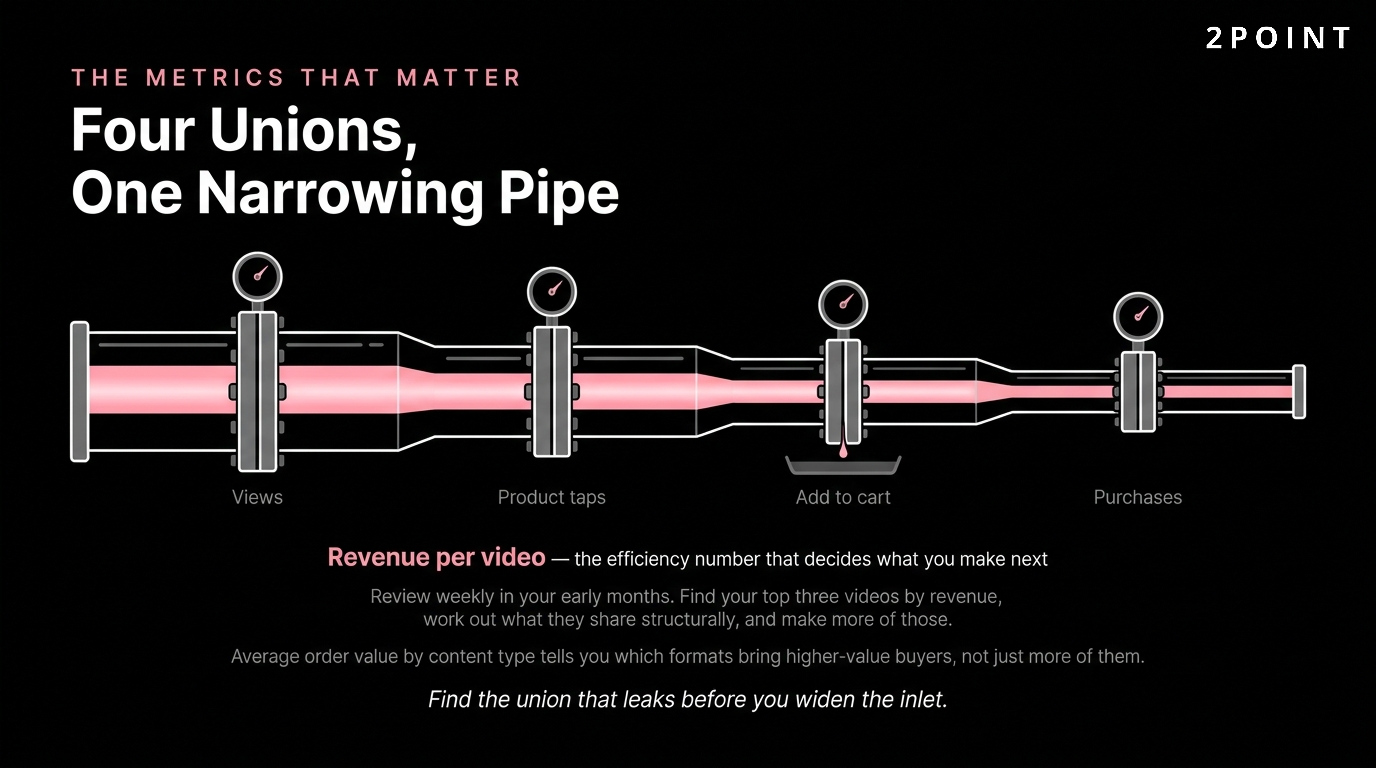
The metrics that matter most for a TikTok Shop seller, ordered by their position in the customer journey, are:
- Video views and reach (top of funnel: are the right people seeing this content?)
- View-to-product-tap rate (are viewers engaging with the product link?)
- Product-tap-to-cart rate (are viewers interested enough to add to cart?)
- Cart-to-purchase conversion (are they completing the transaction?)
- Average order value by content type (which formats drive higher-value purchases?)
- Revenue per video posted (which is your most important efficiency metric overall?)
Review these metrics at least weekly in your early months of selling. Identify your top three performing videos in terms of revenue generated, study what they have in common, and produce more content using those same structural elements. Kill underperforming approaches quickly rather than continuing to invest time in formats that your audience is not responding to. Seasonal content planning, timed to coincide with major shopping events, product launch moments, and culturally relevant trends, adds another layer of strategic timing to your content calendar.
—
TikTok Shop Affiliate Program Strategy: Building a Network of Creator Partners
The TikTok Shop affiliate program is not an optional growth lever for serious sellers. It is the primary driver of sales at scale. According to platform data, 60 to 70% of US gross merchandise value on TikTok Shop is driven by affiliate creators. This means that for every dollar sold on the platform across all US sellers, the majority of it is attributed to a creator who promoted someone else’s product. Building a strong affiliate network is not just a nice-to-have addition to your strategy. For most sellers, it is the primary growth engine.
How the TikTok Shop Affiliate Program Works for Sellers
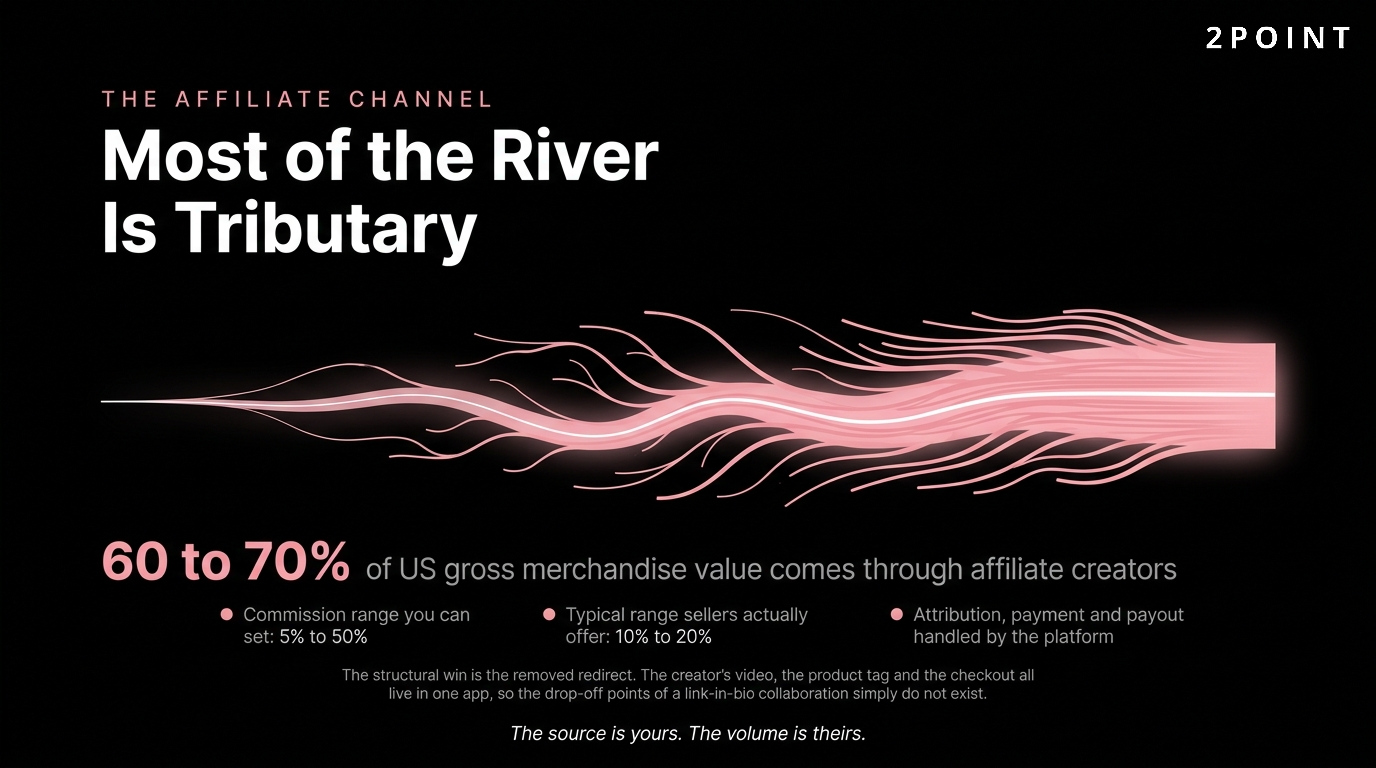
The TikTok Shop affiliate program enables independent creators to promote your products through their own videos and live streams. When a viewer purchases a product through a creator’s content, TikTok’s attribution system records the sale, credits it to the creator, and automatically pays their commission from your payout. You set the commission rate, you approve which creators can access your products, and the platform handles all attribution and payment logistics.
The key structural advantage of the TikTok Shop affiliate program over traditional influencer collaborations is the elimination of the off-platform redirect. In standard influencer collaborations, a creator promotes a product, viewers must click a link in bio or swipe up to a landing page, enter payment information on a separate website, and complete checkout in a different application. Each of these steps represents a drop-off point where a motivated buyer can be lost. In TikTok Shop’s affiliate model, all of these steps collapse into a single in-app experience: the creator’s content, the product tag, and the checkout are all within TikTok. This dramatically reduces conversion friction and is a significant reason why the affiliate channel drives such a dominant share of platform revenue.
Setting Up Your Affiliate Program in Seller Center
Configuring your affiliate program in Seller Center is straightforward, but the strategic decisions you make during setup will determine how effectively you attract and motivate creators to promote your products.
Follow these steps to enable affiliate selling:
- Access Seller Center and navigate to the Affiliate section
- Enable individual products for affiliate promotion (you can exclude products you prefer to sell direct)
- Set commission rates for each product (5% to 50% range, with 10% to 20% being typical)
- Choose your collaboration type: Open Market, Target Collaboration, or both
- Review and approve or decline creator applications where applicable
Understanding the two primary collaboration types helps you make the right strategic choice:
| Collaboration Type | How It Works | Best For | Trade-Off |
|---|---|---|---|
| Open Market | Any eligible creator can find and promote your products | Maximum reach, passive exposure, testing product-market fit | Less predictable posting frequency and brand alignment |
| Target Collaboration | You invite specific creators and offer them personalized terms | Relationship-based partnerships, consistent brand-aligned promotion | Requires more management effort, typically higher commission rates |
Most successful sellers use both collaboration types simultaneously: Open Market provides passive exposure while Target Collaboration with selected creators provides consistent, brand-aligned promotional activity.
Affiliate Commission Strategy: Setting Rates That Attract Creators Without Destroying Margins
Your commission rate is the primary factor that determines whether creators choose your products over a competitor’s. Creators who promote TikTok Shop products typically browse the affiliate marketplace looking for products that offer competitive commissions, strong conversion potential, and appealing customer reviews. A low commission rate will result in your products being overlooked by the creators who drive the most sales volume.
The commission rate decision involves balancing several factors:
- Product margins: Your commission must leave you profitable after subtracting the 6% referral fee, product cost, shipping, and any advertising spend
- Competitive rates in your category: If similar products are offering 15% and you offer 8%, creators will promote competitors instead
- Desired creator quality: Higher commission rates attract more established creators with larger audiences
- Product price point: Higher-priced products can support lower percentage commissions while still delivering meaningful absolute dollar earnings to creators
A practical approach for new sellers is to launch with a slightly above-market commission rate (for example, 15% when the category average is 10% to 12%) to establish early traction and attract creators while your shop’s review count is still low. Once you have accumulated social proof through sales and reviews, you can test reducing your commission rate incrementally while monitoring whether creator promotion volume declines.
For Target Collaborations with high-performing creators, consider offering bonuses tied to sales volume thresholds. A creator who generates $5,000 in sales in a month might earn their standard 12% commission plus an additional $200 bonus. These performance incentives cost you nothing unless the creator is delivering results, and they create strong motivation for creators to prioritize your products in their content planning.
Finding and Recruiting the Right Affiliate Creators
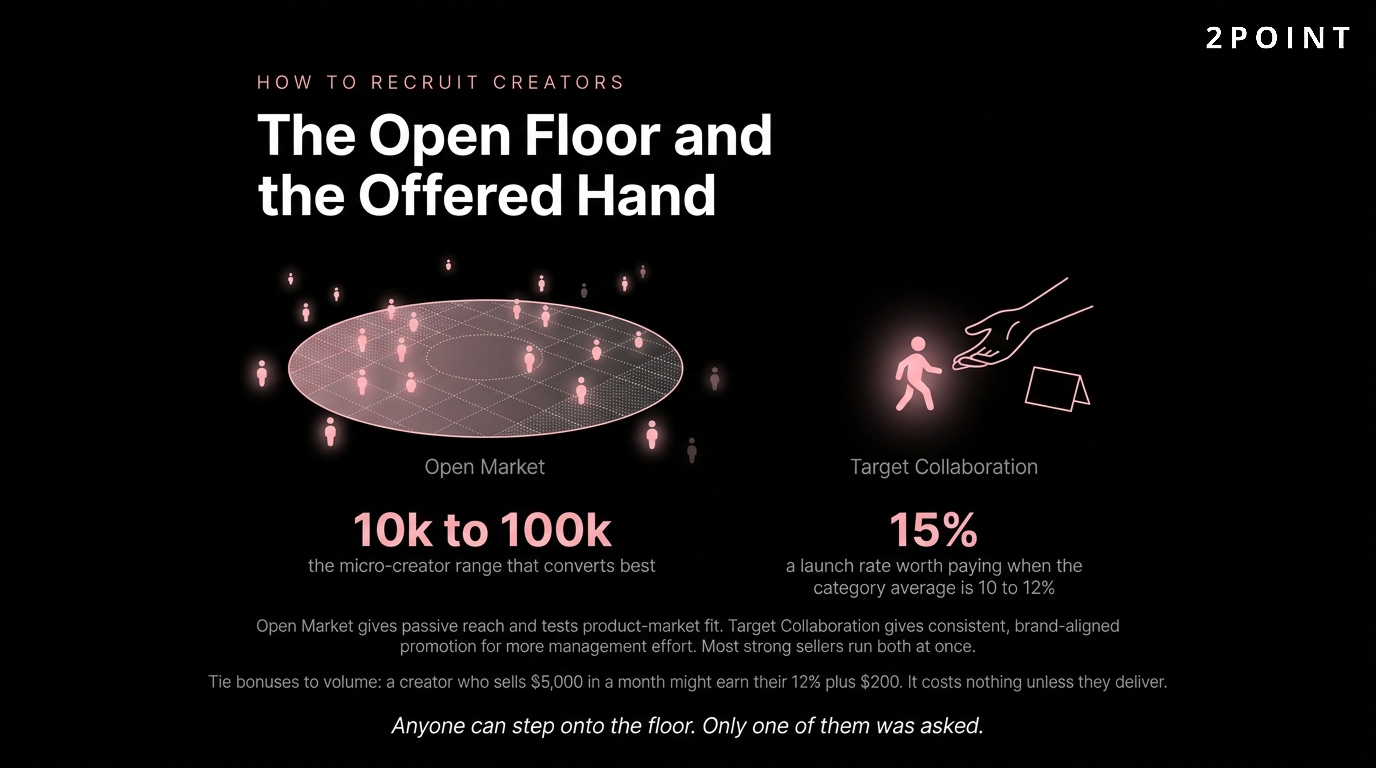
The creators who will drive the most value for your TikTok Shop are not necessarily the ones with the largest follower counts. Micro-creators with 10,000 to 100,000 highly engaged followers in a relevant niche can outperform macro-influencers with millions of followers in terms of conversion rate, because their audience trusts their recommendations more deeply and relates to them as peers rather than celebrities.
When evaluating potential affiliate creators, look for:
- Content that is already aligned with your product category (a beauty creator promoting your skincare line will convert far better than a gaming creator doing the same)
- High engagement rates relative to their follower count (likes, comments, and shares as a percentage of views)
- An existing track record of promoting TikTok Shop products successfully
- Authentic, native content style that does not look like paid advertising
- A posting frequency that suggests they are active and committed to content creation
Within the TikTok Shop Creator Marketplace, you can search for creators by category, follower range, engagement rate, and past affiliate performance. This data takes the guesswork out of outreach and allows you to make evidence-based decisions about who to invite for Target Collaborations. Pair this with a social media marketing plan that aligns your affiliate recruitment with your broader campaign calendar for maximum impact.
Managing and Scaling Your Affiliate Network
Building an affiliate program is an ongoing process, not a one-time setup. The sellers who generate the most consistent affiliate-driven revenue treat creator relationship management as a dedicated function, not an afterthought. As your affiliate network grows, so does the complexity of keeping creators engaged, informed, and motivated to prioritize your products.
Best practices for affiliate program management include:
- Sending regular product updates to your affiliate creators, particularly when you launch new items they might want to promote
- Providing creators with key talking points, product benefits, and approved messaging guidelines without being so restrictive that you eliminate the authentic voice that makes creator content effective
- Monitoring individual creator performance and identifying your top performers for deeper investment through higher commissions or exclusive early access to new products
- Replacing non-performing affiliates regularly rather than carrying a large inactive roster
- Using CRM tools to track creator relationships, communication history, and performance data in one place
- Gathering feedback from creators about what product features customers ask about most frequently. This intelligence is invaluable for improving your product descriptions and identifying future product development opportunities.
Consider the affiliate marketing program as a long-term relationship portfolio rather than a transactional arrangement. The creators who feel genuinely supported by your brand are the ones who continue promoting your products month after month, building sustained revenue rather than one-time promotional spikes.
—
TikTok Live Shopping: How to Host Sessions That Drive Significant Revenue
TikTok live shopping is the format that has generated some of the most dramatic sales stories in social commerce, with some sellers recording five and six-figure revenue in a single broadcast. Understanding what makes these sessions successful, and how to replicate that success systematically rather than hoping for a lucky viral moment, is essential for any seller who wants to use LIVE as a meaningful revenue channel.
Technical Setup and Pre-Live Preparation
A great live shopping session requires both technical preparation and content planning. Technical failures during a live broadcast, such as poor lighting, unstable internet, or awkward product handling, can cause viewers to leave within seconds. Get these fundamentals right before you focus on persuasion and sales technique.
Technical setup essentials:
- Stable, high-speed internet connection (wired preferred over WiFi where possible)
- Good lighting: ring light or softbox positioned in front of you to eliminate shadows on the product
- Clear, uncluttered background that does not distract from the products you are demonstrating
- Tripod or mount to keep the camera stable (shaky handheld footage reduces perceived professionalism)
- Sound quality: a simple clip-on lavalier microphone dramatically improves audio over using only your phone’s built-in microphone
- Pre-loaded product pins in LIVE Manager so you can switch between products quickly without fumbling during the broadcast
Content preparation is equally important. Select your hero products for the session and order them strategically. Lead with your most visually impressive or best-reviewed product to hook viewers early. Build toward your most popular or best-value product as the session’s centerpiece. Know your key talking points for each product, including the primary benefit, the target customer, any special pricing or offers active during the LIVE, and the answers to the questions you receive most frequently.
During the LIVE Session: Engagement and Conversion Tactics
The highest-converting LIVE sessions share a common characteristic: the host creates the feeling of a real-time shared experience rather than a broadcast monologue. Viewers who feel acknowledged and engaged are significantly more likely to purchase than passive observers.
Real-time engagement techniques that drive conversion include:
- Greeting new viewers by name as they join the stream
- Reading and responding to comments out loud so the entire audience benefits from the answer
- Creating interactive moments such as polls, questions for the audience, or demonstrations requested by commenters
- Explicitly acknowledging when viewers express interest in purchasing (“if you want to grab this, tap the link on screen now”)
- Using scarcity authentically: if you have limited stock, state the number remaining and update it in real time as units sell
- Demonstrating products on camera in the most realistic, use-case-relevant way possible
Pin product links actively throughout the session rather than leaving a single product pinned for long periods. When you transition to a new product demonstration, update the pin immediately. Viewers who are ready to buy but cannot find the purchase link will not wait for you to update it. They will scroll away.
Post-Live Analysis and Session Improvement
Every LIVE shopping session generates data that can make your next session more effective. Review your session analytics within Seller Center within 24 hours of each broadcast while the experience is still fresh. Key metrics to analyze include peak concurrent viewership, average view duration, total products sold, revenue by product, and the timing of purchase spikes within the broadcast.
Patterns in this data reveal which products convert best in a live format, which parts of your session lose viewers, and what pricing or scarcity tactics drove the most urgency-based purchases. Use this analysis to refine your product selection, session structure, and pacing for every subsequent broadcast. LIVE shopping is a skill that improves rapidly with deliberate practice and data-driven iteration.
—
How to Use TikTok Seller Center to Manage and Grow Your Shop
TikTok Seller Center is the operational backbone of your TikTok Shop business. Every function related to products, orders, logistics, affiliate partnerships, analytics, and promotions is managed through this dashboard. Becoming proficient with Seller Center is not optional. It is the skill set that separates sellers who grow sustainably from those who scramble reactively every time something changes in their business.
Navigating the Seller Center Dashboard
The Seller Center dashboard is organized into functional modules that correspond to the key operational areas of your business. Familiarize yourself with the location and purpose of each module during your first week of selling, before order volume creates time pressure.
Core Seller Center modules include:
- Product Management: Upload, edit, and organize your product catalog. Manage inventory levels, variants, and pricing.
- Order Management: View, process, and track all customer orders. Handle fulfillment timelines and shipping updates.
- Promotions: Create discount codes, flash sales, and bundle offers. Set up participation in platform-wide shopping events.
- Affiliate: Configure your affiliate program, set commission rates, review creator applications, and monitor affiliate performance.
- Analytics: Access traffic data, sales performance, conversion funnel metrics, and content attribution reports.
- Finance: Review earnings, request withdrawals, and access transaction histories.
- Customer Service: Manage buyer inquiries, dispute resolution, and review responses.
Your brand sentiment on TikTok Shop is directly influenced by how consistently and professionally you handle customer service interactions within Seller Center. Response time, resolution rate, and review scores all factor into your shop’s standing on the platform.
Using Seller Center Analytics to Make Data-Driven Decisions
The analytics capabilities within Seller Center give you visibility into every stage of your sales funnel. Rather than guessing which products are performing and why, you can see exactly where customers are coming from, which content is driving the most sales, and where in the purchase process you are losing buyers.
Key analytics use cases for TikTok Shop sellers include:
- Identifying your top-performing products by revenue and conversion rate (double down on what is already working)
- Tracking traffic sources to understand whether your sales are coming from organic video, LIVE sessions, affiliate creators, or direct catalog browsing
- Monitoring your shop’s review score and identifying products with below-average ratings that need attention
- Analyzing which affiliate creators are generating the most revenue per post so you can invest more deeply in those relationships
- Tracking seasonal patterns in your category to inform future inventory and content planning decisions
Pair your Seller Center analytics with a broader digital advertising strategy to understand how paid promotion complements your organic sales and affiliate channel performance. Many established TikTok Shop sellers run Spark Ads, which boost organic content that is already performing well, rather than running purely promotional ad creatives. This approach preserves the authentic native feel of the content while dramatically extending its reach.
—
What Products Sell Best on TikTok Shop and How to Choose Your Niche
Not every product is well suited to TikTok Shop’s discovery-driven, video-first commerce model. The products that consistently perform best share a common set of characteristics that make them inherently compelling to show and demonstrate in short-form video content. Understanding these characteristics helps you evaluate your existing product catalog or choose the right niche if you are starting from scratch.
Product Categories Driving the Most TikTok Shop Sales
While TikTok Shop’s open catalog model means virtually any product category can find an audience, certain categories consistently outperform because they are visually compelling, produce demonstrable results, or carry strong impulse purchase dynamics.
| Product Category | Why It Performs on TikTok Shop | Content Format That Works Best |
|---|---|---|
| Beauty and Skincare | Visible transformation, high repeat purchase rate, tutorial-friendly | Before-and-after, GRWM (Get Ready With Me), demo |
| Health and Wellness | Strong problem-to-solution narrative, aspirational outcomes | Problem-solution, testimonial, lifestyle demo |
| Home and Kitchen | Satisfying demo potential, clear utility, gift appeal | Demo in action, cleaning transformation, organization reveal |
| Fashion and Apparel | High visual appeal, try-on content drives purchase intent | Outfit reveal, try-on haul, styling tips |
| Gadgets and Tech Accessories | Novelty factor, problem-solving devices, gift appeal | Unboxing, feature demo, comparison |
| Pet Products | Inherently engaging content (animals), strong emotional connection | Pet using product, reaction video, problem-solution |
| Food and Beverage | Sensory appeal, recipe integration, snack culture | Recipe demo, taste test, product reveal |
The categories that perform best on TikTok Shop are those where the product’s value can be communicated visually in under 30 seconds, making video-first discovery feel natural rather than forced.
Characteristics of TikTok Shop Best-Sellers
Across categories, the most successful TikTok Shop products share several characteristics that make them inherently suited to the platform’s discovery model. As you evaluate products to add to your catalog, assess each one against these criteria:
- Visual demonstrability: Can you show, not just tell, why this product is valuable within a short video? Products that produce visible results or have distinctive usage demonstrations are naturally more compelling on a visual platform.
- Impulse price point: Products priced between $15 and $75 typically perform best because they fall within the impulse purchase range where viewers make decisions quickly without requiring extensive research or deliberation.
- Clear value proposition: The benefit of the product should be immediately obvious from watching the video, without requiring the viewer to read a description or visit a website.
- Broad audience relevance: Products that solve problems or fulfill desires experienced by a large segment of TikTok’s demographic perform better in the discovery phase than niche products with very narrow appeal.
- Review potential: Products that deliver consistent, satisfying results generate positive customer reviews that build social proof and reduce purchase hesitation for future buyers.
Developing a clear branding guide for your TikTok Shop presence helps ensure that your product selection, visual identity, and content style all communicate a consistent brand story rather than a disconnected collection of products.
—
TikTok Shop vs. Other E-Commerce Platforms: Making the Right Choice for Your Business
Deciding where to invest your selling energy requires an honest comparison of TikTok Shop’s strengths and limitations against established alternatives. TikTok Shop is not the right choice for every seller or every product category, but for the right combination of seller type, product, and target audience, it can significantly outperform traditional e-commerce channels in terms of customer acquisition cost and revenue growth rate.
How TikTok Shop Compares to Amazon, Shopify, and Etsy
| Platform Feature | TikTok Shop | Amazon | Shopify | Etsy |
|---|---|---|---|---|
| Monthly subscription fee | $0 | $39.99 (Professional) | $29+ per month | $0 (basic) |
| Referral / transaction fee | 6% (most US categories) | 8%–15% by category | 2.9% + $0.30 payment processing | 6.5% transaction fee |
| Built-in traffic source | Yes (organic discovery, For You Page) | Yes (search intent buyers) | No (must build own traffic) | Yes (search-based marketplace) |
| Social commerce integration | Native (video, LIVE, affiliate) | Limited | Requires integrations | Limited |
| Customer acquisition cost | Low (organic content-driven) | High (PPC competition) | Variable (you pay for all traffic) | Moderate (platform search) |
| Brand control | Moderate | Limited | Full | Moderate |
| Best for | Video-friendly products, trend-driven brands | Established products with search demand | Brands wanting full ownership of customer relationships | Handmade, vintage, and craft products |
TikTok Shop offers the lowest barrier to entry and the most powerful organic discovery engine of any major e-commerce platform available to independent sellers today, making it especially compelling for new brands that cannot afford significant paid advertising budgets.
When to Use TikTok Shop Alongside Other Platforms
The most sophisticated sellers do not view TikTok Shop as a replacement for other channels. They use it as a discovery and acquisition engine that feeds customers into a broader ecosystem that may include a Shopify store, an Amazon presence, and an email list. TikTok Shop is exceptional at introducing new customers to your brand at low cost. Other platforms may offer stronger tools for customer retention, repeat purchase mechanics, and long-term relationship building.
A multi-platform approach also provides resilience against the platform-specific risks that come with concentrating your entire business on any single channel. Using TikTok Shop to grow your audience while simultaneously building a direct customer relationship through email or SMS gives you a business that is more durable than one that depends entirely on TikTok’s algorithm, policy decisions, or market availability.
Evaluating which social media platforms best fit your business goals is an important strategic exercise before committing your content resources to a single channel. TikTok Shop may be your primary sales channel, but it should be part of a deliberate broader strategy, not your only option.
—
Scaling Your TikTok Shop: Advanced Strategies for Sustained Growth
Once you have established a foundation with consistent sales, positive reviews, and a growing affiliate network, the focus shifts from launching to scaling. Scaling on TikTok Shop requires a different set of decisions than the early growth phase. You are now optimizing an established operation rather than testing hypotheses, which means better data, higher stakes decisions, and greater opportunity to leverage what is working.
Using TikTok Shop Ads to Accelerate Organic Momentum
Organic content is the foundation of TikTok Shop success, but paid advertising can dramatically accelerate the growth trajectory of proven content and products. The most effective TikTok advertising format for Shop sellers is Spark Ads, which amplify organic content that is already generating engagement rather than running separately produced ad creatives.
The logic behind Spark Ads is straightforward: if an organic video is already converting viewers into buyers, additional distribution of that video through paid promotion will generate more of the same result at a predictable cost. This is fundamentally different from creating a traditional display ad, which asks viewers to respond to promotional content they know is paid rather than organic. Spark Ads preserve the trust and authenticity of native content while extending its reach beyond what the algorithm alone would achieve.
Building a Loyal Customer Base Beyond the First Purchase
TikTok Shop’s strength is acquisition. Its relative weakness is retention, because the in-app experience does not give sellers as much direct access to customer contact information as running their own Shopify store would. Building mechanisms to convert TikTok Shop buyers into repeat customers requires deliberate effort.
Effective retention strategies for TikTok Shop sellers include:
- Including package inserts with every order that invite customers to follow your TikTok account for exclusive deals and early product access
- Creating content specifically designed to re-engage past buyers with new product launches or seasonal collections
- Encouraging satisfied customers to leave reviews and tag your products in their own TikTok content, which creates social proof that drives new customer acquisition simultaneously
- Running loyalty promotions for repeat buyers through the TikTok Shop promotions module
Understanding your customer’s experience after they purchase is equally important. Using customer surveys to gather post-purchase feedback gives you actionable intelligence about product quality, shipping experience, and overall satisfaction that can inform both product improvement and customer service priorities.
Preparing for TikTok Shop’s Major Shopping Events
TikTok Shop participates in platform-wide shopping events that generate significant traffic spikes and buyer intent. The most important dates on the TikTok Shop calendar include Black Friday, Cyber Monday, and TikTok’s own promotional campaigns. Preparing for these events several weeks in advance, with additional inventory, creator collaborations lined up, and promotional pricing ready to activate, is one of the highest-ROI investments a TikTok Shop seller can make.
A well-executed marketing campaign aligned with TikTok’s major shopping moments can produce revenue in a single week that rivals a month of standard sales volume. Build your event preparation into your quarterly planning calendar rather than reacting to these events as they approach.
—
Common TikTok Shop Mistakes and How to Avoid Them

Learning from the mistakes of sellers who have already navigated TikTok Shop’s learning curve is one of the most efficient ways to accelerate your own success. The following pitfalls are among the most common and most costly for new sellers.
Mistakes That Stall TikTok Shop Growth
- Waiting for perfect content before posting: Perfectionism kills momentum on TikTok. Volume and consistency outperform polished infrequency in the algorithm’s eyes. Post imperfect content daily rather than perfect content weekly.
- Setting commission rates too low to attract creators: If your affiliate commission is below market rate for your category, creators will promote competitors instead. Competitive commission rates are a non-negotiable investment in affiliate channel performance.
- Ignoring product listing optimization: Many new sellers invest heavily in content creation while leaving product titles, descriptions, and images at a basic level. Your listing is the last thing a buyer sees before purchasing. Optimize it as carefully as you optimize your videos.
- Not responding to customer reviews or inquiries: TikTok Shop’s algorithm factors seller responsiveness into shop ranking. Ignoring reviews or leaving customer questions unanswered damages both your score and your brand reputation.
- Launching too many products simultaneously: New sellers often list their entire product catalog at once, then spread their content creation effort too thin to effectively promote any single item. Start with two to three hero products, build proven sales velocity, then expand.
- Underestimating shipping importance: Shipping speed and reliability are among the most common sources of negative reviews on TikTok Shop. Set realistic delivery expectations in your listings and communicate proactively about any delays.
- Failing to track analytics: Selling without reviewing your Seller Center analytics regularly means making decisions based on intuition rather than evidence. Weekly analytics reviews should be a non-negotiable part of your business routine.
Avoiding these mistakes does not require exceptional talent or resources. It requires awareness, discipline, and a commitment to treating TikTok Shop as a serious business operation from day one. The sellers who build lasting businesses on the platform are those who combine creative energy with operational rigor.
For brands that want expert guidance navigating the complexity of social commerce at scale, working with a dedicated agency partner like 2POINT can provide the strategic framework, content expertise, and affiliate management infrastructure needed to accelerate results beyond what most in-house teams can achieve independently.
—
Frequently Asked Questions About How to Sell on TikTok Shop
What is TikTok Shop and how does it work for sellers?
TikTok Shop is TikTok’s integrated social commerce platform that allows sellers to list products and sell them directly within the TikTok app. Sellers create shoppable videos, host LIVE shopping sessions, or maintain a product catalog that users can browse, and TikTok handles payment processing and checkout without redirecting buyers to an external website.
How much does it cost to sell on TikTok Shop?
TikTok Shop charges no monthly subscription fee and no per-listing fees. The primary cost is a 6% referral fee on each completed transaction in most US product categories. Additional costs include shipping, optional affiliate commissions (typically 10% to 20%), and a small withdrawal fee when accessing your earnings.
Do you need followers to sell on TikTok Shop?
No, there is no follower minimum required to open a TikTok Shop seller account and list products. However, accessing the TikTok LIVE feature to host live shopping sessions does require a minimum of 1,000 followers, and the affiliate creator program requires creators to have at least 1,000 followers before they can earn commissions promoting products.
How long does TikTok Shop approval take?
TikTok Shop applications with complete and accurate documentation are typically reviewed and approved within 48 hours. Incomplete submissions, blurry document images, or name mismatches between documents can extend the review timeline significantly. Submitting during business hours may result in faster processing.
What are the best products to sell on TikTok Shop?
The best-performing TikTok Shop products are visually demonstrable in short video format, priced between $15 and $75 for impulse purchase appeal, and have a clear benefit that is obvious within the first few seconds of a video. Top categories include beauty, skincare, home organization, kitchen gadgets, fashion, health and wellness, and pet products.
How do TikTok Shop affiliates work and should I use them?
The TikTok Shop affiliate program allows creators to promote your products through their content and earn a commission on completed sales, with TikTok handling attribution and payment automatically. Affiliates drive 60 to 70% of US TikTok Shop gross merchandise value, making this channel essential rather than optional for sellers seeking meaningful sales volume.
Is TikTok Shop better than selling on Amazon or Shopify?
TikTok Shop offers lower barrier to entry, no subscription fees, and a powerful organic discovery engine that Amazon and Shopify do not provide natively. Amazon offers stronger search intent traffic and an established fulfillment infrastructure, while Shopify gives sellers full brand control and direct customer ownership. The best approach for many sellers is using TikTok Shop alongside rather than instead of other channels.
What is the TikTok Shop referral fee and how is it calculated?
The standard TikTok Shop referral fee in the US is 6% of the total transaction value, deducted automatically at the point of sale before your payout is processed. Certain categories carry reduced rates: premium jewelry subcategories pay 5%, and pre-owned items over $10,000 pay 3% on the amount exceeding that threshold. Always confirm your category-specific rate in Seller Center before finalizing your pricing.
Can you sell on TikTok Shop without making videos?
You can maintain a product catalog on TikTok Shop without creating videos, and customers can discover your products through direct catalog browsing. However, organic video content and LIVE sessions are the primary discovery mechanisms driving the majority of sales on the platform. Sellers who do not create content rely almost entirely on affiliate creators to generate their traffic and sales volume.
What documents do I need to register for TikTok Shop?
Individual sellers need a government-issued photo ID, a Social Security number or ITIN, and a W9 tax form. Business sellers additionally need an EIN, a Certificate of Business Incorporation, and IRS correspondence confirming the business name and EIN. All documents must show exactly the same legal name to avoid verification delays.
Is TikTok Shop available outside the United States?
TikTok Shop is available in the United States, United Kingdom, and several Southeast Asian markets including Singapore, Malaysia, Indonesia, Thailand, and Vietnam. Each market has its own fee structure, compliance requirements, and eligibility criteria. Sellers located outside these supported regions cannot open a TikTok Shop account.
What is the difference between a TikTok Shop seller and a TikTok Shop affiliate?
A TikTok Shop seller is a business or individual who lists and sells their own products through the platform, bearing responsibility for inventory, fulfillment, and customer service. A TikTok Shop affiliate is a creator who promotes someone else’s products through their content and earns a commission on resulting sales, without managing inventory or customer service. Many participants operate as both simultaneously.