

 let’s connect


What Is Plastic Surgery Digital Marketing and Why Does It Matter in 2026?
Plastic surgery digital marketing encompasses every strategy aesthetic practices use to attract, educate, convert, and retain patients across online channels. In 2026, this discipline has become the defining growth lever for surgical and non-surgical practices competing in a $61.32 billion global plastic surgery market. Understanding what it includes, and what it demands, is the first step to building a practice that grows predictably.
- Plastic surgery digital marketing covers SEO, paid advertising, social media, email, video, and AI-powered patient engagement.
- Google’s YMYL standards apply directly to aesthetic practices, requiring verified credentials and compliant messaging.
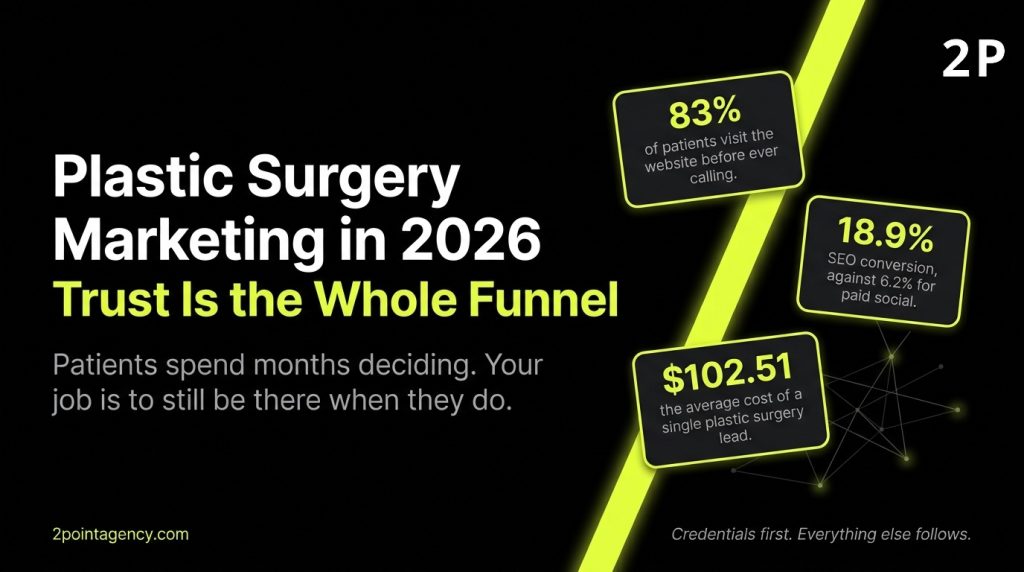
- 83% of patients visit a practice website before ever calling, making digital presence non-negotiable.
- 64% of prospective patients research at least three clinics before booking a consultation.
- The average cost per plastic surgery lead is $102.51, making channel selection a financial decision, not just a tactical one.
- SEO converts at 18.9% while social media advertising converts at 6.2%, a gap that shapes budget priorities.
- HIPAA compliance, ethical advertising, and patient consent requirements set plastic surgery marketing apart from other industries.
- Practices without a coordinated digital strategy are losing patients to competitors who have one.
The sections below break down every major channel, strategy, and measurement framework aesthetic practices need to grow in 2026 and beyond. Whether you are a solo surgeon building your first digital presence or a multi-location group looking to refine your approach, this guide delivers the specificity and depth your decisions require.
How the Plastic Surgery Patient Journey Shapes Your Digital Marketing Strategy
Every channel investment, content decision, and technology purchase in plastic surgery digital marketing should trace back to one question: where is the patient in their journey, and what do they need right now? The plastic surgery decision cycle is unlike any other in healthcare. It combines emotional weight, significant financial commitment, and deeply personal motivations into a process that can span months. Understanding this journey at a granular level allows practices to place the right message in front of the right patient at exactly the right moment.
Understanding the 60 to 180 Day Decision Cycle
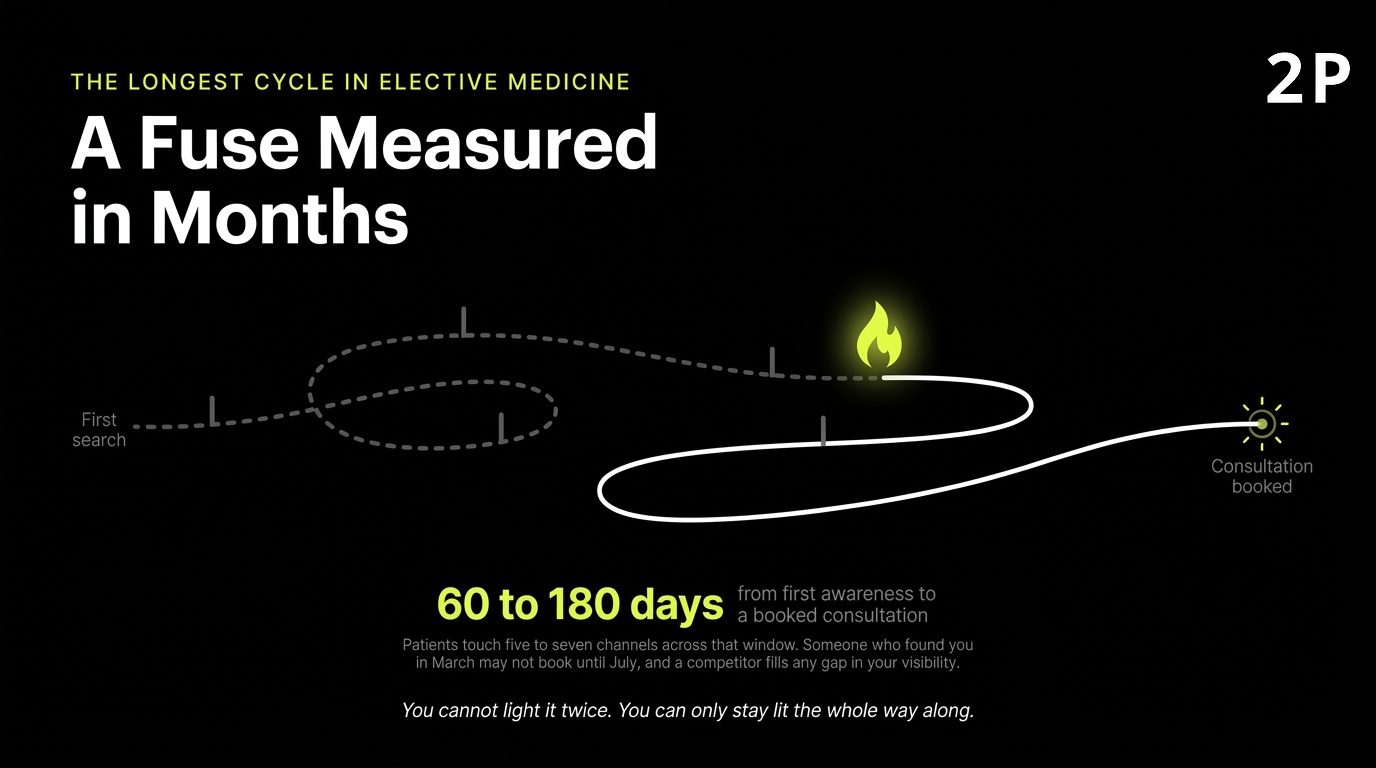
Plastic surgery has the longest patient decision cycle in elective medicine. While a patient might book a dental cleaning within days of searching, someone considering rhinoplasty or body contouring may take 60 to 180 days from initial awareness to consultation booking. The emotional and financial stakes involved extend timelines considerably. A prospective patient might watch YouTube videos for weeks before ever visiting a single clinic website. They compare surgeons across Instagram, read forum threads, ask friends, and circle back to the same handful of practices repeatedly before taking action.
This extended cycle means practices cannot rely on a single touchpoint to capture a patient. Someone who finds your website through a Google search in March might not book until July. If your retargeting campaigns, email nurture sequences, and social media presence are not maintaining visibility throughout that window, a competitor will fill the gap. 64% of patients research at least three clinics before booking, confirming that the patient who found you first is still evaluating their options for weeks or months afterward.
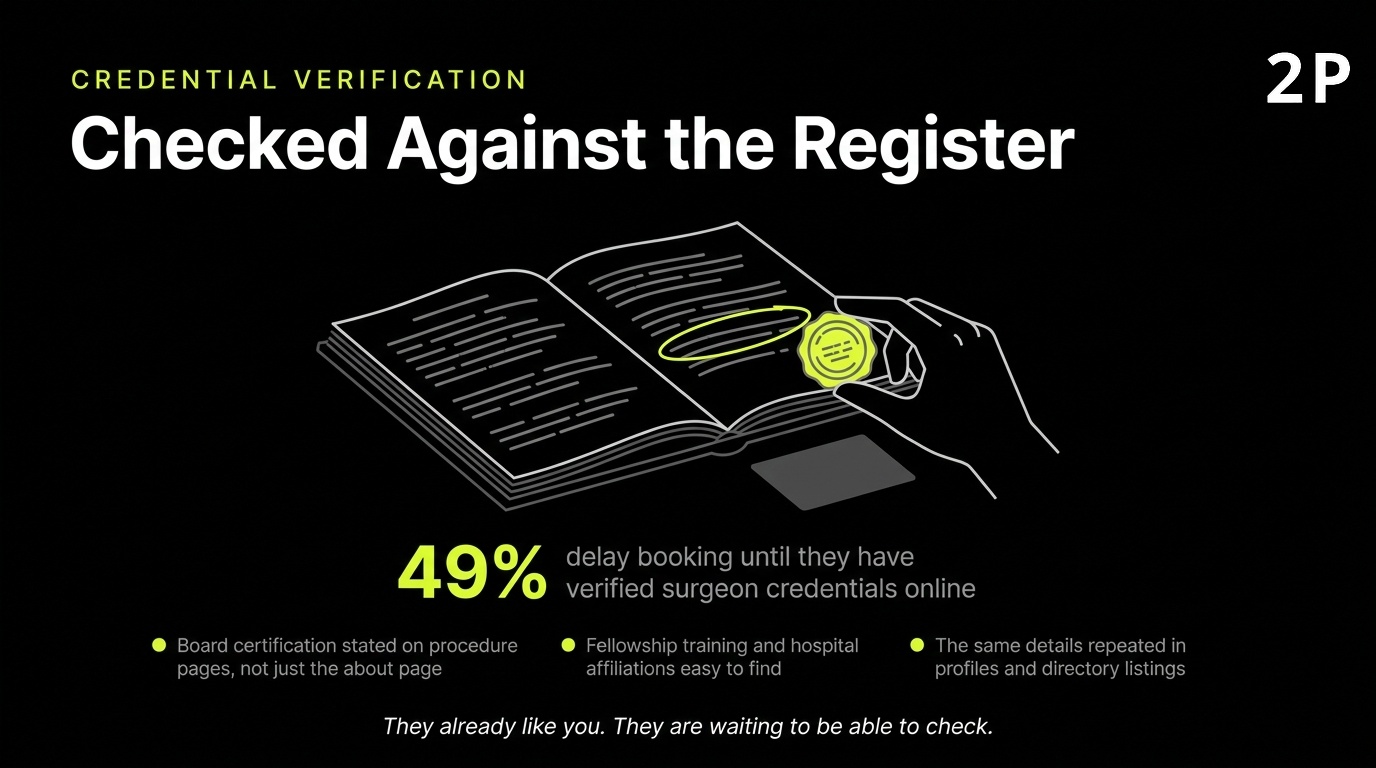
The credentialing verification stage is a particularly critical moment in this journey. 49% of patients delay booking until they have verified surgeon credentials online. This means that even patients who love your content and trust your brand will pause their decision process until they can confirm your qualifications. Board certification, hospital affiliations, professional memberships, and educational background all need to be discoverable, prominent, and easy to verify without requiring a phone call.
Practices that understand this cycle build marketing infrastructure that maintains consistent presence across all 60 to 180 days of a patient’s journey. That means blogging regularly so new content surfaces during ongoing research, running retargeting campaigns that re-engage website visitors, maintaining active social profiles that keep the practice visible, and configuring email nurture sequences that educate and reassure during the long consideration phase. Multi-channel persistence is not optional in this space; it is the fundamental requirement of effective plastic surgery digital marketing.
Mobile-First Patient Behavior Patterns
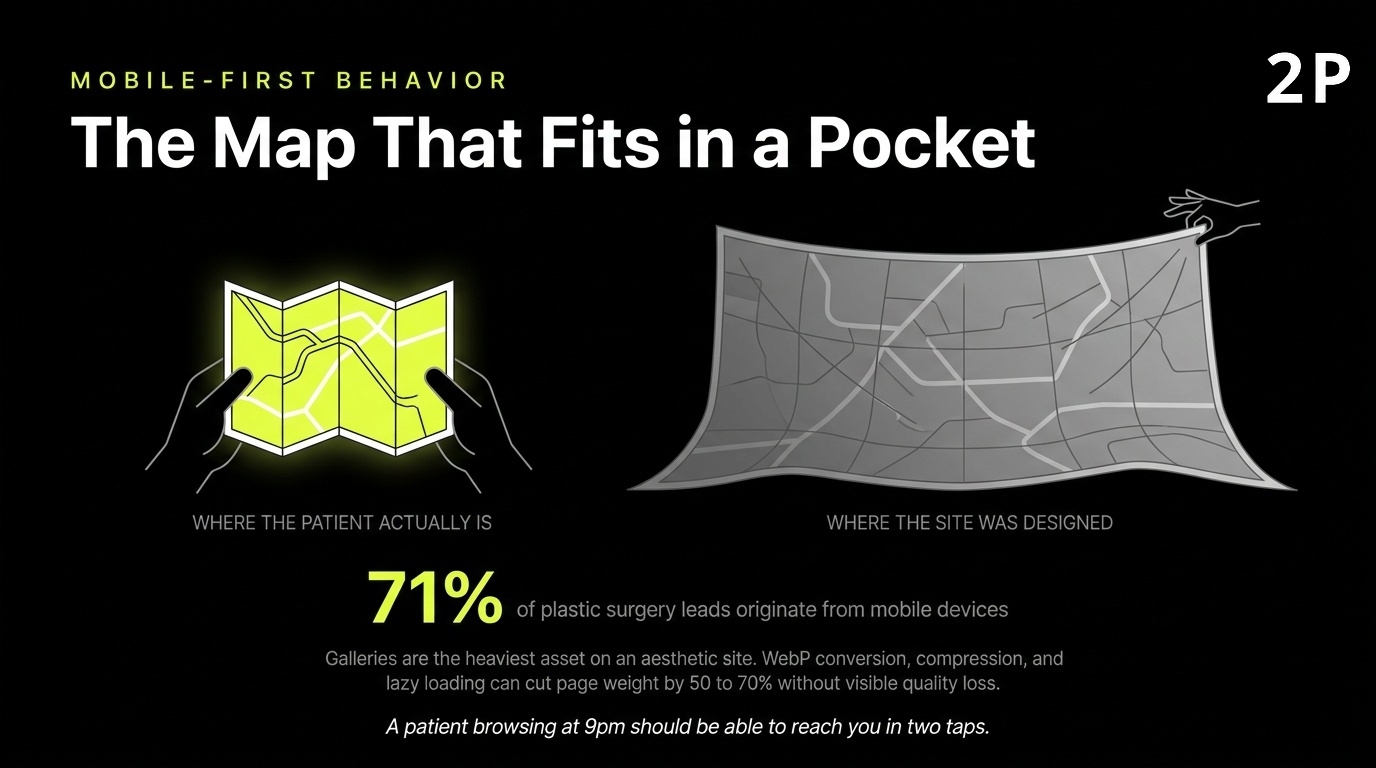
The majority of plastic surgery research happens on a smartphone. 71% of leads originate from mobile devices, which means a website that performs beautifully on desktop but loads slowly or displays awkwardly on mobile is actively costing the practice consultations. Mobile-first design is not a feature upgrade for aesthetic practices; it is foundational infrastructure.
Mobile search patterns for cosmetic procedures differ meaningfully from desktop behavior. Mobile users tend to search with more specific, urgent phrasing. They use voice search more frequently, asking conversational questions like “best rhinoplasty surgeon in Chicago” rather than typing fragmented keywords. They scroll through Instagram Reels between Google searches, blending research channels in ways that make single-platform strategies insufficient. Thumb-friendly navigation, large tap targets, and streamlined contact forms are all critical to keeping mobile visitors engaged long enough to convert.
Before-and-after galleries present a particular mobile challenge. These galleries are among the most viewed and most influential elements of any plastic surgery website, but they are also image-heavy and prone to slow load times on mobile connections. Practices need to invest in image compression, next-generation file formats like WebP, and lazy loading implementations that prioritize above-the-fold content while deferring offscreen images. A gallery that takes four seconds to load on a 4G connection will cost the practice a meaningful percentage of the visitors who would otherwise have stayed. Building a mobile-friendly marketing campaign is not just about aesthetics; it is about protecting conversion rates.
Click-to-call buttons and streamlined mobile contact forms are conversion essentials. A patient browsing surgeon results at 9 PM should be able to initiate contact in two taps. Overly complex forms that require scrolling, typing extensive text, or navigating away from the current page create friction that costs leads. Practices that optimize mobile consultation request flows consistently see measurable improvements in the percentage of mobile visitors who take action rather than bouncing back to search results.
Trust-Building Digital Assets Patients Demand
Before a patient picks up the phone or submits a consultation request form, they have typically evaluated a practice across multiple trust dimensions. These are not passive impressions; they are active assessments that patients make consciously as they compare their shortlisted options. Understanding the hierarchy of trust signals allows practices to prioritize their digital asset investments in order of patient influence.
Credentials occupy the top of this hierarchy. Surgeon qualifications, board certifications from recognized bodies like the American Board of Plastic Surgery, hospital affiliations, and fellowship training all signal that the provider meets professional standards for safe, ethical practice. These credentials need to appear prominently on the website, in social media bios, in Google Business Profile information, and in any directory listings where the practice appears. Patients who cannot quickly find credential information will move on to a competitor who makes it easier. This investment in credential visibility pays dividends throughout the entire patient journey.
Below credentials, visual results drive decision-making more powerfully than any other single element. 52% of patients identify before-and-after photos as the most influential marketing asset in their evaluation process. Galleries need to showcase consistent photography standards, represent a realistic range of results, and cover the procedures each patient segment is researching. Poor photo quality, inconsistent lighting, or a sparse gallery with only a handful of examples will undermine trust even when the surgeon’s work is exceptional.
Reviews and video testimonials round out the essential trust stack. 58% of patients trust online reviews as much as personal recommendations from friends or family. This trust equivalence is remarkable and means that a practice’s review profile carries weight comparable to word-of-mouth. Additionally, video content generates 34% higher consultation bookings compared to practices that rely only on static content. Authentic patient testimonials on video, where viewers can hear tone of voice and see genuine emotion, create emotional connection at a depth that written reviews cannot match.
The Website as Digital Front Door
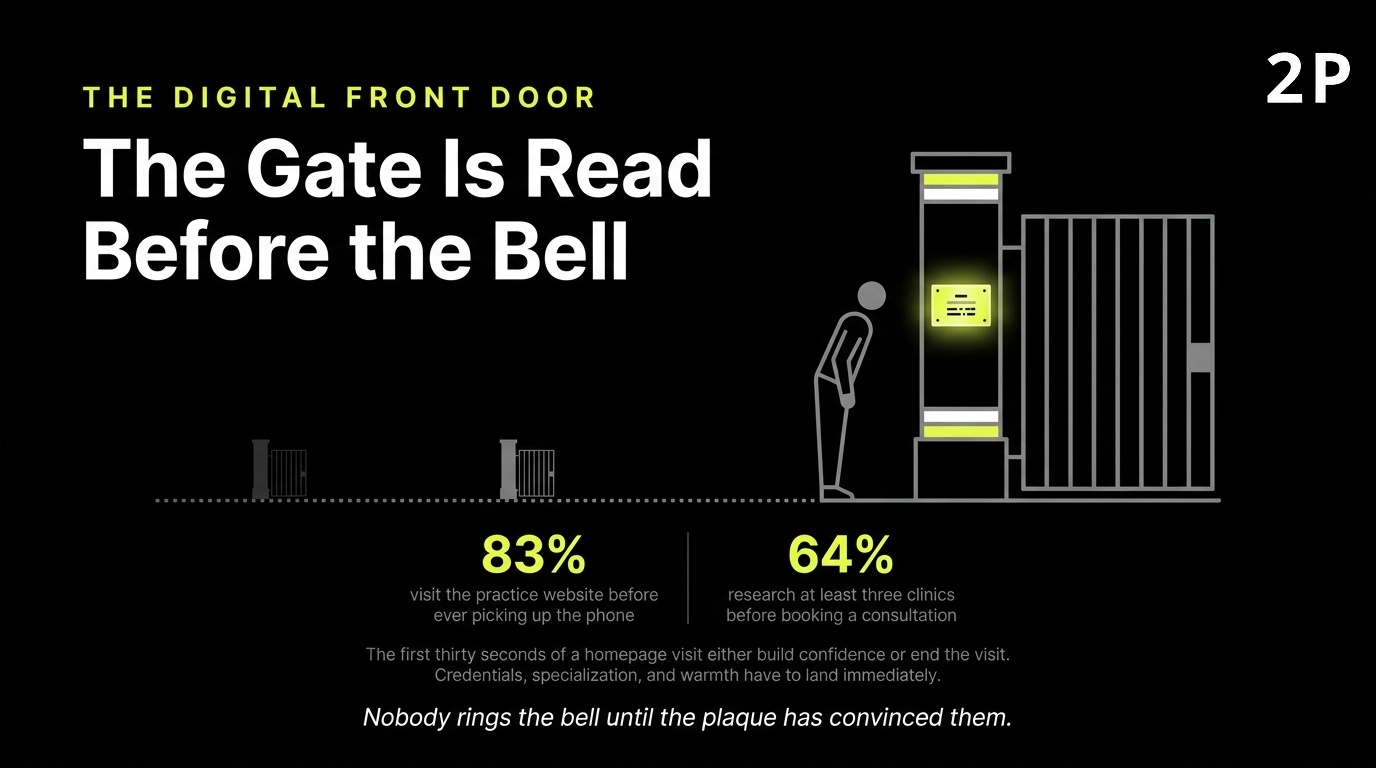
When 83% of patients visit a practice website before calling, the website becomes the single most important conversion tool in the marketing ecosystem. The first 30 seconds of a homepage visit either build confidence or destroy it. Practices have an extremely short window to communicate credibility, specialization, and warmth before a visitor decides to keep reading or hit the back button.
Essential homepage elements include a clear statement of the surgeon’s credentials and specialization, a visually compelling hero image or video that sets aesthetic tone, immediate access to procedure categories, and prominent social proof signals like aggregate review scores and recognizable credential badges. Navigation architecture matters enormously. A patient researching breast augmentation should be able to find the procedure page in a single click without hunting through a complex menu structure. Procedure-organized navigation, supported by internal search functionality, reduces the frustration that drives visitors away.
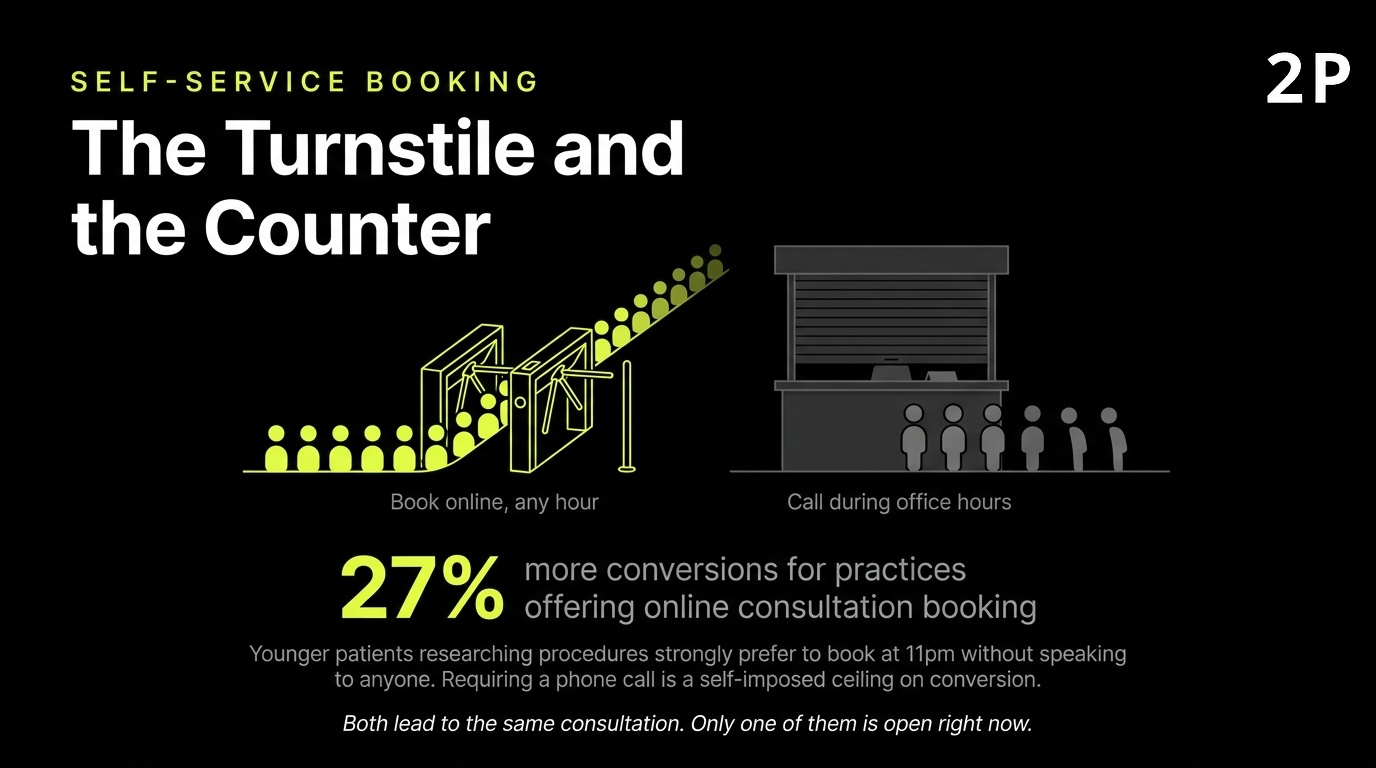
Online scheduling capability has a measurable conversion impact. Practices that offer online consultation booking see 27% more conversions than those requiring phone-only booking. Modern patients, particularly younger demographics researching cosmetic procedures, strongly prefer self-service scheduling tools that allow them to book at 11 PM without speaking to anyone. Practices that require a phone call as the only path to consultation are artificially limiting their own conversion rates. Building a strong digital presence starts with a website that converts visitors into booked appointments, not just casual browsers.
Page speed requirements for visual-heavy plastic surgery websites demand ongoing technical attention. Google’s Core Web Vitals thresholds apply equally to aesthetic practices as to any other industry, and a website that fails these technical benchmarks will struggle to rank in competitive markets regardless of content quality. Fast-loading, mobile-optimized, visually impressive websites are the baseline requirement for practices serious about digital growth in 2026.
Plastic Surgeon SEO: How Organic Search Drives the Highest-Quality Patient Leads
Search engine optimization for plastic surgeons operates at the intersection of technical excellence, credibility-first content, and hyperlocal relevance. Plastic surgeon SEO is not simply a matter of publishing procedure pages and waiting for rankings. It requires a sophisticated, multi-layer approach that accounts for Google’s strictest evaluation standards, the intensely competitive nature of cosmetic surgery markets, and the specific ways patients search when they are ready to book. Done correctly, SEO delivers compounding returns that no other channel can match.
Why SEO Delivers the Highest Digital Channel ROI for Plastic Surgery Practices
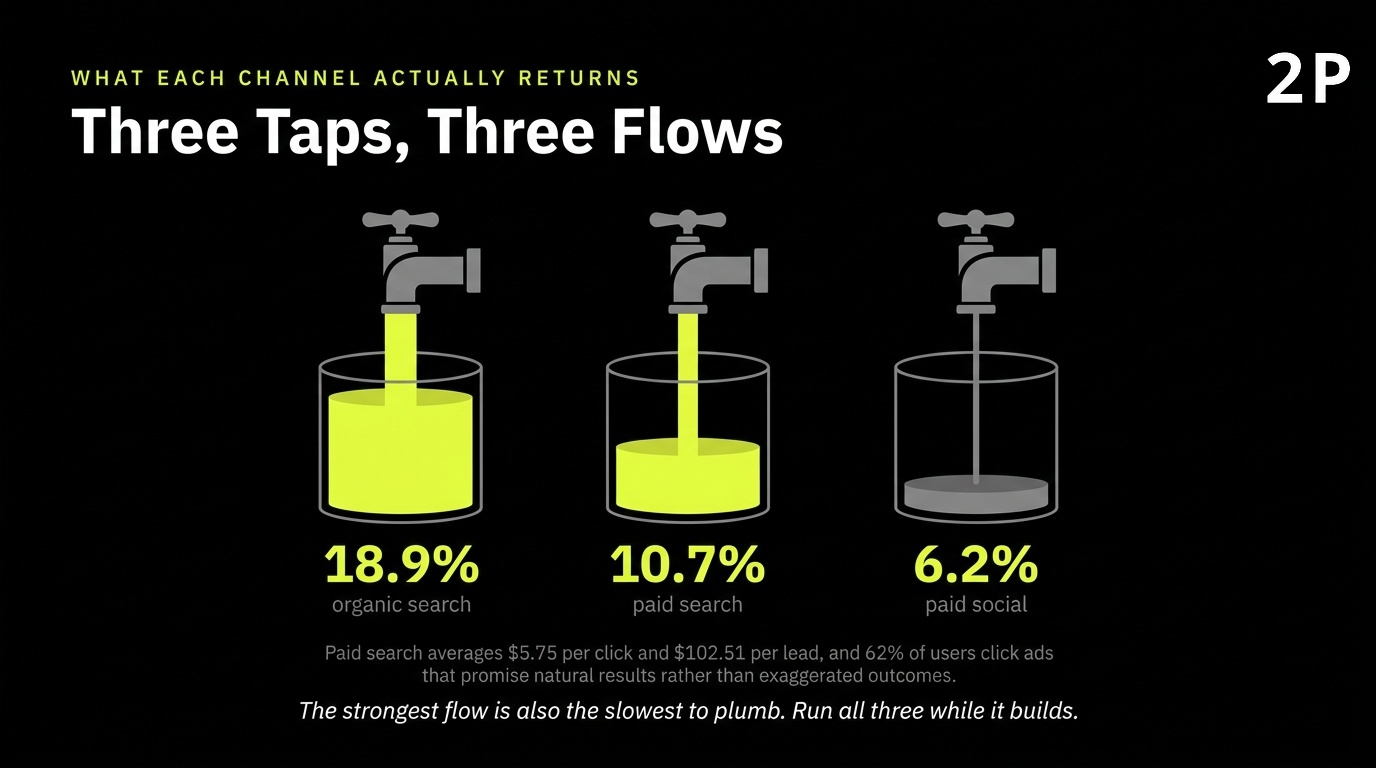
The conversion rate gap between organic search and other digital channels is striking and consequential for budget decisions. Plastic surgery SEO converts at 18.9%, while Meta advertising converts at 6.2%. This nearly three-fold difference reflects a fundamental distinction in patient intent. Someone who types “rhinoplasty surgeon in Dallas” into Google and clicks an organic result is demonstrating active, high-intent research behavior. They are in the middle of their evaluation process and seeking a specific type of solution. Social media audiences, by contrast, encounter advertising while they are doing something entirely different, which explains the lower conversion performance even when targeting is sophisticated.
The financial case for SEO strengthens over time in ways that paid advertising cannot replicate. A well-executed SEO campaign builds an asset: a library of authoritative, ranking content that generates patient inquiries month after month without additional per-click cost. Active blogging generates 67% more organic traffic for plastic surgery practices, and each piece of well-optimized content continues attracting visitors long after its publication date. Paid advertising, by contrast, stops delivering the moment the budget runs out. Practices that invest in SEO are building equity; practices that rely solely on paid advertising are renting visibility.
The compounding nature of SEO investment makes early action especially valuable. A practice that begins serious SEO work today will have accumulated authority, backlinks, and ranking history that creates a meaningful competitive barrier by the time competitors recognize the gap. In competitive metro markets like Los Angeles, Miami, and New York, the top-ranking plastic surgeons often maintain their positions not because they outspend competitors on SEO each month, but because they have accumulated years of authoritative content and earned backlinks that are genuinely difficult to displace. Understanding whether your current approach constitutes a weak digital marketing strategy is critical before investing further.
Local and Hyperlocal SEO Strategies for Cosmetic Surgery Practices
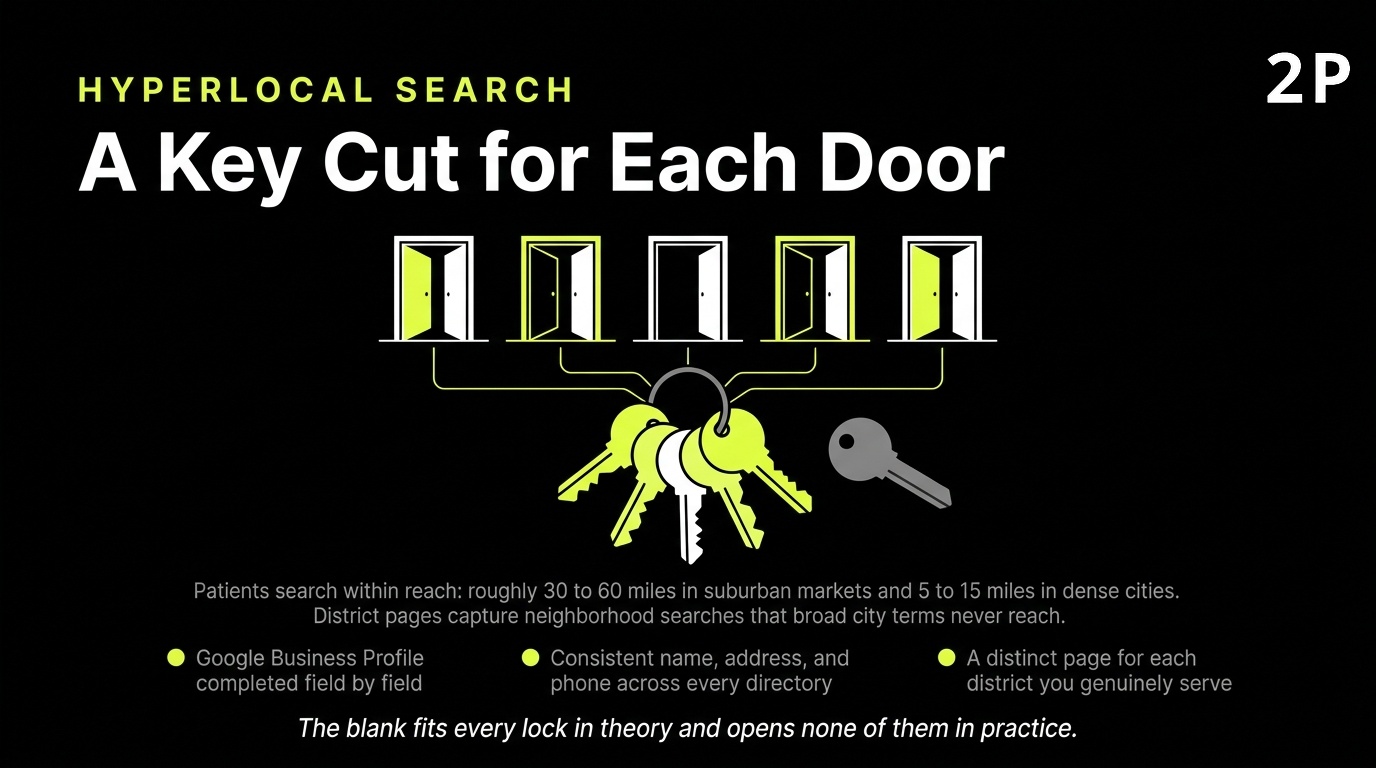
Most plastic surgery searches carry implicit geographic intent. A patient considering liposuction does not want to travel across the country; they want a qualified surgeon within a reasonable distance of their home. This geographic reality means that most cosmetic surgery patients search for providers within a reasonable driving distance, typically 30 to 60 miles in suburban markets and 5 to 15 miles in dense urban areas. Ranking well in those local search results requires a focused approach that goes far beyond including the city name on a few pages.
Neighborhood-level targeting within major metro areas is a powerful and underutilized strategy. A surgeon practicing in Atlanta might rank for “Buckhead plastic surgeon” and “Midtown Atlanta cosmetic surgery” as distinct keyword opportunities from the broader “Atlanta plastic surgeon” terms. Hyperlocal landing pages dramatically expand visibility in competitive metro markets by capturing neighborhood-specific searches that larger, less targeted competitors ignore. Each well-constructed district page can attract meaningful organic traffic from patients who would never encounter the practice through broader city-level searches.
Google Business Profile optimization is non-negotiable for Map Pack visibility. The three-pack of local results that appears above organic listings for location-specific searches drives enormous click volume, and practices that appear in this pack consistently report significant consultation inquiry increases. Optimizing a Google Business Profile means completing every available field, maintaining accurate hours and contact information, uploading high-quality photos regularly, actively collecting and responding to Google reviews, and utilizing the posts and Q&A features that many practices ignore. Building local citations through consistent NAP (Name, Address, Phone) information across relevant directories including Healthgrades, RealSelf, Yelp, and the American Society of Plastic Surgeons directory further reinforces local authority signals.
Effective digital marketing for local businesses in the aesthetic space means thinking at the neighborhood level, not just the city level. Practices that create distinct, well-optimized location content for each area they serve regularly outperform larger, less locally focused competitors in the searches that matter most.
YMYL Compliance and Medical Content Standards
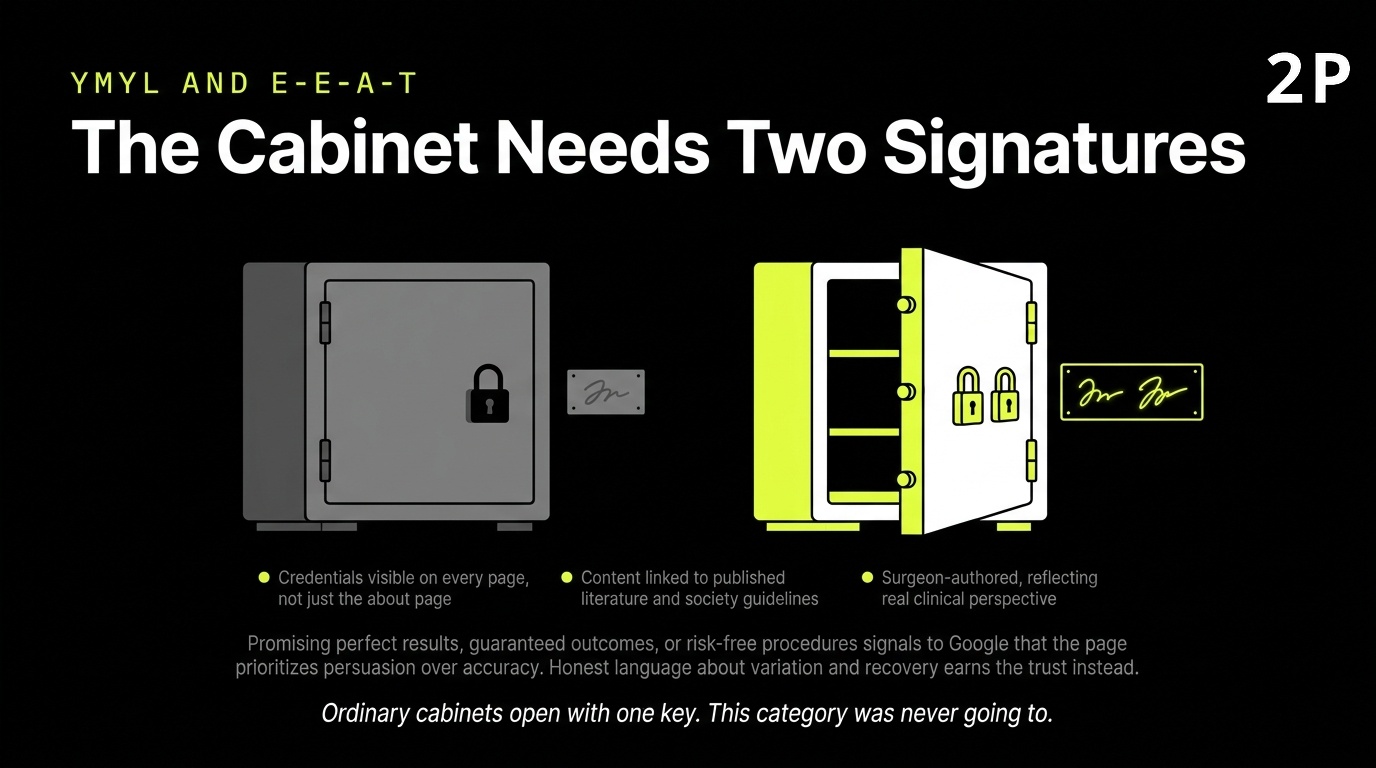
Google’s YMYL designation, standing for Your Money or Your Life, applies with maximum force to plastic surgery content. The classification exists because inaccurate or misleading information in this category can directly harm readers financially or physically. Google responds to this risk by applying its most rigorous E-E-A-T evaluation standards, examining every page for signals of genuine Experience, real Expertise, demonstrated Authoritativeness, and verified Trustworthiness. For plastic surgery practices in 2026, this means that content quality standards have reached levels that require deliberate, ongoing investment.
Meeting YMYL standards means making surgeon credentials visible and verifiable throughout the website, not just on the “about” page. Board certification information, fellowship training, university affiliations, and professional memberships should appear on procedure pages, in site headers, and within the structured data markup that helps search engines understand and display this information. Content should consistently link to authoritative clinical resources such as published medical literature, board certification databases, and professional society guidelines, demonstrating that the practice’s information connects to established medical consensus rather than marketing claims.
The language practices use in their content carries significant YMYL weight. Promising “perfect results,” “guaranteed outcomes,” or “risk-free procedures” not only violates ethical marketing standards but signals to Google that the content prioritizes persuasion over accuracy. Accurate language that acknowledges individual variation, typical recovery timelines, real risk profiles, and the importance of consultation before treatment decisions demonstrates the intellectual honesty that both Google’s algorithms and prospective patients reward with trust.
E-E-A-T signals extend beyond on-page content to the broader digital footprint. Press mentions in reputable publications, speaking engagements at recognized medical conferences, peer-reviewed publications, and mentions on authoritative medical websites all contribute to the authority signals Google evaluates when ranking YMYL content. A comprehensive plastic surgery digital marketing strategy treats authority-building as an ongoing, multi-year investment rather than a one-time setup task.
Technical SEO for Visual-Heavy Aesthetic Websites
The visual nature of plastic surgery websites creates technical SEO challenges that general healthcare practices rarely face. Extensive before-and-after galleries, high-resolution surgeon photography, procedure demonstration videos, and aesthetic design elements combine to create page weight that threatens load times and Core Web Vitals performance. Surgical enhancement websites include significant visual content that can dramatically slow page load times if not managed with technical discipline.
Image optimization is the highest-leverage technical SEO intervention for most plastic surgery websites. Converting images to WebP format, implementing responsive image serving that delivers appropriately sized files to different devices, and running all images through compression tools without visible quality loss can reduce page weight by 50 to 70% on gallery-heavy sites. Lazy loading implementation ensures that only images within the current viewport load immediately, with offscreen gallery images loading progressively as the user scrolls. The combination of these techniques allows practices to maintain visually impressive galleries while meeting Google’s page speed requirements.
Core Web Vitals performance represents a direct ranking factor that practices must monitor and maintain. Largest Contentful Paint, Cumulative Layout Shift, and Interaction to Next Paint each measure distinct aspects of the user experience that Google has committed to rewarding. Regular monitoring through Google Search Console and PageSpeed Insights allows practices to catch regressions before they impact rankings. Structured data markup for procedure pages, surgeon profiles, and FAQ sections provides additional signals that help search engines understand and display practice information accurately in search results.
Cosmetic Surgery Content Marketing That Educates, Builds Trust, and Converts
Content marketing for plastic surgery practices occupies a unique space. It must simultaneously satisfy Google’s demanding YMYL standards, address the genuine anxieties of prospective patients, demonstrate professional expertise, and build the emotional connection that moves people from casual curiosity to scheduled consultation. Effective content marketing in this space is not about volume; it is about intentionality, accuracy, and authentic value delivery at every stage of the patient journey.
Building Procedure-Specific Content Libraries
Every procedure a practice offers deserves its own comprehensive content hub that serves both the patient’s need for reliable information and the practice’s need for keyword-targeted, conversion-optimized web pages. A standalone procedure page that covers the process step by step, explains realistic benefits, addresses genuine risks, describes typical recovery timelines, and showcases real results gives prospective patients what they need to make informed decisions while signaling to search engines that the practice has genuine expertise in that procedure area.
The structure of a high-performing procedure page follows a logical patient-centered flow. It begins with a clear explanation of what the procedure is and who it benefits, moves through the process itself, addresses common concerns and risks honestly, discusses recovery and what patients should expect, and closes with results information including a curated before-and-after gallery. FAQ sections within procedure pages are particularly valuable because they directly address the questions patients are typing into search engines, improving organic visibility while reducing the pre-consultation anxiety that delays booking decisions.
Long-tail keyword integration within procedure pages happens naturally when content is written with genuine patient education as the goal. Someone writing a thorough explanation of rhinoplasty recovery will naturally include phrases like “how long does rhinoplasty recovery take,” “rhinoplasty swelling timeline,” and “rhinoplasty results at 3 months” without any artificial keyword stuffing. The informational depth that patients need and the search terms they use are inherently aligned, making authentic education the most effective keyword strategy. 61% of patients watch educational surgery videos before booking, confirming that content consumption is a standard part of the decision process.
Video Content Strategy Across Platforms for Aesthetic Practices
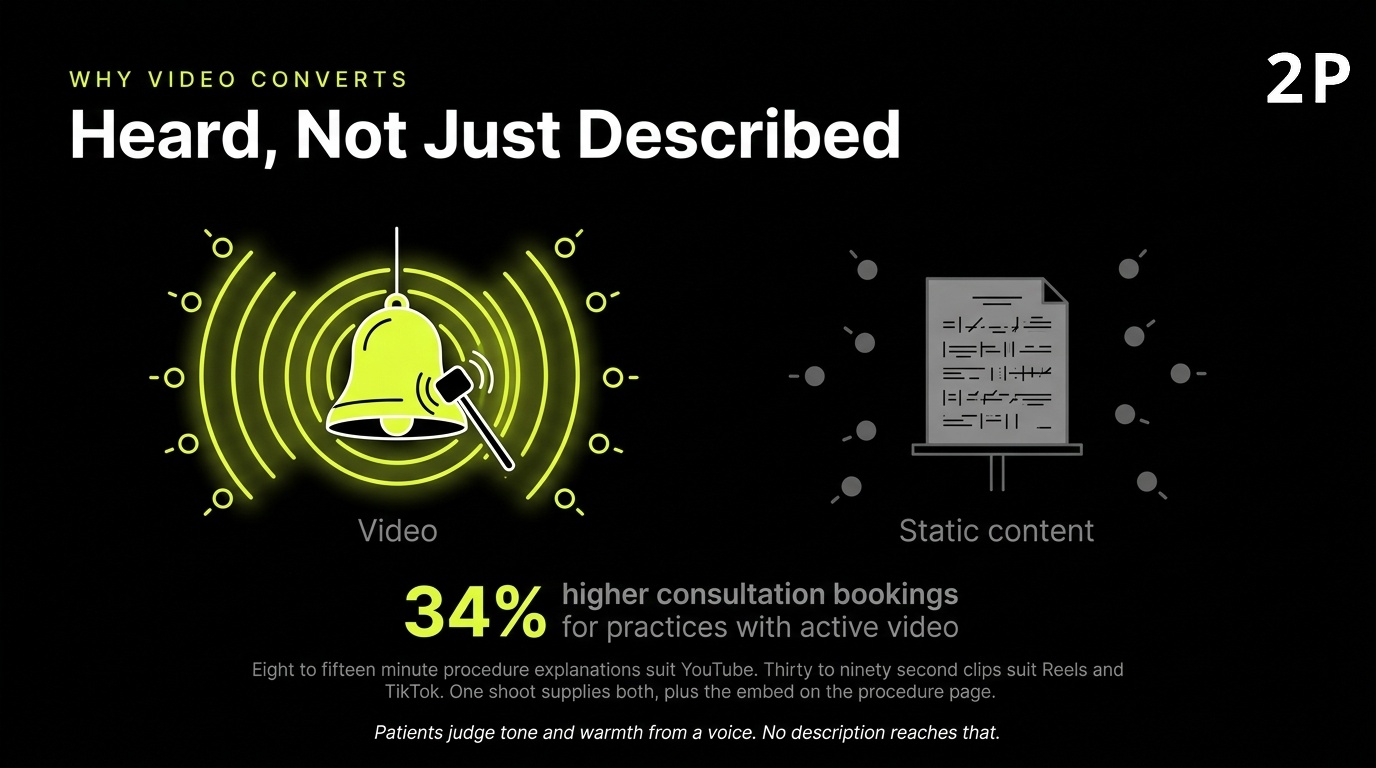
Video has become the dominant content format for plastic surgery patient education and practice differentiation. Practices with active video content strategies report 34% higher consultation booking rates than those relying primarily on static content. This performance gap reflects the unique trust-building power of video: viewers can assess a surgeon’s communication style, warmth, and confidence in ways that written content cannot convey. A two-minute procedure explanation video often accomplishes more credibility-building than a five-page written guide.
The most effective video types for aesthetic practices cover distinct patient needs across the decision journey. Procedure explanation videos address “what is this surgery” searches in the early awareness phase. Surgeon introduction videos build personal connection during the evaluation phase. Patient testimonials with consented participants provide social proof during the consideration phase. Post-operative care guidance and recovery expectation videos address practical concerns that surface during the final decision phase. Each video type serves a specific patient need and belongs in specific channels and placements within the marketing ecosystem.
Platform-specific video format requirements demand thoughtful adaptation rather than simple repurposing. YouTube rewards longer-form, educational content that answers specific search queries in depth, making it ideal for procedure explanation videos of 8 to 15 minutes. Instagram Reels and TikTok favor concise, visually dynamic content of 30 to 90 seconds that captures attention immediately and delivers a clear single message. A surgeon’s team that shoots a 10-minute YouTube procedure overview can extract multiple short-form clips for Instagram, create a condensed TikTok version, and embed the full video within the relevant procedure page for website visitors who want comprehensive information.
Blogging for Organic Traffic and Surgeon Authority
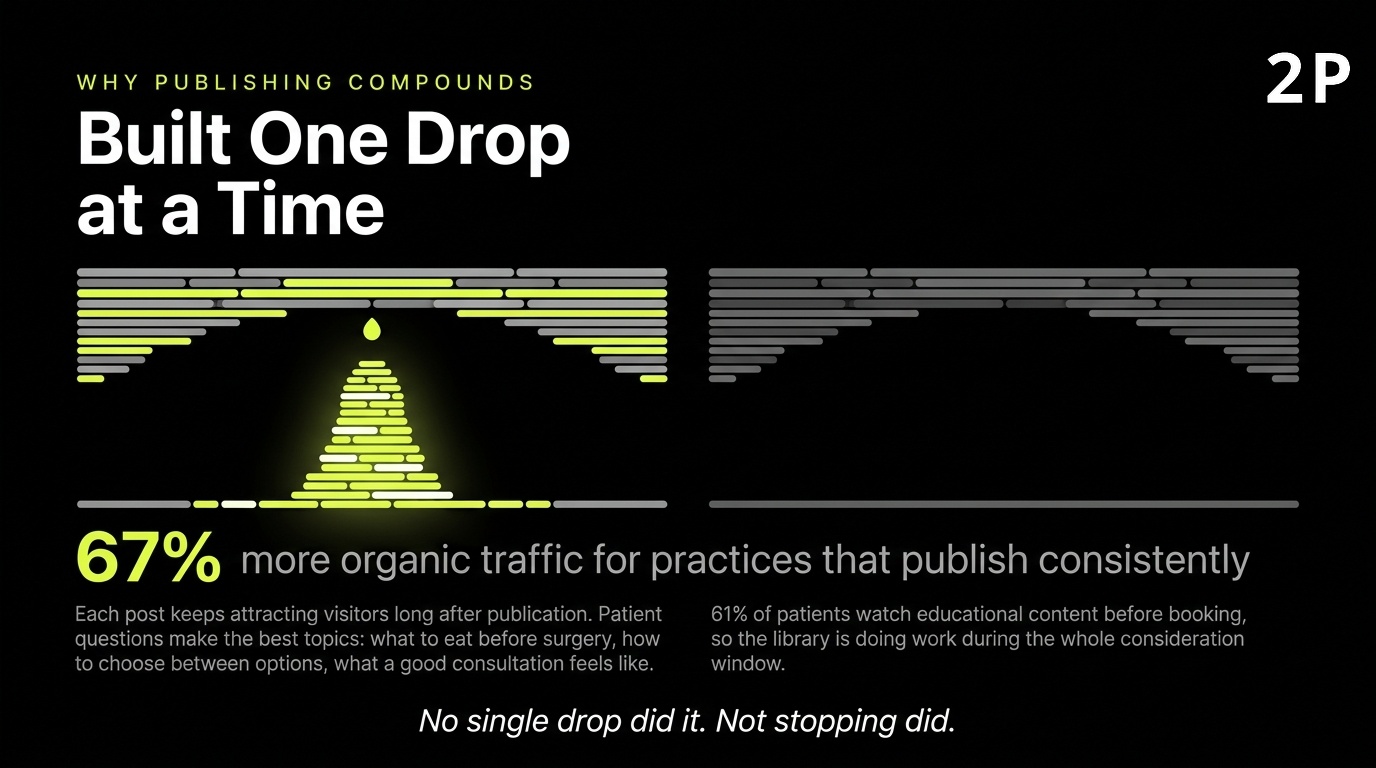
An active practice blog does more than generate content volume. It demonstrates ongoing intellectual engagement with the field, captures the long-tail search traffic that procedure pages alone cannot address, and positions the surgeon as a trusted voice in their specialty. Practices with active blogs generate 67% more organic traffic than those without, a figure that translates directly to more consultation inquiries from patients who would never have found the practice otherwise.
Effective blog topic selection starts with patient questions. Tools like Google’s People Also Ask, AnswerThePublic, and internal inquiry data reveal exactly what prospective patients want to know. Topics like “what to eat before rhinoplasty surgery,” “how to choose between implants and fat transfer,” and “signs your plastic surgery consultation went well” address real patient anxieties with specific, helpful information. These topics attract targeted organic traffic from patients actively preparing for or researching procedures, making them more likely to convert than broader educational topics.
The surgeon-authored versus staff-written content debate matters for YMYL compliance and E-E-A-T signals. Google’s quality raters are specifically trained to evaluate whether medical content reflects genuine clinical expertise or represents generic health writing that could have been produced by anyone. Surgeon-authored content that reflects real clinical experience, personal perspective on patient selection, and honest discussion of procedure limitations carries significantly more authority signal weight than anonymous staff writing. At minimum, all blog content should be reviewed, attributed to, and genuinely reflective of the surgeon’s clinical perspective. Developing a content marketing strategy for brand building through consistent, expert-authored publishing creates compounding authority that becomes increasingly difficult for competitors to displace.
Before-and-After Galleries: Balancing HIPAA Compliance and Marketing Impact
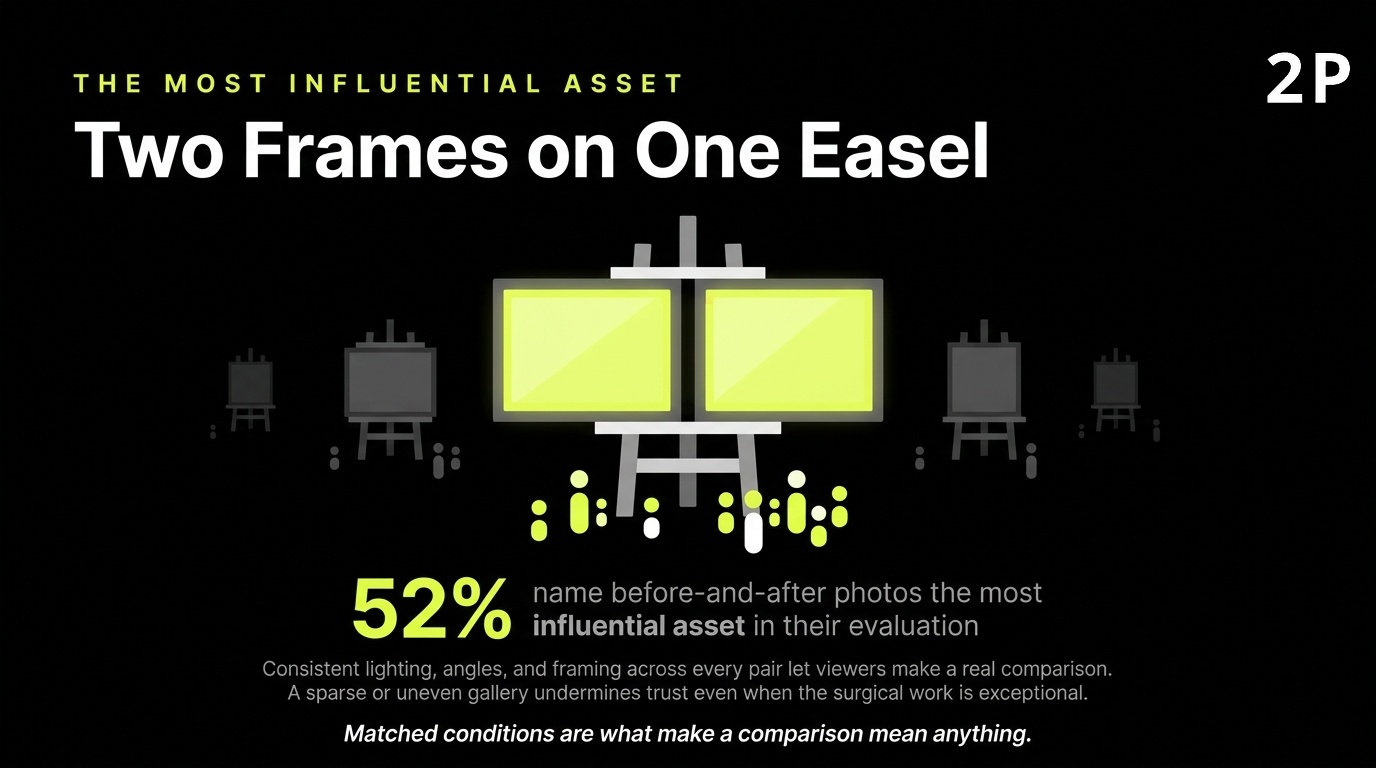
Before-and-after galleries are simultaneously the most powerful and most legally sensitive marketing asset in plastic surgery digital marketing. The 52% of patients who identify these galleries as the most influential element of their evaluation process represent an enormous marketing opportunity. The HIPAA requirements governing patient image use represent an equally significant compliance responsibility. Practices that get this balance right build galleries that convert; those that cut corners risk regulatory consequences and patient trust damage.
Written patient consent is the non-negotiable foundation of any compliant before-and-after gallery. Verbal consent is legally insufficient. Consent forms must specify exactly how the images will be used, which platforms they may appear on, whether they can be used in paid advertising, and what patient identifying information if any may be included in accompanying captions. These forms need to be current, stored securely, and referenced when selecting images for any marketing use. Patients have the right to revoke consent, and practices must have processes to remove images promptly when requested.
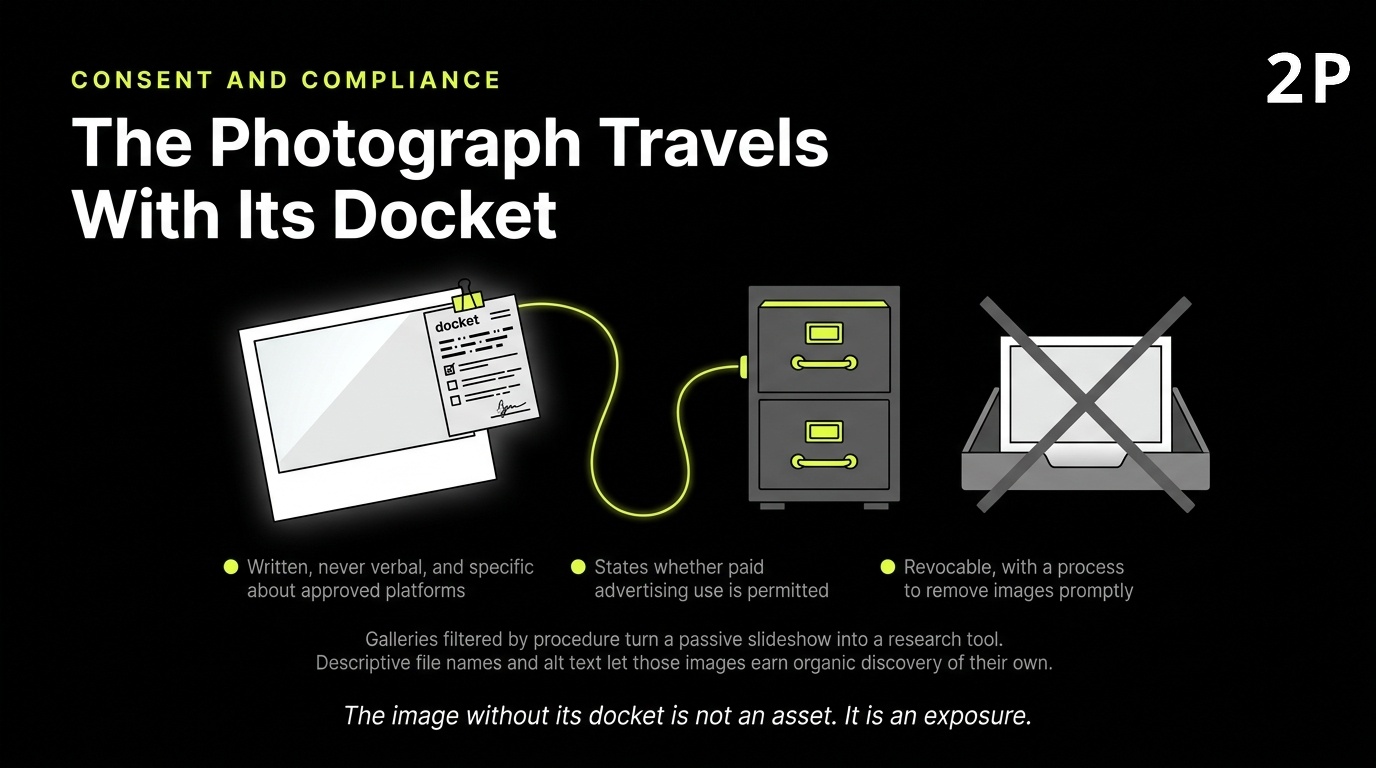
Beyond compliance, gallery organization dramatically affects how much conversion value these images deliver. Galleries organized by procedure allow patients researching a specific surgery to see relevant results without scrolling through unrelated before-and-after pairs. Filters by procedure type, patient characteristics, or result type make the gallery a research tool rather than a passive slideshow. Photo quality and consistency across lighting, angles, and framing standards help viewers make meaningful comparisons and signal professional rigor. SEO optimization for gallery images, including descriptive file names, accurate alt text, and structured data markup, allows these visual assets to appear in Google Image Search and drive additional organic discovery.
Social Media Marketing for Aesthetic Practices: Building Audiences That Convert
Social media marketing holds a unique and sometimes misunderstood role in plastic surgery digital marketing. With 78% of practices reporting social media as their top lead source, the channel’s reach and awareness-building power are undeniable. But social media’s 6.2% conversion rate compared to SEO’s 18.9% reveals an important nuance: social excels at building the awareness and trust that eventually converts through other channels. Understanding this dynamic prevents both underinvestment and misplaced expectations.
Platform Selection and Content Strategy Across Social Channels
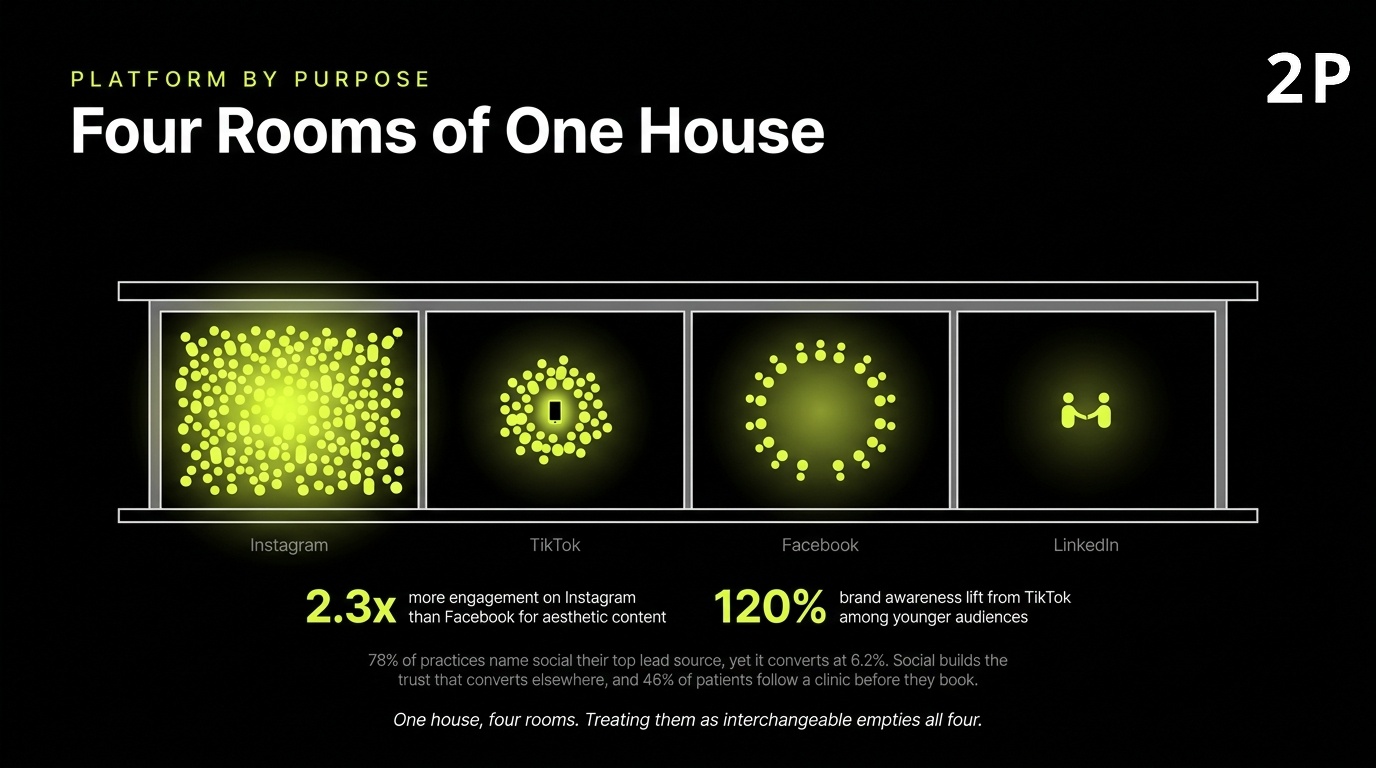
Each major social platform serves a distinct function in an aesthetic practice’s marketing ecosystem, and treating them as interchangeable produces poor results on all of them. Instagram remains the primary visual platform for plastic surgery practices, generating 2.3 times more engagement than Facebook for aesthetic content. Its visual format, story functionality, and Reels feature make it ideal for showcasing before-and-after results, sharing patient testimonials, and building the lifestyle narrative that defines a practice’s brand identity.
TikTok has emerged as a powerful platform for reaching younger demographic patients considering cosmetic procedures. TikTok campaigns increase brand awareness by up to 120% for younger audiences, making it particularly valuable for practices seeking to attract patients in their 20s and 30s who are considering their first cosmetic enhancement. Educational content performs especially well on TikTok, including myth-busting videos, recovery timeline content, and frank discussions about procedure expectations that resonate with audiences seeking authenticity over polish.
Facebook’s role has evolved toward community building and reaching demographics aged 35 and older, who remain a significant cosmetic surgery patient segment. Facebook Groups, longer-form posts, and live Q&A sessions allow practices to create educational communities around procedure categories. LinkedIn serves a different purpose entirely, facilitating professional networking with referring physicians, connecting with potential physician partners, and establishing the surgeon’s profile within the medical community in ways that generate referral relationships and speaking opportunities. Building a comprehensive social media marketing plan accounts for each platform’s distinct audience and content requirements.
Converting Social Engagement Into Consultation Bookings
The gap between social media engagement and consultation conversion is one of the most common sources of frustration in aesthetic practice marketing. A post that generates thousands of likes and hundreds of comments can still produce zero consultation bookings if the conversion pathway from social interaction to appointment is not clearly structured. Recognizing that Meta Ads convert at 6.2% versus SEO’s 18.9% helps set realistic expectations while motivating investment in the conversion infrastructure that maximizes social’s contribution.
Social media’s primary conversion contribution comes through the awareness and trust stages of the patient journey. 46% of patients follow a clinic’s social profiles before booking a consultation, demonstrating that social is often the ongoing relationship maintenance channel that keeps a practice visible during the long consideration period. The patient who follows a surgeon on Instagram in February may book through a Google search in June, but their confidence in that booking decision was built through months of social exposure.
Converting social audiences into consultation bookings requires clear calls to action that do not feel aggressively promotional. Profile bio links directing followers to consultation scheduling pages, story link stickers promoting specific procedures, direct message response systems that capture and qualify inquiries, and retargeting campaigns that follow social followers across other digital channels all contribute to converting social attention into booked appointments. The combination of organic social presence and paid social retargeting creates a powerful awareness-to-conversion system that neither channel achieves alone. Connecting social efforts to a broader digital advertising strategy ensures that social investment feeds into measurable business outcomes.
Content Pillars and Posting Cadence for Aesthetic Practices
Sustainable, high-performing social media presence for plastic surgery practices requires a structured content framework that prevents the constant reinvention that leads to inconsistent posting and eventual abandonment. Defining clear content pillars, the recurring themes that give a social presence coherence and predictability, allows practices to plan content efficiently while ensuring variety that keeps audiences engaged. Video content, live Q&As, and patient testimonials consistently outperform static image posts across aesthetic practice accounts, providing clear guidance on content type prioritization.
The five core content pillars for aesthetic practices balance education, authority, patient experience, community, and authenticity. Educational content explains procedures, addresses common misconceptions, and guides patients through decision considerations without being salesy. Authority content highlights credentials, industry recognition, conference participation, and clinical innovations that demonstrate professional leadership. Patient experience content, always with appropriate consent, shows real results and genuine patient satisfaction. Community content demonstrates local involvement and human connection beyond clinical expertise. Behind-the-scenes content humanizes the practice team, showing the people patients will actually interact with during their care journey.
Posting cadence matters less than posting consistency and quality. A practice that publishes three high-quality, genuinely useful posts per week maintains more effective social presence than one that posts daily low-effort content punctuated by sporadic high-quality work. Platform algorithms reward consistent engagement patterns, and audiences build stronger parasocial relationships with accounts that deliver predictable, reliable value. Consistency also enables meaningful performance measurement, since irregular posting makes it impossible to identify what content resonates with the specific audience a practice is building.
Compliance and Ethical Considerations in Aesthetic Social Media
Social media advertising and content for plastic surgery practices operates within a complex web of legal requirements, platform policies, and professional ethical standards. HIPAA compliance governs any patient-related content and requires that identifiable patient information never appear in social posts without explicit written consent. This includes before-and-after photos, case descriptions detailed enough to identify patients, testimonials that include identifying details, and any patient imagery in paid advertising. The written consent documentation for each patient whose image appears in marketing materials must be current, specific about approved uses, and securely stored.
Sponsored content and influencer partnerships require clear disclosure under FTC guidelines. Any compensation arrangement, whether monetary or in the form of complimentary procedures, that results in promotional content must be explicitly disclosed. The American Society of Plastic Surgeons maintains marketing guidelines that complement legal requirements with professional ethical standards, including prohibitions against making comparative claims about outcomes, using misleading before-and-after imagery, or implying guaranteed results. Practices that adhere to these guidelines consistently build more durable trust than those that push ethical boundaries for short-term engagement gains.
Age-gating content where appropriate protects practices from regulatory scrutiny and reflects genuine ethical responsibility. Platforms provide tools for restricting visibility of certain content to adult users, and practices marketing surgical procedures should utilize these tools. Unrealistic result promises and filter-enhanced before-and-after imagery that misrepresents actual surgical outcomes should be avoided not only because they risk regulatory action but because they attract consultation inquiries from patients with unrealistic expectations, wasting everyone’s time and creating post-consultation dissatisfaction.
Plastic Surgery Advertising: Paid Strategies That Generate Bookings at Scale
Paid advertising in plastic surgery digital marketing delivers what SEO cannot: immediate visibility for specific procedures in targeted geographic areas, beginning from day one. Effective plastic surgery advertising requires understanding which platforms convert at which rates, how to structure campaigns around the long patient decision cycle, and how to deploy retargeting to re-engage the majority of visitors who do not convert on their first website visit.
Google Ads for High-Intent Plastic Surgery Procedure Searches
Google Search advertising reaches prospective patients at the highest-intent moment in their research process: the point at which they have formulated a specific query and are actively looking for results. With PPC converting at 10.7% for plastic surgery, paid search delivers meaningful conversion performance while the SEO investment matures. The average cost per click of $5.75 and cost per lead of $102.51 reflect the competitive, high-value nature of this advertising environment.
Procedure-specific keyword targeting allows practices to concentrate budget on the most commercially relevant searches. Rather than broad match terms like “plastic surgery” that attract enormous traffic volumes with widely varying intent, focused campaigns target phrases like “board certified rhinoplasty surgeon in [city]” or “tummy tuck recovery time [city]” that indicate patients closer to a booking decision. Negative keyword lists prevent ads from appearing on irrelevant searches, protecting budget from wasted clicks. 62% of users click on ads that feature “natural results” messaging, providing clear creative direction for ad copy that emphasizes authentic, realistic outcomes over exaggerated promises.
Landing page alignment with ad promises is critical for both Quality Score optimization and actual conversion performance. An ad for breast augmentation should deliver users to a breast augmentation-specific landing page, not a general homepage. That landing page must deliver on the credibility and result-quality promises the ad made, include clear conversion elements like consultation booking forms and click-to-call buttons, and load within Google’s recommended speed thresholds. Campaigns that invest in paid traffic without investing equally in optimized landing page experiences consistently underperform their potential.
Social Media Advertising on Meta Platforms for Aesthetic Practices
Meta advertising converts at 6.2% for plastic surgery practices, a rate that requires strategic deployment to justify investment. The platform’s primary advertising strength lies in its unmatched audience data and creative targeting capabilities rather than in capturing high-intent searchers. Meta advertising is most effective for awareness campaigns introducing the practice to prospective patients who have not yet started active research, and for retargeting campaigns re-engaging users who have already visited the website or interacted with previous content.
Lookalike audiences built from existing patient email lists allow practices to extend their reach to demographically and behaviorally similar prospects who have not yet discovered the practice. Video ad creative consistently outperforms static imagery on Meta platforms, with short testimonial clips, procedure explanation snippets, and behind-the-scenes practice content generating higher engagement and lower cost per click than static before-and-after images. Budget allocation between Facebook and Instagram should reflect the specific demographics each practice targets, with Instagram generally favored for cosmetic enhancement audiences and Facebook maintaining value for older patient segments and awareness-phase campaigns.
Retargeting Campaigns That Recapture Lost Patient Interest
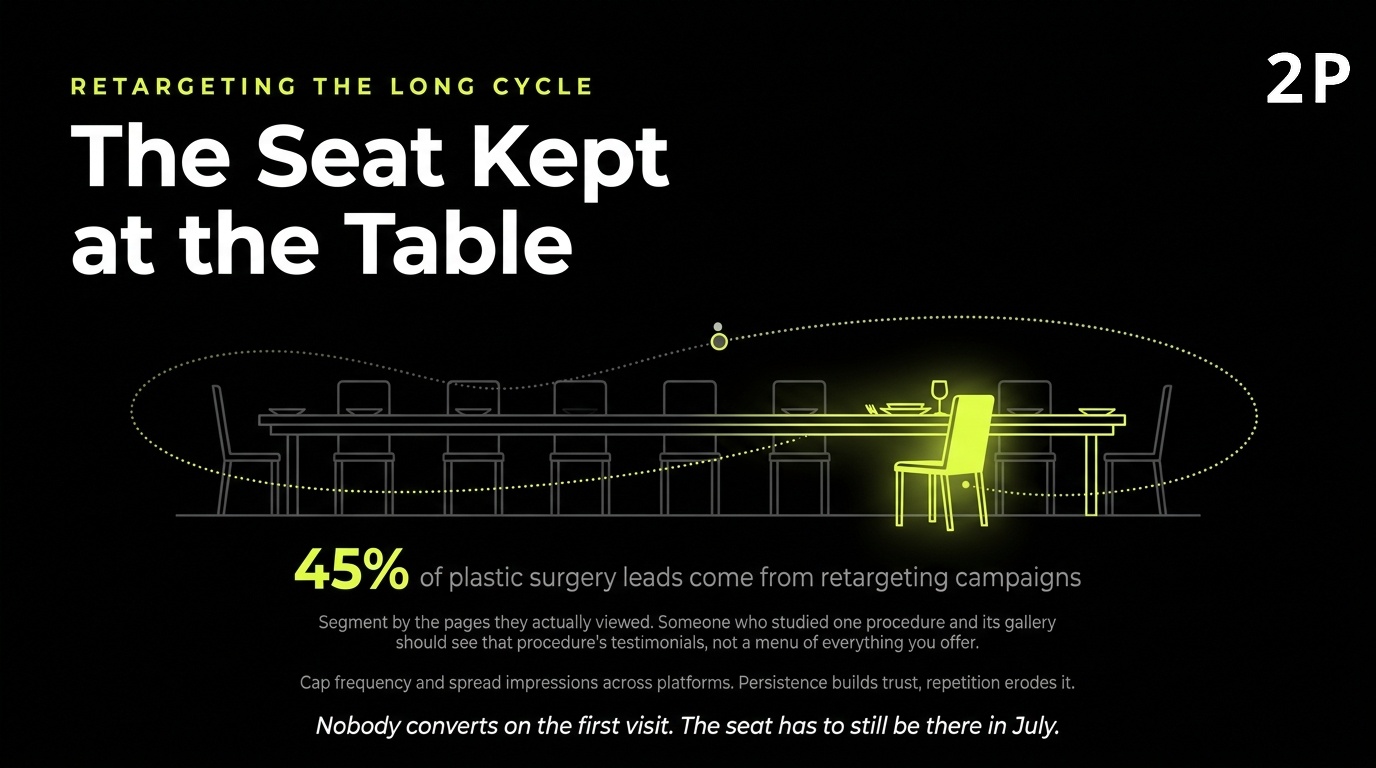
Given the 60 to 180 day decision cycle, the reality that most website visitors do not convert on their first visit is not a failure of acquisition strategy; it is simply how plastic surgery patient decisions work. Retargeting campaigns exist precisely to maintain practice visibility during the long consideration period between first contact and consultation booking. 45% of plastic surgery leads come from retargeting campaigns, making this one of the highest-performing components of a comprehensive paid advertising strategy.
Effective retargeting sequences segment website visitors by the pages they viewed, delivering ads that are relevant to their specific procedure interest rather than generic practice awareness messages. A visitor who spent significant time on the breast augmentation procedure page and the before-and-after gallery should see retargeting ads featuring breast augmentation patient testimonials and surgeon credential messaging, not a generic ad promoting the practice’s full service menu. Decision-stage matching, delivering ads that address the specific concerns typical of patients at different points in the consideration cycle, significantly improves retargeting conversion rates compared to undifferentiated approaches.
Frequency capping prevents retargeting campaigns from crossing from helpful persistence into irritating overexposure. Patients who see the same ad from the same practice across every website they visit multiple times daily experience ad fatigue that actively damages the brand impression the advertising was meant to build. Cross-platform retargeting that spreads impressions across Google Display, YouTube, and Meta reduces repetition fatigue while maintaining consistent presence throughout the patient’s online experience.
Budget Allocation Across Paid Channels for Plastic Surgery Practices
Budget allocation across paid channels should reflect each channel’s demonstrated performance for the specific practice, adjusted for the strategic goals of each campaign period. Digital advertising remains the single most important growth lever for plastic surgery practices competing in 2026, and budgets are increasingly distributed across multiple platforms rather than concentrated in a single channel. This diversification protects practices against platform algorithm changes while maintaining presence across the multiple touchpoints that characterize the modern patient journey.
Practices new to paid advertising benefit from beginning with focused Google Search campaigns targeting their highest-priority procedures before expanding to Meta awareness campaigns and retargeting. This sequencing allows clear performance measurement and learning before scaling spend. A minimum testing period of 90 days with consistent campaign structure provides enough data to make informed optimization decisions. Seasonal procedure demand patterns, rhinoplasty peaks in spring before wedding season and body contouring increases before summer, should inform budget timing and campaign emphasis throughout the year.
| Paid Channel | Average Conversion Rate | Primary Strength | Best Use Case | Average CPC |
|---|---|---|---|---|
| Google Search (SEO) | 18.9% | High-intent lead capture | Long-term authority and organic traffic | N/A (organic) |
| Google Ads (PPC) | 10.7% | Immediate visibility for target keywords | Procedure-specific campaigns with high commercial intent | $5.75 |
| Meta Ads (Facebook/Instagram) | 6.2% | Audience targeting and creative reach | Awareness campaigns and lookalike audiences | Varies by audience |
| Retargeting (Cross-Platform) | Up to 45% of leads | Re-engaging existing interest | Long decision-cycle nurturing between first visit and booking | Lower than acquisition campaigns |
| Referral Programs | 36.8% | Highest trust signal | Patient-referred new consultations | N/A (relationship-based) |
The channel with the highest conversion rate, organic search at 18.9%, is also the one that requires the most consistent long-term investment, reinforcing why the most successful aesthetic practices run SEO, PPC, and paid social simultaneously rather than choosing between them.
Online Reputation Management for Plastic Surgery Practices
In aesthetic medicine, reputation is not just a brand concept; it is a clinical credibility signal that directly influences whether prospective patients trust a surgeon with something as personal and permanent as a surgical procedure. Online reputation management for plastic surgery practices requires active presence across multiple review platforms, systematic strategies for generating authentic patient feedback, and thoughtful responses to the inevitable negative experience that every practice will eventually receive.
The Multi-Platform Review Ecosystem for Aesthetic Practices
Prospective plastic surgery patients do not rely on a single review platform when evaluating surgeons. They cross-reference experiences across multiple sources, each of which serves a distinct purpose in their research process. Google Business Profile is often the first thing patients see when searching for a practice, and the aggregate star rating displayed in Map Pack results influences click-through decisions before patients have read a single word of website content. Google reviews also contribute directly to local SEO performance, making them doubly valuable for practices competing in geographic search results.
RealSelf serves a specialized role at the procedure research stage, where patients are evaluating specific procedures across multiple surgeons. A strong RealSelf profile with detailed procedure-specific reviews positions a practice alongside competitors in the platform where patients are actively comparing options. Healthgrades provides credential verification functionality that satisfies the 49% of patients who delay booking until they have confirmed surgeon qualifications online. Yelp maintains relevance for general consumer confidence, particularly in markets where Yelp has strong user bases. 58% of patients trust online reviews as much as personal recommendations, making multi-platform review management a high-priority investment.
Systematic Review Generation Strategies
A consistent, systematic approach to review generation produces more reliable results than sporadic or reactive outreach. The optimal timing for review requests is immediately following a positive patient experience while the satisfaction is fresh and the patient’s enthusiasm for sharing is highest. Post-procedure follow-up calls or messages that inquire about recovery and satisfaction create a natural opening for review invitations. Patients who express positive experiences during these follow-ups are ideal candidates for gentle review requests.
Making the review process frictionless is essential for conversion. A patient who sincerely wants to share a positive experience will not navigate a complex multi-step process to do so. Direct links to review submission pages on Google, RealSelf, or Healthgrades, included in follow-up emails or text messages, remove every possible barrier between intention and action. Staff training ensures that front-desk team members and surgical coordinators who have positive interactions with patients know how to appropriately mention the value of patient reviews without pressure or incentivization, which would violate both platform policies and medical ethics standards. Effective use of CRM tools in marketing allows practices to systematize and track review outreach across the patient lifecycle.
Responding to Negative Reviews With Professionalism and HIPAA Compliance
Negative reviews are an inevitable reality for every medical practice, and how a practice responds matters as much to prospective patients as the negative review itself. HIPAA compliance creates a significant constraint on public responses: practices cannot confirm whether the reviewer is a patient, cannot discuss any clinical details, and cannot reference appointment or treatment information, even in response to factually inaccurate claims. This constraint requires a response framework that acknowledges concern, demonstrates genuine care, and invites private resolution without disclosing any protected health information.
Effective negative review responses follow a consistent structure: genuine acknowledgment of the reviewer’s experience without confirming or denying the details, a statement of the practice’s commitment to patient satisfaction, an invitation to continue the conversation privately through a specific contact point, and a closing that demonstrates professionalism without defensiveness. Responses should never be argumentative, dismissive, or legalistic in tone. Prospective patients reading negative reviews pay attention not just to what was said about the practice but to how the practice handled the criticism. A thoughtful, compassionate response to a negative review often does more to build trust than a perfect stream of five-star reviews without a single critical voice.
Leveraging Positive Reviews Across Marketing Channels
Authentic positive reviews represent marketing assets that extend far beyond their original platform. Homepage testimonial sections featuring curated patient quotes provide immediate social proof to website visitors in the critical first 30 seconds of their visit. Procedure pages gain credibility from testimonials specific to each surgery type, addressing the same anxieties prospective patients in the same research phase are experiencing. Video testimonials from consenting patients carry emotional resonance that written quotes cannot replicate, making them among the most conversion-effective content assets a practice can develop.
Review content can be repurposed into email marketing sequences that nurture leads during the consideration phase, providing third-party validation at the moment when prospective patients are comparing their shortlisted practices. Testimonial advertising, using patient quotes with appropriate consent and disclosure, adds credibility to paid campaigns that promotional practice messaging cannot provide on its own. The key compliance requirement is clear patient consent for each specific use case, obtained in writing and documented securely before any testimonial content appears in marketing materials.
AI Integration and Marketing Automation for Aesthetic Practices
Artificial intelligence and marketing automation tools have transformed what small-to-medium aesthetic practices can accomplish with limited staff resources. The combination of AI-powered patient communication, automated lead nurturing, and intelligent content optimization allows practices to maintain high-touch patient relationships at scale without proportionally increasing administrative headcount. In 2026, practices that have embraced AI integration consistently outperform those that handle patient communication manually across every measurable marketing metric.
Chatbots and Lead Capture Optimization
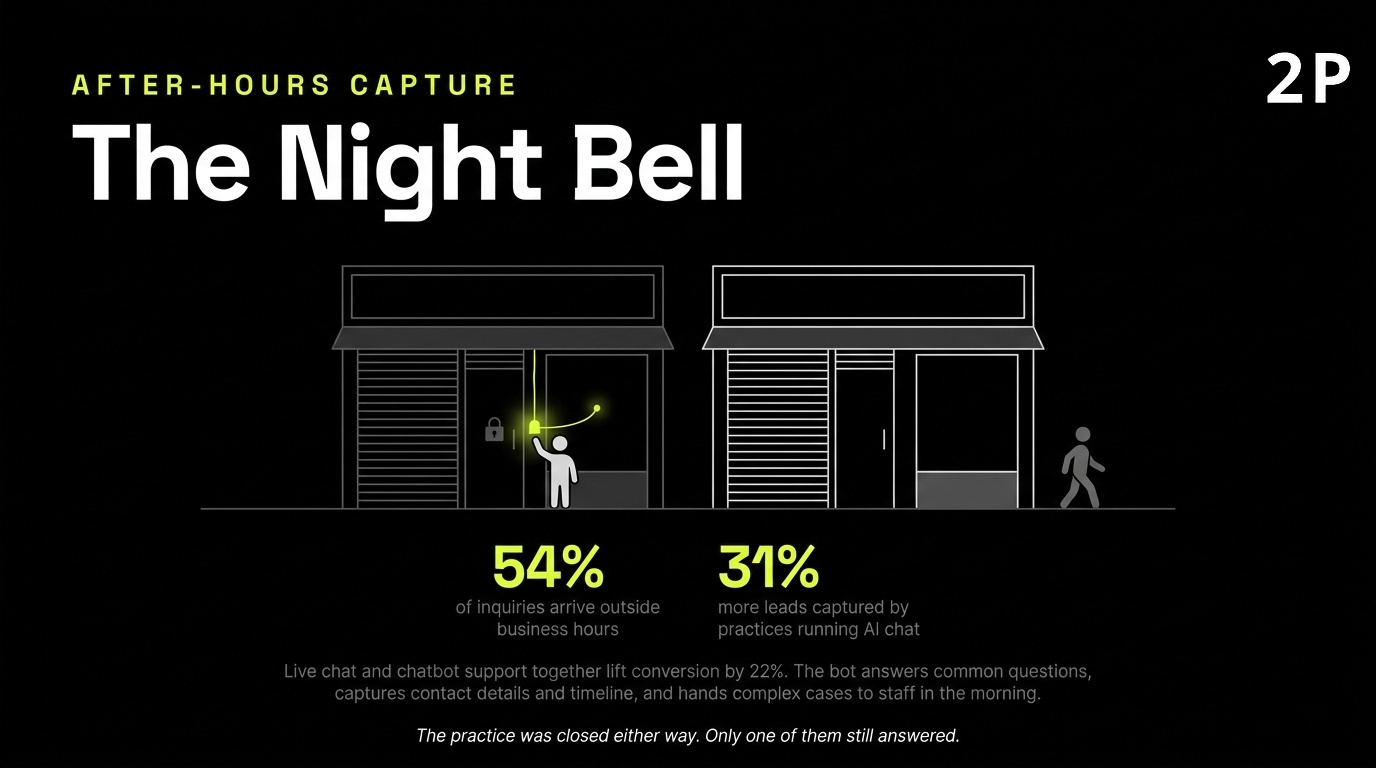
AI-powered chatbots address one of the most persistent lead capture challenges in plastic surgery: the mismatch between when prospective patients want information and when staff are available to provide it. 54% of plastic surgery inquiries originate outside of business hours, and without automated response capability, these after-hours expressions of interest frequently convert to competitors who respond faster. Chatbots configured to answer common initial questions, capture contact information, and schedule consultation requests capture leads that would otherwise evaporate by morning.
Practices that implement AI chatbots report a 31% increase in lead capture and a 22% increase in conversion rates from live chat and chatbot support combined. Effective chatbot configuration for aesthetic practices includes the ability to answer frequently asked questions about procedures, recovery timelines, pricing ranges, and insurance considerations; qualify leads by capturing procedure interest, geographic location, and timeline; and seamlessly hand off complex inquiries to human staff during business hours. Integration with practice management systems allows chatbot-captured leads to flow directly into scheduling and CRM workflows without manual data entry, reducing administrative friction and ensuring consistent follow-up.
AI for Automating Patient Communication Sequences
Beyond chatbots, AI enables sophisticated automation of the patient communication sequences that guide prospective patients through the long consideration cycle. AI now automates routine patient communication tasks that previously consumed significant administrative time, including pre-consultation education delivery, appointment reminders, post-procedure follow-up sequences, and re-engagement campaigns for leads who went quiet during the decision process.
Pre-consultation education automation delivers relevant procedure information, financing option explanations, preparation instructions, and appointment logistics to scheduled consultation patients without requiring staff to send individual emails or make phone calls. This automated education reduces the time surgeons spend in consultations covering basic information, allowing more consultation time for the individualized clinical assessment and relationship building that actually drives booking decisions. Building a comprehensive marketing automation workflow creates a system where every lead receives consistent, high-quality communication regardless of when they inquire or how busy the practice is.
Optimizing Plastic Surgery Content for AI-Driven Search
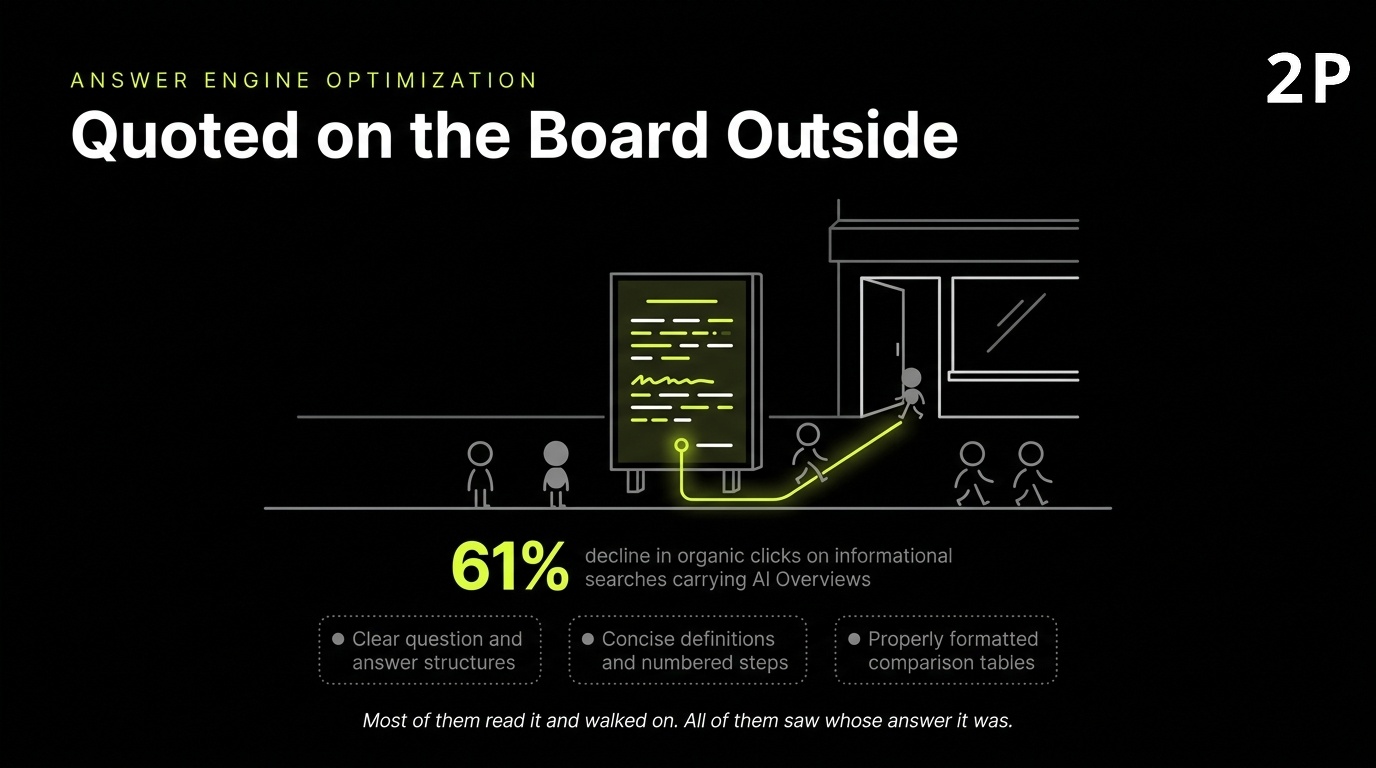
The emergence of AI Overviews in Google Search has fundamentally changed how informational plastic surgery searches deliver results to patients. Organic click-through rates on informational searches featuring AI Overviews have fallen by 61%, meaning that content answering general plastic surgery questions now generates significantly fewer website visitors even when it ranks in the top positions. This shift demands a strategic response that focuses on Answer Engine Optimization rather than traditional click-volume optimization.
AEO for plastic surgery content means structuring information in formats that AI systems can extract and present directly within AI Overview responses, knowledge panels, and conversational AI interfaces. Clear question-and-answer structures, concise definition statements, numbered step-by-step explanations, and properly formatted comparison tables all help AI systems identify and cite practice content in summarized responses. The strategic value of appearing within AI Overviews is brand visibility and credibility signaling even when it does not drive a direct click, as patients who see a practice’s information surfaced by Google’s AI develop familiarity and implicit trust that influences later decision-making. AI-driven search is fundamentally reshaping how patients discover plastic surgeons and will continue to evolve rapidly in the coming years.
Email Marketing Automation and Segmentation for Lead Nurturing
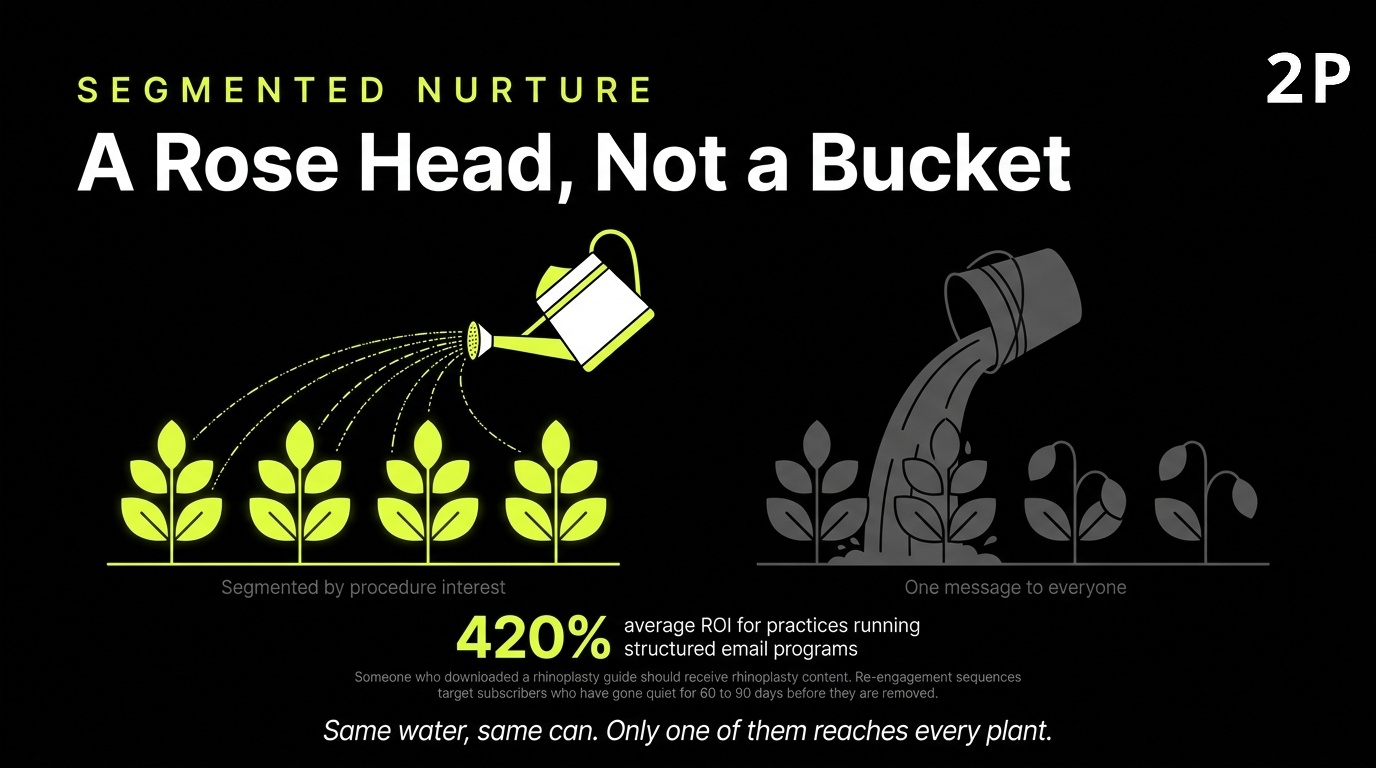
Email marketing remains one of the highest-ROI channels available to plastic surgery practices, generating 420% average ROI for practices with well-structured programs. The combination of low per-send cost, high personalization capability, and direct audience access makes email particularly valuable for the long patient decision cycle where maintaining awareness and providing ongoing education are critical to eventual conversion.
Effective email marketing for aesthetic practices begins with audience segmentation by procedure interest. A prospective patient who downloaded a rhinoplasty guide should receive rhinoplasty-focused nurture content, not generic practice newsletters. Segmented campaigns consistently outperform blanket email blasts across all measurable metrics including open rates, click-through rates, and consultation conversion rates. Re-engagement sequences specifically target subscribers who have gone quiet for 60 to 90 days, using compelling subject lines and value-first content to restart the conversation before these leads are removed from active nurture. Setting clear marketing goals for each email sequence, including target open rates, click rates, and consultation booking conversions, allows practices to measure and optimize their email program systematically.
Measuring Plastic Surgery Marketing Success: Analytics, Attribution, and ROI
Investment in plastic surgery digital marketing without rigorous measurement produces exactly the kind of guesswork that leads to wasted budget and missed growth opportunities. The multi-channel, long-cycle nature of aesthetic patient acquisition creates genuine measurement complexity, but the practices that solve this complexity gain significant competitive advantages through data-driven optimization that intuition-guided approaches cannot achieve.
Essential Metrics by Digital Marketing Channel
Each digital marketing channel requires its own set of performance metrics that reflect what that channel is designed to accomplish and how its contribution to patient acquisition can be tracked meaningfully. Conflating metrics across channels or applying a single performance lens to all channels produces misleading conclusions and bad budget decisions.
| Digital Channel | Primary KPIs | Industry Benchmark | Warning Signals |
|---|---|---|---|
| Organic SEO | Organic traffic, keyword rankings, organic conversion rate | 18.9% lead-to-consultation conversion | Traffic growth without ranking improvement, or rankings without traffic |
| Google Ads | CPC, cost per consultation, ROAS, Quality Score | $5.75 CPC, $102.51 CPL, 10.7% conversion | Rising CPC without improving conversion, low Quality Scores |
| Meta Advertising | Reach, engagement rate, CPM, link clicks, lead form submissions | 6.2% lead-to-consultation conversion | High engagement with zero consultation bookings |
| Email Marketing | Open rate, click rate, unsubscribe rate, attributed consultations | 420% average ROI | Declining open rates, high unsubscribe rates |
| Social Media (Organic) | Follower growth, engagement rate, website referral traffic | 78% report as top lead source | High follower count with minimal website referral traffic |
| Referral Programs | Referral volume, referral conversion rate, referral source tracking | 36.8% referral conversion rate | Referral volume declining without explanation |
Tracking these channel-specific metrics in a unified dashboard allows practices to identify which channels are performing to benchmark, which need optimization, and where budget reallocations might improve overall portfolio performance.
Attribution Modeling for Multi-Touch Patient Journeys
Attribution in plastic surgery marketing is genuinely complex because patients interact with an average of five to seven digital touchpoints across multiple channels over their 60 to 180 day consideration cycle before booking. Standard last-click attribution models, which assign full credit for a conversion to the final touchpoint before booking, systematically undervalue the early-stage channels like SEO blog content and social media that initiated and nurtured the patient relationship throughout the journey.
Multi-touch attribution models distribute conversion credit across multiple touchpoints based on their actual contribution to the patient’s decision process. Position-based models, sometimes called U-shaped models, give significant credit to first-touch and last-touch interactions while distributing remaining credit across middle touchpoints. Time-decay models give increasing credit to touchpoints that occurred closer to the booking decision. Neither model is perfect for the complexity of plastic surgery patient journeys, but both substantially outperform last-click attribution for informing investment decisions.
The role of “dark social” and untrackable referrals deserves explicit acknowledgment in any honest attribution discussion. A patient who hears about a surgeon from a friend, sees the practice’s Instagram posts for three months, then books after a direct Google search will likely attribute their decision to the recommendation they received in a private conversation, a touchpoint that no tracking system will ever capture. Practices that ask “how did you hear about us” during consultation intake consistently uncover referral sources that digital analytics undercount, providing a more complete picture of how the marketing investment is actually driving growth. Integrating CRM data with digital analytics is the most reliable path to attribution clarity that the technology currently supports.
Calculating True Patient Lifetime Value for Marketing Investment Decisions
The $102.51 cost per lead figure takes on a very different meaning depending on how practices calculate the value of a patient acquired through digital marketing. A patient who undergoes a single rhinoplasty represents one transaction. But a patient who subsequently pursues non-surgical treatments, refers two friends who each book procedures, and returns for a secondary procedure years later represents a dramatically higher lifetime value that easily justifies aggressive acquisition investment.
Referrals from satisfied patients convert at a remarkable 36.8%, the highest conversion rate of any patient acquisition source, and referrals account for approximately 22% of new patients at thriving aesthetic practices. This means that every patient successfully acquired through digital marketing represents not just their own procedure revenue but a potential referral pipeline that generates future patients at the highest available conversion rate. When calculating the ROI of digital marketing investments, practices that include referral value as part of the patient lifetime value calculation arrive at much higher justified acquisition cost thresholds than those who only count initial procedure revenue.
Retention marketing for maintenance treatments, including injectables, skin care, laser treatments, and non-surgical enhancement services, generates recurring revenue from the existing patient base that digital marketing initially acquired. Building an active, segmented email communication program that keeps the practice visible to past patients and provides relevant treatment reminders maximizes this retention value. Practices that calculate complete patient lifetime value inclusive of retention revenue, referral pipeline value, and patient advocacy effects consistently justify higher digital marketing investments and achieve stronger growth than those making decisions on cost-per-first-procedure metrics alone. A comprehensive personalized marketing strategy that nurtures patients beyond their initial procedure transforms one-time clients into long-term practice advocates.
The measurement imperative in plastic surgery digital marketing is ultimately about building the organizational discipline to make decisions from evidence rather than intuition. In a field where the average cost per lead is over $100, where patient decisions span months and multiple channels, and where a single acquired patient can generate tens of thousands of dollars in lifetime value, the difference between good and poor measurement practices represents enormous financial consequence. Practices that treat analytics as a core operational competency consistently outperform those that treat it as an afterthought.
Building a Digital Marketing Strategy for Plastic Surgery Practices That Grows with the Market
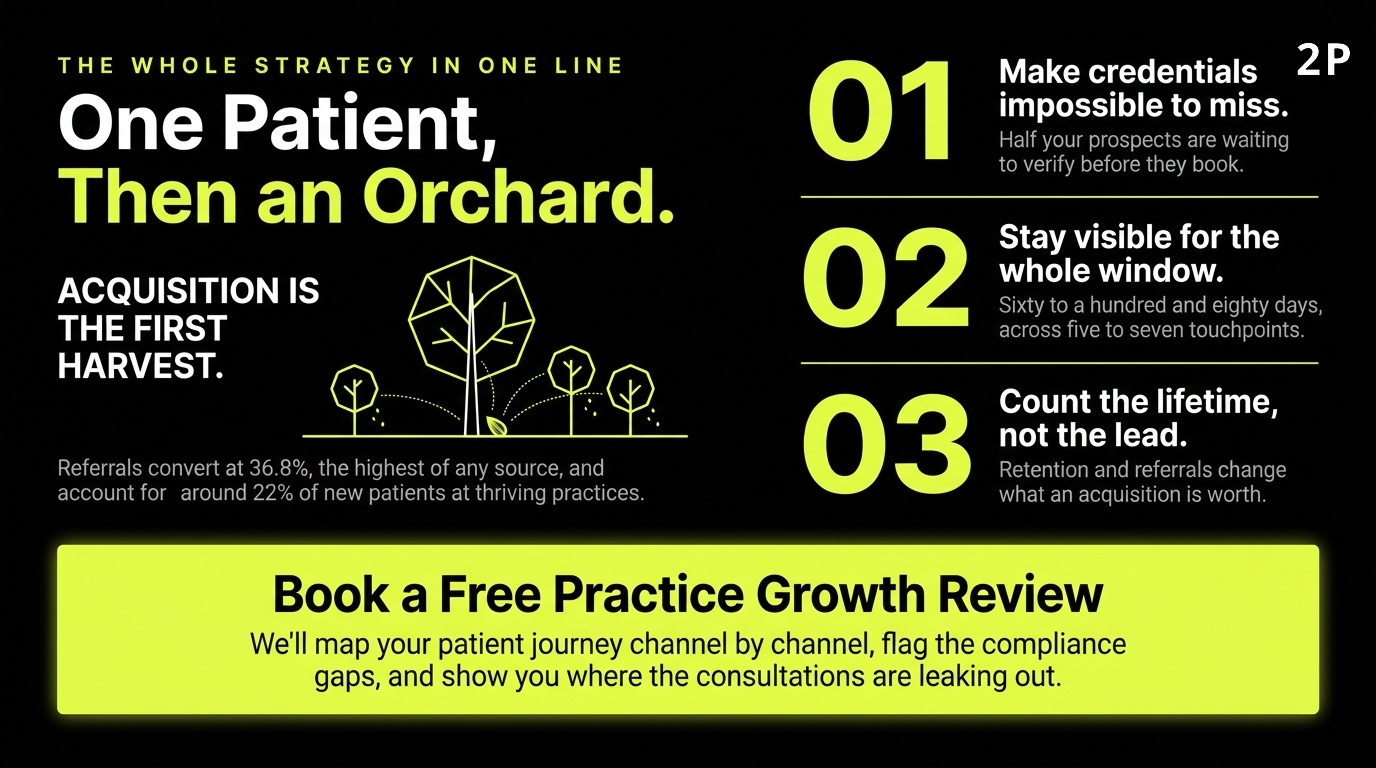
An effective digital marketing strategy for an aesthetic practice is never static. The combination of evolving search algorithms, shifting patient behavior patterns, emerging social platforms, AI-driven search changes, and competitive market dynamics requires ongoing strategy review and adaptation. Practices that treat their digital marketing strategy as a living system, regularly testing new approaches and refining based on performance data, consistently outperform those operating from a set-it-and-forget-it posture.
The most important strategic decision for most aesthetic practices is channel sequencing: building strong SEO and content foundations before scaling paid advertising, ensuring website conversion optimization is complete before driving significant traffic, and establishing review generation systems before concentrating marketing investment on channels where reputation visibility matters most. The sequence matters because effectiveness in later-stage channels depends on the infrastructure that earlier-stage channels establish.
Digital transformation for established practices sometimes means confronting the reality that traditional marketing approaches, newspaper ads, billboard placements, and passive word-of-mouth strategies, can no longer deliver the patient volume and acquisition cost efficiency that digital channels provide. The data is unambiguous: digital channels dominate plastic surgery patient acquisition in 2026, and practices that have not made the transition are operating at a structural competitive disadvantage.
Partnering with specialists who understand the specific compliance requirements, conversion optimization principles, and channel dynamics of aesthetic practice marketing accelerates results while protecting practices from the regulatory and reputational risks that general marketing approaches sometimes inadvertently create. Agencies like 2POINT with demonstrated expertise in healthcare marketing bring the combination of digital marketing sophistication and compliance awareness that aesthetic practices need to grow confidently in an increasingly complex environment.
Frequently Asked Questions About Plastic Surgery Digital Marketing
What is plastic surgery digital marketing?
Plastic surgery digital marketing refers to the strategies and tactics aesthetic practices use to attract, educate, and convert patients through online channels including SEO, paid advertising, social media, email marketing, video content, and AI-powered patient communication tools. It operates under Google’s YMYL standards and HIPAA compliance requirements that make it more complex than general digital marketing. The goal is to build consistent patient inquiry volume while maintaining ethical, compliant messaging throughout.
How much does plastic surgery digital marketing cost?
Costs vary significantly based on market competitiveness, practice size, and channel mix. Google Ads for plastic surgery average $5.75 per click and $102.51 per lead, while SEO investment typically ranges from $2,000 to $8,000 per month for comprehensive campaigns in competitive markets. Social media advertising, email marketing automation, and website optimization add to the total investment. Practices that calculate complete patient lifetime value including referral revenue typically find that even aggressive acquisition costs deliver strong ROI.
Is SEO or paid advertising better for plastic surgery practices?
Both channels serve distinct and complementary functions. SEO converts at 18.9% and builds compounding authority over time without per-click costs, making it the highest long-term ROI channel. Google Ads converts at 10.7% and delivers immediate visibility from day one, making it valuable during the period when SEO authority is still building. The most effective practices run both simultaneously, using PPC for immediate patient acquisition while building the SEO asset that reduces paid dependence over time.
How do HIPAA rules apply to plastic surgery marketing?
HIPAA governs any use of patient information in marketing, including before-and-after photos, video testimonials, written reviews featured in advertising, and case descriptions that could identify patients. Written consent that specifies exactly how patient images and information will be used is required before any patient content appears in marketing materials. HIPAA also restricts how practices can respond to online reviews, prohibiting confirmation or denial of patient status and disclosure of any treatment details in public responses.
What is the average plastic surgery patient decision timeline?
The typical plastic surgery patient takes 60 to 180 days from initial awareness to consultation booking, making it the longest decision cycle in elective medicine. During this period, patients typically research at least three clinics, verify surgeon credentials online, watch educational videos, read reviews across multiple platforms, and follow practice social media accounts before making contact. This extended timeline requires multi-channel marketing presence that maintains visibility throughout the entire consideration period.
How does social media marketing compare to SEO for cosmetic surgery practices?
Social media converts at 6.2% while SEO converts at 18.9%, but social serves a different strategic function: it builds the awareness and trust that eventually converts through other channels. 46% of patients follow a clinic’s social accounts before booking, confirming social’s role in the consideration phase rather than direct conversion. The most effective strategy uses social for awareness and relationship building while relying on SEO and paid search for high-intent conversion.
What makes plastic surgery SEO different from general SEO?
Plastic surgery SEO operates under Google’s YMYL (Your Money or Your Life) designation, which applies maximum E-E-A-T scrutiny to all content. This means that content must demonstrably reflect genuine medical expertise, verifiable credentials, and accurate clinical information rather than general wellness or lifestyle writing. Local SEO carries higher importance than in most industries because patients consistently choose providers within a geographic range. Technical SEO challenges are amplified by the visual-heavy nature of before-and-after galleries and video content.
How can a plastic surgery practice generate more online reviews?
Systematic review generation requires consistent post-procedure follow-up outreach timed to capture patient satisfaction while it is highest, frictionless review submission pathways via direct links in emails and text messages, and staff training on appropriate ways to mention reviews during positive patient interactions. Review incentivization is prohibited by both platform policies and medical ethics standards. Practices that make the review process easy and timely typically see significantly higher review volume than those that rely on patients to take initiative independently.
What role does video content play in plastic surgery marketing?
Video content generates 34% higher consultation booking rates compared to practices relying on static content alone. Patients who watch procedure explanation videos, surgeon introduction videos, and patient testimonials develop significantly stronger confidence in a practice before making contact. Video is effective across all stages of the patient journey, from awareness-phase educational content on YouTube to consideration-phase testimonials on the practice website, and is now considered essential rather than optional for competitive aesthetic practices.
How should plastic surgery practices respond to negative online reviews?
HIPAA compliance requires that responses to negative reviews never confirm patient status, reference appointment details, or discuss any clinical information, even when the review contains inaccurate claims. Effective responses acknowledge the reviewer’s experience with genuine concern, state the practice’s commitment to patient satisfaction, and invite private resolution through a specific contact channel. Prospective patients reading negative reviews judge a practice as much by the response quality as by the review content itself.
What are the best marketing channels for a new plastic surgery practice?
New practices benefit from beginning with Google Business Profile optimization and review generation for immediate local visibility, a well-structured website with online scheduling capability, and Google Ads campaigns targeting their highest-priority procedures for immediate patient acquisition while SEO authority builds. Social media presence on Instagram and TikTok builds brand awareness and humanizes the practice. SEO and content marketing should begin immediately since authority accumulates over time, but results typically emerge over 6 to 12 months of consistent investment.
How do AI tools improve plastic surgery patient acquisition?
AI chatbots capture 31% more leads by responding to the 54% of inquiries that arrive outside business hours. Marketing automation workflows deliver personalized nurture sequences to leads at every stage of the 60 to 180 day consideration cycle without requiring manual staff effort for each communication. AI-optimized content structured for Answer Engine Optimization positions practice information within Google’s AI Overviews, maintaining brand visibility even as traditional organic click-through rates decline in AI-impacted search environments.