


 let’s connect


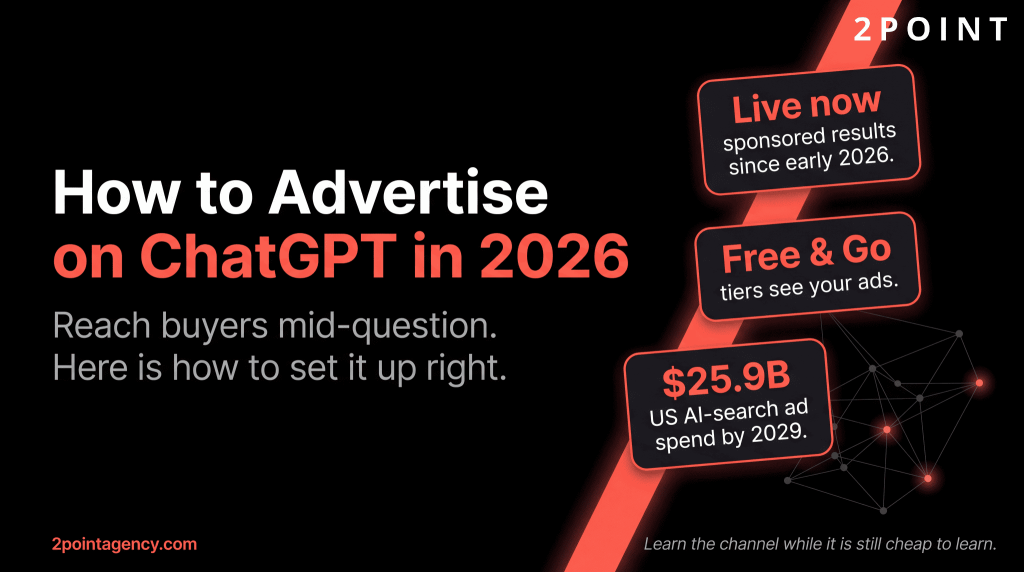
Your next customer isn't typing keywords into Google anymore. Instead, they're asking ChatGPT what to buy, and for the first time, your ad can be the answer.
Sponsored results went live in early 2026, opening a channel that reaches buyers mid-question.
That access sounds simple, yet it rarely is. Learning how to advertise on ChatGPT is the easy part, whereas getting the feed, targeting, and tracking inside ChatGPT Ads Manager is where most advertisers stumble, and that gap separates wasted budget from real revenue.
So rather than learn the hard way, let 2POINT build and manage your campaigns.
Key Takeaways
- ChatGPT shows labeled sponsored results to logged-in adults on the Free and Go tiers, so your audience is large and growing.
- You can run ads on ChatGPT once your business is verified and your products sit in a supported feed.
- Advertising in ChatGPT targets conversation context, not cookies, so genuine relevance beats keyword stuffing.
- Pricing follows a familiar auction model, with daily budgets in ChatGPT Ads Manager, so you start small and scale on proof.
- Conversion tracking is non-negotiable, since clean attribution proves the channel pays you back.
- A disciplined first week, judged on engagement quality over raw clicks, shapes everything that follows.
Can You Advertise on ChatGPT? (2026 Eligibility)
Yes. You can advertise on ChatGPT today. According to OpenAI, sponsored results now sit at the bottom of answers whenever a product fits the conversation someone is already having, so advertising in ChatGPT is a live channel, not a roadmap promise.
Whether you qualify is the real question.
As eWeek reports, ads currently reach only logged-in adults on the Free and Go tiers, while Plus, Pro, Business, Enterprise, and Education subscribers stay ad-free.
Even then, OpenAI says the test stays U.S.-only for now, and ads avoid sensitive ground like health, mental health, and politics, so confirm your market and vertical qualify before you build. Beyond that, buyers increasingly research using AI tools, so your paid presence lands harder when you also show up organically in AI search.
What You Need Before You Start
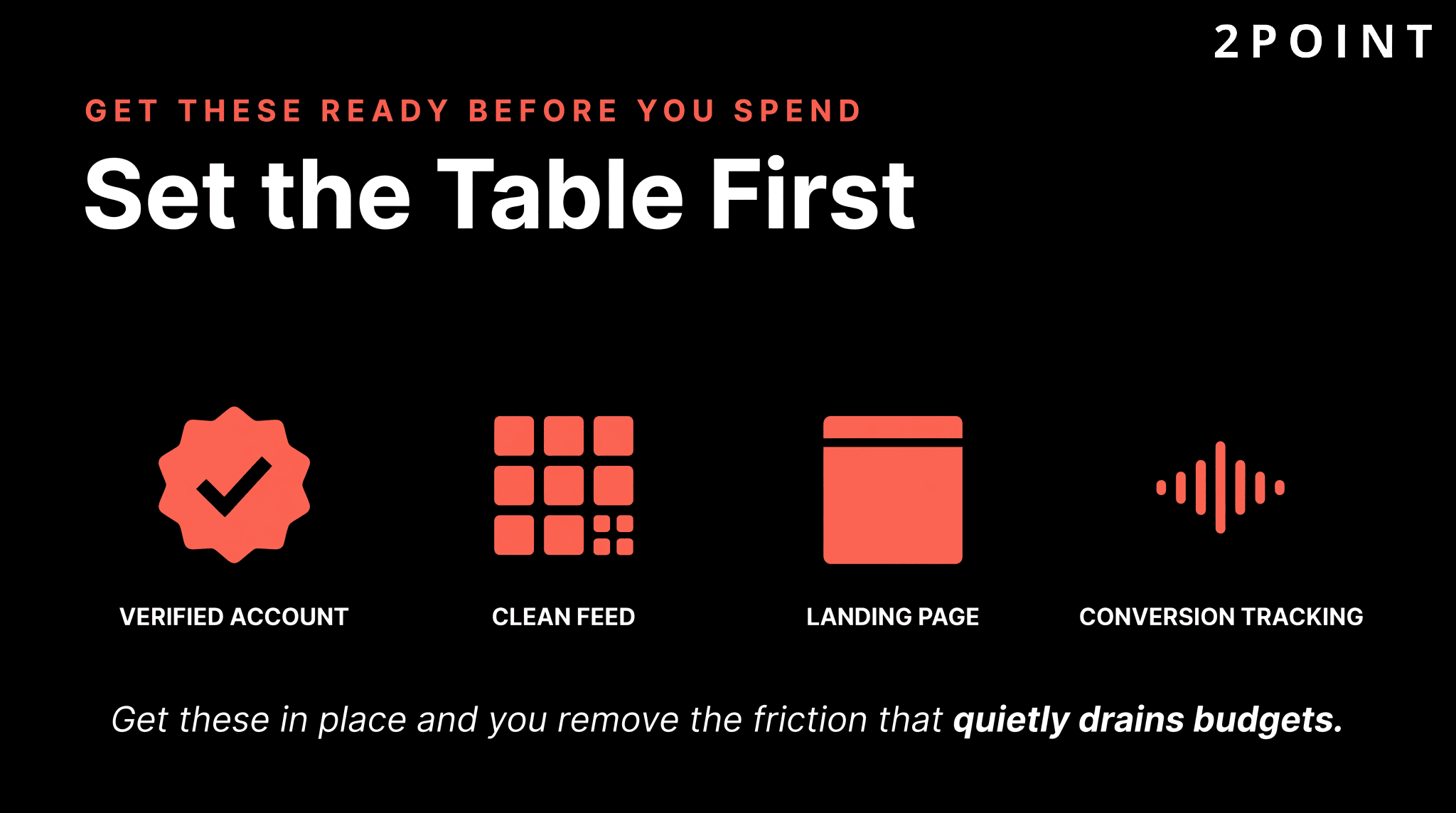
Before you can run ads on ChatGPT, get four things in place, or you'll quietly waste your early spend.
- An advertiser account in ChatGPT Ads Manager, with your business verified.
- A clean product feed, so ChatGPT knows exactly what you sell.
- A landing page that keeps the ad's promise, ideally built on a lead-generation funnel so clicks become customers.
- Conversion tracking ready to fire, whether a pixel or a server-side connection.
Once these are set, you remove the friction that drains budgets, and every later step gets a fair shot.
How to Advertise on ChatGPT: A Step-by-Step Setup
With your groundwork ready, here is how you go from zero to live. Think of the ChatGPT Ads Manager as your command center, where you build, bid, and measure everything in one view.
Step 1: Create and verify your advertiser account
Start by opening the ChatGPT Ads Manager, OpenAI's ad platform, and creating your advertiser account.
Then, complete business verification, since OpenAI confirms you are a legitimate company before any ad goes live. That review takes time, so begin it early.
Billing matters too. You enter your own payment details here, so keep that step in your own hands and never share login credentials. Have your legal business name and website ready to speed approval.
H3: Step 2: Connect your product feed
Once your account is verified, connect a product or service feed so the system can match what you sell to relevant conversations. Accurate titles, correct prices, and clear descriptions cut rejections and sharpen relevance from day one.
Then keep your feed in sync. Outdated stock or pricing sends people down dead ends and wastes spend, whereas clean data means your advertising in ChatGPT aligns with what each user is actually asking for.
Step 3: Set your objective, budget, and schedule
With your feed connected, open the ChatGPT Ads Manager, where three settings shape your campaign, so decide each before you launch.
- Objective: pick a single goal, whether sales, booked calls, or sign-ups, because a focused campaign is easier to read and optimize.
- Budget: start with a modest daily cap, then scale once the numbers prove out.
- Schedule: choose run dates that give the system enough time to learn before you judge results.
Then pair this paid push with your ongoing work to generate organic leads, keeping your pipeline healthy and never reliant on a single channel.
Step 4: Choose how you bid
With your objective set, advertising in ChatGPT runs on a familiar auction, so bidding should feel recognizable. You choose what to optimize for and set the ceiling you are willing to pay.
Then stay conservative early, watch the data, and raise bids only where performance earns it.
- Choose a reach-focused bid when awareness and broad visibility matter most.
- Choose an action-focused bid when clicks and conversions are what you actually care about.
Step 5: Let contextual targeting do the heavy lifting
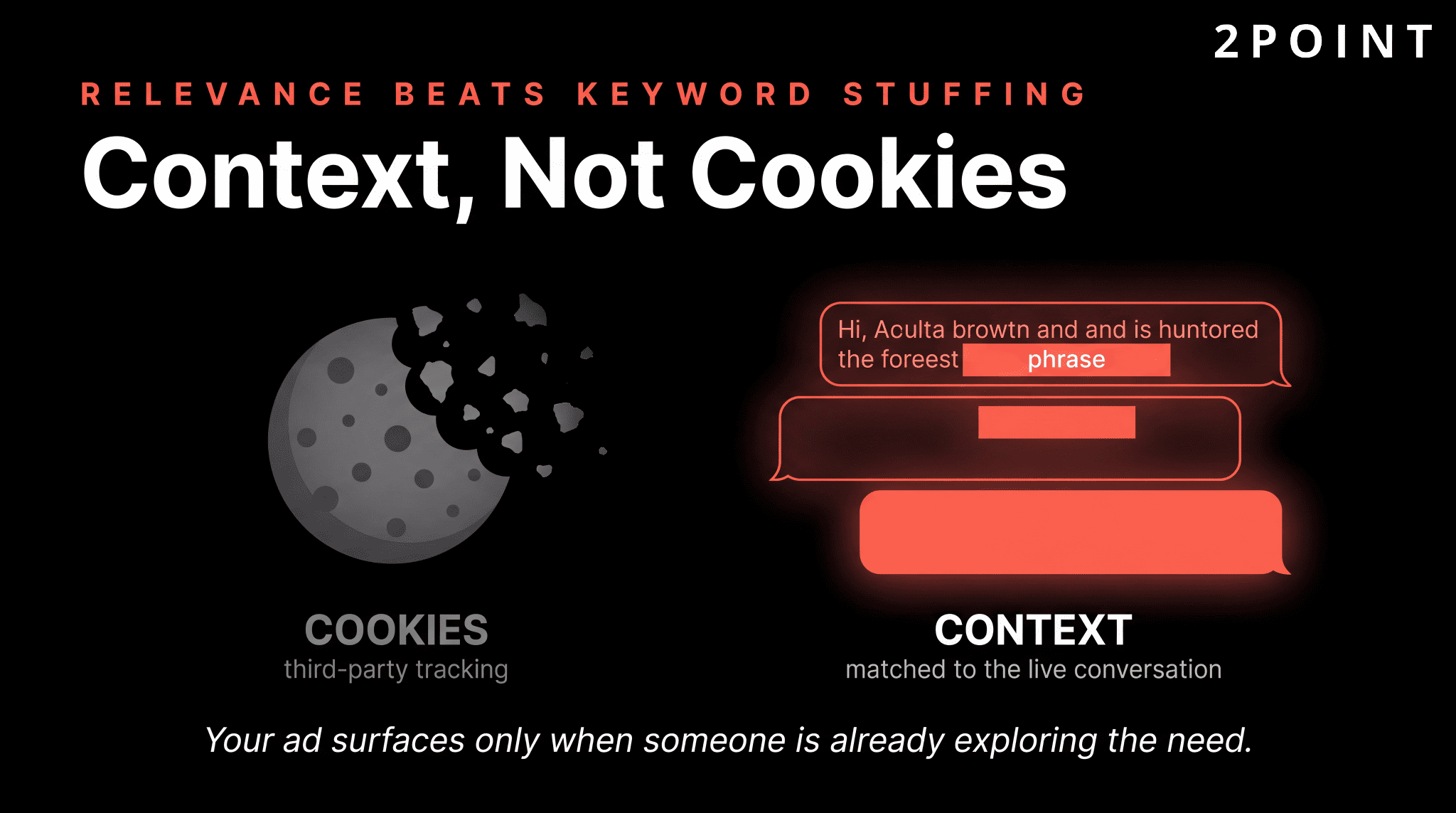
Targeting is where ChatGPT advertising feels genuinely different. Rather than cookies or a long keyword list, your ad matches the context of the live conversation, so it surfaces when someone is already exploring a related need.
As TechCrunch reports, ads are targeted to the discussion topic, keeping each placement relevant rather than intrusive.
- Lean into the topics where your product is the obvious answer.
- Exclude tangents that attract curious clicks but carry no real intent.
Step 6: Write ad copy that fits the conversation
Because your ad sits inside a conversation, it should read like a helpful suggestion, not an interruption. So speak to the need the person just expressed, lead with the outcome, and keep it specific.
Put your strongest benefit in the opening line, since that is the part most likely to earn the click. A small shift in wording changes everything:
- Generic: "We sell project management software."
- Conversation-aware: "Running a remote team? Keep every task and deadline in one shared view."
Step 7: Turn on conversion tracking
With your copy ready, lock down conversion tracking before a single dollar goes out. Fire a test event, then confirm it lands in your ChatGPT Ads Manager dashboard before you scale.
Track the actions that map to revenue, like purchases, booked calls, or sign-ups, not just clicks, since clicks alone say nothing about value. Attribution is not a nice-to-have here.
It is how you prove the channel pays off and decide where to reinvest.
Step 8: Run a pre-launch check before going live
You are almost live, so before you flip the switch, walk this short checklist and fix anything that is not ready:
- Tracking confirmed and reporting correctly, so no early data is lost.
- Daily budget caps set, so spend cannot run away from you.
- Targeting reviewed for relevance, so your ad reaches the right conversations.
- Creative approved and on-brand, so nothing stalls in review.
With every box green, you launch with confidence instead of crossed fingers, and you give every earlier step a fair shot at working.
How to Run Ads on ChatGPT Without Wasting Budget
Knowing how to run ads on ChatGPT is one thing; running them without wasting budget is another. Early on, resist judging by clicks alone, since engagement quality, how often a click becomes a real action, tells you far more.
- Watch conversion quality and depth, not just click volume.
- Tighten targeting toward the conversations that actually convert.
- Pause weak topics fast, so budget flows to your winners.
- Hold bids steady long enough to gather honest, decision-grade data.
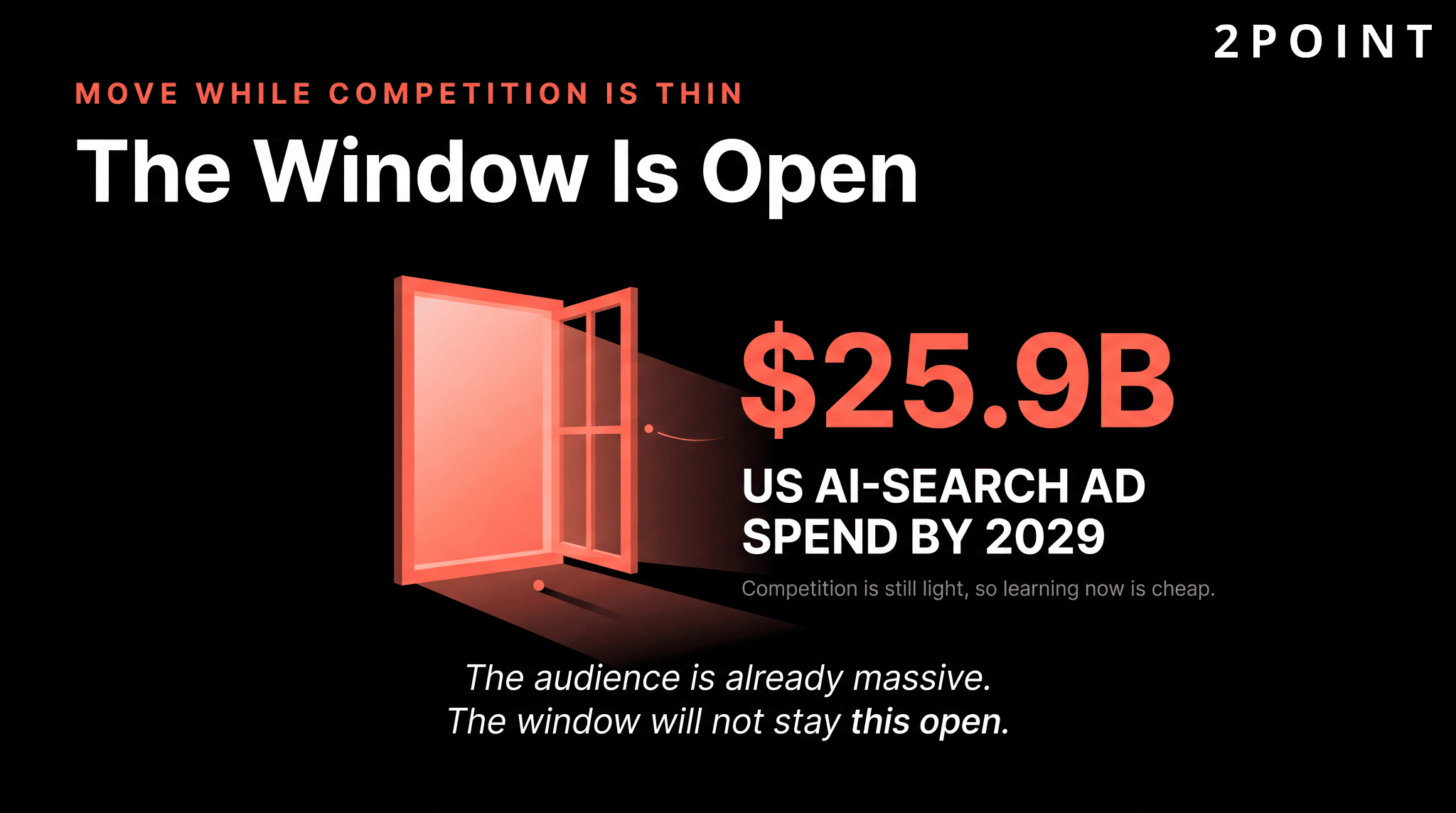
The timing rewards you now: according to EMARKETER, U.S. AI search ad spending will hit $25.9 billion by 2029, up from a sliver today, so learning while competition is light is cheap.
Prefer to hand it off? Our paid advertising services can run it for you.
ChatGPT Ads vs Other Platforms (A Quick Orientation)
So how does advertising in ChatGPT stack up against Google and Meta? Each channel catches demand at a different moment, so the sharpest media plans use them together rather than betting on one:
| Platform | How it captures demand | When it works | Targets based on | Strongest for |
| ChatGPT Ads | The intent you describe in a live conversation | The instant a need first surfaces | Context of the conversation | Discovery the moment a need forms |
| Google Search Ads | The intent you type into a search | The high-intent query that follows | Keywords and search terms | Capturing active, ready-to-act demand |
| Meta/Social Ads | The attention you scroll past | While a decision is still maturing | Audience interests and behavior | Awareness and staying top of mind |
Think of it as a relay, not a contest. ChatGPT can introduce your brand the instant a need surfaces, search captures the high-intent query that follows, and social keeps you visible while the decision matures. When those handoffs are clean, every channel does what it does best, and your cost per result drifts down across the whole program.
Exactly where ChatGPT advertising fits your mix comes down to its ad formats and measurement, both worth getting straight before you put real budget behind it.
Ready to Move Before the Window Closes?
The real edge here is timing. The audience is already massive, the format is genuinely useful, and the competition is still thin, which is exactly the window smart advertisers look for.
Knowing how to advertise on ChatGPT now means you learn the channel while it is still cheap to learn.
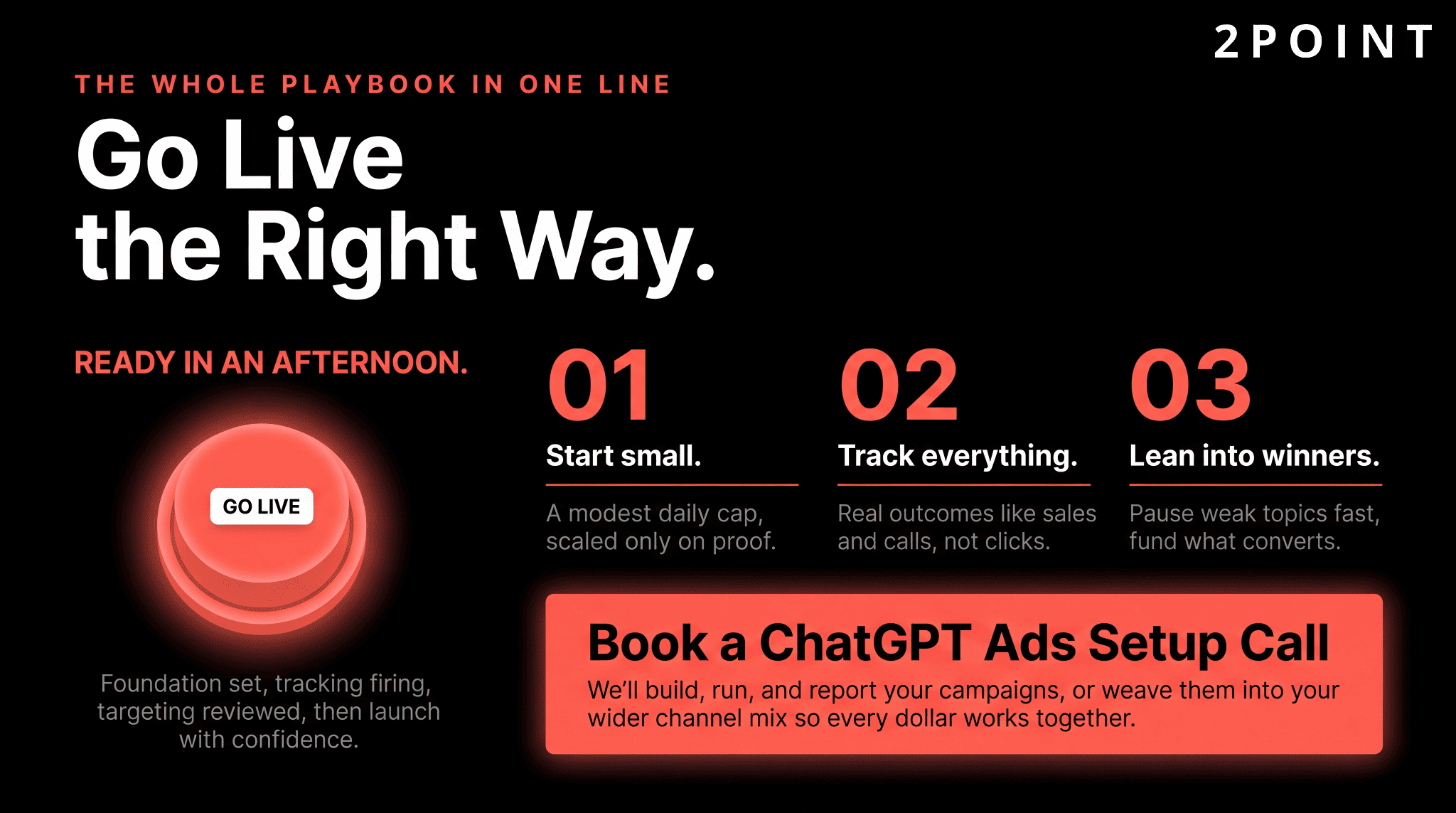
So start small, track everything, and lean in where the data points. And when you are ready to move faster, we can build and run your campaigns or weave them into your wider channel mix, so every dollar works together.
FAQs
Can you advertise on ChatGPT right now?
Yes, you can advertise on ChatGPT today. OpenAI opened sponsored results to logged-in adults on the Free and Go tiers in early 2026, and availability has been expanding by region since then.
Once your business is verified and your products sit in a supported feed, you can build campaigns right away, starting small while the channel is still young.
How much does it cost to advertise on ChatGPT?
Learning how to advertise on ChatGPT carries no fixed price, since costs run on an auction. You set the budget and the bid you are comfortable with, choosing CPM for reach or CPC for clicks. So start with a small daily cap, measure your results, and scale spend toward the conversations that actually convert for you.
Do you need a big budget to run ads on ChatGPT?
No. Knowing how to run ads on ChatGPT efficiently matters far more than budget size, especially now that the self-serve Ads Manager has removed early minimum spends.
A modest daily cap lets you test targeting and creative, gather clean data, and grow spend only where conversions justify it, which protects you while the channel is still young.
How do you track conversions in the ChatGPT Ads Manager?
Install a pixel or the server-side Conversions API, fire a test event, and confirm it appears in your ChatGPT Ads Manager dashboard before you scale. Track real outcomes like purchases, calls, or sign-ups, not just clicks. Accurate attribution is how you prove the channel pays back and decide where to put your next dollar as the program scales.
Who sees ads when advertising in ChatGPT?
Ads appear for logged-in adults on the Free and Go tiers, while Plus, Pro, Business, Enterprise, and Education plans stay ad-free. Because advertising in ChatGPT relies on the context of the live conversation rather than cookies, your message surfaces only when someone is actively exploring a need your product can genuinely meet, keeping the placement relevant rather than intrusive.