let’s connect


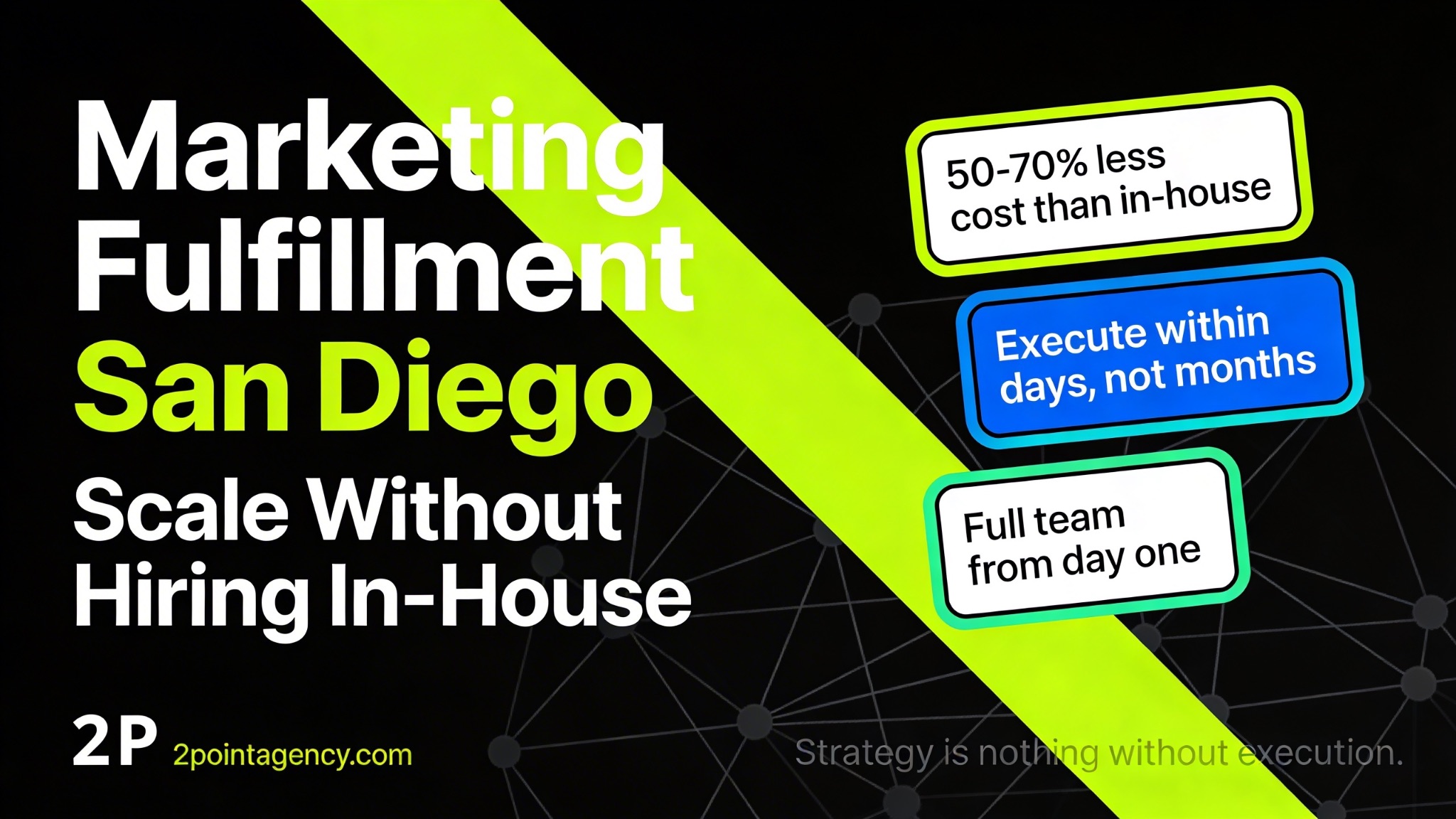
Most San Diego businesses hit the same wall. The strategy exists. The goals are clear.
But execution stalls because the team is stretched too thin. That gap is exactly why marketing fulfillment in San Diego, CA has become essential for companies that need to keep momentum.
Unlike consulting, marketing fulfillment services cover the actual work. Campaigns get built, content gets published, platforms get managed, and results get reported while you focus on running the business.
This guide breaks down what fulfillment looks like across San Diego’s competitive verticals and how to choose the right partner. At 2POINT, we provide structured fulfillment built around measurable outcomes.
Key Takeaways
- Marketing fulfillment services handle the execution layer, where an external partner manages production and delivery across multiple channels.
- Outsourcing marketing execution services lets San Diego businesses scale without the cost of building a full in-house team.
- Common services include SEO execution, PPC management, content production, web development, social media, and creative design.
- Outsourced fulfillment typically costs 50 to 70 percent less than hiring equivalent in-house roles.
- The best marketing fulfillment in San Diego, CA operates as an extension of your team with dedicated management and transparent reporting.
What Is Marketing Fulfillment?
Marketing Fulfillment Defined
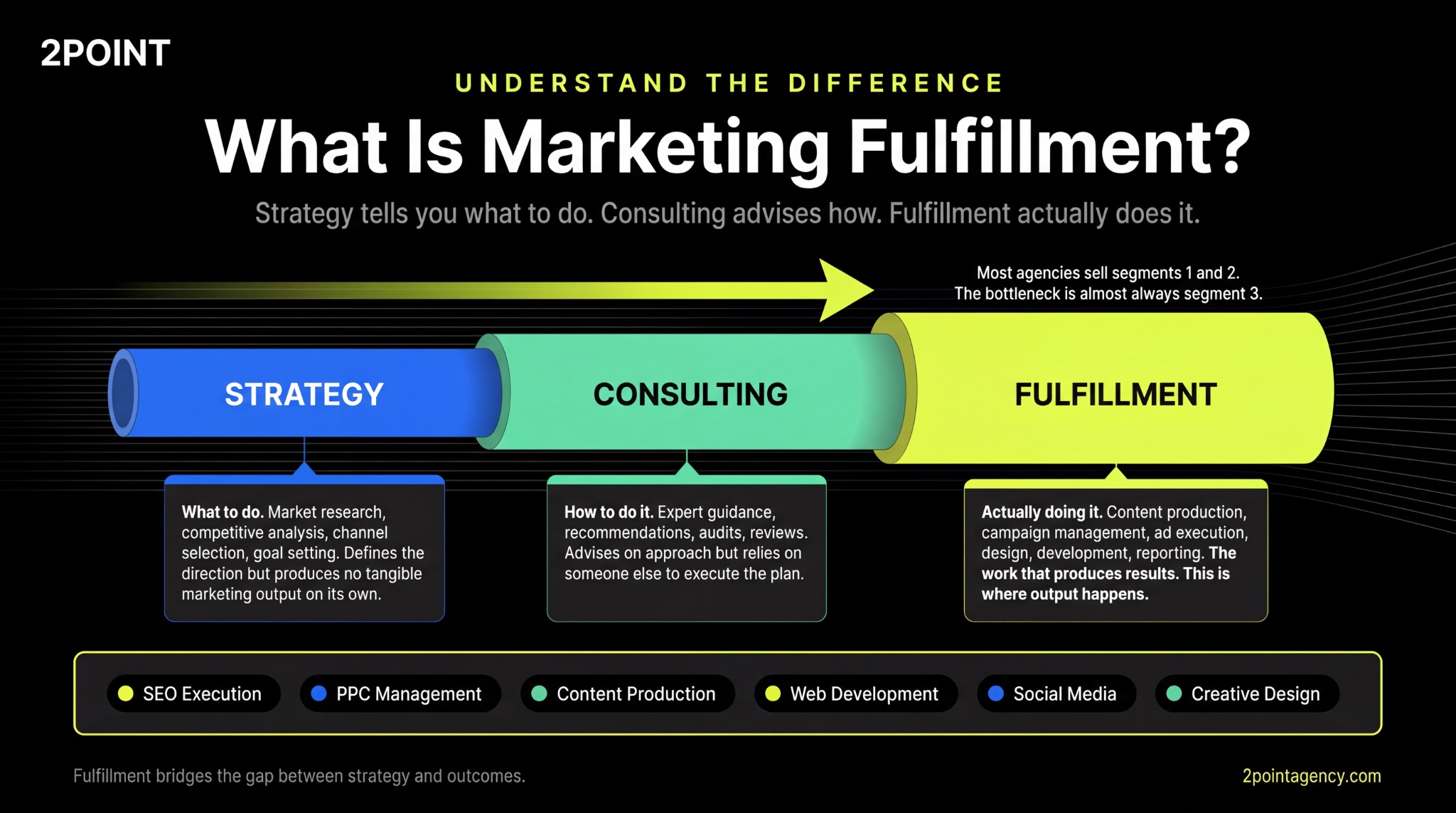
Marketing fulfillment is the process of executing your marketing plans from start to finish. That means creating content, building campaigns, managing platforms, and delivering measurable results.
It bridges the gap between a strategy that looks great in a deck and outcomes you can actually track in your pipeline.
The problem for most businesses isn’t vision. It’s bandwidth. Marketing execution services fill that gap by providing the hands, tools, and expertise you need to turn plans into production across channels like SEO, PPC, social, email, and content, along with traditional deliverables like print and event materials when needed.
Fulfillment vs. Strategy vs. Consulting
These three terms get used interchangeably, but they serve very different roles. Understanding the distinction helps you identify what your business actually needs right now.
| Strategy | Consulting | Fulfilment | |
| What it does | Tells you what to do | Advises on how to do it | Actually does the work |
| Primary output | Plans, roadmaps, frameworks | Recommendations, audits | Campaigns content, deliverables |
| Best for | Direction and goal setting | Diagnosing problems | Scaling execution and output |
Plenty of agencies sell beautiful strategy decks but deliver slow, inconsistent execution once the real work begins. A fulfillment-focused model prioritizes output and velocity. The ideal partner combines strategic thinking with reliable execution, so you never have to chase deliverables or wonder what happened to last month’s campaign.
What Marketing Fulfillment Services Include
SEO Fulfillment
SEO is one of the most execution-heavy marketing channels, which makes it a natural fit for fulfillment. Your partner handles the day-to-day work, including technical audits and fixes, keyword research, on-page optimization, content production, link building, and ongoing monitoring.
What sets strong fulfillment apart is consistency. You’re not just getting a one-time audit. You’re getting continuous execution against agreed-upon KPIs, with progress reported monthly.
When done right, this kind of integrated SEO approach across your tech stack compounds over time, building organic visibility that becomes harder for competitors to displace.
PPC and Paid Media Fulfillment
While SEO builds long-term visibility, paid media delivers immediate traffic. A fulfillment partner manages the full lifecycle for you, including:
- Campaign setup, ad copywriting, and audience targeting across Google Ads and Meta Ads.
- Bid management and A/B testing to improve performance over time.
- Ongoing budget optimization to maximize your return on ad spend.
- Regular performance reporting tied to revenue, not just impressions.
Understanding the differences between search advertising and paid social helps determine which platforms deserve priority in your budget.
Content Production and Copywriting
Both SEO and paid media depend on one thing to perform: content.
A fulfillment partner handles the full production pipeline for you, including blog posts, landing pages, email sequences, case studies, whitepapers, video scripts, and social media content.
Everything is produced on a consistent schedule aligned with your SEO and campaign strategy. That consistency is what matters most. Sporadic publishing undermines your rankings, weakens your ad performance, and signals to your audience that you’re not actively engaged.
Web Design and Development
All the traffic you generate through SEO, ads, and content ultimately lands on your website. That’s why a fulfillment partner should also handle custom site builds, landing page creation, ongoing updates, CRO implementation, and technical maintenance.
You get continuous dev support without putting a full-time developer on payroll.
A site built with engaging animations and conversion-focused design performs dramatically better than a static template, turning more of that traffic into actual leads.
Social Media Management
Your website captures demand, but social media is where you build awareness and stay top of mind. A fulfillment partner handles content creation, scheduling, community management, paid social campaigns, and performance analytics on your behalf.
What matters most is platform selection. Your team should build strategies specific to Instagram, LinkedIn, Facebook, TikTok, or X based on where your audience actually spends time, not where it’s easiest to post. That focus is what turns social presence into pipeline.
Creative and Brand Design
Every channel you invest in needs visual assets to perform. A fulfillment partner keeps your brand consistent across all of them without hiring an in-house creative team.
One designer working under your brand guidelines keeps visual identity tight across:
- Ad creatives for paid search and social campaigns.
- Social media graphics and story content.
- Presentations, pitch decks, and sales collateral.
- Marketing materials for both digital and print.
Maintaining brand consistency across all digital touchpoints is what separates professional brands from forgettable ones.
The Cost of Hiring In-House vs. Outsourcing Fulfillment
What a Full In-House Marketing Team Costs in San Diego
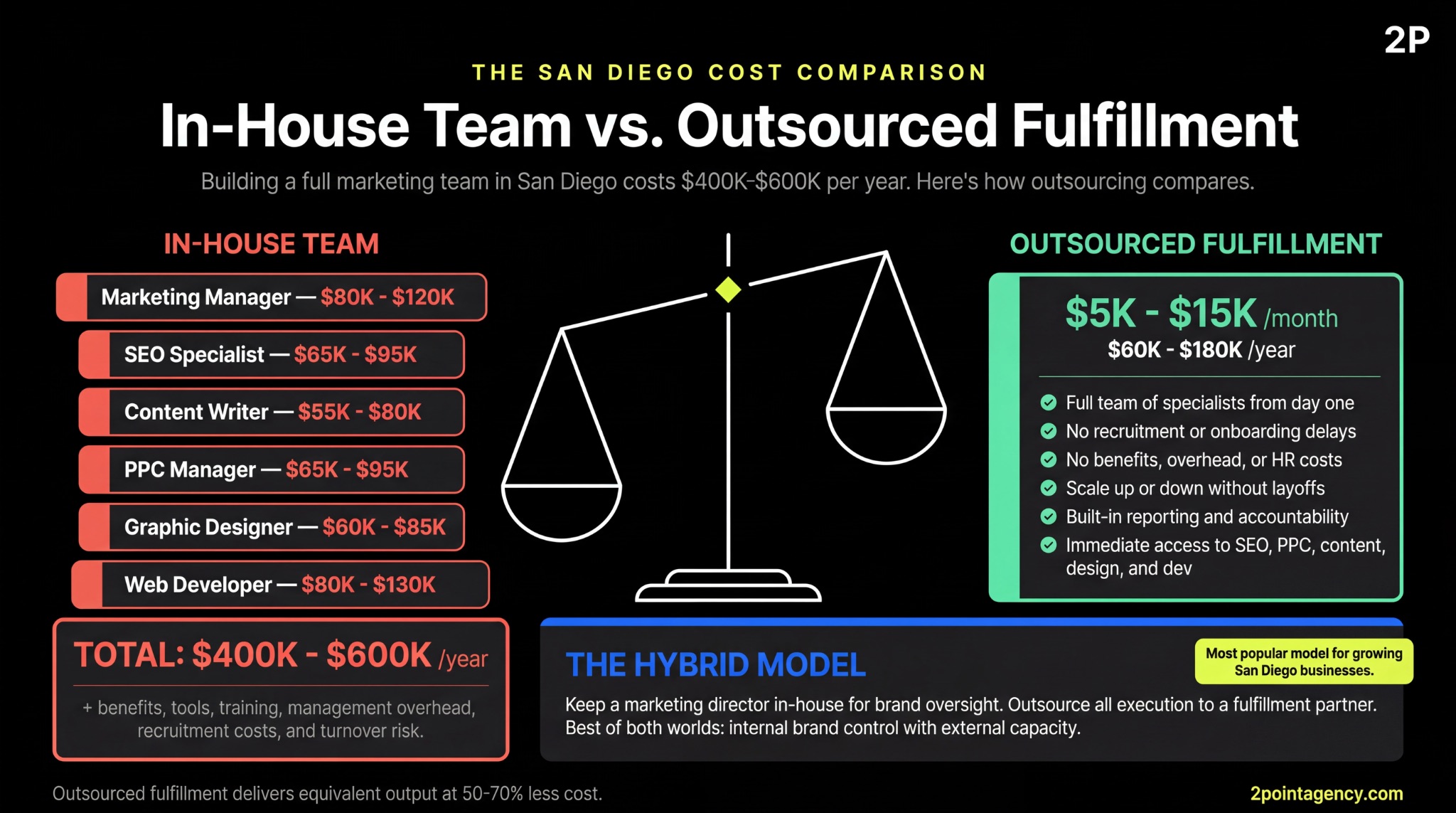
Building a marketing team from scratch in San Diego gets expensive fast. According to the U.S. Bureau of Labor Statistics, a marketing manager alone earns a median salary of $161,030. Add the rest of your team and the numbers climb quickly:
- SEO Specialist: $65,000 to $95,000
- Content Writer: $55,000 to $80,000
- PPC Manager: $65,000 to $95,000
- Graphic Designer: $60,000 to $85,000
- Web Developer: $80,000 to $130,000
Once you factor in benefits, tools, training, and management overhead, a small in-house team runs $400,000 to $600,000 per year. That’s before accounting for turnover, ramp-up time, and the cost of replacing underperformers.
What Outsourced Fulfillment Costs
Compared to building in-house, outsourced fulfillment is significantly more cost-effective.
Full-service marketing fulfillment in San Diego typically runs $5,000 to $15,000 per month depending on scope. That puts your annual investment at $60,000 to $180,000 for output equivalent to a team costing two to three times more internally.
According to Clutch’s digital marketing pricing data, retainers in this range cover execution across multiple channels with dedicated management included. You skip recruitment costs, benefits, and turnover risk while gaining immediate access to a full skill set from day one.
The Hybrid Model
You don’t have to choose entirely between in-house and outsourced. Many growing San Diego businesses keep a marketing director or coordinator on staff for brand oversight and strategic direction.
The fulfillment partner then handles execution under that internal lead, including:
- Campaign builds and management across all active channels.
- Content production on a consistent publishing schedule.
- Creative design, web updates, and reporting.
This gives you internal brand control paired with external execution capacity. It’s the model we see working best for companies in the $5M to $50M revenue range, where you need scale without the overhead of a full team.
Why San Diego Businesses Choose Outsourced Fulfillment
Speed to Market
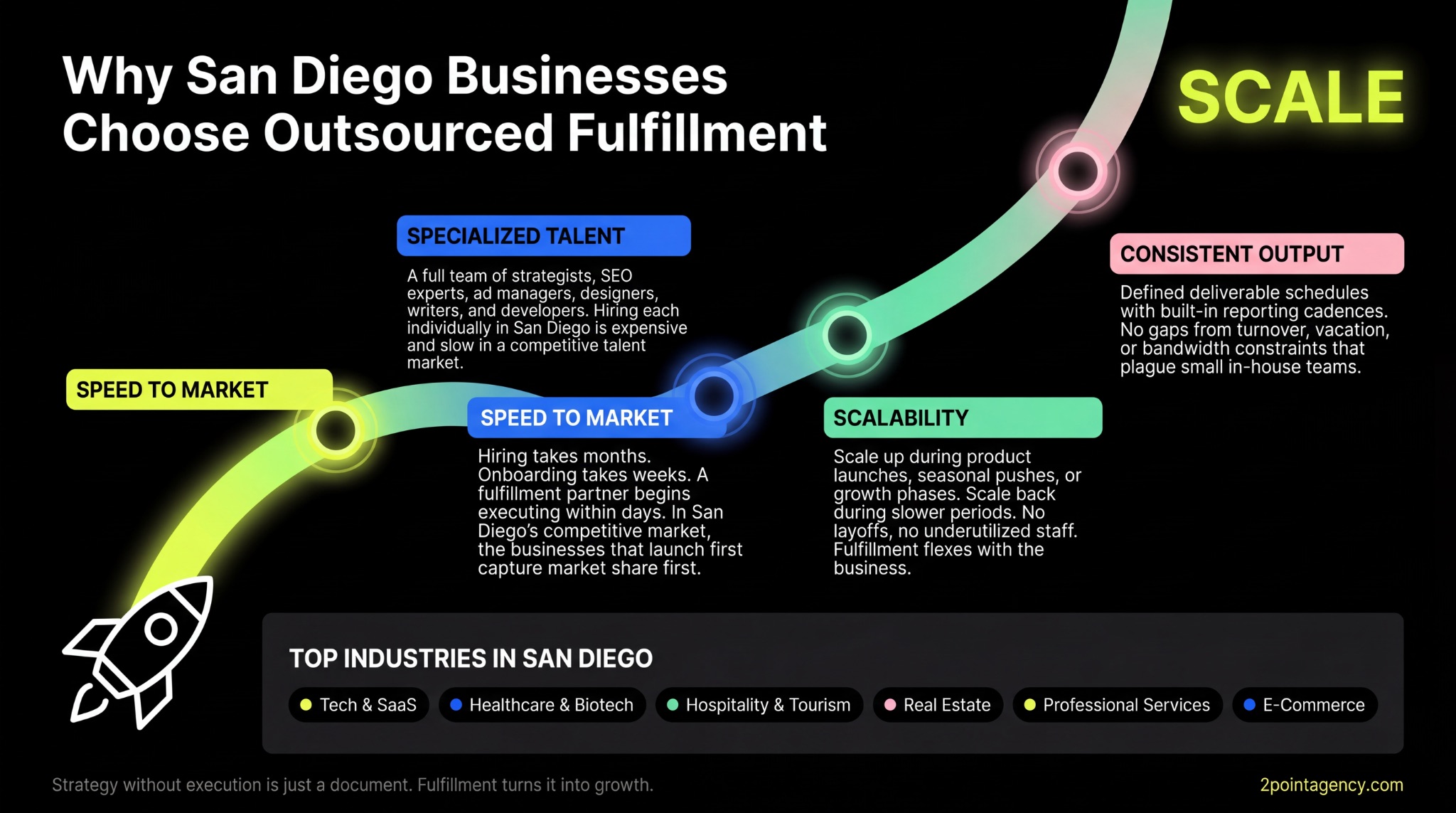
Hiring takes months. Onboarding takes weeks. By contrast, an outsourced marketing fulfillment team can begin executing within days of kickoff.
That speed advantage matters more than most businesses realize.
According to StartupBlink’s ecosystem rankings, San Diego’s startup ecosystem grew 19.4% in 2025, making it one of the fastest-moving markets in the country.
In that kind of environment, the companies that capture market share are the ones that execute first. If your fulfillment partner can launch campaigns while competitors are still posting job listings, you’re already ahead.
Access to Specialized Talent
Speed is only part of the equation. You also need the right people doing the work.
A fulfillment partner gives you a complete team of strategists, SEO specialists, ad managers, designers, writers, and developers, all without the overhead of hiring each role individually.
In San Diego’s competitive talent market, recruiting even one specialist takes time and budget you may not have. That’s why the decision between DIY marketing and hiring professionals often comes down to opportunity cost. Every month you spend recruiting is a month your competitors are executing.
Scalability Without Overhead
Having the right team is one thing. Being able to scale that team up or down without HR complications is another. With a fulfillment partner, you can ramp up during product launches, seasonal pushes, or growth phases, then scale back during slower periods. No layoffs. No underutilized staff sitting idle.
Outsourced marketing partnerships in San Diego flex with your business instead of locking you into fixed headcount, giving you the agility to match your output to your revenue cycle.
Consistent Output and Accountability
Scalability matters, but it means nothing without consistency. A fulfillment partner operates on defined deliverable schedules with reporting cadences baked into the engagement.
You don’t deal with the gaps that plague small in-house teams, like employee turnover, vacation coverage, or bandwidth crunches during busy seasons.
Your marketing output stays steady regardless of what’s happening internally. That reliability is what keeps campaigns on track and ensures the momentum you’re building doesn’t stall when someone calls in sick.
Industries in San Diego That Benefit Most
Marketing fulfillment isn’t one-size-fits-all. Different industries require different rhythms, and San Diego’s market reflects that clearly:
- Technology and SaaS: Consistent content, PPC, and SEO to compete in a crowded digital landscape.
- Healthcare and Biotech: Compliance-aware execution with content that meets regulatory standards.
- Hospitality and Tourism: Seasonal campaign agility and multi-channel presence to capture visitor traffic year-round.
- Real Estate: Local SEO, PPC, and creative production for listings and brand building.
- Professional Services: Authority-building content and local visibility for law firms and consultants.
- E-commerce: Ongoing PPC, product content, email marketing, and conversion optimization.
Understanding how different SEO types apply to enterprise, eCommerce, and local helps your fulfillment partner calibrate execution to match your specific competitive landscape.
How to Choose a Marketing Fulfillment Partner in San Diego
| What to Look For | Questions to Ask | Red Flags |
| Proven execution across multiple channels with work samples | How many deliverables are included each month? | Vague deliveries with no defined scope |
| Dedicated account manager who knows your business | Who does the actual work, and where are they located? | Core work outsourced offshore without disclosure |
| Transparent reporting tied to business KPIs | What’s your typical turnaround time? | No access to campaign data or reporting |
| Flexible scope that scales without lock-in contracts | How do you handle revisions and feedback loops? | Guaranteed results with no caveats |
| Industry experience relevant to your vertical | Can you share client references in my industry? | Rigid contracts regardless of performance |
How 2POINT Delivers Marketing Fulfillment in San Diego
At 2POINT, every engagement starts with a discovery session and audit where we map your business, define deliverables, and set measurable goals before any work begins. From there, execution spans SEO, PPC, content, web design, social media, and creative under one coordinated team.
Our content system builds topical authority through content clusters so every piece connects to a larger strategy. Dedicated account management, monthly revenue-tied reporting, and flexible engagement models mean you get fulfillment built around how your business actually operates.
Explore our full marketing services to see how we structure fulfillment for San Diego businesses.
Is Your Strategy Stuck in a Shared Drive?
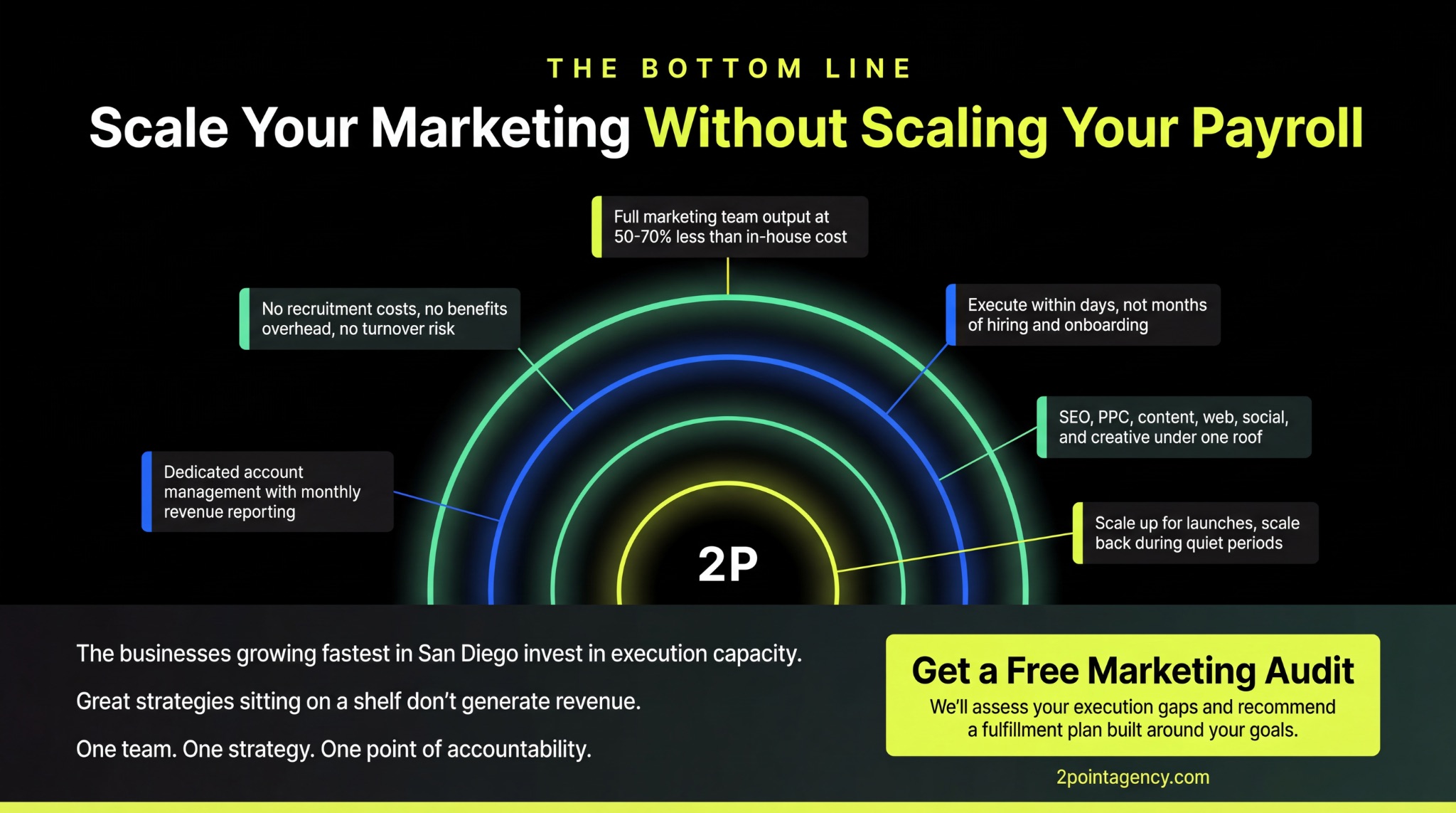
Marketing fulfillment in San Diego, CA is about turning plans into action at scale. The companies growing fastest here aren’t the ones with the best strategy decks. They’re the ones executing consistently.
Outsourced fulfillment gives you a full team’s output without the overhead of building one. If your execution isn’t matching your ambition, reach out to 2POINT and we’ll help you close the gap.
FAQs About Marketing Fulfillment
What is marketing fulfillment?
Marketing fulfillment is the end-to-end execution of your marketing strategy. An external partner handles content production, campaign management, and creative delivery across all active channels so your team can focus on running the business and driving growth.
How is marketing fulfillment different from hiring a marketing agency?
Traditional agencies often focus on strategy and consulting. Marketing fulfillment services prioritize execution and production, delivering campaigns, content, and creative on a defined schedule with measurable output. It’s about doing the work, not just planning it.
How much does outsourced marketing fulfillment cost in San Diego?
Outsourced marketing in San Diego typically ranges from $5,000 to $15,000 per month depending on scope. That delivers output equivalent to an in-house team costing $400,000 or more annually, making San Diego marketing agency fulfillment a cost-effective alternative.
Can I outsource just part of my marketing execution?
Yes. Many San Diego businesses outsource specific channels like SEO or PPC while keeping other functions in-house. A strong marketing execution services partner offers modular scope that flexes around what you actually need right now.
How quickly can a fulfillment partner start executing?
Most outsourced marketing team San Diego partners begin executing within one to two weeks of kickoff, following an initial discovery and audit phase. That speed is a major advantage over the months it takes to recruit and onboard in-house hires.