

 let’s connect


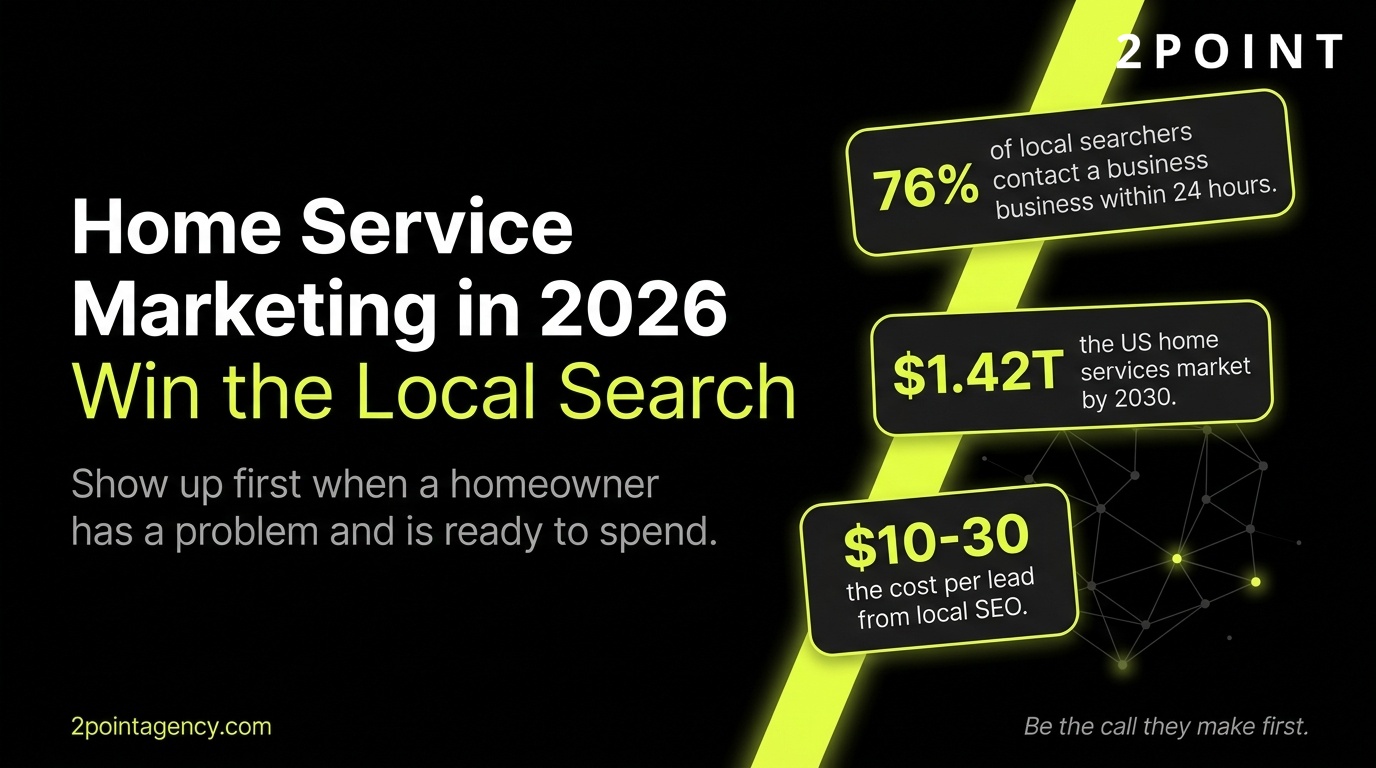
- Home service marketing is the strategic process contractors use to attract local homeowners through digital and traditional channels.
- 76% of people who search for a local service contact a business within 24 hours, making speed and visibility critical.
- The U.S. home services market was valued at $870 billion in 2025 and is projected to reach $1.42 trillion by 2030.
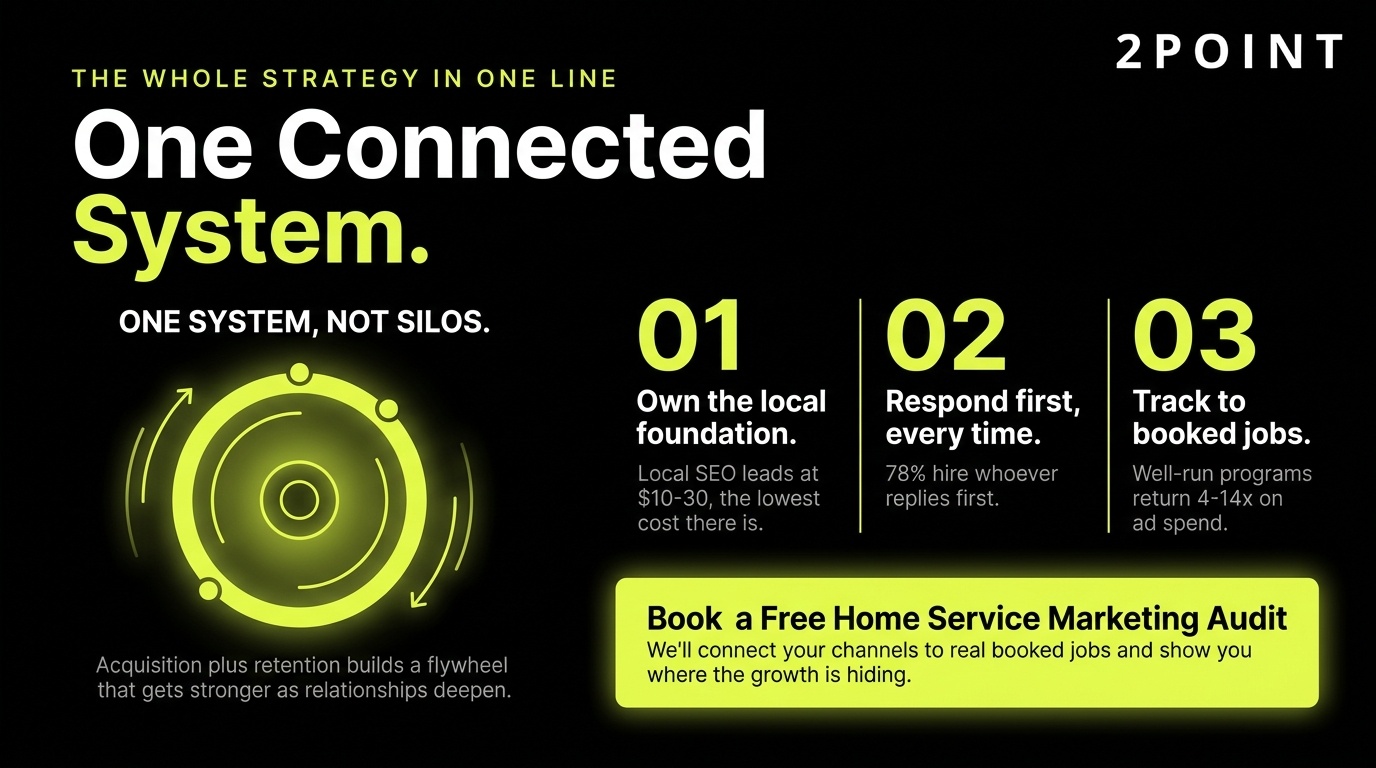
- Local SEO delivers the lowest cost per lead of any channel, typically between $10 and $30.
- Google Local Service Ads (LSAs) convert at 18 to 32% when actively managed, outperforming standard PPC.
- Review generation, content marketing, email retention, and paid social each serve distinct stages of the customer journey.
- AI-powered personalization, hyper-local targeting, and video are the three fastest-growing tactics reshaping the industry in 2026.
- This guide covers eight core strategies every home service business needs to compete and win in 2026.
The Home Service Marketing Revolution: Why 2026 Changes Everything
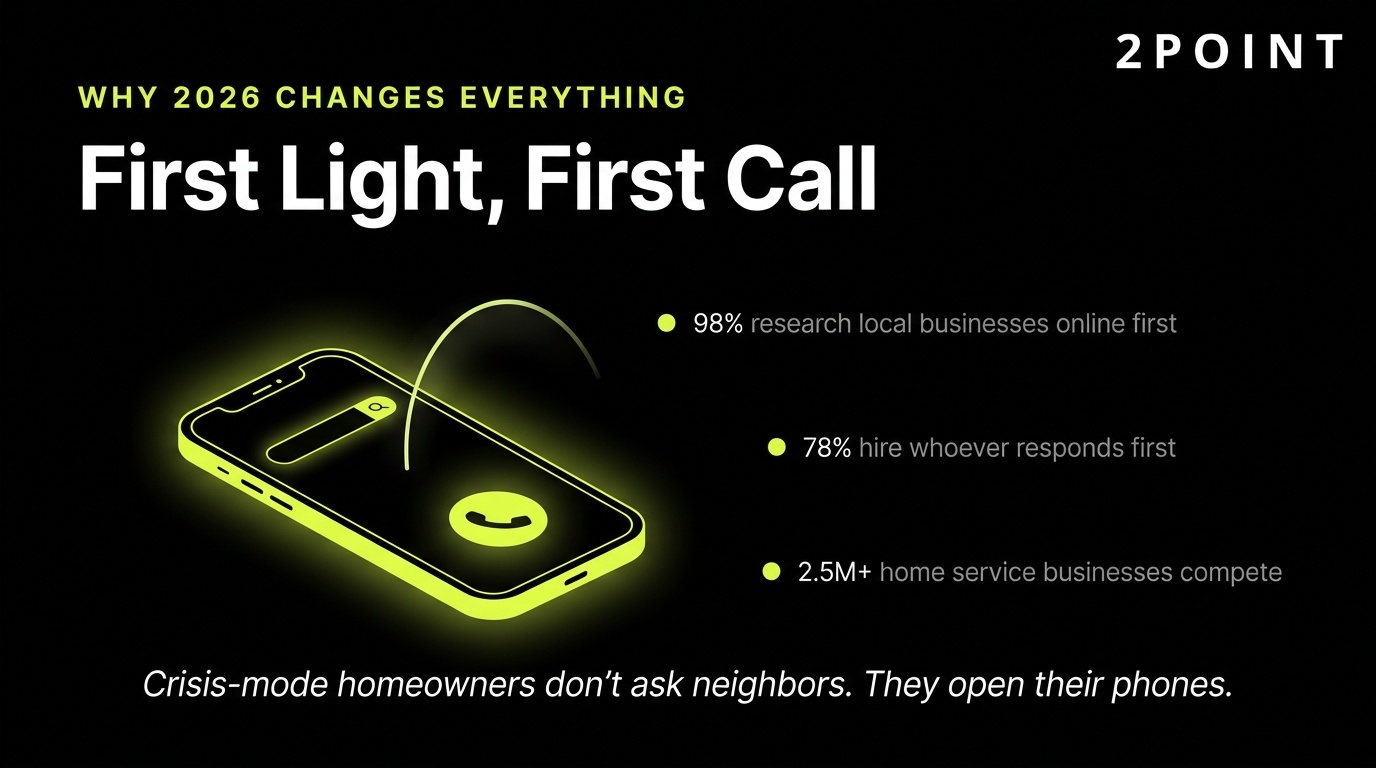
The home service industry has undergone a fundamental transformation in how customers find, evaluate, and hire contractors. A decade ago, a strong referral network and a listing in the Yellow Pages were enough to keep a business busy year-round. Today, that playbook is obsolete. 98% of consumers now research local businesses online before making a hiring decision, and that number climbs higher every year. The contractor who wins is rarely the one with the longest tenure or the most glowing word-of-mouth reputation. It is the one who shows up first in a Google search at 11 PM when a homeowner's furnace stops working.
This shift is not simply about being online. It is about being strategically visible at the exact moment a homeowner has a problem and is ready to spend money to solve it. Homeowners in "crisis mode" do not ask neighbors for recommendations. They open their phones, type their problem into Google, and call the first credible business they see. If your company is not that business, someone else is collecting the revenue that should be yours.
The competitive landscape has intensified dramatically. More than 2.5 million home service businesses compete across the United States, and the stakes are rising. Private equity firms have entered the trades, consolidating regional players into well-funded marketing machines with dedicated digital teams, sophisticated tracking systems, and substantial advertising budgets. Small and mid-size contractors now compete against organizations that treat marketing as a core operational discipline rather than an occasional expense.
The market itself, however, rewards those who invest intelligently. The home services sector has grown at approximately 19% annually heading into 2026, reflecting a sustained surge in homeowner spending on maintenance, renovation, and emergency repairs. The demand is real and growing. The question is whether your business is positioned to capture it. 78% of customers hire the company that responds to their inquiry first, which means that marketing and operations are no longer separate concerns. Your ability to generate and respond to leads is a single competitive advantage, not two separate ones.
This guide is designed to give you a complete, actionable roadmap for home service marketing in 2026. You will find strategies for building organic visibility through local SEO, capturing ready-to-book customers through Google's ad products, building trust through content and social media, retaining customers through email, and adapting to the emerging trends that are redefining the industry right now. Each section is built around proven tactics and real performance data, not theoretical frameworks.
Local SEO: Your Lowest-Cost Lead Generation Engine for Home Service Businesses
Why Local SEO Delivers Unmatched ROI for Home Service Businesses
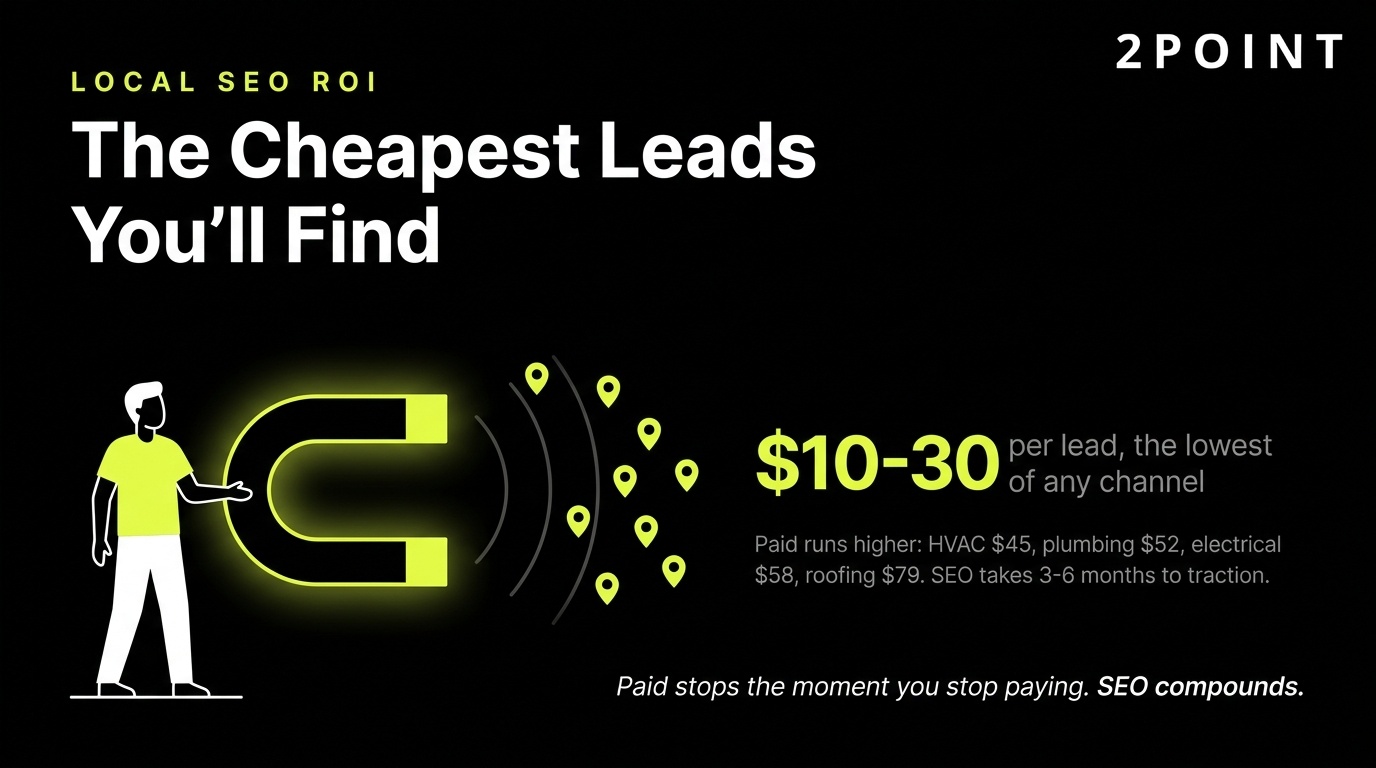
Local SEO is the practice of optimizing your online presence to appear in location-based searches, such as "HVAC repair near me" or "plumber in [city name]." For home service businesses, it is the single highest-return marketing investment available. While paid advertising produces leads immediately, it stops the moment you stop paying. Local SEO builds a compounding asset: organic visibility that generates leads continuously without ongoing spend once it is established.
The economics are compelling. Local SEO for contractors typically delivers a cost per lead of $10 to $30, the lowest of any marketing channel available to home service businesses. Compare that to paid advertising benchmarks: HVAC averages $45 per lead, plumbing reaches $52, electrical sits around $58, and roofing can hit $79 per lead through Google Ads. The tradeoff is time. Local SEO typically requires 3 to 6 months to show meaningful traction and 12 to 18 months to build genuine authority. Businesses that invest early gain a sustainable competitive advantage that becomes increasingly difficult for latecomers to overcome.
A well-built digital marketing strategy for a home service company treats local SEO as a foundation, not an optional add-on. The businesses winning in organic search are the ones that started building six months ago. The best time to invest in local SEO for contractors is always right now.
Google Business Profile Optimization: Your 24/7 Digital Storefront
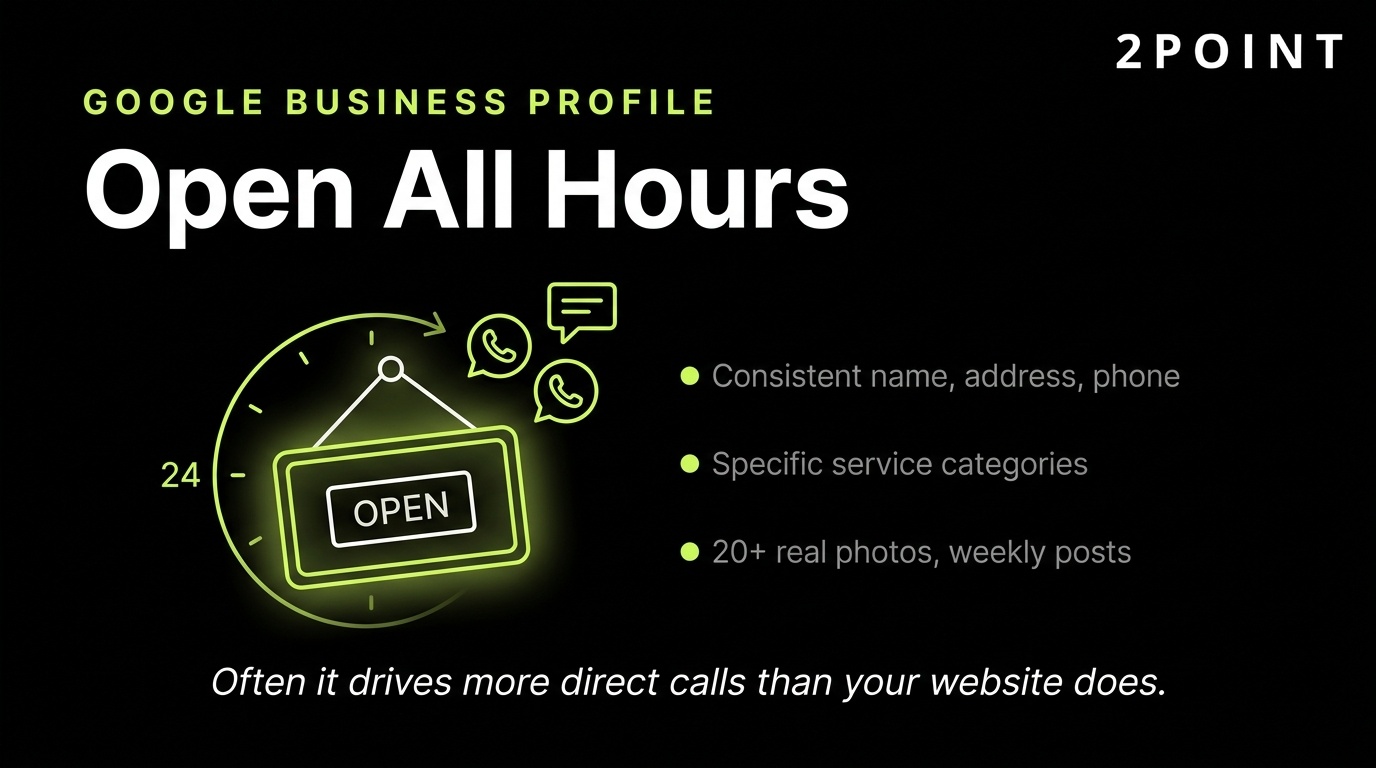
Your Google Business Profile (GBP) is often the first thing a homeowner sees when searching for your services. It displays your business name, phone number, hours, reviews, photos, and a link to your website, all before a person even clicks through to your site. For many home service businesses, the GBP drives more direct calls than the website itself. Treating it as a secondary concern is one of the most expensive mistakes a contractor can make.
Optimization starts with completeness and accuracy. Your Name, Address, and Phone number (NAP) must be consistent across every online listing. Your service categories must be specific, your hours must be current, and your photos must be high-quality and regularly updated. Posting weekly updates to your GBP, including seasonal promotions, completed project photos, answers to common homeowner questions, and service spotlights, signals to Google that your business is active and engaged. Active profiles consistently rank higher than dormant competitors in the local map pack.
Visual prominence in local search results is a genuine ranking and conversion advantage. Businesses with more photos receive more clicks. Your GBP optimization checklist should include: accurate NAP information, all relevant service categories selected, complete business hours including holiday hours, a minimum of 20 high-quality photos, service descriptions written with local keywords, Q&A section populated with common homeowner questions, and messaging enabled for direct contact. Every element you leave incomplete is an opportunity you hand to a competitor.
Service Area Pages and Location-Specific Content Strategy
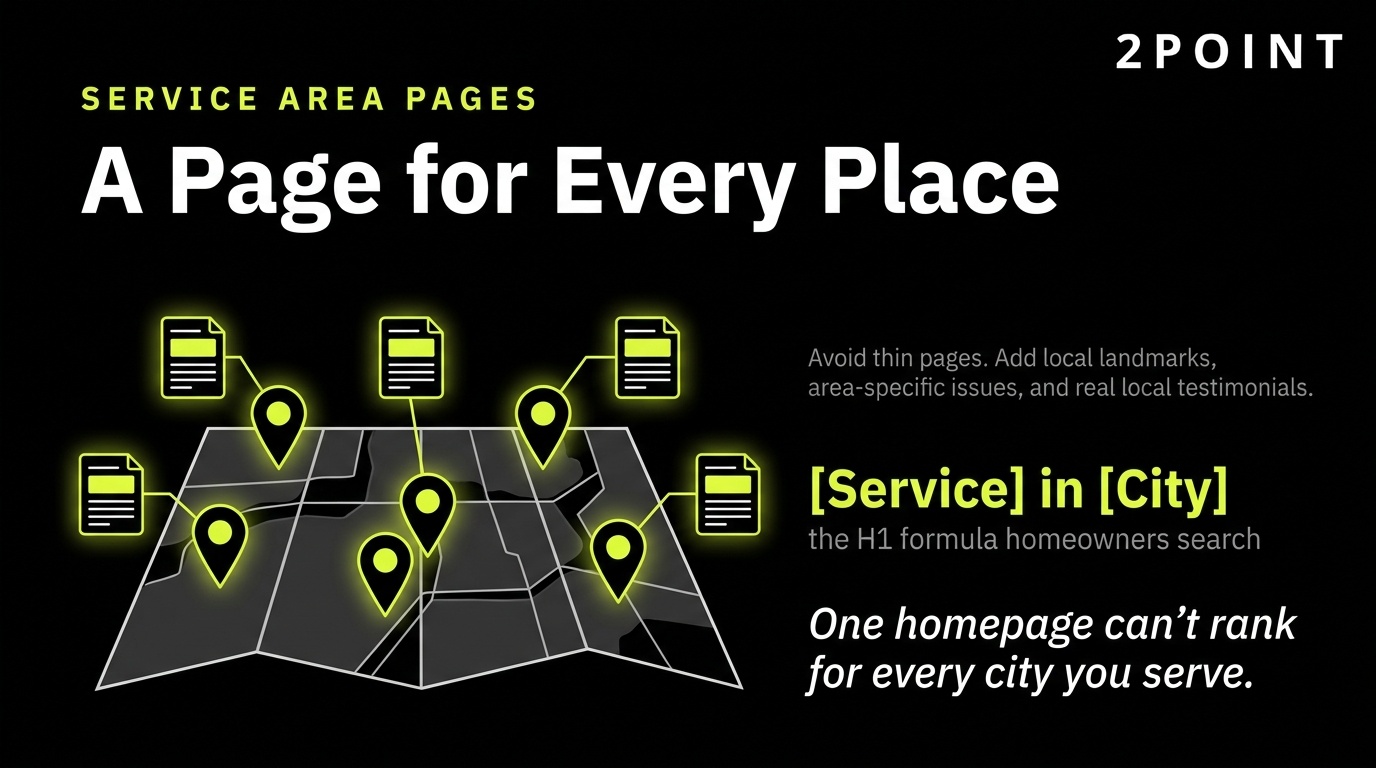
If your business serves multiple cities or neighborhoods, a single homepage cannot rank effectively for all of them. Service area pages solve this problem by creating dedicated, optimized pages for each location and service combination. A plumbing company serving five cities should have pages targeting "water heater repair in [City A]," "drain cleaning in [City B]," and so on. Each page targets a specific geographic query and gives Google a clear signal about where you operate and what you offer.
The key to effective service area pages is avoiding thin content. A page that simply swaps a city name into a generic template provides no value and earns no rankings. Effective service area pages include references to local landmarks or neighborhoods, descriptions of common plumbing, HVAC, or electrical issues specific to that area's housing stock or climate, testimonials from customers in that location, and service-specific information that genuinely helps a homeowner in that community. Internal linking between your service pages and location pages reinforces your site's topical authority and helps search engines understand the full scope of what you offer and where.
Strong H1 structures for service area pages follow a simple formula: "[Service] in [City, State]" or "[City] [Service] Company." These formats align directly with how homeowners search and create a clear, relevant signal for both users and search engines. Geo-targeted content, when done correctly, builds a network of local landing pages that multiply your organic visibility across your entire service territory.
Technical SEO Essentials for Mobile-First Home Service Websites
The majority of home service searches happen on smartphones, often during an emergency or moment of urgent need. Mobile search dominates local intent queries, which means your website must perform flawlessly on a small screen under stress. A site that loads slowly, requires pinching and zooming, or buries the phone number three scrolls down the page will lose leads to a competitor whose site loads in two seconds and has a click-to-call button at the top of every page.
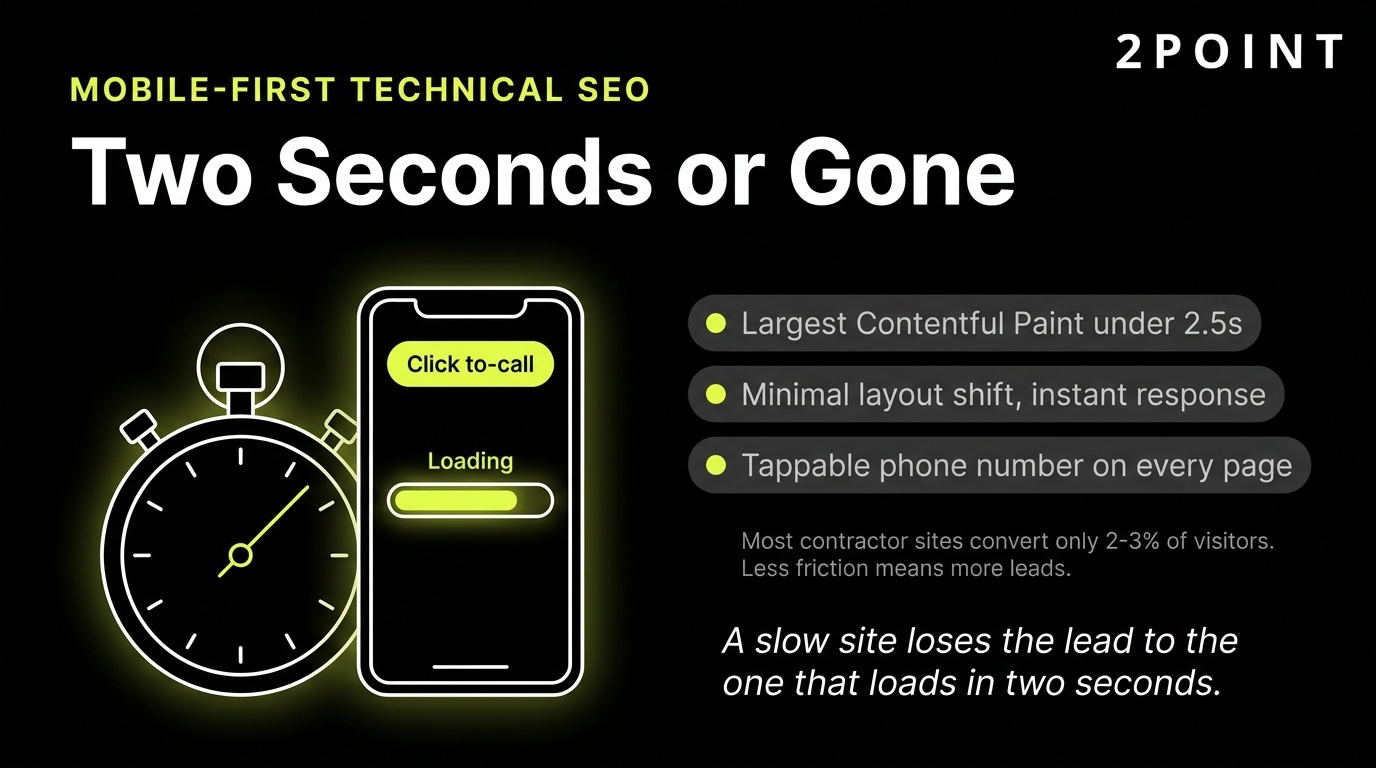
Core Web Vitals, Google's set of page experience metrics, directly influence both rankings and user experience. Largest Contentful Paint (LCP) should load in under 2.5 seconds. Cumulative Layout Shift (CLS) should be minimal. Interaction to Next Paint (INP) should feel immediate. Achieving these benchmarks requires image compression, efficient hosting, minimal render-blocking scripts, and a clean, lightweight site architecture. For most contractor websites, eliminating bloated plugins and switching to a performance-optimized hosting environment produces the largest gains most quickly.
Click-to-call functionality is not optional on a mobile-first site. Your phone number should be tappable at the top of every page, repeated in the footer, and embedded in all calls to action. Most contractor websites convert only 2 to 3% of visitors, which means the majority of people who find your site are leaving without contacting you. Technical improvements that reduce friction, specifically faster loading, clearer navigation, and prominent contact options, are often the fastest path to more leads without increasing your ad spend.
Review Generation and Reputation Management for Local Rankings
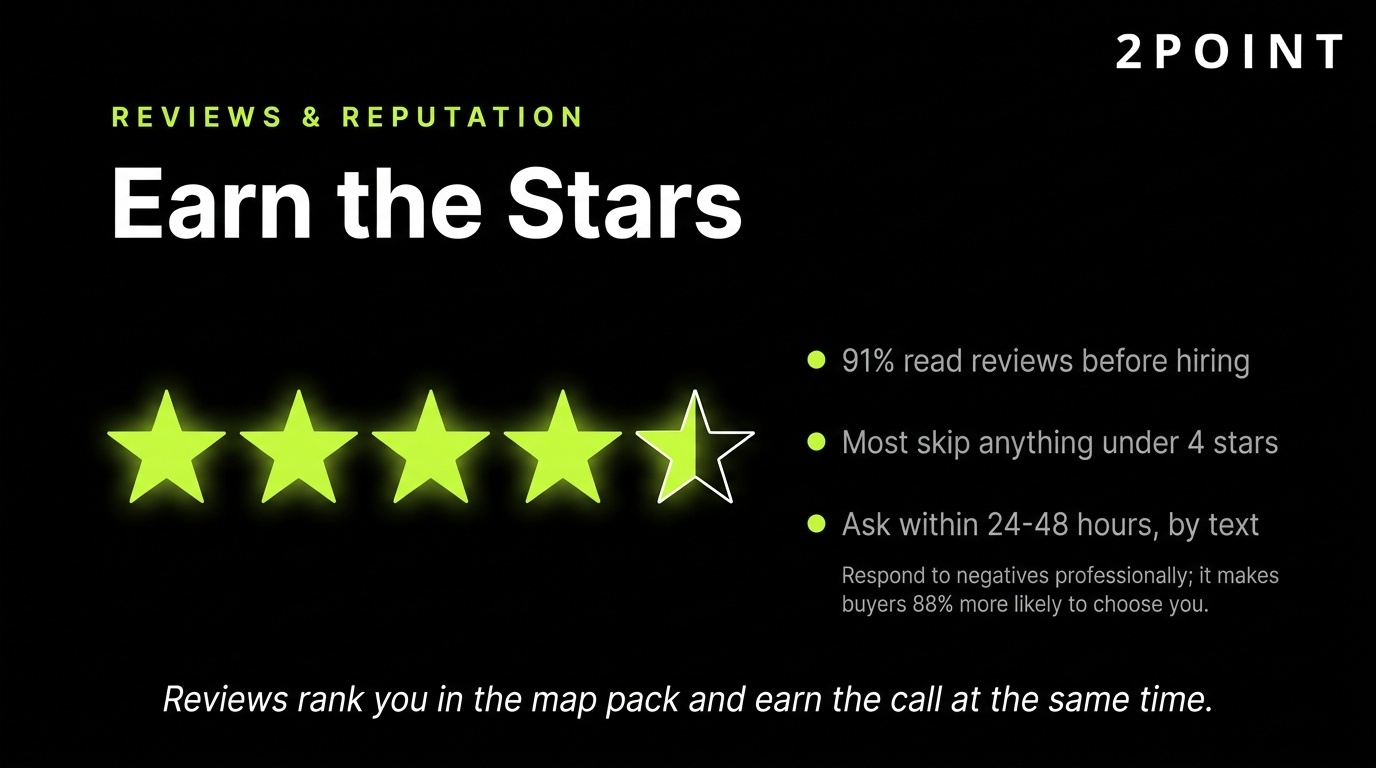
Online reviews are simultaneously a local SEO ranking factor and a conversion driver. They influence whether your business appears in the local map pack and whether a homeowner trusts you enough to make the call. The numbers are striking: 91% of consumers read local reviews before making a hiring decision, and most will not consider any business with a rating below 4 stars. 98% of local consumers read online reviews to evaluate businesses, and the same source notes that 94% say a negative review has caused them to avoid a business entirely.
A systematic review generation process is not about gaming the system. It is about consistently asking satisfied customers to share their experience at the right moment through the right channel. The optimal window for a review request is within 24 to 48 hours of a completed job, when the homeowner's positive experience is fresh. Text message requests outperform email requests in response rate. The ask should be personal, brief, and include a direct link to your Google Business Profile review page. Removing any friction in the process is the single most effective tactic for improving review volume.
Negative reviews require a response strategy, not avoidance. Consumers are 88% more likely to patronize a business that responds professionally to negative reviews, which means a thoughtful, empathetic response to a 2-star review can actually build trust with prospective customers who are reading the exchange. Acknowledge the issue, offer to make it right, and take the conversation offline. Never argue publicly or dismiss concerns.
Your review strategy should extend beyond Google. Multi-platform review presence across Google, Yelp, Nextdoor, and Angi builds broader reputation signals and reaches different segments of your target audience. 86% of consumers read reviews for local businesses, and they are checking multiple platforms before making a decision. A business with 200 Google reviews but nothing on Angi or Nextdoor is leaving trust-building opportunities on the table. Diversifying your review presence, while prioritizing Google, creates a more resilient reputation that is harder for competitors to displace. Building strong customer relationships is the foundation that makes review generation feel natural rather than transactional.
How Google Local Service Ads Capture Ready-to-Book Homeowners
Why LSAs Outperform Traditional PPC for Home Service Leads
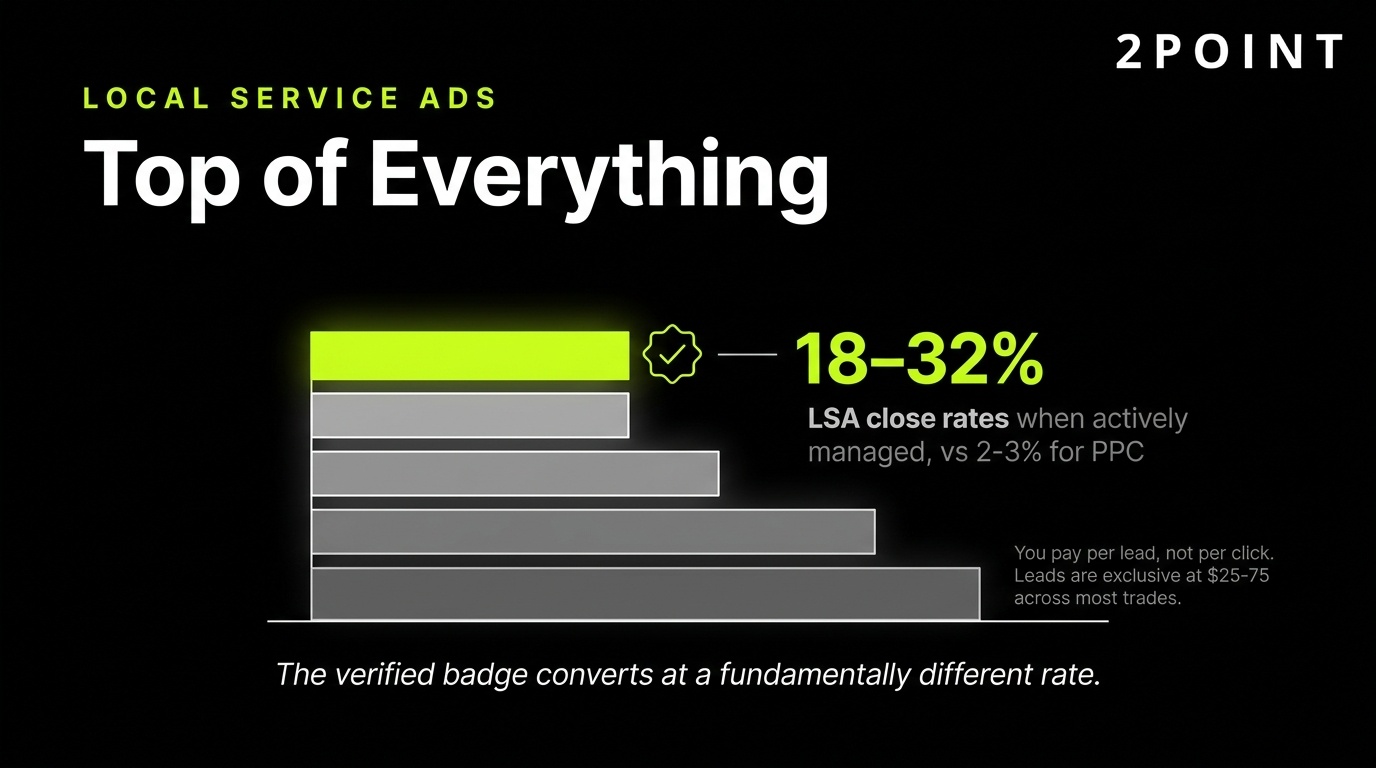
Google Local Service Ads occupy the most valuable real estate in search results. They appear above everything else: above traditional pay-per-click ads, above organic results, and above the local map pack. When a homeowner searches "emergency plumber near me" at midnight, the first three businesses they see are LSA advertisers. That positioning alone justifies the channel. Add the Google Guaranteed or Google Screened badge, a visual trust signal that communicates Google has verified your license, insurance, and background checks, and you have a product that converts at a fundamentally different rate than standard display or search ads.
LSAs convert at 18 to 32% close rates when actively managed, compared to the 2 to 3% conversion rates typical of standard PPC landing pages. The cost structure differs significantly as well. With traditional Google Ads, you pay per click regardless of whether the person converts. With LSAs, you pay per lead, specifically per phone call or message from a verified prospective customer. The cost per lead through LSAs typically ranges from $25 to $75 across most trades, and the leads are exclusive to your business, not shared with competitors as is common on lead aggregator platforms.
LSA Setup and Qualification Requirements by Trade
Getting approved for Google Local Service Ads requires passing a verification process that Google takes seriously. The specific requirements vary by trade, but most categories require proof of a valid business license, current liability insurance, and a background check on the business owner and relevant employees. For specialized trades such as HVAC, plumbing, and electrical, state licensing documentation is mandatory. Roofing, cleaning, landscaping, and pest control categories have their own requirements that vary by state.
The verification timeline typically takes two to four weeks from application submission to approval. The most common obstacles are insurance documentation that does not match the business name exactly, expired licenses, or background check discrepancies. Addressing these proactively before applying saves weeks of delay. Once verified, LSAs provide a fast path to high-quality, exclusive leads from homeowners who are actively searching for the services you provide. The geographic service area setup within the platform allows you to define exactly which zip codes or cities you want to appear in, giving you precise control over where your budget is spent.
Active Management Strategies for Maximum LSA Performance
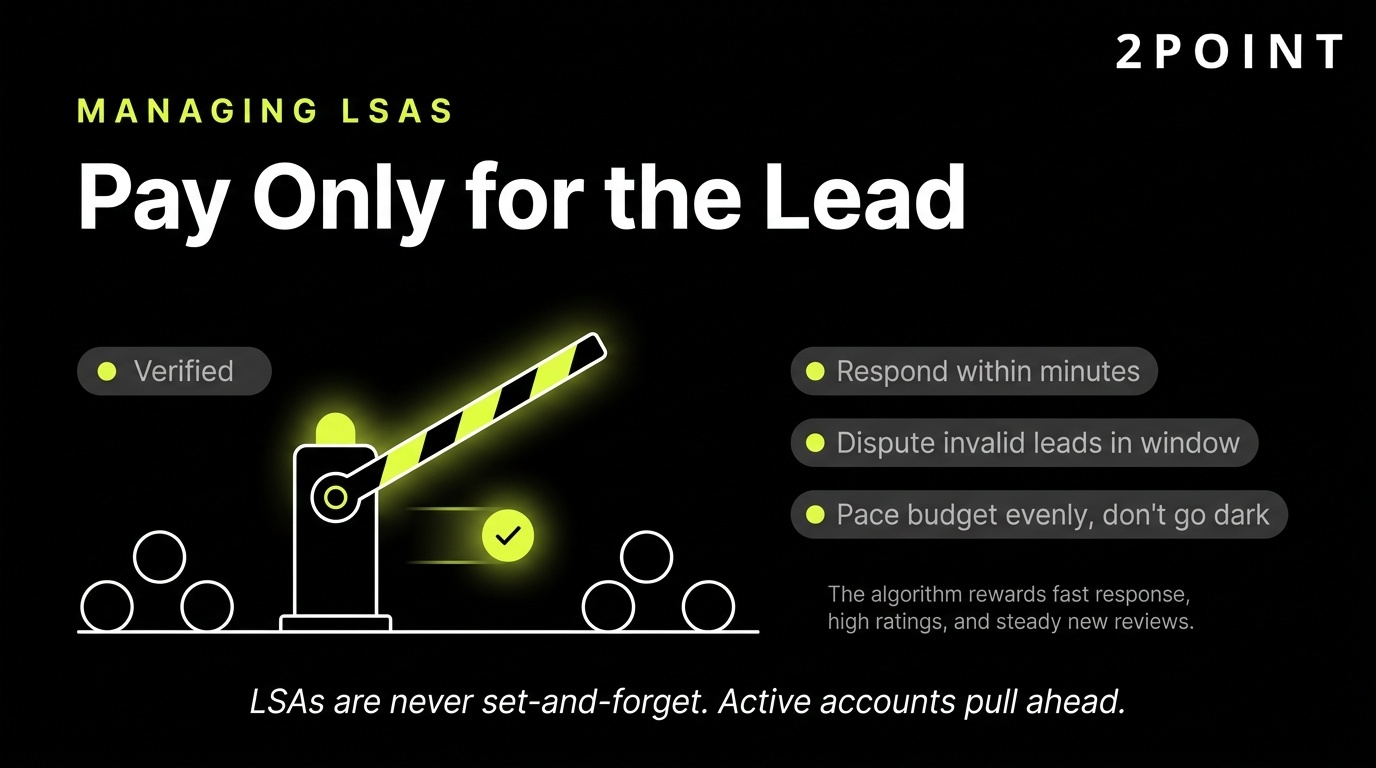
LSAs are not a "set it and forget it" advertising product. Businesses that launch a campaign, enter a weekly budget, and check results monthly consistently underperform compared to those that manage their accounts actively. The platform rewards responsiveness above almost every other factor. Google's algorithm prioritizes businesses that respond to leads quickly, maintain high review ratings, and generate consistent new reviews from LSA-sourced jobs.
Daily management tasks for high-performing LSA accounts include monitoring new lead notifications and responding within minutes, reviewing lead quality and disputing invalid leads within the allowed window, adjusting weekly budgets based on capacity and upcoming schedule, and tracking which job types are generating the most profitable leads. Appearing consistently for ready-to-book homeowners requires staying within your weekly budget parameters rather than exhausting it by Wednesday and going dark for the rest of the week. Budget pacing strategies, such as setting a lower daily cap and allowing the platform to pace spend evenly, prevent this common mistake.
Integrating LSAs with Your Complete Marketing System
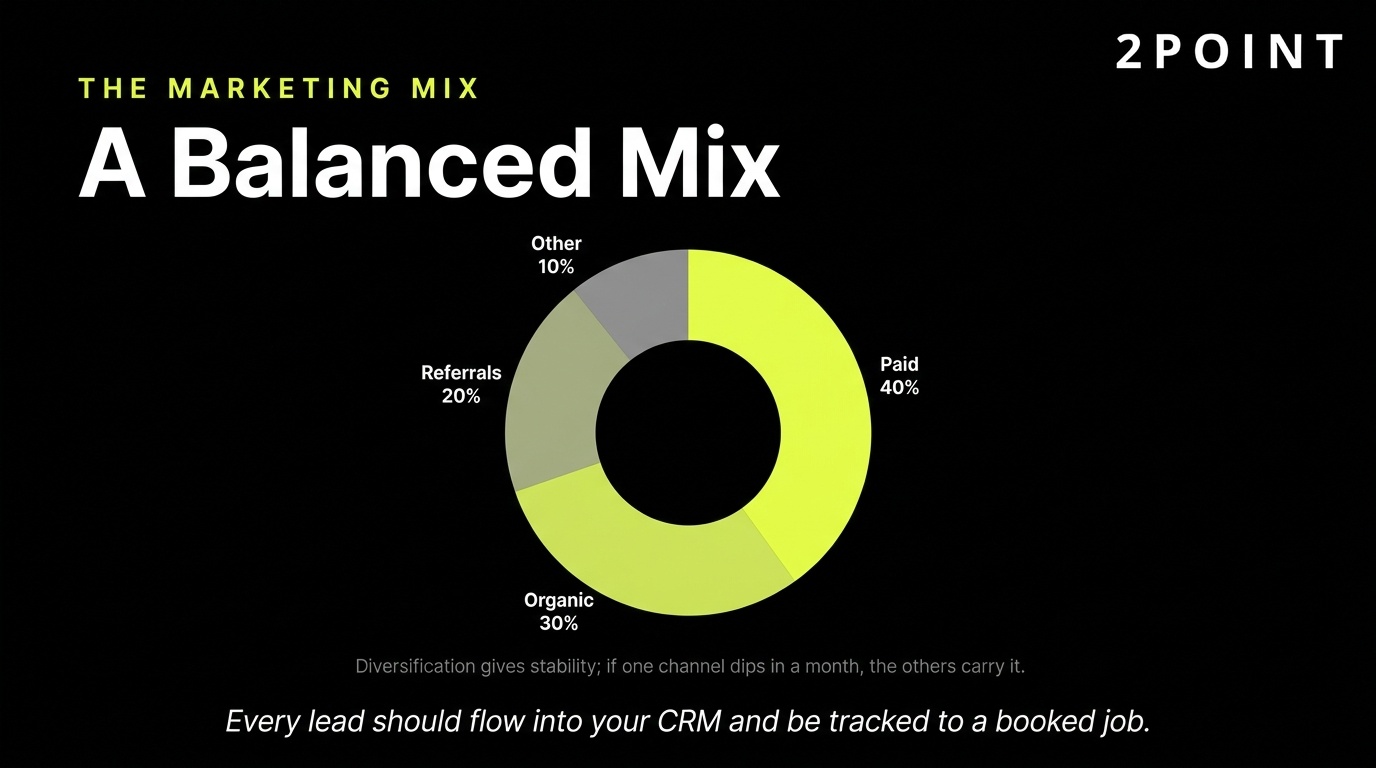
LSAs perform best when they are one component of a balanced lead generation system rather than the only source of new customers. A well-structured home service marketing mix provides stability: if one channel underperforms in a given month, others compensate. The 2026 benchmark allocation for established home service businesses looks like this:
| Marketing Channel | Recommended Budget Allocation | Primary Benefit | Lead Quality |
|---|---|---|---|
| Paid (LSAs + Google Ads) | 40% | Immediate, high-intent lead volume | Very High |
| Organic Search / Google Business Profile | 30% | Lowest cost per lead, compounding returns | High |
| Referrals and Repeat Customers | 20% | Highest trust, lowest friction | Highest |
| Other (social, email, direct mail) | 10% | Brand awareness and retention | Medium |
This allocation reflects industry benchmarks for lead source diversification in home services, and the most successful businesses adjust these percentages based on their market, seasonality, and growth goals.
CRM integration is essential for making this system work. Every LSA lead should flow automatically into your CRM, trigger a follow-up sequence, and be tracked from first contact to booked job to completed invoice. This creates the attribution data you need to evaluate true cost per booked job rather than just cost per lead. The industry's 14% missed call rate is a significant revenue leak. Implementing call answering protocols, after-hours answering services, or AI-powered call routing directly addresses this gap. Speed to response is the first-responder advantage that separates growing businesses from stagnant ones in the home services space.
Understanding your full marketing funnel is what allows you to identify where leads are dropping off and where investment will generate the highest return across your entire lead generation system.
Pay-Per-Click Advertising for Home Services: Strategies Beyond LSAs
Google Search Ads Strategy for High-Intent Home Service Queries
Traditional Google Search Ads remain a powerful complement to LSAs, particularly for businesses that want more control over ad messaging, landing page experience, and keyword targeting. While LSAs are optimized for direct lead generation with a simplified structure, Search Ads allow for granular keyword selection, custom ad copy, and dedicated landing pages built to convert specific segments of your audience.
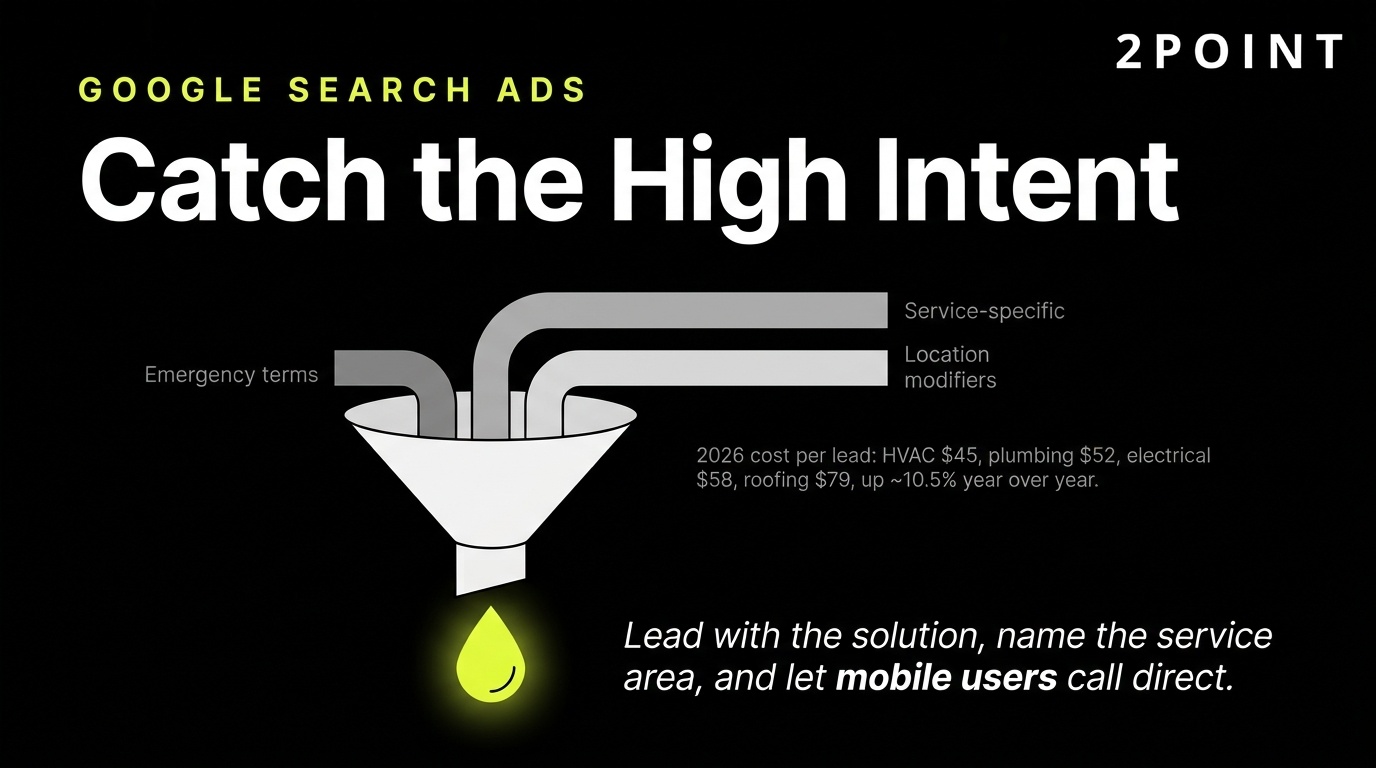
Keyword strategy for home services PPC should center on three categories. Emergency terms ("emergency HVAC repair," "24-hour plumber") capture the highest-intent, highest-converting searches. Service-specific terms ("water heater installation," "roof leak repair") target homeowners with a defined problem and a decision already made. Location modifier terms ("electrician in [city]," "contractor near [zip code]") capture geo-specific intent at every stage of decision-making. The cost per lead benchmarks for 2026 are HVAC at $45, plumbing at $52, electrical at $58, and roofing at $79, and these costs have increased by an average of 10.51% year over year, making efficient campaign management more important than ever.
Ad copy for homeowners in crisis mode should be direct, specific, and trust-forward. Lead with the benefit or solution, not the company name. Include the service area in the headline. Use call extensions so mobile users can call directly from the search result without clicking through. Add location extensions to show your proximity. Every element of the ad should reduce friction and signal credibility in the two seconds a homeowner spends deciding whether to click.
Budget Management and Bidding Strategies for Home Service PPC
Budget allocation in home service PPC requires balancing competitive pressure against profitable return thresholds. The recommended marketing investment for home service businesses is 8 to 15% of gross revenue, with businesses in highly competitive markets investing toward the upper end of that range. A company generating $1 million in annual revenue should expect to invest $80,000 to $150,000 per year in marketing, with a significant portion allocated to paid search during peak seasons.
Seasonal budget allocation is one of the most impactful levers available to home service advertisers. An HVAC company should weight its budget heavily toward summer cooling season and winter heating emergencies, reducing spend during shoulder months when demand softens. A landscaping company should invert that pattern. Dayparting, the practice of adjusting bids by time of day, matters for emergency services, where search volume spikes in the evening and overnight hours when competitors may reduce their bids. Bid adjustments by device (mobile vs. desktop), location (within your service area vs. edge zones), and audience (past website visitors vs. new users) create a more efficient spend profile that maximizes returns within your budget.
Ad Copy and Landing Page Conversion Tactics
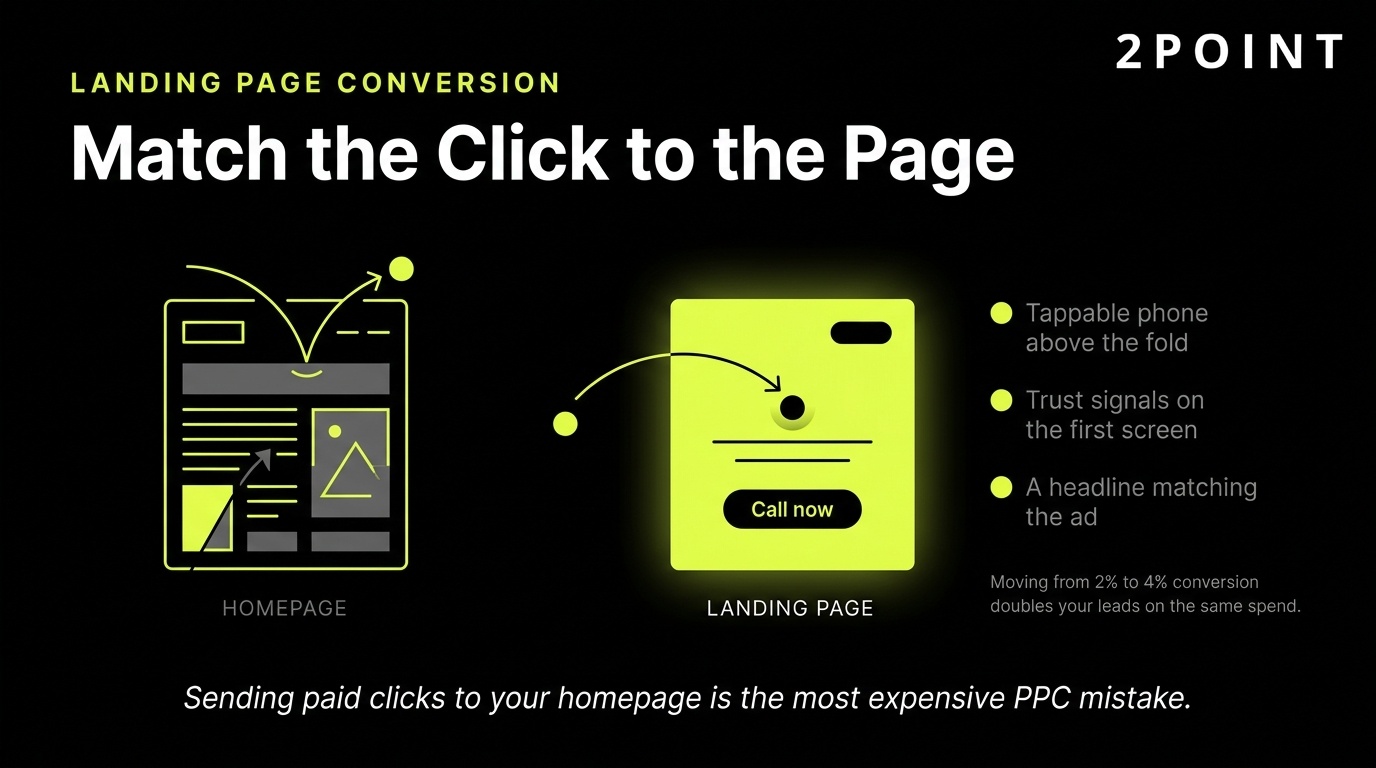
The gap between a click and a booked job is where most PPC campaigns lose money. Driving traffic to your homepage, rather than a dedicated, conversion-optimized landing page, is the single most common and expensive PPC mistake. Each service category or campaign should send traffic to a page that matches the ad's intent precisely.
High-converting landing pages for home services share a set of consistent characteristics. The phone number is prominent, clickable on mobile, and appears above the fold. A trust section featuring review ratings, years in business, licensing information, and any relevant certifications appears within the first screen. The form, if present, asks for the minimum information needed to book a call: name, phone, and service type. Before/after photos or project galleries provide social proof. A clear, specific headline matches the ad copy and confirms to the visitor that they are in the right place. Communicating your differentiation quickly is essential because homeowners evaluating multiple options make snap judgments about which company to call first.
A/B testing should be a continuous practice, not a one-time event. Test headline variations, CTA button text, form length, and hero image choices systematically. Incremental improvements to conversion rate compound over time. Moving from a 2% to a 4% conversion rate on the same ad spend effectively doubles your lead volume without increasing your budget.
Tracking, Attribution, and ROI Measurement for Home Service Advertising
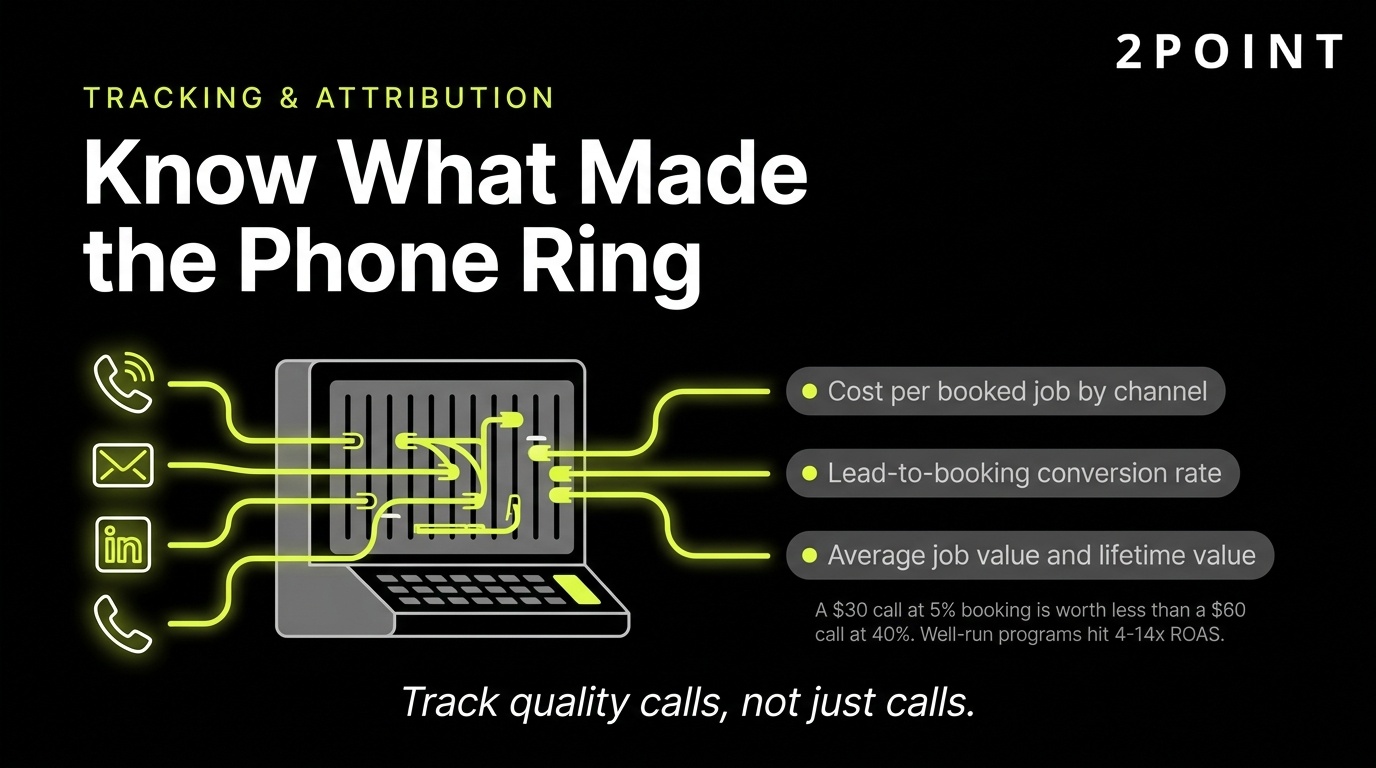
One of the most significant advantages of digital marketing over traditional advertising is the ability to measure exactly what is working. Digital channels provide attribution data that traditional advertising simply cannot match, allowing you to calculate cost per lead, cost per booked job, and ultimately cost per dollar of revenue generated for every campaign you run.
Call tracking is foundational to accurate attribution. Assign unique phone numbers to each marketing channel, including Google Ads, LSAs, your GBP listing, and your website's organic traffic. When a call comes in, your system records the source, duration, and outcome. This data reveals not just which channels generate calls, but which channels generate quality calls that convert to booked jobs. A channel with a $30 cost per call but a 5% booking rate is less valuable than one with a $60 cost per call and a 40% booking rate.
The dashboard KPIs most relevant to home service marketing include cost per lead by channel, cost per booked job, lead-to-booking conversion rate, average job value, and customer lifetime value. When these metrics are tracked consistently, the path to optimization becomes clear. Well-managed home service marketing campaigns can deliver 4 to 14x return on ad spend, but achieving that range requires rigorous tracking, honest attribution, and a willingness to cut underperforming campaigns and reinvest in what works. Leveraging marketing analytics as an ongoing practice, rather than a quarterly report, is what separates businesses that optimize continuously from those that guess.
Content Marketing That Builds Trust and Rankings for Home Service Businesses
Educational Content Strategy for Pre-Decision Homeowners
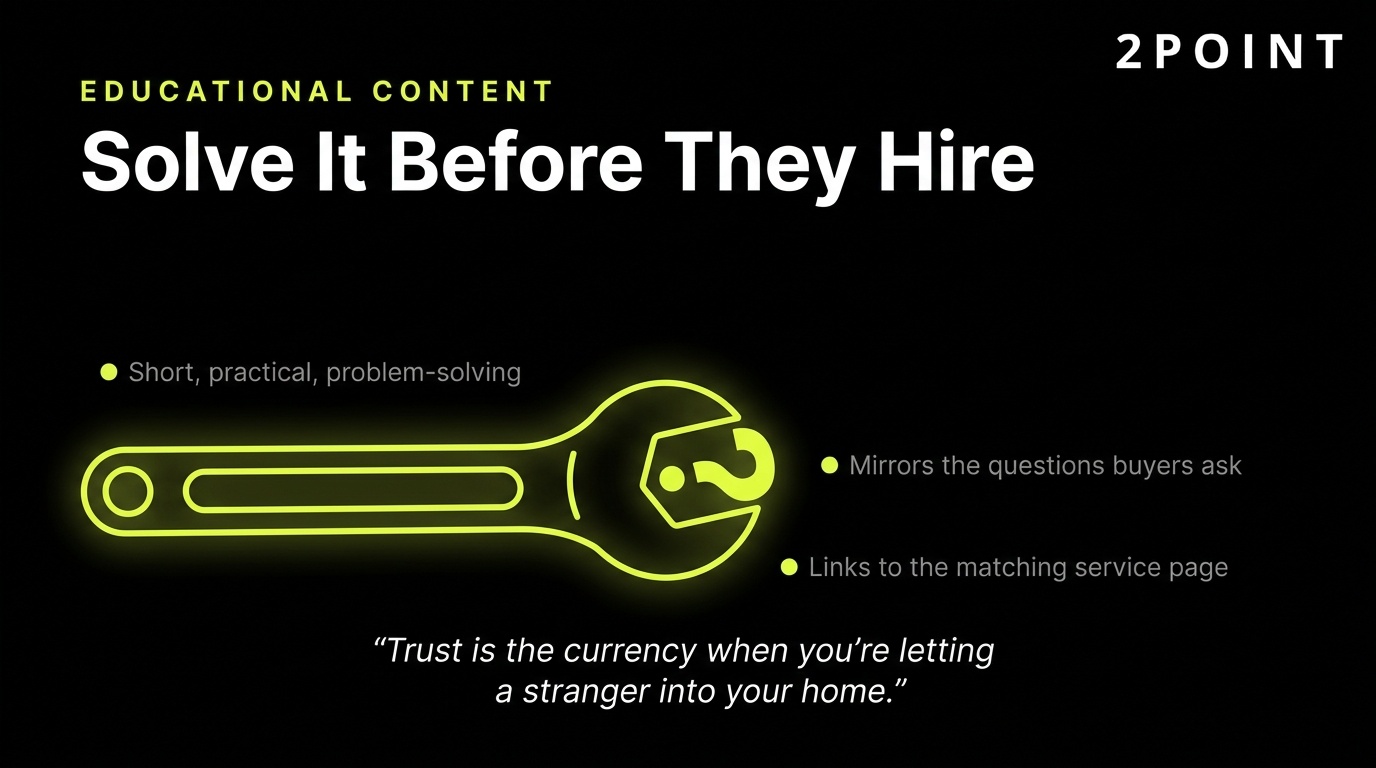
Not every homeowner searching the internet for home service information is in immediate crisis mode. Many are researching problems before they become emergencies, comparing options before committing to a contractor, or educating themselves about maintenance responsibilities they have been ignoring. Content marketing positions your business as the trusted expert that helps homeowners through this pre-decision research phase, so that when they are ready to hire, your name is already familiar and credible.
Content builds trust before a homeowner ever makes contact, and trust is the primary currency in a service industry where customers are letting strangers into their homes. Effective topic selection mirrors the actual questions your customers ask before, during, and after a service call. For an HVAC company, this might include articles such as "What to Do When Your AC Stops Cooling at Night," "Why Is My Furnace Making a Banging Noise," or "How Often Should You Change Your Air Filter and Why It Matters." Short, practical, problem-solving content consistently outperforms long theoretical articles in both search rankings and reader engagement for home service audiences.
Each piece of content should serve a dual purpose: ranking for a relevant search query and converting readers into leads. Content-to-conversion pathways include inline CTAs, prominent click-to-call buttons, related service page links, and embedded contact forms. A homeowner reading your article about common causes of low water pressure is a warm prospect. Internal linking from that article to your plumbing service page creates a natural, low-friction path from information to inquiry. A strong content marketing plan maps every piece of content to a specific stage in the customer journey and a specific action you want the reader to take.
Video Content: The Fastest-Growing Discovery Channel for Contractors
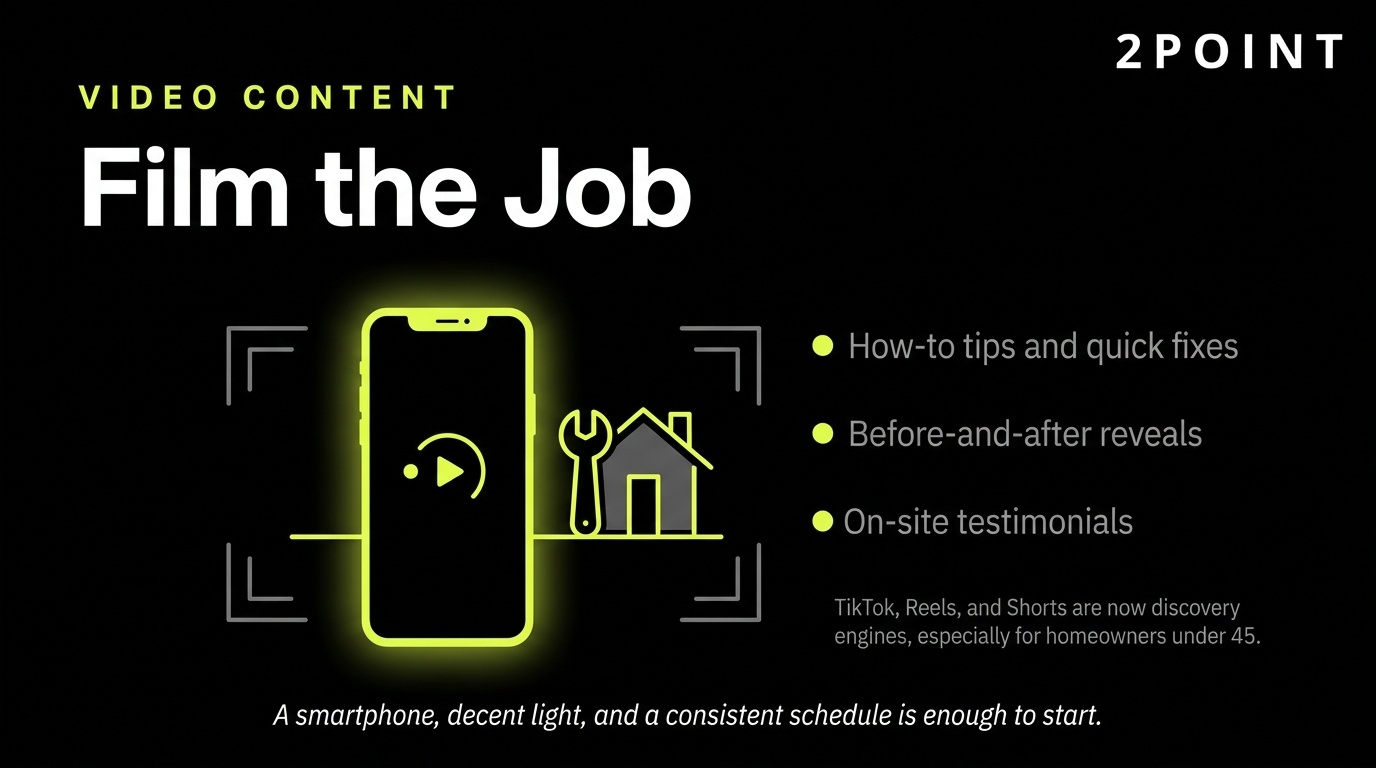
Video has moved from a supplementary content format to a primary discovery channel for home service businesses. TikTok, Instagram Reels, and YouTube Shorts are now primary discovery engines for local service businesses, particularly among homeowners under 45 who are the most active home buyers and renovators in the current market. A plumber who posts a 60-second Reel showing how to diagnose a slow drain reaches an audience that would never find them through a Google search.
The most effective approach is what marketers call "edutainment," a combination of education and entertainment that teaches viewers something useful while simultaneously demonstrating your expertise. A roofer showing the top three signs of storm damage, filmed from their truck in a neighborhood where they just finished a job, accomplishes three things simultaneously: it provides genuinely useful information, it demonstrates field expertise, and it reinforces local presence. Content ideas that consistently perform well include how-to videos for simple maintenance tasks, before-and-after project reveals, technician-on-site day-in-the-life content, and customer testimonials filmed at the job site immediately after completion.
The production barrier to entry is lower than most contractors realize. A smartphone with decent lighting, a brief script or outline, and a consistent posting schedule is sufficient to build a meaningful social video presence. Video is increasingly essential for effective messaging across every digital channel, and businesses that delay adopting video content are ceding discovery opportunities to competitors who are already posting consistently. Reviewing the latest video marketing trends regularly helps you stay ahead of format changes and algorithm shifts on each platform.
Blog Content Development and Topic Selection for Organic Search
A well-maintained blog serves as the primary driver of long-tail organic search traffic for home service businesses. While your service pages target high-intent commercial queries, your blog captures the informational searches that happen earlier in the homeowner's decision journey. These readers are not ready to book today, but they will be, and the business that provided the most helpful information during their research phase has a significant advantage when the decision point arrives.
Topic selection should be driven by keyword research, not assumptions. Tools such as Google's "People Also Ask" boxes, keyword planning tools, and your own customer service inquiry records reveal the exact questions your target audience is typing into search engines. Prioritize topics with clear local relevance, such as questions about plumbing codes in your state or HVAC requirements for your climate region, alongside universal maintenance and troubleshooting topics. A content calendar that maps blog topics to seasonal demand, for example, publishing furnace maintenance content in early October and AC tune-up content in March, aligns your content investment with periods of peak homeowner intent. The seasonal marketing trends affecting search behavior in your trade should directly inform your content publishing schedule. Repurposing each blog post into social media snippets, email newsletter sections, and short video scripts multiplies the return on your content investment without proportionally increasing production time.
Leveraging AI for Content Creation and Personalization at Scale
The role of artificial intelligence in home service marketing has shifted from experimental to operational. In 2026, the competitive divide is no longer between businesses that use AI and those that do not. It is between those that have integrated AI into their core marketing operations and those that are still experimenting. The practical applications are wide-ranging and immediately actionable for businesses of any size.
AI tools now enable home service companies to produce personalized email sequences triggered by specific customer behaviors, generate social media captions tailored to local events or weather conditions, create localized variations of landing pages at scale, and draft customer review responses that match the specific concern raised. A roofing company that used AI-powered personalization to tailor follow-up messaging based on a homeowner's specific concern increased response rates from 8% to 31%. That kind of performance improvement, previously achievable only by large marketing teams, is now accessible to a single-person marketing operation with the right tools and workflow.
AI's influence extends beyond content production into search itself. ChatGPT and Google AI Overviews are now influencing how homeowners discover and evaluate local service businesses, and optimizing your content for AI-driven search results requires the same fundamentals as traditional SEO: clear, authoritative, well-structured content that directly answers specific questions. Quality control and brand voice consistency remain human responsibilities. AI accelerates production; your team ensures the output reflects the specific expertise, personality, and local knowledge that differentiates your business. Personalized marketing at scale is now a realistic goal for even small home service companies willing to integrate AI into their workflow.
Social Media Marketing Strategies for Home Service Businesses
Platform Selection and Strategy by Home Service Business Type
Not every social media platform delivers equal value for every type of home service business, and spreading your effort equally across all platforms produces mediocre results everywhere rather than strong results where it matters. Platform selection should be guided by where your target homeowners spend their time and what type of content performs best on each network.
Facebook and Instagram are the primary platforms for residential home service businesses targeting homeowners aged 35 to 65. Facebook's local targeting capabilities, community group presence, and event-based advertising make it particularly effective for service area marketing. Instagram performs best for visually compelling trades, specifically landscaping, remodeling, interior painting, and renovation work where before-and-after transformations create natural scroll-stopping content. Social media builds brand loyalty in a way that paid advertising cannot replicate, because the relationship-building content that works on social creates familiarity and trust before a homeowner ever needs your services. For contractors targeting commercial property managers, facility directors, or real estate professionals, LinkedIn provides a B2B audience that no other platform reaches as efficiently. Pinterest serves home improvement inspiration content and can drive traffic for remodeling and design-forward trades, though it requires a longer content development investment before delivering significant results.
Content Types and Posting Frequency for Maximum Organic Reach
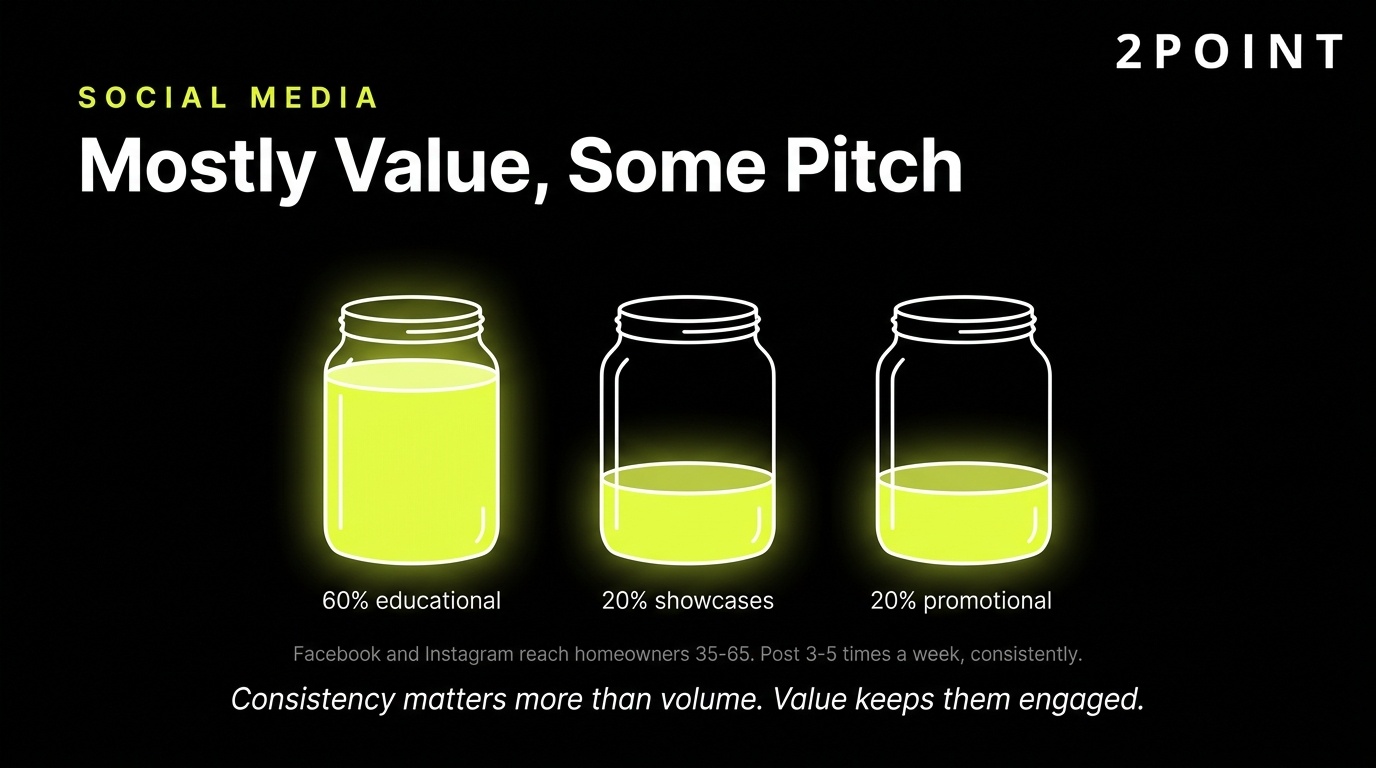
Effective social media content for home service businesses follows a consistent mix that balances promotional messaging with genuinely useful or entertaining content. The ratio that works best for most contractor social profiles is roughly 60% educational and entertaining content, 20% project showcases and testimonials, and 20% direct promotional content. Audiences that feel they are being marketed to on every post disengage quickly. Audiences that receive value consistently will stay engaged and share your content within their own networks.
The highest-performing content types for home service social media include before-and-after project photos, short video tutorials or tips, employee spotlights that humanize your team, seasonal maintenance reminders, and customer testimonials captured on location. Posting frequency should match your capacity to produce quality content: three to five times per week on Facebook and Instagram is a sustainable target for most small businesses. Consistency matters more than volume. A business that posts twice per week, every week, without fail will outperform one that posts daily for two weeks and then goes silent for a month. Before-and-after photo content is particularly powerful for driving shares and saves, which extend your organic reach beyond your existing follower base.
Paid Social Advertising for Local Home Service Targeting
Organic social media reach has declined steadily on most platforms, making paid social advertising increasingly necessary for businesses that want their content to reach homeowners outside their existing audience. Facebook and Instagram Ads provide geographic targeting capabilities that are exceptionally well-suited to home service businesses operating within defined service areas.
The most effective paid social strategy for home services combines two campaign types. Brand awareness campaigns reach homeowners in your service area with educational, trust-building content before they have an immediate need. When a pipe bursts at 2 AM, the plumber whose video they watched last month is the one they call first. Remarketing campaigns retarget website visitors, past customers, and social media video viewers with more direct promotional offers and calls to action. This two-stage approach is efficient because the remarketing audience has already demonstrated interest, making conversion rates significantly higher than cold audience campaigns.
A real-world example of social advertising performance in home services demonstrates the channel's potential: one campaign reached 213,380 people and generated 10,700 ad recall lifts within a defined service area, building substantial brand recognition at a fraction of the cost of traditional broadcast advertising. Budget recommendations for most local home service businesses start at $500 to $1,000 per month for paid social, with increases justified as performance data confirms positive ROI. Creative best practices for home services paid social emphasize authentic visuals over polished stock photography, specific local references that resonate with the target geographic area, and CTAs that match the viewer's stage in the decision journey.
Community Engagement and Customer Service on Social Media
Social media has evolved into a customer service channel whether businesses are prepared for it or not. Homeowners post service complaints, ask questions publicly, and share their experiences in community groups that reach thousands of local residents. A business that ignores its social media inbox or fails to monitor community mentions is leaving a significant reputation management gap exposed.
Response time expectations on social media are demanding. Facebook's algorithm penalizes business pages that respond slowly to messages, reducing their organic reach. More importantly, a homeowner who sends a Facebook message and receives no response for 24 hours has almost certainly called a competitor by the time you reply. The target response time for social media messages is under one hour during business hours and no more than four hours outside of them. For businesses without dedicated social media management, automated response tools that acknowledge receipt and provide a direct contact option bridge the gap effectively.
Participating in local Facebook Groups and Nextdoor communities as a helpful, knowledgeable neighbor rather than an advertiser is one of the most underutilized community-building tactics available to home service businesses. Answering questions about common home maintenance issues, offering seasonal tips, and responding genuinely to requests for contractor recommendations positions your business as a trusted community resource. This approach builds community loyalty that translates into direct referrals and word-of-mouth recommendations that no amount of paid advertising can replicate. User-generated content, specifically photos and testimonials that satisfied customers post about your work, should be actively encouraged and amplified through your own channels with the customer's permission.
Email Marketing and Customer Retention Systems That Drive Repeat Revenue
Why Owned Marketing Channels Provide Unfair Leverage for Home Service Businesses
The most overlooked revenue opportunity in home service marketing is not a new lead source. It is the database of past customers that most contractors have collected and done nothing with. Owned channels such as email and SMS provide low cost per contact and access to an audience that has already demonstrated willingness to pay for your services. Acquiring a new customer costs five to seven times more than retaining an existing one. The math alone makes customer retention through owned channels one of the highest-ROI activities available to any home service business.
Most contractors break their owned channel advantage unintentionally by failing to collect contact information systematically, failing to maintain that data in an organized CRM, or simply never sending any follow-up communication after a job is completed. A customer who had a positive experience with your company and never hears from you again is a customer who will search Google when their next home service need arises, potentially hiring a competitor they find through organic search or LSAs. Keeping your brand present through regular, valuable email communication ensures that your past customers think of you first when the next need emerges. Systematically building feedback loops into your post-service process also provides the operational intelligence you need to improve service delivery and marketing messaging over time.
Email List Building and Segmentation Strategies
Building a high-quality email list for a home service business requires capturing contact information at every logical touchpoint in the customer relationship. The most effective collection points are the initial contact form or call booking process, the job completion follow-up sequence (which should include a review request and a subscription to your maintenance reminder emails), and any ongoing service agreement or maintenance plan enrollment.
Segmentation transforms a generic email list into a precision marketing tool. A homeowner who just had their AC installed has very different needs than a customer who has been on your maintenance plan for three years. Segmenting your list by service type allows you to send heating season reminders only to customers with HVAC systems, not to plumbing-only customers. Segmenting by customer value allows you to create VIP programs for high-revenue repeat clients. Segmenting by property type (residential vs. small commercial) allows you to tailor messaging to each audience's specific concerns. The more relevant your emails are to each segment, the higher your open rates, click rates, and conversion rates will be across the board.
Email Campaign Types and Timing for Home Service Revenue Generation
A complete email marketing program for a home service business encompasses several distinct campaign types, each serving a different purpose within the customer retention and revenue generation system. Seasonal maintenance reminder campaigns are the backbone of most contractor email programs: a reminder to schedule furnace service before the first cold snap, or an AC tune-up reminder in early spring, captures customers who would otherwise delay until an emergency. These campaigns work best when sent 30 to 45 days before the relevant season begins, giving customers time to schedule without feeling pressured.
Educational newsletters build ongoing relationships by delivering genuinely useful home maintenance information on a monthly or bimonthly basis. The key is providing value-first content, maintenance checklists, energy-saving tips, seasonal home care guides, with service offers as a natural extension rather than the lead message. Customers who find your newsletter useful open it consistently and think of you positively even when they have no immediate need. Special offer campaigns tied to low-demand periods can fill schedule gaps by offering current customers incentives to book during traditionally slow weeks. Maintenance plan enrollment campaigns targeting existing customers who have not yet signed up for recurring service agreements convert at high rates because the trust barrier has already been cleared. Leveraging seasonal marketing strategies within your email calendar ensures your messaging aligns with when homeowners are most receptive to each type of offer.
Measuring Email Performance and Continuous Improvement
Email marketing performance in the home services industry benchmarks against a set of consistent metrics that allow you to evaluate effectiveness and identify optimization opportunities. Average open rates for well-maintained service business email lists typically range from 20 to 35%. Click-through rates on content-focused emails average 2 to 5%, while promotional emails targeting past customers for specific services often see higher click rates when the offer is relevant and timely. The most important metric, however, is not the open rate or click rate. It is the number of service appointments booked that can be attributed to email campaigns.
Deliverability is the foundation everything else is built on. An email that lands in a spam folder has zero open rate regardless of how well it is written. Maintaining a clean list by removing hard bounces promptly, honoring unsubscribe requests immediately, and sending from a verified domain with proper authentication (SPF, DKIM, and DMARC records) are non-negotiable hygiene practices. A/B testing subject lines is the highest-leverage optimization available to most email marketers, because the subject line determines whether the email gets opened at all. Test one variable at a time, allow each test to reach statistical significance before drawing conclusions, and implement winning variations consistently. Re-engagement campaigns targeting subscribers who have not opened or clicked in six or more months can recover lapsed customer relationships before they expire permanently. The customer behavior analysis revealed by your email engagement data also feeds your broader marketing strategy by showing which topics, offers, and formats resonate most with your audience.
Emerging Trends Reshaping Home Service Marketing in 2026
Hyper-Local Targeting and Same-Day Service Marketing
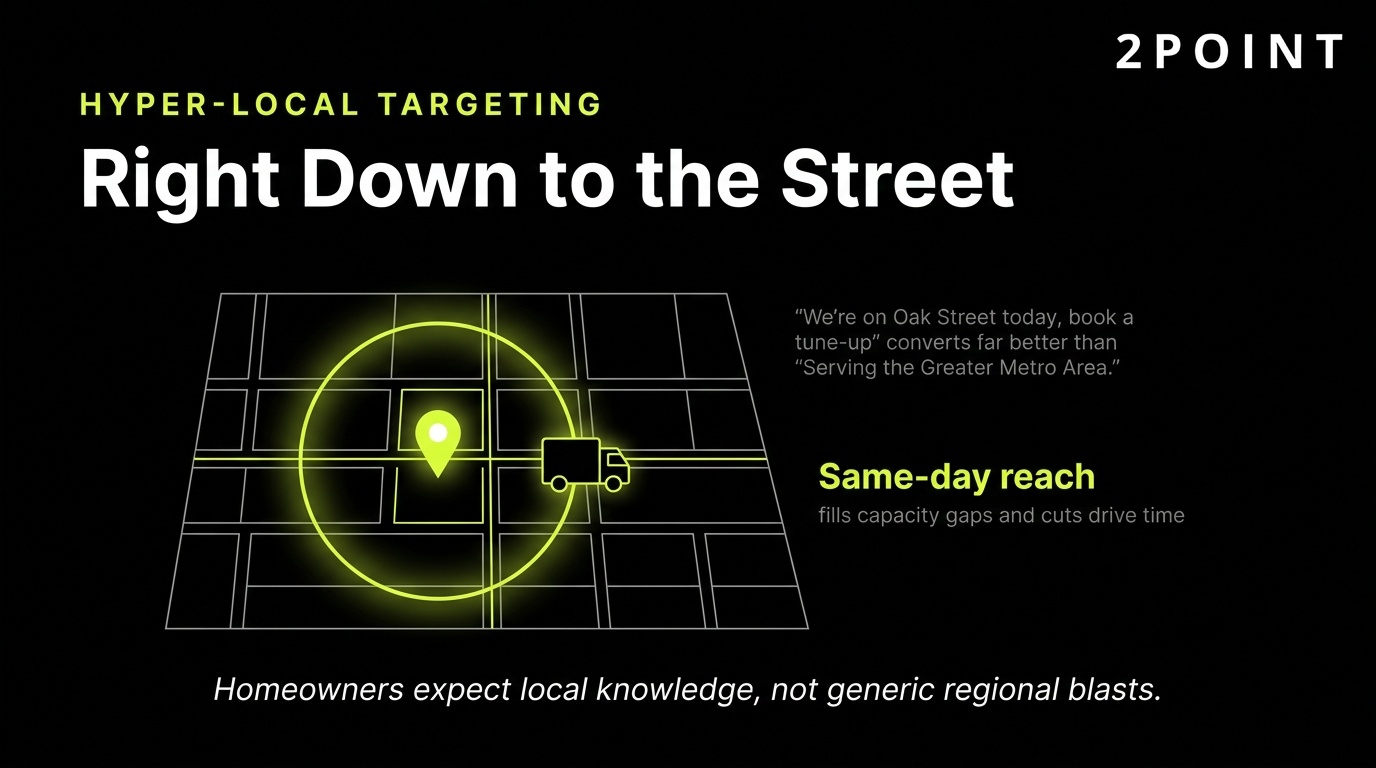
The most significant tactical shift in home service marketing for 2026 is the move from city-wide targeting to neighborhood-specific messaging. Forward-thinking contractors are using precise location data to execute neighborhood-level campaigns that speak directly to residents of a specific subdivision or zip code. The specificity of the messaging, "We're working on Oak Street today, book your furnace tune-up and we'll be there within the hour," converts at dramatically higher rates than generic "Serving the Greater Metro Area" messaging.
Homeowners increasingly expect marketing messages to reflect local knowledge rather than generic regional campaigns. Same-day service marketing, where businesses advertise availability and capacity for the current day within a specific geographic radius, takes advantage of the same urgency psychology that makes LSAs so effective. Route optimization software that identifies nearby capacity gaps allows marketing teams to send targeted social media posts or SMS messages to homeowners in that area offering priority scheduling windows. This approach reduces drive time costs while increasing schedule density, creating an operational advantage that compounds as the data improves. Multi-channel marketing executed at the neighborhood level delivers the personalization and relevance that today's homeowners expect.
Transparency as a Competitive Advantage in Home Service Marketing
2026 is being called the "Digital Transparency" era in home services marketing, and the businesses that embrace radical openness are winning significant market share from competitors who still rely on vague advertising claims. Trust drives hiring decisions more than price in the current market, and homeowners who have been burned by unreliable or overcharging contractors are actively seeking businesses that demonstrate trustworthiness before the first service call.
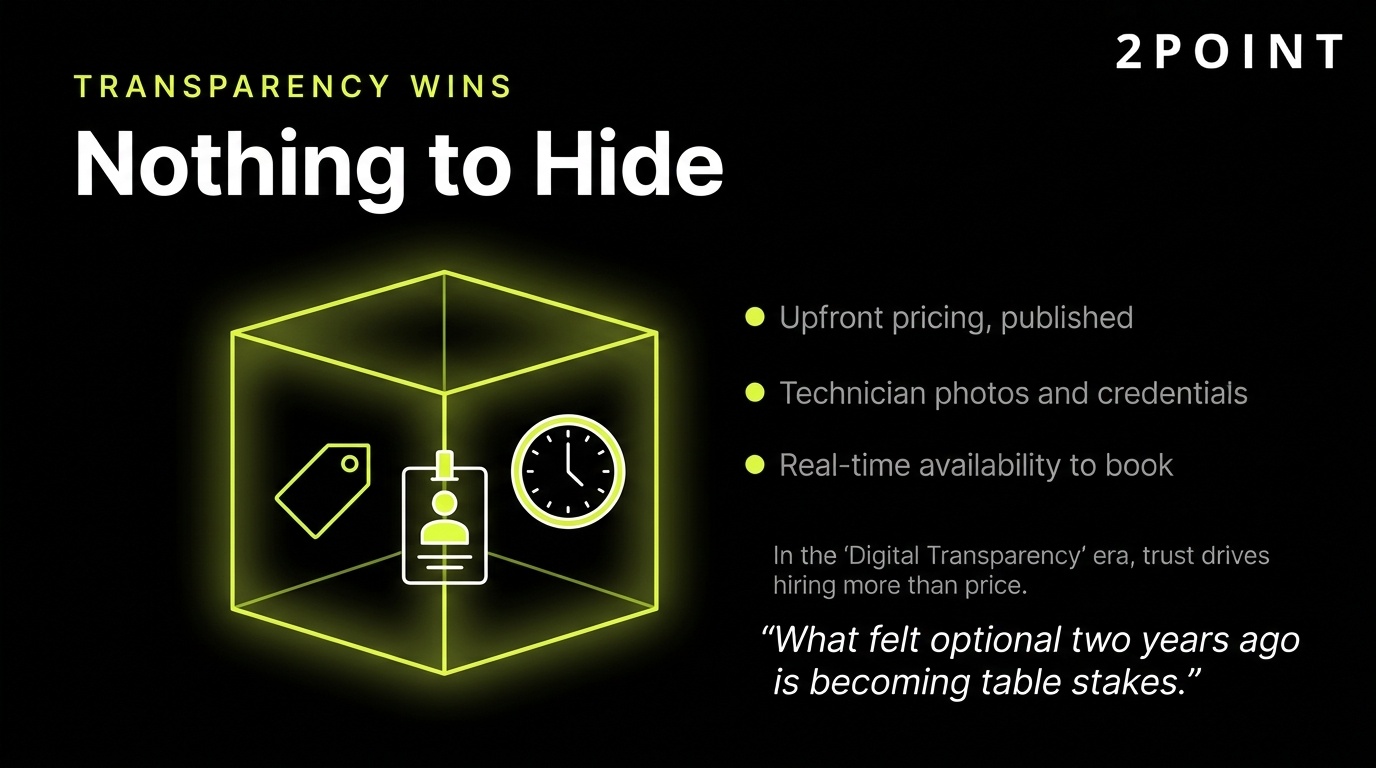
Upfront pricing, published on your website and communicated during the booking call, eliminates one of the most common homeowner anxieties about hiring a contractor. Technician profiles, including photos, credentials, background check status, and personal bios, published on your website or sent via text before a scheduled appointment, convert fence-sitters into confirmed appointments. Real-time availability communication through online booking tools removes the "I'll call around and see who can come soonest" dynamic that sends potential customers to competitors. The marketing transparency practices that felt optional two years ago are rapidly becoming table stakes as homeowners demand them and competitors who provide them capture disproportionate market share. Building strong service-based branding around transparency and reliability creates a durable competitive position that price-focused competitors cannot easily replicate.
Voice Search and AI-Driven Discovery for Home Service Businesses
Voice search and AI-powered discovery tools are changing the syntax of how homeowners find home service providers, and businesses that optimize only for traditional text-based search queries are missing a growing segment of high-intent traffic. Voice searches are conversational and question-based: "Hey Google, who is the best-reviewed HVAC company near me?" or "Alexa, find a plumber that can come today." These queries differ structurally from typed searches and require content that answers questions directly and naturally in the way a person would speak.
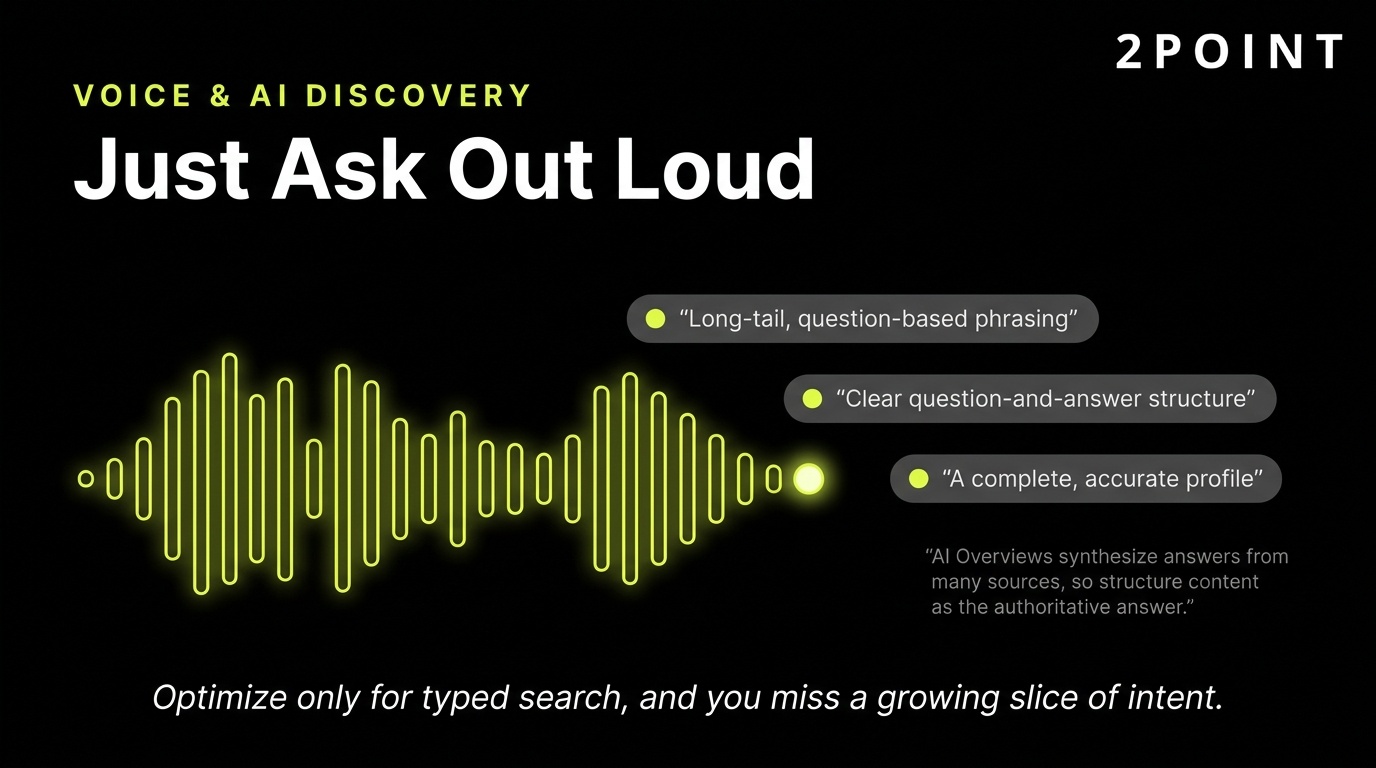
Optimizing for voice search requires focusing on long-tail question-based keywords, structuring content with clear question-and-answer formats, and ensuring your GBP is completely and accurately filled out since voice assistants pull heavily from this data source. Google AI Overviews increasingly synthesize information from multiple sources to provide direct answers to home service queries, which means your content needs to be structured as a clear, authoritative answer rather than a promotional piece if it is to appear in these AI-generated responses. Businesses that understand this shift and adapt their content strategy accordingly gain visibility in discovery channels that did not exist as recently as two years ago.
Direct Mail and Omnichannel Integration in the Digital Age
The rise of digital marketing has not eliminated the effectiveness of direct mail for home service businesses. It has actually increased its relative impact as digital advertising clutter intensifies. A physical postcard or targeted mailer arriving in a homeowner's mailbox now has less competition for attention than it did a decade ago, particularly for older homeowner demographics who remain less engaged with digital discovery channels.
The most sophisticated home service marketing programs in 2026 integrate direct mail with digital channels in coordinated sequences. A homeowner sees a social media ad for a seasonal HVAC promotion, then receives a postcard with the same offer and a QR code linking to a dedicated landing page, then receives an email follow-up. This omnichannel approach reinforces the message across multiple touchpoints and significantly increases the probability of conversion compared to any single-channel approach. Geographic targeting for direct mail has become considerably more precise, allowing businesses to focus mailing efforts on specific neighborhoods, recently sold homes (whose new owners are highly likely to need multiple home services), or properties of a specific age range that correlate with common repair needs. The digital marketing trends shaping consumer behavior also affect how homeowners respond to physical marketing, making integration across channels more valuable than either approach in isolation. Building a complete online marketing strategy that connects digital and physical touchpoints creates a cohesive brand experience that reinforces trust and recognition at every point of contact.
Building a Complete Home Service Marketing System That Scales
Defining Your Marketing Budget and Investment Priorities
A scalable home service marketing system starts with a clear, defensible budget allocation based on revenue percentage and growth goals. The recommended range of 8 to 15% of gross revenue provides a workable framework, but the specific allocation within that budget should reflect your current market position. Businesses with limited organic visibility should weight their initial investment toward local SEO and Google Business Profile optimization, because these investments build a foundation that reduces long-term paid advertising dependency. Businesses with strong organic visibility but inconsistent lead flow should weight toward LSAs and Google Ads to capture immediate demand. Businesses with healthy lead volume but poor retention should redirect investment toward email marketing and customer experience improvements.
The investment prioritization framework for most home service businesses follows a clear sequence: first, ensure your foundational digital presence is solid (GBP, website, reviews, local citations); second, activate high-intent paid channels (LSAs, then Search Ads); third, build organic authority through local SEO and content; fourth, develop customer retention systems through email and owned channels; fifth, layer in social media, video, and emerging channels as resources allow. This sequence is not arbitrary. It reflects the order in which each investment builds on the previous one and the relative time required to see returns. Jumping to social media video before your GBP is optimized or your review count is competitive is a common mistake that produces frustration rather than results.
Technology Stack and CRM Requirements for Marketing Integration
The technology infrastructure supporting your marketing system determines how efficiently you can execute, track, and optimize every strategy in this guide. A field service management platform that handles scheduling, dispatching, invoicing, and customer communication provides the operational backbone. A CRM layer on top of this captures marketing attribution data, stores customer history, and enables the segmented email and follow-up sequences that drive retention revenue. Call tracking software bridges the gap between your marketing channels and your phone-based sales process, providing the attribution data needed to evaluate channel performance accurately.
Integration between these systems is more important than any individual platform's feature set. A call tracking number that routes leads into your CRM, which triggers an automated follow-up sequence while recording the marketing source, creates a closed-loop measurement system that most competitors do not have. This data advantage compounds over time: the more accurately you measure, the more precisely you can optimize, and the more efficiently your marketing budget generates revenue. The technology investment required to build this infrastructure is modest compared to the ROI it enables, and many field service management platforms now include built-in CRM, review management, and marketing automation features that reduce the number of separate tools required.
Competitor Analysis and Differentiation Strategy
Understanding the competitive landscape in your specific service area is prerequisite to building a differentiated marketing strategy. Many home service businesses market themselves in nearly identical terms: "licensed, insured, family-owned, serving [city] for X years." When every competitor says the same thing, no one has an advantage. True differentiation requires identifying what your business genuinely does better than competitors and communicating that specific advantage clearly and consistently across every marketing channel.
Common differentiation opportunities for home service businesses include response time guarantees, transparent flat-rate pricing, technician background check publication, service warranties that exceed industry standards, environmentally friendly product options, financing availability, same-day service guarantees, or specialized expertise in a particular type of equipment or problem. Competitor analysis using tools that reveal their keyword rankings, review sentiment, advertising activity, and content strategy provides the data needed to identify gaps your positioning can fill. A business that specializes in a particular brand of HVAC equipment and markets itself as the local expert for that brand captures a specific, highly motivated segment of searchers that generic competitors cannot serve as effectively. Storytelling in marketing is a powerful tool for communicating differentiation in a way that is memorable and emotionally resonant rather than purely factual.
Measuring Marketing Success and Setting Realistic Growth Benchmarks
The metrics that matter most in home service marketing are the ones closest to revenue. Vanity metrics such as social media followers, website page views, and email list size provide context but should never be the primary success indicators. The KPIs that drive growth decisions are cost per booked job by channel, customer lifetime value by acquisition source, revenue attributed to each marketing channel, and retention rate for past customers.
Setting realistic growth benchmarks requires understanding both your historical performance and your market's growth rate. A business growing its lead volume by 20% annually in a market growing at 19% is essentially maintaining its market share. A business growing leads at 40% annually is gaining meaningful competitive ground. Monthly tracking of your core KPIs, combined with quarterly strategic reviews of channel performance and budget allocation, creates the discipline needed to make informed decisions rather than reactive ones. Most home service businesses that invest in marketing consistently and measure it rigorously see meaningful revenue growth within the first 12 months, with compounding returns as organic and retention channels mature. The combination of strong acquisition marketing and disciplined retention creates a business development flywheel that becomes increasingly powerful as customer relationships deepen and referral networks expand. A team at 2POINT brings precisely this kind of integrated thinking to home service marketing, helping contractors build systems that generate predictable, measurable growth rather than sporadic campaign-by-campaign results.
Frequently Asked Questions About Home Service Marketing
What is home service marketing?
Home service marketing is the strategic process of attracting and retaining customers for businesses that provide residential services such as HVAC, plumbing, electrical, roofing, cleaning, and landscaping. It includes digital tactics such as local SEO, Google Ads, social media, email, and content marketing, as well as traditional approaches such as direct mail and community engagement. The goal is to generate a consistent, profitable flow of leads from homeowners who need the services you provide.
How much should a home service business spend on marketing?
Most home service businesses should invest 8 to 15% of gross annual revenue in marketing, with businesses in highly competitive markets or aggressive growth phases investing toward the higher end of that range. A company generating $500,000 annually should budget $40,000 to $75,000 for marketing across all channels. The allocation within that budget should prioritize the channels that have demonstrated the highest return on investment for your specific market and trade.
What is the most effective marketing channel for home service companies?
No single channel is universally most effective, but local SEO combined with Google Local Service Ads consistently delivers the highest return on investment for most home service businesses. Local SEO provides the lowest long-term cost per lead, while LSAs generate high-quality exclusive leads from homeowners actively seeking services. The most effective overall strategy combines multiple channels in a coordinated system rather than relying on any single source.
How long does it take for home service marketing to show results?
Paid channels such as LSAs and Google Ads generate leads within days of launch. Local SEO and content marketing typically require 3 to 6 months to show meaningful traction and 12 to 18 months to build genuine authority in competitive markets. Email marketing and customer retention programs begin generating measurable revenue within the first campaign cycle. A balanced marketing system produces both immediate results from paid channels and compounding long-term returns from organic channels.
What is local SEO for contractors and why does it matter?
Local SEO for contractors is the practice of optimizing your website, Google Business Profile, and online presence to rank prominently in location-based searches such as "electrician near me" or "HVAC repair in [city]." It matters because 98% of homeowners research local businesses online before hiring, and businesses that appear at the top of local search results receive the vast majority of clicks and calls. The cost per lead from local SEO is $10 to $30, making it the most cost-efficient lead source available.
How do Google Local Service Ads differ from regular Google Ads for home services?
Google Local Service Ads appear above all other search results, including standard Google Ads, and charge per lead rather than per click. LSAs include the Google Guaranteed or Google Screened badge, which verifies your license, insurance, and background checks, providing a trust signal that standard ads cannot replicate. Regular Google Ads offer more control over keywords, ad copy, and landing page experience, and work best as a complement to LSAs rather than a replacement.
What types of content work best for home service business marketing?
Educational content that solves specific homeowner problems consistently performs best: troubleshooting guides, maintenance checklists, warning sign explanations, and how-to videos generate both organic search traffic and direct trust with potential customers. Short-form video on platforms such as TikTok, Instagram Reels, and YouTube Shorts is the fastest-growing discovery format in the industry. Before-and-after project photos perform strongly on social media and in Google Business Profile posts.
How important are online reviews for home service marketing?
Online reviews are critically important for both local SEO rankings and customer conversion. 91% of consumers read reviews before hiring a local service provider, and most will not consider businesses with ratings below 4 stars. Reviews are a confirmed ranking factor in Google's local search algorithm, meaning businesses with more positive reviews appear higher in map pack results. A systematic review generation process that requests feedback within 48 hours of job completion is essential for competitive positioning.
Is email marketing effective for home service companies?
Email marketing is highly effective for home service companies when used primarily for customer retention rather than new customer acquisition. Past customers who have had a positive experience represent the lowest-cost, highest-converting audience available. Seasonal maintenance reminders, educational newsletters, and special offer campaigns sent to a segmented past-customer list consistently generate appointment bookings at a fraction of the cost of paid advertising.
What is the biggest marketing mistake home service businesses make?
The most costly and common marketing mistake is treating marketing as a single channel rather than an integrated system. Businesses that rely exclusively on word-of-mouth referrals, spend all of their budget on a single ad platform, or neglect their past customer database consistently underperform competitors who use multiple coordinated channels. The second most common mistake is failing to track marketing performance at the revenue level, making it impossible to identify which investments are generating profitable returns.
How does AI affect home service marketing in 2026?
AI is now integrated into the core marketing operations of the most competitive home service businesses, enabling personalized email sequences, localized content creation at scale, automated review response drafting, and AI-powered chatbots that qualify leads outside of business hours. AI also influences search itself, with Google AI Overviews and tools like ChatGPT increasingly influencing how homeowners discover local service providers. Businesses that optimize their content for AI-driven search results gain visibility in discovery channels that are growing rapidly.
How do I measure the ROI of home service marketing?
Home service marketing ROI is most accurately measured by tracking cost per booked job and revenue attributed to each channel, rather than simply cost per lead or website traffic. Implement call tracking numbers for each marketing channel, integrate your CRM with your marketing platforms, and calculate cost per booked job by dividing channel spend by the number of appointments that originated from that channel. Well-managed home service marketing programs deliver 4 to 14 times return on ad spend when tracked and optimized consistently.
