

Digital Marketing Agency in:
Creating innovative marketing for Jacksonville brands since 2006
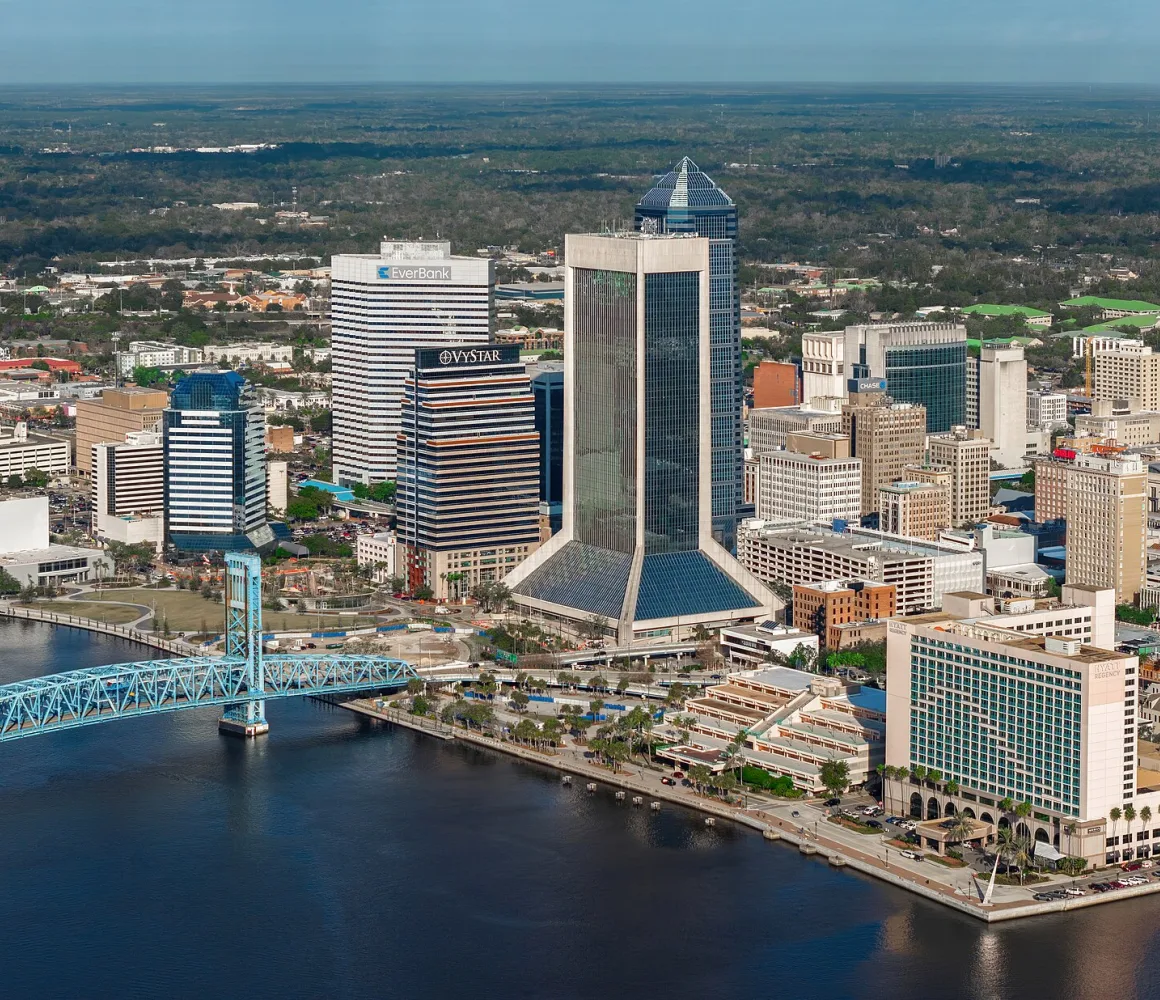 Quintin Soloviev, CC BY 4.0, via Wikimedia Commons

5.0

We enjoyed our entire experience with 2POINT designing our website. Melanie was very attentive, courteous, and applied a level of creativity that we greatly appreciated throughout this process. So proud of our new website and how it all came together! Would 100% recommend.
We had a website malware issue, and they saved us! I can't say enough about Jon and the 2POINT team. Fast, efficient, affordable and one of the best customer experiences I've had as a business owner. I can't recommend them enough and will be a customer with 2POINT for life. Our vision came to life with them and our website turned out INCREDIBLE!
We recently worked with 2POINT on an icon design project. We needed a really quick turnaround, and the 2POINT team was super responsive and delivered an excellent product! Corey was a pleasure to work with.
Working with Ross and his team was an absolute pleasure. From the very beginning, they took the time to truly understand our vision and brand identity, then translated that into a stunning, professional website that perfectly encapsulates who we are.
The entire process was seamless — they were communicative, creative, and responsive every step of the way. We’re thrilled with the final result — the site not only looks incredible but also functions beautifully. Ross and his team exceeded our expectations, and we couldn’t recommend them more highly!
We hired 2POINT Agency to completely redesign our website for Mission Pools, and they exceeded every expectation. We started the project with only a general idea of what we wanted, and they brought our vision to life in ways we never could have imagined. Their team also refreshed our logo and created brand guidelines that captured everything we hoped for and more.
The creativity, care, and attention to detail they put into every step made us feel like we were their top priority. We’ve since continued to work with them on our digital ads and SEO, and the ongoing support has been outstanding. The team is responsive, proactive, and genuinely invested in helping our business succeed. We couldn’t recommend 2POINT Agency more highly!
Wow! I have owned my business for 14 years now and experiencing the process of various web designs, hostings, seo services, marketing and advertising over the years, I can say without a doubt that 2POINT blows away its competition! We opted to pre-pay for our service package and with the events 2020 had brought, we sure are glad we did. Their prices are more than reasonable and packages are customizable based on your needs. Not only do we know that we have a team of designers and seo pros working behind the scenes to keep our rankings up and design on point, but we also have real live humans available for last minute projects, which this year has definitely required more impromptu email campaigns and website revisions than all of my previous years combined. But because Jon and his team are efficient, concise and have eyes for great design we haven’t skipped a beat! So happy we have 2 Point on our team!
These guys are great at what they do, and will do everything in their power to not only work with your budget, but maximize benefits without gauging you... thanks guys!
Definitely recommend 2Point. Chris is amazing to work with and actually listens to our needs and requests. All projects always looks amazing with great ideas. Thanks for all your help!
We had a fantastic experience working with 2POINT! As a nonprofit organization with limited marketing expertise, the 2POINT team made the process of designing two new websites completely manageable. The end results exceeded our expectations! They were professional, enjoyable to collaborate with, and kept the project on schedule. Corey was the lead on our project, and we thoroughly enjoyed working with her! We highly recommend 2POINT not only for their advanced web design skills but also for their amazing team that ensures everything gets done right!
I work for a salmon company, and we did our frozen bags with 2 POINT agency, it was a great experience! For our first project we were in a rush, and they did it in record time, we accomplish the deadline with a professional, clean and on time design. Corey, Haydn and Melanie did a great job. We keep working with them, the price is really good, modern designs and always offer a few sketches for you to choose (I love that). Highly reccomended company :)
Working with 2POINT has been a great experience, specifically working with Karla and Giselle. They're always available to answer questions, and they are super quick with deadlines. They never forget the little details I mention about what we want to include in our social media calendar. What really sets them apart is their responsiveness and attention to detail.
I can't express how grateful we are to have worked with 2 Point Agency on redesigning our logo after over 20 years. From the very first meeting, their team took the time to truly understand our vision and brand identity. They provided thoughtful feedback and creative insights that helped us achieve a fresh, luxurious look! Thank you, 2 Point Agency Team!
Working with 2POINT to develop my e-commerce site has been a game-changer for my business. From the outset, their team demonstrated a remarkable level of expertise, creativity, and commitment. They took the time to understand my vision and translated it into a beautiful, user-friendly website that exceeds my expectations. The team at 2POINT was always available to answer questions and provide support, making the entire process smooth and stress-free. Their professionalism and passion for their work truly set them apart. If you’re looking to build an e-commerce store, I can’t recommend 2POINT highly enough. They deliver exceptional results and are an absolute pleasure to work with. Thank you, 2POINT, for taking my business to the next level!
2POINT Agency listened and produced a working brand document that will forever benefit the thinking, the evolution, and the journey on behalf of the Greenwald Realty Team. I continually read and reread their final delivery because it is a testimonial to 2POINT for a superior job well done and it is a constant reminder to me as to where and what I seek for my business and lifestyle to strive towards.
We’re thrilled with the animations created by 2POINT Agency for our ready-mix concrete division! From the initial brainstorming sessions to the flawless delivery of the final product, every phase of the project exuded professionalism and creativity. The punctuality was exemplary, leaving us eager to embark on another project with them, this time for our separate landscape division. Kudos in bringing our vision to life! Thanks again, and here to our continued partnership
We have been working with 2POINT for the past year and they have really helped us develop our online presence. They are very knowledgeable in all things marketing. We are currently in the process of building a new website to house multiple brands – not an easy task. The site is looking amazing and I can’t wait for it to go live. Great group of people, always willing to listen and work together to collaborate on the best ideas for our company! Highly recommend!
2POINT was able to create 3 versions of animations for our logo for use in marketing applications. They were very easy to work with, incorporated our feedback and turned it around quickly.
I would definitely work with these guys again, they were able to take my visions and bring it to light. Extremely excited to use my animations on all my projects.
San Diego Prestige
I’m really happy that I have asked this company to work on my marketing needs. They did a great job so far and I will definitely work with them again!
David Aylor Law Offices
Jon and his team were amazing! Their communication and final delivery of my animated logo order was top notch. I highly suggest 2POINT.
The 2POINT team I worked with was professional, prompt, and eager to meet our specific needs. I can highly recommend them. They definitely delivered!
Working with 2POINT on our custom animations was just delightful! They were so responsive, very creative, and struck that balance between gathering ideas from us and bringing plenty of their own to our project. Great collaboration, and as soon as we finished our first project, we immediately jumped into our second project!
Love working with 2POINT Digital Marketing Agency! Expedient, reliable, professional and talented experts are just a few words that come to mind! We have been doing business together for several years and look forward to working together for many more to come.
Excellent communication, and product we were very happy with the work they did for us.
Jon, Paola and the rest of the team were so fantastic in helping us get our site designed and live. They went above and beyond throughout the entire process providing multiple options, edits and even designing custom visual effects. I would highly recommend 2POINT Digital to anyone that needs something done right the FIRST time.
The absolute BEST marketing agency hands down! Haydn and his team have been nothing short of spectacular throughout the entire process and have delivered time and time again with consistent and on time results. Everything from our website redesign, brand guide, social media management, ad creation, and overall marketing strategy has been amazing! I am so glad we decided to work with 2POINT, I can't imagine getting the level of expertise, customer service, and care anywhere else. 10/10 recommend!
These guys were able to hit the nail on the head on everything we asked for and MORE! They work extremely hard to get your website up and functioning the way YOU want it done! It's been a pleasure for us to work with them through our new website creation and they always make themselves available to help your project. Communication is an A+. I can't say enough about how well of a job they did & their VERY FAIR pricing. If you want top of the line developers - I'd HIGHLY recommend these guys
Simply the best.
I work with 2POINT as our website developers for Zynex Medical. 2POINT is very professional, attentive, responsive and honestly a life saver. We used to spend way more for a much lower quality. Since using 2POINT, they’ve leveled up our website, are helping with developing mobile applications, and helping increase our marketing footprint. The team has been amazing and I highly recommend them. Big shout out to Jon D and the programming team as they are incredible!!
For many months, I searched for someone to help me get my website updated but usually ended up speaking to Bangor with folk who had no idea of me or my business. Finding Jon Dubensky and all those at 2POINT Digital was such a refreshing relief! I was understood and the final project is exactly what I wanted. If you are at all considering updating your websites, I highly recommend 2POINT Digital Marketing Agency.

Jacksonville is the largest city by land area in the contiguous United States: roughly 875 square miles, bigger than several states' metro areas combined. That single fact shapes almost everything about marketing here. A customer in Mandarin and one at the Beaches are forty minutes apart and behave like they live in different cities, because functionally they do. The economy underneath it is logistics, insurance and healthcare: JAXPORT and the rail and distribution network around it, the largest concentration of financial and insurance operations in Florida, Mayo Clinic, and a substantial Navy presence at Mayport and NAS Jacksonville.
The sprawl is the strategy. Anyone selling Jacksonville as a single market has not looked at a map. 2POINT helps Jacksonville businesses build the digital authority needed to compete in this market. Our SEO work builds Jacksonville out by district rather than as one page with a city-wide service area: the Beaches, the Southside, Mandarin, Orange Park and Nocatee each get their own treatment, because each produces its own map pack. Our paid media is geo-segmented for the same reason, so spend follows the areas that actually convert instead of averaging across 875 square miles. And we design premium animated websites and brand systems that hold up in front of a logistics buyer, an insurance carrier and a homeowner. The useful question for a Jacksonville marketing agency is not what they do, but what they would stop doing here. Good Jacksonville web design is judged by what happens after the click, not by how the homepage looks in a pitch.
 1 Minute Read
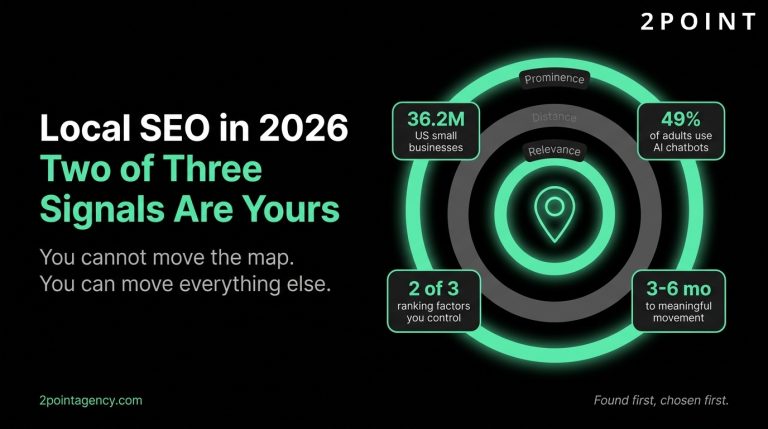
Somebody two miles away is searching for what you sell right now, and they will pick whoever shows up first.
Who we are

20 years of running a digital agency
WHERE WE WORK
Because of the geography, mostly. Jacksonville covers 875 square miles and no other city in the country forces the same problem: one Google Business Profile cannot serve the Beaches, Mandarin, the Westside and Nocatee, and a service-area radius wide enough to cover them all is wide enough to rank for none of them well. An agency that has not worked here will set it up wrong on day one. The second reason is that the local agency market is unusually entrenched. Both agency search terms here carry difficulty scores in the sixties (the highest of any market this size in the South), which means the incumbents have been building links for a long time. Beating them takes a plan rather than a budget, and it takes knowing where they are weak. That is local work, and it is what senior strategy across SEO, paid media, web and brand is actually for.
Jacksonville is moderately priced: most categories $4 to $14 a click, with legal, insurance and medical specialties well above that. The cost problem here is almost never the bid; it is the geography. Running one campaign across 875 square miles averages away the information you need. The Beaches, Southside and Westside convert at materially different rates for most businesses, and a single geo target hides that completely. You end up subsidising the weak areas out of the strong ones without ever seeing it. Segmenting by district is the highest-leverage change available in a Jacksonville account, and most accounts have not made it. After that the usual discipline applies: negative keyword lists maintained properly, with brand, high-intent and research kept in separate campaigns on separate budgets, and conversion tracking that counts calls when calls are what close, not form fills. Landing pages built for the specific query outperform bid adjustments every time. Done properly, geo-segmentation alone typically moves Jacksonville cost per qualified lead more than any other single change. That structure is what a Jacksonville PPC agency should have in place before it starts moving bids.
In Jacksonville, judge a local SEO provider mainly on whether they have a district-level answer. Alongside that, the map pack is where it shows. Proximity does more work here than in any comparable market, because the city is so large that a searcher in Nocatee and one in Baldwin get almost no overlap in results. A provider whose plan is one Google Business Profile with a city-wide service area has not understood the problem. What works is a deliberate primary location, correctly drawn service areas, and reviews that name both the service and the specific district. Next is content a national competitor cannot write, and in Jacksonville that content is genuinely district-specific. Flood zones, insurance requirements, construction constraints and even service pricing differ between the Beaches and the Westside. Writing that honestly earns links from local publications and neighbourhood associations that an out-of-state competitor cannot match. Third is citation consistency: name, address and phone matching everywhere they are published, plus LocalBusiness schema, so Google and the AI search systems are in no doubt about what the business is or where it operates. Every quarter that AI Overviews take more of the answer, entity data of this kind matters more than another handful of links. Six months of district-level work will usually outperform a competitor spending more on a single undifferentiated city campaign.
Meet some of our clients, the most amazing people at industry leading companies














Learn more about what our clients have to say
We’re right here in Jacksonville








 let’s connect


