

 let’s connect


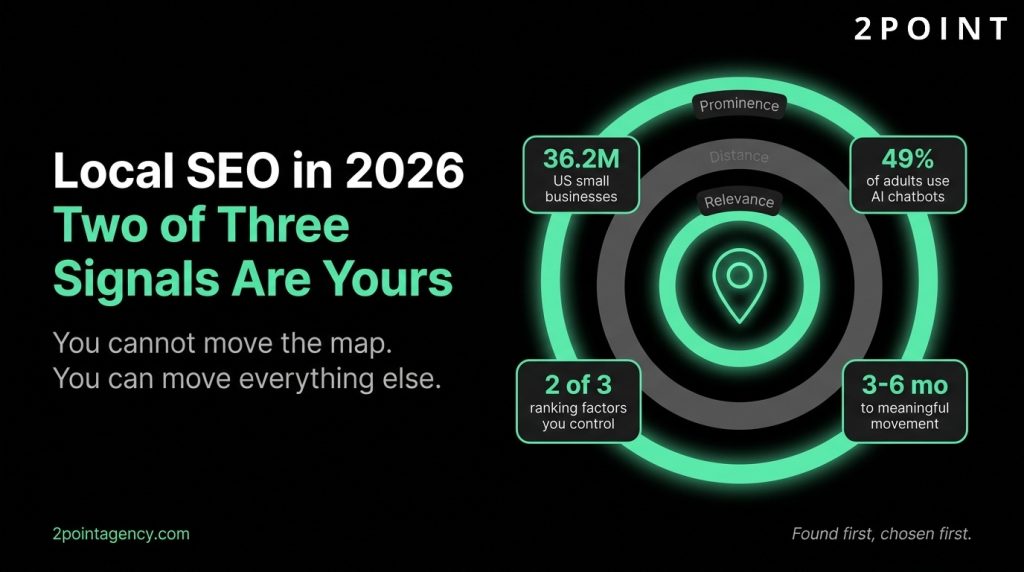
Somebody two miles away is searching for what you sell right now, and they will pick whoever shows up first.
Somebody two miles away is searching for what you sell right now, and they will pick whoever shows up first.
That is what local SEO for small business is built to control. It pulls your Google Business Profile, your website, your reviews, and your wider footprint into one signal, and that signal now shapes AI answers as much as map results.
The benefits of local SEO are simple: steady calls, better leads, less guessing. Below, you get costs, timelines, and whether you need an agency at all, drawn from the local search programs we run at 2POINT.
Key Takeaways
- Local SEO for small business captures buyers at the exact moment they are ready to act.
- Google ranks local results on relevance, distance, and prominence. You control two outright.
- The benefits of local SEO compound: steady calls, higher-intent leads, lower cost per acquisition.
- Under roughly $500 a month, DIY beats hiring an agency for most businesses.
- Reviews move rankings harder than any other lever, and 2024 tightened the legal rules sharply.
- AI assistants are now a real discovery channel, with nearly half of US adults using them.
- Expect meaningful movement in three to six months. Faster promises are sales pitches.
What Local SEO Is, and What It Actually Does for a Small Business
Strip away the jargon and local SEO comes down to one outcome. Someone nearby needs what you sell, reaches for their phone, and finds you looking credible enough to choose.
The work splits across two places. On your website, your pages explain what you do and where you do it. Off it, your Google Business Profile, reviews, and directory listings confirm you exist where you claim. Traditional SEO lives almost entirely on-site, which is why local business SEO behaves differently.
Picture a bakery. Ranking for "sourdough recipes" brings traffic that never visits. Ranking for "bakery near me" brings buyers that afternoon.
Local SEO vs Regular SEO
The clearest difference is proximity. Standard SEO asks whether your page deserves to rank. Local search adds a second question: are you close enough to be useful to this searcher?
A brilliant page cannot overcome being twenty miles away when three good options sit within one.
| Regular SEO | Local SEO | |
| Core question | Does this page deserve to rank? | Does this page deserve to rank, and are you nearby? |
| Where signals live | Mostly on your website | Split between your site and platforms you don’t own |
| Biggest levers | Content quality, backlinks, technical health | Google Business Profile, reviews, categories, NAP consistency |
| Competiton set | Anyone publishing on the topic | Businesses inside the searcher’s radius |
| What winning looks like | Traffic from anywhere | Calls, visits, and bookings from people who can reach you |
That third row is where owners get caught out. Better copy alone will not fix rankings when your review count, category selection, and address consistency sit outside your content management system entirely.
Why Local SEO Matters for a Small Business
The commercial case is simple. A local searcher has already narrowed the field by geography and usually sits near a decision, so you are answering a raised hand instead of interrupting a scroll. That is why local SEO is important.
Scale sharpens it. The SBA counts 36.2 million small businesses in the US, and 578,926 more applications landed in July 2026 alone. New competitors arrive monthly.
The benefits of local SEO then land in order:
- Discovery, as you appear in map results and local listings.
- Trust, because recent reviews signal a working business.
- Calls and direction requests climb before rankings visibly shift.
- Revenue, usually a month or two behind.
Not every business needs this equally. Sell software across forty states, and your energy belongs elsewhere. Run a clinic, a salon, or a home service business, and geography decides nearly every sale you make.
Where Your Business Can Actually Show Up
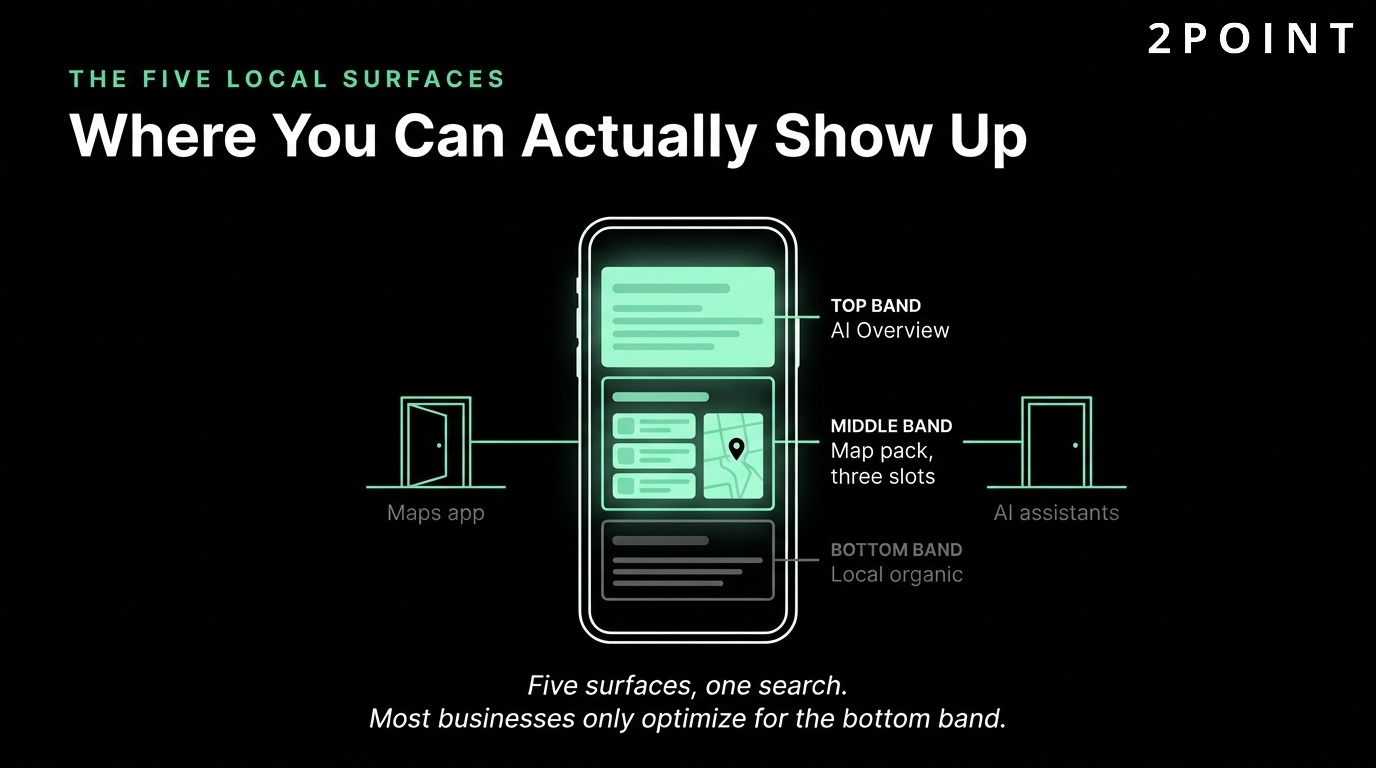
Owners often treat the map results and the blue links beneath them as one thing, then spend months fixing the wrong surface. They run on separate rules. In 2026, two newer surfaces sit alongside them.
| Surface | What it is | What decides whether you appear |
| Google map pack | The three-business block at the top of local results | Profile completeness, proximity, review volume, and recency |
| Local organic results | The standard links below the map block | On-page relevance, site authority, location-specific content |
| AI Overviews and AI Mode | Google’s generated answer above the results | Quotable answers on your pages, plus mentions elsewhere |
| AI assistants | What ChatGPT or Gemini says when asked for a local recommendation | Citations on the sources those models pull from |
| Google Maps app | Searches made inside Maps rather than Search | The same profile signals, weighted harder toward distance |
The top two rows share one engine. Google's local ranking factors are relevance, distance, and prominence, and you cannot move your address. Google is equally blunt that placement is not for sale, so a promised position is a promise nobody can keep.
The bottom rows are why this guide carries a 2026 date. Getting cited in AI Overviews is now part of the job, and it rewards different work than the local SEO playbook you already know.
The Map Pack Is the Real Prize
For most local companies, a top-three map pack spot beats the number one organic result. It sits higher, includes a call button, and reaches people ready to act rather than research.
Three signals decide who lands there:
- Your Business Profile, which you control outright.
- Your reviews, which you build steadily.
- Your proximity, which you cannot change.
That last one explains the odd results. A rival across town wins searchers on their block while you win yours. That is why local SEO is important when buyers choose within blocks, not counties.
A Practical Local SEO Checklist
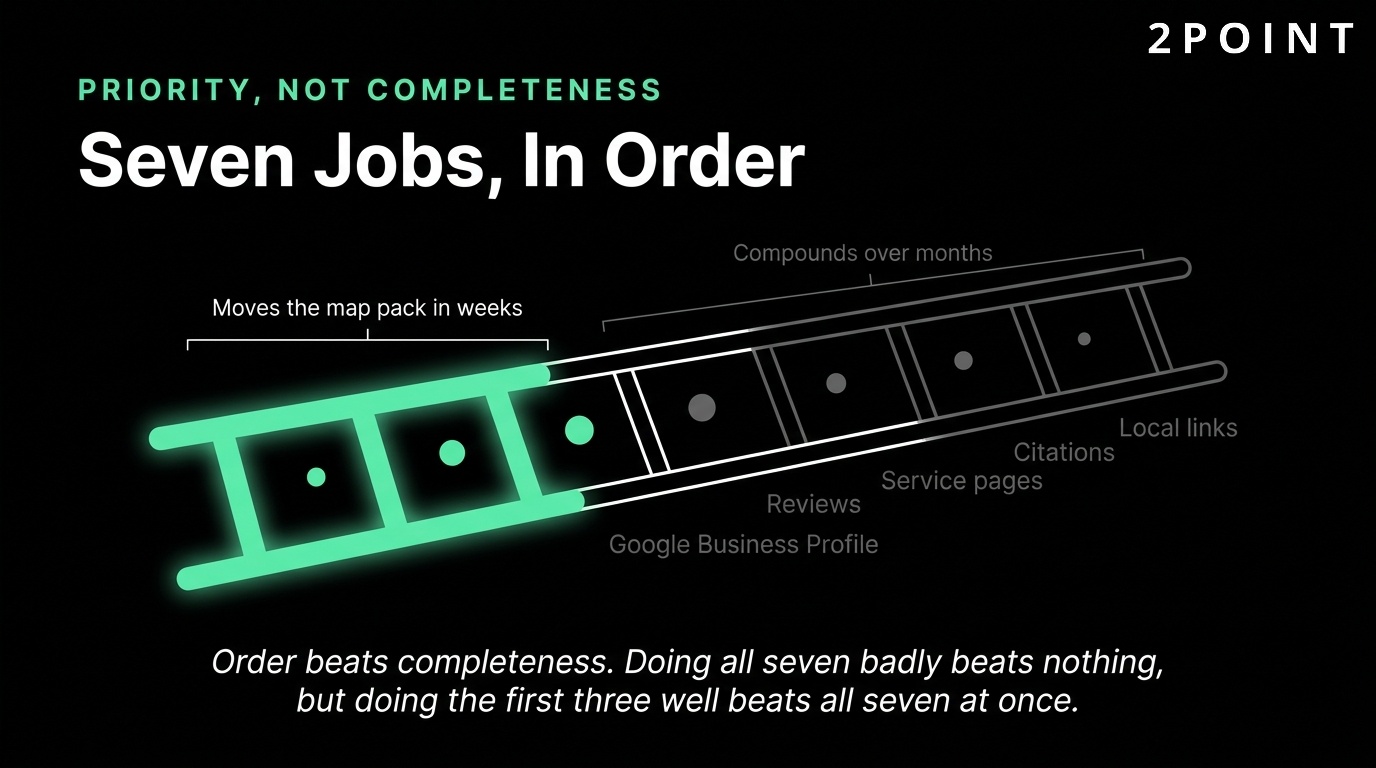
Local SEO for small business comes down to seven jobs. Order matters more than completeness, since the first three drive most of what moves in your opening quarter.
- Claim and complete your Google Business Profile. Fill every field, pick accurate categories, add real photos, and keep hours current. This is the single highest-return task on the list.
- Build a steady review habit. Ask after every job, reply to all reviews, and never buy any. Recency counts as much as total volume.
- Give every service and location its own page. One thin page listing eight services won't rank for any of them.
- Match your name, address, and phone everywhere. Consistency across directories beats sheer listing count.
- Earn a handful of local links. Chambers, suppliers, sponsorships, and local press outweigh a hundred generic directories.
- Make the mobile experience fast. Most local searches happen on a phone, often outdoors, so slow pages lose the call.
- Write answers machines can quote. Short, self-contained blocks get lifted into AI results. Sprawling paragraphs do not.
Start at the top and finish each before moving on. Profile and review work can shift map pack visibility within weeks, while new pages take months to rank.
Your Google Business Profile Does the Heavy Lifting
Most owners set this up once, in a hurry, years ago, and never open it again. Then they pay for local SEO and wonder why the map pack ignores them.
Categories are where the damage usually is. Your primary category is Google's answer to what you fundamentally are, and "General Dentist" pulls different searches than "Cosmetic Dentist." Add secondary ones for what you actually do, not what you would like to be known for.
Photos are the other neglected field. Stock images of a generic office tell Google and customers nothing, and a profile untouched in eight months reads like a business that may have closed.
Some of this shifts by industry. If you run several offices, the setup changes again, and our dental practices breakdown covers that case in detail.
Reviews Carry More Weight Than You Think
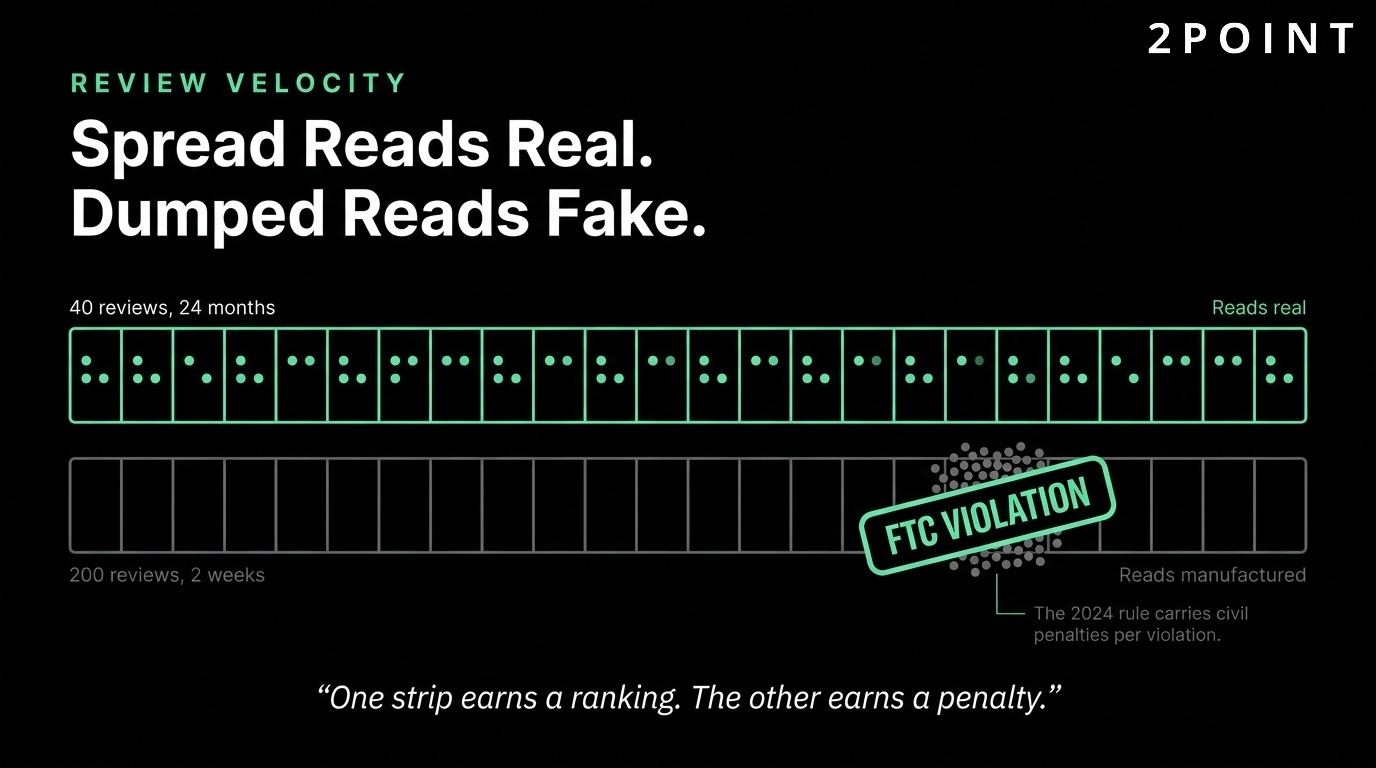
Volume, recency, and whether you bother replying. That is the whole list.
Forty reviews earned steadily across two years will usually beat two hundred that all landed in a fortnight, because a burst reads as manufactured to Google and to the person scrolling past it.
So ask. Build it into the end of the job, while the work is still fresh, rather than hoping people remember you unprompted.
Shortcuts are where owners get hurt now. The FTC rule bans fabricated reviews, AI-written ones, incentives tied to a specific sentiment, undisclosed insider reviews, and threatening customers into pulling negatives. Civil penalties apply, so this is no longer an SEO question.
Bad reviews are survivable. Reply calmly, stay factual, take the details offline.
Citations and NAP Consistency
NAP means name, address, phone number. Consistency is whether those three match everywhere they appear online. When your address shows up three different ways across Google, Yelp, and a directory you forgot about in 2019, you feed doubt into a system built on confirming you are where you claim to be.
Know the ceiling, though. This is maintenance, not growth. Fix the majors, correct what is wrong, and ignore anyone selling submissions to 500 directories.
The list worth your time:
- Google Business Profile.
- Apple Business Connect, which powers Siri and Apple Maps.
- Bing Places, increasingly feeding AI assistants.
- Your main industry directories.
- The review platforms your customers actually use.
Audit once a quarter. That is enough.
Local Link Building You Can Realistically Do
A link from the town paper is worth more here than fifty from directories nobody reads. Not because it carries more authority in the abstract, but because it plants you somewhere specific.
You can earn most of these without a budget. Sponsor a youth team. Join the chamber and claim the listing. Give a local reporter the quote they need on deadline. Build a referral page with a business that complements yours rather than competes.
None of that is link building in the way agencies sell it. It is showing up in your own town and letting the link happen.
Trades get an easier version of this, since suppliers and trade associations already link out to the contractors they work with. Our HVAC contractors guide covers where those sit, and plumbers, electricians, and roofers work the same relationships.
Local SEO and AI Search in 2026
Here is the part most guides on this topic have not caught up to. Pew found that 49 percent of US adults now use AI chatbots, up from 33 percent in 2024, and 60 percent read the AI summary sitting above their search results.
The good news is that you do not need a separate program. Google's own documentation says there are no extra requirements for AI Overviews, no special schema, no new files.
Structure is the real difference, since these systems lift passages rather than pages:
- Put the question in your heading.
- Answer it in the next 40 to 60 words.
- Save your caveats and detail for after that.
Tidy blocks get quoted. Rambling ones get skipped.
Getting Cited by AI Assistants
An assistant can only recommend what it can find, so this comes down to being present where it looks. Keep business details consistent everywhere, maintain an active presence on the review platforms that get crawled, and write pages that answer questions clearly enough to lift.
Finding out where you stand takes ten minutes. Ask ChatGPT, Gemini, and Perplexity who they would recommend in your category and city, then look at whether you show up and what they cited instead.
Do that monthly. Our Perplexity citations piece unpacks what the patterns mean.
How Much Does Local SEO Cost?
“How much does local SEO cost?” is one of the most searched questions on this topic and one of the least frequently answered, largely because publishing numbers makes agencies uncomfortable. Broadly, small businesses in 2026 spend anywhere from nothing to a few hundred dollars monthly running it themselves, and between $500 and $3,000 monthly for professional help on a single location.
These are typical market bands rather than fixed pricing, and where you land inside them depends on how many locations you run, how competitive your category is locally, and how much groundwork already exists.
| Engagement | Monthly range | What it should cover |
| Do it yourself | $0 to $100 | Profile management, basic rank tracking, a citation checker |
| Freelancer | $500 to $1500 | Profile work, citations, light on-page, monthly reporting |
| Agency, one location | $1500 to $3000 | The above plus content, reviews, local links, AI search |
| Agency, multi-location | $3000 to $7500+ | Per-location profiles and pages, bulk citations, consolidated reporting |
| One-off audit | $500 to $2500 | Findings and a prioritized roadmap, no execution |
Two things should stop you cold. Under roughly $500 a month, nobody can fund real work, so something is being skipped or automated badly. And anyone guaranteeing a position contradicts Google's own position that placement cannot be bought or requested.
So ask what you are buying before signing. A real answer names deliverables and hours.
Should You Handle Local SEO Yourself, or Hire Someone?
Here is what most agencies will not tell you. Plenty of small businesses should handle local SEO themselves at first. The fundamentals take a weekend to learn, and the first 60 to 70 percent of the benefit comes from diligence, not expertise.
| Your Situation | Handle It Yourself | Get Help |
|---|---|---|
| One location, no competitor ranking well | Yes, the basics get you most of the way | Not yet |
| One location, competitors already established | Do the profile and reviews yourself | Worth a conversation on content and links |
| Two to five locations | Rarely practical alone | Yes |
| No time, but budget exists | No | Yes |
| Budget under $500 a month | Yes, and this is the honest answer | No, and be cautious of anyone who disagrees |
Hiring makes sense once your own time becomes the bottleneck, or once funded competitors move into your market. Multi-location businesses hit that almost immediately, since coordination alone eats more hours than an owner has.
Our managed SEO runs a hub-and-spoke structure built for exactly that, with a published 222 percent traffic lift over six months.
How Long Local SEO Takes
Expectations kill more engagements than execution does. SEO for local business compounds, so the early weeks look discouraging and the later months look better than you expected.
| Timeframe | What Realistically Happens | What Does Not Happen Yet |
|---|---|---|
| Month 1 | Profile optimized, citations corrected, tracking in place | Any ranking movement |
| Months 2 to 3 | Map movement on lower-competition terms, reviews building | Top three on your main money term |
| Months 4 to 6 | Organic rankings improve, leads become measurable | Market dominance |
| Months 7 to 12 | Competitive terms come within reach, AI citations appear | Anything anyone could guarantee |
| Ongoing | Returns compound, provided reviews and activity continue | A point where you can stop |
Notice the right-hand column. Knowing what will not happen protects you from abandoning something at month two that was working exactly as expected.
The Mistakes That Cost Small Businesses the Most
The same handful of errors show up in nearly every audit we run, and together they account for most of the lost ground in local SEO for small business campaigns.
- Treating the profile as a one-time setup. Claimed in 2022, untouched since, wrong hours over the holidays. Activity is a signal on its own.
- Chasing review volume instead of rhythm. Twenty reviews in one week looks worse than twenty across five months.
- Cramming eight services onto one page. Google will not rank a paragraph as a service page, so each real offering needs its own.
- Buying citation packages. Widely sold, rarely useful. Accuracy on the platforms that matter is the whole job.
- Ignoring the phone experience. A slow mobile site loses customers who already found you, which makes it the most expensive mistake here.
What Will You Fix First?

Go back to the choice you were weighing at the start. One location, nobody doing this properly? Handle it yourself. Established competitors, several locations, or no hours left in your week? Help stops being a luxury.
Either way, local SEO for small business rewards consistency over cleverness. Complete the profile, earn reviews honestly, build pages worth ranking.
If you want a straight read on where your visibility stands, talk to our SEO team. We will tell you if you do not need us yet.
FAQs
How much does local SEO cost for a small business?
Most small businesses pay $500 to $3,000 a month for professional help on one location, while doing it yourself costs under $100 in tools. How much does local SEO cost comes down to your competition, location count, and starting position. Under $500 monthly, handling it yourself delivers better value.
Can I do local SEO myself?
Yes, and many businesses should. The fundamentals of local SEO for small business are learnable in a weekend, and completing your Google Business Profile plus building reviews delivers most early gains.
Hire once competitors are established, you run several locations, or your own time becomes the bottleneck.
Why is local SEO important for a small business?
Local searches carry unusually high purchase intent, because the searcher has already narrowed by geography and is close to a decision. That is why local SEO is important for any company serving a defined area.
The benefits of local SEO compound as reviews, rankings, and citations build over months.
What are the benefits of local SEO?
The benefits of local SEO arrive in order: discovery in map results, trust from recent reviews, then calls and direction requests, with revenue following a month or two behind. Unlike ads, local SEO for small businesses keeps working after you stop paying, which lowers your cost per lead.
How long does local SEO take to work?
Expect meaningful movement in three to six months. Google Business Profile and review work can shift map pack visibility within weeks, while new service pages take longer to rank. SEO for local business compounds, so month two often looks flat even when everything is working as planned.
Does AI search affect local SEO?
Yes. Pew Research found 49 percent of US adults now use AI chatbots, and 60 percent read AI summaries above search results. Strong local business SEO already supports this, since consistent business details and clean, quotable answers help models cite you when someone asks for a nearby recommendation.
How does hyper-local SEO work?
Hyper-local SEO targets neighborhood-level searches rather than whole cities, using specific area pages, localized content, and proximity signals.
In dense markets, this lets a smaller company win nearby searches that citywide competitors overlook, because Google weighs distance heavily in every local result it returns.






